Digestive
System III
Note Taking
Fill in Chart
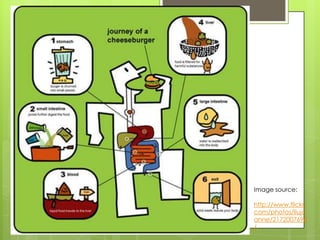
Image source:

http://www.flickr.
com/photos/liujo
anne/2172007698
/
Is this in your notes yet?


Review 3 functions of digestive
system!
 1.   D

 2.   A

 3.   E
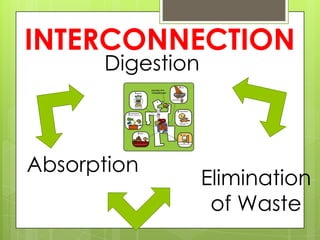
INTERCONNECTION
      Digestion


Absorption
                  Elimination
                   of Waste
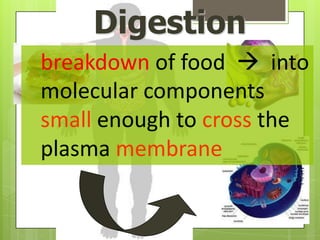
Digestion
breakdown of food  into
molecular components
small enough to cross the
plasma membrane
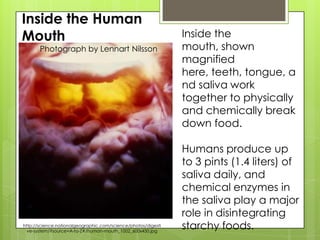
Inside the Human
Mouth                                                          Inside the
       Photograph by Lennart Nilsson                           mouth, shown
                                                               magnified
                                                               here, teeth, tongue, a
                                                               nd saliva work
                                                               together to physically
                                                               and chemically break
                                                               down food.

                                                               Humans produce up
                                                               to 3 pints (1.4 liters) of
                                                               saliva daily, and
                                                               chemical enzymes in
                                                               the saliva play a major
                                                               role in disintegrating
http://science.nationalgeographic.com/science/photos/digesti
  ve-system/?source=A-to-Z#/human-mouth_1002_600x450.jpg
                                                               starchy foods.
NOTES!

We know that M and C digestion
begins in the mouth…
  What are the structures in the mouth?
  What do they do?
  Which structure starts C digestion?
NOTES!

What’s happening with your
saliva?
 Starch  is a long glucose polymer
 Enzyme amylase, found in your
  saliva, breaks down starch into smaller
  glucose units
Take notes in your notebook!


Cracker Experiment
 Each   person gets one cracker.
 Break off a small part of your cracker and
  place it on the front of your tongue. Leave it
  there for at least two minutes!
 What does it taste like (bitter, sweet, salty)?
 What is happening and why?
 Is there a connection between this
  experiment and the peristalsis experiment?
Brain Pop on the
Digestive System

http://www.brainpop.com/health/bodysystems/digestive
system/preview.weml
Describe peristalsis and why
you can eat upside down…

Turn and talk to your table partner
Mouth – Esophagus - ??


    What comes Next?
NOTES!


Your stomach!
   Muscular sac where food mixes with gastric
    juice (also called stomach acid or
    Hydrochloric acid (HCl)).
   If HCl is so strong, why doesn’t your stomach
    burn from the inside out?
   HCl is produced in the stomach lining and
    activates the enzyme pepsin which starts
    protein digestion.
   Does peristalsis occur in the stomach too?
    Why or why not?
   Discuss with the people at the table in front or
    behind you.
NOTES!


The Small Intestine
 What  structures are associated with the
 small intestine?
    D
    L
    G
    P
 What functions of the digestive system do
 they support?
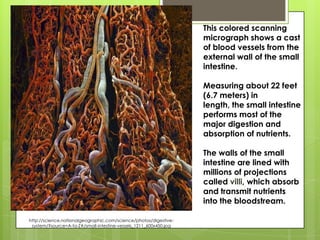
This colored scanning
                                                                   micrograph shows a cast
                                                                   of blood vessels from the
                                                                   external wall of the small
                                                                   intestine.

                                                                   Measuring about 22 feet
                                                                   (6.7 meters) in
                                                                   length, the small intestine
                                                                   performs most of the
                                                                   major digestion and
                                                                   absorption of nutrients.

                                                                   The walls of the small
                                                                   intestine are lined with
                                                                   millions of projections
                                                                   called villi, which absorb
                                                                   and transmit nutrients
                                                                   into the bloodstream.

http://science.nationalgeographic.com/science/photos/digestive-
 system/?source=A-to-Z#/small-intestine-vessels_1211_600x450.jpg
NOTES!


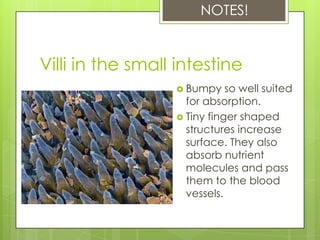
Villi in the small intestine
                   Bumpy    so well suited
                    for absorption.
                   Tiny finger shaped
                    structures increase
                    surface. They also
                    absorb nutrient
                    molecules and pass
                    them to the blood
                    vessels.
Villi Volunteers
             (two different people!)
   Compare the two different pieces of fabric.
    The one with the finger like pieces is similar to
    the villi.
   Which fabric will absorb more water? What
    do you think?
   Each volunteer should submerge their piece
    of fabric into the water and hold it for five
    seconds.
   Bring the fabric out of the water and squeeze
    the water into a cylinder.
   Which piece of fabric absorbed more water?
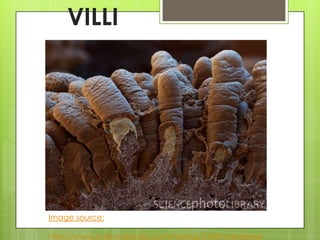
VILLI


Image source:

http://www.sciencephoto.com/media/310014/enlarge
How do nutrients get to the
rest of the body?
Nutrients   pass from the cells of
 the villi into the body.
Blood vessels are covered by
 a single layer of cells so
 nutrients pass through cells
 into the blood.
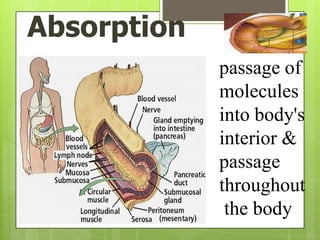
Absorption
             passage of
             molecules
             into body's
             interior &
             passage
             throughout
              the body
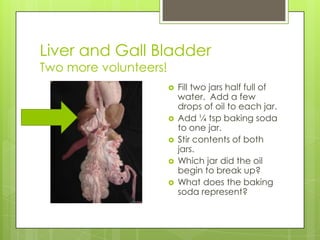
Liver and Gall Bladder
Two more volunteers!
                          Fill two jars half full of
                           water. Add a few
                           drops of oil to each jar.
                          Add ¼ tsp baking soda
                           to one jar.
                          Stir contents of both
                           jars.
                          Which jar did the oil
                           begin to break up?
                          What does the baking
                           soda represent?
NOTES!


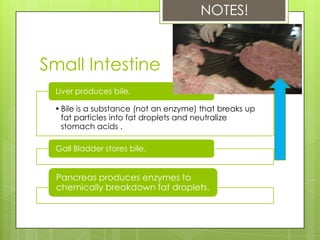
Small Intestine
 Liver produces bile.

 • Bile is a substance (not an enzyme) that breaks up
   fat particles into fat droplets and neutralize
   stomach acids .

 Gall Bladder stores bile.


  Pancreas produces enzymes to
  chemically breakdown fat droplets.
NOTES!

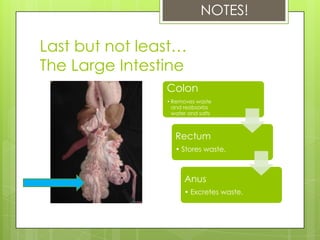
Last but not least…
The Large Intestine
                Colon
                • Removes waste
                  and reabsorbs
                  water and salts


                   Rectum
                   • Stores waste.


                      Anus
                      • Excretes waste.
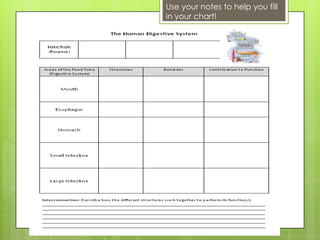
Use your notes to help you fill
in your chart!

Digestive system iii wo sugar cubes

  • 1.
  • 2.
  • 3.
    Is this inyour notes yet? Review 3 functions of digestive system!  1. D  2. A  3. E
  • 4.
    INTERCONNECTION Digestion Absorption Elimination of Waste
  • 5.
    Digestion breakdown of food into molecular components small enough to cross the plasma membrane
  • 6.
    Inside the Human Mouth Inside the Photograph by Lennart Nilsson mouth, shown magnified here, teeth, tongue, a nd saliva work together to physically and chemically break down food. Humans produce up to 3 pints (1.4 liters) of saliva daily, and chemical enzymes in the saliva play a major role in disintegrating http://science.nationalgeographic.com/science/photos/digesti ve-system/?source=A-to-Z#/human-mouth_1002_600x450.jpg starchy foods.
  • 7.
    NOTES! We know thatM and C digestion begins in the mouth…  What are the structures in the mouth?  What do they do?  Which structure starts C digestion?
  • 8.
    NOTES! What’s happening withyour saliva?  Starch is a long glucose polymer  Enzyme amylase, found in your saliva, breaks down starch into smaller glucose units
  • 9.
    Take notes inyour notebook! Cracker Experiment  Each person gets one cracker.  Break off a small part of your cracker and place it on the front of your tongue. Leave it there for at least two minutes!  What does it taste like (bitter, sweet, salty)?  What is happening and why?  Is there a connection between this experiment and the peristalsis experiment?
  • 10.
    Brain Pop onthe Digestive System http://www.brainpop.com/health/bodysystems/digestive system/preview.weml
  • 11.
    Describe peristalsis andwhy you can eat upside down… Turn and talk to your table partner
  • 12.
    Mouth – Esophagus- ?? What comes Next?
  • 13.
    NOTES! Your stomach!  Muscular sac where food mixes with gastric juice (also called stomach acid or Hydrochloric acid (HCl)).  If HCl is so strong, why doesn’t your stomach burn from the inside out?  HCl is produced in the stomach lining and activates the enzyme pepsin which starts protein digestion.  Does peristalsis occur in the stomach too? Why or why not?  Discuss with the people at the table in front or behind you.
  • 14.
    NOTES! The Small Intestine What structures are associated with the small intestine?  D  L  G  P  What functions of the digestive system do they support?
  • 15.
    This colored scanning micrograph shows a cast of blood vessels from the external wall of the small intestine. Measuring about 22 feet (6.7 meters) in length, the small intestine performs most of the major digestion and absorption of nutrients. The walls of the small intestine are lined with millions of projections called villi, which absorb and transmit nutrients into the bloodstream. http://science.nationalgeographic.com/science/photos/digestive- system/?source=A-to-Z#/small-intestine-vessels_1211_600x450.jpg
  • 16.
    NOTES! Villi in thesmall intestine  Bumpy so well suited for absorption.  Tiny finger shaped structures increase surface. They also absorb nutrient molecules and pass them to the blood vessels.
  • 17.
    Villi Volunteers (two different people!)  Compare the two different pieces of fabric. The one with the finger like pieces is similar to the villi.  Which fabric will absorb more water? What do you think?  Each volunteer should submerge their piece of fabric into the water and hold it for five seconds.  Bring the fabric out of the water and squeeze the water into a cylinder.  Which piece of fabric absorbed more water?
  • 18.
  • 19.
    How do nutrientsget to the rest of the body? Nutrients pass from the cells of the villi into the body. Blood vessels are covered by a single layer of cells so nutrients pass through cells into the blood.
  • 20.
    Absorption passage of molecules into body's interior & passage throughout the body
  • 21.
    Liver and GallBladder Two more volunteers!  Fill two jars half full of water. Add a few drops of oil to each jar.  Add ¼ tsp baking soda to one jar.  Stir contents of both jars.  Which jar did the oil begin to break up?  What does the baking soda represent?
  • 22.
    NOTES! Small Intestine Liverproduces bile. • Bile is a substance (not an enzyme) that breaks up fat particles into fat droplets and neutralize stomach acids . Gall Bladder stores bile. Pancreas produces enzymes to chemically breakdown fat droplets.
  • 23.
    NOTES! Last but notleast… The Large Intestine Colon • Removes waste and reabsorbs water and salts Rectum • Stores waste. Anus • Excretes waste.
  • 24.
    Use your notesto help you fill in your chart!

Editor's Notes

  • #4 Digestion (C and M), Absorption of Nutrients, Excretion of Waste
  • #8 Structures: teeth cut, grind and chew food; tongue moves food around; and salivary glands begin chemical digestion
  • #10 Explain how the enzyme, amylase, in your saliva breaks down the carbohydrate into a simple sugar (glucose). What type of digestion is this? Answer: Chemical.
  • #11 User ID: ismanila; Password: ismanila
  • #12 Because involuntary muscle contractions of the esophagus PUSH the food to the stomach.
  • #13 Stomach
  • #14 Mucus coats and protects the lining of the stomach; Yes peristalsis occurs in the stomach because it is has muscular contractions also which aid in mechanical digestion by churning the food.
  • #15 Duodenum takes nutrients in to the blood (absorption). Liver, gall bladder and pancreas have enzymes that break down fat (chemical digestion).
  • #22 Baking Soda: Bile