Chapter 2
Nutrition in Animals
Digestion
The breakdown of
complex components
of food into simpler
substance is called
digestion
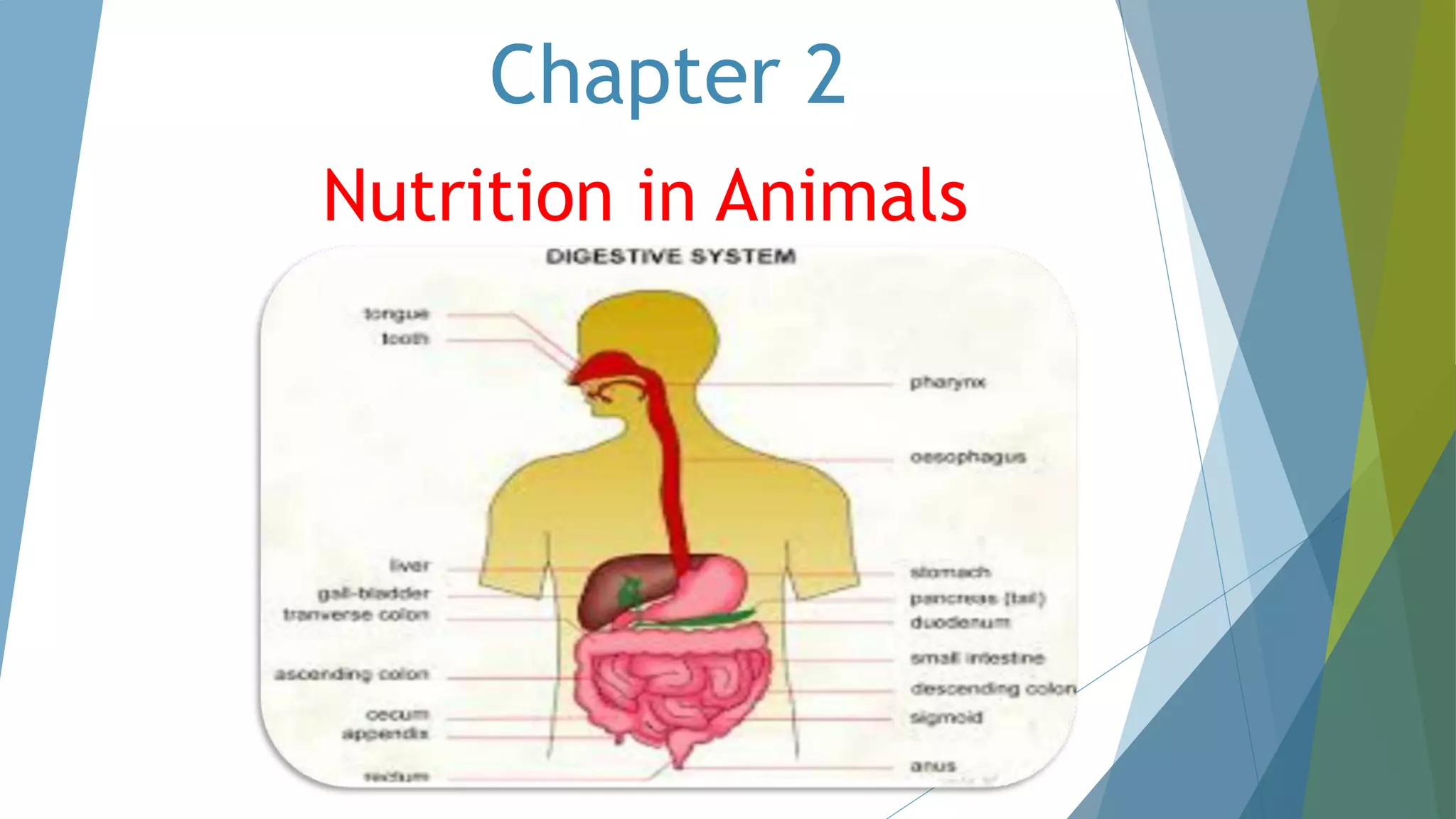
Parts of Digestive system
Buccal cavity
Oesophagus
Stomach
Small Intestine
Large Intestine
Rectum
Anus
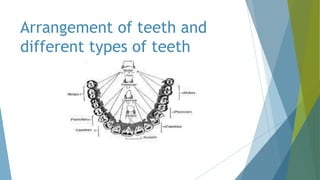
The mouth and Buccal cavity
Food is taken into the body through the
mouth. The process of taking food into
the body is called ingestion. We chew the
food with the teeth and break it down
mechanically into small pieces. Each tooth
is rooted in a separate socket in the gums
our teeth vary in appearance and perform
different functions. Accordingly they are
given different names.
Arrangement of teeth and
different types of teeth
The foodpipe or oesophagus
The swallowed food passes into the
foodpipe or oesophagus. The food pipe
runs along the neck and the chest.
Food is pushed down by movement of
the wall of the food pipe. Actually this
movement takes place throughout the
alimentary canal and pushes the food
downwards. At times the food is not
accepted by our stomach and is
vomited out.
The stomach
 The stomach is a thick-walled bag. Its shape is like a
flattened U and it is the widest part of the alimentary canal.
 It receives food from the food pipe at one end and opens in
to the small intestine at the other.
 The inner lining of the stomach secretes mucous,
hydrochloric acid and digestive juices. The mucous protects
the lining of the stomach.The acid kills many bacteria that
enter along with the food and makes the medium in the
stomach acid and helps the digestive juices to act.
 The digestive juices break down the proteins into simpler
substance.
The Small Intestine
 The small intestine is highly coiled and is about 7.5 meters long. It receives
secretions from the liver and the pancreas. Besides, its wall also secretes
juices.
 The liver is a reddish brown gland situated in the upper part of the abdomen
on the right side. It is the largest gland in the body. It secretes bile juice that
is stored in a sac called the Gall Bladder. The bile plays an important role in
the digestion of fats.
 The pancreas is a large cream coloured gland located just below the
stomach.The pancreatic juice act on carbohydrates, fats and proteins and
changes them into simpler forms.
 The partly digested food now reaches the lower part at the small intestine,
where the intestinal juice completes the digestion of all components of the
food. The carbohydrates get broken into simple sugars such as glucose, fats
into fatty acids and glycerol and proteins into amino acids.
Large Intestine
 The large intestine is wider and shorter than the
small intestine. It is about 1.5 meters in length.
 Its function is to absorb water and some salts
from the undigested food material. The remaining
waste passes into the rectum and remains there
as semi solid faeces. The faecal matter is
removed through the anus from time to time. This
is called Egestion.
Digestion in Grass Eating Animals
 Cows, buffaloes and other grass eating animals
chew continuously even when they are not eating.
Actually, they quickly swallow the grass and store
it in a part of the stomach called Rumen.
 Here the food gets partly digested and is called
Cud. But later the cud returns to the mouth in
small lumps and the animal chews it. The process
is called Rumination and these animals are called
Ruminants.
Feeding and digestion in Amoeba
 Amoeba is a microscopic single-celled organism found in
pond water. It has a cell membrane, a rounded, dense
nucleus and many small bubble like vacuoles in its
cytoplasm.
 It constantly changes its shape and position. It pushes out
one or more finger-like projections called Pseudopodia or
false feet for movement and capture of food.
 It feeds on same microscopic organisms. When it senses
food it pushes out pseudopodia around the food particle
and engulfs it. The food becomes trapped in a food
vacuole.
Thank you
By Prasanth
Class VII

Nutrition in Animals

  • 1.
  • 2.
    Digestion The breakdown of complexcomponents of food into simpler substance is called digestion
  • 3.
    Parts of Digestivesystem Buccal cavity Oesophagus Stomach Small Intestine Large Intestine Rectum Anus
  • 4.
    The mouth andBuccal cavity Food is taken into the body through the mouth. The process of taking food into the body is called ingestion. We chew the food with the teeth and break it down mechanically into small pieces. Each tooth is rooted in a separate socket in the gums our teeth vary in appearance and perform different functions. Accordingly they are given different names.
  • 5.
    Arrangement of teethand different types of teeth
  • 6.
    The foodpipe oroesophagus The swallowed food passes into the foodpipe or oesophagus. The food pipe runs along the neck and the chest. Food is pushed down by movement of the wall of the food pipe. Actually this movement takes place throughout the alimentary canal and pushes the food downwards. At times the food is not accepted by our stomach and is vomited out.
  • 7.
    The stomach  Thestomach is a thick-walled bag. Its shape is like a flattened U and it is the widest part of the alimentary canal.  It receives food from the food pipe at one end and opens in to the small intestine at the other.  The inner lining of the stomach secretes mucous, hydrochloric acid and digestive juices. The mucous protects the lining of the stomach.The acid kills many bacteria that enter along with the food and makes the medium in the stomach acid and helps the digestive juices to act.  The digestive juices break down the proteins into simpler substance.
  • 8.
    The Small Intestine The small intestine is highly coiled and is about 7.5 meters long. It receives secretions from the liver and the pancreas. Besides, its wall also secretes juices.  The liver is a reddish brown gland situated in the upper part of the abdomen on the right side. It is the largest gland in the body. It secretes bile juice that is stored in a sac called the Gall Bladder. The bile plays an important role in the digestion of fats.  The pancreas is a large cream coloured gland located just below the stomach.The pancreatic juice act on carbohydrates, fats and proteins and changes them into simpler forms.  The partly digested food now reaches the lower part at the small intestine, where the intestinal juice completes the digestion of all components of the food. The carbohydrates get broken into simple sugars such as glucose, fats into fatty acids and glycerol and proteins into amino acids.
  • 9.
    Large Intestine  Thelarge intestine is wider and shorter than the small intestine. It is about 1.5 meters in length.  Its function is to absorb water and some salts from the undigested food material. The remaining waste passes into the rectum and remains there as semi solid faeces. The faecal matter is removed through the anus from time to time. This is called Egestion.
  • 10.
    Digestion in GrassEating Animals  Cows, buffaloes and other grass eating animals chew continuously even when they are not eating. Actually, they quickly swallow the grass and store it in a part of the stomach called Rumen.  Here the food gets partly digested and is called Cud. But later the cud returns to the mouth in small lumps and the animal chews it. The process is called Rumination and these animals are called Ruminants.
  • 11.
    Feeding and digestionin Amoeba  Amoeba is a microscopic single-celled organism found in pond water. It has a cell membrane, a rounded, dense nucleus and many small bubble like vacuoles in its cytoplasm.  It constantly changes its shape and position. It pushes out one or more finger-like projections called Pseudopodia or false feet for movement and capture of food.  It feeds on same microscopic organisms. When it senses food it pushes out pseudopodia around the food particle and engulfs it. The food becomes trapped in a food vacuole.
  • 12.