Differentiated Instruction
The Basic Steps Towards
Differentiating
Super Sleuth
Directions: Walk around the room and find
someone to respond to the questions on your
Super Sleuth paper. After a verbal answer
the person will initial the square.
Rules:
- A person can only answer and initial one
square.
- The goals are to activate prior knowledge and
to meet new people with new ideas.
Super SleuthSuper Sleuth
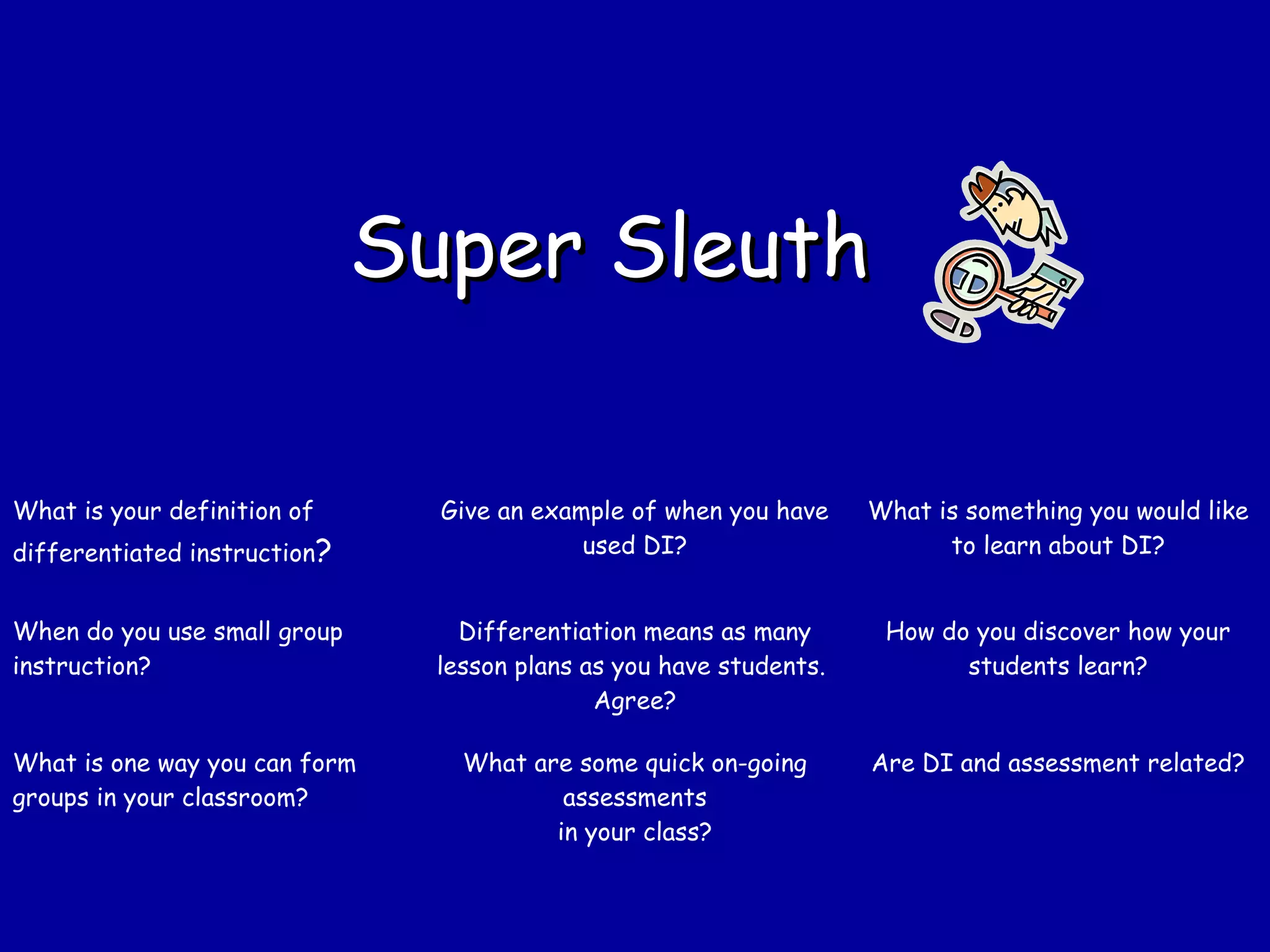
What is your definition of
differentiated instruction?
Give an example of when you have
used DI?
What is something you would like
to learn about DI?
When do you use small group
instruction?
Differentiation means as many
lesson plans as you have students.
Agree?
How do you discover how your
students learn?
What is one way you can form
groups in your classroom?
What are some quick on-going
assessments
in your class?
Are DI and assessment related?
Let’s Define Differentiated
Instruction
Differentiating instruction is doing
what’s fair for students. It means
creating multiple paths so that students
of different abilities, interests, or
learning needs experience equally
appropriate ways to learn.
The Rationale for Differentiated
Instruction
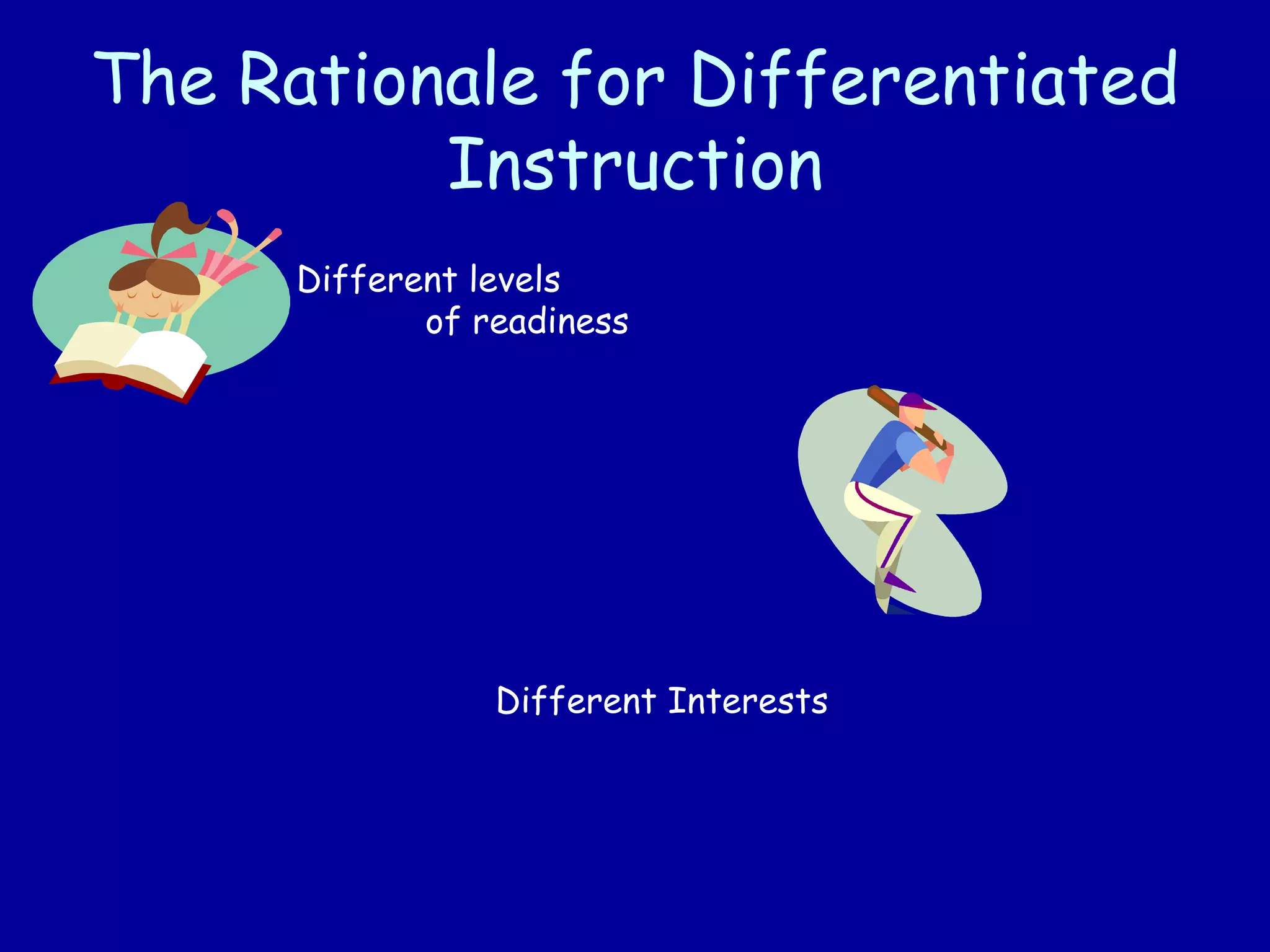
Different levels
of readiness
Different Interests
The Rationale for Differentiated
Instruction
Different Ability Levels
Different Cognitive Needs
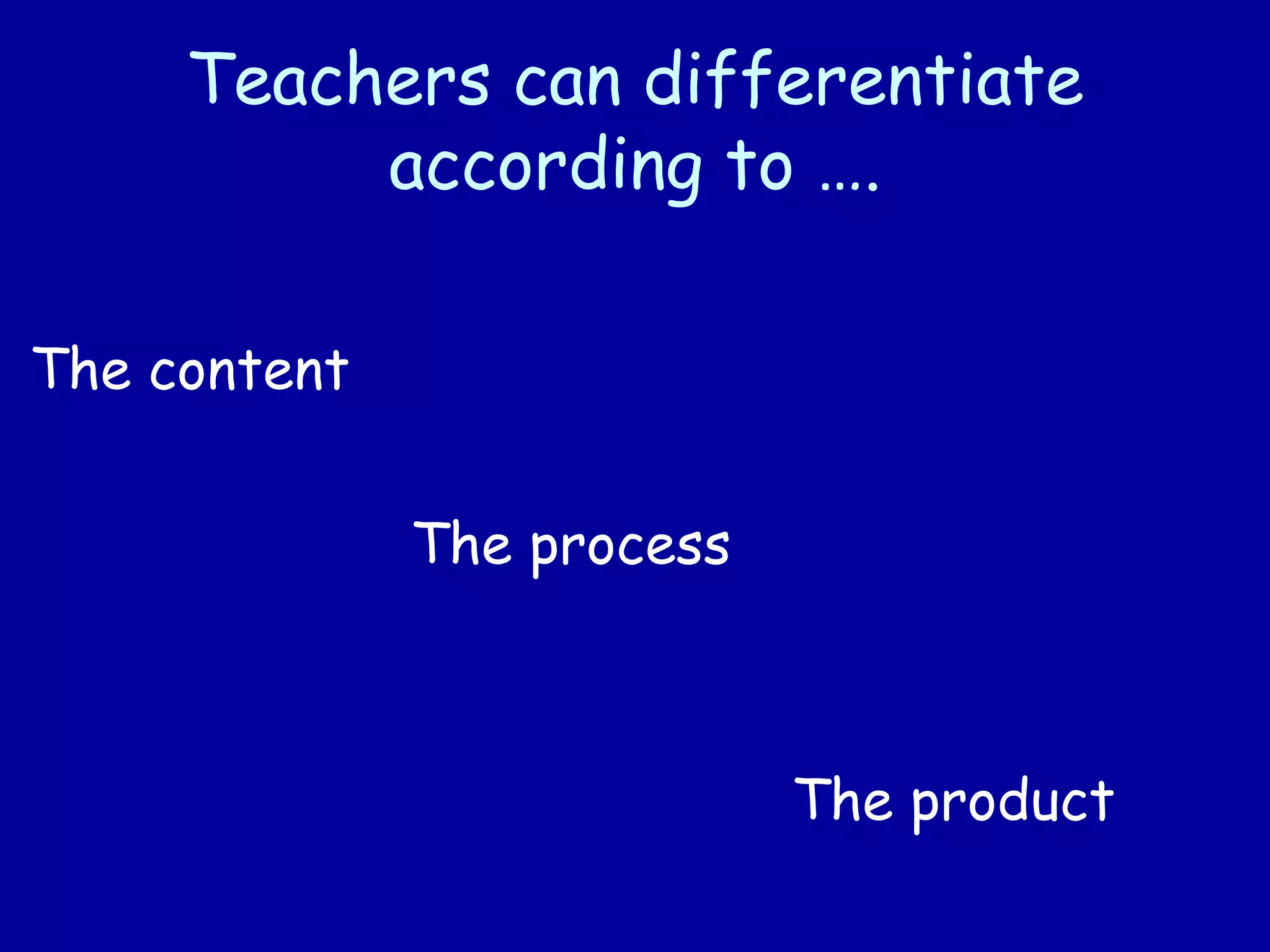
Teachers can differentiate
according to ….
The content
The process
The product
Differentiating Content
• Resource materials at varying
readability levels
• Audio and video recordings
• Highlighted vocabulary
• Charts and models
• Interest centers
• Varied manipulatives and resources
• Peer and adult mentors
Differentiating Process
(making sense and meaning of content)
• Use leveled or tiered activities
• Interest centers
• Hands-on materials
• Vary pacing according to readiness
• Allow for working alone, in partners,
triads, and small groups
• Allow choice in strategies for
processing and for expressing results of
processing
Differentiating Products
(showing what is know and able to be done)
• Tiered product choices
• Model, use and encourage student use
of technology within products and
presentations
• Provide product choices that range in
choices from all multiple intelligences,
options for gender, culture, and race
• Use related arts teachers to help with
student products
Strategies to Make
Differentiation Work
1. Tiered Instruction
Changing the level of complexity or
required readiness of a task or unit of
study in order to meet the
developmental needs of the students
involved.
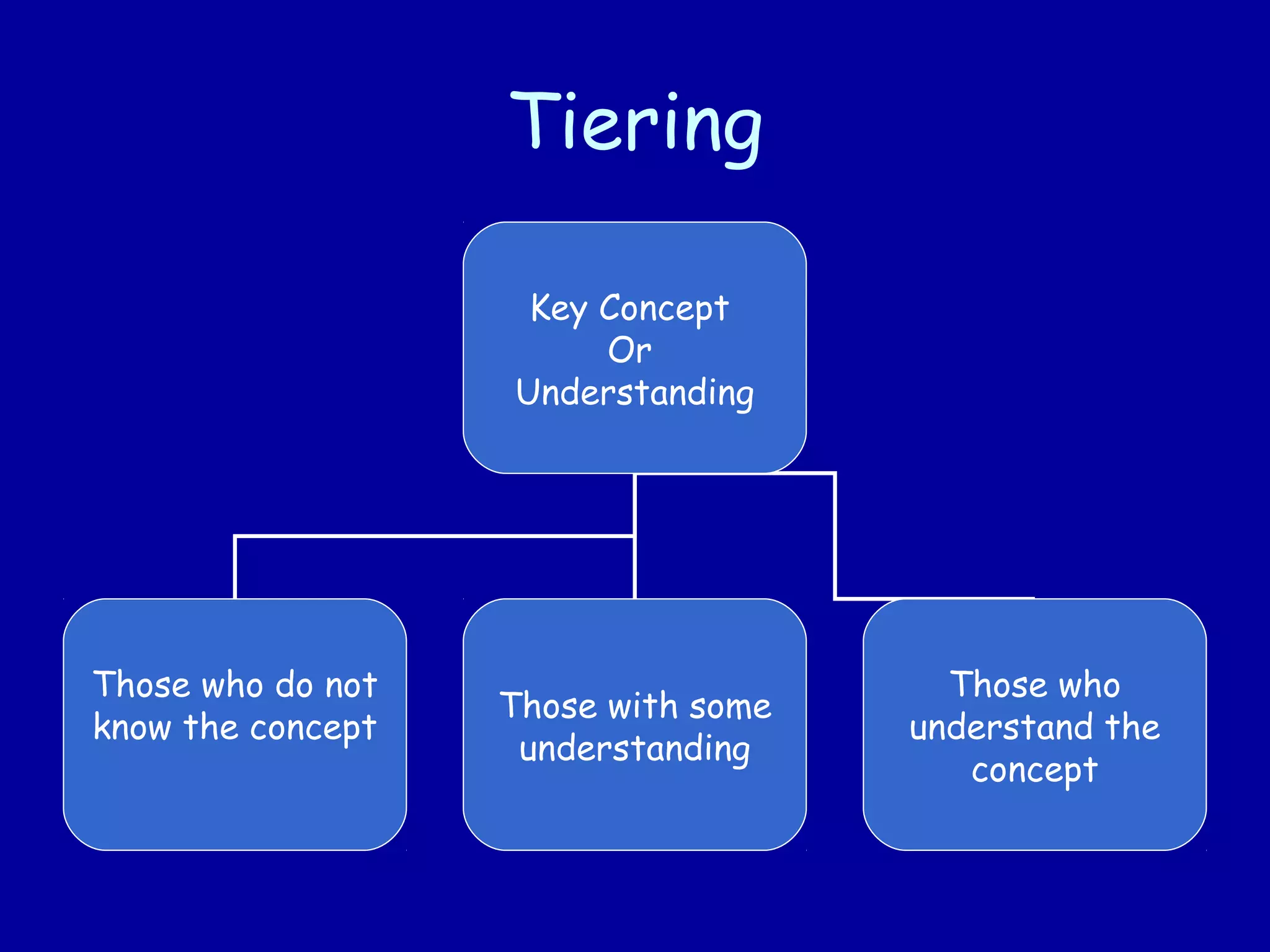
Tiering
Key Concept
Or
Understanding
Those who do not
know the concept
Those with some
understanding
Those who
understand the
concept
What Can Be Tiered?
• Processes, content
and products
• Assignments
• Homework
• Learning stations
• Assessments
• Writing prompts
• Anchor activities
• Materials
What Can We Adjust?
• Level of complexity
• Amount of structure
• Pacing
• Materials
• Concrete to abstract
• Options based on student interests
• Options based on learning styles
Tiering Instruction
1. Identify the standards, concepts, or
generalizations you want the students
to learn.
2. Decide if students have the
background necessary to be successful
with the lesson.
3. Assess the students’ readiness,
interests, and learning profiles.
Tiering Instructions
4. Create an activity or project that is clearly
focused on the standard, concept or
generalization of the lesson.
5. Adjust the activity to provide different
levels or tiers of difficulty that will lead all
students to an understanding.
6. Develop an assessment component for the
lesson. Remember, it is on-going!
Strategies to Make
Differentiation Work
2. Anchoring Activities
These are activities that a student may do at any
time when they have completed their present
assignment or when the teacher is busy with other
students. They may relate to specific needs or
enrichment opportunities, including problems to
solve or journals to write. They could also be part
of a long term project.
Strategies to Make
Differentiation Work
3. Flexible Grouping
This allows students to be appropriately
challenged and avoids labeling a student’s readiness
as a static state. It is important to permit
movement between groups because interest changes
as we move from one subject to another
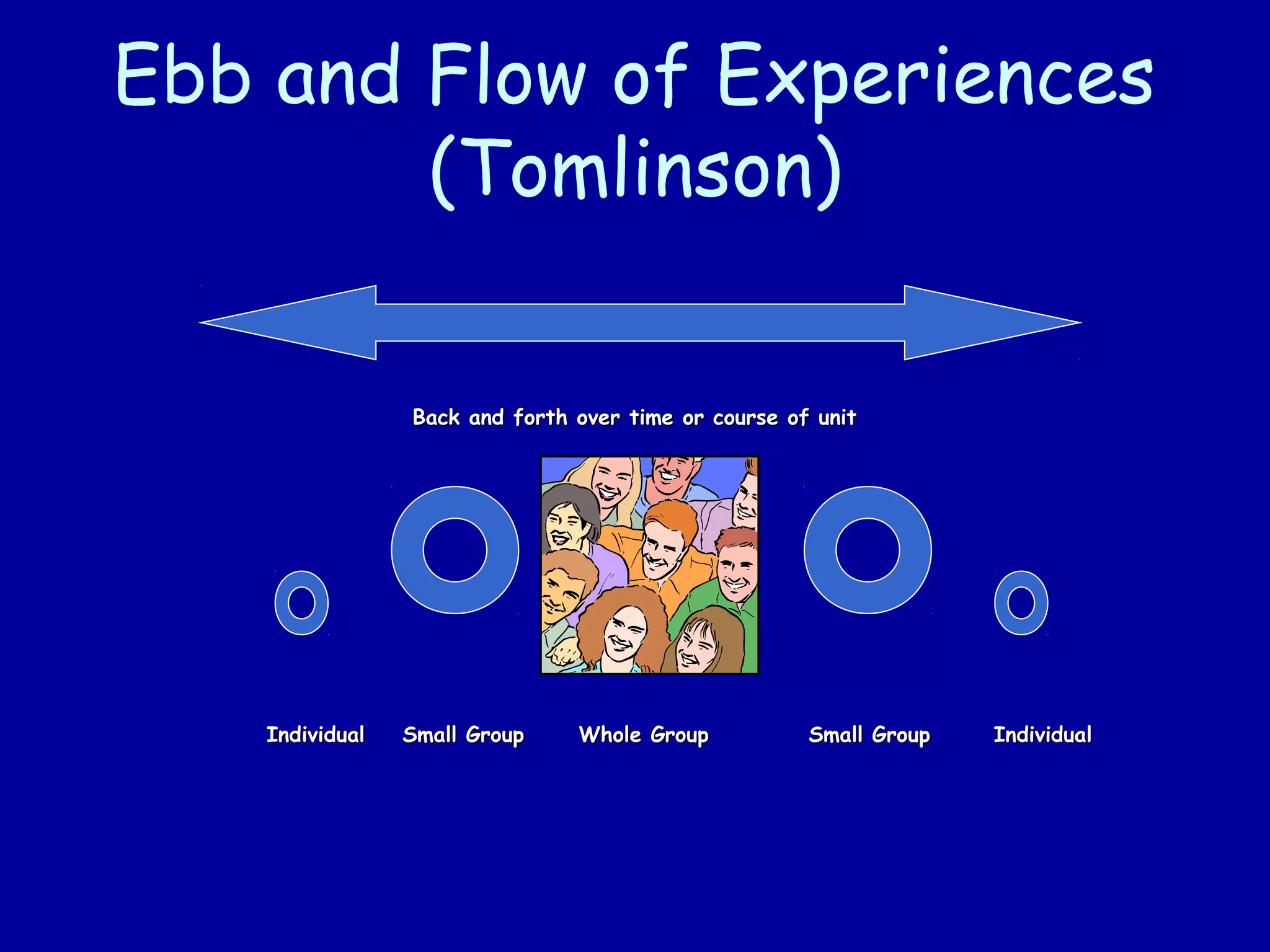
Ebb and Flow of Experiences
(Tomlinson)
Back and forth over time or course of unitBack and forth over time or course of unit
IndividualIndividual Small Group Whole Group Small Group IndividualSmall Group Whole Group Small Group Individual
Flexible Grouping
Homogenous/Ability
-Clusters students of similar
abilities, level, learning style,
or interest.
-Usually based on some type
of pre-assessment
Heterogeneous Groups
-Different abilities, levels or
interest
- Good for promoting creative
thinking.
Individualized or
Independent Study
-Self paced learning
-Teaches time management
and responsibility
-Good for remediation or
extensions
Whole Class
-Efficient way to present new
content
-Use for initial instruction
Strategies to Make
Differentiation Work
4. Compacting Curriculum
Compacting the curriculum means assessing a
student’s knowledge and skills, and providing
alternative activities for the student who has
already mastered curriculum content. This can
be achieved by pre-testing basic concepts or
using performance assessment methods.
Students demonstrating they do not require
instruction move on to tiered problem solving
activities while others receive instruction.
What Differentiation Is …
• Student Centered
• Best practices
• Different
approaches
• 3 or 4 different
activities
• Multiple approaches
to content, process,
and product
• A way of thinking
and planning
• Flexible grouping
What Differentiation Isn’t
• One Thing
• A Program
• The Goal
• Hard questions for
some and easy for
others
• 35 different plans
for one classroom
• A chaotic classroom
• Just homogenous
grouping
In Summary…..
What is fair isn’t always equal…
and
Differentiation gets us away
from “one size fits all” approach to
curriculum and instruction that doesn’t
fit anyone
Bibliography
Campbell, Bruce. The Multiple Intelligences Handbook: Lesson Plans and
More. Stanwood, WA. 1996.
Daniels, Harvey and Bizar. (2005). Teaching The Best Practice Way:
Methods that Matter, K-12. Portland, Maine: Stenhouse Publishers.
Gregory, Gayle. Differentiated Instructional Strategies in Practice.
Thousand Oaks, CA. 2003.
Tomlinson, Carol Ann. The Differentiated Classroom. Alexandria, VA:
ASCD. 1995.
Wormeli, Rick. Fair Isn’t Always Equal: Assessment and Grading in the
Differentiated Classroom, Stenhouse Publishers, 2006.

Differentiated instruction 2 (1)

  • 1.
    Differentiated Instruction The BasicSteps Towards Differentiating
  • 2.
    Super Sleuth Directions: Walkaround the room and find someone to respond to the questions on your Super Sleuth paper. After a verbal answer the person will initial the square. Rules: - A person can only answer and initial one square. - The goals are to activate prior knowledge and to meet new people with new ideas.
  • 3.
    Super SleuthSuper Sleuth Whatis your definition of differentiated instruction? Give an example of when you have used DI? What is something you would like to learn about DI? When do you use small group instruction? Differentiation means as many lesson plans as you have students. Agree? How do you discover how your students learn? What is one way you can form groups in your classroom? What are some quick on-going assessments in your class? Are DI and assessment related?
  • 4.
    Let’s Define Differentiated Instruction Differentiatinginstruction is doing what’s fair for students. It means creating multiple paths so that students of different abilities, interests, or learning needs experience equally appropriate ways to learn.
  • 5.
    The Rationale forDifferentiated Instruction Different levels of readiness Different Interests
  • 6.
    The Rationale forDifferentiated Instruction Different Ability Levels Different Cognitive Needs
  • 7.
    Teachers can differentiate accordingto …. The content The process The product
  • 8.
    Differentiating Content • Resourcematerials at varying readability levels • Audio and video recordings • Highlighted vocabulary • Charts and models • Interest centers • Varied manipulatives and resources • Peer and adult mentors
  • 9.
    Differentiating Process (making senseand meaning of content) • Use leveled or tiered activities • Interest centers • Hands-on materials • Vary pacing according to readiness • Allow for working alone, in partners, triads, and small groups • Allow choice in strategies for processing and for expressing results of processing
  • 10.
    Differentiating Products (showing whatis know and able to be done) • Tiered product choices • Model, use and encourage student use of technology within products and presentations • Provide product choices that range in choices from all multiple intelligences, options for gender, culture, and race • Use related arts teachers to help with student products
  • 11.
    Strategies to Make DifferentiationWork 1. Tiered Instruction Changing the level of complexity or required readiness of a task or unit of study in order to meet the developmental needs of the students involved.
  • 12.
    Tiering Key Concept Or Understanding Those whodo not know the concept Those with some understanding Those who understand the concept
  • 13.
    What Can BeTiered? • Processes, content and products • Assignments • Homework • Learning stations • Assessments • Writing prompts • Anchor activities • Materials
  • 14.
    What Can WeAdjust? • Level of complexity • Amount of structure • Pacing • Materials • Concrete to abstract • Options based on student interests • Options based on learning styles
  • 15.
    Tiering Instruction 1. Identifythe standards, concepts, or generalizations you want the students to learn. 2. Decide if students have the background necessary to be successful with the lesson. 3. Assess the students’ readiness, interests, and learning profiles.
  • 16.
    Tiering Instructions 4. Createan activity or project that is clearly focused on the standard, concept or generalization of the lesson. 5. Adjust the activity to provide different levels or tiers of difficulty that will lead all students to an understanding. 6. Develop an assessment component for the lesson. Remember, it is on-going!
  • 17.
    Strategies to Make DifferentiationWork 2. Anchoring Activities These are activities that a student may do at any time when they have completed their present assignment or when the teacher is busy with other students. They may relate to specific needs or enrichment opportunities, including problems to solve or journals to write. They could also be part of a long term project.
  • 18.
    Strategies to Make DifferentiationWork 3. Flexible Grouping This allows students to be appropriately challenged and avoids labeling a student’s readiness as a static state. It is important to permit movement between groups because interest changes as we move from one subject to another
  • 19.
    Ebb and Flowof Experiences (Tomlinson) Back and forth over time or course of unitBack and forth over time or course of unit IndividualIndividual Small Group Whole Group Small Group IndividualSmall Group Whole Group Small Group Individual
  • 20.
    Flexible Grouping Homogenous/Ability -Clusters studentsof similar abilities, level, learning style, or interest. -Usually based on some type of pre-assessment Heterogeneous Groups -Different abilities, levels or interest - Good for promoting creative thinking. Individualized or Independent Study -Self paced learning -Teaches time management and responsibility -Good for remediation or extensions Whole Class -Efficient way to present new content -Use for initial instruction
  • 21.
    Strategies to Make DifferentiationWork 4. Compacting Curriculum Compacting the curriculum means assessing a student’s knowledge and skills, and providing alternative activities for the student who has already mastered curriculum content. This can be achieved by pre-testing basic concepts or using performance assessment methods. Students demonstrating they do not require instruction move on to tiered problem solving activities while others receive instruction.
  • 22.
    What Differentiation Is… • Student Centered • Best practices • Different approaches • 3 or 4 different activities • Multiple approaches to content, process, and product • A way of thinking and planning • Flexible grouping
  • 23.
    What Differentiation Isn’t •One Thing • A Program • The Goal • Hard questions for some and easy for others • 35 different plans for one classroom • A chaotic classroom • Just homogenous grouping
  • 24.
    In Summary….. What isfair isn’t always equal… and Differentiation gets us away from “one size fits all” approach to curriculum and instruction that doesn’t fit anyone
  • 25.
    Bibliography Campbell, Bruce. TheMultiple Intelligences Handbook: Lesson Plans and More. Stanwood, WA. 1996. Daniels, Harvey and Bizar. (2005). Teaching The Best Practice Way: Methods that Matter, K-12. Portland, Maine: Stenhouse Publishers. Gregory, Gayle. Differentiated Instructional Strategies in Practice. Thousand Oaks, CA. 2003. Tomlinson, Carol Ann. The Differentiated Classroom. Alexandria, VA: ASCD. 1995. Wormeli, Rick. Fair Isn’t Always Equal: Assessment and Grading in the Differentiated Classroom, Stenhouse Publishers, 2006.

Editor's Notes

  • #3 Pass out Super Sleuth paper for this activity.
  • #12 Tiering is one of the best approaches because it allows that all students with different learning needs work with the same curriculum.
  • #13 Two students in the same math class. Student A struggles with basic concepts and math reasoning and needs help understanding the principle of the lesson. Student b is beyond grade level. A single approach will not work. The two students need to approach the principles from different directions or at different levels of difficulty.
  • #15 Pass out lesson plan showing three tiers to a lesson.
  • #18 Give examples of anchoring activities.