Howdo you successfully
meetthe needs of the
diverse learners in your
classroom ?
So now you have a classroom of
diverse learners… and you know that
some of our past teaching strategies are
not going to be effective with them…
So, the million dollar question is…
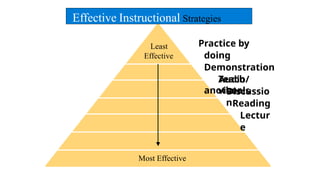
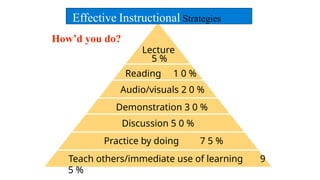
Effective Instructional Strategies
Reading1 0 %
Audio/visuals 2 0 %
Demonstration 3 0 %
Discussion 5 0 %
Practice by doing 7 5 %
Teach others/immediate use of learning 9
5 %
Lecture
5 %
How’d you do?
8.
Differentiated Instruction is…
Aset of unique decisions that the
educator makes to bring
learning
within the grasp of all students.
Remember, this includes students
who are working on grade level,
below grade level, and for those
students working above grade
level!
12.
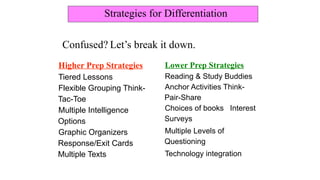
Higher Prep Strategies
TieredLessons
Flexible Grouping Think-
Tac-Toe
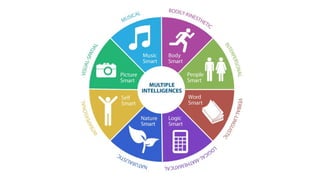
Multiple Intelligence
Options
Graphic Organizers
Response/Exit Cards
Multiple Texts
Lower Prep Strategies
Reading & Study Buddies
Anchor Activities Think-
Pair-Share
Choices of books Interest
Surveys
Multiple Levels of
Questioning
Technology integration
Strategies for Differentiation
Confused? Let’s break it down.
13.
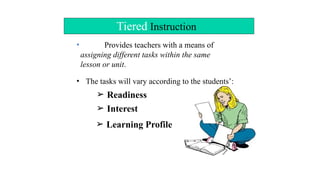
Tiered Instruction
• Providesteachers with a means of
assigning different tasks within the same
lesson or unit.
• The tasks will vary according to the students’:
➢ Readiness
➢ Interest
➢ Learning Profile
14.
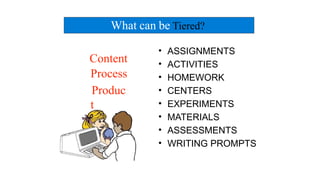
• ASSIGNMENTS
• ACTIVITIES
•HOMEWORK
• CENTERS
• EXPERIMENTS
• MATERIALS
• ASSESSMENTS
• WRITING PROMPTS
Content
Process
Produc
t
What can be Tiered?
15.
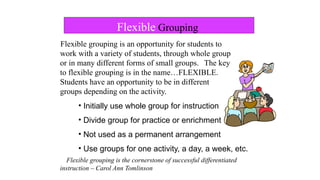
Flexible grouping isan opportunity for students to
work with a variety of students, through whole group
or in many different forms of small groups. The key
to flexible grouping is in the name…FLEXIBLE.
Students have an opportunity to be in different
groups depending on the activity.
• Initially use whole group for instruction
• Divide group for practice or enrichment
• Not used as a permanent arrangement
• Use groups for one activity, a day, a week, etc.
Flexible grouping is the cornerstone of successful differentiated
instruction – Carol Ann Tomlinson
Flexible Grouping
16.
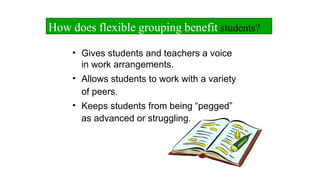
• Gives studentsand teachers a voice
in work arrangements.
• Allows students to work with a variety
of peers.
• Keeps students from being “pegged”
as advanced or struggling.
How does flexible grouping benefit students?
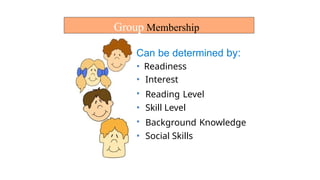
17.
Can be determinedby:
• Readiness
• Interest
• Reading Level
• Skill Level
• Background Knowledge
• Social Skills
Group Membership
18.
Anchor activities areongoing
assignmentsthat students
can work
on independentlythroughout a
unit, a grading period,or
longer.
Anchor Activities
19.
"Brain Busters"
Learning Packets
ActivityBox
Learning /Interest Centers
Vocabulary Work
Accelerated Reader
Investigations
FCAT Practice Activities
Magazine Articles with Generic Questions or Activities
Listening Stations
Research Questions or Projects
Commercial Kits and Materials
Journals or Learning Logs
Silent reading
Websites
Some Anchor Activities
20.
The Purpose ofan Anchor Activity
Provide meaningful work for students when
they finish an assignment or project, when
they first enter the class, or when they are
“stumped.”
Provide ongoing tasks that tie to the content
and instruction
Free up the classroom teacher to work with
other groups of students or individuals
21.
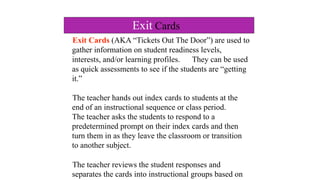
Exit Cards (AKA“Tickets Out The Door”) are used to
gather information on student readiness levels,
interests, and/or learning profiles. They can be used
as quick assessments to see if the students are “getting
it.”
The teacher hands out index cards to students at the
end of an instructional sequence or class period.
The teacher asks the students to respond to a
predetermined prompt on their index cards and then
turn them in as they leave the classroom or transition
to another subject.
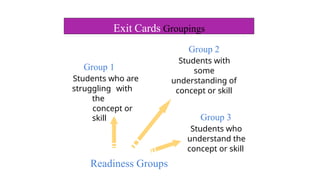
The teacher reviews the student responses and
separates the cards into instructional groups based on
Exit Cards
22.
Group 1
Students whoare
struggling with
the
concept or
skill
Group 2
Students with
some
understanding of
concept or skill
Group 3
Students who
understand the
concept or skill
Readiness Groups
Exit Cards Groupings
23.
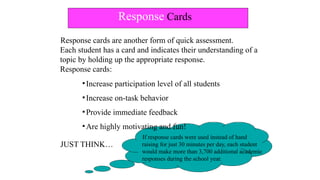
Response Cards
JUST THINK…
Ifresponse cards were used instead of hand
raising for just 30 minutes per day, each student
would make more than 3,700 additional academic
responses during the school year.
Response cards are another form of quick assessment.
Each student has a card and indicates their understanding of a
topic by holding up the appropriate response.
Response cards:
▪Increase participation level of all students
▪Increase on-task behavior
▪Provide immediate feedback
▪Are highly motivating and fun!
24.
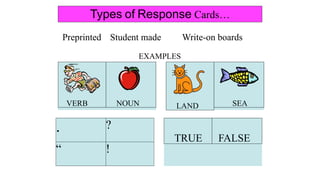
Types of ResponseCards…
Preprinted Student made Write-on boards
EXAMPLES
VERB NOUN
. ?
“ !
LAND SEA
TRUE FALSE
25.
Complete a
character
analysis forthe
main character of
your story.
Complete a
character report
card .
Name & draw a
person who is like
one of the
characters from the
book.
Build a miniature
stage setting for
your story.
Draw a picture
describing at least 3
settings from the
story.
Make up a
limerick or
cinquain poem
about the setting of
your story
Use a sequence
chart or timeline to
describe at least 7
events.
Write a new
beginning or ending
to the story.
Make a game
board about your
story. Include key
events
(in order)
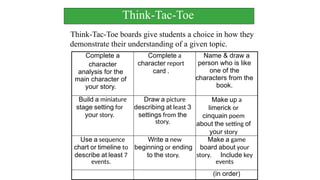
Think-Tac-Toe
Think-Tac-Toe boards give students a choice in how they
demonstrate their understanding of a given topic.
26.
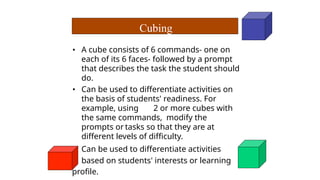
• A cubeconsists of 6 commands- one on
each of its 6 faces- followed by a prompt
that describes the task the student should
do.
• Can be used to differentiate activities on
the basis of students' readiness. For
example, using 2 or more cubes with
the same commands, modify the
prompts or tasks so that they are at
different levels of difficulty.
• Can be used to differentiate activities
based on students' interests or learning
profile.
Cubing
27.
• Aides comprehension,concept
development and learning
• Highlights key vocabulary
• Provides an organized, visual display of
knowledge
• Focuses attention on key elements
• Helps integrate prior knowledge with new
knowledge
Graphic Organizers
What else canI do?
Here are some more specific strategies you can do as a teacher
that will help meet the needs of ALL the students in your class.
Use cassette recorders as a means for students to receive
information or as a means for students to demonstrate knowledge
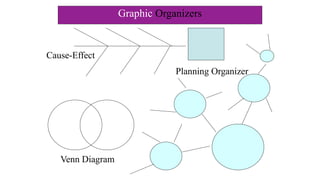
Use graphic organizers such as flowcharts, Venn diagrams,
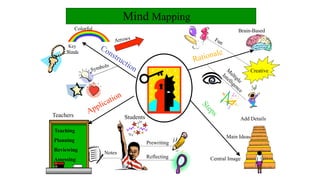
semantic mapping, mind mapping, etc.
Have students underline or highlight key words or
phrases Use texts that are tailored to the students’ reading
levels
Use questions that are tailored to the students’ comprehension
level (Bloom)
Collect topic related supplementary materials such as
31.
Continued…
Provide word wallsfor students to reference while
reading/writing
Encourage different forms of expressing learning such as
drawing, acting, poetry, etc.
Use flexible grouping, peer tutoring, learning buddies, etc.
Use ongoing assessment of students progress so that
intervention can occur quickly (exit cards, response cards…)
Use student diaries, learning logs, journals, prediction logs
Shorten or lengthen assignments while still maintaining
the objective of the lesson
Rewrite problems using less/more complex language
32.
• Examine YourPhilosophy About Individual
Student Needs
• Start Small
• Grow Slowly - But Grow
• Envision How an Activity Will Look
• Step Back and Reflect
• Talk with Students Early and Often
• Continue to Empower Students
• Continue to be Analytical
33.
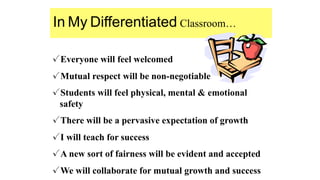
In My DifferentiatedClassroom…
✓Everyone will feel welcomed
✓Mutual respect will be non-negotiable
✓Students will feel physical, mental & emotional
safety
✓There will be a pervasive expectation of growth
✓I will teach for success
✓A new sort of fairness will be evident and accepted
✓We will collaborate for mutual growth and success
34.
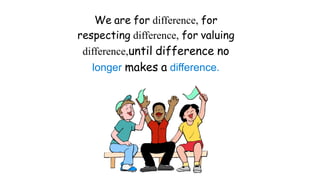
We are fordifference, for
respecting difference, for valuing
difference,until difference no
longer makes a difference.
➢ How toDifferentiate Instruction in Mixed-Ability
Classrooms 2nd
Edition
Virginia
By Carol Ann Tomlinson University of
➢ The Differentiated Classroom Responding to the Needs of
All Learners By Carol Ann Tomlinson
Resources
38.
➢ Differentiated InstructionalStrategies: One Size
Doesn’t
Fit All By Gayle H. Gregory and Carolyn
Chapman
➢ Differentiating Instruction for Students with Learning
Disabilities By William Bender
Resources
#5 Rank the strategies on the right of the pyramid from least effective to most effective ( top to bottom) . Try to guess the percentage of information a typical student may retain for each strategy.
#12 Differentiation can include complex strategies, like writing tiered lesson plans, or it can take a more simplistic form, such as using reading buddies or think-pair-share strategies. Here is a condensed list of the continuum of differentiated strategies.




![Differentiation 2012[1]](https://cdn.slidesharecdn.com/ss_thumbnails/differentiation20121-141020222707-conversion-gate02-thumbnail.jpg?width=640&height=640&fit=bounds)


