Ceramic Solutions for Specific Restorative Indications
Alexandre dos Santos, CDT Milko Villarroel, DDS, MS, PhD
Andrea Sousa Villarroel, DDS, MS, PhD Diana Garrigós Portales, DDS
Mr. dos Santos is the owner of Studio Art Dental in Curitiba, Brazil. He can
be contacted at alexandre@studioartdental.com.br
Dr. Milko Villarroel owns a private practice in Curitiba, Brazil. He can be
contacted at milko.villarroel@gmail.com
Dr. Andrea Villarroel is the owner of Innova Odontologia in Curitiba
Paraná, Brazil. She can be contacted at andreasousa.ms@gmail.com
Dr. Garrigós Portales is the owner of Medica Atenas in San Luis Potosí,
Mexico. She can be contacted at dr.garrigos@hotmail.com
Disclosures: The authors did not report any disclosures.
All images in this slideshow are copyright protected and belong to the authors.
Copyright © 2016. All rights reserved. No part of this slideshow may be reproduced,
distributed, or transmitted in any form or by any means, including copying, recording, or other
electronic or mechanical methods, without the prior written permission of the publisher.
Case 1: Laminate Veneers on Refractory Model
The patient presented with direct
restorations that were replaced three
times over a four-year period after a
sports-related trauma. The restorations
had color deficiencies, stained
margins, and lack of gloss. The patient
did not want a radical change,
therefore two laminate feldspathic
veneers were chosen for treatment.
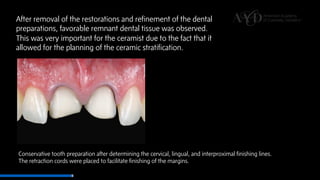
Conservative tooth preparation after determining the cervical, lingual, and interproximal finishing lines.
The retraction cords were placed to facilitate finishing of the margins.
After removal of the restorations and refinement of the dental
preparations, favorable remnant dental tissue was observed.
This was very important for the ceramist due to the fact that it
allowed for the planning of the ceramic stratification.
Observe how the dentin-colored ceramic is needed
to compensate for the loss of dentin tissue.
Wash-bake and opaque dentin ceramics must
be layered carefully to control light reflection
from the abutment.
Final master cast before preparations to
produce the final restorations with the
index guide.
Silicone gingiva was used to create the emergence profile.
The application began with more saturated layers in the cervical
region. Then the vestibular margin crests were built until the
final dentin shape was obtained.
(a) The shape is sculpted to create the anatomical form. (b) Dentin layer buildup. (c) Dentin ceramic is built up in
full contour according to the diagnostic wax-up.
a b c
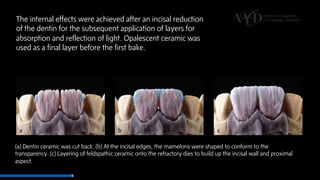
The internal effects were achieved after an incisal reduction
of the dentin for the subsequent application of layers for
absorption and reflection of light. Opalescent ceramic was
used as a final layer before the first bake.
(a) Dentin ceramic was cut back. (b) At the incisal edges, the mamelons were shaped to conform to the
transparency. (c) Layering of feldspathic ceramic onto the refractory dies to build up the incisal wall and proximal
aspect.
a b c
After the first bake, the incisal ceramic was used on the
restoration’s entire surface. The final bake allowed the
ceramic layers to be observed.
(a) Enamel layer buildup. It is important not to overbuild ceramics when fabricating laminate veneers.
(b) Completed ceramic layering.
a b
Macro and micro texture was performed for better
individualization of the veneers.
(a) Final shape. (b) Final texture of the laminate veneers.
a b
The esthetic potential of veneers fabricated with feldspathic
ceramic on a refractory model is an excellent option to solve
esthetic problems in the anterior region, as seen 30 days after
final veneers were placed.
Case 2: Anterior Crowns Over Different Substrates
Patient presented with a deficient
porcelain fused-to-metal restoration and
metal post in the upper right incisor,
darkening of the upper right lateral
incisor due to a previous endodontic
treatment, and extensive vestibular and
palatine composite resin restorations in
the upper left central and lateral incisors.
A situation that represents great challenge is the differences
between substrates.
Intraoperative views of the abutment tooth after crown preparation.
a b
Selecting the correct ceramic is important to prevent the
unfavorable substrates from negatively influencing the esthetics
of the final result; therefore it was decided to fabricate ceramic
crowns using a stratification technique. A fine layer of ceramic
wash was applied for better adhesion and control of the
luminosity.
The copings in position on the solid model.
Ceramic layering started on the cervical region until the full
shape was conformed. Incisal cuts were made to apply the
internal effects.
Ceramic layering.
a b
Evaluate ceramics for necessary corrections. An incisal
layer was used to complete the final shape of the crowns.
Completed crown restorations on the solid cast before finishing: (a) Ideal positioning of the line angles for optimal
light reflection. (b) Texture and final form.
a b
The final outcome shows how the shape, texture, and color
favored the integration and how selecting the right ceramic
system prevented the different substrates from negatively
influencing the new restorations.
Case 3: Single Anterior Crown Over Unfavorable Substrate
Patient presented with a provisional
crown and wished to have a definitive
restoration.
Once the provisional was removed, an obscured dental
remnant with a composite resin was found. To mask the
unfavorable dental tissue it is necessary to use a material that
possesses enough opacity to hide the tooth, but at the same
time delivers an adequate chromatic base for the
stratification. Therefore, a zirconia coping was created.
(Photographs courtesy of Dr. Luis Garbelotto and Dr. Claudia Volpato)
a b
(a) Prepared tooth with grave
discoloration in the cervical area
superior.
(b) Clinical appearance of
zirconia copings positioned
above the abutment.
After the first ceramic bake it is helpful to make a try-in, which
will allow evaluation of the ceramic stratification.
(a) Masking porcelain (100%) was applied to the ceramic core. No difference can be observed in color and light
reflection compared to the natural right central incisor. (b) Similar translucency at the incisal edge is evident
between the incisors. (c) After the first bake try-in, the ceramic crown on the left central incisor masks the dark
color in the cervical area.
a b c
Small differences in color are always present; therefore, when
restoring a single tooth the shape and secondary characteristics
of morphology will play a very important role in the integration
of the restoration. Ten days after cementation, it was possible
to see that the shape, texture, and color were very close to the
patient’s natural teeth, achieving a good integration.
The authors thank Luis Garbelotto, DDS, MS, and Claudia Volpato, DDS,MS, PhD (both of
Santa Catarina, Brazil) for their prosthetic work in the third case discussed in this slideshow.
ACKNOWLEDGMENTS
_________________________________
The AACD would like to thank the authors of
this slideshow for their work and dedication
to the education in esthetic dentistry.
_________________________________
This slideshow was an excerpt from the original article published in the Journal of Cosmetic
Dentistry, Winter 2016, Volume 31, Number 4, titled: Different Materials for Different Situations—
Ceramic Solutions for Specific Restorative Indications authored by Alexandre dos Santos, CDT, Milko
Villarroel, DDS, MS, PhD, Andrea Sousa Villarroel, DDS, MS, PhD, and Diana Garrigós Portales, DDS.
To receive the quarterly, peer-reviewed Journal of Cosmetic Dentistry,
available to members only, enroll as an AACD member at www.aacd.com/join

Different Materials for Different Situations

  • 1.
    Ceramic Solutions forSpecific Restorative Indications Alexandre dos Santos, CDT Milko Villarroel, DDS, MS, PhD Andrea Sousa Villarroel, DDS, MS, PhD Diana Garrigós Portales, DDS
  • 2.
    Mr. dos Santosis the owner of Studio Art Dental in Curitiba, Brazil. He can be contacted at alexandre@studioartdental.com.br Dr. Milko Villarroel owns a private practice in Curitiba, Brazil. He can be contacted at milko.villarroel@gmail.com Dr. Andrea Villarroel is the owner of Innova Odontologia in Curitiba Paraná, Brazil. She can be contacted at andreasousa.ms@gmail.com Dr. Garrigós Portales is the owner of Medica Atenas in San Luis Potosí, Mexico. She can be contacted at dr.garrigos@hotmail.com Disclosures: The authors did not report any disclosures.
  • 3.
    All images inthis slideshow are copyright protected and belong to the authors. Copyright © 2016. All rights reserved. No part of this slideshow may be reproduced, distributed, or transmitted in any form or by any means, including copying, recording, or other electronic or mechanical methods, without the prior written permission of the publisher.
  • 4.
    Case 1: LaminateVeneers on Refractory Model The patient presented with direct restorations that were replaced three times over a four-year period after a sports-related trauma. The restorations had color deficiencies, stained margins, and lack of gloss. The patient did not want a radical change, therefore two laminate feldspathic veneers were chosen for treatment.
  • 5.
    Conservative tooth preparationafter determining the cervical, lingual, and interproximal finishing lines. The retraction cords were placed to facilitate finishing of the margins. After removal of the restorations and refinement of the dental preparations, favorable remnant dental tissue was observed. This was very important for the ceramist due to the fact that it allowed for the planning of the ceramic stratification.
  • 6.
    Observe how thedentin-colored ceramic is needed to compensate for the loss of dentin tissue. Wash-bake and opaque dentin ceramics must be layered carefully to control light reflection from the abutment. Final master cast before preparations to produce the final restorations with the index guide.
  • 7.
    Silicone gingiva wasused to create the emergence profile. The application began with more saturated layers in the cervical region. Then the vestibular margin crests were built until the final dentin shape was obtained. (a) The shape is sculpted to create the anatomical form. (b) Dentin layer buildup. (c) Dentin ceramic is built up in full contour according to the diagnostic wax-up. a b c
  • 8.
    The internal effectswere achieved after an incisal reduction of the dentin for the subsequent application of layers for absorption and reflection of light. Opalescent ceramic was used as a final layer before the first bake. (a) Dentin ceramic was cut back. (b) At the incisal edges, the mamelons were shaped to conform to the transparency. (c) Layering of feldspathic ceramic onto the refractory dies to build up the incisal wall and proximal aspect. a b c
  • 9.
    After the firstbake, the incisal ceramic was used on the restoration’s entire surface. The final bake allowed the ceramic layers to be observed. (a) Enamel layer buildup. It is important not to overbuild ceramics when fabricating laminate veneers. (b) Completed ceramic layering. a b
  • 10.
    Macro and microtexture was performed for better individualization of the veneers. (a) Final shape. (b) Final texture of the laminate veneers. a b
  • 11.
    The esthetic potentialof veneers fabricated with feldspathic ceramic on a refractory model is an excellent option to solve esthetic problems in the anterior region, as seen 30 days after final veneers were placed.
  • 12.
    Case 2: AnteriorCrowns Over Different Substrates Patient presented with a deficient porcelain fused-to-metal restoration and metal post in the upper right incisor, darkening of the upper right lateral incisor due to a previous endodontic treatment, and extensive vestibular and palatine composite resin restorations in the upper left central and lateral incisors.
  • 13.
    A situation thatrepresents great challenge is the differences between substrates. Intraoperative views of the abutment tooth after crown preparation. a b
  • 14.
    Selecting the correctceramic is important to prevent the unfavorable substrates from negatively influencing the esthetics of the final result; therefore it was decided to fabricate ceramic crowns using a stratification technique. A fine layer of ceramic wash was applied for better adhesion and control of the luminosity. The copings in position on the solid model.
  • 15.
    Ceramic layering startedon the cervical region until the full shape was conformed. Incisal cuts were made to apply the internal effects. Ceramic layering. a b
  • 16.
    Evaluate ceramics fornecessary corrections. An incisal layer was used to complete the final shape of the crowns. Completed crown restorations on the solid cast before finishing: (a) Ideal positioning of the line angles for optimal light reflection. (b) Texture and final form. a b
  • 17.
    The final outcomeshows how the shape, texture, and color favored the integration and how selecting the right ceramic system prevented the different substrates from negatively influencing the new restorations.
  • 18.
    Case 3: SingleAnterior Crown Over Unfavorable Substrate Patient presented with a provisional crown and wished to have a definitive restoration.
  • 19.
    Once the provisionalwas removed, an obscured dental remnant with a composite resin was found. To mask the unfavorable dental tissue it is necessary to use a material that possesses enough opacity to hide the tooth, but at the same time delivers an adequate chromatic base for the stratification. Therefore, a zirconia coping was created. (Photographs courtesy of Dr. Luis Garbelotto and Dr. Claudia Volpato) a b (a) Prepared tooth with grave discoloration in the cervical area superior. (b) Clinical appearance of zirconia copings positioned above the abutment.
  • 20.
    After the firstceramic bake it is helpful to make a try-in, which will allow evaluation of the ceramic stratification. (a) Masking porcelain (100%) was applied to the ceramic core. No difference can be observed in color and light reflection compared to the natural right central incisor. (b) Similar translucency at the incisal edge is evident between the incisors. (c) After the first bake try-in, the ceramic crown on the left central incisor masks the dark color in the cervical area. a b c
  • 21.
    Small differences incolor are always present; therefore, when restoring a single tooth the shape and secondary characteristics of morphology will play a very important role in the integration of the restoration. Ten days after cementation, it was possible to see that the shape, texture, and color were very close to the patient’s natural teeth, achieving a good integration.
  • 22.
    The authors thankLuis Garbelotto, DDS, MS, and Claudia Volpato, DDS,MS, PhD (both of Santa Catarina, Brazil) for their prosthetic work in the third case discussed in this slideshow. ACKNOWLEDGMENTS
  • 23.
    _________________________________ The AACD wouldlike to thank the authors of this slideshow for their work and dedication to the education in esthetic dentistry. _________________________________
  • 24.
    This slideshow wasan excerpt from the original article published in the Journal of Cosmetic Dentistry, Winter 2016, Volume 31, Number 4, titled: Different Materials for Different Situations— Ceramic Solutions for Specific Restorative Indications authored by Alexandre dos Santos, CDT, Milko Villarroel, DDS, MS, PhD, Andrea Sousa Villarroel, DDS, MS, PhD, and Diana Garrigós Portales, DDS. To receive the quarterly, peer-reviewed Journal of Cosmetic Dentistry, available to members only, enroll as an AACD member at www.aacd.com/join