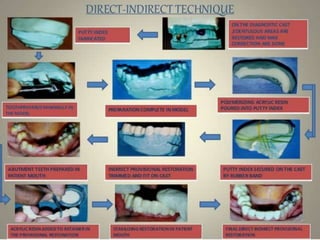
SILICONE INDEX & BURS
The Finishing line is chamfer for ceramic fused to metal & deep
chamfer for all ceramic.
The position is within the level of the gingiva.
1.OCCLUSAL REDUCTION.
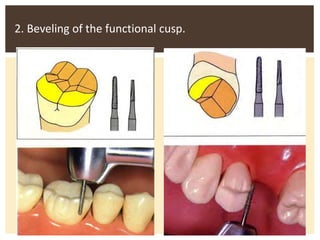
2. Beveling of the functional cusp.
The occlusal clearance should be kept in all occlusal
movements (centric, eccentric, protrusive movements).
-In the case of the mandibular post.teeth the buccal
surface is prepared in two steps(two planes) due to the
lingual convexity which are:
1. Gingival 2/3.
2. Occlusal 1/3 (beveling of the functional cusp).
2. Buccal reduction:
-In the case of the maxillary post. teeth the palatal
surface is prepared in two steps(two planes) due to the
convexity which are:
1. Gingival 2/3.
2. Occlusal 1/3 (beveling of the functional cusp).
2. palatal reduction:
3. LINGUAL & PALATAL REDUCTION.
4.AXIAL REDUCTION
60 Tapering
Classification
Predominantly glass. feldspathic: have a high content of glass
making this type of dental ceramic highly esthetic and translucent
type is the best in mimicking the optical properties of enamel and
dentin
(feldspathic)
Particle-filled glass: Filler particles are added to the glass matrix
to improve the mechanical properties. Fillers can be crystalline
particles of high-melting glasses.
Leucite reinforced(empress)lithium disilicate (emax) alumina
reinforced (inceram)
Polycrystalline: This type of ceramic contains no glass. Atoms are
packed into regular crystalline arrangement making it tougher and
less susceptible to crack propagation
zirconia
CERAMIC MATERIALS
FELD SPATHIC CERAMIC
- composed mainly of oxide components including
- sio2 (52-62 wt %)
- al2o (11-16 wt %) alumina
- na2o (5-7 wt %)
-17-25%filler
-used mainly as direct veneering in layers .
-considered the traditional fabrication of an all-ceramic
restoration.
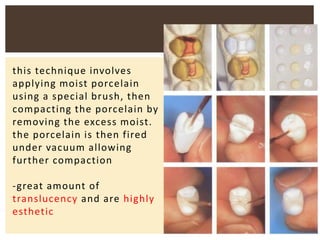
this technique involves
applying moist porcelain
using a special brush, then
compacting the porcelain by
removing the excess moist.
the porcelain is then fired
under vacuum allowing
further compaction
-great amount of
translucency and are highly
esthetic
IPS EMPRESS®
leucite-reinforced glass ceramic (sio2-al2o3
40%
introduced in 1980(ivoclar vivadent)
hot pressable ceramics are available as glass-
ceramic ready ingots have a similar
composition of powder porcelains, with less
porosity and more crystalline content
the ingots are heated to a high temperature &
become a highly viscous liquid,
then pressed slowly into the formed mold
formed utilizing the lost wax technique.
leucite are few microns filler
prevents crack propagation
highly esthetic and high translucent
has a low flexural strength of 112±10
mpa
limiting its use to single unit
complete-coverage restorations in the
anterior region
IPS E.MAX PRESS®
-introduced in 2006(ivoclar vivadent)
hot pressing and lost wax technique
lithium-disilicate glass ceramic (sio2-li2o).
suitable for the usage for fabrication of wide
range of restorations from non prep veneer to 3 -
unit anterior bridge and can extend to the
second premolar
ht and lt ingots recommended in situations
where average to high translucency is needed
mo and ho ingots used to mask discoloration
introduced from 1990
poly crystalline dense solid glass free
zirconium dioxide ceramics have excellent
mechanical properties.
high flexural strength (750- >1000 mpa) when
compared to other dental ceramics.
zirconia
zirconium oxide ceramics are indicated for
fabrication of crowns, posterior FPDs.
the cores have opacity which makes zirconia has a
color similar to teeth but without translucency
which if needed other ceramic veneering
materials should be used
restorations with zirconia cores do not have
equivalent esthetic potential,
reputation of looking artificially white and
lifelike appearance difficult if reduction
insufficient (2mm)
impossible to etch
as a rule highest esthetic is
feldspathic ,empress emax
inceram least zircon
Provisional restoration
CELLULOID TEMPORARY CROWNS
 Clinical procedure
 1. Coat the prepared tooth with petroleum
or Vaseline to facilitate removal of the
temporary crown.
 2. Select the proper size and shape of the
celluloid crown.
 3. Make tow holes in the corners of
temporary crown to provide an escape way
for the excess material.
 4. Cut the gingival margin of the crown to
accommodate that of the prepared tooth.
 5. Fill the celluloid crown with provisional
material (acrylic resin or composite resin) if
acrylic is used as a provisional material, the
celluloid crown should be removed at its
semi plastic
 6. Take the crown out and remove the excess
material. Then place it again on the prepared
tooth and check the occlusion, contact with
adjacent teeth, fitness, extension and
cemented by non eugenol zinc oxide cement.
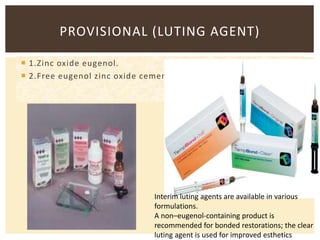
PROVISIONAL (LUTING AGENT)
 1.Zinc oxide eugenol.
 2.Free eugenol zinc oxide cement.
Interim luting agents are available in various
formulations.
A non–eugenol-containing product is
recommended for bonded restorations; the clear
luting agent is used for improved esthetics
SHADE SELECTION
A B C
Hue classified : A,B,C,D. WITH numerical SUBCLASSES
OF VALUE AND CHROMA
D
VITA CLASSIC – STEP 3
(VALUE SELECTION)
Value oriented shade guide
B1, A1, B2, D2, A2, C1, C2, D4, A3,
D3, B3, A3.5, B4, C3, A4, C4,
Shade matching with the use of the VITA classical (Lumin Vacuum) shade guide. A,
Selecting hue by matching samples with high chroma (e.g., A4, B4, C4, or D3) to a
tooth with high chroma. B, Selecting chroma from within the hue group (e.g., B1, B2,
B3, or B4).
C, Value-ordered shade guide is used to check lightness start from (B1,A1 ,B2,-------)
VITA CLASSIC SHADE GUIDE
A3 ( A = hue,3=chroma)
A B C D
VITAPAN 3D-MASTER SHADE GUIDE
-it based on 3 dimensional shade selection.
-it consist of 11 sets of fired porcelain tooth
shaped samples built up with cervical, dentinal &
incisal porcelain.
value:1,2-5. from the lightest color to the
darkest.
VITA-3D – STEP 1
1. Select the value :
 Remove the L & R degree of
Each value leaving only M.
 Start with darkest group
moving right to left
 Select Value group
1, 2, 3, 4, or 5.
For example it is 2
VITA-3D – STEP 2
2.Select the chroma:
From your selected Value
group, remove the middle
tab (M) and spread the
samples out like a fan.
Select one of the three
shade samples to
determine Chroma.
Ex: 2M2
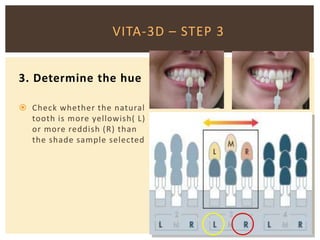
VITA-3D – STEP 3
3. Determine the hue
 Check whether the natural
tooth is more yellowish( L)
or more reddish (R) than
the shade sample selected
EVALUATION
(TRY IN)
&
CEMENTATION
1. Proximal contacts.
2. Marginal integrity.
3. Stability.
4. Occlusion.
5. Shade.
Evaluation Sequence
Checking the proximal contact is done using:
 Dental floss .
 Articulating paper (thin Mylar film).
1.The proximal contact area:
if the contact is too tight or deficient (opened)
what will occur?
TOO HEAVY CONTACT RESULTS IN:
A. In correct seating of the restoration which leads to a
marginal discrepancy.
B. Difficult flossing by the patient.
C. Produce discomfort by exerting too much pressure on the
adjacent tooth.
DEFICIENT CONTACT (OPEN CONTACT)
Result in:
Food impaction, which
cause gingival problems&
dental caries to adjacent
tooth. In addition it is
annoying to the patient.
Drifting of the adjacent
teeth &affecting the
patient occlusion.
The articulating paper tears before
seating, the location of tight contact
can be adjusted with cylindrical
stone bur for ceramic restoration.
Note: If both proximal contacts feel too tight, adjust only the
tighter contact first…Sometimes this will relieve the pressure on
the second Contact without needing adjustment.
Adjustment of too tight proximal contact
For full metal restoration,
adjustment is done using wheel
rubber bur.
ADJUSTMENT OF OPEN CONTACT
Open proximal contact must be corrected :
 Ceramic → Adding ceramic layer then firing.
 Full metal → soldering.
2. MARGINAL INTEGRITY
Defective margin of the restoration might be:
i. Short margin(under extended).
ii. Long margin (over hang).
iii. Open margin.
Marginal shortness of more than 0.5 mm (tip of the
probe) necessitates the repeat of the imp.
the margin is short & not fit the F.L. in this case
,we should check:
If there is too tight proximal contacts that prevent complete
seating.
The internal surface of the retainer: if slight undercut in tooth
surface interfere with complete seating. It can be checked by
indicator spray or elastomeric paste similar to silicone imp.
Material.
SHORT MARGIN(UNDER EXTENDED):
.
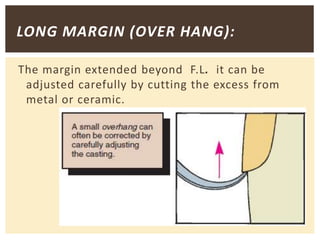
LONG MARGIN (OVER HANG):
The margin extended beyond F.L. it can be
adjusted carefully by cutting the excess from
metal or ceramic.
OPEN MARGIN
the margin is within the F.L. but there is space between it &the
prepared tooth. this space leads to:
-fluid microleakage & possibility of secondarycaries
- luting dissolution.
CORRECTION
 Metal→ burnishing .it depends on :
i) The type of metal (burnishable metal is
gold).
ii) ii) Type of F.L. feather edge & shoulder with
bevel can be burnished.
 Ceramic → repeat the impression.
3. STABILITY:
Any degree of instability is likely to cause failure
during function.
1) If instability is caused by a small positive nodule(inner
surface), this can usually be corrected.
2) if it is caused by distortion, a new casting is necessary.
4. OCCLUSION
using articulating paper in centric or eccentric relation, remove
the premature contact (high spot) with stone bur and always
checking the restoration thickness with metal gauge to avoid
perforation or over thinning of restoration.
5. SHADE
color mismatching restoration must return to the lab to add
the simulated stain then fired& glazed the restoration.
Applying the stain
Drying of the stain in front of the furnace. After firing & glazing.

Basic principles of crowns & bridges

  • 3.
    SILICONE INDEX &BURS The Finishing line is chamfer for ceramic fused to metal & deep chamfer for all ceramic. The position is within the level of the gingiva.
  • 4.
  • 5.
  • 6.
    2. Beveling ofthe functional cusp.
  • 7.
    The occlusal clearanceshould be kept in all occlusal movements (centric, eccentric, protrusive movements).
  • 8.
    -In the caseof the mandibular post.teeth the buccal surface is prepared in two steps(two planes) due to the lingual convexity which are: 1. Gingival 2/3. 2. Occlusal 1/3 (beveling of the functional cusp). 2. Buccal reduction:
  • 9.
    -In the caseof the maxillary post. teeth the palatal surface is prepared in two steps(two planes) due to the convexity which are: 1. Gingival 2/3. 2. Occlusal 1/3 (beveling of the functional cusp). 2. palatal reduction:
  • 10.
    3. LINGUAL &PALATAL REDUCTION.
  • 11.
  • 12.
    Classification Predominantly glass. feldspathic:have a high content of glass making this type of dental ceramic highly esthetic and translucent type is the best in mimicking the optical properties of enamel and dentin (feldspathic) Particle-filled glass: Filler particles are added to the glass matrix to improve the mechanical properties. Fillers can be crystalline particles of high-melting glasses. Leucite reinforced(empress)lithium disilicate (emax) alumina reinforced (inceram) Polycrystalline: This type of ceramic contains no glass. Atoms are packed into regular crystalline arrangement making it tougher and less susceptible to crack propagation zirconia CERAMIC MATERIALS
  • 13.
    FELD SPATHIC CERAMIC -composed mainly of oxide components including - sio2 (52-62 wt %) - al2o (11-16 wt %) alumina - na2o (5-7 wt %) -17-25%filler -used mainly as direct veneering in layers . -considered the traditional fabrication of an all-ceramic restoration.
  • 14.
    this technique involves applyingmoist porcelain using a special brush, then compacting the porcelain by removing the excess moist. the porcelain is then fired under vacuum allowing further compaction -great amount of translucency and are highly esthetic
  • 15.
    IPS EMPRESS® leucite-reinforced glassceramic (sio2-al2o3 40% introduced in 1980(ivoclar vivadent) hot pressable ceramics are available as glass- ceramic ready ingots have a similar composition of powder porcelains, with less porosity and more crystalline content the ingots are heated to a high temperature & become a highly viscous liquid, then pressed slowly into the formed mold formed utilizing the lost wax technique.
  • 16.
    leucite are fewmicrons filler prevents crack propagation highly esthetic and high translucent has a low flexural strength of 112±10 mpa limiting its use to single unit complete-coverage restorations in the anterior region
  • 17.
    IPS E.MAX PRESS® -introducedin 2006(ivoclar vivadent) hot pressing and lost wax technique lithium-disilicate glass ceramic (sio2-li2o). suitable for the usage for fabrication of wide range of restorations from non prep veneer to 3 - unit anterior bridge and can extend to the second premolar ht and lt ingots recommended in situations where average to high translucency is needed mo and ho ingots used to mask discoloration
  • 18.
    introduced from 1990 polycrystalline dense solid glass free zirconium dioxide ceramics have excellent mechanical properties. high flexural strength (750- >1000 mpa) when compared to other dental ceramics. zirconia
  • 19.
    zirconium oxide ceramicsare indicated for fabrication of crowns, posterior FPDs.
  • 20.
    the cores haveopacity which makes zirconia has a color similar to teeth but without translucency which if needed other ceramic veneering materials should be used restorations with zirconia cores do not have equivalent esthetic potential, reputation of looking artificially white and lifelike appearance difficult if reduction insufficient (2mm) impossible to etch
  • 21.
    as a rulehighest esthetic is feldspathic ,empress emax inceram least zircon
  • 22.
  • 23.
    CELLULOID TEMPORARY CROWNS Clinical procedure  1. Coat the prepared tooth with petroleum or Vaseline to facilitate removal of the temporary crown.  2. Select the proper size and shape of the celluloid crown.  3. Make tow holes in the corners of temporary crown to provide an escape way for the excess material.  4. Cut the gingival margin of the crown to accommodate that of the prepared tooth.  5. Fill the celluloid crown with provisional material (acrylic resin or composite resin) if acrylic is used as a provisional material, the celluloid crown should be removed at its semi plastic  6. Take the crown out and remove the excess material. Then place it again on the prepared tooth and check the occlusion, contact with adjacent teeth, fitness, extension and cemented by non eugenol zinc oxide cement.
  • 24.
    PROVISIONAL (LUTING AGENT) 1.Zinc oxide eugenol.  2.Free eugenol zinc oxide cement. Interim luting agents are available in various formulations. A non–eugenol-containing product is recommended for bonded restorations; the clear luting agent is used for improved esthetics
  • 28.
  • 29.
    A B C Hueclassified : A,B,C,D. WITH numerical SUBCLASSES OF VALUE AND CHROMA D
  • 30.
    VITA CLASSIC –STEP 3 (VALUE SELECTION) Value oriented shade guide B1, A1, B2, D2, A2, C1, C2, D4, A3, D3, B3, A3.5, B4, C3, A4, C4,
  • 31.
    Shade matching withthe use of the VITA classical (Lumin Vacuum) shade guide. A, Selecting hue by matching samples with high chroma (e.g., A4, B4, C4, or D3) to a tooth with high chroma. B, Selecting chroma from within the hue group (e.g., B1, B2, B3, or B4). C, Value-ordered shade guide is used to check lightness start from (B1,A1 ,B2,-------)
  • 32.
    VITA CLASSIC SHADEGUIDE A3 ( A = hue,3=chroma) A B C D
  • 33.
    VITAPAN 3D-MASTER SHADEGUIDE -it based on 3 dimensional shade selection. -it consist of 11 sets of fired porcelain tooth shaped samples built up with cervical, dentinal & incisal porcelain. value:1,2-5. from the lightest color to the darkest.
  • 34.
    VITA-3D – STEP1 1. Select the value :  Remove the L & R degree of Each value leaving only M.  Start with darkest group moving right to left  Select Value group 1, 2, 3, 4, or 5. For example it is 2
  • 35.
    VITA-3D – STEP2 2.Select the chroma: From your selected Value group, remove the middle tab (M) and spread the samples out like a fan. Select one of the three shade samples to determine Chroma. Ex: 2M2
  • 36.
    VITA-3D – STEP3 3. Determine the hue  Check whether the natural tooth is more yellowish( L) or more reddish (R) than the shade sample selected
  • 37.
  • 38.
    1. Proximal contacts. 2.Marginal integrity. 3. Stability. 4. Occlusion. 5. Shade. Evaluation Sequence
  • 39.
    Checking the proximalcontact is done using:  Dental floss .  Articulating paper (thin Mylar film). 1.The proximal contact area:
  • 40.
    if the contactis too tight or deficient (opened) what will occur?
  • 41.
    TOO HEAVY CONTACTRESULTS IN: A. In correct seating of the restoration which leads to a marginal discrepancy. B. Difficult flossing by the patient. C. Produce discomfort by exerting too much pressure on the adjacent tooth.
  • 42.
    DEFICIENT CONTACT (OPENCONTACT) Result in: Food impaction, which cause gingival problems& dental caries to adjacent tooth. In addition it is annoying to the patient. Drifting of the adjacent teeth &affecting the patient occlusion.
  • 43.
    The articulating papertears before seating, the location of tight contact can be adjusted with cylindrical stone bur for ceramic restoration. Note: If both proximal contacts feel too tight, adjust only the tighter contact first…Sometimes this will relieve the pressure on the second Contact without needing adjustment. Adjustment of too tight proximal contact For full metal restoration, adjustment is done using wheel rubber bur.
  • 44.
    ADJUSTMENT OF OPENCONTACT Open proximal contact must be corrected :  Ceramic → Adding ceramic layer then firing.  Full metal → soldering.
  • 45.
    2. MARGINAL INTEGRITY Defectivemargin of the restoration might be: i. Short margin(under extended). ii. Long margin (over hang). iii. Open margin.
  • 46.
    Marginal shortness ofmore than 0.5 mm (tip of the probe) necessitates the repeat of the imp.
  • 47.
    the margin isshort & not fit the F.L. in this case ,we should check: If there is too tight proximal contacts that prevent complete seating. The internal surface of the retainer: if slight undercut in tooth surface interfere with complete seating. It can be checked by indicator spray or elastomeric paste similar to silicone imp. Material. SHORT MARGIN(UNDER EXTENDED):
  • 48.
  • 49.
    LONG MARGIN (OVERHANG): The margin extended beyond F.L. it can be adjusted carefully by cutting the excess from metal or ceramic.
  • 50.
    OPEN MARGIN the marginis within the F.L. but there is space between it &the prepared tooth. this space leads to: -fluid microleakage & possibility of secondarycaries - luting dissolution.
  • 51.
    CORRECTION  Metal→ burnishing.it depends on : i) The type of metal (burnishable metal is gold). ii) ii) Type of F.L. feather edge & shoulder with bevel can be burnished.  Ceramic → repeat the impression.
  • 52.
    3. STABILITY: Any degreeof instability is likely to cause failure during function. 1) If instability is caused by a small positive nodule(inner surface), this can usually be corrected. 2) if it is caused by distortion, a new casting is necessary.
  • 53.
    4. OCCLUSION using articulatingpaper in centric or eccentric relation, remove the premature contact (high spot) with stone bur and always checking the restoration thickness with metal gauge to avoid perforation or over thinning of restoration.
  • 54.
    5. SHADE color mismatchingrestoration must return to the lab to add the simulated stain then fired& glazed the restoration. Applying the stain Drying of the stain in front of the furnace. After firing & glazing.