An Introduction to
Forensic Science
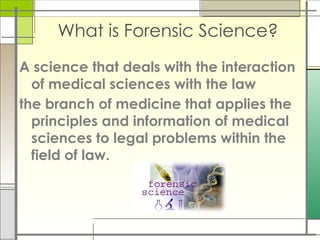
What is Forensic Science?
A science that deals with the interaction
of medical sciences with the law
the branch of medicine that applies the
principles and information of medical
sciences to legal problems within the
field of law.
Forensic Science is…
Forensic science involves the
collection, examination, and analysis
of evidence to determine the facts of
a crime or legal matter. This includes
fields like forensic biology, chemistry,
ballistics, and digital forensics.
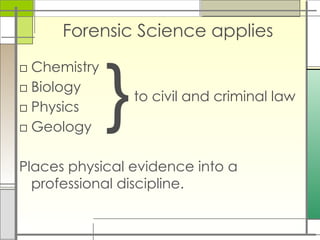
Forensic Science applies
□ Chemistry
□ Biology
□ Physics
□ Geology
Places physical evidence into a
professional discipline.
to civil and criminal law
}
The development of
Forensic Science
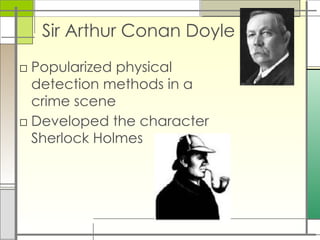
Sir Arthur Conan Doyle
□ Popularized physical
detection methods in a
crime scene
□ Developed the character
Sherlock Holmes
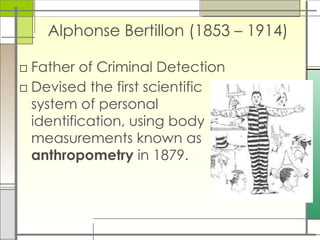
Alphonse Bertillon (1853 – 1914)
□ Father of Criminal Detection
□ Devised the first scientific
system of personal
identification, using body
measurements known as
anthropometry in 1879.
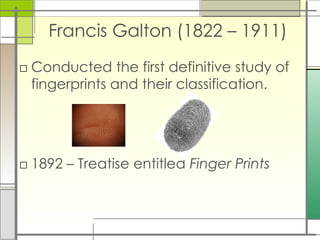
Francis Galton (1822 – 1911)
□ Conducted the first definitive study of
fingerprints and their classification.
□ 1892 – Treatise entitled Finger Prints
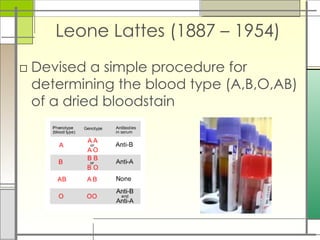
Leone Lattes (1887 – 1954)
□ Devised a simple procedure for
determining the blood type (A,B,O,AB)
of a dried bloodstain
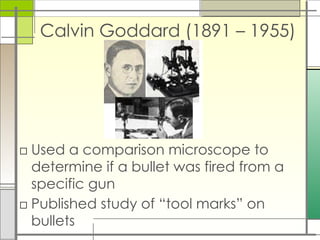
Calvin Goddard (1891 – 1955)
□ Used a comparison microscope to
determine if a bullet was fired from a
specific gun
□ Published study of “tool marks” on
bullets
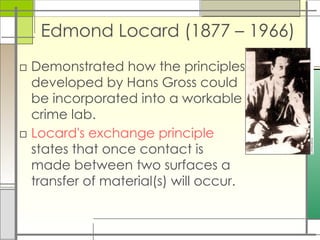
Edmond Locard (1877 – 1966)
□ Demonstrated how the principles
developed by Hans Gross could
be incorporated into a workable
crime lab.
□ Locard's exchange principle
states that once contact is
made between two surfaces a
transfer of material(s) will occur.
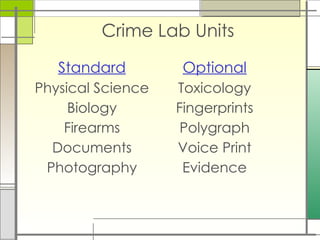
Crime Lab Units
Standard
Physical Science
Biology
Firearms
Documents
Photography
Optional
Toxicology
Fingerprints
Polygraph
Voice Print
Evidence
Basic Services Provided by
Full-Service Crime Laboratories
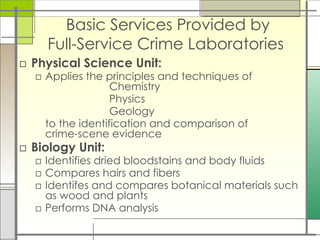
□ Physical Science Unit:
□ Applies the principles and techniques of
Chemistry
Physics
Geology
to the identification and comparison of
crime-scene evidence
□ Biology Unit:
□ Identifies dried bloodstains and body fluids
□ Compares hairs and fibers
□ Identifes and compares botanical materials such
as wood and plants
□ Performs DNA analysis
Basic Services (continued)
□ Firearms Unit: examines
□ Firearms
□ Discharged bullets
□ Cartridge cases
□ Shotgun shells
□ Ammunition of all types
□ Document Examination Unit:
□ Analyzes handwriting, paper and printers of
documents
□ Photography Unit:
□ Examines and records physical evidence at the
crime scene and at suspects' locations
Optional Services Provided by Full-
Service Crime Labs
□ Toxicology Unit:
□ Examines body fluids and organs in order to
determine the presence and identification of
drugs and poisons
□ Latent Fingerprint Unit:
□ Processes and examines evidence for latent
fingerprints
□ i.e. those found on surfaces
□ Polygraph Unit:
□ Uses lie detectors, an essential tool of the crime
investigator rather than the forensic scientist
Optional Services (continued)
□ Voiceprint Analysis Unit:
□ Involved in cases of telephone threats or
tape-recorded messages
□ Investigators may be able to connect a
voice to a particular suspect
□ Evidence-Collection Unit:
□ Incorporates evidence collection into a
total forensic science service
The Functions of the
Forensic Scientist
□ Analysis of Physical Evidence
□ The forensic scientist must be skilled in applying
the principles and techniques of the physical and
natural sciences in order to identify the many
types of evidence that may be recovered during
crime investigations.
□ Expert witness
□ An expert witness possesses a particular skill or
has knowledge in a trade or profession that will
aid the court in determining the truth.
The Functions of the
Forensic Scientist
(continued)
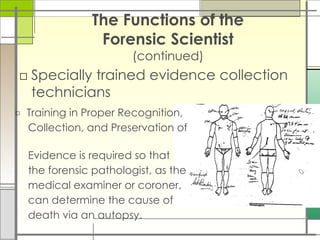
□ Specially trained evidence collection
technicians
□ Training in Proper Recognition,
Collection, and Preservation of
Evidence is required so that
the forensic pathologist, as the
medical examiner or coroner,
can determine the cause of
death via an autopsy.
Other Forensic Services
Death can be classified into five different
categories: natural death, homicide, suicide,
accident or undetermined manner of death.
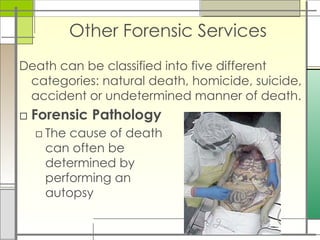
□ Forensic Pathology
□ The cause of death
can often be
determined by
performing an
autopsy
Other Forensic Services - 2
□ Forensic Pathology – continued
□ After a human body expires there are several
stages of death
□ Rigor Mortis
□ immediately following death, the muscles relax and then
become rigid, shortening of the muscles.
□ Livor Mortis
□ when the human heart stops pumping, due to the blood
begins to settle in the parts of the body closest to the
ground due to gravity. The skin will appear dark blue or
purple in these lower areas close to the ground.
□ Algor Mortis
□ the process in which the body temperature continually
cools after death until it reaches room temperature,
enabling the medical examiner to establish the general
time of death.
Other Forensic Services - 3
□ Forensic Anthropology:
□ Primarily involves the identification and
examination of skeletal remains, in order
to determine if the remains are human or
another type of animal.
□ If human, ethnicity, sex, approximate age,
and manner of death can often be
determined by an anthropologist.
Other Forensic Services - 4
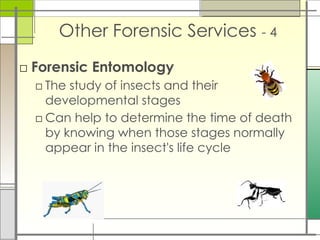
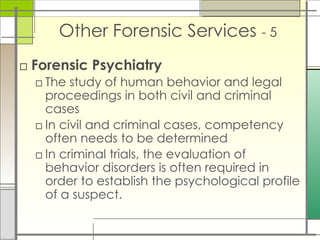
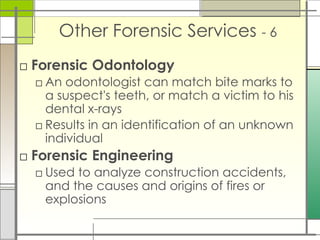
□ Forensic Entomology
□ The study of insects and their
developmental stages
□ Can help to determine the time of death
by knowing when those stages normally
appear in the insect's life cycle
Other Forensic Services - 5
□ Forensic Psychiatry
□ The study of human behavior and legal
proceedings in both civil and criminal
cases
□ In civil and criminal cases, competency
often needs to be determined
□ In criminal trials, the evaluation of
behavior disorders is often required in
order to establish the psychological profile
of a suspect.
Other Forensic Services - 6
□ Forensic Odontology
□ An odontologist can match bite marks to
a suspect's teeth, or match a victim to his
dental x-rays
□ Results in an identification of an unknown
individual
□ Forensic Engineering
□ Used to analyze construction accidents,
and the causes and origins of fires or
explosions
Forensic Analysis
□ Can include organic and inorganic
analytical techniques
□ Organic analysis of unknown substances
□Includes analytical techniques such as
Chromatography, UV- visible and infrared
Spectrophotometry and Mass Spectrometry.
□ Inorganic analysis
□Includes techniques such as the emission
spectrum of elements, Atomic Absorption
Spectrophotometry, Neutron Activation
Analysis, and X-Ray Diffraction Analysis.
Forensic physician
I- Clinical Knowledge
II- Basic Life Support Training
III-Legal Knowledge in:
□ Statements /
□ Reports/
□ Courts.
Diagnosis of death.
Sex identification.
Age estimation.
Violent and natural death.
Report victim of assault(traumatic
and sexual).
1. Identification
2. Thanatology (death and PM
changes).
3. Sudden unexpected death
4. Wounds (types – instrument etc..
5. Head injuries
6. Injury due to heat, cold and
electricity
7 - Firearm injuries (characters –
weapons)
8 - Asphyxia (homicide – suicide –
accidental)
9- ML aspects of Pregnancy and
abortion
10 - Death and injury in infancy
11 -Sexual offences
12- general toxicology
13 – drug abuse
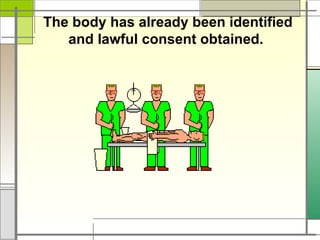
The body has already been identified
and lawful consent obtained.
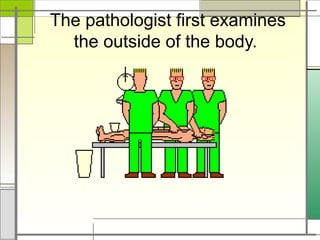
The pathologist first examines
the outside of the body.
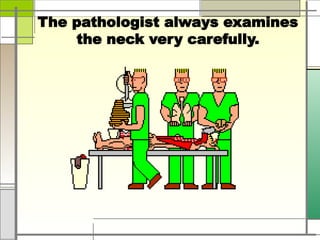
The pathologist always examines
the neck very carefully.
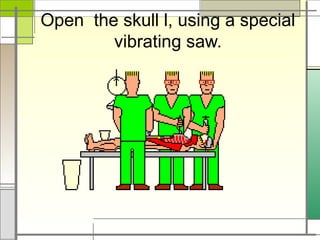
Open the skull l, using a special
vibrating saw.
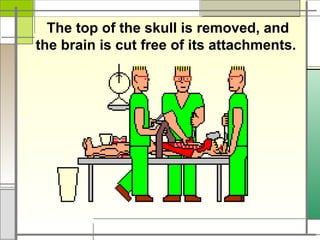
The top of the skull is removed, and
the brain is cut free of its attachments.
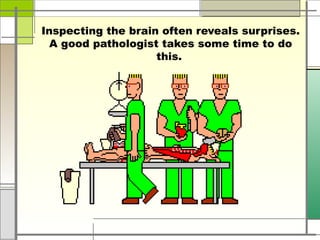
Inspecting the brain often reveals surprises.
A good pathologist takes some time to do
this.
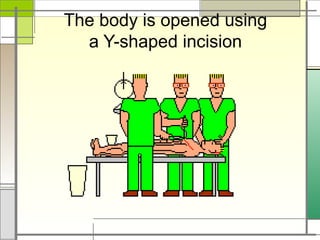
The body is opened using
a Y-shaped incision
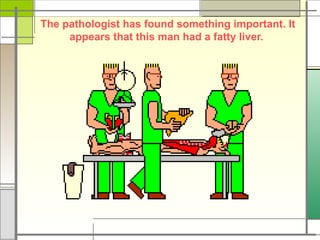
The pathologist has found something important. It
appears that this man had a fatty liver.
Thank you.

Introduction to Forensic medicine basics.pptx

  • 1.
  • 2.
    What is ForensicScience? A science that deals with the interaction of medical sciences with the law the branch of medicine that applies the principles and information of medical sciences to legal problems within the field of law.
  • 3.
    Forensic Science is… Forensicscience involves the collection, examination, and analysis of evidence to determine the facts of a crime or legal matter. This includes fields like forensic biology, chemistry, ballistics, and digital forensics.
  • 4.
    Forensic Science applies □Chemistry □ Biology □ Physics □ Geology Places physical evidence into a professional discipline. to civil and criminal law }
  • 5.
  • 6.
    Sir Arthur ConanDoyle □ Popularized physical detection methods in a crime scene □ Developed the character Sherlock Holmes
  • 7.
    Alphonse Bertillon (1853– 1914) □ Father of Criminal Detection □ Devised the first scientific system of personal identification, using body measurements known as anthropometry in 1879.
  • 8.
    Francis Galton (1822– 1911) □ Conducted the first definitive study of fingerprints and their classification. □ 1892 – Treatise entitled Finger Prints
  • 9.
    Leone Lattes (1887– 1954) □ Devised a simple procedure for determining the blood type (A,B,O,AB) of a dried bloodstain
  • 10.
    Calvin Goddard (1891– 1955) □ Used a comparison microscope to determine if a bullet was fired from a specific gun □ Published study of “tool marks” on bullets
  • 11.
    Edmond Locard (1877– 1966) □ Demonstrated how the principles developed by Hans Gross could be incorporated into a workable crime lab. □ Locard's exchange principle states that once contact is made between two surfaces a transfer of material(s) will occur.
  • 12.
    Crime Lab Units Standard PhysicalScience Biology Firearms Documents Photography Optional Toxicology Fingerprints Polygraph Voice Print Evidence
  • 13.
    Basic Services Providedby Full-Service Crime Laboratories □ Physical Science Unit: □ Applies the principles and techniques of Chemistry Physics Geology to the identification and comparison of crime-scene evidence □ Biology Unit: □ Identifies dried bloodstains and body fluids □ Compares hairs and fibers □ Identifes and compares botanical materials such as wood and plants □ Performs DNA analysis
  • 14.
    Basic Services (continued) □Firearms Unit: examines □ Firearms □ Discharged bullets □ Cartridge cases □ Shotgun shells □ Ammunition of all types □ Document Examination Unit: □ Analyzes handwriting, paper and printers of documents □ Photography Unit: □ Examines and records physical evidence at the crime scene and at suspects' locations
  • 15.
    Optional Services Providedby Full- Service Crime Labs □ Toxicology Unit: □ Examines body fluids and organs in order to determine the presence and identification of drugs and poisons □ Latent Fingerprint Unit: □ Processes and examines evidence for latent fingerprints □ i.e. those found on surfaces □ Polygraph Unit: □ Uses lie detectors, an essential tool of the crime investigator rather than the forensic scientist
  • 16.
    Optional Services (continued) □Voiceprint Analysis Unit: □ Involved in cases of telephone threats or tape-recorded messages □ Investigators may be able to connect a voice to a particular suspect □ Evidence-Collection Unit: □ Incorporates evidence collection into a total forensic science service
  • 17.
    The Functions ofthe Forensic Scientist □ Analysis of Physical Evidence □ The forensic scientist must be skilled in applying the principles and techniques of the physical and natural sciences in order to identify the many types of evidence that may be recovered during crime investigations. □ Expert witness □ An expert witness possesses a particular skill or has knowledge in a trade or profession that will aid the court in determining the truth.
  • 18.
    The Functions ofthe Forensic Scientist (continued) □ Specially trained evidence collection technicians □ Training in Proper Recognition, Collection, and Preservation of Evidence is required so that the forensic pathologist, as the medical examiner or coroner, can determine the cause of death via an autopsy.
  • 19.
    Other Forensic Services Deathcan be classified into five different categories: natural death, homicide, suicide, accident or undetermined manner of death. □ Forensic Pathology □ The cause of death can often be determined by performing an autopsy
  • 20.
    Other Forensic Services- 2 □ Forensic Pathology – continued □ After a human body expires there are several stages of death □ Rigor Mortis □ immediately following death, the muscles relax and then become rigid, shortening of the muscles. □ Livor Mortis □ when the human heart stops pumping, due to the blood begins to settle in the parts of the body closest to the ground due to gravity. The skin will appear dark blue or purple in these lower areas close to the ground. □ Algor Mortis □ the process in which the body temperature continually cools after death until it reaches room temperature, enabling the medical examiner to establish the general time of death.
  • 21.
    Other Forensic Services- 3 □ Forensic Anthropology: □ Primarily involves the identification and examination of skeletal remains, in order to determine if the remains are human or another type of animal. □ If human, ethnicity, sex, approximate age, and manner of death can often be determined by an anthropologist.
  • 22.
    Other Forensic Services- 4 □ Forensic Entomology □ The study of insects and their developmental stages □ Can help to determine the time of death by knowing when those stages normally appear in the insect's life cycle
  • 23.
    Other Forensic Services- 5 □ Forensic Psychiatry □ The study of human behavior and legal proceedings in both civil and criminal cases □ In civil and criminal cases, competency often needs to be determined □ In criminal trials, the evaluation of behavior disorders is often required in order to establish the psychological profile of a suspect.
  • 24.
    Other Forensic Services- 6 □ Forensic Odontology □ An odontologist can match bite marks to a suspect's teeth, or match a victim to his dental x-rays □ Results in an identification of an unknown individual □ Forensic Engineering □ Used to analyze construction accidents, and the causes and origins of fires or explosions
  • 25.
    Forensic Analysis □ Caninclude organic and inorganic analytical techniques □ Organic analysis of unknown substances □Includes analytical techniques such as Chromatography, UV- visible and infrared Spectrophotometry and Mass Spectrometry. □ Inorganic analysis □Includes techniques such as the emission spectrum of elements, Atomic Absorption Spectrophotometry, Neutron Activation Analysis, and X-Ray Diffraction Analysis.
  • 26.
    Forensic physician I- ClinicalKnowledge II- Basic Life Support Training III-Legal Knowledge in: □ Statements / □ Reports/ □ Courts.
  • 27.
    Diagnosis of death. Sexidentification. Age estimation. Violent and natural death. Report victim of assault(traumatic and sexual).
  • 28.
    1. Identification 2. Thanatology(death and PM changes). 3. Sudden unexpected death 4. Wounds (types – instrument etc.. 5. Head injuries 6. Injury due to heat, cold and electricity
  • 29.
    7 - Firearminjuries (characters – weapons) 8 - Asphyxia (homicide – suicide – accidental) 9- ML aspects of Pregnancy and abortion 10 - Death and injury in infancy 11 -Sexual offences 12- general toxicology 13 – drug abuse
  • 30.
    The body hasalready been identified and lawful consent obtained.
  • 31.

    The pathologist firstexamines the outside of the body.
  • 32.
    The pathologist alwaysexamines the neck very carefully.
  • 33.
    Open the skulll, using a special vibrating saw.
  • 34.
    The top ofthe skull is removed, and the brain is cut free of its attachments.
  • 35.
    Inspecting the brainoften reveals surprises. A good pathologist takes some time to do this.
  • 36.
    The body isopened using a Y-shaped incision
  • 37.
    The pathologist hasfound something important. It appears that this man had a fatty liver.
  • 38.