Differences Between Face to Face and Distance Education in General Done by: Azeer (82920) Ahmed(68693)
Name of the study 1: Online versus face-to-face learning: looking at modes of instruction in Master’s-level courses Overview and objectives of the study: This study examined performance of Master’s-level students in an online course in Cognition, Learning and Assessment and  compared   it with the performance of students in a face-to-face classroom setting of the same  course. Journal of Further and Higher Education(United States) 2009
Name of the study 1: Online versus face-to-face learning: looking at modes of instruction in Master’s-level courses Target audience  This study examined Six  sections  of  the  course  over  a  two-year  period.  The  same Professor taught all sections over  a  two-year  period. .
Name of the study 1: Online versus face-to-face learning: looking at modes of instruction in Master’s-level courses Assessment tool: Final exams  Two common assignments
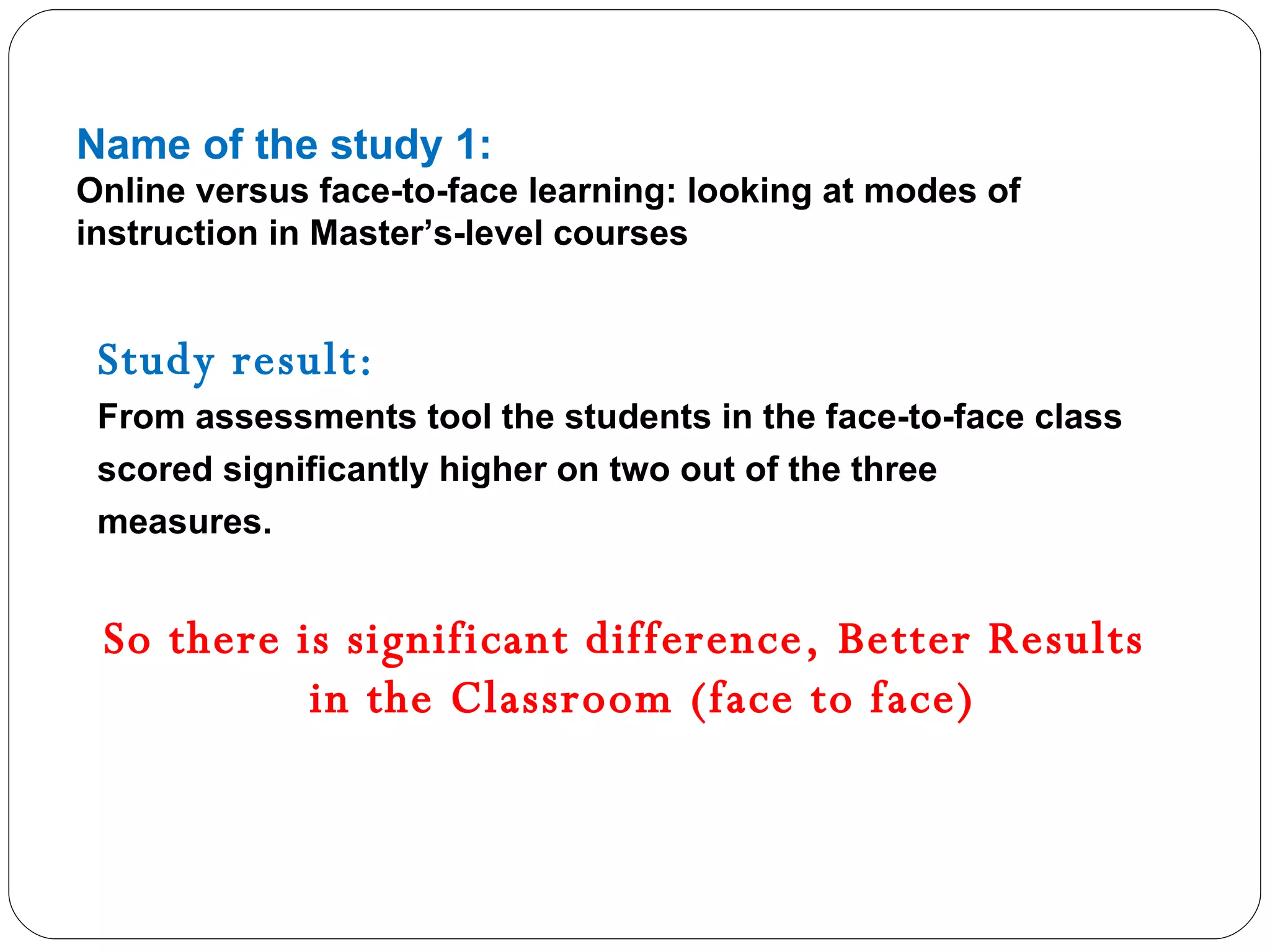
Name of the study 1: Online versus face-to-face learning: looking at modes of instruction in Master’s-level courses Study result: From assessments tool the students in the face-to-face class scored significantly higher on two out of the three measures. So there is significant difference, Better Results in the Classroom (face to face)
Name of the study 1: Online versus face-to-face learning: looking at modes of instruction in Master’s-level courses Resources : http://www.informaworld.com/smpp/content~db=all~content=a913430396
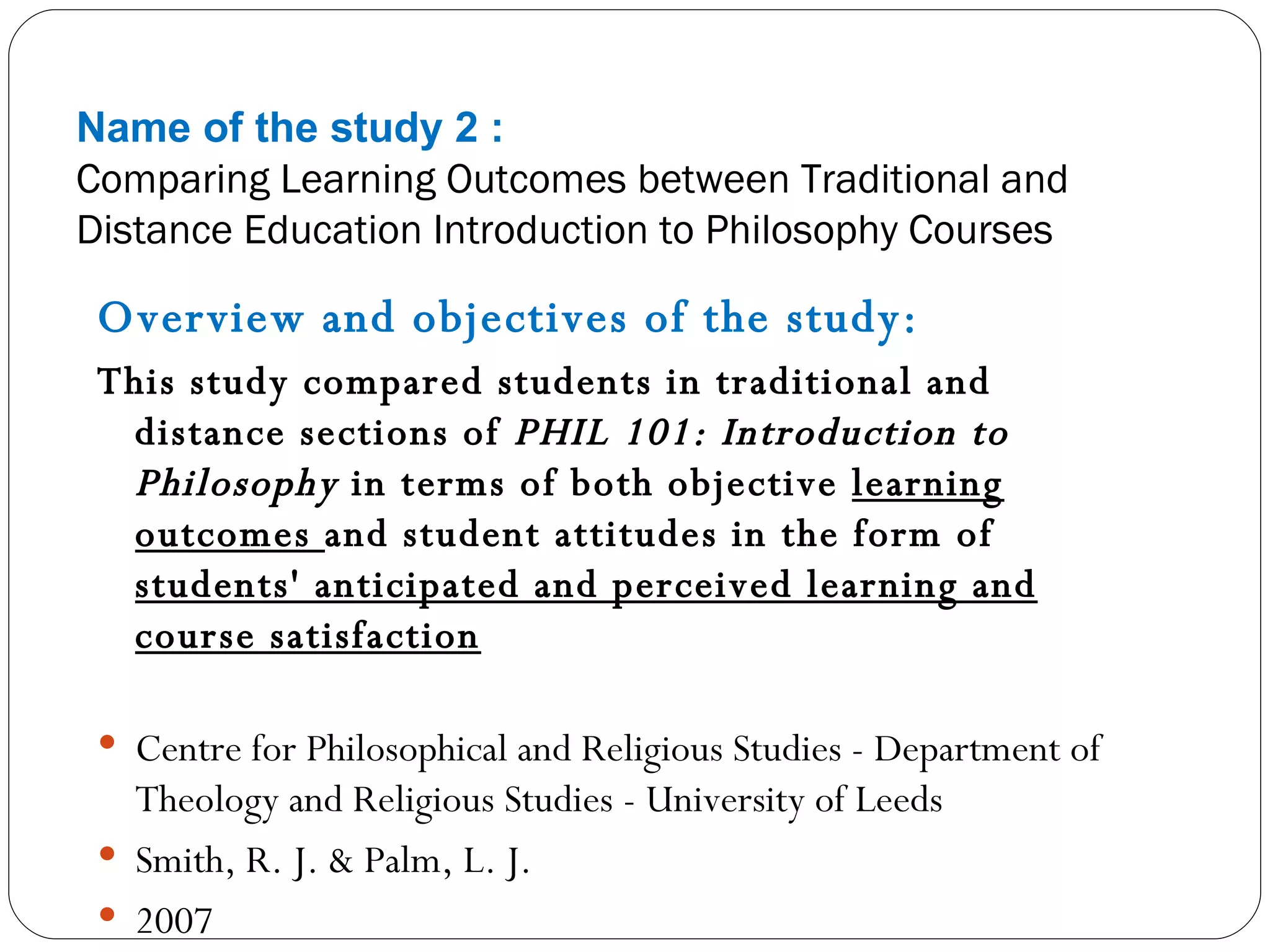
Name of the study 2 : Comparing Learning Outcomes between Traditional and Distance Education Introduction to Philosophy Courses Overview and objectives of the study: This study compared students in traditional and distance sections of  PHIL 101: Introduction to Philosophy  in terms of both objective  learning outcomes  and student attitudes in the form of  students' anticipated and perceived learning and course satisfaction Centre for Philosophical and Religious Studies - Department of Theology and Religious Studies - University of Leeds Smith, R. J. & Palm, L. J. 2007
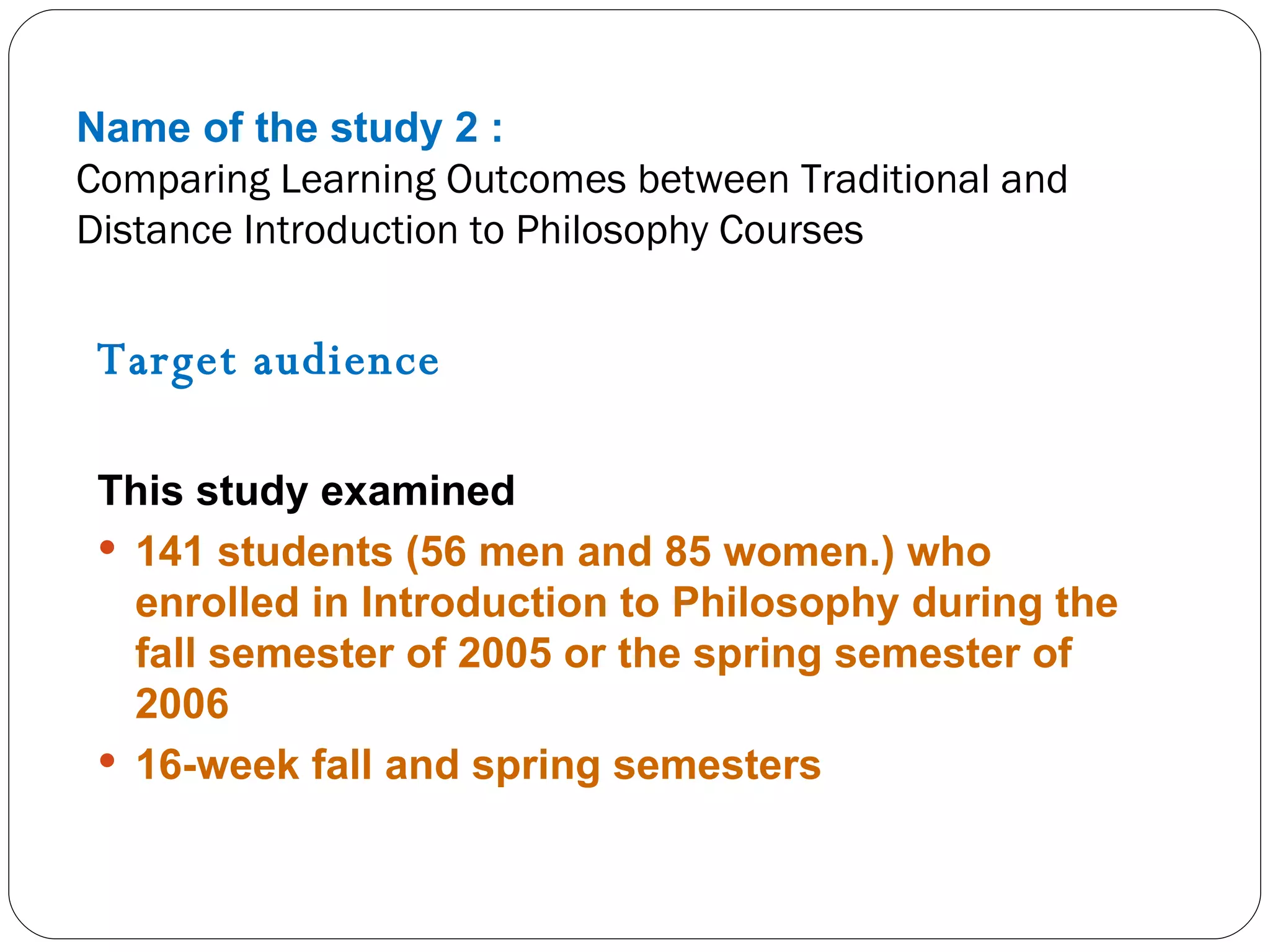
Name of the study 2 : Comparing Learning Outcomes between Traditional and Distance Introduction to Philosophy Courses Target audience  This study examined 141 students (56 men and 85 women.) who enrolled in Introduction to Philosophy during the fall semester of 2005 or the spring semester of 2006 16-week fall and spring semesters
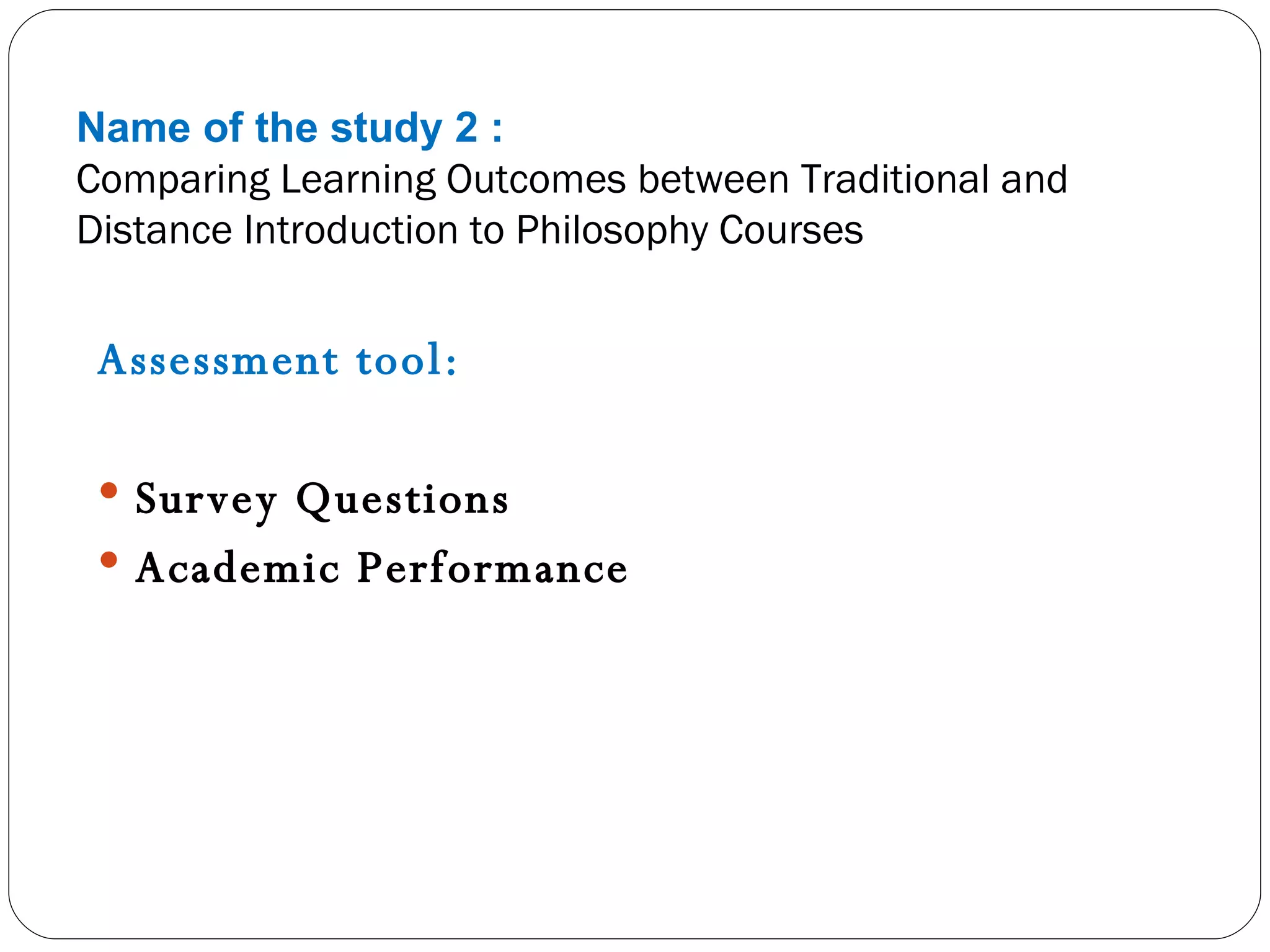
Name of the study 2 : Comparing Learning Outcomes between Traditional and Distance Introduction to Philosophy Courses Assessment tool: Survey Questions Academic Performance
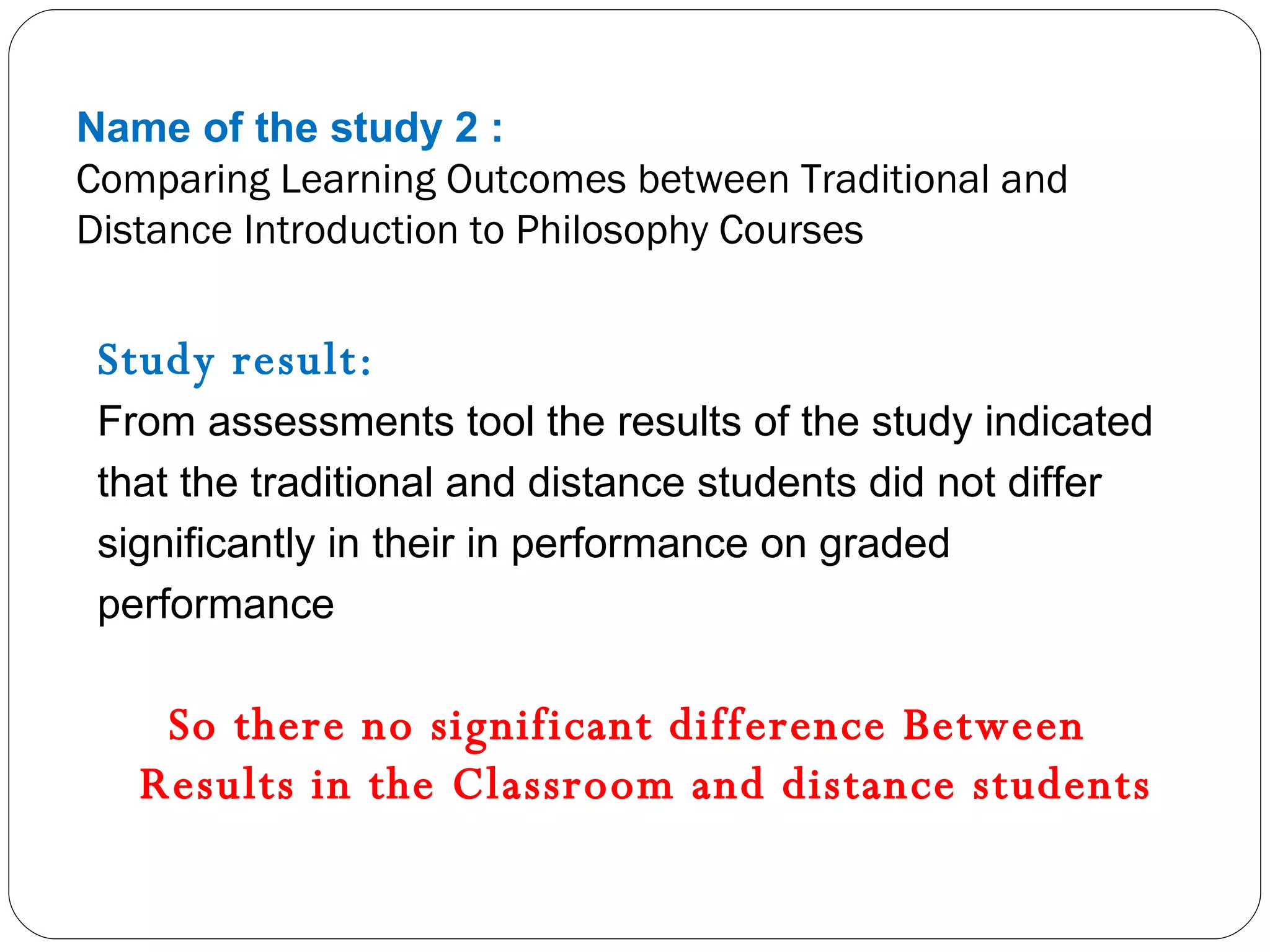
Name of the study 2 : Comparing Learning Outcomes between Traditional and Distance Introduction to Philosophy Courses Study result: From assessments tool the results of the study indicated that the traditional and distance students did not differ significantly in their in performance on graded performance So there no significant difference Between  Results in the Classroom and distance students
Name of the study 2 : Comparing Learning Outcomes between Traditional and Distance Introduction to Philosophy Courses Resources : http://prs.heacademy.ac.uk/view.html/PrsDiscourseArticles/5
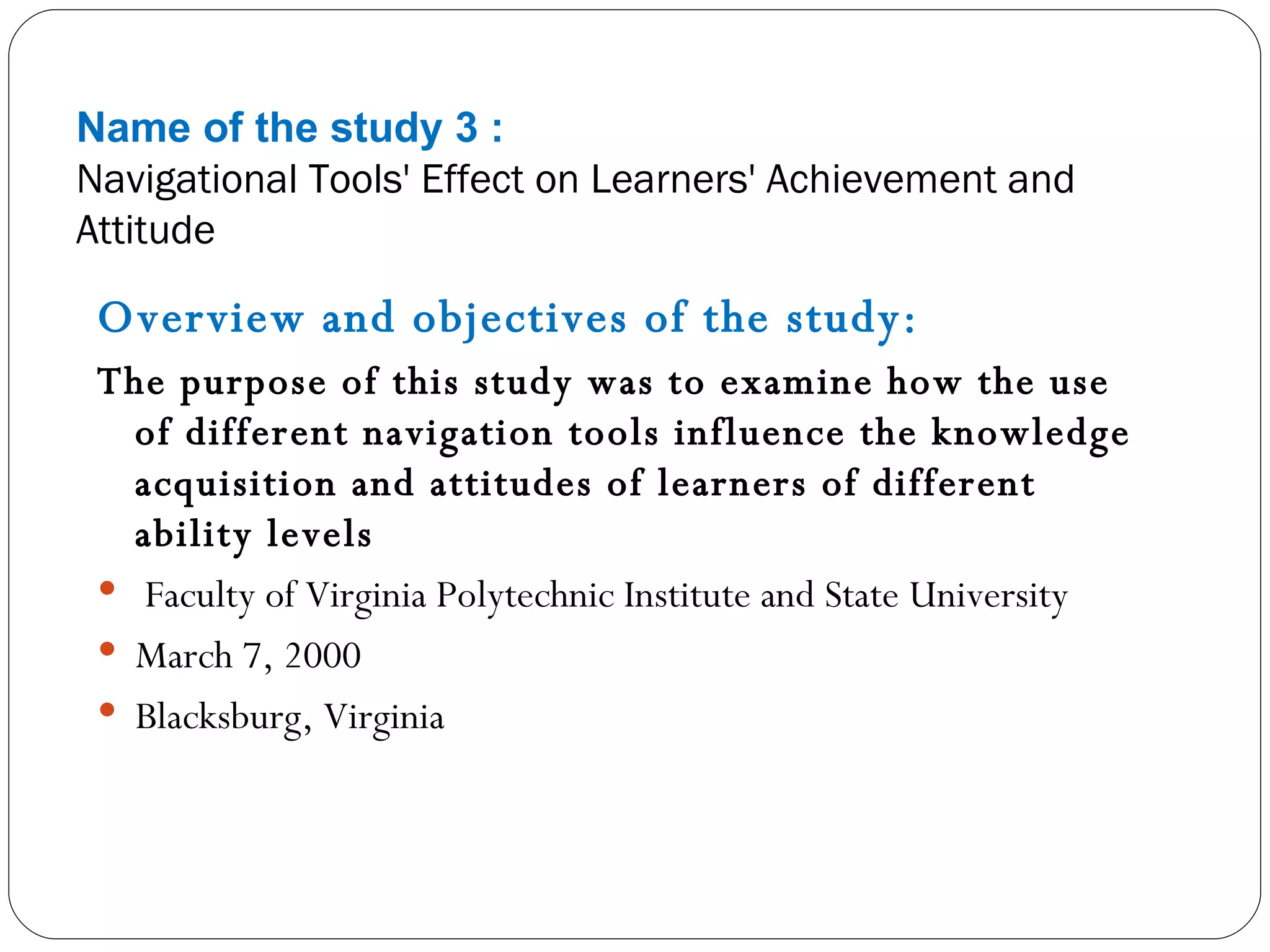
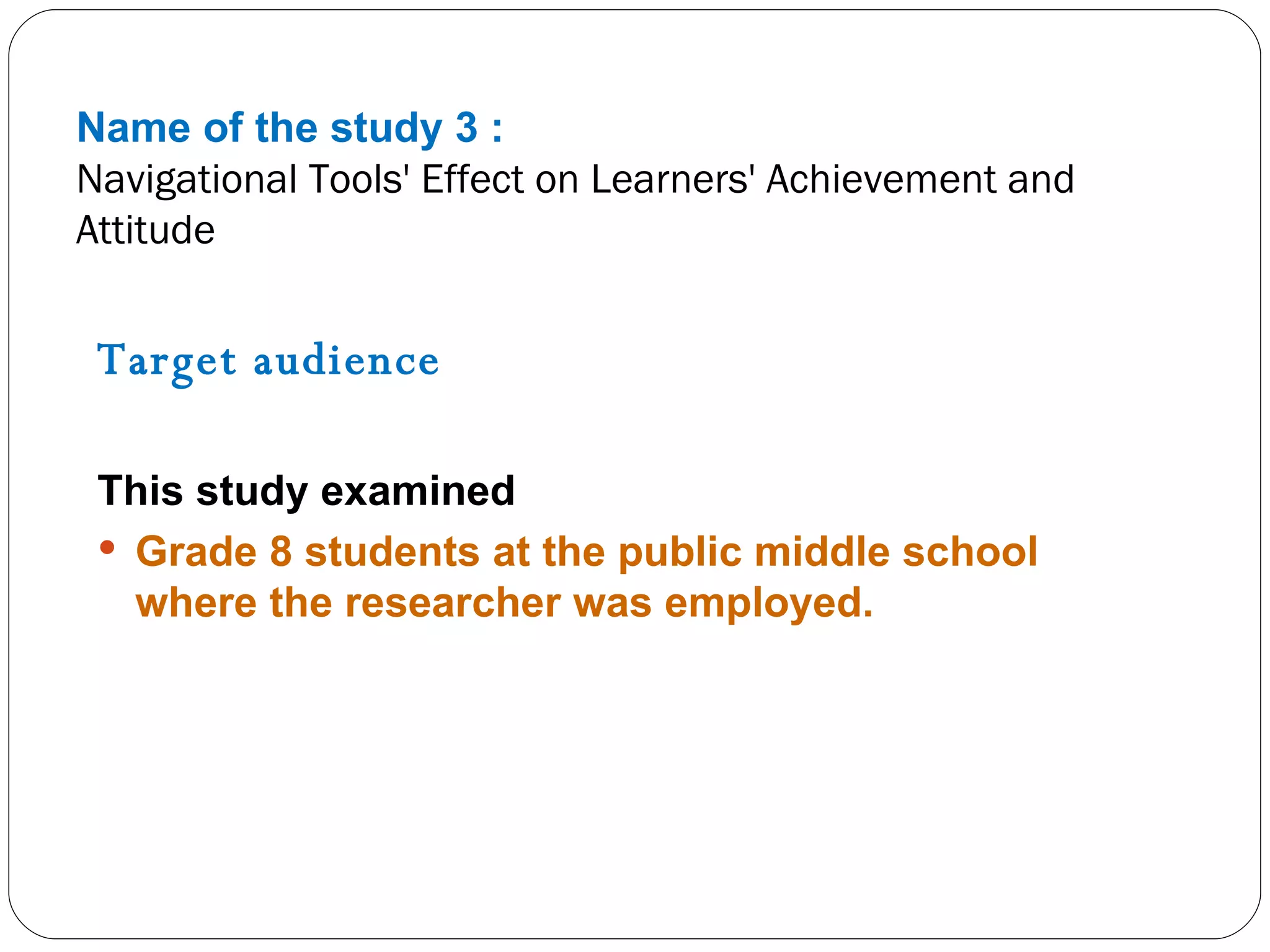
Name of the study 3 : Navigational Tools' Effect on Learners' Achievement and Attitude Overview and objectives of the study: The purpose of this study was to examine how the use of different navigation tools influence the knowledge acquisition and attitudes of learners of different ability levels Faculty of Virginia Polytechnic Institute and State University March 7, 2000 Blacksburg, Virginia
Name of the study 3 : Navigational Tools' Effect on Learners' Achievement and Attitude Target audience  This study examined Grade 8 students at the public middle school where the researcher was employed.
Name of the study 3 : Navigational Tools' Effect on Learners' Achievement and Attitude Assessment tool: Academic Performance
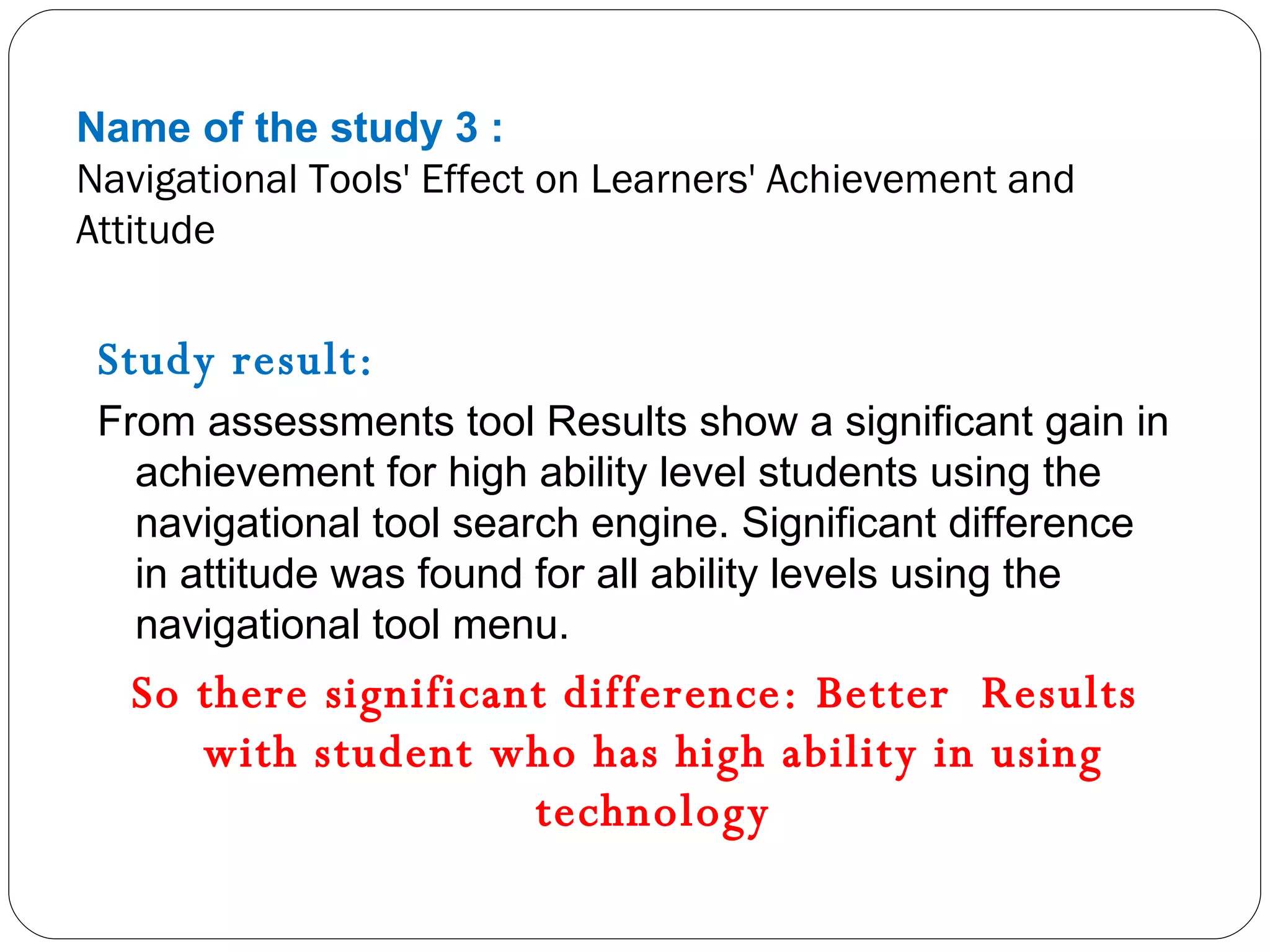
Name of the study 3 : Navigational Tools' Effect on Learners' Achievement and Attitude Study result: From assessments tool Results show a significant gain in achievement for high ability level students using the navigational tool search engine. Significant difference in attitude was found for all ability levels using the navigational tool menu. So there significant difference: Better  Results with student who has high ability in using technology
Name of the study 3 : Navigational Tools' Effect on Learners' Achievement and Attitude Resources : http://scholar.lib.vt.edu/theses/available/etd-04132000-16260041/unrestricted/Navigation_Tools.pdf
Our point of view: We believe that we cannot say that  there is  or  there is no   significant deference  as everything depend on the situation it self

Differences Between Face To Face And Distance Education

  • 1.
    Differences Between Faceto Face and Distance Education in General Done by: Azeer (82920) Ahmed(68693)
  • 2.
    Name of thestudy 1: Online versus face-to-face learning: looking at modes of instruction in Master’s-level courses Overview and objectives of the study: This study examined performance of Master’s-level students in an online course in Cognition, Learning and Assessment and compared it with the performance of students in a face-to-face classroom setting of the same course. Journal of Further and Higher Education(United States) 2009
  • 3.
    Name of thestudy 1: Online versus face-to-face learning: looking at modes of instruction in Master’s-level courses Target audience This study examined Six sections of the course over a two-year period. The same Professor taught all sections over a two-year period. .
  • 4.
    Name of thestudy 1: Online versus face-to-face learning: looking at modes of instruction in Master’s-level courses Assessment tool: Final exams Two common assignments
  • 5.
    Name of thestudy 1: Online versus face-to-face learning: looking at modes of instruction in Master’s-level courses Study result: From assessments tool the students in the face-to-face class scored significantly higher on two out of the three measures. So there is significant difference, Better Results in the Classroom (face to face)
  • 6.
    Name of thestudy 1: Online versus face-to-face learning: looking at modes of instruction in Master’s-level courses Resources : http://www.informaworld.com/smpp/content~db=all~content=a913430396
  • 7.
    Name of thestudy 2 : Comparing Learning Outcomes between Traditional and Distance Education Introduction to Philosophy Courses Overview and objectives of the study: This study compared students in traditional and distance sections of PHIL 101: Introduction to Philosophy in terms of both objective learning outcomes and student attitudes in the form of students' anticipated and perceived learning and course satisfaction Centre for Philosophical and Religious Studies - Department of Theology and Religious Studies - University of Leeds Smith, R. J. & Palm, L. J. 2007
  • 8.
    Name of thestudy 2 : Comparing Learning Outcomes between Traditional and Distance Introduction to Philosophy Courses Target audience This study examined 141 students (56 men and 85 women.) who enrolled in Introduction to Philosophy during the fall semester of 2005 or the spring semester of 2006 16-week fall and spring semesters
  • 9.
    Name of thestudy 2 : Comparing Learning Outcomes between Traditional and Distance Introduction to Philosophy Courses Assessment tool: Survey Questions Academic Performance
  • 10.
    Name of thestudy 2 : Comparing Learning Outcomes between Traditional and Distance Introduction to Philosophy Courses Study result: From assessments tool the results of the study indicated that the traditional and distance students did not differ significantly in their in performance on graded performance So there no significant difference Between Results in the Classroom and distance students
  • 11.
    Name of thestudy 2 : Comparing Learning Outcomes between Traditional and Distance Introduction to Philosophy Courses Resources : http://prs.heacademy.ac.uk/view.html/PrsDiscourseArticles/5
  • 12.
    Name of thestudy 3 : Navigational Tools' Effect on Learners' Achievement and Attitude Overview and objectives of the study: The purpose of this study was to examine how the use of different navigation tools influence the knowledge acquisition and attitudes of learners of different ability levels Faculty of Virginia Polytechnic Institute and State University March 7, 2000 Blacksburg, Virginia
  • 13.
    Name of thestudy 3 : Navigational Tools' Effect on Learners' Achievement and Attitude Target audience This study examined Grade 8 students at the public middle school where the researcher was employed.
  • 14.
    Name of thestudy 3 : Navigational Tools' Effect on Learners' Achievement and Attitude Assessment tool: Academic Performance
  • 15.
    Name of thestudy 3 : Navigational Tools' Effect on Learners' Achievement and Attitude Study result: From assessments tool Results show a significant gain in achievement for high ability level students using the navigational tool search engine. Significant difference in attitude was found for all ability levels using the navigational tool menu. So there significant difference: Better Results with student who has high ability in using technology
  • 16.
    Name of thestudy 3 : Navigational Tools' Effect on Learners' Achievement and Attitude Resources : http://scholar.lib.vt.edu/theses/available/etd-04132000-16260041/unrestricted/Navigation_Tools.pdf
  • 17.
    Our point ofview: We believe that we cannot say that there is or there is no significant deference as everything depend on the situation it self