Lecture 13
Late Modern English
Prepared by Assanova.A
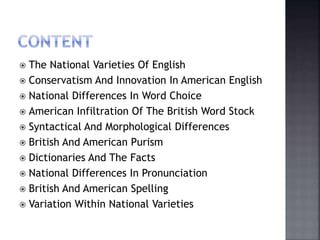
 The National Varieties Of English
 Conservatism And Innovation In American English
 National Differences In Word Choice
 American Infiltration Of The British Word Stock
 Syntactical And Morphological Differences
 British And American Purism
 Dictionaries And The Facts
 National Differences In Pronunciation
 British And American Spelling
 Variation Within National Varieties
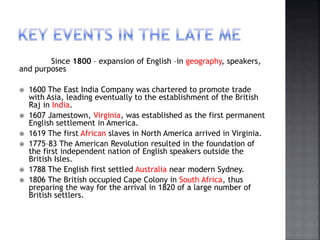
Since 1800 – expansion of English –in geography, speakers,
and purposes
 1600 The East India Company was chartered to promote trade
with Asia, leading eventually to the establishment of the British
Raj in India.
 1607 Jamestown, Virginia, was established as the first permanent
English settlement in America.
 1619 The first African slaves in North America arrived in Virginia.
 1775–83 The American Revolution resulted in the foundation of
the first independent nation of English speakers outside the
British Isles.
 1788 The English first settled Australia near modern Sydney.
 1806 The British occupied Cape Colony in South Africa, thus
preparing the way for the arrival in 1820 of a large number of
British settlers.
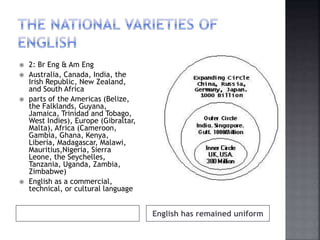
English has remained uniform
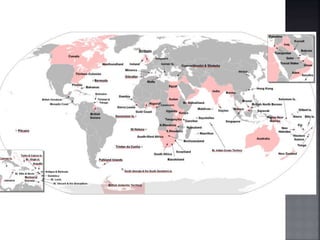
 2: Br Eng & Am Eng
 Australia, Canada, India, the
Irish Republic, New Zealand,
and South Africa
 parts of the Americas (Belize,
the Falklands, Guyana,
Jamaica, Trinidad and Tobago,
West Indies), Europe (Gibraltar,
Malta), Africa (Cameroon,
Gambia, Ghana, Kenya,
Liberia, Madagascar, Malawi,
Mauritius,Nigeria, Sierra
Leone, the Seychelles,
Tanzania, Uganda, Zambia,
Zimbabwe)
 English as a commercial,
technical, or cultural language
The language changed gradually on both sides of the Atlantic
Which one is more conservative, Am Eng or Br Eng?
 America – new conditions, but retained characteristics:
 [æ] in ask, dance, after, glass, path
 [r] pronounce r where it is spelled, but no r in GB
 E.Ekwall “Am Pr. ..has not shared the development undergone by
Standard English”
 Lexical one (saved): gotten (Am Eng), but in phrase “ill-gotten
gains” (Br Eng), fall, deck
innovation
 Lost – waistcoat – vest, fortnight – 2 weeks, copse, dell, moor
 New one to designate topographical features: backwoods,
underbrush
 New meaning to words: creek ( inlet on the sea-a small stream)
 Foreign words: canyon (Sp), mesa (Sp), prairie (Fr), Indian words
(animals and plants)
 Am. locution ‘automobile’ in ‘The Royal Automobile Club”
 Br locution ‘postman’ in ‘The Postman Always Rings Twice’ and railway in Railway
Express but mailman and railroad
 Baggage (Am Eng)- luggage
 Undershorts – underpants
 Panties – pants or knickers
 Mailbox-pillar-box
 Package-parcel
 Sick –ill
 Stairway-staircase
 Window shade-blinds
Confusion words:
Bus – coach
First floor-ground floor
Truck-lorry
Gas- petrol
Insane-mental
Baby carriage –pram
A rise- a raise
 Attitude:
 Francis Moore, describing for his countrymen said, “It stands upon the
flat of a Hill; the Bank of the River (which they in barbarous
English call a bluff) is steep”
But
Br Eng has been infiltrated by Am. Usage
 William Craigie: “for some two centuries . . . the passage of new words
..across the Atlantic was regularly westwards . . . bearing with it many a
piece of drift-wood to the shores of Britain, there to be picked up and
incorporated in the structure of the language”
 Americanisms: backwoods, beeline, belittle, blizzard, bunkum, caucus,
cloudburst, prairie, swamp
 cafeteria, cocktail, egghead, electrocute, TV, fan, radio, OK
 Am-sms in formal utterances of VIPs:
 alibi ,allergy ,angle, blurb, breakdown, crash, know-how, maybe, sales
resistance, to go back on, to slip up, to stand up
 Conversion in Am Eng – a contact
 Br Eng – pl.verb for collective nouns
‘England await chance to mop up’
‘The US government are believed to favour’
Am. Eng:
Thus Mgr. Knox is faced by a word, which, if
translated by its English equivalent, will give a meaning
possibly very different to [from, than] its sense.
I’ll tell it you [to you].
In the morning I was woken up [awakened] at eight
by a housemaid.
 The choice in preposition
Lives in a street (Br Eng), ….on a street (Am. Eng)
To get in or out of a train (Br Eng), …on or off it
 Grammatical ‘correctness’- is a moral
obligation in the US
 No for terminal prepositions
‘What newspaper do you work for?’
 Whom for who
 Notable exceptions in:
 Merriam-Webster’s Dictionary of English
Usage, by E. Ward Gilman
 The Cambridge Guide to English Usage, by
Pam Peters.
Dictionary tradition since 1800
Oxford English Dictionary (OED)
1857 - a project of the Philological Society of London for a
“New English Dictionary,” ,the Oxford University Press
assumed responsibility for it.
James Murray -the principal editor of the dictionary, his
family worked on the dictionary.
1928 -completed in twelve volumes
1933 a supplementary volume was published
1989, a second edition of the dictionary was published in 20
volumes
1992 - an electronic version of the second edition
Webster’s Third New International Dictionary
1961- first published and edited by Philip Gove in the
Merriam-Webster Company
Noah Webster - a “born definer”
 Either- neither [i], [ai]
 ate [et], been [bɪn], evolution [ɛvǝlušǝn],
medicine [mɛdǝsǝn], nephew [nɛfyu], leisure [ližǝr], quinine
[kwaɪnaɪn]
 ate [ɛt], been [bin], evolution [ivǝlušǝn], medicine
[mɛdsɪn], nephew [nɛvyu], [lɛžǝ(r)], [kwɪnin]
Stress:
[ˈkɔrǝˌlɛri] / [kǝˈrɒlǝrɪ], dynasty [ˈdaɪnǝsti] / [ˈdɪnǝstɪ],
miscellany [ˈmɪsǝˌleni] / [mɪˈsɛlǝnɪ]
Shift of [æ] to [ɑ] (except before r, lm)
Class, ask, path
Sstress on the penultimate syllables of polysyllables in -ary, -
ery, and -ory
mónastery, sécretary
mónastèry, sécretàry
Intonational characteristics
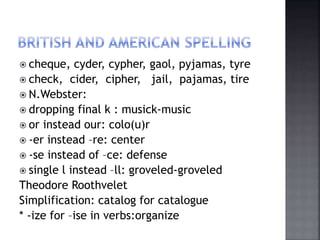
 cheque, cyder, cypher, gaol, pyjamas, tyre
 check, cider, cipher, jail, pajamas, tire
 N.Webster:
 dropping final k : musick-music
 or instead our: colo(u)r
 -er instead –re: center
 -se instead of –ce: defense
 single l instead –ll: groveled-groveled
Theodore Roothvelet
Simplification: catalog for catalogue
* -ize for –ise in verbs:organize
 Variations within a national varieties
1) Regional or geographical dialects
2) Ethnic or social dialects
Dialect – differences –who we are
Register-differences- where, why, how we are using
Factors: place, ethnic group, sex, age, education
Standard English- edited English
 America has 3-4 regional dialects: Northern, North Midland , South Midland, and
Southern, or Coastal Southern
 DARE (1889), American Tongues
 Ethnic dialects: Spanish-influenced dialects, Jewish dialect
 American-African or Black English: omission of ‘t’ in soft,rest; r-less pronunciation in
bird, four; [f] in with, nothing; consuetudinal be (She be here every day), and
omission of ‘be’ (She here now), omission of –s (He hear you)
 The origin of American African:
 1) language of ancestors
 2) pidgin that became creolized
 Slang- stylistic variety (I dig you, waste sb)
British Eng has 6 major dialects roughly correspond to the ME dialects (Peter Trudgill in
Dialects of England)
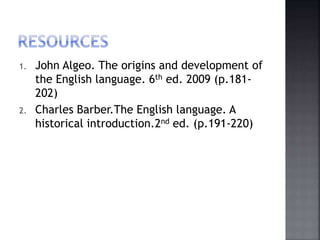
1. John Algeo. The origins and development of
the English language. 6th ed. 2009 (p.181-
202)
2. Charles Barber.The English language. A
historical introduction.2nd ed. (p.191-220)

Lecture 13

  • 1.
    Lecture 13 Late ModernEnglish Prepared by Assanova.A
  • 2.
     The NationalVarieties Of English  Conservatism And Innovation In American English  National Differences In Word Choice  American Infiltration Of The British Word Stock  Syntactical And Morphological Differences  British And American Purism  Dictionaries And The Facts  National Differences In Pronunciation  British And American Spelling  Variation Within National Varieties
  • 3.
    Since 1800 –expansion of English –in geography, speakers, and purposes  1600 The East India Company was chartered to promote trade with Asia, leading eventually to the establishment of the British Raj in India.  1607 Jamestown, Virginia, was established as the first permanent English settlement in America.  1619 The first African slaves in North America arrived in Virginia.  1775–83 The American Revolution resulted in the foundation of the first independent nation of English speakers outside the British Isles.  1788 The English first settled Australia near modern Sydney.  1806 The British occupied Cape Colony in South Africa, thus preparing the way for the arrival in 1820 of a large number of British settlers.
  • 5.
    English has remaineduniform  2: Br Eng & Am Eng  Australia, Canada, India, the Irish Republic, New Zealand, and South Africa  parts of the Americas (Belize, the Falklands, Guyana, Jamaica, Trinidad and Tobago, West Indies), Europe (Gibraltar, Malta), Africa (Cameroon, Gambia, Ghana, Kenya, Liberia, Madagascar, Malawi, Mauritius,Nigeria, Sierra Leone, the Seychelles, Tanzania, Uganda, Zambia, Zimbabwe)  English as a commercial, technical, or cultural language
  • 6.
    The language changedgradually on both sides of the Atlantic Which one is more conservative, Am Eng or Br Eng?  America – new conditions, but retained characteristics:  [æ] in ask, dance, after, glass, path  [r] pronounce r where it is spelled, but no r in GB  E.Ekwall “Am Pr. ..has not shared the development undergone by Standard English”  Lexical one (saved): gotten (Am Eng), but in phrase “ill-gotten gains” (Br Eng), fall, deck innovation  Lost – waistcoat – vest, fortnight – 2 weeks, copse, dell, moor  New one to designate topographical features: backwoods, underbrush  New meaning to words: creek ( inlet on the sea-a small stream)  Foreign words: canyon (Sp), mesa (Sp), prairie (Fr), Indian words (animals and plants)
  • 7.
     Am. locution‘automobile’ in ‘The Royal Automobile Club”  Br locution ‘postman’ in ‘The Postman Always Rings Twice’ and railway in Railway Express but mailman and railroad  Baggage (Am Eng)- luggage  Undershorts – underpants  Panties – pants or knickers  Mailbox-pillar-box  Package-parcel  Sick –ill  Stairway-staircase  Window shade-blinds Confusion words: Bus – coach First floor-ground floor Truck-lorry Gas- petrol Insane-mental Baby carriage –pram A rise- a raise
  • 8.
     Attitude:  FrancisMoore, describing for his countrymen said, “It stands upon the flat of a Hill; the Bank of the River (which they in barbarous English call a bluff) is steep” But Br Eng has been infiltrated by Am. Usage  William Craigie: “for some two centuries . . . the passage of new words ..across the Atlantic was regularly westwards . . . bearing with it many a piece of drift-wood to the shores of Britain, there to be picked up and incorporated in the structure of the language”  Americanisms: backwoods, beeline, belittle, blizzard, bunkum, caucus, cloudburst, prairie, swamp  cafeteria, cocktail, egghead, electrocute, TV, fan, radio, OK  Am-sms in formal utterances of VIPs:  alibi ,allergy ,angle, blurb, breakdown, crash, know-how, maybe, sales resistance, to go back on, to slip up, to stand up  Conversion in Am Eng – a contact
  • 9.
     Br Eng– pl.verb for collective nouns ‘England await chance to mop up’ ‘The US government are believed to favour’ Am. Eng: Thus Mgr. Knox is faced by a word, which, if translated by its English equivalent, will give a meaning possibly very different to [from, than] its sense. I’ll tell it you [to you]. In the morning I was woken up [awakened] at eight by a housemaid.  The choice in preposition Lives in a street (Br Eng), ….on a street (Am. Eng) To get in or out of a train (Br Eng), …on or off it
  • 10.
     Grammatical ‘correctness’-is a moral obligation in the US  No for terminal prepositions ‘What newspaper do you work for?’  Whom for who  Notable exceptions in:  Merriam-Webster’s Dictionary of English Usage, by E. Ward Gilman  The Cambridge Guide to English Usage, by Pam Peters.
  • 11.
    Dictionary tradition since1800 Oxford English Dictionary (OED) 1857 - a project of the Philological Society of London for a “New English Dictionary,” ,the Oxford University Press assumed responsibility for it. James Murray -the principal editor of the dictionary, his family worked on the dictionary. 1928 -completed in twelve volumes 1933 a supplementary volume was published 1989, a second edition of the dictionary was published in 20 volumes 1992 - an electronic version of the second edition Webster’s Third New International Dictionary 1961- first published and edited by Philip Gove in the Merriam-Webster Company Noah Webster - a “born definer”
  • 12.
     Either- neither[i], [ai]  ate [et], been [bɪn], evolution [ɛvǝlušǝn], medicine [mɛdǝsǝn], nephew [nɛfyu], leisure [ližǝr], quinine [kwaɪnaɪn]  ate [ɛt], been [bin], evolution [ivǝlušǝn], medicine [mɛdsɪn], nephew [nɛvyu], [lɛžǝ(r)], [kwɪnin] Stress: [ˈkɔrǝˌlɛri] / [kǝˈrɒlǝrɪ], dynasty [ˈdaɪnǝsti] / [ˈdɪnǝstɪ], miscellany [ˈmɪsǝˌleni] / [mɪˈsɛlǝnɪ] Shift of [æ] to [ɑ] (except before r, lm) Class, ask, path Sstress on the penultimate syllables of polysyllables in -ary, - ery, and -ory mónastery, sécretary mónastèry, sécretàry Intonational characteristics
  • 13.
     cheque, cyder,cypher, gaol, pyjamas, tyre  check, cider, cipher, jail, pajamas, tire  N.Webster:  dropping final k : musick-music  or instead our: colo(u)r  -er instead –re: center  -se instead of –ce: defense  single l instead –ll: groveled-groveled Theodore Roothvelet Simplification: catalog for catalogue * -ize for –ise in verbs:organize
  • 14.
     Variations withina national varieties 1) Regional or geographical dialects 2) Ethnic or social dialects Dialect – differences –who we are Register-differences- where, why, how we are using Factors: place, ethnic group, sex, age, education Standard English- edited English  America has 3-4 regional dialects: Northern, North Midland , South Midland, and Southern, or Coastal Southern  DARE (1889), American Tongues  Ethnic dialects: Spanish-influenced dialects, Jewish dialect  American-African or Black English: omission of ‘t’ in soft,rest; r-less pronunciation in bird, four; [f] in with, nothing; consuetudinal be (She be here every day), and omission of ‘be’ (She here now), omission of –s (He hear you)  The origin of American African:  1) language of ancestors  2) pidgin that became creolized  Slang- stylistic variety (I dig you, waste sb) British Eng has 6 major dialects roughly correspond to the ME dialects (Peter Trudgill in Dialects of England)
  • 15.
    1. John Algeo.The origins and development of the English language. 6th ed. 2009 (p.181- 202) 2. Charles Barber.The English language. A historical introduction.2nd ed. (p.191-220)