JESSAC. SARMIENTO
DIFFERENCE BETWEEN MICROSOFT EXCEL 2007, 2010 and 2013
Excel 2013 - continuing Microsoft's commitment to collaborative working and increasing
the user's ability to visualise, analyse and present their results quickly and efficiently.
1. Making it easier for the user to analyse data
 FlashFill
Excel 2013 notices pattern in the user's data entry and then auto completes the
remaining data - so no need to use formulas or macros to do this.
 Recommended Pivot table
Excel gives the user a range of previews of pivot table options, allowing the user
to select the best option.
2. New analysis tools to improve the visualisation of data
Includes the following:
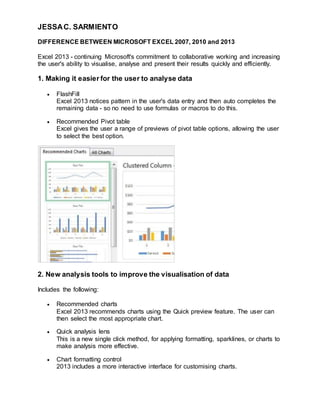
 Recommended charts
Excel 2013 recommends charts using the Quick preview feature. The user can
then select the most appropriate chart.
 Quick analysis lens
This is a new single click method, for applying formatting, sparklines, or charts to
make analysis more effective.
 Chart formatting control
2013 includes a more interactive interface for customising charts.
3. Making it easier to share work, present it online, add it to a social
networks
 Simplified sharing
2013 includes a default setting so that workbooks are automatically saved online.
This ensures all users are working on the latest version, with the added
protection of control of the viewing and editing permissions.
 Share part of a worksheet via embedding selected sections in social networks.
 Present online - 2013 makes it easier to share workbooks with colleagues using
a Lync conversation or meeting.
What's the difference between Excel 2010 and Excel 2007?
At a glance, it doesn't look as though there's a great deal of difference between Excel
2007 and Excel 2010. A couple of additions to the Ribbon, the new Backstage view and
a handful of bonus features such as the Slicer and Sparklines. It could be said that an
"average" user could switch from 2007 to 2010 without batting an eyelid.
Anyone that handles large amounts of data, however, will appreciate the additions
made to Excel, many of which are designed to bring the power of data analysis to those
unwilling to dedicate hours trying to work out how to use what appear to be
impenetrable tools.
Access the Right Tools, at the Right Time
New and improved features can help you be more productive, but only if you can find
them when you need them. Like the other Microsoft Office 2010 programs, Excel 2010
includes the Microsoft Office Fluent interface, which consists of a customizable visual
system of tools and commands.
Improved Ribbon
First introduced in Excel 2007, the Ribbon makes it easy for you to find commands and
features that were previously buried in complex menus and toolbars. Although you
could customize the Quick Access Toolbar in Excel 2007, it wasn't possible to add your
own tabs or groups to the ribbon. In Excel 2010, however, you can create custom tabs
and groups and rename or change the order of the built-in tabs and groups.
Microsoft Office Backstage view
Click the File tab to open Backstage view, where you create new files, open existing
files, save, send, protect, preview, and print files, set options for Excel, and more.
Sparklines
Sparklines are a new kind of visualization in Excel 2010. They are small cell-sized
graphics used to show trends in series of values by using line, column, or win/loss
charts. Sparklines allow the viewer to see in a single cell information-dense graphics
that greatly increase reader comprehension of the data. They demonstrate the “what”
not the “why” of the data.
Slicers
Slicers make filtering and interpretation of data easier. They improve PivotTables and
CUBE functions in a workbook. Slices filtered data interactively. They float above the
grid and behave like report filters so you can hook them to PivotTables, PivotCharts, or
CUBE functions to create interactive reports or dashboards.
Microsoft SQL Server PowerPivot for Excel add-in
If you have to model and analyse very large amounts of data, you can download the
PowerPivot for Excel add-in and work with that data inside your Excel workbooks. By
using this add-in, you can quickly combine data from multiple sources that include
corporate databases, worksheets, reports, and data feeds. You can then interactively
explore, calculate, and summarize that data by using PivotTables, slicers, and other
Excel features. As you interact with the data, you will notice that the response time is
fast, whether you are working with hundreds of rows, or hundreds of millions of rows. If
you have access to Excel Services in Microsoft SharePoint Server 2010, you can make
your reports and analyses available on a SharePoint site so that other people in your
organization can benefit from your work.
Workbook Management Tools
Excel 2010 comes with tools that can help you manage, protect, and share your
content.
 Recover previous versions - You can now recover versions of files that you
closed without saving. This is helpful when you forget to manually save, when
you save changes that you didn't mean to save, or when you just want to revert
to an earlier version of your workbook.
 Protected view - Excel 2010 includes a Protected View, so you can make more
informed decisions before exposing your computer to possible vulnerabilities. By
default, documents that originate from an Internet source are opened in
Protected View. When this happens, you see a warning on the Message bar,
along with the option to enable editing. You can control which originating sources
trigger Protected View. You can also set specific file types to open in Protected
View regardless of where they originate
 Trusted documents - The trusted documents feature is designed to make it
easier to open workbooks and other documents that contain active content, such
as data connections or macros. Now, after you confirm that active content in a
workbook is safe to enable, you don't have to repeat yourself. Excel 2010
remembers the workbooks you trust so that you can avoid being prompted each
time you open the workbook.
Access you Excel workbooks in new ways
You can now access and work with your files from anywhere you are - whether at work,
at home, or on the go.
Microsoft Excel Web App
Excel Web App extends your Excel experience to the web browser, where you can work
with workbooks directly on the site where the workbook is stored. Excel Web App is part
of Microsoft Office Web Apps, and is available in Windows Live SkyDrive and in
organizations that have configured Office Web Apps on SharePoint 2010.
With Excel Web App, you can:
 View a workbook in the browser - When you click on a workbook to open it in
Excel Web App, the workbook is displayed in view mode. You can sort and filter
data in the workbook, expand PivotTables to see relationships and trends in the
data, recalculate values, and view different worksheets.
 Edit a workbook in the browser - With Excel Web App, all you need to access
your workbooks is a browser. Your teammates can work with you, regardless of
which version of Excel they have. When you click on an Excel workbook that is
stored in a SharePoint site or in SkyDrive, the workbook opens directly in your
browser. Your workbooks look the same in the browser as they do in Excel. You
can edit your worksheets in the browser, using the familiar look and feel of Excel.
When you edit in the browser, you can change data, enter or edit formulas, and
apply basic formatting within the spreadsheet. You can also work with others on
the same workbook at the same time.

Difference between microsoft excel 2007

  • 1.
    JESSAC. SARMIENTO DIFFERENCE BETWEENMICROSOFT EXCEL 2007, 2010 and 2013 Excel 2013 - continuing Microsoft's commitment to collaborative working and increasing the user's ability to visualise, analyse and present their results quickly and efficiently. 1. Making it easier for the user to analyse data  FlashFill Excel 2013 notices pattern in the user's data entry and then auto completes the remaining data - so no need to use formulas or macros to do this.  Recommended Pivot table Excel gives the user a range of previews of pivot table options, allowing the user to select the best option. 2. New analysis tools to improve the visualisation of data Includes the following:  Recommended charts Excel 2013 recommends charts using the Quick preview feature. The user can then select the most appropriate chart.  Quick analysis lens This is a new single click method, for applying formatting, sparklines, or charts to make analysis more effective.  Chart formatting control 2013 includes a more interactive interface for customising charts.
  • 2.
    3. Making iteasier to share work, present it online, add it to a social networks  Simplified sharing 2013 includes a default setting so that workbooks are automatically saved online. This ensures all users are working on the latest version, with the added protection of control of the viewing and editing permissions.  Share part of a worksheet via embedding selected sections in social networks.  Present online - 2013 makes it easier to share workbooks with colleagues using a Lync conversation or meeting. What's the difference between Excel 2010 and Excel 2007? At a glance, it doesn't look as though there's a great deal of difference between Excel 2007 and Excel 2010. A couple of additions to the Ribbon, the new Backstage view and a handful of bonus features such as the Slicer and Sparklines. It could be said that an "average" user could switch from 2007 to 2010 without batting an eyelid. Anyone that handles large amounts of data, however, will appreciate the additions made to Excel, many of which are designed to bring the power of data analysis to those unwilling to dedicate hours trying to work out how to use what appear to be impenetrable tools. Access the Right Tools, at the Right Time New and improved features can help you be more productive, but only if you can find them when you need them. Like the other Microsoft Office 2010 programs, Excel 2010 includes the Microsoft Office Fluent interface, which consists of a customizable visual system of tools and commands. Improved Ribbon First introduced in Excel 2007, the Ribbon makes it easy for you to find commands and features that were previously buried in complex menus and toolbars. Although you could customize the Quick Access Toolbar in Excel 2007, it wasn't possible to add your own tabs or groups to the ribbon. In Excel 2010, however, you can create custom tabs and groups and rename or change the order of the built-in tabs and groups. Microsoft Office Backstage view Click the File tab to open Backstage view, where you create new files, open existing files, save, send, protect, preview, and print files, set options for Excel, and more. Sparklines
  • 3.
    Sparklines are anew kind of visualization in Excel 2010. They are small cell-sized graphics used to show trends in series of values by using line, column, or win/loss charts. Sparklines allow the viewer to see in a single cell information-dense graphics that greatly increase reader comprehension of the data. They demonstrate the “what” not the “why” of the data. Slicers Slicers make filtering and interpretation of data easier. They improve PivotTables and CUBE functions in a workbook. Slices filtered data interactively. They float above the grid and behave like report filters so you can hook them to PivotTables, PivotCharts, or CUBE functions to create interactive reports or dashboards. Microsoft SQL Server PowerPivot for Excel add-in If you have to model and analyse very large amounts of data, you can download the PowerPivot for Excel add-in and work with that data inside your Excel workbooks. By using this add-in, you can quickly combine data from multiple sources that include corporate databases, worksheets, reports, and data feeds. You can then interactively explore, calculate, and summarize that data by using PivotTables, slicers, and other Excel features. As you interact with the data, you will notice that the response time is fast, whether you are working with hundreds of rows, or hundreds of millions of rows. If you have access to Excel Services in Microsoft SharePoint Server 2010, you can make your reports and analyses available on a SharePoint site so that other people in your organization can benefit from your work. Workbook Management Tools Excel 2010 comes with tools that can help you manage, protect, and share your content.  Recover previous versions - You can now recover versions of files that you closed without saving. This is helpful when you forget to manually save, when you save changes that you didn't mean to save, or when you just want to revert to an earlier version of your workbook.  Protected view - Excel 2010 includes a Protected View, so you can make more informed decisions before exposing your computer to possible vulnerabilities. By default, documents that originate from an Internet source are opened in Protected View. When this happens, you see a warning on the Message bar, along with the option to enable editing. You can control which originating sources trigger Protected View. You can also set specific file types to open in Protected View regardless of where they originate  Trusted documents - The trusted documents feature is designed to make it easier to open workbooks and other documents that contain active content, such as data connections or macros. Now, after you confirm that active content in a workbook is safe to enable, you don't have to repeat yourself. Excel 2010
  • 4.
    remembers the workbooksyou trust so that you can avoid being prompted each time you open the workbook. Access you Excel workbooks in new ways You can now access and work with your files from anywhere you are - whether at work, at home, or on the go. Microsoft Excel Web App Excel Web App extends your Excel experience to the web browser, where you can work with workbooks directly on the site where the workbook is stored. Excel Web App is part of Microsoft Office Web Apps, and is available in Windows Live SkyDrive and in organizations that have configured Office Web Apps on SharePoint 2010. With Excel Web App, you can:  View a workbook in the browser - When you click on a workbook to open it in Excel Web App, the workbook is displayed in view mode. You can sort and filter data in the workbook, expand PivotTables to see relationships and trends in the data, recalculate values, and view different worksheets.  Edit a workbook in the browser - With Excel Web App, all you need to access your workbooks is a browser. Your teammates can work with you, regardless of which version of Excel they have. When you click on an Excel workbook that is stored in a SharePoint site or in SkyDrive, the workbook opens directly in your browser. Your workbooks look the same in the browser as they do in Excel. You can edit your worksheets in the browser, using the familiar look and feel of Excel. When you edit in the browser, you can change data, enter or edit formulas, and apply basic formatting within the spreadsheet. You can also work with others on the same workbook at the same time.