Presented by
     Devesh Sharma
     M.Pharm (DRA)
devesh.m.pharmdra@gmail.com
Japan is the second largest pharmaceutical market behind
the United States and a highly developed country.

It has been discovered that Japanese people are using
multiple drugs with an especially high use of recently
approved drugs. The patient awareness is now similar to that
in the Western countries. Medicinal products represent over
20% of healthcare costs with about almost 50% in elderly
patients. Therefore Japan becomes more and more attractive
for the pharmaceutical industry.

One of the biggest hurdles for the government is the “drug
lag” problem due to the obligation to perform clinical
bridging studies in Japan hand since clinical data obtained in
non-Japanese trials such as EU and US studies cannot solely
be used to obtain market approval in Japan.

To minimize this “drug lag” the Japanese government is
encouraging      pharmaceutical companies  to  conduct
simultaneous clinical development and include Japan in
global clinical trials.
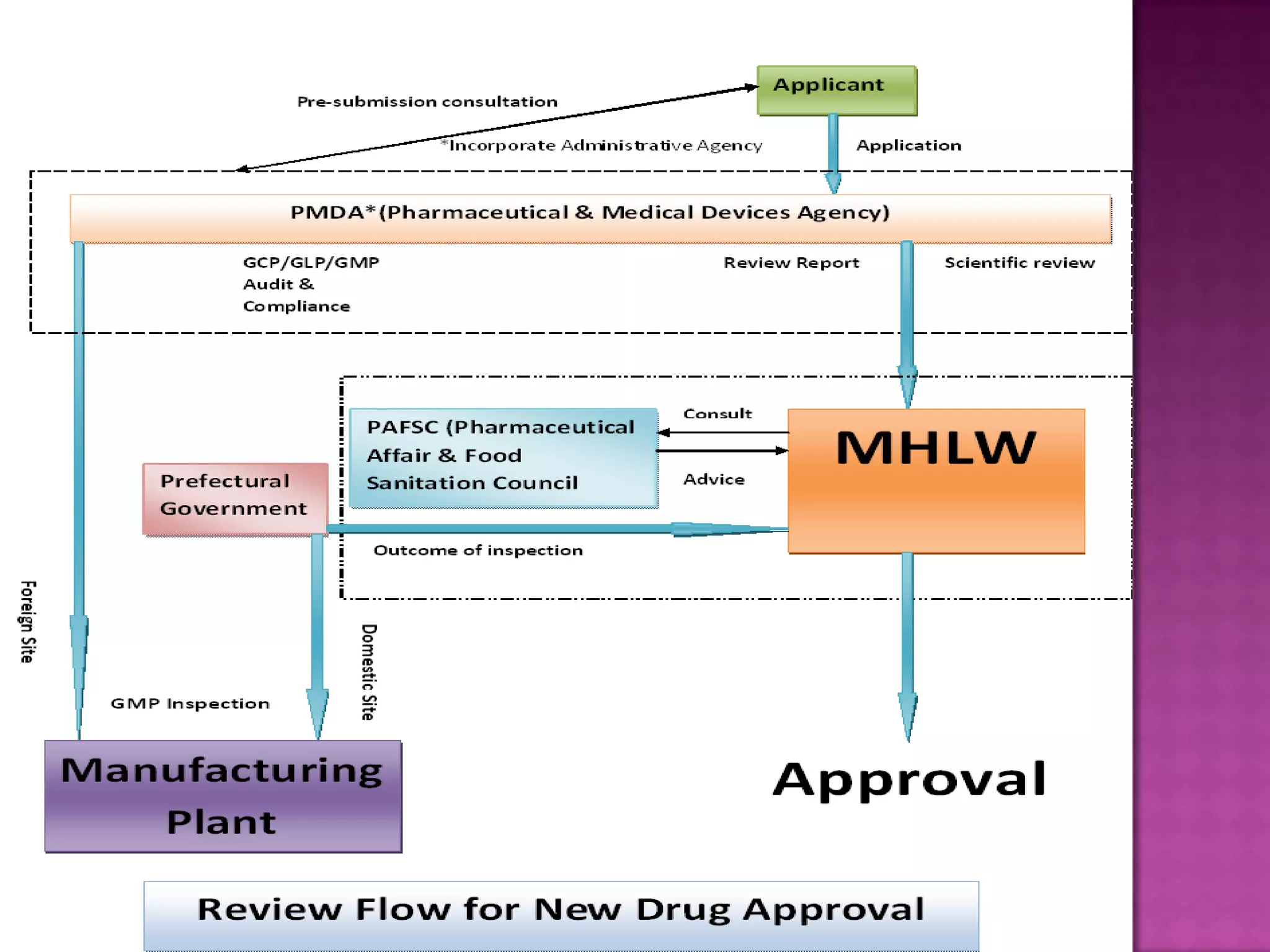
The Ministry of Health, Labor and Welfare (MHLW) is
regulatory authority of the pharmaceutical regulatory affairs
in Japan. Formal approvals and licenses are required to
marketing drugs in Japan which are obtained from the
MHLW.

One of the 11 bureaus of the MHLW is the Pharmaceutical
and Food Safety Bureau (PFSB). This bureau handles clinical
studies, approval reviews and post-marketing safety
measures.

Functions of MHLW:

To give a marketing approval.

To issue a license for marketing authorization holder.

To issue a manufacturer license.
   The work of the PMDA can be divided into following
    categories:

   ADR relief work: Collection, examination and analysis,
    assessment & provision of ADR information

   Review and Implementation of works, such as examination,
    data analysis, etc. before administrative measures eg.

   Scientific review of Pharmaceuticals and Medical Devices
    application.

   GLP/GCP/GMP/QMS inspection.

   Clinical trial consultation.
   Subjects of GMP Inspection by PMDA
   Domestic manufacturing sites which are manufacturing
    following products;
   New drugs
   Biological Products
   Products derived from human blood and human plasma
   Vaccines
   Tissue-based pharmaceuticals
   Radiopharmaceuticals
   Biotechnology-products
   Foreign manufacturing sites
   The objective of the Pharmaceutical Affairs Law is to
    improve public health through regulations required to
    assure the quality, efficacy, and safety of drugs, quasi-
    drugs, cosmetics, and medical devices, and through
    measures to promote R&D of drugs and medical devices
    that are especially essential for health care.

   Manufacturing    and   marketing    medical      devices   are
    regulated by the Pharmaceutical Affairs Law (PAL). The
    current PAL came into effect in April 2005 after the
    revision of the Pharmaceutical

   Affairs Law was promulgated in 2002.
a) Substantial reforms of safety measures for medical
  devices,

(b) Revision of the approval and licensing system and
  enhancement of post marketing safety measures,

(c) Enhancement of safety measures of biological products.
  This report highlights the above revised points and explains
  procedures for manufacturing and marketing medical
  devices in connection with PAL.
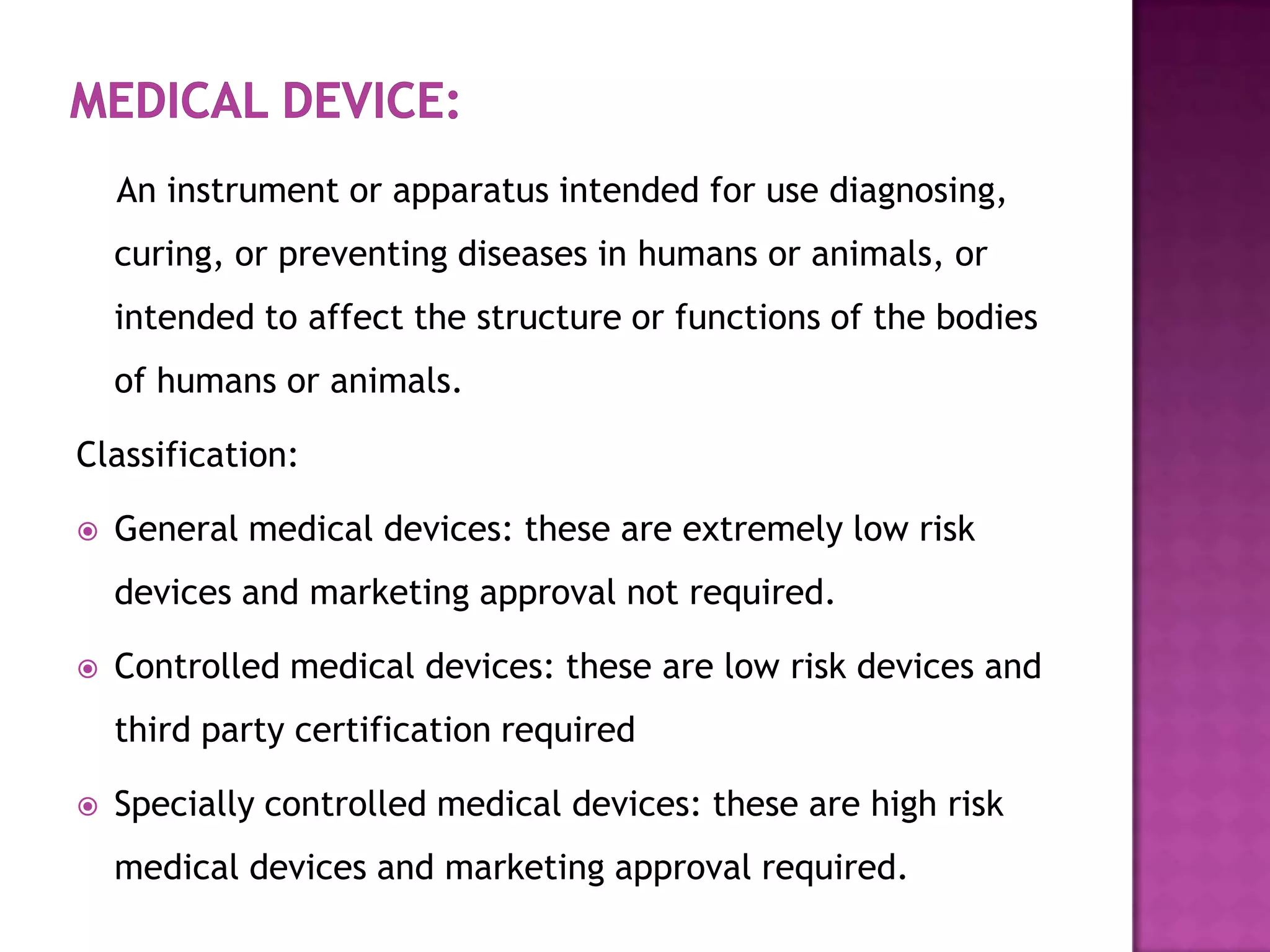
An instrument or apparatus intended for use diagnosing,
    curing, or preventing diseases in humans or animals, or
    intended to affect the structure or functions of the bodies
    of humans or animals.

Classification:

   General medical devices: these are extremely low risk
    devices and marketing approval not required.

   Controlled medical devices: these are low risk devices and
    third party certification required

   Specially controlled medical devices: these are high risk
    medical devices and marketing approval required.
Drug Marketing Approvals:
   Drug     marketing   approval   refers   to   governmental
    permission for a drug with the quality, efficacy, and safety
    or a drug that is manufactured by a method in compliance
    with manufacturing control and quality control standards
    based on an appropriate quality and safety management
    system, generally distributed, and used for healthcare in
    Japan.
   The Pharmaceutical Affairs Law of Japan requires a license
    for marketing authorization when importing to Japan and
    selling pharmaceutical products manufactured in other
    countries.
   When manufacturing pharmaceuticals in Japan, each
    manufacturing location requires a manufacturing license.

   As a condition to receiving a manufacturing license, there
    must be a full-time pharmacologist in each manufacturing
    location who serves as the Pharmaceuticals Manufacturing
    Manager (Managing Pharmacist).]

   The manufacturing license is issued by the governor of the
    prefecture in which the manufacturing location is located
    except in cases requiring particularly high levels of
    expertise.
The Pharmaceutical Affairs Law stipulates that when
 pharmaceutical products are manufactured in other
 countries for export to Japan, the foreign manufacturer
 may receive accreditation from the Minister of Health,
 Labor and Welfare for each foreign location at which
 pharmaceutical products are manufactured, and in actual
 practice, foreign manufacturers are required to obtain this
 accreditation.
Manufacture and Sale Approval:


 Parties engaged in manufacture/sale must in principle
 receive the approval of the Minister of Health, Labor
 and Welfare for the manufacture and sale of each
 pharmaceutical product to be manufactured and sold
 (including import sales) in Japan. Notwithstanding,
 approval may be revoked in the event of problems
 with the efficacy or safety of a pharmaceutical
 product after it has been approved
Exceptional Approvals for Foreign Countries:


 Under the Pharmaceutical Affairs Law, enterprises located
  in foreign countries may apply for manufacture and sale
  approval from outside of Japan. For example, a foreign
  pharmaceuticals manufacturer who wishes to obtain
  approval for manufacture and sale in Japan may nominate
  a party to conduct manufacture/sale in Japan and seek
  approval from the Minister of Health, Labor and Welfare
  for manufacture and sale by that party.
Post marketing Safety:


The pharmaceutical manufacturer/seller and the party
  obtaining approval under foreign country exceptions are
  required under the Pharmaceutical Affairs Law to collect
  and investigate information on side effects and infections
  resulting from the pharmaceutical product.
   Various regulations apply to the development,
    manufacture, import, marketing and proper use of drugs
    exists. Some of the main regulations affecting
    pharmaceuticals are listed below:
   Quality standards and government standards e.g. Japanese
    Pharmacopeia (JP)
   Classification of drugs e.g. biological products and
    specified biological products
   Concerning marketing approvals e.g. revision in April 2005
   GMP status e.g. GMP certificate as prerequisite to obtain a
    manufacturing business license
   Accreditation of overseas manufacturers e.g. accreditation
    is required to export medicinal products from overseas to
    Japan
   GLP and GCP standards
   Good Quality Practice (GQP) on marketed products
   The PAL’s principle objective is to provide an
    approval system which ensures good quality, efficacy
    and safety of the medicinal products to be marketed
    and used for healthcare in Japan.
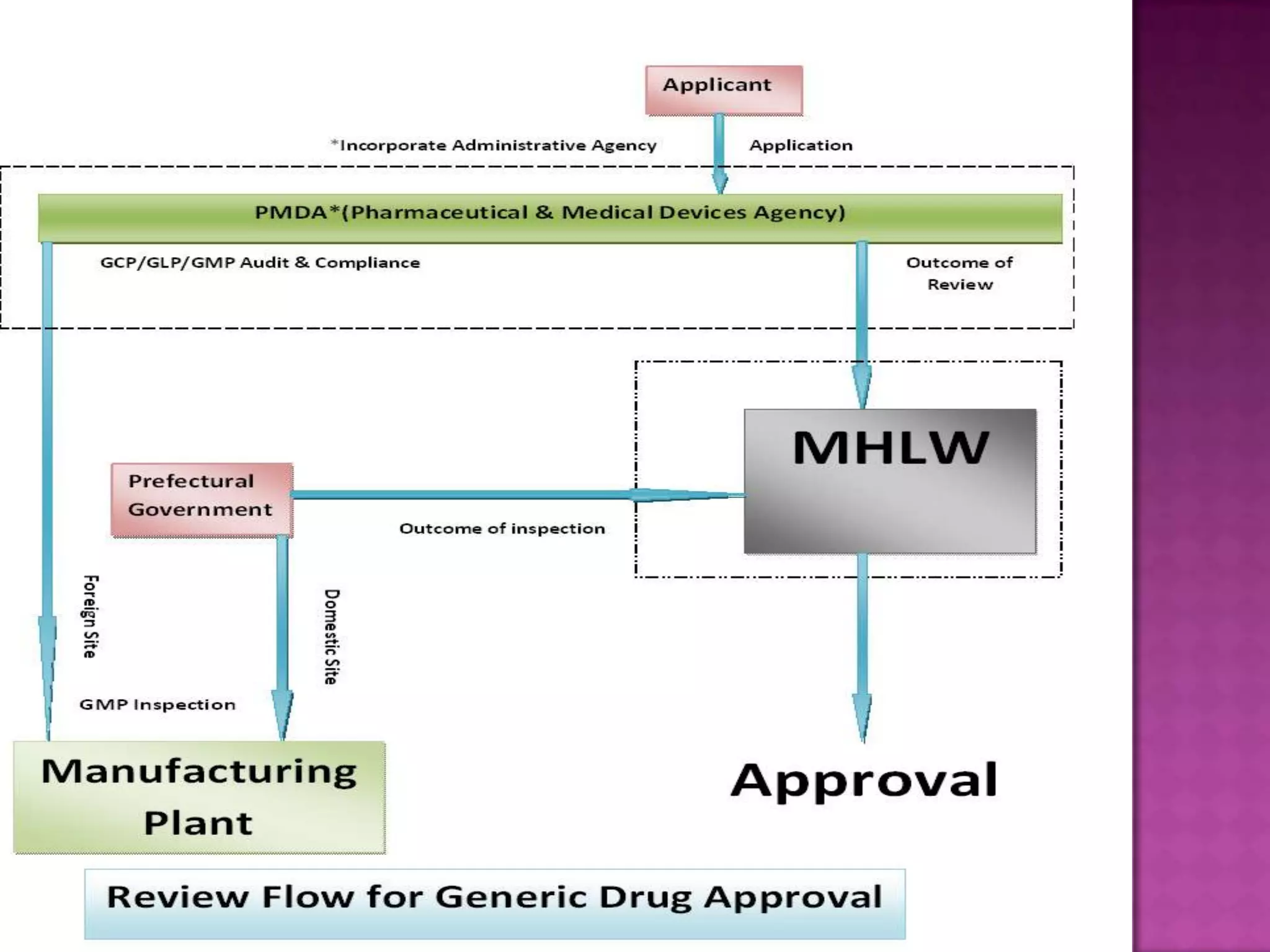
   The approval review process consists of the following
    steps:
   J-NDA evaluation process
   Compliance Review (including GCP inspection)
   GMP inspection (can also be performed as paper
    audit)
Priority Review Designation
   NDA approvals reviews are normally processed in the order
    the application forms are received. For medicinal products
    considered to be especially important from a medical
    standpoint such as new drugs treating serious diseases and
    meeting especially high medical need, priority review can be
    granted (for orphan drugs priority review is automatically
    granted).
   Criteria for priority review are severity of the target
    indication (disease with important effect on patient’s survival
    (fatal disease), progressive and irreversible disease with
    marked effect on daily life) and medical efficacy (no existing
    treatments    available,   superior   to   currently   available
    therapies with regard to efficacy, safety and quality of life).
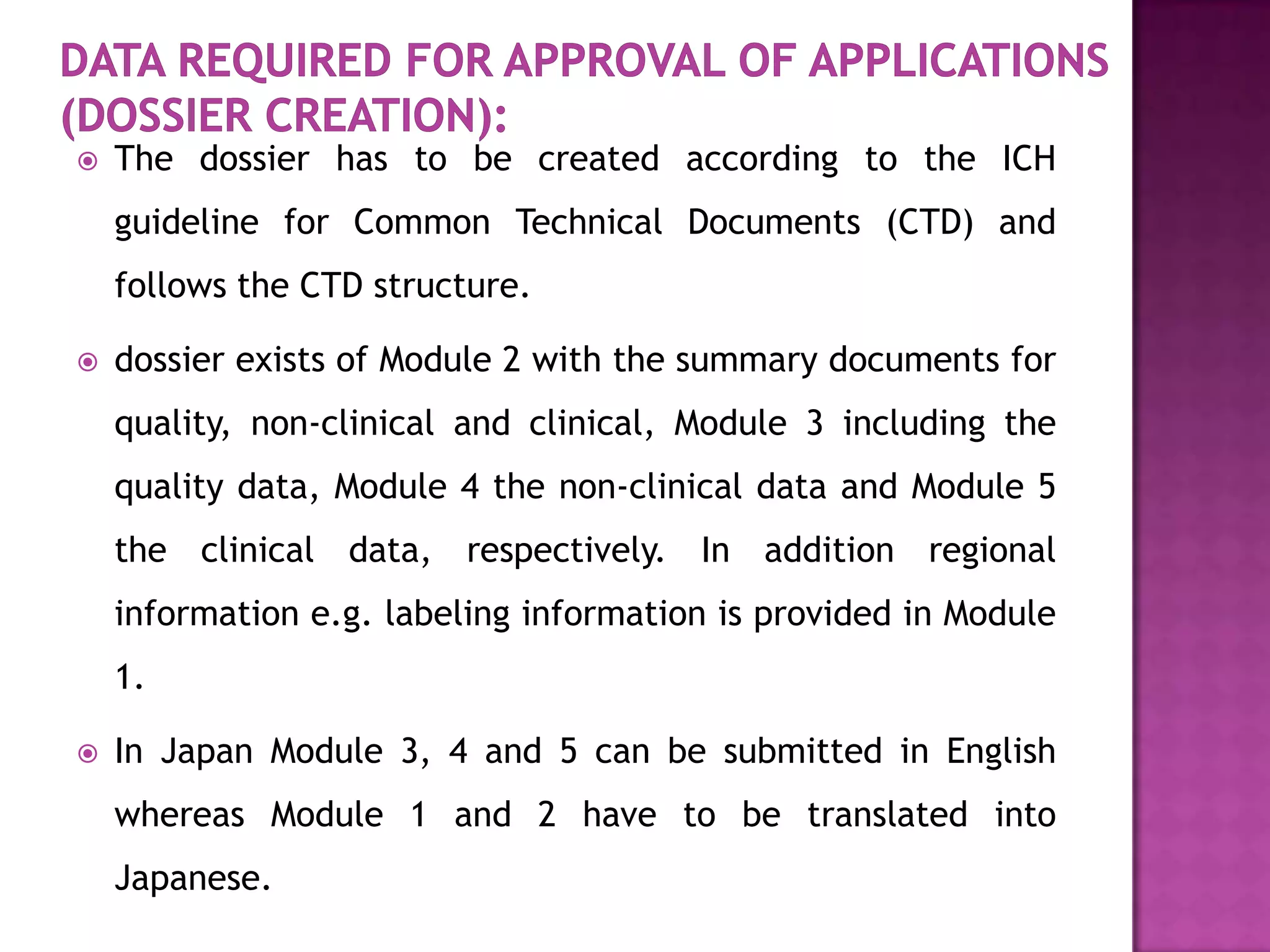
   The dossier has to be created according to the ICH
    guideline for Common Technical Documents (CTD) and
    follows the CTD structure.

   dossier exists of Module 2 with the summary documents for
    quality, non-clinical and clinical, Module 3 including the
    quality data, Module 4 the non-clinical data and Module 5
    the clinical data, respectively. In addition regional
    information e.g. labeling information is provided in Module
    1.

   In Japan Module 3, 4 and 5 can be submitted in English
    whereas Module 1 and 2 have to be translated into
    Japanese.
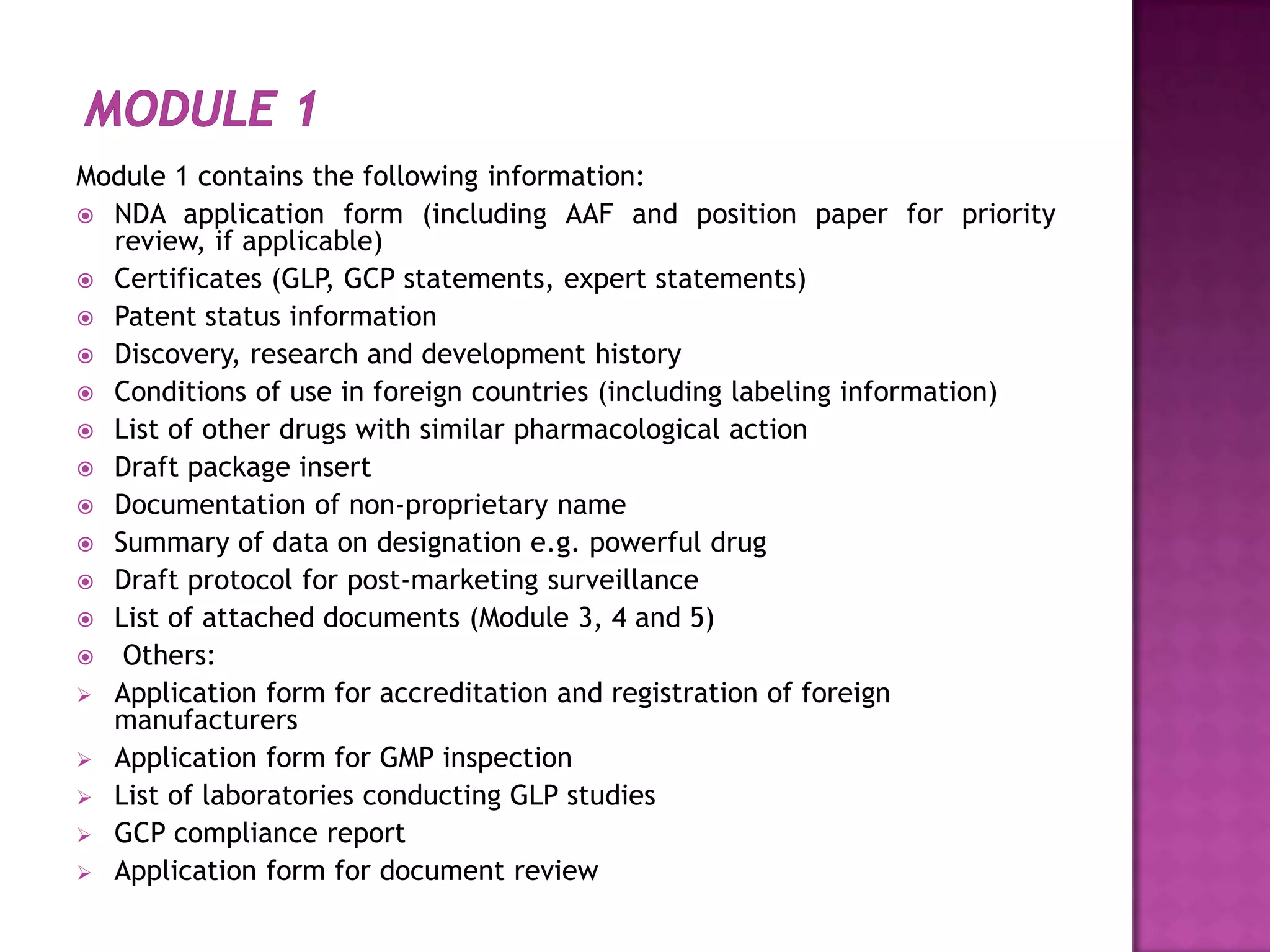
Module 1 contains the following information:
 NDA application form (including AAF and position paper for priority
  review, if applicable)
 Certificates (GLP, GCP statements, expert statements)
 Patent status information
 Discovery, research and development history
 Conditions of use in foreign countries (including labeling information)
 List of other drugs with similar pharmacological action
 Draft package insert
 Documentation of non-proprietary name
 Summary of data on designation e.g. powerful drug
 Draft protocol for post-marketing surveillance
 List of attached documents (Module 3, 4 and 5)
 Others:
 Application form for accreditation and registration of foreign
  manufacturers
 Application form for GMP inspection
 List of laboratories conducting GLP studies
 GCP compliance report
 Application form for document review
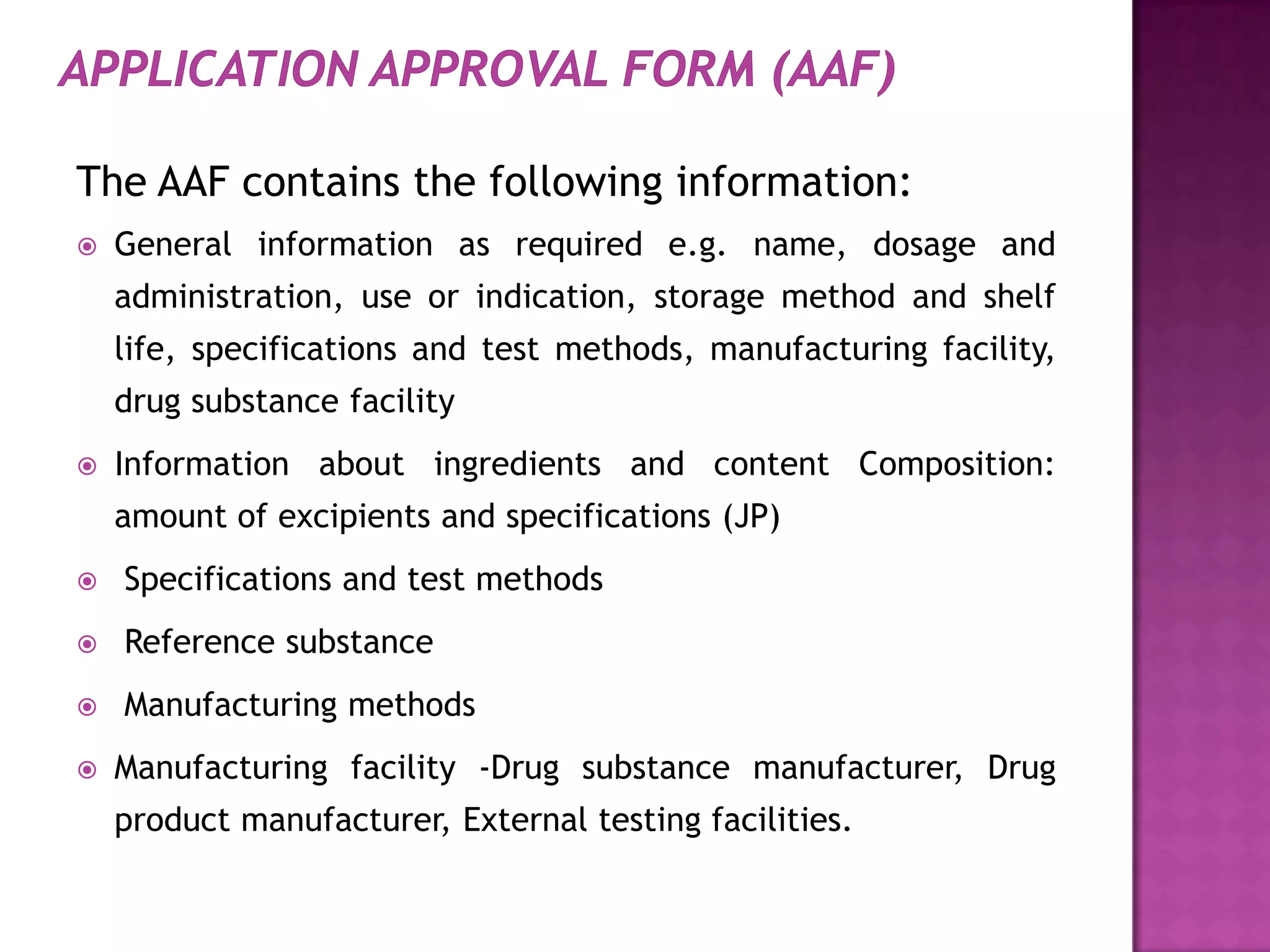
The AAF contains the following information:
   General information as required e.g. name, dosage and
    administration, use or indication, storage method and shelf
    life, specifications and test methods, manufacturing facility,
    drug substance facility
   Information about ingredients and content Composition:
    amount of excipients and specifications (JP)
   Specifications and test methods
   Reference substance
   Manufacturing methods
   Manufacturing facility -Drug substance manufacturer, Drug
    product manufacturer, External testing facilities.
(1) Modules 2 to 5 (CTD) table of contents
(2) CTD introduction
(3) Quality overall summary
(4) Nonclinical overview
(5) Clinical overview
(6) Nonclinical summary (text and tables)
 Pharmacology
 Pharmacokinetics
 Toxicity
(7) Clinical summary
 Summary of bio pharmaceutics and associated analytical
   methods
 Summary of clinical pharmacology studies
 Summary of clinical efficacy
 Summary of clinical safety
 Literature references
 Synopses of individual studies
   The QOS of Module 2 is the main review document for the
    PDMA. In Japan it is expected that the applicant
    summarizes all critical data from Module 3 together with a
    sufficient discussion on every critical point for ensuring the
    quality of the medicinal product.

   The QOS should be written in a way that it makes it
    possible for the reviewer to understand the characteristics
    of the drug within a short time and to review the J-NDA
    application efficiently.
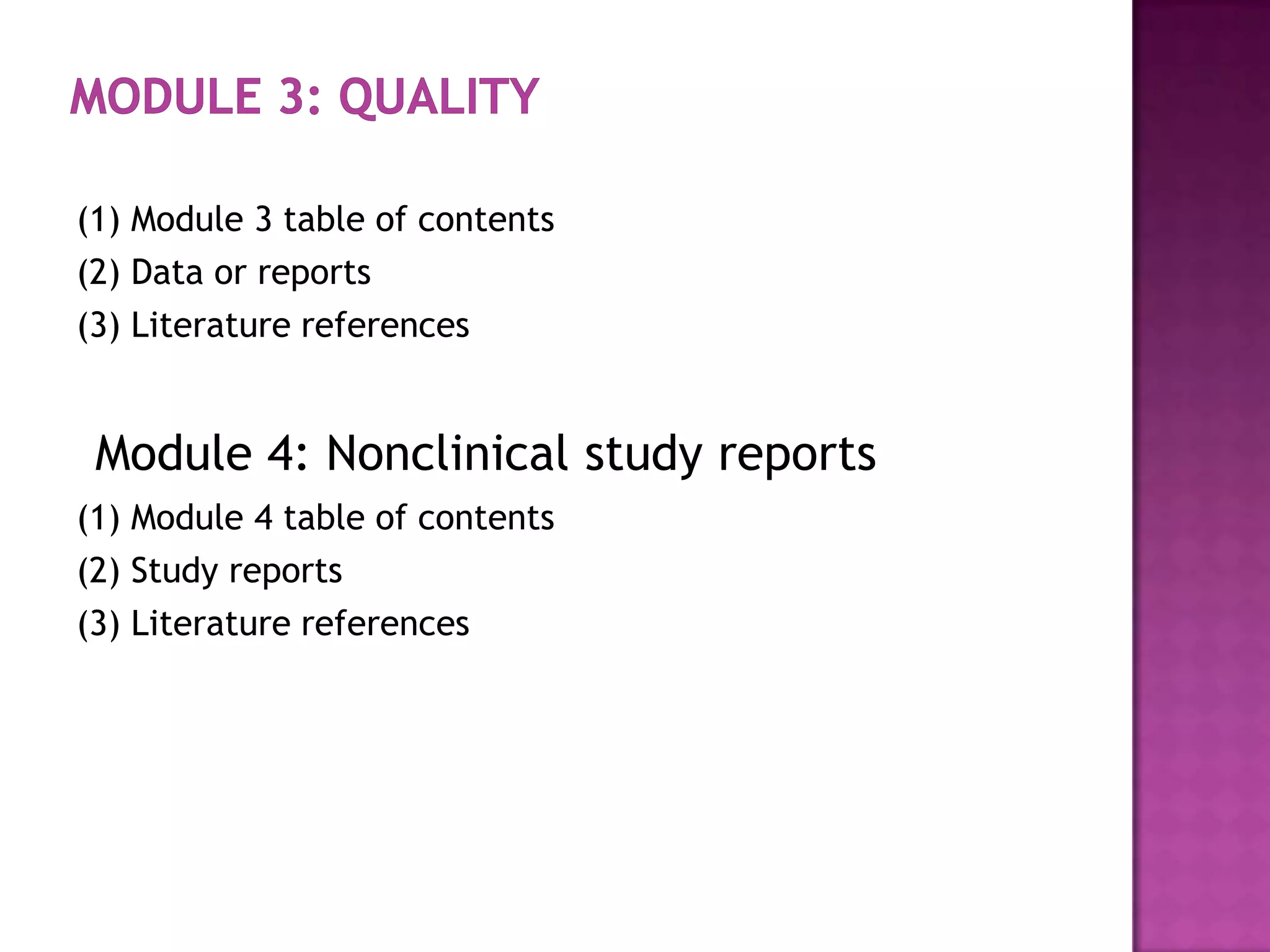
(1) Module 3 table of contents
(2) Data or reports
(3) Literature references


 Module 4: Nonclinical study reports
(1) Module 4 table of contents
(2) Study reports
(3) Literature references
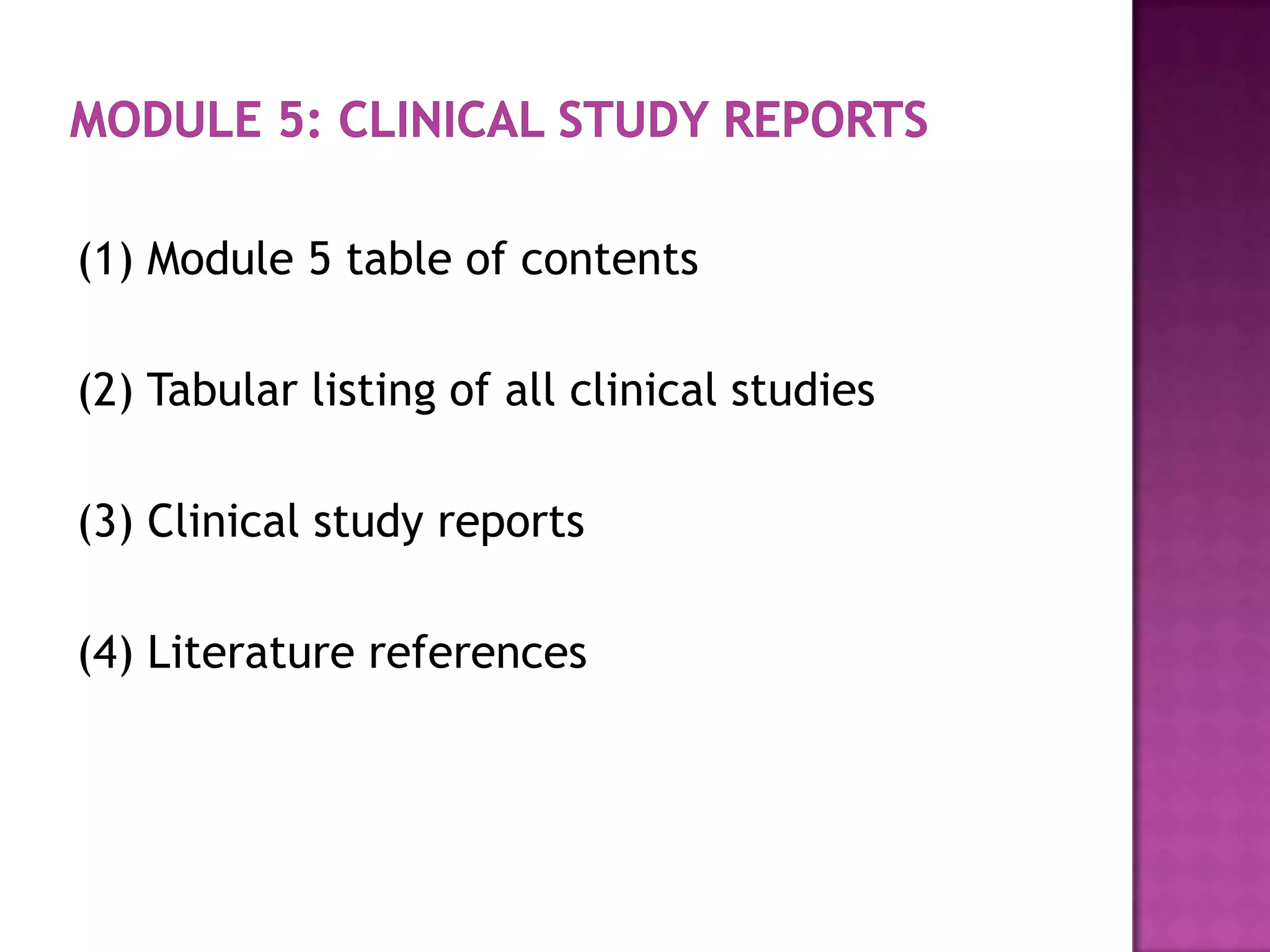
(1) Module 5 table of contents

(2) Tabular listing of all clinical studies

(3) Clinical study reports

(4) Literature references
   Proper control at the stage of drug manufacture is
    essential so that drugs can be supplied to patients with
    good quality. This means that the manufacturers and the
    buildings and facilities in the manufacturing plants must be
    appropriate so that drugs based on the approvals can be
    produced.
   The manufacturing process as a whole must be controlled
    on the basis of scientific principles, and it is also necessary
    to assure the quality of drugs manufactured by taking
    measures to prevent errors during processing.
   The requirements for manufacturing control and quality
    control methods for drug substance should be referred to
    the Guidelines on GMP for Drug Substance (ICH Q7A,
    currently Q7) which concretely specifies 20 requirements
    concerning manufacturing and control of drug substance,
    including quality control, buildings and facility, validation
   According to the GMP regulation, all of the operations in the plants
    must be divided into operations for manufacturing control and those
    for quality control, and various types of documentation are required,
    including standard operating procedures for standardization of all
    work conditions (drug product standards, manufacturing control
    standards, manufacturing hygiene control standards and quality
    control standards), documentation required for actual operation
    procedures based on these standards (manufacturing instructions and
    test and self-inspection protocols), records of the results of all of
    these operating procedures (records related to manufacture, records
    of manufacturing hygiene control, and records of tests and self-
    inspections), and records of storage and distribution.
   Additional documents should be compiled if they are considered
    necessary for proper manufacturing control and quality control.
    These documents must be retained for designated time periods from
    the date of preparation.
   All operations in manufacturing plants are subject to
    manufacturing control and quality control based on
    standard    operating    procedures     as    described
    previously, and the managers in each division used to
    bear responsibility for these operating procedures,
    but this now lies with the quality control unit.
   The final responsibility for deciding whether or not
    drugs should be shipped and that for solving problems
    related to overall manufacturing control and quality
    control in the plant lies with the drug manufacturing
    control manager designated in each plant under the
    Pharmaceutical Affairs Law.
The manufacturer, etc. must assure that the duties set
    forth below are carried out appropriately by the
    manufacturing department in compliance with standard
    operating procedures.
   To prepare and preserve manufacturing instructions.

   To manufacture products based on the manufacturing
    instructions.

   To prepare and preserve records related to product
    manufacture for each lot.

   To check packaging materials for products for each lot, and
    to prepare and preserve records related to the results
    thereof.
   To appropriately store and circulate products by lot and
    packaging materials by control unit, and to prepare and
    preserve records thereof.

   To check the cleaning of buildings and facilities, and to
    prepare and preserve records relating to the results thereof.

   To inspect and maintain buildings and facilities on a regular
    schedule, and to prepare and preserve records thereof.
    Further, to carry out appropriate calibration of measuring
    instruments, and to prepare and preserve records relating to
    the results thereof.

   To check that manufacturing control has been appropriately
    conducted on the basis of records relating to manufacturing,
    storage and distribution, as well as to sanitation control.
   The manufacturer, etc. must assure that the duties set forth below are
    carried out systematically and appropriately by the quality department in
    compliance with standard operating procedures.

   To collect samples required for the testing and inspection of products,
    etc. for each lot and of packaging materials for each control unit, and to
    prepare and preserve records thereof.

   To conduct testing and inspection of the samples collected for each lot or
    for each control unit, and to prepare and preserve records thereof.

   To store samples of products consisting of an amount two or more times
    greater than the amount required for testing and inspection for each lot
    under appropriate storage conditions for a period of one year longer than
    the expiration period or the shelf-life from the date of manufacture for
    the product concerned.
   To inspect and maintain on a regular schedule the
    facilities and implements relating to testing and
    inspection, and to prepare and preserve records
    thereof. Further to carry out appropriate calibration
    of measuring instruments relating to testing and
    inspection, and to prepare and preserve records
    related to the results thereof.

   To evaluate the test results of the samples collected,
    and to notify the manufacturing department in
    writing of the results thereof.
   Further, manufacturers, etc. makes use of the tests and inspections
    performed in the import source country, they must assure that the
    quality department carries out the duties set forth below:

   To confirm at on a regular schedule that that the product, etc. is
    manufactured    in   accordance   with   appropriate   manufacturing
    procedures.

   To confirm on a regular schedule that the manufacturing plant of an
    overseas manufacturer conforms to the standards relating to
    manufacturing control and quality control in that country, and to
    prepare and preserve records thereof.

   To confirm the records of tests and inspections carried out by the
    foreign manufacturer, and to prepare and preserve records thereof.
The manufacturer must prepare written procedures for

validation change control, deviation control, complaints,

recalls, self-inspections, training and education for each

plant so that these procedures can be performed

appropriately.
   The manufacturer, etc. must ensure that the following
    obligations are fulfilled by a person designated beforehand
    in compliance with the standard operating procedures.

   The validation plan and results must be reported in
    writing to the quality control unit. The manufacturer, etc.
    must take appropriate measures when improvements are
    required in manufacturing control or quality control based
    on the results of the validation. Records of the measures
    taken must be prepared and retained.
   When manufacturers, etc. implement changes with respect
    to manufacturing procedures, etc. that might affect the
    quality of the product, they must assure that a previously
    designated person carries out the duties set forth below, in
    compliance the standard operating procedures:
   To evaluate the effect on product quality due to the
    changes and to obtain the consent of the quality
    department for implementation of changes based on the
    results of the evaluation.
   When implementing the changes, to take measures for
    amendment of the relevant documentation, education and
    training of personnel, and any other requisite measures.
When a deviation from the manufacturing procedures occurs,
    the manufacturer, etc. must assure that a previously
    designated person carries out the duties set forth below, in
    compliance with the standard operating procedures:
   To record the details of the deviation.
   In cases where a major deviation has occurred, to evaluate
    the effect on product quality, to take requisite measures,
    to prepare and preserve the records, and to notify and
    obtain confirmation from the quality department.
   To elucidate the causes of items relating to the quality
    information concerned, and in cases in which improvements
    related to manufacturing control or quality control are required,
    to take the requisite measures.


   To prepare and preserve a record specifying the nature of the
    quality information concerned, the results of the elucidation of
    causes, and the measures for improvement, and to promptly and
    in writing notify and obtain confirmation from the quality
    assurance department.


   In cases in which the manufacturer, etc. has identified a quality
    defect or the risk thereof, to assure that the manufacturing
    control manager notifies quality department in writing on the
    basis of the standard operating procedures.
When manufacturers decide to recall drugs for reasons related
    to quality, etc., they must assure that a previously designated
    person carries out the duties set forth below in compliance
    with the standard operating procedures.

   To classify the recalled products and dispose of them
    appropriately after retention for a certain period.

   To prepare and retain recall records including the contents of
    the recall, results of clarification of the cause and measures
    taken for improvement and notify the quality department and
    manufacturing control manager in writing thereof.
The manufacturer, etc. must have the following obligations
  fulfilled by a person designated beforehand in compliance
  with the standard operating procedures.
 To    undertake their own self-inspections of the
  manufacturing control and quality control in the plant
  concerned periodically.
 To report the results of these self-inspections in writing to
  the manufacturing control manger.
 To prepare and retain records of the results of self
  inspections.
 The manufacturer must take appropriate measures when
  improvement is required in manufacturing control or
  quality control based on the results of the self-inspection.
  Records of the measures taken must be prepared and
  retained.
 The manufacturer must have the following
  obligations fulfilled by a person designated
  beforehand in compliance with the standard
  operating procedures.
 To systematically educate and train the workers
  in terms of manufacturing control and quality
  control.
 To report the status of implementation of
  education and training in writing to the
  manufacturing control manager.
 To prepared and retain records of the conduct of
  education and training.
   To provide personnel engaged in manufacture or testing
    and inspection with education and training in hygiene
    control, microbiology, and other matters requisite for the
    manufacture of sterile products.
   The manufacturer shall provide education and training on
    microbiology, medicine and veterinary medicine for
    employees engaged in manufacture or testing of biological
    products.
   The manufacturer shall provide education and training on
    the measures required to prevent contamination by
    microorganisms for employees engaged in work in sterile
    areas or in areas handling pathogenic microorganisms.
 Themanufacturer, etc. must assure that,
 with respect to the documents and records
 specified under 1) through 12) above, a
 previously designated person.
Post-marketing surveillance (PMS) to assure the
  efficacy and safety of drugs after they go on
  the market and to establish proper methods
  of use of drugs consists of three systems:

   ADR collecting and reporting system
   reexamination system, and
   reevaluation system
   Japan provides a public medical insurance system, which is
    carried on as a social insurance system covering all citizens.
    Through this insurance system, about 30% of the nation’s
    medical expenses are covered by public funds, and all prices
    for medicine, including medical compensation for doctors and
    prices for new drugs are substantially controlled by the
    Japanese government.
   The Japanese government determines prices reimbursed by
    public medical insurance for each of preparations and
    standards of all drugs prescribed by doctors. The
    reimbursement price of each drug is reviewed every two
    years and almost all reimbursement prices of drugs are
    reduced, including those of new drugs immediately after their
    release onto the market.
   On the other hand, among major advanced nations, only
    Japan has a system in which the prices of new drugs
    immediately after their release onto the market are reduced
    through political action.
   Japan has made significant progress in reforming and
    modernizing its drug and medical device approval
    process in recent years. Although approval times
    continue to lag behind those of other developed
    countries, the government has set ambitious goals
    and the PMDA and MHLW have made marked
    improvements.
   These gains, along with Japan’s position as the
    world’s second largest medical market, continue to
    make   Japan     a   desirable     place   for   foreign
    pharmaceutical   companies       and   medical   devices
    makers to do business.
1.Organization and Function of the Ministry of Health, Labor and Welfare,
   www.igpamumbai2010.com

2.“chapter 1 Organization and Function of the Ministry of Health, Labour and
   Welfare” www.jpma.or.jp/english/parj/pdf/2011_ch01.pdf

3.“Japan’s growing major market for Pharmaceuticals and medical devices”
   http://www.jetro.go.jp/en/invest/reports/pdf/market090331.pdf

4“GMP system in Japan and globalization efforts”
  http://www.ccpie.org/news/download/zrh-8.pdf

5.“Regulation of Pharmaceutical Products and Medical Devices in Japan”
   www.morganlewis.com/documents/erh/ERH_RegulationOfPharmaceuticalPro
   ductsAndMedicalDevicesInJapan_ELSCDeskbook.pdf

6.“Japan Quality Systems Auditing-Current and Future”
   http://www.ghtf.org/meetings/conferences/11thconference/BL/02TAKAE.p
   df

7. “Comparing Medical Device Law & Regulations of Japan, EU and US”
   http://www.forumsci.co.il/Landau/General/Comparing medical device .pdf

8. “CHAPTER 2 Pharmaceutical Laws and Regulations
   www.jpma.or.jp/english/parj/pdf/2011_ch02.pdf
9.“Global Regulatory Requirements for Medical Devices” www. mdh.diva-
   portal.org/smash/get/diva2:121327/FULLTEXT01


10.“Understanding the Japanese culture and approval process”
   http://www.lexjansen.com/phuse/2005/rc/rc04.pdf


11.“Comparison of marketing authorization procedures for biotechnological
   products in the European Union (centralized procedure) and in Japan
   (JNDA)” http://www.dgra.de/studiengang/pdf/master_metzner_b.pdf


12.“ The Review of New Drug Applications in Japan”
   http://www.diahome.org/DIAHome/resources/content.aspx?type=eopdf&
   file=%2Fproductfiles%2F8357%2Fdiaj_11193.pdf&cat=DIAJ


13. Global GMP Harmonization – A Japanese Perspective.
   http://www.nihs.go.jp/drug/section3/hiyama070518-3.pdf


14. CTD: ICH ,http://www.ich.org/products/ctd.html
MEDICAL DEVICE APPROVAL PROCESS IN JAPAN

MEDICAL DEVICE APPROVAL PROCESS IN JAPAN

  • 1.
    Presented by Devesh Sharma M.Pharm (DRA) devesh.m.pharmdra@gmail.com
  • 2.
    Japan is thesecond largest pharmaceutical market behind the United States and a highly developed country. It has been discovered that Japanese people are using multiple drugs with an especially high use of recently approved drugs. The patient awareness is now similar to that in the Western countries. Medicinal products represent over 20% of healthcare costs with about almost 50% in elderly patients. Therefore Japan becomes more and more attractive for the pharmaceutical industry. One of the biggest hurdles for the government is the “drug lag” problem due to the obligation to perform clinical bridging studies in Japan hand since clinical data obtained in non-Japanese trials such as EU and US studies cannot solely be used to obtain market approval in Japan. To minimize this “drug lag” the Japanese government is encouraging pharmaceutical companies to conduct simultaneous clinical development and include Japan in global clinical trials.
  • 3.
    The Ministry ofHealth, Labor and Welfare (MHLW) is regulatory authority of the pharmaceutical regulatory affairs in Japan. Formal approvals and licenses are required to marketing drugs in Japan which are obtained from the MHLW. One of the 11 bureaus of the MHLW is the Pharmaceutical and Food Safety Bureau (PFSB). This bureau handles clinical studies, approval reviews and post-marketing safety measures. Functions of MHLW: To give a marketing approval. To issue a license for marketing authorization holder. To issue a manufacturer license.
  • 4.
    The work of the PMDA can be divided into following categories:  ADR relief work: Collection, examination and analysis, assessment & provision of ADR information  Review and Implementation of works, such as examination, data analysis, etc. before administrative measures eg.  Scientific review of Pharmaceuticals and Medical Devices application.  GLP/GCP/GMP/QMS inspection.  Clinical trial consultation.
  • 5.
    Subjects of GMP Inspection by PMDA  Domestic manufacturing sites which are manufacturing following products;  New drugs  Biological Products  Products derived from human blood and human plasma  Vaccines  Tissue-based pharmaceuticals  Radiopharmaceuticals  Biotechnology-products  Foreign manufacturing sites
  • 6.
    The objective of the Pharmaceutical Affairs Law is to improve public health through regulations required to assure the quality, efficacy, and safety of drugs, quasi- drugs, cosmetics, and medical devices, and through measures to promote R&D of drugs and medical devices that are especially essential for health care.  Manufacturing and marketing medical devices are regulated by the Pharmaceutical Affairs Law (PAL). The current PAL came into effect in April 2005 after the revision of the Pharmaceutical  Affairs Law was promulgated in 2002.
  • 7.
    a) Substantial reformsof safety measures for medical devices, (b) Revision of the approval and licensing system and enhancement of post marketing safety measures, (c) Enhancement of safety measures of biological products. This report highlights the above revised points and explains procedures for manufacturing and marketing medical devices in connection with PAL.
  • 8.
    An instrument orapparatus intended for use diagnosing, curing, or preventing diseases in humans or animals, or intended to affect the structure or functions of the bodies of humans or animals. Classification:  General medical devices: these are extremely low risk devices and marketing approval not required.  Controlled medical devices: these are low risk devices and third party certification required  Specially controlled medical devices: these are high risk medical devices and marketing approval required.
  • 9.
    Drug Marketing Approvals:  Drug marketing approval refers to governmental permission for a drug with the quality, efficacy, and safety or a drug that is manufactured by a method in compliance with manufacturing control and quality control standards based on an appropriate quality and safety management system, generally distributed, and used for healthcare in Japan.  The Pharmaceutical Affairs Law of Japan requires a license for marketing authorization when importing to Japan and selling pharmaceutical products manufactured in other countries.
  • 10.
    When manufacturing pharmaceuticals in Japan, each manufacturing location requires a manufacturing license.  As a condition to receiving a manufacturing license, there must be a full-time pharmacologist in each manufacturing location who serves as the Pharmaceuticals Manufacturing Manager (Managing Pharmacist).]  The manufacturing license is issued by the governor of the prefecture in which the manufacturing location is located except in cases requiring particularly high levels of expertise.
  • 11.
    The Pharmaceutical AffairsLaw stipulates that when pharmaceutical products are manufactured in other countries for export to Japan, the foreign manufacturer may receive accreditation from the Minister of Health, Labor and Welfare for each foreign location at which pharmaceutical products are manufactured, and in actual practice, foreign manufacturers are required to obtain this accreditation.
  • 12.
    Manufacture and SaleApproval: Parties engaged in manufacture/sale must in principle receive the approval of the Minister of Health, Labor and Welfare for the manufacture and sale of each pharmaceutical product to be manufactured and sold (including import sales) in Japan. Notwithstanding, approval may be revoked in the event of problems with the efficacy or safety of a pharmaceutical product after it has been approved
  • 13.
    Exceptional Approvals forForeign Countries: Under the Pharmaceutical Affairs Law, enterprises located in foreign countries may apply for manufacture and sale approval from outside of Japan. For example, a foreign pharmaceuticals manufacturer who wishes to obtain approval for manufacture and sale in Japan may nominate a party to conduct manufacture/sale in Japan and seek approval from the Minister of Health, Labor and Welfare for manufacture and sale by that party.
  • 14.
    Post marketing Safety: Thepharmaceutical manufacturer/seller and the party obtaining approval under foreign country exceptions are required under the Pharmaceutical Affairs Law to collect and investigate information on side effects and infections resulting from the pharmaceutical product.
  • 15.
    Various regulations apply to the development, manufacture, import, marketing and proper use of drugs exists. Some of the main regulations affecting pharmaceuticals are listed below:  Quality standards and government standards e.g. Japanese Pharmacopeia (JP)  Classification of drugs e.g. biological products and specified biological products  Concerning marketing approvals e.g. revision in April 2005  GMP status e.g. GMP certificate as prerequisite to obtain a manufacturing business license  Accreditation of overseas manufacturers e.g. accreditation is required to export medicinal products from overseas to Japan  GLP and GCP standards  Good Quality Practice (GQP) on marketed products
  • 16.
    The PAL’s principle objective is to provide an approval system which ensures good quality, efficacy and safety of the medicinal products to be marketed and used for healthcare in Japan.  The approval review process consists of the following steps:  J-NDA evaluation process  Compliance Review (including GCP inspection)  GMP inspection (can also be performed as paper audit)
  • 17.
    Priority Review Designation  NDA approvals reviews are normally processed in the order the application forms are received. For medicinal products considered to be especially important from a medical standpoint such as new drugs treating serious diseases and meeting especially high medical need, priority review can be granted (for orphan drugs priority review is automatically granted).  Criteria for priority review are severity of the target indication (disease with important effect on patient’s survival (fatal disease), progressive and irreversible disease with marked effect on daily life) and medical efficacy (no existing treatments available, superior to currently available therapies with regard to efficacy, safety and quality of life).
  • 20.
    The dossier has to be created according to the ICH guideline for Common Technical Documents (CTD) and follows the CTD structure.  dossier exists of Module 2 with the summary documents for quality, non-clinical and clinical, Module 3 including the quality data, Module 4 the non-clinical data and Module 5 the clinical data, respectively. In addition regional information e.g. labeling information is provided in Module 1.  In Japan Module 3, 4 and 5 can be submitted in English whereas Module 1 and 2 have to be translated into Japanese.
  • 21.
    Module 1 containsthe following information:  NDA application form (including AAF and position paper for priority review, if applicable)  Certificates (GLP, GCP statements, expert statements)  Patent status information  Discovery, research and development history  Conditions of use in foreign countries (including labeling information)  List of other drugs with similar pharmacological action  Draft package insert  Documentation of non-proprietary name  Summary of data on designation e.g. powerful drug  Draft protocol for post-marketing surveillance  List of attached documents (Module 3, 4 and 5)  Others:  Application form for accreditation and registration of foreign manufacturers  Application form for GMP inspection  List of laboratories conducting GLP studies  GCP compliance report  Application form for document review
  • 22.
    The AAF containsthe following information:  General information as required e.g. name, dosage and administration, use or indication, storage method and shelf life, specifications and test methods, manufacturing facility, drug substance facility  Information about ingredients and content Composition: amount of excipients and specifications (JP)  Specifications and test methods  Reference substance  Manufacturing methods  Manufacturing facility -Drug substance manufacturer, Drug product manufacturer, External testing facilities.
  • 23.
    (1) Modules 2to 5 (CTD) table of contents (2) CTD introduction (3) Quality overall summary (4) Nonclinical overview (5) Clinical overview (6) Nonclinical summary (text and tables)  Pharmacology  Pharmacokinetics  Toxicity (7) Clinical summary  Summary of bio pharmaceutics and associated analytical methods  Summary of clinical pharmacology studies  Summary of clinical efficacy  Summary of clinical safety  Literature references  Synopses of individual studies
  • 24.
    The QOS of Module 2 is the main review document for the PDMA. In Japan it is expected that the applicant summarizes all critical data from Module 3 together with a sufficient discussion on every critical point for ensuring the quality of the medicinal product.  The QOS should be written in a way that it makes it possible for the reviewer to understand the characteristics of the drug within a short time and to review the J-NDA application efficiently.
  • 25.
    (1) Module 3table of contents (2) Data or reports (3) Literature references Module 4: Nonclinical study reports (1) Module 4 table of contents (2) Study reports (3) Literature references
  • 26.
    (1) Module 5table of contents (2) Tabular listing of all clinical studies (3) Clinical study reports (4) Literature references
  • 27.
    Proper control at the stage of drug manufacture is essential so that drugs can be supplied to patients with good quality. This means that the manufacturers and the buildings and facilities in the manufacturing plants must be appropriate so that drugs based on the approvals can be produced.  The manufacturing process as a whole must be controlled on the basis of scientific principles, and it is also necessary to assure the quality of drugs manufactured by taking measures to prevent errors during processing.  The requirements for manufacturing control and quality control methods for drug substance should be referred to the Guidelines on GMP for Drug Substance (ICH Q7A, currently Q7) which concretely specifies 20 requirements concerning manufacturing and control of drug substance, including quality control, buildings and facility, validation
  • 28.
    According to the GMP regulation, all of the operations in the plants must be divided into operations for manufacturing control and those for quality control, and various types of documentation are required, including standard operating procedures for standardization of all work conditions (drug product standards, manufacturing control standards, manufacturing hygiene control standards and quality control standards), documentation required for actual operation procedures based on these standards (manufacturing instructions and test and self-inspection protocols), records of the results of all of these operating procedures (records related to manufacture, records of manufacturing hygiene control, and records of tests and self- inspections), and records of storage and distribution.  Additional documents should be compiled if they are considered necessary for proper manufacturing control and quality control. These documents must be retained for designated time periods from the date of preparation.
  • 29.
    All operations in manufacturing plants are subject to manufacturing control and quality control based on standard operating procedures as described previously, and the managers in each division used to bear responsibility for these operating procedures, but this now lies with the quality control unit.  The final responsibility for deciding whether or not drugs should be shipped and that for solving problems related to overall manufacturing control and quality control in the plant lies with the drug manufacturing control manager designated in each plant under the Pharmaceutical Affairs Law.
  • 30.
    The manufacturer, etc.must assure that the duties set forth below are carried out appropriately by the manufacturing department in compliance with standard operating procedures.  To prepare and preserve manufacturing instructions.  To manufacture products based on the manufacturing instructions.  To prepare and preserve records related to product manufacture for each lot.  To check packaging materials for products for each lot, and to prepare and preserve records related to the results thereof.
  • 31.
    To appropriately store and circulate products by lot and packaging materials by control unit, and to prepare and preserve records thereof.  To check the cleaning of buildings and facilities, and to prepare and preserve records relating to the results thereof.  To inspect and maintain buildings and facilities on a regular schedule, and to prepare and preserve records thereof. Further, to carry out appropriate calibration of measuring instruments, and to prepare and preserve records relating to the results thereof.  To check that manufacturing control has been appropriately conducted on the basis of records relating to manufacturing, storage and distribution, as well as to sanitation control.
  • 32.
    The manufacturer, etc. must assure that the duties set forth below are carried out systematically and appropriately by the quality department in compliance with standard operating procedures.  To collect samples required for the testing and inspection of products, etc. for each lot and of packaging materials for each control unit, and to prepare and preserve records thereof.  To conduct testing and inspection of the samples collected for each lot or for each control unit, and to prepare and preserve records thereof.  To store samples of products consisting of an amount two or more times greater than the amount required for testing and inspection for each lot under appropriate storage conditions for a period of one year longer than the expiration period or the shelf-life from the date of manufacture for the product concerned.
  • 33.
    To inspect and maintain on a regular schedule the facilities and implements relating to testing and inspection, and to prepare and preserve records thereof. Further to carry out appropriate calibration of measuring instruments relating to testing and inspection, and to prepare and preserve records related to the results thereof.  To evaluate the test results of the samples collected, and to notify the manufacturing department in writing of the results thereof.
  • 34.
    Further, manufacturers, etc. makes use of the tests and inspections performed in the import source country, they must assure that the quality department carries out the duties set forth below:  To confirm at on a regular schedule that that the product, etc. is manufactured in accordance with appropriate manufacturing procedures.  To confirm on a regular schedule that the manufacturing plant of an overseas manufacturer conforms to the standards relating to manufacturing control and quality control in that country, and to prepare and preserve records thereof.  To confirm the records of tests and inspections carried out by the foreign manufacturer, and to prepare and preserve records thereof.
  • 35.
    The manufacturer mustprepare written procedures for validation change control, deviation control, complaints, recalls, self-inspections, training and education for each plant so that these procedures can be performed appropriately.
  • 36.
    The manufacturer, etc. must ensure that the following obligations are fulfilled by a person designated beforehand in compliance with the standard operating procedures.  The validation plan and results must be reported in writing to the quality control unit. The manufacturer, etc. must take appropriate measures when improvements are required in manufacturing control or quality control based on the results of the validation. Records of the measures taken must be prepared and retained.
  • 37.
    When manufacturers, etc. implement changes with respect to manufacturing procedures, etc. that might affect the quality of the product, they must assure that a previously designated person carries out the duties set forth below, in compliance the standard operating procedures:  To evaluate the effect on product quality due to the changes and to obtain the consent of the quality department for implementation of changes based on the results of the evaluation.  When implementing the changes, to take measures for amendment of the relevant documentation, education and training of personnel, and any other requisite measures.
  • 38.
    When a deviationfrom the manufacturing procedures occurs, the manufacturer, etc. must assure that a previously designated person carries out the duties set forth below, in compliance with the standard operating procedures:  To record the details of the deviation.  In cases where a major deviation has occurred, to evaluate the effect on product quality, to take requisite measures, to prepare and preserve the records, and to notify and obtain confirmation from the quality department.
  • 39.
    To elucidate the causes of items relating to the quality information concerned, and in cases in which improvements related to manufacturing control or quality control are required, to take the requisite measures.  To prepare and preserve a record specifying the nature of the quality information concerned, the results of the elucidation of causes, and the measures for improvement, and to promptly and in writing notify and obtain confirmation from the quality assurance department.  In cases in which the manufacturer, etc. has identified a quality defect or the risk thereof, to assure that the manufacturing control manager notifies quality department in writing on the basis of the standard operating procedures.
  • 40.
    When manufacturers decideto recall drugs for reasons related to quality, etc., they must assure that a previously designated person carries out the duties set forth below in compliance with the standard operating procedures.  To classify the recalled products and dispose of them appropriately after retention for a certain period.  To prepare and retain recall records including the contents of the recall, results of clarification of the cause and measures taken for improvement and notify the quality department and manufacturing control manager in writing thereof.
  • 41.
    The manufacturer, etc.must have the following obligations fulfilled by a person designated beforehand in compliance with the standard operating procedures.  To undertake their own self-inspections of the manufacturing control and quality control in the plant concerned periodically.  To report the results of these self-inspections in writing to the manufacturing control manger.  To prepare and retain records of the results of self inspections.  The manufacturer must take appropriate measures when improvement is required in manufacturing control or quality control based on the results of the self-inspection. Records of the measures taken must be prepared and retained.
  • 42.
     The manufacturermust have the following obligations fulfilled by a person designated beforehand in compliance with the standard operating procedures.  To systematically educate and train the workers in terms of manufacturing control and quality control.  To report the status of implementation of education and training in writing to the manufacturing control manager.  To prepared and retain records of the conduct of education and training.
  • 43.
    To provide personnel engaged in manufacture or testing and inspection with education and training in hygiene control, microbiology, and other matters requisite for the manufacture of sterile products.  The manufacturer shall provide education and training on microbiology, medicine and veterinary medicine for employees engaged in manufacture or testing of biological products.  The manufacturer shall provide education and training on the measures required to prevent contamination by microorganisms for employees engaged in work in sterile areas or in areas handling pathogenic microorganisms.
  • 44.
     Themanufacturer, etc.must assure that, with respect to the documents and records specified under 1) through 12) above, a previously designated person.
  • 45.
    Post-marketing surveillance (PMS)to assure the efficacy and safety of drugs after they go on the market and to establish proper methods of use of drugs consists of three systems:  ADR collecting and reporting system  reexamination system, and  reevaluation system
  • 47.
    Japan provides a public medical insurance system, which is carried on as a social insurance system covering all citizens. Through this insurance system, about 30% of the nation’s medical expenses are covered by public funds, and all prices for medicine, including medical compensation for doctors and prices for new drugs are substantially controlled by the Japanese government.  The Japanese government determines prices reimbursed by public medical insurance for each of preparations and standards of all drugs prescribed by doctors. The reimbursement price of each drug is reviewed every two years and almost all reimbursement prices of drugs are reduced, including those of new drugs immediately after their release onto the market.  On the other hand, among major advanced nations, only Japan has a system in which the prices of new drugs immediately after their release onto the market are reduced through political action.
  • 48.
    Japan has made significant progress in reforming and modernizing its drug and medical device approval process in recent years. Although approval times continue to lag behind those of other developed countries, the government has set ambitious goals and the PMDA and MHLW have made marked improvements.  These gains, along with Japan’s position as the world’s second largest medical market, continue to make Japan a desirable place for foreign pharmaceutical companies and medical devices makers to do business.
  • 49.
    1.Organization and Functionof the Ministry of Health, Labor and Welfare, www.igpamumbai2010.com 2.“chapter 1 Organization and Function of the Ministry of Health, Labour and Welfare” www.jpma.or.jp/english/parj/pdf/2011_ch01.pdf 3.“Japan’s growing major market for Pharmaceuticals and medical devices” http://www.jetro.go.jp/en/invest/reports/pdf/market090331.pdf 4“GMP system in Japan and globalization efforts” http://www.ccpie.org/news/download/zrh-8.pdf 5.“Regulation of Pharmaceutical Products and Medical Devices in Japan” www.morganlewis.com/documents/erh/ERH_RegulationOfPharmaceuticalPro ductsAndMedicalDevicesInJapan_ELSCDeskbook.pdf 6.“Japan Quality Systems Auditing-Current and Future” http://www.ghtf.org/meetings/conferences/11thconference/BL/02TAKAE.p df 7. “Comparing Medical Device Law & Regulations of Japan, EU and US” http://www.forumsci.co.il/Landau/General/Comparing medical device .pdf 8. “CHAPTER 2 Pharmaceutical Laws and Regulations www.jpma.or.jp/english/parj/pdf/2011_ch02.pdf
  • 50.
    9.“Global Regulatory Requirementsfor Medical Devices” www. mdh.diva- portal.org/smash/get/diva2:121327/FULLTEXT01 10.“Understanding the Japanese culture and approval process” http://www.lexjansen.com/phuse/2005/rc/rc04.pdf 11.“Comparison of marketing authorization procedures for biotechnological products in the European Union (centralized procedure) and in Japan (JNDA)” http://www.dgra.de/studiengang/pdf/master_metzner_b.pdf 12.“ The Review of New Drug Applications in Japan” http://www.diahome.org/DIAHome/resources/content.aspx?type=eopdf& file=%2Fproductfiles%2F8357%2Fdiaj_11193.pdf&cat=DIAJ 13. Global GMP Harmonization – A Japanese Perspective. http://www.nihs.go.jp/drug/section3/hiyama070518-3.pdf 14. CTD: ICH ,http://www.ich.org/products/ctd.html