THE DIETARY REFERENCE INTAKES (DRI)
Dietary reference intakes
Dietary reference intakes: • Introduction: Using the results of
thousands of research studies, nutrition experts have produced
a set of standards that define the amounts of energy, nutrients,
other dietary components, and physical activity that best support
health. These recommendations are called Dietary Reference
Intakes (DRI).
These recommendations apply to healthy people and may not
be appropriate for people with diseases that increase or
decrease nutrient needs. The next several paragraphs discuss
specific aspects of how the committee goes about establishing
the values that make up the DRI:
THE DIETARY REFERENCE INTAKES (DRI)
🞭 The DRI Committee consists of highly
qualified scientists who base their estimates
of nutrient needs on careful examination and
interpretation of scientific evidence.
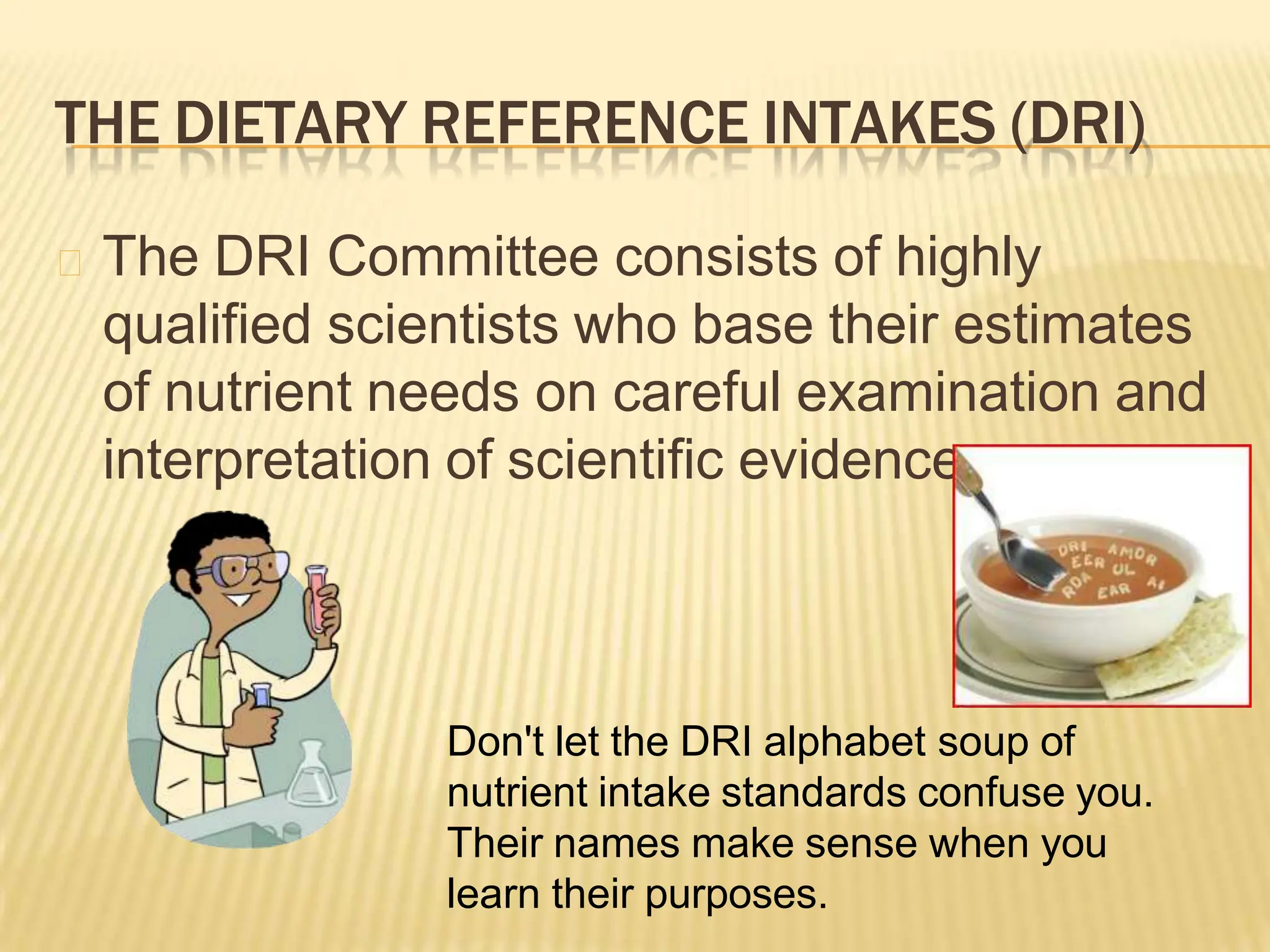
Don't let the DRI alphabet soup of
nutrient intake standards confuse you.
Their names make sense when you
learn their purposes.
THE DIETARY REFERENCE INTAKES (DRI)
🞭 Establishing Nutrient Recommendations
🞭 EAR: Estimated Average Requirement (EAR)
The Estimated Average Requirement (EAR) is defined as “the
daily intake value that is estimated to meet the requirement, as
defined by the specified indicator of adequacy, in half of the
apparently healthy individuals in a life stage or gender group
defines the requirement of a nutrient that supports a specific
function in the body for half of the healthy population.
🞭 The committee reviews hundreds of research studies to
determine the requirement for a nutrient how much is needed
in the diet.
🞭 The intake that meets the estimated nutrient need of 50%
individuals.
🞭 The EAR serves as the basis for setting the Recommended
Dietary Allowance (RDA). If an EAR cannot be established,
then an RDA cannot be set
© 2008 Thomson - Wadsworth
DRI Committee defines nutrient requirement as the minimal
intake sustaining defined nutriture. For EAR, specific
adequacy criteria are chosen based on literature, varying
across life stages. Criteria include preventing deficiency
diseases, measuring nutrient levels in tissues, and maintaining
metabolic pathways. Adjustments for insufficient data on
children, adolescents, and pregnant/lactating females involve
referencing adult EAR or accounting for increased needs
during pregnancy. Chronic disease risk reduction is
considered, but data on nutrient effects on morbidity/mortality
in the US and Canada are limited.
THE DIETARY REFERENCE INTAKES (DRI)
🞭 Establishing Nutrient Recommendations
🞭 RDA: Recommended Dietary Allowances (RDA) Once
a nutrient requirement is established (EAR), the
committee must decide what intake to recommend for
everybody
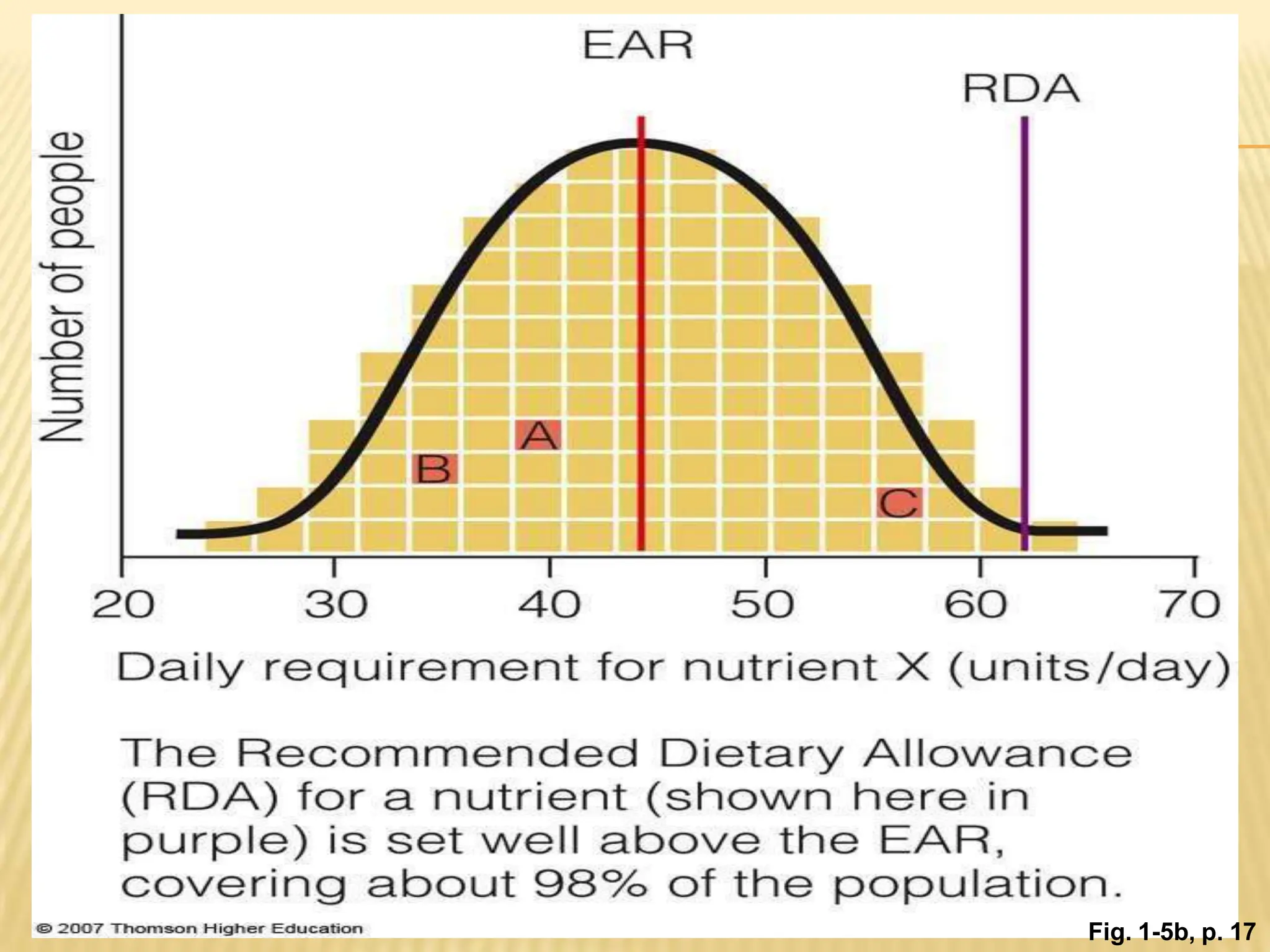
🞭 (RDA) uses the EAR as a base and includes sufficient
daily amounts of nutrients to meet the known nutrient
needs of practically all healthy populations (almost all
-97 to 98%)
🞭 This recommendation considers deficiencies. This is
set above the EAR.
© 2008 Thomson - Wadsworth
Fig. 1-5b, p. 17
What are the Benefits of Recommended Dietary Allowance (RDA) for
Nutrition
1.Individual Nutrient Guidance: The RDA provides specific guidance on
the amounts of various nutrients needed for a healthy diet. It acts as an
effective tool for evaluating nutrient adequacy on an individual level.
2.Prevention of Nutrient Deficiency: By adhering to the RDA guidelines,
individuals can prevent nutritional deficiencies, which could otherwise lead
to serious health complications.
3.Promotion of Overall Health: Following the RDA helps promote overall
health and well-being. It ensures the proper functioning of various body
systems, including immune health, bone health, and energy production.
4.Scientific Basis: The RDA is based on scientific research and evidence,
ensuring the recommendations provided are reliable and valid.
5.Foundation for Dietary Planning: The RDA serves as a foundation for
dietary planning at individual and group levels. It aids in the formation of
dietary guidelines, meal planning for institutions, and nutritional policies
What are the Risks of Recommended Dietary
Allowance (RDA) for Nutrition?
1.Individual Variability: The RDA might not cater to individual variability in
nutrient requirements due to factors such as genetic makeup, health status,
and lifestyle. As such, it may not fully address the needs of all individuals.
2.Potential for Overconsumption: Misinterpretation of the RDA as a
nutrient target, rather than a guideline, could lead to overconsumption of
certain nutrients. This can potentially lead to nutrient toxicity and
associated health complications.
3.Not Comprehensive: The RDA does not account for all nutrients.
Particularly for those nutrients for which there is insufficient scientific data,
the RDA may fall short in providing guidelines.
4.Not Tailored to Special Conditions: The RDA does not take into
consideration special dietary needs due to illnesses, pregnancy, or specific
physiological conditions. Individuals with these conditions may require
more personalized nutritional advice.
5.Doesn’t Address Food Quality: The RDA focuses on nutrient quantities,
not the quality of the food consumed. As a result, it might not reflect the
benefits associated with consuming whole, unprocessed foods.
Adequate Intakes (AI)
For some nutrients, such as calcium, there is insufficient scientific evidence
to determine an Estimated Average Requirement (which is needed to set
an RDA). In these cases, the committee establishes an Adequate Intake
(AI) instead of an RDA. ‘An AI reflects the average amount of a nutrient that
a group of healthy people consumes’. Like the RDA, the AI may be used as
a nutrient goal for individuals. Although both the RDA and the AI serve as
nutrient intake goals for individuals, their differences are noteworthy. An
RDA for a given nutrient is based on enough scientific evidence to expect
that the needs of almost all healthy people will be met. An AI, on the other
hand, must rely more heavily on scientific judgments because sufficient
evidence is lacking. The percentage of people covered by an AI is
unknown; an AI is expected to exceed average requirements, but it may
cover more or fewer people than an RDA would cover (if an RDA could be
determined). For these reasons, AI values are more uncertain than RDA.
The table on the inside front cover identifies which nutrients have an RDA
and which have an AI.
THE DIETARY REFERENCE INTAKES (DRI)
🞭 Establishing Nutrient Recommendations
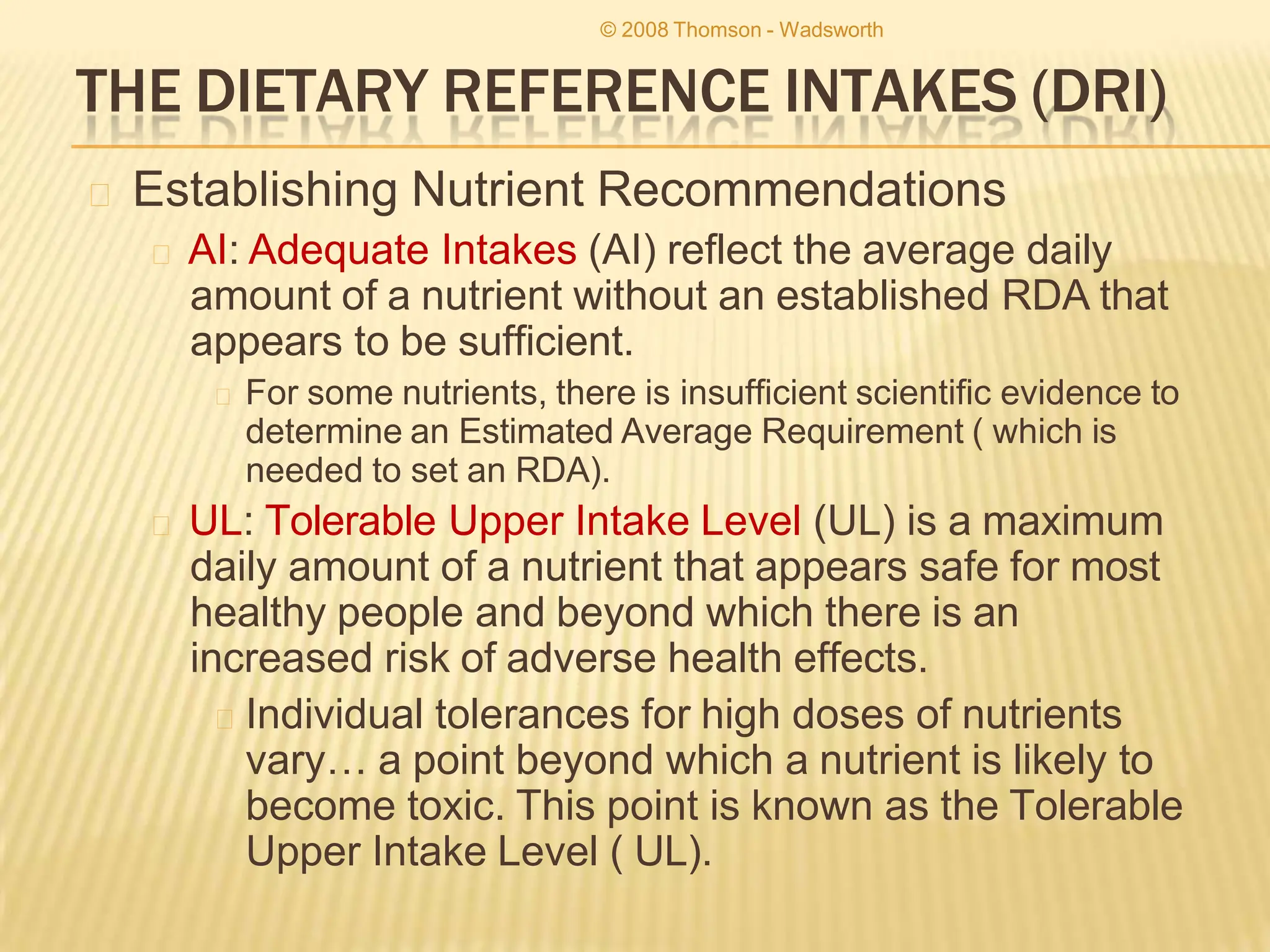
🞭 AI: Adequate Intakes (AI) reflect the average daily
amount of a nutrient without an established RDA that
appears to be sufficient.
🞭 For some nutrients, there is insufficient scientific evidence to
determine an Estimated Average Requirement ( which is
needed to set an RDA).
🞭 UL: Tolerable Upper Intake Level (UL) is a maximum
daily amount of a nutrient that appears safe for most
healthy people and beyond which there is an
increased risk of adverse health effects.
🞭 Individual tolerances for high doses of nutrients
vary… a point beyond which a nutrient is likely to
become toxic. This point is known as the Tolerable
Upper Intake Level ( UL).
© 2008 Thomson - Wadsworth
Establishing Energy Recommendations
Establishing Energy Recommendations In contrast to
the RDA and AI values for nutrients, the
recommendation for energy is not generous. Excess
energy cannot be readily excreted and is eventually
stored as body fat. These reserves may be beneficial
when food is scarce, but they can also lead to obesity
and its associated health consequences.
Estimated Energy Requirement (EER)
The energy recommendation—called the Estimated Energy
Requirement (EER)—represents the average dietary energy
intake (kcalories per day) that will maintain energy balance in
a person who has a healthy body weight ♦ and level of
physical activity. Balance is key to the energy
recommendation. Enough energy is needed to sustain a
healthy and active life, but too much energy can lead to weight
gain and obesity. Because any amount in excess of energy
needs will result in weight gain, no upper level for energy has
been determined.
Formula:Adult male: EER = 662 − [9.53 X age (y)] + PA X
[15.91 X wt (kg) + 539.6 X ht (m)]
Adult female: EER = 354 − [6.91 x age (y)] + PA x [9.36 x wt
(kg) + 726 x ht (m)]
© 2008 Thomson - Wadsworth
THE DIETARY REFERENCE INTAKES (DRI)
Acceptable Macronutrient Distribution Ranges (AMDR) People don’t
eat energy directly; they derive energy from foods containing
carbohydrates, fats, and proteins. Each of these three energy-yielding
nutrients contributes to the total energy intake, and those contributions vary
in relation to one another. The DRI Committee has determined that the
composition of a diet that provides adequate energy and nutrients and
reduces the risk of chronic diseases is:
Acceptable Macronutrient Distribution Range (AMDR)
represents the range of intakes for energy nutrients that
provide adequate energy and nutrients and reduce risk of
chronic disease.
🞭 45 - 65 percent kcalories from carbohydrate •
🞭 20 - 35 percent kcalories from fat •
🞭 10 - 35 percent kcalories from protein
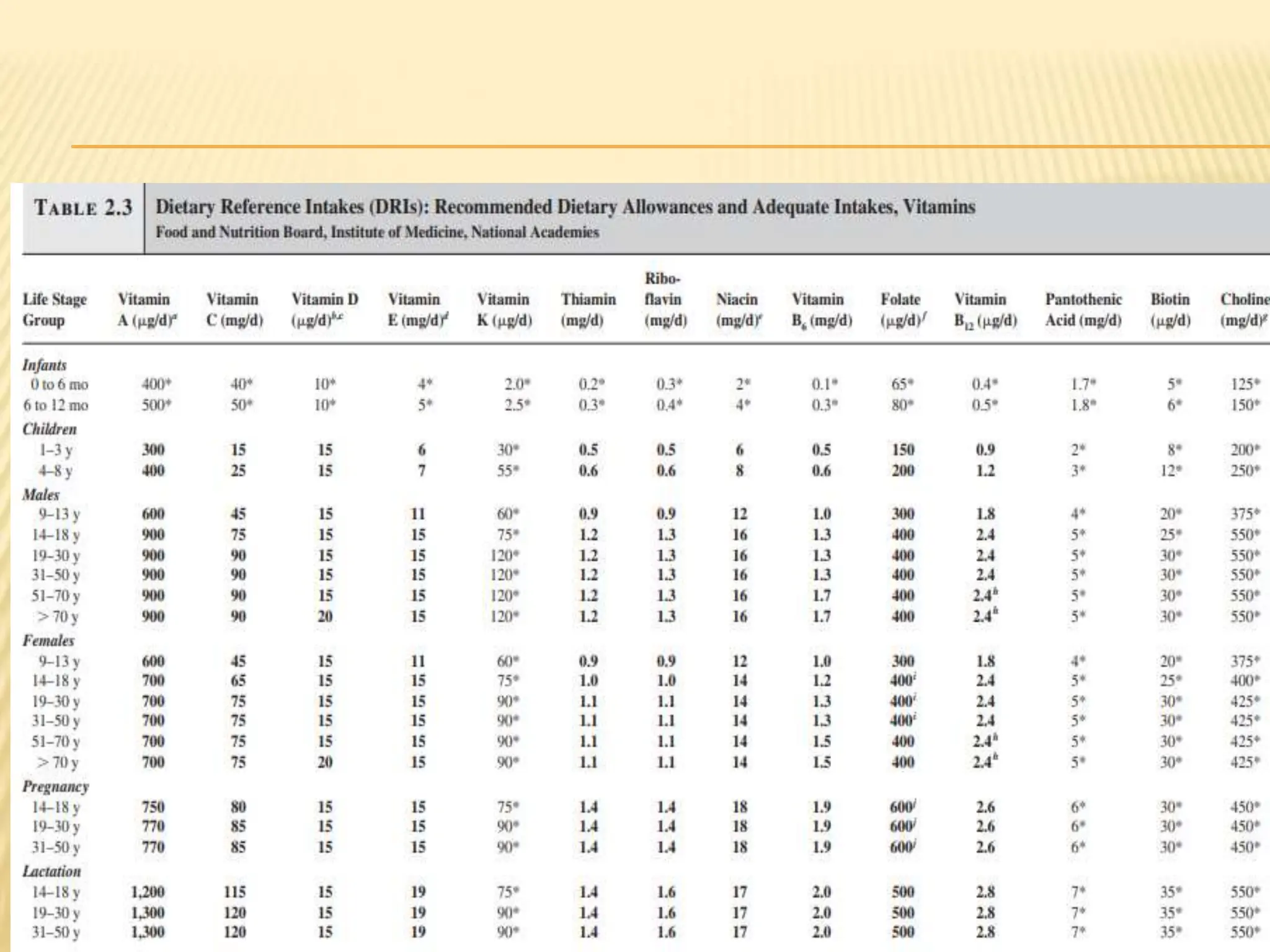
Recommended dietary Allowances for Specific Nutrietns
DRIs:Estimated Average Requirements
IN SUMMARY
🞭 The Dietary Reference Intakes (DRI) are a set
of nutrient intake values that can be used to
plan and evaluate diets for healthy people.
🞭 The Estimated Average Requirement ( EAR)
defines the amount of a nutrient that supports a
specific function in the body for half of the
population.
🞭 The Recommended Dietary Allowance ( RDA) is
based on the Estimated Average Requirement
and establishes a goal for dietary intake that will
meet the needs of almost all
Dietary assessment methods
Dietary assessment
Dietary assessment is an evaluation of food and nutrient
intake and dietary pattern of an individual or individuals in the
household or population group over time. It is one of the four
approaches in nutrition assessment to evaluating the
nutritional status of individuals comprehensively. The other
three are anthropometrics, biochemical parameters and
clinical examination (Gibson, 2005). Dietary assessment
methods are usually categorized according to the nature of the
method used as shown in Figure 1.
1. Indirect methods utilize secondary data for assessing diets,
while
2. Direct methods collect primary dietary data from
individuals.
Methods of Dietary Assessment
Figure 1 - Overview of dietary assessment methods to estimate food and nutrient
consumption at national, household and individual level
Indirect methods
Indirect methods
 use secondary information (e.g. food supply, agricultural statistics,
food expenditure) to estimate food available for consumption at the
national and household levels.
Food Balance Sheet (FBS):
 Provides national-level food consumption estimates.
 Estimation from the perspective of food supply.
 Utilizes data on food production, imports, and exports.
Household Consumption and Expenditure Survey (HCES):
 . which provide food consumption information at household level.
 Estimates consumption from the viewpoint of food demand.
. Neither of the two methods directly obtain primary dietary data from
individuals to evaluate dietary intake or food consumption on an
individual basis. Indirect methods are useful for identifying trends in
food availability and consumption across different geographical
regions and time.

Dietary Referance Intake DRI Lec 4th sem.pptx

  • 1.
    THE DIETARY REFERENCEINTAKES (DRI)
  • 2.
    Dietary reference intakes Dietaryreference intakes: • Introduction: Using the results of thousands of research studies, nutrition experts have produced a set of standards that define the amounts of energy, nutrients, other dietary components, and physical activity that best support health. These recommendations are called Dietary Reference Intakes (DRI). These recommendations apply to healthy people and may not be appropriate for people with diseases that increase or decrease nutrient needs. The next several paragraphs discuss specific aspects of how the committee goes about establishing the values that make up the DRI:
  • 3.
    THE DIETARY REFERENCEINTAKES (DRI) 🞭 The DRI Committee consists of highly qualified scientists who base their estimates of nutrient needs on careful examination and interpretation of scientific evidence. Don't let the DRI alphabet soup of nutrient intake standards confuse you. Their names make sense when you learn their purposes.
  • 4.
    THE DIETARY REFERENCEINTAKES (DRI) 🞭 Establishing Nutrient Recommendations 🞭 EAR: Estimated Average Requirement (EAR) The Estimated Average Requirement (EAR) is defined as “the daily intake value that is estimated to meet the requirement, as defined by the specified indicator of adequacy, in half of the apparently healthy individuals in a life stage or gender group defines the requirement of a nutrient that supports a specific function in the body for half of the healthy population. 🞭 The committee reviews hundreds of research studies to determine the requirement for a nutrient how much is needed in the diet. 🞭 The intake that meets the estimated nutrient need of 50% individuals. 🞭 The EAR serves as the basis for setting the Recommended Dietary Allowance (RDA). If an EAR cannot be established, then an RDA cannot be set © 2008 Thomson - Wadsworth
  • 5.
    DRI Committee definesnutrient requirement as the minimal intake sustaining defined nutriture. For EAR, specific adequacy criteria are chosen based on literature, varying across life stages. Criteria include preventing deficiency diseases, measuring nutrient levels in tissues, and maintaining metabolic pathways. Adjustments for insufficient data on children, adolescents, and pregnant/lactating females involve referencing adult EAR or accounting for increased needs during pregnancy. Chronic disease risk reduction is considered, but data on nutrient effects on morbidity/mortality in the US and Canada are limited.
  • 6.
    THE DIETARY REFERENCEINTAKES (DRI) 🞭 Establishing Nutrient Recommendations 🞭 RDA: Recommended Dietary Allowances (RDA) Once a nutrient requirement is established (EAR), the committee must decide what intake to recommend for everybody 🞭 (RDA) uses the EAR as a base and includes sufficient daily amounts of nutrients to meet the known nutrient needs of practically all healthy populations (almost all -97 to 98%) 🞭 This recommendation considers deficiencies. This is set above the EAR. © 2008 Thomson - Wadsworth
  • 7.
  • 8.
    What are theBenefits of Recommended Dietary Allowance (RDA) for Nutrition 1.Individual Nutrient Guidance: The RDA provides specific guidance on the amounts of various nutrients needed for a healthy diet. It acts as an effective tool for evaluating nutrient adequacy on an individual level. 2.Prevention of Nutrient Deficiency: By adhering to the RDA guidelines, individuals can prevent nutritional deficiencies, which could otherwise lead to serious health complications. 3.Promotion of Overall Health: Following the RDA helps promote overall health and well-being. It ensures the proper functioning of various body systems, including immune health, bone health, and energy production. 4.Scientific Basis: The RDA is based on scientific research and evidence, ensuring the recommendations provided are reliable and valid. 5.Foundation for Dietary Planning: The RDA serves as a foundation for dietary planning at individual and group levels. It aids in the formation of dietary guidelines, meal planning for institutions, and nutritional policies
  • 9.
    What are theRisks of Recommended Dietary Allowance (RDA) for Nutrition? 1.Individual Variability: The RDA might not cater to individual variability in nutrient requirements due to factors such as genetic makeup, health status, and lifestyle. As such, it may not fully address the needs of all individuals. 2.Potential for Overconsumption: Misinterpretation of the RDA as a nutrient target, rather than a guideline, could lead to overconsumption of certain nutrients. This can potentially lead to nutrient toxicity and associated health complications. 3.Not Comprehensive: The RDA does not account for all nutrients. Particularly for those nutrients for which there is insufficient scientific data, the RDA may fall short in providing guidelines. 4.Not Tailored to Special Conditions: The RDA does not take into consideration special dietary needs due to illnesses, pregnancy, or specific physiological conditions. Individuals with these conditions may require more personalized nutritional advice. 5.Doesn’t Address Food Quality: The RDA focuses on nutrient quantities, not the quality of the food consumed. As a result, it might not reflect the benefits associated with consuming whole, unprocessed foods.
  • 10.
    Adequate Intakes (AI) Forsome nutrients, such as calcium, there is insufficient scientific evidence to determine an Estimated Average Requirement (which is needed to set an RDA). In these cases, the committee establishes an Adequate Intake (AI) instead of an RDA. ‘An AI reflects the average amount of a nutrient that a group of healthy people consumes’. Like the RDA, the AI may be used as a nutrient goal for individuals. Although both the RDA and the AI serve as nutrient intake goals for individuals, their differences are noteworthy. An RDA for a given nutrient is based on enough scientific evidence to expect that the needs of almost all healthy people will be met. An AI, on the other hand, must rely more heavily on scientific judgments because sufficient evidence is lacking. The percentage of people covered by an AI is unknown; an AI is expected to exceed average requirements, but it may cover more or fewer people than an RDA would cover (if an RDA could be determined). For these reasons, AI values are more uncertain than RDA. The table on the inside front cover identifies which nutrients have an RDA and which have an AI.
  • 11.
    THE DIETARY REFERENCEINTAKES (DRI) 🞭 Establishing Nutrient Recommendations 🞭 AI: Adequate Intakes (AI) reflect the average daily amount of a nutrient without an established RDA that appears to be sufficient. 🞭 For some nutrients, there is insufficient scientific evidence to determine an Estimated Average Requirement ( which is needed to set an RDA). 🞭 UL: Tolerable Upper Intake Level (UL) is a maximum daily amount of a nutrient that appears safe for most healthy people and beyond which there is an increased risk of adverse health effects. 🞭 Individual tolerances for high doses of nutrients vary… a point beyond which a nutrient is likely to become toxic. This point is known as the Tolerable Upper Intake Level ( UL). © 2008 Thomson - Wadsworth
  • 12.
    Establishing Energy Recommendations EstablishingEnergy Recommendations In contrast to the RDA and AI values for nutrients, the recommendation for energy is not generous. Excess energy cannot be readily excreted and is eventually stored as body fat. These reserves may be beneficial when food is scarce, but they can also lead to obesity and its associated health consequences.
  • 13.
    Estimated Energy Requirement(EER) The energy recommendation—called the Estimated Energy Requirement (EER)—represents the average dietary energy intake (kcalories per day) that will maintain energy balance in a person who has a healthy body weight ♦ and level of physical activity. Balance is key to the energy recommendation. Enough energy is needed to sustain a healthy and active life, but too much energy can lead to weight gain and obesity. Because any amount in excess of energy needs will result in weight gain, no upper level for energy has been determined. Formula:Adult male: EER = 662 − [9.53 X age (y)] + PA X [15.91 X wt (kg) + 539.6 X ht (m)] Adult female: EER = 354 − [6.91 x age (y)] + PA x [9.36 x wt (kg) + 726 x ht (m)]
  • 14.
    © 2008 Thomson- Wadsworth THE DIETARY REFERENCE INTAKES (DRI) Acceptable Macronutrient Distribution Ranges (AMDR) People don’t eat energy directly; they derive energy from foods containing carbohydrates, fats, and proteins. Each of these three energy-yielding nutrients contributes to the total energy intake, and those contributions vary in relation to one another. The DRI Committee has determined that the composition of a diet that provides adequate energy and nutrients and reduces the risk of chronic diseases is: Acceptable Macronutrient Distribution Range (AMDR) represents the range of intakes for energy nutrients that provide adequate energy and nutrients and reduce risk of chronic disease. 🞭 45 - 65 percent kcalories from carbohydrate • 🞭 20 - 35 percent kcalories from fat • 🞭 10 - 35 percent kcalories from protein
  • 16.
    Recommended dietary Allowancesfor Specific Nutrietns
  • 17.
  • 22.
    IN SUMMARY 🞭 TheDietary Reference Intakes (DRI) are a set of nutrient intake values that can be used to plan and evaluate diets for healthy people. 🞭 The Estimated Average Requirement ( EAR) defines the amount of a nutrient that supports a specific function in the body for half of the population. 🞭 The Recommended Dietary Allowance ( RDA) is based on the Estimated Average Requirement and establishes a goal for dietary intake that will meet the needs of almost all
  • 23.
  • 24.
    Dietary assessment Dietary assessmentis an evaluation of food and nutrient intake and dietary pattern of an individual or individuals in the household or population group over time. It is one of the four approaches in nutrition assessment to evaluating the nutritional status of individuals comprehensively. The other three are anthropometrics, biochemical parameters and clinical examination (Gibson, 2005). Dietary assessment methods are usually categorized according to the nature of the method used as shown in Figure 1. 1. Indirect methods utilize secondary data for assessing diets, while 2. Direct methods collect primary dietary data from individuals.
  • 25.
    Methods of DietaryAssessment Figure 1 - Overview of dietary assessment methods to estimate food and nutrient consumption at national, household and individual level
  • 26.
    Indirect methods Indirect methods use secondary information (e.g. food supply, agricultural statistics, food expenditure) to estimate food available for consumption at the national and household levels. Food Balance Sheet (FBS):  Provides national-level food consumption estimates.  Estimation from the perspective of food supply.  Utilizes data on food production, imports, and exports. Household Consumption and Expenditure Survey (HCES):  . which provide food consumption information at household level.  Estimates consumption from the viewpoint of food demand. . Neither of the two methods directly obtain primary dietary data from individuals to evaluate dietary intake or food consumption on an individual basis. Indirect methods are useful for identifying trends in food availability and consumption across different geographical regions and time.