Introduction
• A variety of disorders (severe sepsis, systemic inflammatory conditions,
trauma, and malignant disease) will lead to activation of the coagulation
system.
• In many cases, this coagulation will not result in clinical complications
and will not even be identified by routine laboratory tests
• However, if the activation of coagulation is sufficiently strong,
consumption of platelets and coagulation proteins may become visible
 result in prolongation of clotting test and thrombocytopenia
• Systemic activation of coagulation  DIC
• DIC is always secondary to an underlying condition causing activation
of coagulation
Definition
• 2001 International Society on Thrombosis and Hemostasis (ISTH)
• “DIC is an acquired syndrome characterized by the intravascular activation of
coagulation without a specific localization and arising from different causes. It
can originate from and cause damage to the microvasculature, which if
sufficiently severe, can produce organ dysfunction.
Classification
• Non-overt (early)
• Overt (decompensated)
• Acute
• Chronic
Disseminated Intravascular Coagulation
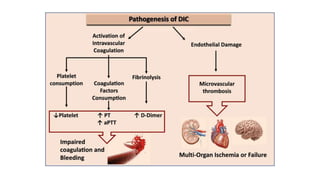
• Characterized by the simultaneous occurrence of widespread vascular clot
deposition, compromising an adequate blood supply to various organs  result
in organ failure
• Thrombin generation in DIC is initiated through the tissue factor/ factor VII(a)
pathway that activates downstream coagulation factors
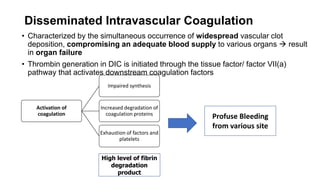
Activation of
coagulation
Impaired synthesis
Increased degradation of
coagulation proteins
Exhaustion of factors and
platelets
High level of fibrin
degradation
product
Profuse Bleeding
from various site
DIC INTRODUCTION.pptx

DIC INTRODUCTION.pptx

  • 1.
    Introduction • A varietyof disorders (severe sepsis, systemic inflammatory conditions, trauma, and malignant disease) will lead to activation of the coagulation system. • In many cases, this coagulation will not result in clinical complications and will not even be identified by routine laboratory tests • However, if the activation of coagulation is sufficiently strong, consumption of platelets and coagulation proteins may become visible  result in prolongation of clotting test and thrombocytopenia • Systemic activation of coagulation  DIC • DIC is always secondary to an underlying condition causing activation of coagulation
  • 2.
    Definition • 2001 InternationalSociety on Thrombosis and Hemostasis (ISTH) • “DIC is an acquired syndrome characterized by the intravascular activation of coagulation without a specific localization and arising from different causes. It can originate from and cause damage to the microvasculature, which if sufficiently severe, can produce organ dysfunction.
  • 4.
    Classification • Non-overt (early) •Overt (decompensated) • Acute • Chronic
  • 6.
    Disseminated Intravascular Coagulation •Characterized by the simultaneous occurrence of widespread vascular clot deposition, compromising an adequate blood supply to various organs  result in organ failure • Thrombin generation in DIC is initiated through the tissue factor/ factor VII(a) pathway that activates downstream coagulation factors Activation of coagulation Impaired synthesis Increased degradation of coagulation proteins Exhaustion of factors and platelets High level of fibrin degradation product Profuse Bleeding from various site

Editor's Notes

  • #7 Ongoing activation of coagulation  impaired synthesis + increased degradation of coagulation proteins and protease inhibitors + exhaustion of factors and platelets  profuse bleeding from various sites High level of fibrin degradation product  affect platelet function and fibrin cross linking  bleeding