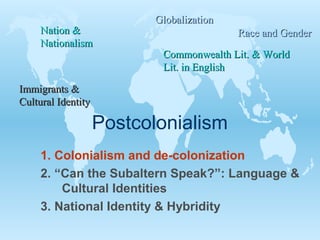
Postcolonialism
1. Colonialism and de-colonization
2. “Can the Subaltern Speak?”: Language &
Cultural Identities
3. National Identity & Hybridity
Nation &Nation &
NationalismNationalism
GlobalizationGlobalization
Race and GenderRace and Gender
Commonwealth Lit. & WorldCommonwealth Lit. & World
Lit. in EnglishLit. in English
Immigrants &Immigrants &
Cultural IdentityCultural Identity
Colonialism and de-colonization
1. From Form to Race, Starting Questions
2. Colonialism defined; physical and economic
exploitation
3. Cultural Imperialism: 1) definition; 2) Colonial
Discourse—e.g. Orientalism; 3) science
4. Cultural Imperialism: cultural & literary Examples
5. Colonial Mentality (& the relations between the
colonized and colonizer)
6. Effects of cultural imperialism;
7. De-colonization (& post-colonial resistance)
From Form to Race
1. Form—textual and linguistic:
literary forms (e.g. organic form),
linguistic forms (e.g. semiotic rectangle, différance)
2. From Text to Context:
Social forms (e.g. discourse, hierarchy, etc.)
Postmodern forms (e.g. metafiction, pastiche)
Colonial & Postcolonial forms (e.g. mental/power
structure, lit: parody, historical re-vision)
Starting Questions
What are the examples of colonialism? Is KMT’s
regime an example?
What are the examples of colonial thinking (e.g. the
racial/cultural prejudices and stereotypes) in
“English” Literature?
Is de-colonization possible?
How do we or the colonized resist colonialism in life
and through literature?
Is it racist to call foreigns 鬼佬,番仔,老外?
Colonialism: Definition and
Kinds
Definition: colonialism --military,
economic, cultural oppression &
domination of one country over another.
Kinds:
1. Invasion-colonization;
2. Settlement-colonization;
3. Internal Colonialism;
4. Neo-Colonialism
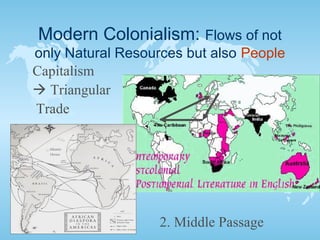
Modern Colonialism: Flows of not
only Natural Resources but also People
Capitalism
 Triangular
Trade
2. Middle Passage
Colonialism: flows of migration
Flows of Migrants
1st
World Colonial
powers:
Adventurers,
Merchants, army,
travelers,
missionaries,
immigrants
“Third World”:
Slaves,
Contract laborers,
Students,
businessmen, etc.
Triangular Trade
This trade is a source of wealth to tribal chiefs, to
the shipping business, to plantation owners in the
South of U.S., and to merchants and shipbuilders
in the North.  For the Africans, it means
displacement and/or death.
An estimated 8 to 15 million Africans reached the
Americas from the 16th through the 19 century,
with a peak of about 6 million arriving in the 18th
century alone. (another estimate)
Replaced by Indentured Labour in the 19th
century
Middle Passage
“. . . it has been estimated that between
30 and 60 million Africans were
subjected to this horrendous triangular
trade system and that only one third-of
those people survived...' (source)
” All of it is now it is always now there
will never be a time when I am not
crouching and watching others who are
crouching too I am always crouching"
Beloved by Toni Morrison
Middle Passage
left: structure of the ship
Right: by TomRight: by Tom
FeelingsFeelings
cultural imperialism (1): Theories
 1. Culture (e.g. literature, language, popular culture)
supports imperialism and is one way to spread it.
The definition of the self and others are based
upon representations rather than reality 。
 2. Also called neo-colonialism; Supported by its
economic power, one culture (e.g. of films, foods)
dominates over the other cultures. (related to
globalization and free trade agreements)
The West as civilized,
just, moral, industrious,
rational, democratic
Masculine
The Oriental as savage,
lewd, lazy, superstitious,
irrational, despotic
feminine
Colonial Discourse—
Orientalism as an example
(textbook 203- 206) Orientalism –presenting the
East as “the Other”, or as “the exotic” e.g. Arabian
Nights & Oriental women
1) Said’s book: about Islamic Middle East;
2) a discourse, (knowledge = disciplinary
power; structure of formation and
circulation)
3) hegemony  control by consent
4) possible problems: homogenizing the
East, and the West.
後結構︰
Foucault
Colonial Discourse (3):
power & knowledge
Racial difference =
biological difference 
Africans = black skin,
small brain + savagery
e.g. Darwin The Descent
of Man (1871); C Murray
and R. J. Herrnstein The
Bell Curve (1994)
differences of whites’ and
black’s IQ test
performances caused by
their genetic differences.
Stereotyping supported
by scientific studies
Cultural Imperialism (1): White Center
Mr & Mrs Andrews, 1748-9 Thomas Gainsborough source
cultural imperialism (2):
representation of “blackness”
cultural imperialism (2):
representation of “blackness”
French harem fantasy
with a black eunuch
servant. The link
between popularized
orientalism &
libidinization is
obvious. "Les petits voyages de
Paris-Plaisirs."--Paris Plaisir, Feb.
1930. (Image and text from Jan
Nederveen Pieterse's White on
Black: Images of Africa and Blacks
in Western Popular Culture. New
Haven: Yale UP, 1992) Source
cultural imperialism (2):

cultural imperialism (2):
representation of “Otherness”
Humanitarian or commercial
interest?
cultural imperialism (3):
Literary Examples
(1). “discovery+education” = possession
and exploitation
 The Tempest– Caliban
 Robinson Crusoe– Friday
“PROSPERO: Thou poisonous slave, got by the devil
himself
Upon thy wicked dam, come forth!
. . .
CALIBAN You taught me language; and my
profit on't
Is, I know how to curse. ”
cultural imperialism (3):
Literary Examples
(2). Economic support the power of the
Empire, decorating its polite society
 Mansfield Park– dependant on the business
from the West Indian Estate (in Antigua)
 And many other Victorian novels.
(3) “Other-ed” and used as symbol of
madness & darkness:
 Jane Eyre –the madwoman Bertha;
 Heart of Darkness --
Africa: Heart of Darkness
Africa = darkness, stage for self-or-sexual discovery
and power struggle
"The conquest of the earth, which mostly means the
taking it away from those who have a different
complexion or slightly flatter noses than ourselves, is
not a pretty thing when you look at it too much. What
redeems it is the idea only. An idea at the back of it:
not a sentimental pretence but an idea; an unselfish
belief in the idea something you can set up, and bow
down before, and offer sacrifice to…“ (Joseph
Conrad's Heart of Darkness)
Others: Out of Africa, Sheltering Sky, The English
Patient.
cultural imperialism (3): Heart
of Darkness
 “'Mistah Kurtz -- he dead.' "All the
pilgrims rushed out to see. I remained, and
went on with my dinner. I believe that I was
considered brutally callous. However, I did
not eat much. There was a lamp in there --
light, don't you know -- and outside it was
so beastly, beastly dark. I went no more near
the remarkable man who had pronounced a
judgment upon the adventures of his soul on
this earth. The voice was gone. What else had
been there? ”
cultural imperialism (4):
Education
2. The East:
 English Studies in India
 Taiwan: Popularity of translations of
American novels such as those of
Hemingway and Jack London.
 Taiwan: Un-self-reflective absorption of
English literary canon/values
cultural imperialism (4): Ethnic Colors
Furniture
from
Artikeln
Colonial mentality
(textbook: 206-)
Colonial identity – defined through
difference with ‘others’ and “the Other.’
Cultural Imperialism: Effects
self-hatred [inferiority complex] or self-
annihilation: blackness confirms the white self,
but whiteness empties the black subject.”
(e.g.: F. Fanon “. . .the black man is not a man.”
e.g. laziness as “a conscious sabotage of the
colonial machine” Loomba 143-44)
Split Subject: Black Skin, White Mask; e.g. 阿
爸的情人 clip 14
Resistance
Colonizer vs. colonized
(Homi Bhabha textbook p. 209-210)
Two ways to challenge colonial identity:
Différance/Dissemination of colonial
culture and its mimicry
Hybridity
Post-Structuralist + Post-Colonial:
Mimicry
C
center
Colonial Mimicry:
All the same but not
quite– e.g. Indian
gentleman or Indian
celebration of U.K.’s
national day.
Taiwanese Imitations:
bell-bottom, rock and roll
Différance= Dissemination
De-Colonization: history
1945 -- 750 million people - a third of the world's
population - lived in Territories that were non-self-
governing, dependent on colonial Powers.
British decolonization, 1945–56 (e.g. India); Wars
in overseas France, 1945–56 (e.g. Vietnam)
The Sinai-Suez campaign (October–November
1956)
a federal Malaysian government (1957); Hong
Kong (1997). Algeria and French decolonization,
from 1956
 colonization is not over; internal fractures;
 “The Empire Strikes back.”
Post-Colonial Resistance
Positions: the subaltern, postcolonial intellectuals
(exiles or at home), rejecting the past etc.
Means: Language, History and (personal,
cultural, national )Identity
Strategies: Between Nativism & Assimilation.
Mimicry
Separati-
Sm;
open
rebellion
Re-
Creation;
Cultural
Syncreticism
; negotiation
Active
participa-
tion
Appropriation
Post-Colonial Resistance (2)
Examples:
Separatism vs. Cultural Syncreticism:
Chinua Achebe vs. Ngugi wa Thiong'o
(Writing in Gikuyu) clip 1
Re-Creation ; 鄉土文學、台灣新電影(冬冬
的假期﹚
reinterprete the signs 
parody
Mimicry: e.g. 戲夢人生 clip 5 , Buddha
Bless America, clips 21, 23
Appropriation;
Reference
Loomba, Ania.
Colonialism/Postcolonialism. NY:
Routeledge, 1998.

Postcolonialism 1

  • 1.
    Postcolonialism 1. Colonialism andde-colonization 2. “Can the Subaltern Speak?”: Language & Cultural Identities 3. National Identity & Hybridity Nation &Nation & NationalismNationalism GlobalizationGlobalization Race and GenderRace and Gender Commonwealth Lit. & WorldCommonwealth Lit. & World Lit. in EnglishLit. in English Immigrants &Immigrants & Cultural IdentityCultural Identity
  • 2.
    Colonialism and de-colonization 1.From Form to Race, Starting Questions 2. Colonialism defined; physical and economic exploitation 3. Cultural Imperialism: 1) definition; 2) Colonial Discourse—e.g. Orientalism; 3) science 4. Cultural Imperialism: cultural & literary Examples 5. Colonial Mentality (& the relations between the colonized and colonizer) 6. Effects of cultural imperialism; 7. De-colonization (& post-colonial resistance)
  • 3.
    From Form toRace 1. Form—textual and linguistic: literary forms (e.g. organic form), linguistic forms (e.g. semiotic rectangle, différance) 2. From Text to Context: Social forms (e.g. discourse, hierarchy, etc.) Postmodern forms (e.g. metafiction, pastiche) Colonial & Postcolonial forms (e.g. mental/power structure, lit: parody, historical re-vision)
  • 4.
    Starting Questions What arethe examples of colonialism? Is KMT’s regime an example? What are the examples of colonial thinking (e.g. the racial/cultural prejudices and stereotypes) in “English” Literature? Is de-colonization possible? How do we or the colonized resist colonialism in life and through literature? Is it racist to call foreigns 鬼佬,番仔,老外?
  • 5.
    Colonialism: Definition and Kinds Definition:colonialism --military, economic, cultural oppression & domination of one country over another. Kinds: 1. Invasion-colonization; 2. Settlement-colonization; 3. Internal Colonialism; 4. Neo-Colonialism
  • 6.
    Modern Colonialism: Flowsof not only Natural Resources but also People Capitalism  Triangular Trade 2. Middle Passage
  • 7.
    Colonialism: flows ofmigration Flows of Migrants 1st World Colonial powers: Adventurers, Merchants, army, travelers, missionaries, immigrants “Third World”: Slaves, Contract laborers, Students, businessmen, etc.
  • 8.
    Triangular Trade This tradeis a source of wealth to tribal chiefs, to the shipping business, to plantation owners in the South of U.S., and to merchants and shipbuilders in the North.  For the Africans, it means displacement and/or death. An estimated 8 to 15 million Africans reached the Americas from the 16th through the 19 century, with a peak of about 6 million arriving in the 18th century alone. (another estimate) Replaced by Indentured Labour in the 19th century
  • 9.
    Middle Passage “. .. it has been estimated that between 30 and 60 million Africans were subjected to this horrendous triangular trade system and that only one third-of those people survived...' (source) ” All of it is now it is always now there will never be a time when I am not crouching and watching others who are crouching too I am always crouching" Beloved by Toni Morrison
  • 10.
    Middle Passage left: structureof the ship Right: by TomRight: by Tom FeelingsFeelings
  • 11.
    cultural imperialism (1):Theories  1. Culture (e.g. literature, language, popular culture) supports imperialism and is one way to spread it. The definition of the self and others are based upon representations rather than reality 。  2. Also called neo-colonialism; Supported by its economic power, one culture (e.g. of films, foods) dominates over the other cultures. (related to globalization and free trade agreements) The West as civilized, just, moral, industrious, rational, democratic Masculine The Oriental as savage, lewd, lazy, superstitious, irrational, despotic feminine
  • 12.
    Colonial Discourse— Orientalism asan example (textbook 203- 206) Orientalism –presenting the East as “the Other”, or as “the exotic” e.g. Arabian Nights & Oriental women 1) Said’s book: about Islamic Middle East; 2) a discourse, (knowledge = disciplinary power; structure of formation and circulation) 3) hegemony  control by consent 4) possible problems: homogenizing the East, and the West. 後結構︰ Foucault
  • 13.
    Colonial Discourse (3): power& knowledge Racial difference = biological difference  Africans = black skin, small brain + savagery e.g. Darwin The Descent of Man (1871); C Murray and R. J. Herrnstein The Bell Curve (1994) differences of whites’ and black’s IQ test performances caused by their genetic differences. Stereotyping supported by scientific studies
  • 14.
    Cultural Imperialism (1):White Center Mr & Mrs Andrews, 1748-9 Thomas Gainsborough source
  • 15.
  • 16.
    cultural imperialism (2): representationof “blackness” French harem fantasy with a black eunuch servant. The link between popularized orientalism & libidinization is obvious. "Les petits voyages de Paris-Plaisirs."--Paris Plaisir, Feb. 1930. (Image and text from Jan Nederveen Pieterse's White on Black: Images of Africa and Blacks in Western Popular Culture. New Haven: Yale UP, 1992) Source
  • 17.
  • 18.
    cultural imperialism (2): representationof “Otherness” Humanitarian or commercial interest?
  • 19.
    cultural imperialism (3): LiteraryExamples (1). “discovery+education” = possession and exploitation  The Tempest– Caliban  Robinson Crusoe– Friday “PROSPERO: Thou poisonous slave, got by the devil himself Upon thy wicked dam, come forth! . . . CALIBAN You taught me language; and my profit on't Is, I know how to curse. ”
  • 20.
    cultural imperialism (3): LiteraryExamples (2). Economic support the power of the Empire, decorating its polite society  Mansfield Park– dependant on the business from the West Indian Estate (in Antigua)  And many other Victorian novels. (3) “Other-ed” and used as symbol of madness & darkness:  Jane Eyre –the madwoman Bertha;  Heart of Darkness --
  • 21.
    Africa: Heart ofDarkness Africa = darkness, stage for self-or-sexual discovery and power struggle "The conquest of the earth, which mostly means the taking it away from those who have a different complexion or slightly flatter noses than ourselves, is not a pretty thing when you look at it too much. What redeems it is the idea only. An idea at the back of it: not a sentimental pretence but an idea; an unselfish belief in the idea something you can set up, and bow down before, and offer sacrifice to…“ (Joseph Conrad's Heart of Darkness) Others: Out of Africa, Sheltering Sky, The English Patient.
  • 22.
    cultural imperialism (3):Heart of Darkness  “'Mistah Kurtz -- he dead.' "All the pilgrims rushed out to see. I remained, and went on with my dinner. I believe that I was considered brutally callous. However, I did not eat much. There was a lamp in there -- light, don't you know -- and outside it was so beastly, beastly dark. I went no more near the remarkable man who had pronounced a judgment upon the adventures of his soul on this earth. The voice was gone. What else had been there? ”
  • 23.
    cultural imperialism (4): Education 2.The East:  English Studies in India  Taiwan: Popularity of translations of American novels such as those of Hemingway and Jack London.  Taiwan: Un-self-reflective absorption of English literary canon/values
  • 24.
    cultural imperialism (4):Ethnic Colors Furniture from Artikeln
  • 25.
    Colonial mentality (textbook: 206-) Colonialidentity – defined through difference with ‘others’ and “the Other.’
  • 26.
    Cultural Imperialism: Effects self-hatred[inferiority complex] or self- annihilation: blackness confirms the white self, but whiteness empties the black subject.” (e.g.: F. Fanon “. . .the black man is not a man.” e.g. laziness as “a conscious sabotage of the colonial machine” Loomba 143-44) Split Subject: Black Skin, White Mask; e.g. 阿 爸的情人 clip 14 Resistance
  • 27.
    Colonizer vs. colonized (HomiBhabha textbook p. 209-210) Two ways to challenge colonial identity: Différance/Dissemination of colonial culture and its mimicry Hybridity
  • 28.
    Post-Structuralist + Post-Colonial: Mimicry C center ColonialMimicry: All the same but not quite– e.g. Indian gentleman or Indian celebration of U.K.’s national day. Taiwanese Imitations: bell-bottom, rock and roll Différance= Dissemination
  • 29.
    De-Colonization: history 1945 --750 million people - a third of the world's population - lived in Territories that were non-self- governing, dependent on colonial Powers. British decolonization, 1945–56 (e.g. India); Wars in overseas France, 1945–56 (e.g. Vietnam) The Sinai-Suez campaign (October–November 1956) a federal Malaysian government (1957); Hong Kong (1997). Algeria and French decolonization, from 1956  colonization is not over; internal fractures;  “The Empire Strikes back.”
  • 30.
    Post-Colonial Resistance Positions: thesubaltern, postcolonial intellectuals (exiles or at home), rejecting the past etc. Means: Language, History and (personal, cultural, national )Identity Strategies: Between Nativism & Assimilation. Mimicry Separati- Sm; open rebellion Re- Creation; Cultural Syncreticism ; negotiation Active participa- tion Appropriation
  • 31.
    Post-Colonial Resistance (2) Examples: Separatismvs. Cultural Syncreticism: Chinua Achebe vs. Ngugi wa Thiong'o (Writing in Gikuyu) clip 1 Re-Creation ; 鄉土文學、台灣新電影(冬冬 的假期﹚ reinterprete the signs  parody Mimicry: e.g. 戲夢人生 clip 5 , Buddha Bless America, clips 21, 23 Appropriation;
  • 32.