Dr V Krishna Kumar
Senior Resident
Dept of Nephrology
 Chronic Kidney Disease is considered a
state of immunosupression and hence
patients with CKD are susceptible to
infections.
 Hence it is imperative that the patients are
given appropriate vaccination as and when
they are diagnosed as CKD
When patients are on hemodialysis, the
response to number of commonly used
vaccines are sub-optimal.
Moreover, when patients are planned for
transplant/transplanted already, some live
vaccines cannot be given.
Hence planning of vaccines is very
important
 All patients on HD except those with
HBsAg positivity should receive HBV
vaccine.
The chances of successful vaccination is
higher with double the dose of normal
amount.
 A total of 40 mcg HBsAg subunit vaccine
should be given as intramuscular injection
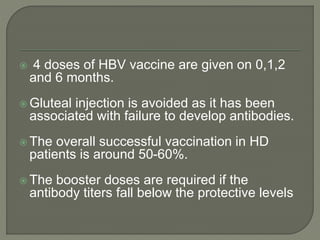
 4 doses of HBV vaccine are given on 0,1,2
and 6 months.
 Gluteal injection is avoided as it has been
associated with failure to develop antibodies.
 The overall successful vaccination in HD
patients is around 50-60%.
 The booster doses are required if the
antibody titers fall below the protective levels
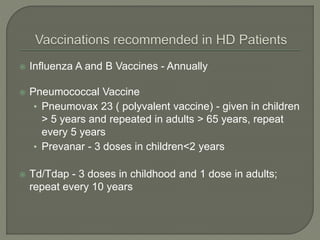
 Influenza A and B Vaccines - Annually
 Pneumococcal Vaccine
• Pneumovax 23 ( polyvalent vaccine) - given in children
> 5 years and repeated in adults > 65 years, repeat
every 5 years
• Prevanar - 3 doses in children<2 years
 Td/Tdap - 3 doses in childhood and 1 dose in adults;
repeat every 10 years
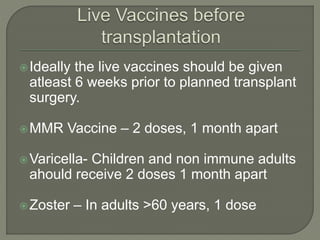
Ideally the live vaccines should be given
atleast 6 weeks prior to planned transplant
surgery.
MMR Vaccine – 2 doses, 1 month apart
Varicella- Children and non immune adults
ahould receive 2 doses 1 month apart
Zoster – In adults >60 years, 1 dose
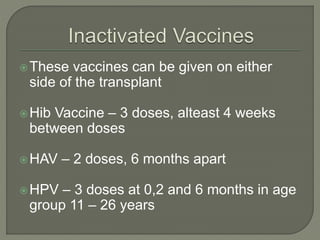
These vaccines can be given on either
side of the transplant
Hib Vaccine – 3 doses, alteast 4 weeks
between doses
HAV – 2 doses, 6 months apart
HPV – 3 doses at 0,2 and 6 months in age
group 11 – 26 years
VACCINATION.pptx

VACCINATION.pptx

  • 1.
    Dr V KrishnaKumar Senior Resident Dept of Nephrology
  • 2.
     Chronic KidneyDisease is considered a state of immunosupression and hence patients with CKD are susceptible to infections.  Hence it is imperative that the patients are given appropriate vaccination as and when they are diagnosed as CKD
  • 3.
    When patients areon hemodialysis, the response to number of commonly used vaccines are sub-optimal. Moreover, when patients are planned for transplant/transplanted already, some live vaccines cannot be given. Hence planning of vaccines is very important
  • 4.
     All patientson HD except those with HBsAg positivity should receive HBV vaccine. The chances of successful vaccination is higher with double the dose of normal amount.  A total of 40 mcg HBsAg subunit vaccine should be given as intramuscular injection
  • 5.
     4 dosesof HBV vaccine are given on 0,1,2 and 6 months.  Gluteal injection is avoided as it has been associated with failure to develop antibodies.  The overall successful vaccination in HD patients is around 50-60%.  The booster doses are required if the antibody titers fall below the protective levels
  • 6.
     Influenza Aand B Vaccines - Annually  Pneumococcal Vaccine • Pneumovax 23 ( polyvalent vaccine) - given in children > 5 years and repeated in adults > 65 years, repeat every 5 years • Prevanar - 3 doses in children<2 years  Td/Tdap - 3 doses in childhood and 1 dose in adults; repeat every 10 years
  • 7.
    Ideally the livevaccines should be given atleast 6 weeks prior to planned transplant surgery. MMR Vaccine – 2 doses, 1 month apart Varicella- Children and non immune adults ahould receive 2 doses 1 month apart Zoster – In adults >60 years, 1 dose
  • 8.
    These vaccines canbe given on either side of the transplant Hib Vaccine – 3 doses, alteast 4 weeks between doses HAV – 2 doses, 6 months apart HPV – 3 doses at 0,2 and 6 months in age group 11 – 26 years