“Do I actually have to
interact with students as
  well as teach them?”


    Valéria Benévolo França
During a training session being conducted by my colleague Guilherme
Pacheco, he was asked by a relatively inexperienced teacher: “Do I
actually have to interact with students as well as teach them?”
This question caused a degree of discomfort. One would have thought
that recent graduates, fed on a diet of “constructivist” and “learner-
centred teaching” approaches would „ve hardly asked this question.
But this novice teacher was truly shaken. She was still trying to come
to grips with handling the learners, the teaching context and her own
understanding of her role as a teacher.
Her question set me thinking: what was her interpretation of what it
meant to teach? How did she understand the role of interaction ? The
only clear thing was that the learner did not occupy centre-stage in her
lessons.
There was a degree of isolation between the teacher and learner.
The pervasiveness of technology: are we isolating
                                ourselves?
             I began wondering whether the pervasiveness of technology, with
             its possibility of actually promoting a degree of isolation
             (earphones isolating us from the outside world and external sounds
             and the impact which a tablet can have in the way we
             work, especially for chidlren, who seem to lose themselves in apps
             and find it difficult even to look up from the tablet) could already
             be changing some patterns of interaction within society.

                I know this may be understood as quite a radical comment and
                believe me, I am a great advocate of technology, but there are
                issues we need to reflect upon as educators .
Plus we have the recent additions to the clasroom in the form of
the IWB. Based on lesson observation it becomes clear that
whilst the potential of the IWB to engage and stimulate
language learning is tremendous, they can actually create a very
teacher-centred classroom
Metaphors for learning

Anna Sfard (who studies human thinking) proposes two metaphors for learning.

       Acquisition Metaphor vs. Participation Metaphor


Anna Sfard, On two metaphors for learning and the danger of
choosing just one, 1998


Anna concludes that we still need both metaphors AM & PM since they lead to
different & important learning experiences.

But thinking back to our teacher at the start, which metaphor do you think she
probably had as her reference for her teaching?
An existing metaphor for learning: a more traditional context


 Acquisition Metaphor

 “The language of “knowledge acquisition” and “concept
 development” makes us think about the human mind as a
 container to be filled with certain materials and about the
 learner as becoming an owner of these materials.”


 Anna Sfard, On two metaphors for learning and the danger of
 choosing just one, 1998, p.5
The learner as a receptor of knowledge


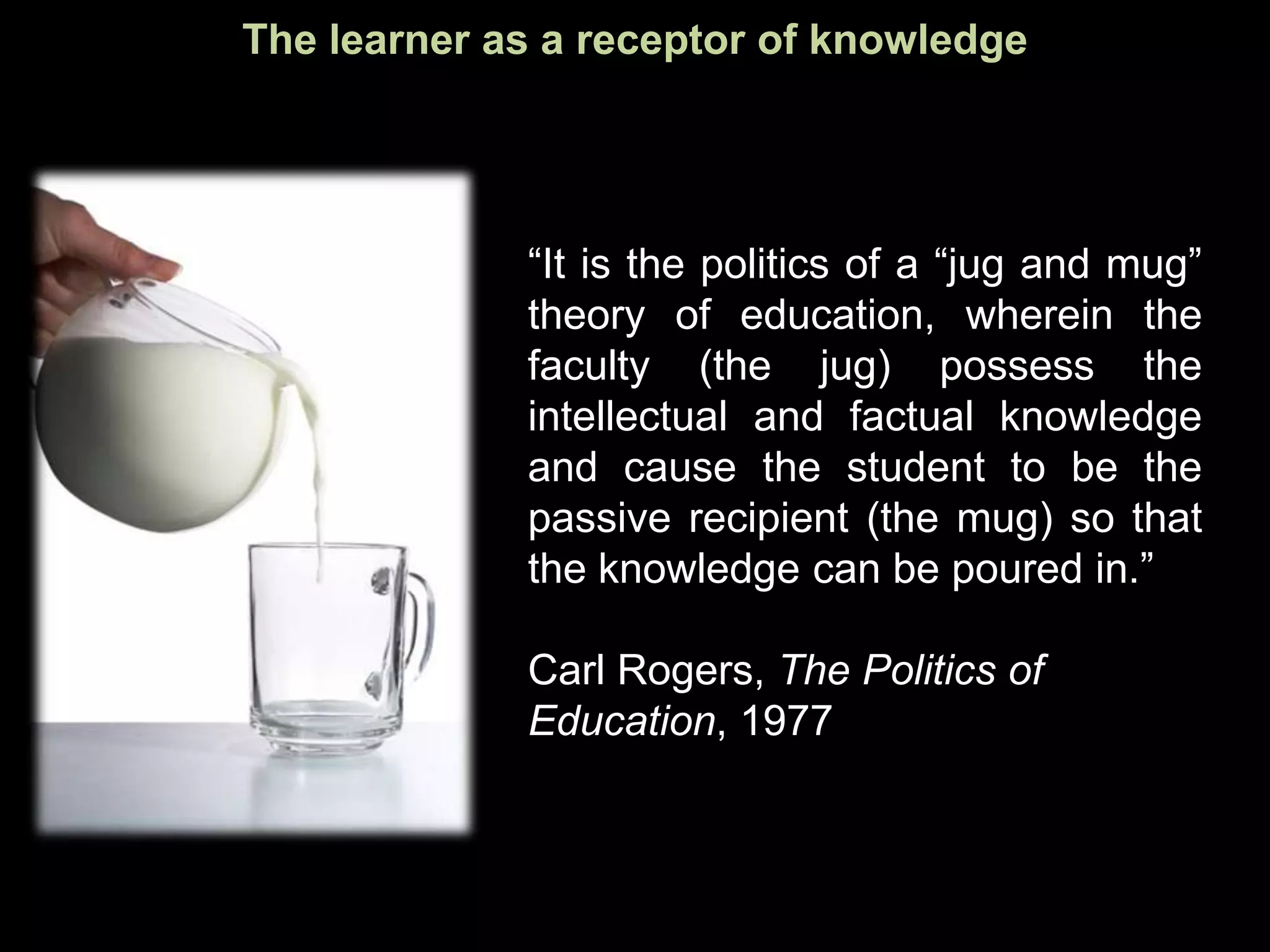
             “It is the politics of a “jug and mug”
             theory of education, wherein the
             faculty (the jug) possess the
             intellectual and factual knowledge
             and cause the student to be the
             passive recipient (the mug) so that
             the knowledge can be poured in.”

             Carl Rogers, The Politics of
             Education, 1977
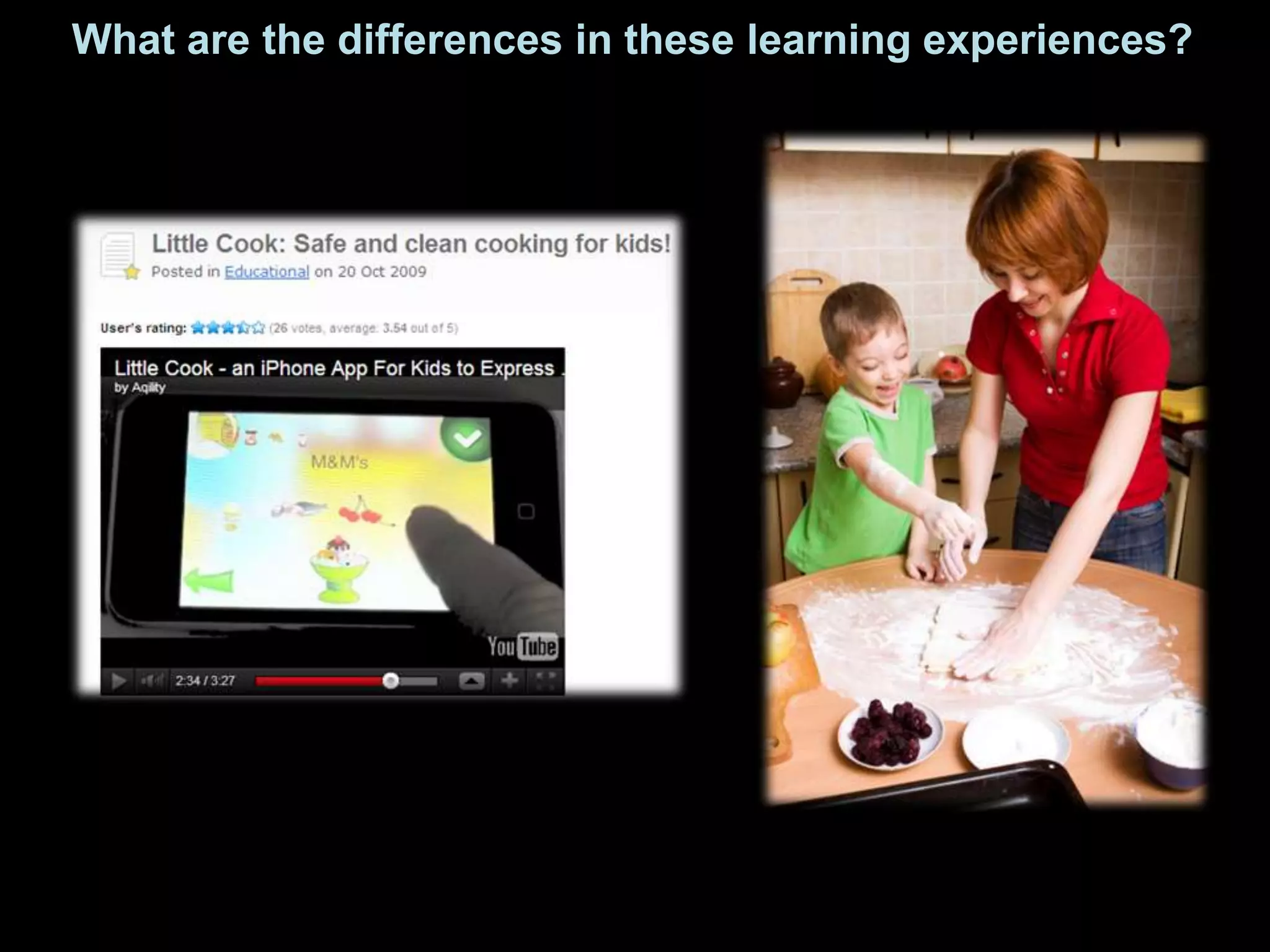
What are the differences in these learning experiences?
A safe and clean cooking experience?
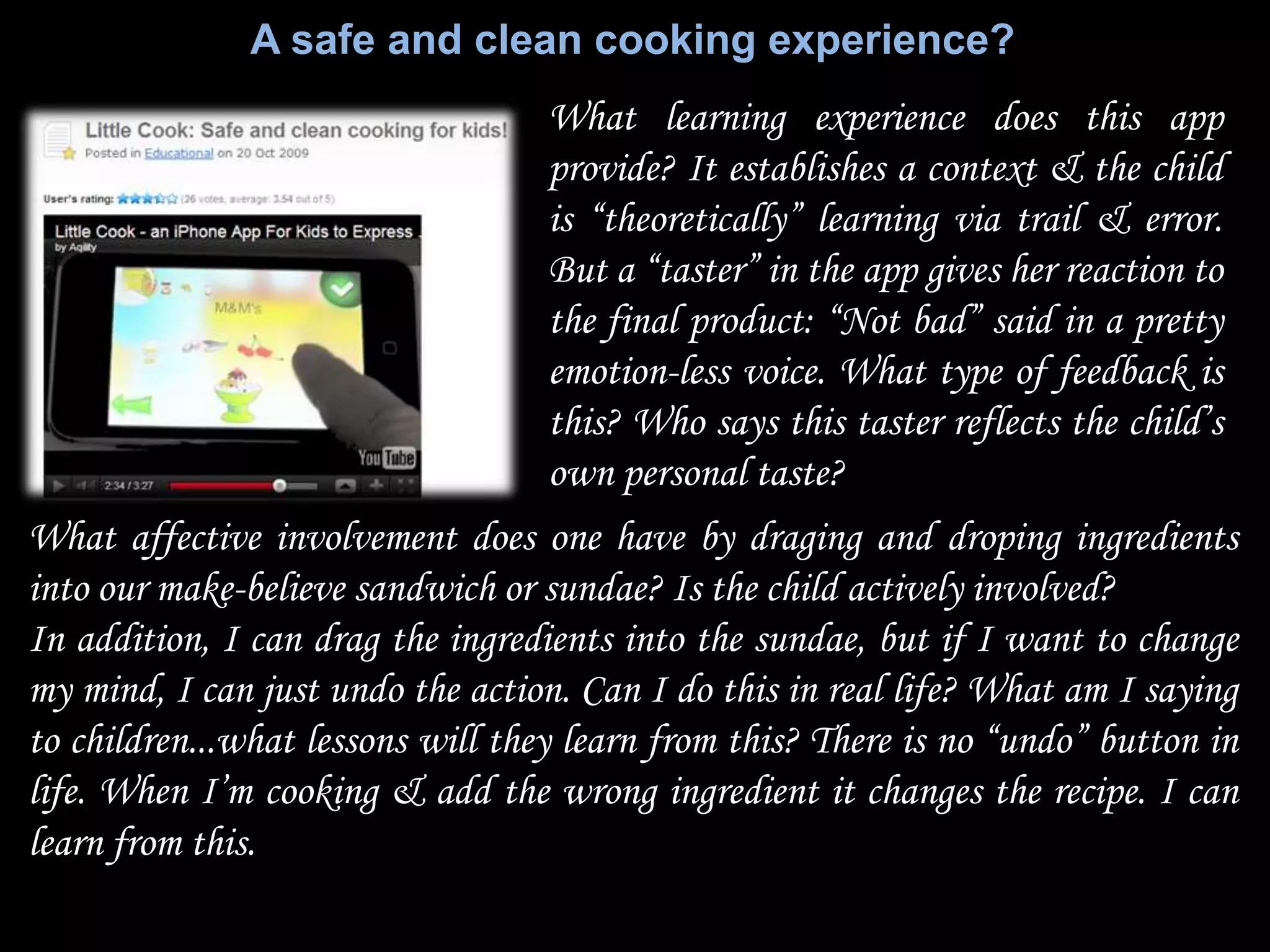
                                   What learning experience does this app
                                   provide? It establishes a context & the child
                                   is “theoretically” learning via trail & error.
                                   But a “taster” in the app gives her reaction to
                                   the final product: “Not bad” said in a pretty
                                   emotion-less voice. What type of feedback is
                                   this? Who says this taster reflects the child‟s
                                   own personal taste?
What affective involvement does one have by draging and droping ingredients
into our make-believe sandwich or sundae? Is the child actively involved?
In addition, I can drag the ingredients into the sundae, but if I want to change
my mind, I can just undo the action. Can I do this in real life? What am I saying
to children...what lessons will they learn from this? There is no “undo” button in
life. When I‟m cooking & add the wrong ingredient it changes the recipe. I can
learn from this.
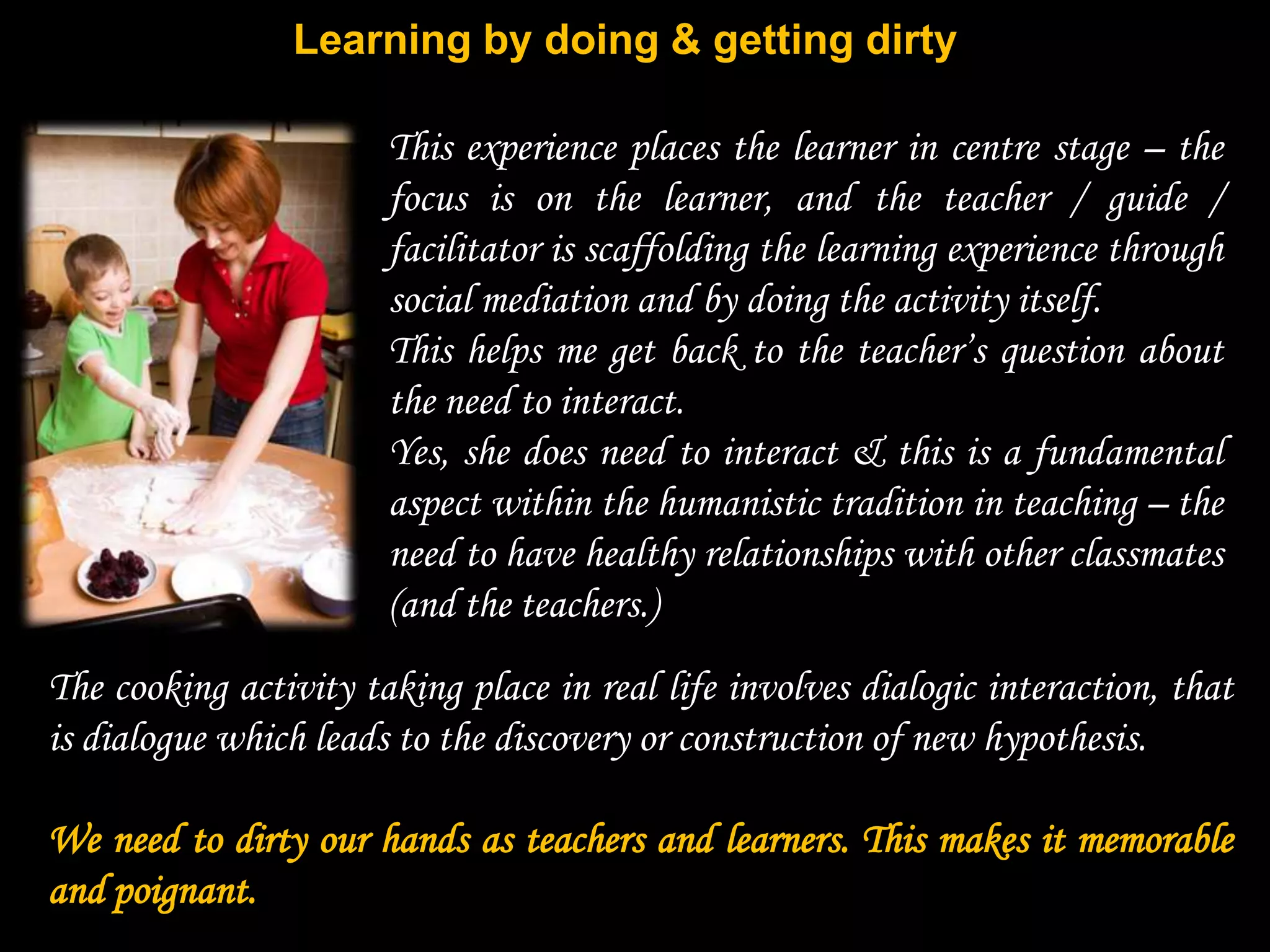
Learning by doing & getting dirty

                       This experience places the learner in centre stage – the
                       focus is on the learner, and the teacher / guide /
                       facilitator is scaffolding the learning experience through
                       social mediation and by doing the activity itself.
                       This helps me get back to the teacher‟s question about
                       the need to interact.
                       Yes, she does need to interact & this is a fundamental
                       aspect within the humanistic tradition in teaching – the
                       need to have healthy relationships with other classmates
                       (and the teachers.)
The cooking activity taking place in real life involves dialogic interaction, that
is dialogue which leads to the discovery or construction of new hypothesis.

We need to dirty our hands as teachers and learners. This makes it memorable
and poignant.
A new metaphor for learning: collaboration
 Participation Metaphor

 “The talk about states has been replaced with attention to
 activities. In the image of learning that emerges ...the
 permenance of having gives way to the constant flux of doing.”

 Anna Sfard, On two metaphors for learning and the danger of
 choosing just one, 1998, p.8

The moment we begin understanding that there can be a possibility for dialogic
interaction, we‟re also saying that a new metaphor for learning is needed. It
does not focus on the having of knowledge but rather on the flux of doing, of
doing things through activities, activities which are contextually embedded &
allow for social mediation.
Bonds are created between individuals & others. The dialectic nature of learning
is highlighted. You take part and make a move towards being a part of a team.
Elements within Humanism
- Feelings: personal emotions & esthetic appreciation (creativity). Rejects
things that cause discomfort or behaviours which cause anxiety/stress.

- Social relations: Encourages friendship, cooperation, collaboration. Allows
for social mediation.

- Responsibility: Importance to scrutinise, criticise and correct. Self-
responsibility for own learning.

- Intellect: knowledge, reason & understanding.

- Self-actualization: quest for the full realization of one s deepest qualities.
Seeks uniqueness and not conformity. To get to know your real self
Personal growth, including realizing one’s full potential, is one of the primary
goals of education.

“...become the self which one truly is...” – Carl Rogers


Stevick, E. Humanism in Language Teaching, 1990, pp23-24
The demand on teachers

- The teachers’ focus is on the learner and each learners’
developmental readiness to engage in the learning process.
Looking at the whole person.

- The learning process will make use of problem solving
activities.

- The learner should be engaged affectively (i.e. emotionally)
as well intellectually (affect).

- The teacher needs to be aware of the teachers’ role in class
so that it is just enough to stimulate, engage and foster learner
autonomy. The scaffolding of tasks needs to be thought of
carefully.
The demand on teachers

-The teacher needs to be flexible and aware of motivation
factors.

-The teacher must be open to listen.

- The teacher needs to be aware of his/her self in order to
stimulate the self-actualisation process amongst learners.
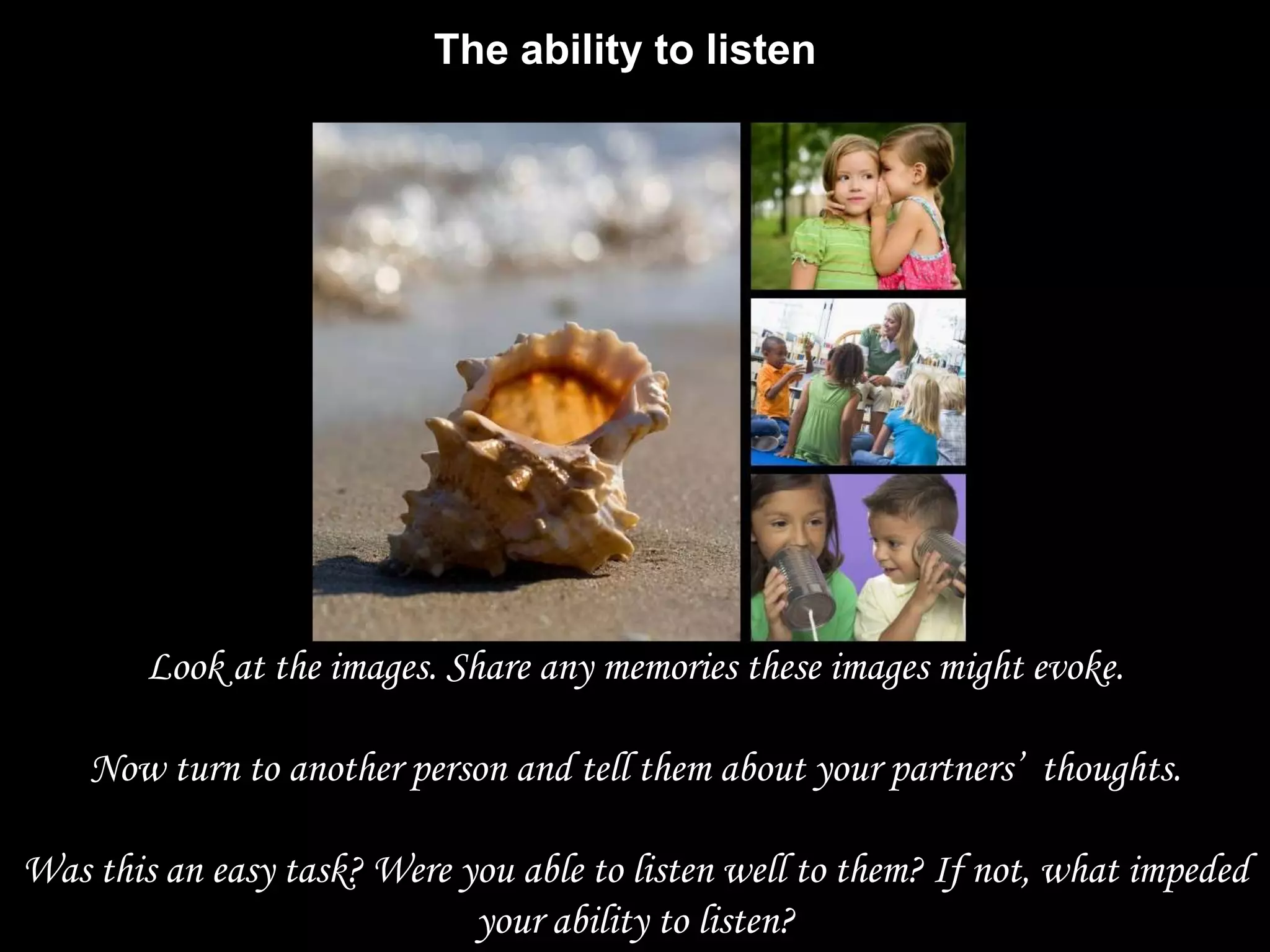
The ability to listen


        Look at the images. Share any memories these images might evoke.

    Now turn to another person and tell them about your partners‟ thoughts.

Was this an easy task? Were you able to listen well to them? If not, what impeded
                             your ability to listen?
The ability to listen: losing it

- There are ways to record (in writing , audio & video) what you
are listening to. Playback has affected how we listen to things.

- The world has become a noisier place, but there is also
excessive visual stimulus. Creates a cacophony of images &
sound.

- We no longer have enough patience to listen to long streams
of communication, only sound bites.


Julian Treasure – “Five ways to listen better.”

In his TED talk he argued we are losing our ability to listen. The
     implications for us language teachers are tremendous.
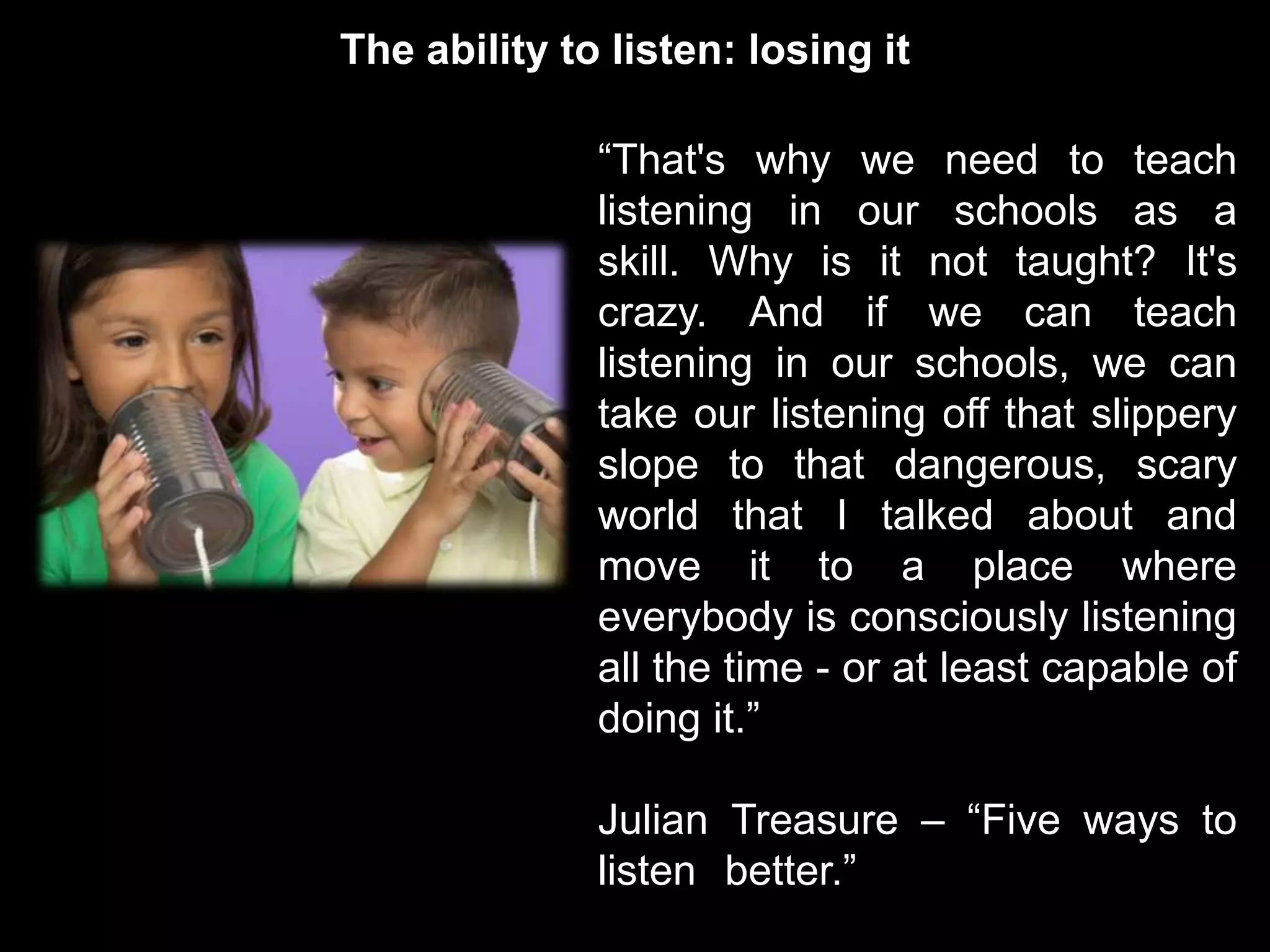
The ability to listen: losing it

              “That's why we need to teach
              listening in our schools as a
              skill. Why is it not taught? It's
              crazy. And if we can teach
              listening in our schools, we can
              take our listening off that slippery
              slope to that dangerous, scary
              world that I talked about and
              move it to a place where
              everybody is consciously listening
              all the time - or at least capable of
              doing it.”

              Julian Treasure – “Five ways to
              listen better.”
Telling stories: learning about oneself
              Emotionally charged moments


As teachers we need to know, or at least be willing to get to
know ourselves.

I cannot expect learners to engage in activities which will
demand things of them cognitively and affectively if I’m not
ready to embark on this journey myself.


               THIS CAN BE SCARY!

            DO I WANT TO DO THIS?
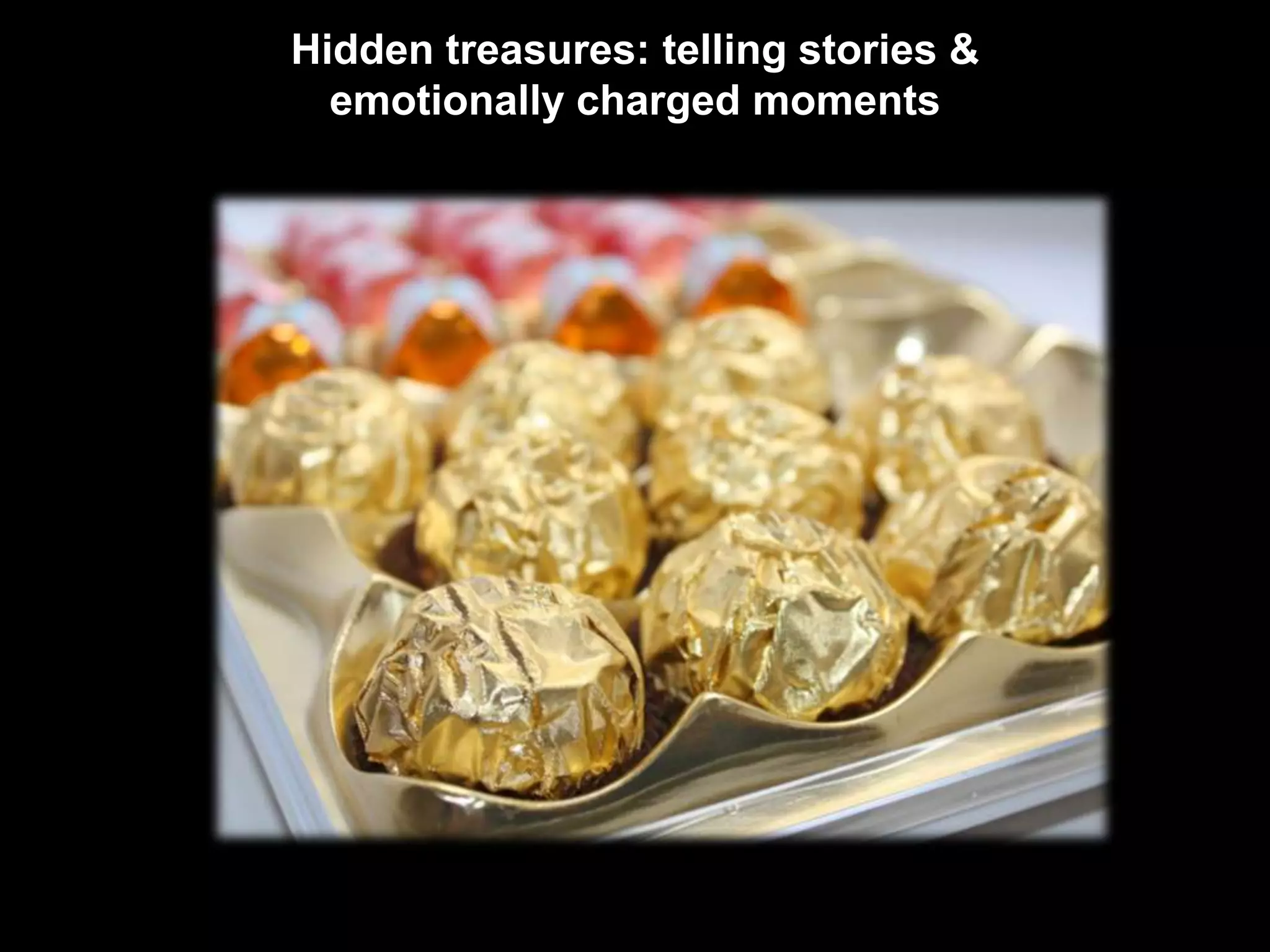
Hidden treasures: telling stories &
  emotionally charged moments
valeria.franca@culturainglesa.net
   Twitter: @vbenevolofranca

Do i actually have to interact with students as well as teach them slideshare

  • 1.
    “Do I actuallyhave to interact with students as well as teach them?” Valéria Benévolo França
  • 2.
    During a trainingsession being conducted by my colleague Guilherme Pacheco, he was asked by a relatively inexperienced teacher: “Do I actually have to interact with students as well as teach them?” This question caused a degree of discomfort. One would have thought that recent graduates, fed on a diet of “constructivist” and “learner- centred teaching” approaches would „ve hardly asked this question. But this novice teacher was truly shaken. She was still trying to come to grips with handling the learners, the teaching context and her own understanding of her role as a teacher. Her question set me thinking: what was her interpretation of what it meant to teach? How did she understand the role of interaction ? The only clear thing was that the learner did not occupy centre-stage in her lessons. There was a degree of isolation between the teacher and learner.
  • 3.
    The pervasiveness oftechnology: are we isolating ourselves? I began wondering whether the pervasiveness of technology, with its possibility of actually promoting a degree of isolation (earphones isolating us from the outside world and external sounds and the impact which a tablet can have in the way we work, especially for chidlren, who seem to lose themselves in apps and find it difficult even to look up from the tablet) could already be changing some patterns of interaction within society. I know this may be understood as quite a radical comment and believe me, I am a great advocate of technology, but there are issues we need to reflect upon as educators . Plus we have the recent additions to the clasroom in the form of the IWB. Based on lesson observation it becomes clear that whilst the potential of the IWB to engage and stimulate language learning is tremendous, they can actually create a very teacher-centred classroom
  • 4.
    Metaphors for learning AnnaSfard (who studies human thinking) proposes two metaphors for learning. Acquisition Metaphor vs. Participation Metaphor Anna Sfard, On two metaphors for learning and the danger of choosing just one, 1998 Anna concludes that we still need both metaphors AM & PM since they lead to different & important learning experiences. But thinking back to our teacher at the start, which metaphor do you think she probably had as her reference for her teaching?
  • 5.
    An existing metaphorfor learning: a more traditional context Acquisition Metaphor “The language of “knowledge acquisition” and “concept development” makes us think about the human mind as a container to be filled with certain materials and about the learner as becoming an owner of these materials.” Anna Sfard, On two metaphors for learning and the danger of choosing just one, 1998, p.5
  • 6.
    The learner asa receptor of knowledge “It is the politics of a “jug and mug” theory of education, wherein the faculty (the jug) possess the intellectual and factual knowledge and cause the student to be the passive recipient (the mug) so that the knowledge can be poured in.” Carl Rogers, The Politics of Education, 1977
  • 7.
    What are thedifferences in these learning experiences?
  • 8.
    A safe andclean cooking experience? What learning experience does this app provide? It establishes a context & the child is “theoretically” learning via trail & error. But a “taster” in the app gives her reaction to the final product: “Not bad” said in a pretty emotion-less voice. What type of feedback is this? Who says this taster reflects the child‟s own personal taste? What affective involvement does one have by draging and droping ingredients into our make-believe sandwich or sundae? Is the child actively involved? In addition, I can drag the ingredients into the sundae, but if I want to change my mind, I can just undo the action. Can I do this in real life? What am I saying to children...what lessons will they learn from this? There is no “undo” button in life. When I‟m cooking & add the wrong ingredient it changes the recipe. I can learn from this.
  • 9.
    Learning by doing& getting dirty This experience places the learner in centre stage – the focus is on the learner, and the teacher / guide / facilitator is scaffolding the learning experience through social mediation and by doing the activity itself. This helps me get back to the teacher‟s question about the need to interact. Yes, she does need to interact & this is a fundamental aspect within the humanistic tradition in teaching – the need to have healthy relationships with other classmates (and the teachers.) The cooking activity taking place in real life involves dialogic interaction, that is dialogue which leads to the discovery or construction of new hypothesis. We need to dirty our hands as teachers and learners. This makes it memorable and poignant.
  • 10.
    A new metaphorfor learning: collaboration Participation Metaphor “The talk about states has been replaced with attention to activities. In the image of learning that emerges ...the permenance of having gives way to the constant flux of doing.” Anna Sfard, On two metaphors for learning and the danger of choosing just one, 1998, p.8 The moment we begin understanding that there can be a possibility for dialogic interaction, we‟re also saying that a new metaphor for learning is needed. It does not focus on the having of knowledge but rather on the flux of doing, of doing things through activities, activities which are contextually embedded & allow for social mediation. Bonds are created between individuals & others. The dialectic nature of learning is highlighted. You take part and make a move towards being a part of a team.
  • 11.
    Elements within Humanism -Feelings: personal emotions & esthetic appreciation (creativity). Rejects things that cause discomfort or behaviours which cause anxiety/stress. - Social relations: Encourages friendship, cooperation, collaboration. Allows for social mediation. - Responsibility: Importance to scrutinise, criticise and correct. Self- responsibility for own learning. - Intellect: knowledge, reason & understanding. - Self-actualization: quest for the full realization of one s deepest qualities. Seeks uniqueness and not conformity. To get to know your real self Personal growth, including realizing one’s full potential, is one of the primary goals of education. “...become the self which one truly is...” – Carl Rogers Stevick, E. Humanism in Language Teaching, 1990, pp23-24
  • 12.
    The demand onteachers - The teachers’ focus is on the learner and each learners’ developmental readiness to engage in the learning process. Looking at the whole person. - The learning process will make use of problem solving activities. - The learner should be engaged affectively (i.e. emotionally) as well intellectually (affect). - The teacher needs to be aware of the teachers’ role in class so that it is just enough to stimulate, engage and foster learner autonomy. The scaffolding of tasks needs to be thought of carefully.
  • 13.
    The demand onteachers -The teacher needs to be flexible and aware of motivation factors. -The teacher must be open to listen. - The teacher needs to be aware of his/her self in order to stimulate the self-actualisation process amongst learners.
  • 14.
    The ability tolisten Look at the images. Share any memories these images might evoke. Now turn to another person and tell them about your partners‟ thoughts. Was this an easy task? Were you able to listen well to them? If not, what impeded your ability to listen?
  • 15.
    The ability tolisten: losing it - There are ways to record (in writing , audio & video) what you are listening to. Playback has affected how we listen to things. - The world has become a noisier place, but there is also excessive visual stimulus. Creates a cacophony of images & sound. - We no longer have enough patience to listen to long streams of communication, only sound bites. Julian Treasure – “Five ways to listen better.” In his TED talk he argued we are losing our ability to listen. The implications for us language teachers are tremendous.
  • 16.
    The ability tolisten: losing it “That's why we need to teach listening in our schools as a skill. Why is it not taught? It's crazy. And if we can teach listening in our schools, we can take our listening off that slippery slope to that dangerous, scary world that I talked about and move it to a place where everybody is consciously listening all the time - or at least capable of doing it.” Julian Treasure – “Five ways to listen better.”
  • 17.
    Telling stories: learningabout oneself Emotionally charged moments As teachers we need to know, or at least be willing to get to know ourselves. I cannot expect learners to engage in activities which will demand things of them cognitively and affectively if I’m not ready to embark on this journey myself. THIS CAN BE SCARY! DO I WANT TO DO THIS?
  • 18.
    Hidden treasures: tellingstories & emotionally charged moments
  • 19.
    valeria.franca@culturainglesa.net Twitter: @vbenevolofranca