DIABETIC EMERGENCIES
DR. A. SAJJAD PATHAN MBBS MHA
Department of Accident & Emergency Medicine
Kokilaben Dhirubhai Ambani Hospital & Medical Research Institute
ACUTE METABOLIC COMPLICATIONS

 Diabetic Ketoacidosis (DKA)
 Hyperosmolar Hyperglycemic State (HHS)


   Absolute/relative insulin deficiency
   Counter-regulatory hormone execess:
    Glucagon, Catecholamines, Steroids, GH
   Precipitating Factors: Infection, Drugs, Stress
   Mortality in HHS much higher than DKA (5 – 20
    %)
DIABETIC KETOACIDOSIS

 Acute, life threatening complication of DM
 Occurs predominantly in Type 1 DM, but can
  be seen in Type 2 DM too
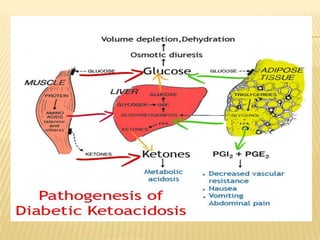
PATHOPHYSIOLOGY
   Hyperglycemic Crisis
   Due to absence/decreased Insulin
   Excess Glucogenic hormones
   Leading to Increased Osmolarity & Osmotic diuresis,
    loss of HCO3 and other electrolytes
   Cellular Starvation
   Ketosis
   Metabolic Acidosis & Hyperventilation (to
    compensate)
   Altered LOC due to elevated S. Osmolality > 320
    mOsm/L
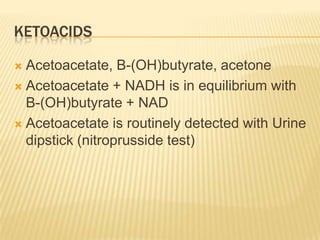
KETOACIDS

 Acetoacetate, B-(OH)butyrate, acetone
 Acetoacetate + NADH is in equilibrium with
  B-(OH)butyrate + NAD
 Acetoacetate is routinely detected with Urine
  dipstick (nitroprusside test)
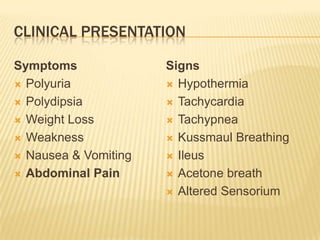
CLINICAL PRESENTATION

Symptoms              Signs
 Polyuria             Hypothermia

 Polydipsia           Tachycardia

 Weight Loss          Tachypnea

 Weakness             Kussmaul Breathing

 Nausea & Vomiting    Ileus

 Abdominal Pain       Acetone breath

                       Altered Sensorium
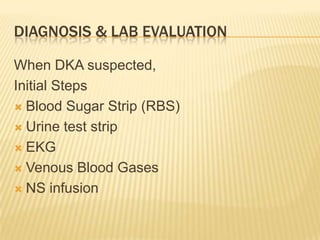
DIAGNOSIS & LAB EVALUATION

When DKA suspected,
Initial Steps
 Blood Sugar Strip (RBS)

 Urine test strip

 EKG

 Venous Blood Gases

 NS infusion
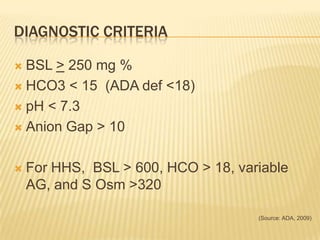
DIAGNOSTIC CRITERIA

 BSL > 250 mg %
 HCO3 < 15 (ADA def <18)

 pH < 7.3

 Anion Gap > 10


   For HHS, BSL > 600, HCO > 18, variable
    AG, and S Osm >320

                                     (Source: ADA, 2009)
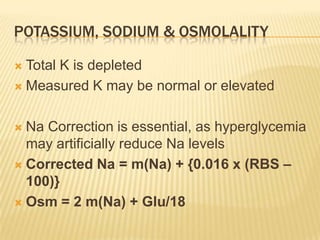
POTASSIUM, SODIUM & OSMOLALITY

 Total K is depleted
 Measured K may be normal or elevated


 Na Correction is essential, as hyperglycemia
  may artificially reduce Na levels
 Corrected Na = m(Na) + {0.016 x (RBS –
  100)}
 Osm = 2 m(Na) + Glu/18
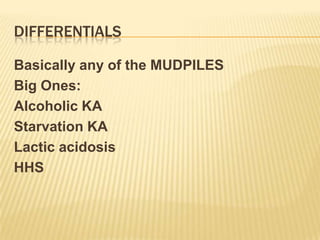
DIFFERENTIALS

Basically any of the MUDPILES
Big Ones:
Alcoholic KA
Starvation KA
Lactic acidosis
HHS
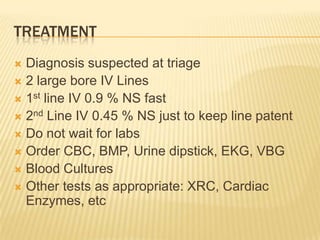
TREATMENT
 Diagnosis suspected at triage
 2 large bore IV Lines
 1st line IV 0.9 % NS fast
 2nd Line IV 0.45 % NS just to keep line patent
 Do not wait for labs
 Order CBC, BMP, Urine dipstick, EKG, VBG
 Blood Cultures
 Other tests as appropriate: XRC, Cardiac
  Enzymes, etc
ORDER OF THERAPEUTIC PRIORITIES

 Volume first
 Correction of Potassium deficits

 Lastly, Insulin administration
IV FLUIDS
First ½ Hour: Suspect DKA
 # 1 Line: NS wide open (1 Litre atleast)
 # 2 Line: ½ NS to keep patent
 In general, first 2 L in 0 – 2 hours, next 2 L in 2 –
  6 hours, next 2 L in 6 – 12 hours
 When BSL is ~ 250 mg % , replace ½ NS with
  ½ DNS
 Consider monitoring CVP/PCWP in
  elderly/cardiac comorbidities
K+ REPLACEMENT
 Magic Number 3.3 – 5.3
 If K > 5.3, no supplemental is required before
  insulin
 If K 3.3 – 5.3, 20 mEq/L of replacement fluid,
  while insulin is initiated alongside (~ 250 ml/hr)
 If K < 3.3, 40 mEq/L of replacement fluid before
  insulin is initiated, Check K in an hour and Start
  Insulin if K > 3.3, while correcting K (~ 10
  mEq/hr)
 Adequate Urine output is essential before
  initiating K therapy
INSULIN
Low dose, regular insulin, thru infusion
If K > 3.3 (excluding hypokalemia)
 IV Bolus: 0.1 U/kg Body Weight (Optional: Adults)

 IV Maintenance: 0.1 U/kg/hr BW


   HGT Hourly
   If sugars < 250 mg %
     IV drip: 0.05 - 0.1 U/kg/hr with a
     ½ DNS in other line until resolution of ketoacisosis
INSULIN
 S/C Insulin can also be used, 0.2 U/kg bolus,
  then 0.1 U/kg/hr or 0.3 U/kg Bolus, then 0.2
  U/kg/2hr till HGT < 250 mg%
 No response: Commonly due to infection (50
  – 75 decrease/hr)  double the infusion
  dose
 Insulin to be continued until ketonemia and
  AG has normalized
 Transition from IV to SQ insulin to prevent
  relapse
HCO3 ADMINISTRATION

Routine Use is not recommended
 pH > 7.0: No Bicarbonate

 pH < 7.0, and Bicarbonate < 5mEq/L :
  One can give 44.6 mEq in 500 ml ½ NS
  over 1 hour until pH > 7.0
 Do Not Give HCO3 IV PUSH
            (Source: ADA Position Statement Diabetes Care, 2003)
PHOSPHORUS

 Not routinely indicated (atleast not in the ED)
 If serum phosphorus < 1mg %  30 – 40
  mmol K- Phos over 24 hours
 Monitor Serum Calcium levels
OUTCOMES: COMPLICATIONS RELATED TO
THERAPY/ACUTE DISEASES
 Electrolyte abnormalities
 Hypoglycemia

 ARDS

 CEREBRAL EDEMA (esp in young age/new
  onset DM)
 Mortality in DKA results mainly from SEPSIS
  or Cardiac (MI) or pulmonary complications
  in elderly
DISPOSITION

 Majority patients go to the Intensive Care
  Units/High dependency units
 Selected group with AG < 25 & no co-
  morbidities can be managed in IP Diabetes
  Units
PITFALLS
 10 % of DKA patients have “euglycemic
  DKA”
  May continue taking their insulin just before
  approaching the ED
 Failure to realize other cause of altered
  mental status, Calculate Effective Osmolality
 Elevated/Normal Serum K may still be
  hypokalemic
 Abdominal Pain with Raised amylase/lipase
  is common in DKA in absence of pancreatitis
PITFALLS

 Not all patients with ketoacidosis areDKA
 Look for MUDPILES

 Stopping the inslin infusion when serum
  glucose goes below 200 – 250 rather than
  adding D5W infusion and continuing the
  insulin to treat ketosis (Hyperglycemia is
  corrected faster than ketoacidosis)
 Failure to search for precipitating causes

Diabetic emergencies

  • 1.
    DIABETIC EMERGENCIES DR. A.SAJJAD PATHAN MBBS MHA Department of Accident & Emergency Medicine Kokilaben Dhirubhai Ambani Hospital & Medical Research Institute
  • 2.
    ACUTE METABOLIC COMPLICATIONS Diabetic Ketoacidosis (DKA)  Hyperosmolar Hyperglycemic State (HHS)  Absolute/relative insulin deficiency  Counter-regulatory hormone execess: Glucagon, Catecholamines, Steroids, GH  Precipitating Factors: Infection, Drugs, Stress  Mortality in HHS much higher than DKA (5 – 20 %)
  • 3.
    DIABETIC KETOACIDOSIS  Acute,life threatening complication of DM  Occurs predominantly in Type 1 DM, but can be seen in Type 2 DM too
  • 4.
    PATHOPHYSIOLOGY  Hyperglycemic Crisis  Due to absence/decreased Insulin  Excess Glucogenic hormones  Leading to Increased Osmolarity & Osmotic diuresis, loss of HCO3 and other electrolytes  Cellular Starvation  Ketosis  Metabolic Acidosis & Hyperventilation (to compensate)  Altered LOC due to elevated S. Osmolality > 320 mOsm/L
  • 6.
    KETOACIDS  Acetoacetate, B-(OH)butyrate,acetone  Acetoacetate + NADH is in equilibrium with B-(OH)butyrate + NAD  Acetoacetate is routinely detected with Urine dipstick (nitroprusside test)
  • 7.
    CLINICAL PRESENTATION Symptoms Signs  Polyuria  Hypothermia  Polydipsia  Tachycardia  Weight Loss  Tachypnea  Weakness  Kussmaul Breathing  Nausea & Vomiting  Ileus  Abdominal Pain  Acetone breath  Altered Sensorium
  • 8.
    DIAGNOSIS & LABEVALUATION When DKA suspected, Initial Steps  Blood Sugar Strip (RBS)  Urine test strip  EKG  Venous Blood Gases  NS infusion
  • 9.
    DIAGNOSTIC CRITERIA  BSL> 250 mg %  HCO3 < 15 (ADA def <18)  pH < 7.3  Anion Gap > 10  For HHS, BSL > 600, HCO > 18, variable AG, and S Osm >320 (Source: ADA, 2009)
  • 10.
    POTASSIUM, SODIUM &OSMOLALITY  Total K is depleted  Measured K may be normal or elevated  Na Correction is essential, as hyperglycemia may artificially reduce Na levels  Corrected Na = m(Na) + {0.016 x (RBS – 100)}  Osm = 2 m(Na) + Glu/18
  • 11.
    DIFFERENTIALS Basically any ofthe MUDPILES Big Ones: Alcoholic KA Starvation KA Lactic acidosis HHS
  • 12.
    TREATMENT  Diagnosis suspectedat triage  2 large bore IV Lines  1st line IV 0.9 % NS fast  2nd Line IV 0.45 % NS just to keep line patent  Do not wait for labs  Order CBC, BMP, Urine dipstick, EKG, VBG  Blood Cultures  Other tests as appropriate: XRC, Cardiac Enzymes, etc
  • 13.
    ORDER OF THERAPEUTICPRIORITIES  Volume first  Correction of Potassium deficits  Lastly, Insulin administration
  • 14.
    IV FLUIDS First ½Hour: Suspect DKA  # 1 Line: NS wide open (1 Litre atleast)  # 2 Line: ½ NS to keep patent  In general, first 2 L in 0 – 2 hours, next 2 L in 2 – 6 hours, next 2 L in 6 – 12 hours  When BSL is ~ 250 mg % , replace ½ NS with ½ DNS  Consider monitoring CVP/PCWP in elderly/cardiac comorbidities
  • 15.
    K+ REPLACEMENT  MagicNumber 3.3 – 5.3  If K > 5.3, no supplemental is required before insulin  If K 3.3 – 5.3, 20 mEq/L of replacement fluid, while insulin is initiated alongside (~ 250 ml/hr)  If K < 3.3, 40 mEq/L of replacement fluid before insulin is initiated, Check K in an hour and Start Insulin if K > 3.3, while correcting K (~ 10 mEq/hr)  Adequate Urine output is essential before initiating K therapy
  • 16.
    INSULIN Low dose, regularinsulin, thru infusion If K > 3.3 (excluding hypokalemia)  IV Bolus: 0.1 U/kg Body Weight (Optional: Adults)  IV Maintenance: 0.1 U/kg/hr BW  HGT Hourly  If sugars < 250 mg % IV drip: 0.05 - 0.1 U/kg/hr with a ½ DNS in other line until resolution of ketoacisosis
  • 17.
    INSULIN  S/C Insulincan also be used, 0.2 U/kg bolus, then 0.1 U/kg/hr or 0.3 U/kg Bolus, then 0.2 U/kg/2hr till HGT < 250 mg%  No response: Commonly due to infection (50 – 75 decrease/hr)  double the infusion dose  Insulin to be continued until ketonemia and AG has normalized  Transition from IV to SQ insulin to prevent relapse
  • 18.
    HCO3 ADMINISTRATION Routine Useis not recommended  pH > 7.0: No Bicarbonate  pH < 7.0, and Bicarbonate < 5mEq/L : One can give 44.6 mEq in 500 ml ½ NS over 1 hour until pH > 7.0  Do Not Give HCO3 IV PUSH (Source: ADA Position Statement Diabetes Care, 2003)
  • 19.
    PHOSPHORUS  Not routinelyindicated (atleast not in the ED)  If serum phosphorus < 1mg %  30 – 40 mmol K- Phos over 24 hours  Monitor Serum Calcium levels
  • 20.
    OUTCOMES: COMPLICATIONS RELATEDTO THERAPY/ACUTE DISEASES  Electrolyte abnormalities  Hypoglycemia  ARDS  CEREBRAL EDEMA (esp in young age/new onset DM)  Mortality in DKA results mainly from SEPSIS or Cardiac (MI) or pulmonary complications in elderly
  • 21.
    DISPOSITION  Majority patientsgo to the Intensive Care Units/High dependency units  Selected group with AG < 25 & no co- morbidities can be managed in IP Diabetes Units
  • 22.
    PITFALLS  10 %of DKA patients have “euglycemic DKA” May continue taking their insulin just before approaching the ED  Failure to realize other cause of altered mental status, Calculate Effective Osmolality  Elevated/Normal Serum K may still be hypokalemic  Abdominal Pain with Raised amylase/lipase is common in DKA in absence of pancreatitis
  • 23.
    PITFALLS  Not allpatients with ketoacidosis areDKA  Look for MUDPILES  Stopping the inslin infusion when serum glucose goes below 200 – 250 rather than adding D5W infusion and continuing the insulin to treat ketosis (Hyperglycemia is corrected faster than ketoacidosis)  Failure to search for precipitating causes

Editor's Notes

  • #7 The major ketone bodies are acetoacetate and beta-hydroxybutyrate and the ratio between these two acid anions depends on the prevailing redox state (eg as assessed by the NADH/NAD+ ratio).A mixed acid-base disorder may be present (eg lactic acidosis from peripheral circulatory failure, or metabolic alkalosis from vomiting). An associated lactic acidosis may mask the presence of the ketoacidosis. This occurs because the lactic acidosis decreases the acetoacetate : beta-hydroxybutyrate ratio (ie more beta-hydroxybutyrate produced ) because NAD+ is produced in the production of lactate. The common test used to detect ketones (eg ‘Acetest’) depends on the reaction of acetoacetate (and to a lesser extent acetone) with the nitroprusside reagent. A decreased acetoacetate level may lead to a weak or absent test reaction despite high total levels of total ketoanions (acetoacetate and beta-hydroxybutyrate combined) because the beta-hydroxybutyrate is not detected.Outline of Interaction between Lactic Acidosis &amp; KetoacidosisAcetoacetate &lt;=&gt; beta-hydroxybutyrate (BOHB)                  NAD+ NADH          Lactate &lt;=&gt; PyruvateNote: Increased lactate cause increased BOHB &amp; decreased AcAc by Law of Mass Action
  • #9 Venous pH is 0.03 lower than Arterial pH
  • #10 Some patients with DKA may present with normal-appearing [HCO3–] or even an elevated [HCO3–], if coexisting metabolic alkalosis is severe enough to mask the acidosis. In such situations, an elevated anion gap may be the only clue to the presence of an underlying metabolic acidosis .