© 2022, IRJET | Impact Factor value: 7.529 | ISO 9001:2008 Certified Journal | Page 3133
Diabetes Prediction using Machine Learning Algorithms
Kiran D.Yesugade1 , Harshada V. Ankam2, Anushka A. Urunkar3, Poonam D. Dede4,
Sonal S. Kale5
2,3,4,5Student, Dept. of Computer Engineering, Bharati Vidyapeeth's College of Engineering for Women, Pune,
Maharashtra, India
1Assistant Professor, Dept. of Computer Engineering, Bharati Vidyapeeth's College of Engineering for Women, Pune,
Maharashtra, India
---------------------------------------------------------------------***---------------------------------------------------------------------
Abstract – Diabetes is one of the harmful health disease
which is affecting millions of people in the world. By
diagnosis, prediction and by taking proper medications
and management it can be cured after certain time
duration. Many such techniques are formed and invented
using Machine Learning Algorithms through which we can
detect and predict which type of diabetes. Data mining-
based forecasting tools for diabetes data analysis can aid in
the early diagnosis and prediction of the disease, as well as
its associated crucial events like hypo/hyperglycemia. In
this field, a variety of approaches for diabetes detection,
prediction, and classification have been established. We
give a complete evaluation of the state-of-the-art in data
mining-based diabetes diagnosis and prediction in this
work. The purpose of this work is twofold: first, we will
investigate and explore data mining- based diagnosis and
prediction methods in the field of diabetes glycemic
management. Second, based on the findings of this study,
we present a complete classification and comparison of the
methodologies that have been widely utilised for diabetes
diagnosis and predictionbased on essential factors.
Key Words: XG Boost, Random Forest, Health Care
Diabetes Mellitus.
1.INTRODUCTION
Diabetes is a non-communicable chronic disease that
disrupts the body's natural blood glucose concentration
management. Insulin and glucagon, which are released by
cells in the pancreas, are usually responsible for
controlling blood glucose levels. However, diabetes is
caused by aberrant hormone secretion. There are several
forms of diabetes, each with a varied prevalence;
nevertheless, type 1 diabetes, type 2 diabetes, and
gestational diabetes mellitus are the most frequent (GDM).
Children are more likely to get type 1 diabetes, while
middle-aged and elderly people are more likely to develop
type 2. Diabetes is one of the most dangerous metabolic
conditions in today's world. Diabetes is a long-term health
problem. Diabetes affects around 400 million people
globally. India has an estimated 77 million diabetics,
making it the world's second-largest diabetic population
behind China. To compare both Machine Learning
Algorithms, they employed Logistic Regression with 96
percent accuracy and AdaBoost with 98.8% accuracy in the
given basis article. As a result, we're putting the XGBoost
and Random Forest algorithms to the test to see which one
has the highest accuracy %. As a result, we can use the
optimal algorithm for our project. Because there are a rising
number of diabetic patients around the world, not all test
labs are real or valid. As a result, we've proposed our
Diabetes Prediction App. This will aid us in analysing and
comparing test lab reports to actual data. If a patient has test
lab reports, he or she can self-test them using our proposed
programme. We make ideas to users of home remedies,
pharmaceuticals, and doctor's recommendations based on
Diabetes Analysis as low, medium, and high.
1.1 XGBoost
Extreme Gradient Development Algorithm is what XGBoost
stands for. Gradient boosting is a type of integrated machine
learning technique that can be used to distinguish or
forecast model deficit problems. "Extreme Gradient
Boosting" is what XGBoost stands for. XGBoost is a dispersed
gradient enhancement library that focuses on efficiency,
flexibility, and portability. The Gradient Boosting framework
employs machine learning methods. It provides a consistent
tree upgrade that can be used to tackle a variety of data
science challenges quickly and accurately. It refers to both
the algorithm for raising tree trunk gradients and the open-
source framework that implements that approach. We can
simply call the algorithm "XGBoost the Algorithm" and the
framework "XGBoost the Framework" to distinguish
between thetwo definitions of XGBoost.
International Research Journal of Engineering and Technology (IRJET) e-ISSN: 2395-0056
Volume: 09 Issue: 04 | Apr 2022 www.irjet.net p-ISSN: 2395-0072
International Research Journal of Engineering and Technology (IRJET) e-ISSN: 2395-0056
Volume: 09 Issue: 04 | Apr 2022 www.irjet.net p-ISSN: 2395-0072
© 2022, IRJET | Impact Factor value: 7.529 | ISO 9001:2008 Certified Journal | Page 3134
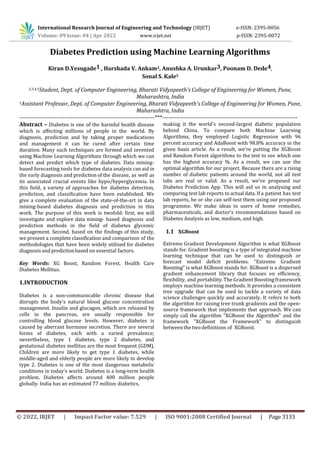
Fig 1. XG Boost Algorithm
Thefollowingaresimpleproceduresthatcanbeutilisedto
solve any data problem utilising the XGBoostAlgorithm:
Step 1: To upload all of your libraries (xgboost).
Step 2: To upload the database.
Step 3: Feature Engineering and Data Cleaning
Step 4: Fine-tune the model before launching it.
1.2 Random Forest
Random Forest is a well-known machine learning
technique that is used in conjunction with supervised
learning. In ML, it can be used to solve both scheduling and
retrieval problems. It is built on the notion of integrated
learning, which is the process of combining many dividers
to solve a complicated problem and efficiently increase
model performance. As the name implies, the Random
Forest is a sub-division that contains a number of decision
trees for various datasets and collects measurements to
improve the datasets prediction accuracy. Instead of
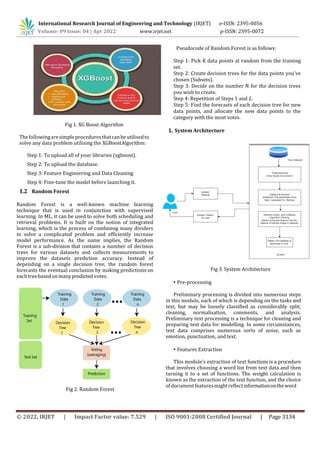
depending on a single decision tree, the random forest
forecasts the eventual conclusion by making predictions on
eachtreebasedonmanypredicted votes.
Fig 2. Random Forest
Pseudocode of Random Forest is as follows:
Step 1: Pick K data points at random from the training
set.
Step 2: Create decision trees for the data points you've
chosen (Subsets).
Step 3: Decide on the number N for the decision trees
you wish to create.
Step 4: Repetition of Steps 1 and 2.
Step 5: Find the forecasts of each decision tree for new
data points, and allocate the new data points to the
category with the most votes.
1. System Architecture
Fig 3. System Architecture
• Pre-processing
Preliminary processing is divided into numerous steps
in this module, each of which is depending on the tasks and
text, but may be loosely classified as considerably split,
cleaning, normalisation, comments, and analysis.
Preliminary text processing is a technique for cleaning and
preparing text data for modelling. In some circumstances,
text data comprises numerous sorts of noise, such as
emotion, punctuation, and text.
• Features Extraction
This module's extraction of text functions is a procedure
that involves choosing a word list from text data and then
turning it to a set of functions. The weight calculation is
known as the extraction of the text function, and the choice
ofdocumentfeaturesmightreflectinformationontheword
© 2022, IRJET | Impact Factor value: 7.529 | ISO 9001:2008 Certified Journal | Page 3135
of the contents. Filtering, merging, matching, and
clustering are all common approaches for extracting text
features.
• Segmentation
Text splitting is a technique for dividing a document
into smaller chunks, known as segments. In word
processing, it is commonly utilised. Every part has its own
significance. Depending on the text analysis task, these
segments are categorised as words, sentences, themes,
phrases, or information units.
• XG Boost Classification, RandomForest
• Import the data.
• Look at the data to see how itlooks.
3. CONCLUSIONS
As a result, we're working on a system that uses Machine
Learning Algorithms like XGBoost and Random Forest. You
can get reliable results by comparing these two algorithms
and then implementing the same algorithm.
Diabetes prediction was carried out in this study utilising
the suggested ensemble model on the dataset, with
preprocessing playing an essential part in ensuring a
reliable and accurate prediction. The proposed
preprocessing strategy increased the dataset's quality,
with a focus on eliminating outliers and filling missing
values as a primary concern.
REFERENCES
1. INTERNATIONAL CONFERENCE ON RECENT
TRENDS IN ADVANCED COMPUTING 2019, ICRTAC
2019 Diabetes Prediction using Machine Learning
Algorithms Aishwarya Mujumdara, Dr. Vaidehi V.
2. Machine Learning Algorithms in Healthcare: A
Literature Survey Munira Ferdous, Jui Debnath And
Narayan Ranjan Chakraborty Department of
Computer Science and Engineering Daffodil
International University Dhaka, Bangladesh.
BIOGRAPHIES
Assistant Professor at Bharati
Vidyapeeth’s College of
Engineeringfor Women, Pune.
Harshada V. Ankam
Student at Bharati Vidyapeeth’s
Collegeof Engineering for Women,
Pune.
Anushka A. Urunkar
Student at Bharati Vidyapeeth’s
College of Engineering for
Women,Pune.
Poonam D. Dede
Student at Bharati Vidyapeeth’s
College of Engineering for Women,
Pune.
Sonal S. Kale
Student at Bharati Vidyapeeth’s
College of Engineering
forWomen, Pune.
Prof. Kiran D. Yesugade
International Research Journal of Engineering and Technology (IRJET) e-ISSN: 2395-0056
Volume: 09 Issue: 04 | Apr 2022 www.irjet.net p-ISSN: 2395-0072

Diabetes Prediction using Machine Learning Algorithms

  • 1.
    © 2022, IRJET| Impact Factor value: 7.529 | ISO 9001:2008 Certified Journal | Page 3133 Diabetes Prediction using Machine Learning Algorithms Kiran D.Yesugade1 , Harshada V. Ankam2, Anushka A. Urunkar3, Poonam D. Dede4, Sonal S. Kale5 2,3,4,5Student, Dept. of Computer Engineering, Bharati Vidyapeeth's College of Engineering for Women, Pune, Maharashtra, India 1Assistant Professor, Dept. of Computer Engineering, Bharati Vidyapeeth's College of Engineering for Women, Pune, Maharashtra, India ---------------------------------------------------------------------***--------------------------------------------------------------------- Abstract – Diabetes is one of the harmful health disease which is affecting millions of people in the world. By diagnosis, prediction and by taking proper medications and management it can be cured after certain time duration. Many such techniques are formed and invented using Machine Learning Algorithms through which we can detect and predict which type of diabetes. Data mining- based forecasting tools for diabetes data analysis can aid in the early diagnosis and prediction of the disease, as well as its associated crucial events like hypo/hyperglycemia. In this field, a variety of approaches for diabetes detection, prediction, and classification have been established. We give a complete evaluation of the state-of-the-art in data mining-based diabetes diagnosis and prediction in this work. The purpose of this work is twofold: first, we will investigate and explore data mining- based diagnosis and prediction methods in the field of diabetes glycemic management. Second, based on the findings of this study, we present a complete classification and comparison of the methodologies that have been widely utilised for diabetes diagnosis and predictionbased on essential factors. Key Words: XG Boost, Random Forest, Health Care Diabetes Mellitus. 1.INTRODUCTION Diabetes is a non-communicable chronic disease that disrupts the body's natural blood glucose concentration management. Insulin and glucagon, which are released by cells in the pancreas, are usually responsible for controlling blood glucose levels. However, diabetes is caused by aberrant hormone secretion. There are several forms of diabetes, each with a varied prevalence; nevertheless, type 1 diabetes, type 2 diabetes, and gestational diabetes mellitus are the most frequent (GDM). Children are more likely to get type 1 diabetes, while middle-aged and elderly people are more likely to develop type 2. Diabetes is one of the most dangerous metabolic conditions in today's world. Diabetes is a long-term health problem. Diabetes affects around 400 million people globally. India has an estimated 77 million diabetics, making it the world's second-largest diabetic population behind China. To compare both Machine Learning Algorithms, they employed Logistic Regression with 96 percent accuracy and AdaBoost with 98.8% accuracy in the given basis article. As a result, we're putting the XGBoost and Random Forest algorithms to the test to see which one has the highest accuracy %. As a result, we can use the optimal algorithm for our project. Because there are a rising number of diabetic patients around the world, not all test labs are real or valid. As a result, we've proposed our Diabetes Prediction App. This will aid us in analysing and comparing test lab reports to actual data. If a patient has test lab reports, he or she can self-test them using our proposed programme. We make ideas to users of home remedies, pharmaceuticals, and doctor's recommendations based on Diabetes Analysis as low, medium, and high. 1.1 XGBoost Extreme Gradient Development Algorithm is what XGBoost stands for. Gradient boosting is a type of integrated machine learning technique that can be used to distinguish or forecast model deficit problems. "Extreme Gradient Boosting" is what XGBoost stands for. XGBoost is a dispersed gradient enhancement library that focuses on efficiency, flexibility, and portability. The Gradient Boosting framework employs machine learning methods. It provides a consistent tree upgrade that can be used to tackle a variety of data science challenges quickly and accurately. It refers to both the algorithm for raising tree trunk gradients and the open- source framework that implements that approach. We can simply call the algorithm "XGBoost the Algorithm" and the framework "XGBoost the Framework" to distinguish between thetwo definitions of XGBoost. International Research Journal of Engineering and Technology (IRJET) e-ISSN: 2395-0056 Volume: 09 Issue: 04 | Apr 2022 www.irjet.net p-ISSN: 2395-0072
  • 2.
    International Research Journalof Engineering and Technology (IRJET) e-ISSN: 2395-0056 Volume: 09 Issue: 04 | Apr 2022 www.irjet.net p-ISSN: 2395-0072 © 2022, IRJET | Impact Factor value: 7.529 | ISO 9001:2008 Certified Journal | Page 3134 Fig 1. XG Boost Algorithm Thefollowingaresimpleproceduresthatcanbeutilisedto solve any data problem utilising the XGBoostAlgorithm: Step 1: To upload all of your libraries (xgboost). Step 2: To upload the database. Step 3: Feature Engineering and Data Cleaning Step 4: Fine-tune the model before launching it. 1.2 Random Forest Random Forest is a well-known machine learning technique that is used in conjunction with supervised learning. In ML, it can be used to solve both scheduling and retrieval problems. It is built on the notion of integrated learning, which is the process of combining many dividers to solve a complicated problem and efficiently increase model performance. As the name implies, the Random Forest is a sub-division that contains a number of decision trees for various datasets and collects measurements to improve the datasets prediction accuracy. Instead of depending on a single decision tree, the random forest forecasts the eventual conclusion by making predictions on eachtreebasedonmanypredicted votes. Fig 2. Random Forest Pseudocode of Random Forest is as follows: Step 1: Pick K data points at random from the training set. Step 2: Create decision trees for the data points you've chosen (Subsets). Step 3: Decide on the number N for the decision trees you wish to create. Step 4: Repetition of Steps 1 and 2. Step 5: Find the forecasts of each decision tree for new data points, and allocate the new data points to the category with the most votes. 1. System Architecture Fig 3. System Architecture • Pre-processing Preliminary processing is divided into numerous steps in this module, each of which is depending on the tasks and text, but may be loosely classified as considerably split, cleaning, normalisation, comments, and analysis. Preliminary text processing is a technique for cleaning and preparing text data for modelling. In some circumstances, text data comprises numerous sorts of noise, such as emotion, punctuation, and text. • Features Extraction This module's extraction of text functions is a procedure that involves choosing a word list from text data and then turning it to a set of functions. The weight calculation is known as the extraction of the text function, and the choice ofdocumentfeaturesmightreflectinformationontheword
  • 3.
    © 2022, IRJET| Impact Factor value: 7.529 | ISO 9001:2008 Certified Journal | Page 3135 of the contents. Filtering, merging, matching, and clustering are all common approaches for extracting text features. • Segmentation Text splitting is a technique for dividing a document into smaller chunks, known as segments. In word processing, it is commonly utilised. Every part has its own significance. Depending on the text analysis task, these segments are categorised as words, sentences, themes, phrases, or information units. • XG Boost Classification, RandomForest • Import the data. • Look at the data to see how itlooks. 3. CONCLUSIONS As a result, we're working on a system that uses Machine Learning Algorithms like XGBoost and Random Forest. You can get reliable results by comparing these two algorithms and then implementing the same algorithm. Diabetes prediction was carried out in this study utilising the suggested ensemble model on the dataset, with preprocessing playing an essential part in ensuring a reliable and accurate prediction. The proposed preprocessing strategy increased the dataset's quality, with a focus on eliminating outliers and filling missing values as a primary concern. REFERENCES 1. INTERNATIONAL CONFERENCE ON RECENT TRENDS IN ADVANCED COMPUTING 2019, ICRTAC 2019 Diabetes Prediction using Machine Learning Algorithms Aishwarya Mujumdara, Dr. Vaidehi V. 2. Machine Learning Algorithms in Healthcare: A Literature Survey Munira Ferdous, Jui Debnath And Narayan Ranjan Chakraborty Department of Computer Science and Engineering Daffodil International University Dhaka, Bangladesh. BIOGRAPHIES Assistant Professor at Bharati Vidyapeeth’s College of Engineeringfor Women, Pune. Harshada V. Ankam Student at Bharati Vidyapeeth’s Collegeof Engineering for Women, Pune. Anushka A. Urunkar Student at Bharati Vidyapeeth’s College of Engineering for Women,Pune. Poonam D. Dede Student at Bharati Vidyapeeth’s College of Engineering for Women, Pune. Sonal S. Kale Student at Bharati Vidyapeeth’s College of Engineering forWomen, Pune. Prof. Kiran D. Yesugade International Research Journal of Engineering and Technology (IRJET) e-ISSN: 2395-0056 Volume: 09 Issue: 04 | Apr 2022 www.irjet.net p-ISSN: 2395-0072