 Definition
 Principle
 Properties
 Advantages
 Disadvantages
 An example - Kurilpa Foot Bridge
 Conclusion
 “Tensegrity structure is the minimal structure that can
support a weight and oppose horizontal forces, that uses
compression and tension, but experiences
no torque” (Fuller, cited in Flavin, 1996)
The term Tensegrity was coined by Buckminster Fuller
in 1960s as a portmanteau of ‘Tensional Integrity’.
‘Tensegrity’ is a pattern that results when ‘push’ and ‘pull’
have a win-win relationship with each other.
 Pull is continuous whereas push is discontinuous.
 Tensegrity is the name for a synergy between a co-existing
pairs of fundamental physical laws of push and pull, or
compression and tension, or repulsion and attraction.
 The struts can resist compressive force and the cables cannot.
 A tensegrity structure’s struts cannot be attached to each other
through joints that impart torques.
 Only cable strut configurations in a stable equilibrium will be
called as tensegrity structures.
 Light weight - Similar resistance.
High resistance - Similar weight.
They have no redundant parts, although new tendons can be
added to consolidate the structure. (Kenner, 1976).
They don’t depend on gravity due to their self-stability, so
they don’t need to be anchored or leaned on any surface.
The degree of tension of the pre-stressed components is
proportional to the amount of space that they occupy
(Muller, 1971).
They have the ability of respond as a whole, so local
stresses are transmitted uniformly and absorbed throughout
the structure.
Due to the ability to respond as a whole, it is possible to
use materials in a very economical way, offering a
maximum amount of strength for a given amount of
building material (Ingber, 1998).
They don’t suffer any kind of torque or torsion, and
buckling is very rare due to the short length of their
components in compression.
The construction of towers, bridges, domes, etc.
employing tensegrity principles will make them highly
resilient and, at the same time, very economical.
 Tensegrity arrangements need to solve the problem of bar
congestion. As some designs become larger, the struts start
running into each other.
The fabrication complexity is also a barrier for developing
the floating compression structures. Spherical and domical
structures are complex, which can lead to problems in
production.
There was a lack of design and analysis techniques for
these structures.
In order to support critical loads, the pre-stress forces
should be high enough, which could be difficult in larger-
size constructions
An example-Kurilpa Foot
Bridge
BRISBANE, AUSTRALIA
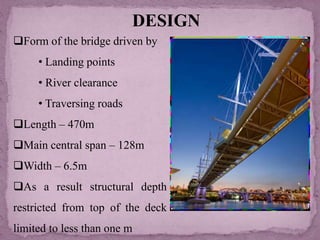
DESIGN
Form of the bridge driven by
• Landing points
• River clearance
• Traversing roads
Length – 470m
Main central span – 128m
Width – 6.5m
As a result structural depth
restricted from top of the deck
limited to less than one m
The 120m long Kurilpa Point
approach is a reinforced concrete
spiral ramp structure comprising
seven spans up to
20m supported on reinforced
concrete blade piers.
The deck cross section tapers
from a central 780mm deep spine
to 280mm deep edges.
The Kurilpa Point approach is
separated from the tensegrity river
spans and the Kurilpa Point
landing abutment by expansion
joints and bearings.
 A composite steel and concrete deck structure
 A series of steel struts and cables
 An integrated tensegrity array of steel ties
 Flying struts (spars)
 A steel framed tensegrity canopy
 One of the unique aspects of the Kurilpa bridge is that span over
major river is the need for the structure to support itself at each
stage of the erection, without depending upon temporary props and
scaffolding
 Structurally this span composition is approximately balanced
eliminating the need for massive abutments and allowing the
tensegrity structure to be constructed via a balanced cantilever
technique.
 Tie downs are provided at the outer ends of the side spans to
counter the weight supported over the large river span.
 Tensegrity structures present a remarkable blend of geometry and
mechanics. Out of various available combinations of geometrical
parameters, only a small subset exists that guarantees the existence of
the tensegrity.
 The analysis of tensegrity structures reveals the concept that
lightweight is a real measure of structural effectiveness.
 Tensegrity structures promise to be highly efficient in the ratio of
material to both performance and maintenance.
 Investigations on foldable tensegrity structures are under process. As a
result of which they could be used for disaster relief in areas
devastated by earthquakes, hurricanes, floods and so on, by installing
deployable systems in the form of temporal dwellings, bridges, field
hospitals, etc.
Tensegrity

Tensegrity

  • 2.
     Definition  Principle Properties  Advantages  Disadvantages  An example - Kurilpa Foot Bridge  Conclusion
  • 3.
     “Tensegrity structureis the minimal structure that can support a weight and oppose horizontal forces, that uses compression and tension, but experiences no torque” (Fuller, cited in Flavin, 1996) The term Tensegrity was coined by Buckminster Fuller in 1960s as a portmanteau of ‘Tensional Integrity’.
  • 5.
    ‘Tensegrity’ is apattern that results when ‘push’ and ‘pull’ have a win-win relationship with each other.  Pull is continuous whereas push is discontinuous.  Tensegrity is the name for a synergy between a co-existing pairs of fundamental physical laws of push and pull, or compression and tension, or repulsion and attraction.  The struts can resist compressive force and the cables cannot.  A tensegrity structure’s struts cannot be attached to each other through joints that impart torques.  Only cable strut configurations in a stable equilibrium will be called as tensegrity structures.
  • 6.
     Light weight- Similar resistance. High resistance - Similar weight. They have no redundant parts, although new tendons can be added to consolidate the structure. (Kenner, 1976). They don’t depend on gravity due to their self-stability, so they don’t need to be anchored or leaned on any surface. The degree of tension of the pre-stressed components is proportional to the amount of space that they occupy (Muller, 1971). They have the ability of respond as a whole, so local stresses are transmitted uniformly and absorbed throughout the structure.
  • 7.
    Due to theability to respond as a whole, it is possible to use materials in a very economical way, offering a maximum amount of strength for a given amount of building material (Ingber, 1998). They don’t suffer any kind of torque or torsion, and buckling is very rare due to the short length of their components in compression. The construction of towers, bridges, domes, etc. employing tensegrity principles will make them highly resilient and, at the same time, very economical.
  • 9.
     Tensegrity arrangementsneed to solve the problem of bar congestion. As some designs become larger, the struts start running into each other. The fabrication complexity is also a barrier for developing the floating compression structures. Spherical and domical structures are complex, which can lead to problems in production. There was a lack of design and analysis techniques for these structures. In order to support critical loads, the pre-stress forces should be high enough, which could be difficult in larger- size constructions
  • 10.
  • 11.
    DESIGN Form of thebridge driven by • Landing points • River clearance • Traversing roads Length – 470m Main central span – 128m Width – 6.5m As a result structural depth restricted from top of the deck limited to less than one m
  • 12.
    The 120m longKurilpa Point approach is a reinforced concrete spiral ramp structure comprising seven spans up to 20m supported on reinforced concrete blade piers. The deck cross section tapers from a central 780mm deep spine to 280mm deep edges. The Kurilpa Point approach is separated from the tensegrity river spans and the Kurilpa Point landing abutment by expansion joints and bearings.
  • 13.
     A compositesteel and concrete deck structure  A series of steel struts and cables  An integrated tensegrity array of steel ties  Flying struts (spars)  A steel framed tensegrity canopy
  • 14.
     One ofthe unique aspects of the Kurilpa bridge is that span over major river is the need for the structure to support itself at each stage of the erection, without depending upon temporary props and scaffolding  Structurally this span composition is approximately balanced eliminating the need for massive abutments and allowing the tensegrity structure to be constructed via a balanced cantilever technique.  Tie downs are provided at the outer ends of the side spans to counter the weight supported over the large river span.
  • 16.
     Tensegrity structurespresent a remarkable blend of geometry and mechanics. Out of various available combinations of geometrical parameters, only a small subset exists that guarantees the existence of the tensegrity.  The analysis of tensegrity structures reveals the concept that lightweight is a real measure of structural effectiveness.  Tensegrity structures promise to be highly efficient in the ratio of material to both performance and maintenance.  Investigations on foldable tensegrity structures are under process. As a result of which they could be used for disaster relief in areas devastated by earthquakes, hurricanes, floods and so on, by installing deployable systems in the form of temporal dwellings, bridges, field hospitals, etc.