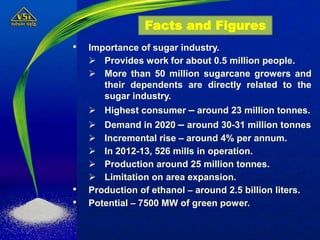
• Importance of sugar industry.
 Provides work for about 0.5 million people.
 More than 50 million sugarcane growers and
their dependents are directly related to the
sugar industry.
 Highest consumer – around 23 million tonnes.
 Demand in 2020 – around 30-31 million tonnes
 Incremental rise – around 4% per annum.
 In 2012-13, 526 mills in operation.
 Production around 25 million tonnes.
 Limitation on area expansion.
• Production of ethanol – around 2.5 billion liters.
• Potential – 7500 MW of green power.
Facts and Figures
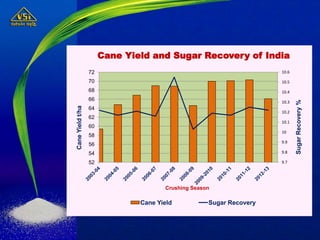
9.7
9.8
9.9
10
10.1
10.2
10.3
10.4
10.5
10.6
52
54
56
58
60
62
64
66
68
70
72
SugarRecovery%
CaneYieldt/ha
Crushing Season
Cane Yield and Sugar Recovery of India
Cane Yield Sugar Recovery
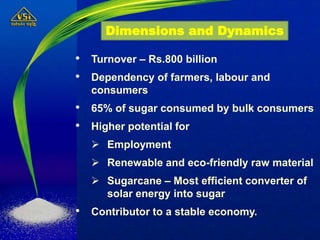
• Turnover – Rs.800 billion
• Dependency of farmers, labour and
consumers
• 65% of sugar consumed by bulk consumers
• Higher potential for
 Employment
 Renewable and eco-friendly raw material
 Sugarcane – Most efficient converter of
solar energy into sugar
• Contributor to a stable economy.
Dimensions and Dynamics
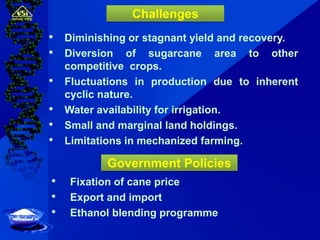
• Diminishing or stagnant yield and recovery.
• Diversion of sugarcane area to other
competitive crops.
• Fluctuations in production due to inherent
cyclic nature.
• Water availability for irrigation.
• Small and marginal land holdings.
• Limitations in mechanized farming.
Challenges
• Fixation of cane price
• Export and import
• Ethanol blending programme
Government Policies
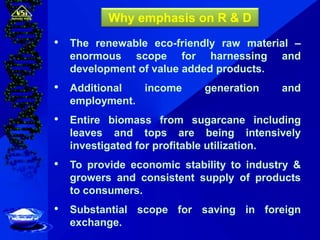
• The renewable eco-friendly raw material –
enormous scope for harnessing and
development of value added products.
• Additional income generation and
employment.
• Entire biomass from sugarcane including
leaves and tops are being intensively
investigated for profitable utilization.
• To provide economic stability to industry &
growers and consistent supply of products
to consumers.
• Substantial scope for saving in foreign
exchange.
Why emphasis on R & D
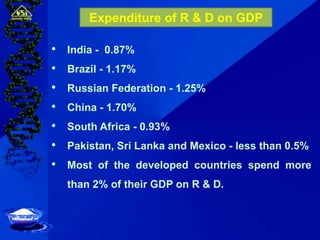
• India - 0.87%
• Brazil - 1.17%
• Russian Federation - 1.25%
• China - 1.70%
• South Africa - 0.93%
• Pakistan, Sri Lanka and Mexico - less than 0.5%
• Most of the developed countries spend more
than 2% of their GDP on R & D.
Expenditure of R & D on GDP
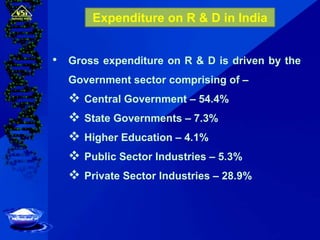
• Gross expenditure on R & D is driven by the
Government sector comprising of –
 Central Government – 54.4%
 State Governments – 7.3%
 Higher Education – 4.1%
 Public Sector Industries – 5.3%
 Private Sector Industries – 28.9%
Expenditure on R & D in India
• In Industrial R & D,
 Drugs and Pharmaceutical – 27.7%
 Transportation – 14%
 Information Technology -13.6%
 Defence Industries – 6.1%
Expenditure on R & D in India
• Industrial sector spent 0.61% of their sales
turnover on R & D activities. For Private
sector – 0.27% and Public sector – 0.82%
• Applying this formula to sugar industry, our
expenditure on R & D should be around
Rs. 4.4 billion
• R & D expenditure of Brazil in sugar sector is
of US$ 1.7 billion (Rs. 105.4billion)
Indian investment in R & D (2009-10)
• Leading Institutes in sugarcane research (ICAR)
 Sugarcane Breeding Institute (SBI),
Coimbatore
 Indian Institute of Sugarcane Research
(IISR), Lucknow
• Organizations engaged in developing sugarcane
and sugarbeet varieties
 UP Government Federation
 State Agriculture Universities
• Institutes engaged in R & D activities related to
processing of sugarcane, ethanol, co-generation
and by-products
 National Sugar Institute
 Vasantdada Sugar Institute
 Praj Industries Ltd.
R & D Organizations in sugar sector
• Sugarcane Development Fund (SDF), Govt. of India
 Soft loan assistance for agriculture, plant
expansion and modernization of sugar mills.
 Grants for research projects.
• Project based funding from Govt. organizations
 Indian Council for Agriculture Research (ICAR)
 Department of Science & Technology (DST)
 Department of Bio-technology (DBT)
 Bhabha Atomic Research Centre (BARC)
Funding agencies
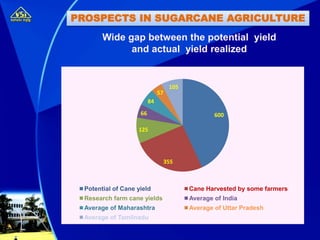
PROSPECTS IN SUGARCANE AGRICULTURE
Wide gap between the potential yield
and actual yield realized
600
355
125
66
84
57
105
Potential of Cane yield Cane Harvested by some farmers
Research farm cane yields Average of India
Average of Maharashtra Average of Uttar Pradesh
Average of Tamilnadu
 Varietal development
 Planting and harvesting programme
 Seed replacement programme
 Soil fertility and integrated nutrient management
 Use of microbial inoculants
 Micro irrigation and fertigation
 Strengthening research on mechanization
 Plant protection through bio-control agents
 Ratoon management
 HRD and extension mechanism
Sugarcane Agriculture – R & D Priorities
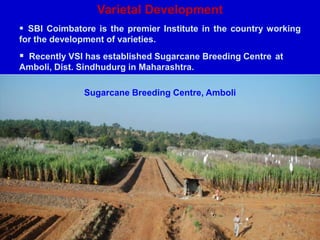
Varietal Development
 SBI Coimbatore is the premier Institute in the country working
for the development of varieties.
 Recently VSI has established Sugarcane Breeding Centre at
Amboli, Dist. Sindhudurg in Maharashtra.
Sugarcane Breeding Centre, Amboli
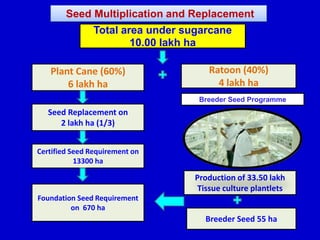
Seed Multiplication and Replacement
Plant Cane (60%)
6 lakh ha
Ratoon (40%)
4 lakh ha
Seed Replacement on
2 lakh ha (1/3)
Certified Seed Requirement on
13300 ha
Foundation Seed Requirement
on 670 ha
Total area under sugarcane
10.00 lakh ha
Production of 33.50 lakh
Tissue culture plantlets
Breeder Seed 55 ha
Breeder Seed Programme
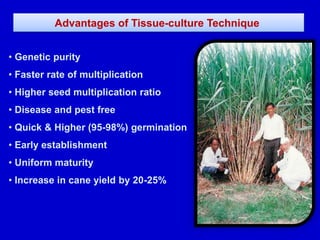
Advantages of Tissue-culture Technique
• Genetic purity
• Faster rate of multiplication
• Higher seed multiplication ratio
• Disease and pest free
• Quick & Higher (95-98%) germination
• Early establishment
• Uniform maturity
• Increase in cane yield by 20-25%
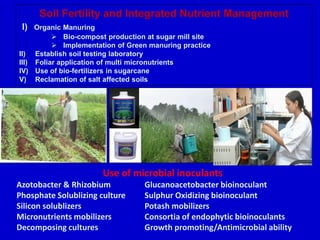
Soil Fertility and Integrated Nutrient Management
I) Organic Manuring
 Bio-compost production at sugar mill site
 Implementation of Green manuring practice
II) Establish soil testing laboratory
III) Foliar application of multi micronutrients
IV) Use of bio-fertilizers in sugarcane
V) Reclamation of salt affected soils
Use of microbial inoculants
Azotobacter & Rhizobium Glucanoacetobacter bioinoculant
Phosphate Solublizing culture Sulphur Oxidizing bioinoculant
Silicon solublizers Potash mobilizers
Micronutrients mobilizers Consortia of endophytic bioinoculants
Decomposing cultures Growth promoting/Antimicrobial ability
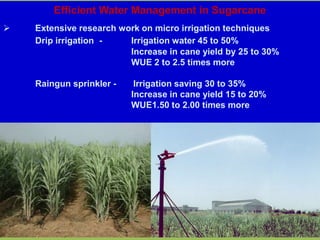
Efficient Water Management in Sugarcane
 Extensive research work on micro irrigation techniques
Drip irrigation - Irrigation water 45 to 50%
Increase in cane yield by 25 to 30%
WUE 2 to 2.5 times more
Raingun sprinkler - Irrigation saving 30 to 35%
Increase in cane yield 15 to 20%
WUE1.50 to 2.00 times more
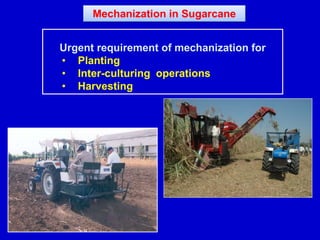
Urgent requirement of mechanization for
• Planting
• Inter-culturing operations
• Harvesting
Mechanization in Sugarcane
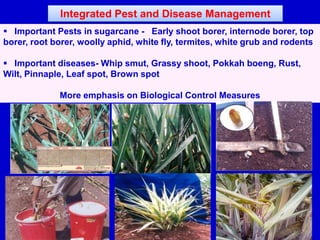
 Important Pests in sugarcane - Early shoot borer, internode borer, top
borer, root borer, woolly aphid, white fly, termites, white grub and rodents
 Important diseases- Whip smut, Grassy shoot, Pokkah boeng, Rust,
Wilt, Pinnaple, Leaf spot, Brown spot
More emphasis on Biological Control Measures
Integrated Pest and Disease Management
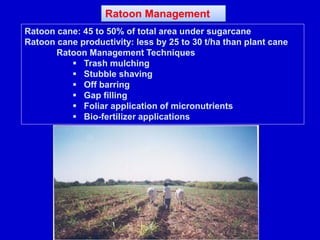
Ratoon cane: 45 to 50% of total area under sugarcane
Ratoon cane productivity: less by 25 to 30 t/ha than plant cane
Ratoon Management Techniques
 Trash mulching
 Stubble shaving
 Off barring
 Gap filling
 Foliar application of micronutrients
 Bio-fertilizer applications
Ratoon Management
• Manpower
• HRD Infrastructure
• Training Facilities
• Field demonstrations
Strengthening HRD and Extension Mechanism
• Use of membrane filtration in sugar industry.
• Product diversification and improved sugar
quality – VVHP raw sugar.
• Reduction in steam consumption.
• Cane sampler
Thrust areas for R & D
Sugar Processing
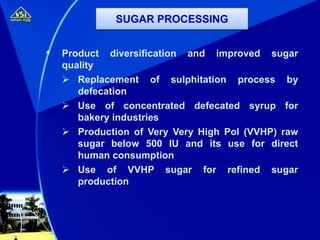
• Product diversification and improved sugar
quality
 Replacement of sulphitation process by
defecation
 Use of concentrated defecated syrup for
bakery industries
 Production of Very Very High Pol (VVHP) raw
sugar below 500 IU and its use for direct
human consumption
 Use of VVHP sugar for refined sugar
production
SUGAR PROCESSING
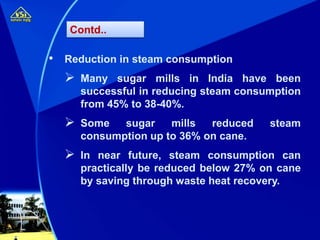
• Reduction in steam consumption
 Many sugar mills in India have been
successful in reducing steam consumption
from 45% to 38-40%.
 Some sugar mills reduced steam
consumption up to 36% on cane.
 In near future, steam consumption can
practically be reduced below 27% on cane
by saving through waste heat recovery.
Contd..
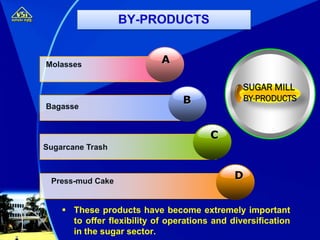
AMolasses
B
Bagasse
C
Sugarcane Trash
DPress-mud Cake
SUGAR MILL
BY-PRODUCTS
 These products have become extremely important
to offer flexibility of operations and diversification
in the sugar sector.
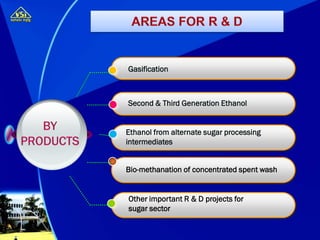
Gasification
Second & Third Generation Ethanol
Ethanol from alternate sugar processing
intermediates
Bio-methanation of concentrated spent wash
Other important R & D projects for
sugar sector
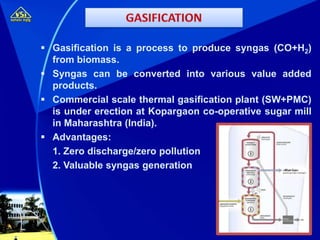
 Gasification is a process to produce syngas (CO+H2)
from biomass.
 Syngas can be converted into various value added
products.
 Commercial scale thermal gasification plant (SW+PMC)
is under erection at Kopargaon co-operative sugar mill
in Maharashtra (India).
 Advantages:
1. Zero discharge/zero pollution
2. Valuable syngas generation
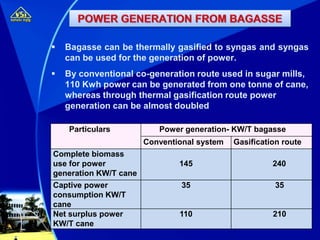
Particulars Power generation- KW/T bagasse
Conventional system Gasification route
Complete biomass
use for power
generation KW/T cane
145 240
Captive power
consumption KW/T
cane
35 35
Net surplus power
KW/T cane
110 210
 Bagasse can be thermally gasified to syngas and syngas
can be used for the generation of power.
 By conventional co-generation route used in sugar mills,
110 Kwh power can be generated from one tonne of cane,
whereas through thermal gasification route power
generation can be almost doubled
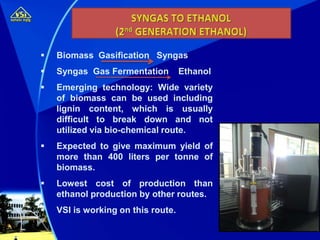
 Biomass Gasification Syngas
 Syngas Gas Fermentation Ethanol
 Emerging technology: Wide variety
of biomass can be used including
lignin content, which is usually
difficult to break down and not
utilized via bio-chemical route.
 Expected to give maximum yield of
more than 400 liters per tonne of
biomass.
 Lowest cost of production than
ethanol production by other routes.
 VSI is working on this route.
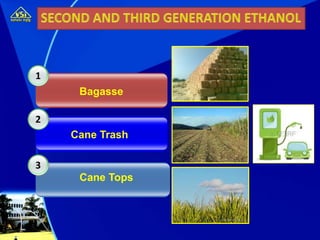
1
2
3
Bagasse
Cane Trash
Cane Tops
 Cellulosic ethanol fermentation using genetically
modified microorganisms is under investigation.
 Use of genetically modified microorganisms for
production of ethanol and other value added
products like hydrogen, bio-butanol, is also
interesting and extremely potential area for R & D
activities.
 VSI has started activities in this direction.
 Amyris (Brazil): Sugarcane juice to diesel
(genetically modified yeast).
 Biogas based Compress Natural Gas (CNG)
production (First plant is now operating in one of the
member distillery of VSI)
 Bio-butanol production.
 Lactic acid production by fermentation route
 Development of thermotolerant yeast for alcoholic
fermentation
 Development of Very High Gravity fermenting yeast
for alcoholic fermentation
 To make the industry globally competitive,
the industry must be able to innovate
putting in investment in R & D.
 There should be constant interaction and
effective coordination between the industry
and research organizations.
 There is urgent need to create a separate
fund for providing financial assistance for
R & D activities in sugar sector.
CONCLUSION
 All research organizations need to
coordinate their efforts for enhancing future
technologies in every field and to avoid
duplication of research activities.
 All stakeholders i.e. growers, processors,
consumers and most importantly the
government have to play proactive role to
assure the country to protect the interest of
each stakeholder and make the sector stable,
strong and efficient.
Contd…
THANK YOU…

Dg vsi foundation lecture lucknow - final

  • 2.
    • Importance ofsugar industry.  Provides work for about 0.5 million people.  More than 50 million sugarcane growers and their dependents are directly related to the sugar industry.  Highest consumer – around 23 million tonnes.  Demand in 2020 – around 30-31 million tonnes  Incremental rise – around 4% per annum.  In 2012-13, 526 mills in operation.  Production around 25 million tonnes.  Limitation on area expansion. • Production of ethanol – around 2.5 billion liters. • Potential – 7500 MW of green power. Facts and Figures
  • 3.
  • 4.
    • Turnover –Rs.800 billion • Dependency of farmers, labour and consumers • 65% of sugar consumed by bulk consumers • Higher potential for  Employment  Renewable and eco-friendly raw material  Sugarcane – Most efficient converter of solar energy into sugar • Contributor to a stable economy. Dimensions and Dynamics
  • 5.
    • Diminishing orstagnant yield and recovery. • Diversion of sugarcane area to other competitive crops. • Fluctuations in production due to inherent cyclic nature. • Water availability for irrigation. • Small and marginal land holdings. • Limitations in mechanized farming. Challenges • Fixation of cane price • Export and import • Ethanol blending programme Government Policies
  • 6.
    • The renewableeco-friendly raw material – enormous scope for harnessing and development of value added products. • Additional income generation and employment. • Entire biomass from sugarcane including leaves and tops are being intensively investigated for profitable utilization. • To provide economic stability to industry & growers and consistent supply of products to consumers. • Substantial scope for saving in foreign exchange. Why emphasis on R & D
  • 7.
    • India -0.87% • Brazil - 1.17% • Russian Federation - 1.25% • China - 1.70% • South Africa - 0.93% • Pakistan, Sri Lanka and Mexico - less than 0.5% • Most of the developed countries spend more than 2% of their GDP on R & D. Expenditure of R & D on GDP
  • 8.
    • Gross expenditureon R & D is driven by the Government sector comprising of –  Central Government – 54.4%  State Governments – 7.3%  Higher Education – 4.1%  Public Sector Industries – 5.3%  Private Sector Industries – 28.9% Expenditure on R & D in India
  • 9.
    • In IndustrialR & D,  Drugs and Pharmaceutical – 27.7%  Transportation – 14%  Information Technology -13.6%  Defence Industries – 6.1% Expenditure on R & D in India
  • 10.
    • Industrial sectorspent 0.61% of their sales turnover on R & D activities. For Private sector – 0.27% and Public sector – 0.82% • Applying this formula to sugar industry, our expenditure on R & D should be around Rs. 4.4 billion • R & D expenditure of Brazil in sugar sector is of US$ 1.7 billion (Rs. 105.4billion) Indian investment in R & D (2009-10)
  • 11.
    • Leading Institutesin sugarcane research (ICAR)  Sugarcane Breeding Institute (SBI), Coimbatore  Indian Institute of Sugarcane Research (IISR), Lucknow • Organizations engaged in developing sugarcane and sugarbeet varieties  UP Government Federation  State Agriculture Universities • Institutes engaged in R & D activities related to processing of sugarcane, ethanol, co-generation and by-products  National Sugar Institute  Vasantdada Sugar Institute  Praj Industries Ltd. R & D Organizations in sugar sector
  • 12.
    • Sugarcane DevelopmentFund (SDF), Govt. of India  Soft loan assistance for agriculture, plant expansion and modernization of sugar mills.  Grants for research projects. • Project based funding from Govt. organizations  Indian Council for Agriculture Research (ICAR)  Department of Science & Technology (DST)  Department of Bio-technology (DBT)  Bhabha Atomic Research Centre (BARC) Funding agencies
  • 13.
    PROSPECTS IN SUGARCANEAGRICULTURE Wide gap between the potential yield and actual yield realized 600 355 125 66 84 57 105 Potential of Cane yield Cane Harvested by some farmers Research farm cane yields Average of India Average of Maharashtra Average of Uttar Pradesh Average of Tamilnadu
  • 14.
     Varietal development Planting and harvesting programme  Seed replacement programme  Soil fertility and integrated nutrient management  Use of microbial inoculants  Micro irrigation and fertigation  Strengthening research on mechanization  Plant protection through bio-control agents  Ratoon management  HRD and extension mechanism Sugarcane Agriculture – R & D Priorities
  • 15.
    Varietal Development  SBICoimbatore is the premier Institute in the country working for the development of varieties.  Recently VSI has established Sugarcane Breeding Centre at Amboli, Dist. Sindhudurg in Maharashtra. Sugarcane Breeding Centre, Amboli
  • 16.
    Seed Multiplication andReplacement Plant Cane (60%) 6 lakh ha Ratoon (40%) 4 lakh ha Seed Replacement on 2 lakh ha (1/3) Certified Seed Requirement on 13300 ha Foundation Seed Requirement on 670 ha Total area under sugarcane 10.00 lakh ha Production of 33.50 lakh Tissue culture plantlets Breeder Seed 55 ha Breeder Seed Programme
  • 17.
    Advantages of Tissue-cultureTechnique • Genetic purity • Faster rate of multiplication • Higher seed multiplication ratio • Disease and pest free • Quick & Higher (95-98%) germination • Early establishment • Uniform maturity • Increase in cane yield by 20-25%
  • 18.
    Soil Fertility andIntegrated Nutrient Management I) Organic Manuring  Bio-compost production at sugar mill site  Implementation of Green manuring practice II) Establish soil testing laboratory III) Foliar application of multi micronutrients IV) Use of bio-fertilizers in sugarcane V) Reclamation of salt affected soils Use of microbial inoculants Azotobacter & Rhizobium Glucanoacetobacter bioinoculant Phosphate Solublizing culture Sulphur Oxidizing bioinoculant Silicon solublizers Potash mobilizers Micronutrients mobilizers Consortia of endophytic bioinoculants Decomposing cultures Growth promoting/Antimicrobial ability
  • 19.
    Efficient Water Managementin Sugarcane  Extensive research work on micro irrigation techniques Drip irrigation - Irrigation water 45 to 50% Increase in cane yield by 25 to 30% WUE 2 to 2.5 times more Raingun sprinkler - Irrigation saving 30 to 35% Increase in cane yield 15 to 20% WUE1.50 to 2.00 times more
  • 20.
    Urgent requirement ofmechanization for • Planting • Inter-culturing operations • Harvesting Mechanization in Sugarcane
  • 21.
     Important Pestsin sugarcane - Early shoot borer, internode borer, top borer, root borer, woolly aphid, white fly, termites, white grub and rodents  Important diseases- Whip smut, Grassy shoot, Pokkah boeng, Rust, Wilt, Pinnaple, Leaf spot, Brown spot More emphasis on Biological Control Measures Integrated Pest and Disease Management
  • 22.
    Ratoon cane: 45to 50% of total area under sugarcane Ratoon cane productivity: less by 25 to 30 t/ha than plant cane Ratoon Management Techniques  Trash mulching  Stubble shaving  Off barring  Gap filling  Foliar application of micronutrients  Bio-fertilizer applications Ratoon Management
  • 23.
    • Manpower • HRDInfrastructure • Training Facilities • Field demonstrations Strengthening HRD and Extension Mechanism
  • 24.
    • Use ofmembrane filtration in sugar industry. • Product diversification and improved sugar quality – VVHP raw sugar. • Reduction in steam consumption. • Cane sampler Thrust areas for R & D Sugar Processing
  • 25.
    • Product diversificationand improved sugar quality  Replacement of sulphitation process by defecation  Use of concentrated defecated syrup for bakery industries  Production of Very Very High Pol (VVHP) raw sugar below 500 IU and its use for direct human consumption  Use of VVHP sugar for refined sugar production SUGAR PROCESSING
  • 26.
    • Reduction insteam consumption  Many sugar mills in India have been successful in reducing steam consumption from 45% to 38-40%.  Some sugar mills reduced steam consumption up to 36% on cane.  In near future, steam consumption can practically be reduced below 27% on cane by saving through waste heat recovery. Contd..
  • 27.
    AMolasses B Bagasse C Sugarcane Trash DPress-mud Cake SUGARMILL BY-PRODUCTS  These products have become extremely important to offer flexibility of operations and diversification in the sugar sector.
  • 28.
    Gasification Second & ThirdGeneration Ethanol Ethanol from alternate sugar processing intermediates Bio-methanation of concentrated spent wash Other important R & D projects for sugar sector
  • 29.
     Gasification isa process to produce syngas (CO+H2) from biomass.  Syngas can be converted into various value added products.  Commercial scale thermal gasification plant (SW+PMC) is under erection at Kopargaon co-operative sugar mill in Maharashtra (India).  Advantages: 1. Zero discharge/zero pollution 2. Valuable syngas generation
  • 30.
    Particulars Power generation-KW/T bagasse Conventional system Gasification route Complete biomass use for power generation KW/T cane 145 240 Captive power consumption KW/T cane 35 35 Net surplus power KW/T cane 110 210  Bagasse can be thermally gasified to syngas and syngas can be used for the generation of power.  By conventional co-generation route used in sugar mills, 110 Kwh power can be generated from one tonne of cane, whereas through thermal gasification route power generation can be almost doubled
  • 31.
     Biomass GasificationSyngas  Syngas Gas Fermentation Ethanol  Emerging technology: Wide variety of biomass can be used including lignin content, which is usually difficult to break down and not utilized via bio-chemical route.  Expected to give maximum yield of more than 400 liters per tonne of biomass.  Lowest cost of production than ethanol production by other routes.  VSI is working on this route.
  • 32.
  • 33.
     Cellulosic ethanolfermentation using genetically modified microorganisms is under investigation.  Use of genetically modified microorganisms for production of ethanol and other value added products like hydrogen, bio-butanol, is also interesting and extremely potential area for R & D activities.  VSI has started activities in this direction.  Amyris (Brazil): Sugarcane juice to diesel (genetically modified yeast).
  • 34.
     Biogas basedCompress Natural Gas (CNG) production (First plant is now operating in one of the member distillery of VSI)  Bio-butanol production.  Lactic acid production by fermentation route  Development of thermotolerant yeast for alcoholic fermentation  Development of Very High Gravity fermenting yeast for alcoholic fermentation
  • 35.
     To makethe industry globally competitive, the industry must be able to innovate putting in investment in R & D.  There should be constant interaction and effective coordination between the industry and research organizations.  There is urgent need to create a separate fund for providing financial assistance for R & D activities in sugar sector. CONCLUSION
  • 36.
     All researchorganizations need to coordinate their efforts for enhancing future technologies in every field and to avoid duplication of research activities.  All stakeholders i.e. growers, processors, consumers and most importantly the government have to play proactive role to assure the country to protect the interest of each stakeholder and make the sector stable, strong and efficient. Contd…
  • 37.