SOCIAL
INTEGRATED
PROJECT
introduction
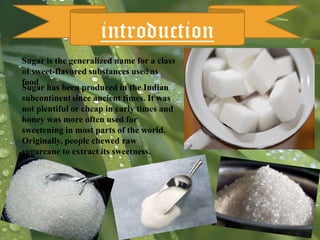
Sugar is the generalized name for a class
of sweet-flavored substances used as
food.
Sugar has been produced in the Indian
subcontinent since ancient times. It was
not plentiful or cheap in early times and
honey was more often used for
sweetening in most parts of the world.
Originally, people chewed raw
sugarcane to extract its sweetness.
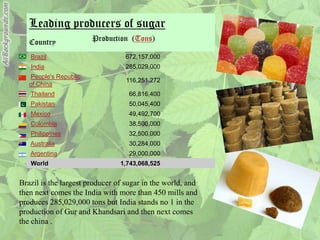
Leading producers of sugar
Country

Production (Tons)

Brazil

672,157,000

India

285,029,000

People's Republic
of China

116,251,272

Thailand

66,816,400

Pakistan

50,045,400

Mexico

49,492,700

Colombia

38,500,000

Philippines

32,500,000

Australia

30,284,000

Argentina

29,000,000

World

1,743,068,525

Brazil is the largest producer of sugar in the world, and
then next comes the India with more than 450 mills and
produces 285,029,000 tons but India stands no 1 in the
production of Gur and Khandsari and then next comes
the china .
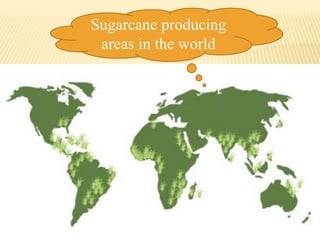
Sugarcane producing
areas in the world
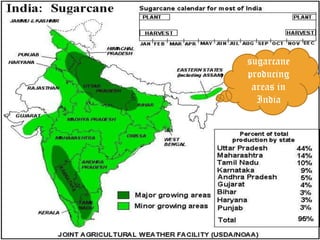
sugarcane
producing
areas in
India
Manufacturing of sugar
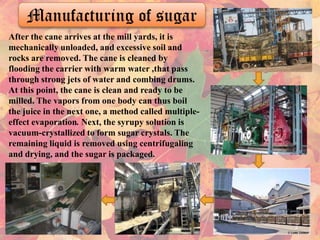
After the cane arrives at the mill yards, it is
mechanically unloaded, and excessive soil and
rocks are removed. The cane is cleaned by
flooding the carrier with warm water ,that pass
through strong jets of water and combing drums.
At this point, the cane is clean and ready to be
milled. The vapors from one body can thus boil
the juice in the next one, a method called multipleeffect evaporation. Next, the syrupy solution is
vacuum-crystallized to form sugar crystals. The
remaining liquid is removed using centrifugaling
and drying, and the sugar is packaged.
By products
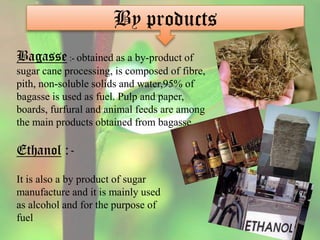
Bagasse :- obtained as a by-product of
sugar cane processing, is composed of fibre,
.
pith, non-soluble solids and water,95% of
bagasse is used as fuel. Pulp and paper,
boards, furfural and animal feeds are among
the main products obtained from bagasse

Ethanol :It is also a by product of sugar
manufacture and it is mainly used
as alcohol and for the purpose of
fuel
Sugar- cooperative
sector
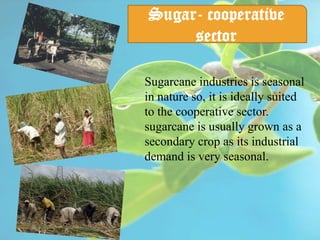
Sugarcane industries is seasonal
in nature so, it is ideally suited
to the cooperative sector.
sugarcane is usually grown as a
secondary crop as its industrial
demand is very seasonal.
Ideal place for sugar mills
sugar factories are situated only in the cane
growing areas and almost within 25 kms
distance from the sugarcane farms.
However, proportion of area under sugar
cane production is small relatively. As
such, sugar factories are highly dispersed
even in those areas that have an
appreciable hectare under cane.

Production areas
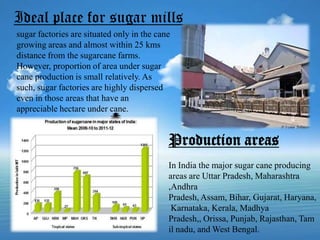
In India the major sugar cane producing
areas are Uttar Pradesh, Maharashtra
,Andhra
Pradesh, Assam, Bihar, Gujarat, Haryana,
Karnataka, Kerala, Madhya
Pradesh,, Orissa, Punjab, Rajasthan, Tam
il nadu, and West Bengal.
Growth promotional activities
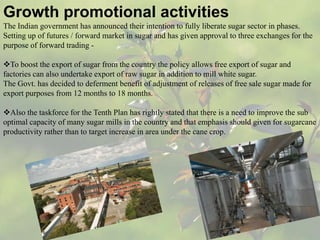
The Indian government has announced their intention to fully liberate sugar sector in phases.
Setting up of futures / forward market in sugar and has given approval to three exchanges for the
purpose of forward trading To boost the export of sugar from the country the policy allows free export of sugar and
factories can also undertake export of raw sugar in addition to mill white sugar.
The Govt. has decided to deferment benefit of adjustment of releases of free sale sugar made for
export purposes from 12 months to 18 months.
Also the taskforce for the Tenth Plan has rightly stated that there is a need to improve the sub
optimal capacity of many sugar mills in the country and that emphasis should given for sugarcane
productivity rather than to target increase in area under the cane crop.
Sugarcane industry

Sugarcane industry

  • 1.
  • 2.
    introduction Sugar is thegeneralized name for a class of sweet-flavored substances used as food. Sugar has been produced in the Indian subcontinent since ancient times. It was not plentiful or cheap in early times and honey was more often used for sweetening in most parts of the world. Originally, people chewed raw sugarcane to extract its sweetness.
  • 3.
    Leading producers ofsugar Country Production (Tons) Brazil 672,157,000 India 285,029,000 People's Republic of China 116,251,272 Thailand 66,816,400 Pakistan 50,045,400 Mexico 49,492,700 Colombia 38,500,000 Philippines 32,500,000 Australia 30,284,000 Argentina 29,000,000 World 1,743,068,525 Brazil is the largest producer of sugar in the world, and then next comes the India with more than 450 mills and produces 285,029,000 tons but India stands no 1 in the production of Gur and Khandsari and then next comes the china .
  • 4.
  • 5.
  • 6.
    Manufacturing of sugar Afterthe cane arrives at the mill yards, it is mechanically unloaded, and excessive soil and rocks are removed. The cane is cleaned by flooding the carrier with warm water ,that pass through strong jets of water and combing drums. At this point, the cane is clean and ready to be milled. The vapors from one body can thus boil the juice in the next one, a method called multipleeffect evaporation. Next, the syrupy solution is vacuum-crystallized to form sugar crystals. The remaining liquid is removed using centrifugaling and drying, and the sugar is packaged.
  • 7.
    By products Bagasse :-obtained as a by-product of sugar cane processing, is composed of fibre, . pith, non-soluble solids and water,95% of bagasse is used as fuel. Pulp and paper, boards, furfural and animal feeds are among the main products obtained from bagasse Ethanol :It is also a by product of sugar manufacture and it is mainly used as alcohol and for the purpose of fuel
  • 8.
    Sugar- cooperative sector Sugarcane industriesis seasonal in nature so, it is ideally suited to the cooperative sector. sugarcane is usually grown as a secondary crop as its industrial demand is very seasonal.
  • 9.
    Ideal place forsugar mills sugar factories are situated only in the cane growing areas and almost within 25 kms distance from the sugarcane farms. However, proportion of area under sugar cane production is small relatively. As such, sugar factories are highly dispersed even in those areas that have an appreciable hectare under cane. Production areas In India the major sugar cane producing areas are Uttar Pradesh, Maharashtra ,Andhra Pradesh, Assam, Bihar, Gujarat, Haryana, Karnataka, Kerala, Madhya Pradesh,, Orissa, Punjab, Rajasthan, Tam il nadu, and West Bengal.
  • 10.
    Growth promotional activities TheIndian government has announced their intention to fully liberate sugar sector in phases. Setting up of futures / forward market in sugar and has given approval to three exchanges for the purpose of forward trading To boost the export of sugar from the country the policy allows free export of sugar and factories can also undertake export of raw sugar in addition to mill white sugar. The Govt. has decided to deferment benefit of adjustment of releases of free sale sugar made for export purposes from 12 months to 18 months. Also the taskforce for the Tenth Plan has rightly stated that there is a need to improve the sub optimal capacity of many sugar mills in the country and that emphasis should given for sugarcane productivity rather than to target increase in area under the cane crop.

Editor's Notes

  • #2 SOCIAL INTEGRATED PROJECT
  • #4 Brazil is the largest producer of sugar in the world, and then next comes the India with more than 450 mills and produces 285,029,000 tons but india stands no 1 in the production of Gur and Khandsari and then next comes the china .
  • #8 It is also a by product of sugar manfacture and it is mainly used as alchol and for the purpose of fuel
  • #10 Idle place for sugar mills