Dextrose solution (GW)
Alaa F. Hassan (MSc. Pharmacology)
Drug Information Centre/ Al-Mahmoudiya G. Hospital
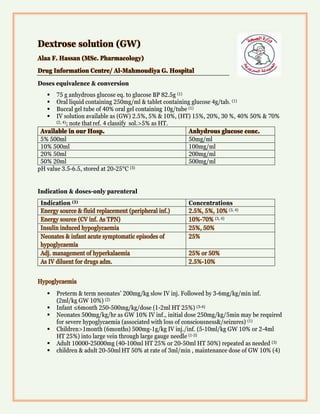
Doses equivalence & conversion
 75 g anhydrous glucose eq. to glucose BP 82.5g (1)
 Oral liquid containing 250mg/ml & tablet containing glucose 4g/tab. (1)
 Buccal gel tube of 40% oral gel containing 10g/tube (1)
 IV solution available as (GW) 2.5%, 5% & 10%, (HT) 15%, 20%, 30 %, 40% 50% & 70%
(2, 4); note thatref. 4 classify sol.>5% as HT.
Available in our Hosp. Anhydrous glucose conc.
5% 500ml 50mg/ml
10% 500ml 100mg/ml
20% 50ml 200mg/ml
50% 20ml 500mg/ml
pH value 3.5-6.5, stored at 20-25°C (3)
Indication & doses-only parenteral
Indication (3) Concentrations
Energy source & fluid replacement (peripheral inf.) 2.5%, 5%, 10% (3, 4)
Energy source (CV inf. As TPN) 10%-70% (3, 4)
Insulin induced hypoglycaemia 25%, 50%
Neonates & infant acute symptomatic episodes of
hypoglycaemia
25%
Adj. management of hyperkalaemia 25% or 50%
As IV diluent for drugs adm. 2.5%-10%
Hypoglycaemia
 Preterm & term neonates’ 200mg/kg slow IV inj. Followed by 3-6mg/kg/min inf.
(2ml/kg GW 10%) (2)
 Infant ≤6month 250-500mg/kg/dose (1-2ml HT 25%) (3-4)
 Neonates 500mg/kg/hr as GW 10% IV inf., initial dose 250mg/kg/5min may be required
for severe hypoglycaemia (associated with loss of consciousness&/seizures) (1)
 Children>1month (6months) 500mg-1g/kg IV inj./inf. (5-10ml/kg GW 10% or 2-4ml
HT 25%) into large vein through large gauge needle (1-3)
 Adult 10000-25000mg (40-100ml HT 25% or 20-50ml HT 50%) repeated as needed (3)
 children & adult 20-50ml HT 50% at rate of 3ml/min , maintenance dose of GW 10% (4)
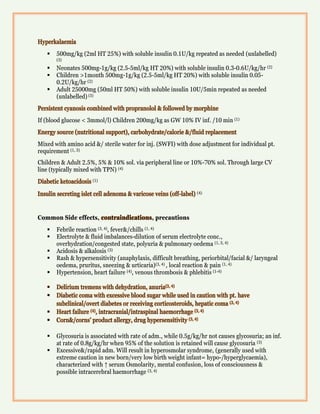
Hyperkalaemia
 500mg/kg (2ml HT 25%) with soluble insulin 0.1U/kg repeated as needed (unlabelled)
(3)
 Neonates 500mg-1g/kg (2.5-5ml/kg HT 20%) with soluble insulin 0.3-0.6U/kg/hr (2)
 Children >1month 500mg-1g/kg (2.5-5ml/kg HT 20%) with soluble insulin 0.05-
0.2U/kg/hr (2)
 Adult 25000mg (50ml HT 50%) with soluble insulin 10U/5min repeated as needed
(unlabelled) (3)
Persistent cyanosis combined with propranolol & followed by morphine
If (blood glucose < 3mmol/l) Children 200mg/kg as GW 10% IV inf. /10 min (1)
Energy source (nutritional support), carbohydrate/calorie &/fluid replacement
Mixed with amino acid &/ sterile water for inj. (SWFI) with dose adjustment for individual pt.
requirement (1, 3)
Children & Adult 2.5%, 5% & 10% sol. via peripheral line or 10%-70% sol. Through large CV
line (typically mixed with TPN) (4)
Diabetic ketoacidosis (1)
Insulin secreting islet cell adenoma & varicose veins (off-label) (4)
Common Side effects, contraindications, precautions
 Febrile reaction (3, 4), fever&/chills (1, 4)
 Electrolyte & fluid imbalances-dilution of serum electrolyte conc.,
overhydration/congested state, polyuria & pulmonary oedema (1, 3, 4)
 Acidosis & alkalosis (3)
 Rash & hypersensitivity (anaphylaxis, difficult breathing, periorbital/facial &/ laryngeal
oedema, pruritus, sneezing & urticaria)(3, 4) , local reaction & pain (1, 4)
 Hypertension, heart failure (4), venous thrombosis & phlebitis (1-4)
 Delirium tremens with dehydration, anuria(3, 4)
 Diabetic coma with excessive blood sugar while used in caution with pt. have
subclinical/overt diabetes or receiving corticosteroids, hepatic coma (3, 4)
 Heart failure (4), intracranial/intraspinal haemorrhage (3, 4)
 Corn&/corns’ product allergy, drug hypersensitivity (3, 4)
 Glycosuria is associated with rate of adm., while 0.5g/kg/hr not causes glycosuria; an inf.
at rate of 0.8g/kg/hr when 95% of the solution is retained will cause glycosuria (3)
 Excessive&/rapid adm. Will result in hyperosmolar syndrome, (generally used with
extreme caution in new born/very low birth weight infant= hypo-/hyperglycaemia),
characterized with ↑ serum Osmolarity, mental confusion, loss of consciousness &
possible intracerebral haemorrhage (3, 4)
Also fatty liver infiltration, acute respiratory failure & hypermetabolic pt. difficult
weaning from respirator (3), besides resulting in sig. hypokalaemia & hypophosphatemia
(3).While prolong administration of glucose without electrolyte is associated with
hyponatraemia & electrolyte imbalance (1)
 Slow iv inf. /5min suggested for conc. not >25% (2), When higher conc. >5% to be given
via peripheral vein, adm. Slowly preferably through small bore needle into large vein to
minimize irritation (3, 4), use umbilical/central venous catheter for sol. Conc.>10% after
appropriate dilution (1, 2) , > 12.5% (5), or an inf. via CV line for conc. not >25% or 30%
(considered irritant to central vein) (2)
 HT 50% sol. should be only administered in emergency; avoid sudden withdrawal, adm.
GW 5% or 10% infusion after the HT inj. To avoid rebound hypoglycaemia (2-4)
 1 manufacturer state the use final filter during adm. Of all parenteral sol. When possible
(3)
 Causes pseudoagglutination of RBCs when adm. simultaneously with whole blood (3, 4)
 Do not use plastic bags in series connection, pressurize bag to increase flow rate nor use
vented IV adm. Set (results in air embolism) (3,4)
 Some sol. Contains Aluminium, in pt. with impaired renal fx. , toxicity is expected
(Premature neonates are at particular risk-their immature kidneys & requirement of
calcium + phosphate) (pt. with impaired renal fx. Receiving parenteral Al >4-5mcg/day
are at risk for CNS or bone toxicity) (3)
Preparation of other conc. From GW 10% 500ml +HT 50% (2)
Volume removed
from GW 10% (ml)
Volume of HT 50% to
be added (ml)
Final conc. Final vol. (ml)
31.25 31.25 12.5% 500
62.5 62.5 15% 500
93.75 93.75 17.5% 500
187.5 187.5 25% 500
Volume req. HT 50%= (% change [higher conc. – lower conc.] * final volume) /40 (5)
If you need to add NaCl 0.9% to the made 500ml bottle, remove 15ml prepared solution & add
15ml NaCl 30% (2)
References
1. British National Formulary for Children. V3.1.6 updated 28th Sep. 2022 [Android apk]
2. Guy’s & St Thomas’ NHS Foundation Trust - Paediatric Formulary. First Ed. Updated 27th
April 2020 [Android apk]
3. Elsevier’s 2032 Intravenous Medications, A handbook for nurses and health professionals.
Thirty-nine Ed. V3.6.14 [Android apk]
4. McGraw-Hill - I.V Drug Handbook. V3.0.82 2009-2010 [Android apk]
5. Neonatal Guidelines And Drug Doses 2015 [Android apk]

Dextrose solution (GW).pdf

  • 1.
    Dextrose solution (GW) AlaaF. Hassan (MSc. Pharmacology) Drug Information Centre/ Al-Mahmoudiya G. Hospital Doses equivalence & conversion  75 g anhydrous glucose eq. to glucose BP 82.5g (1)  Oral liquid containing 250mg/ml & tablet containing glucose 4g/tab. (1)  Buccal gel tube of 40% oral gel containing 10g/tube (1)  IV solution available as (GW) 2.5%, 5% & 10%, (HT) 15%, 20%, 30 %, 40% 50% & 70% (2, 4); note thatref. 4 classify sol.>5% as HT. Available in our Hosp. Anhydrous glucose conc. 5% 500ml 50mg/ml 10% 500ml 100mg/ml 20% 50ml 200mg/ml 50% 20ml 500mg/ml pH value 3.5-6.5, stored at 20-25°C (3) Indication & doses-only parenteral Indication (3) Concentrations Energy source & fluid replacement (peripheral inf.) 2.5%, 5%, 10% (3, 4) Energy source (CV inf. As TPN) 10%-70% (3, 4) Insulin induced hypoglycaemia 25%, 50% Neonates & infant acute symptomatic episodes of hypoglycaemia 25% Adj. management of hyperkalaemia 25% or 50% As IV diluent for drugs adm. 2.5%-10% Hypoglycaemia  Preterm & term neonates’ 200mg/kg slow IV inj. Followed by 3-6mg/kg/min inf. (2ml/kg GW 10%) (2)  Infant ≤6month 250-500mg/kg/dose (1-2ml HT 25%) (3-4)  Neonates 500mg/kg/hr as GW 10% IV inf., initial dose 250mg/kg/5min may be required for severe hypoglycaemia (associated with loss of consciousness&/seizures) (1)  Children>1month (6months) 500mg-1g/kg IV inj./inf. (5-10ml/kg GW 10% or 2-4ml HT 25%) into large vein through large gauge needle (1-3)  Adult 10000-25000mg (40-100ml HT 25% or 20-50ml HT 50%) repeated as needed (3)  children & adult 20-50ml HT 50% at rate of 3ml/min , maintenance dose of GW 10% (4)
  • 2.
    Hyperkalaemia  500mg/kg (2mlHT 25%) with soluble insulin 0.1U/kg repeated as needed (unlabelled) (3)  Neonates 500mg-1g/kg (2.5-5ml/kg HT 20%) with soluble insulin 0.3-0.6U/kg/hr (2)  Children >1month 500mg-1g/kg (2.5-5ml/kg HT 20%) with soluble insulin 0.05- 0.2U/kg/hr (2)  Adult 25000mg (50ml HT 50%) with soluble insulin 10U/5min repeated as needed (unlabelled) (3) Persistent cyanosis combined with propranolol & followed by morphine If (blood glucose < 3mmol/l) Children 200mg/kg as GW 10% IV inf. /10 min (1) Energy source (nutritional support), carbohydrate/calorie &/fluid replacement Mixed with amino acid &/ sterile water for inj. (SWFI) with dose adjustment for individual pt. requirement (1, 3) Children & Adult 2.5%, 5% & 10% sol. via peripheral line or 10%-70% sol. Through large CV line (typically mixed with TPN) (4) Diabetic ketoacidosis (1) Insulin secreting islet cell adenoma & varicose veins (off-label) (4) Common Side effects, contraindications, precautions  Febrile reaction (3, 4), fever&/chills (1, 4)  Electrolyte & fluid imbalances-dilution of serum electrolyte conc., overhydration/congested state, polyuria & pulmonary oedema (1, 3, 4)  Acidosis & alkalosis (3)  Rash & hypersensitivity (anaphylaxis, difficult breathing, periorbital/facial &/ laryngeal oedema, pruritus, sneezing & urticaria)(3, 4) , local reaction & pain (1, 4)  Hypertension, heart failure (4), venous thrombosis & phlebitis (1-4)  Delirium tremens with dehydration, anuria(3, 4)  Diabetic coma with excessive blood sugar while used in caution with pt. have subclinical/overt diabetes or receiving corticosteroids, hepatic coma (3, 4)  Heart failure (4), intracranial/intraspinal haemorrhage (3, 4)  Corn&/corns’ product allergy, drug hypersensitivity (3, 4)  Glycosuria is associated with rate of adm., while 0.5g/kg/hr not causes glycosuria; an inf. at rate of 0.8g/kg/hr when 95% of the solution is retained will cause glycosuria (3)  Excessive&/rapid adm. Will result in hyperosmolar syndrome, (generally used with extreme caution in new born/very low birth weight infant= hypo-/hyperglycaemia), characterized with ↑ serum Osmolarity, mental confusion, loss of consciousness & possible intracerebral haemorrhage (3, 4)
  • 3.
    Also fatty liverinfiltration, acute respiratory failure & hypermetabolic pt. difficult weaning from respirator (3), besides resulting in sig. hypokalaemia & hypophosphatemia (3).While prolong administration of glucose without electrolyte is associated with hyponatraemia & electrolyte imbalance (1)  Slow iv inf. /5min suggested for conc. not >25% (2), When higher conc. >5% to be given via peripheral vein, adm. Slowly preferably through small bore needle into large vein to minimize irritation (3, 4), use umbilical/central venous catheter for sol. Conc.>10% after appropriate dilution (1, 2) , > 12.5% (5), or an inf. via CV line for conc. not >25% or 30% (considered irritant to central vein) (2)  HT 50% sol. should be only administered in emergency; avoid sudden withdrawal, adm. GW 5% or 10% infusion after the HT inj. To avoid rebound hypoglycaemia (2-4)  1 manufacturer state the use final filter during adm. Of all parenteral sol. When possible (3)  Causes pseudoagglutination of RBCs when adm. simultaneously with whole blood (3, 4)  Do not use plastic bags in series connection, pressurize bag to increase flow rate nor use vented IV adm. Set (results in air embolism) (3,4)  Some sol. Contains Aluminium, in pt. with impaired renal fx. , toxicity is expected (Premature neonates are at particular risk-their immature kidneys & requirement of calcium + phosphate) (pt. with impaired renal fx. Receiving parenteral Al >4-5mcg/day are at risk for CNS or bone toxicity) (3) Preparation of other conc. From GW 10% 500ml +HT 50% (2) Volume removed from GW 10% (ml) Volume of HT 50% to be added (ml) Final conc. Final vol. (ml) 31.25 31.25 12.5% 500 62.5 62.5 15% 500 93.75 93.75 17.5% 500 187.5 187.5 25% 500 Volume req. HT 50%= (% change [higher conc. – lower conc.] * final volume) /40 (5) If you need to add NaCl 0.9% to the made 500ml bottle, remove 15ml prepared solution & add 15ml NaCl 30% (2) References 1. British National Formulary for Children. V3.1.6 updated 28th Sep. 2022 [Android apk] 2. Guy’s & St Thomas’ NHS Foundation Trust - Paediatric Formulary. First Ed. Updated 27th April 2020 [Android apk] 3. Elsevier’s 2032 Intravenous Medications, A handbook for nurses and health professionals. Thirty-nine Ed. V3.6.14 [Android apk] 4. McGraw-Hill - I.V Drug Handbook. V3.0.82 2009-2010 [Android apk] 5. Neonatal Guidelines And Drug Doses 2015 [Android apk]