DevOps Support
for Ethical SDLC
Overview of DevOps-related SDLC ethical concerns from IEEE P70nn Working Groups @IEEESA http://sites.ieee.org/sagroups-7000/
Mark Underwood @knowlengr | Synchrony | Views my own | DevOps SDLC Ethics | dark@computer.org | v1.1 | Rev History @ end
IEEE P7000: Marquis Group Charter
“Scope: The standard establishes a process model by which engineers and technologists can
address ethical consideration throughout the various stages of system initiation, analysis and
design. Expected process requirements include management and engineering view of new
IT product development, computer ethics and IT system design, value-sensitive design, and,
stakeholder involvement in ethical IT system design. . .. The purpose of this standard is to
enable the pragmatic application of this type of Value-Based System Design methodology
which demonstrates that conceptual analysis of values and an extensive feasibility analysis
can help to refine ethical system requirements in systems and software life cycles.”
Mark Underwood @knowlengr | Synchrony | Views my own | DevOps SDLC Ethics | dark@computer.org | v1.1 | Rev History @ end
Related IEEE P70nn Groups
 IEEE P7000 Ethical Systems Design
 IEEE P7001 Transparency of Autonomous Systems
 IEEE P7002 Data Privacy Process
 IEEE P7003 Algorithmic Bias Considerations
 IEEE P7004 Standard for Child and Student Data Governance
 IEEE P7005 Standard for Transparent Employer Data Governance
 IEEE P7006 Standard for Personal AI Agent
 IEEE P7007 Ontological Standard for Ethically Driven Robotics and Automation Systems
 IEEE P7008 - Standard for Ethically Driven Nudging for Robotic, Intelligent and Autonomous Systems
 IEEE P7009 - Standard for Fail-Safe Design of Autonomous and Semi-Autonomous Systems
 IEEE P7010 - Wellbeing Metrics Standard for Ethical Artificial Intelligence and Autonomous Systems
 IEEE P7011 - SSIE Standard for Trustworthiness of News Media
 IEEE P7012 - SSIE Machine Readable Personal Privacy Terms
 IEEE P7013 - Facial Analysis
Mark Underwood @knowlengr | Synchrony | Views my own | DevOps SDLC Ethics | dark@computer.org | v1.1 | Rev History @ end
Key References
Mark Underwood @knowlengr | Synchrony | Views my own | DevOps SDLC Ethics | dark@computer.org | v1.1 | Rev History @ end
Focus: artificial
intelligence and
autonomous systems.
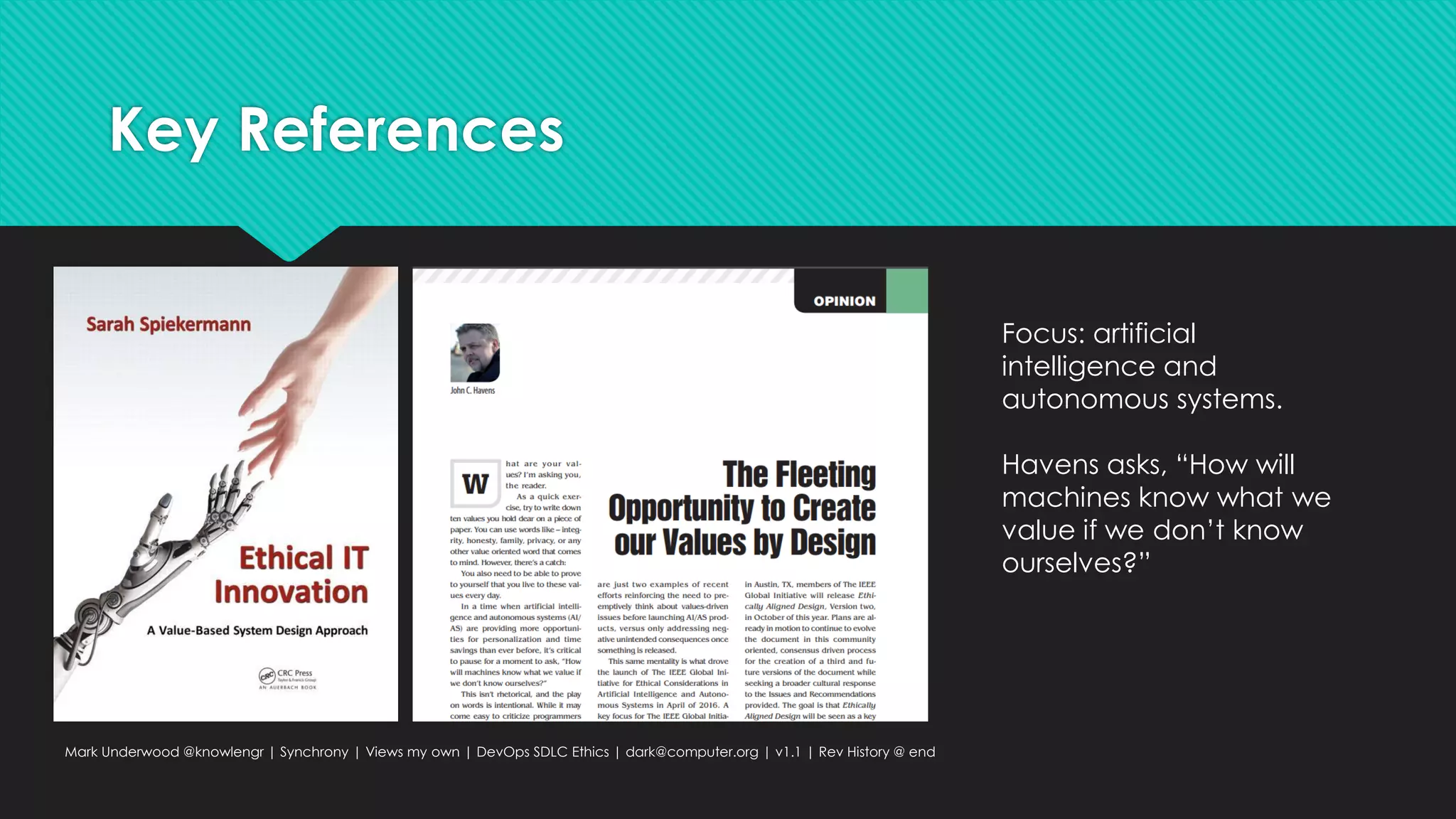
Havens asks, “How will
machines know what we
value if we don’t know
ourselves?”
Recent Case Study Opportunities:
Case Study 1
Mark Underwood @knowlengr | Synchrony | Views my own | DevOps SDLC Ethics | dark@computer.org | v1.1 | Rev History @ end
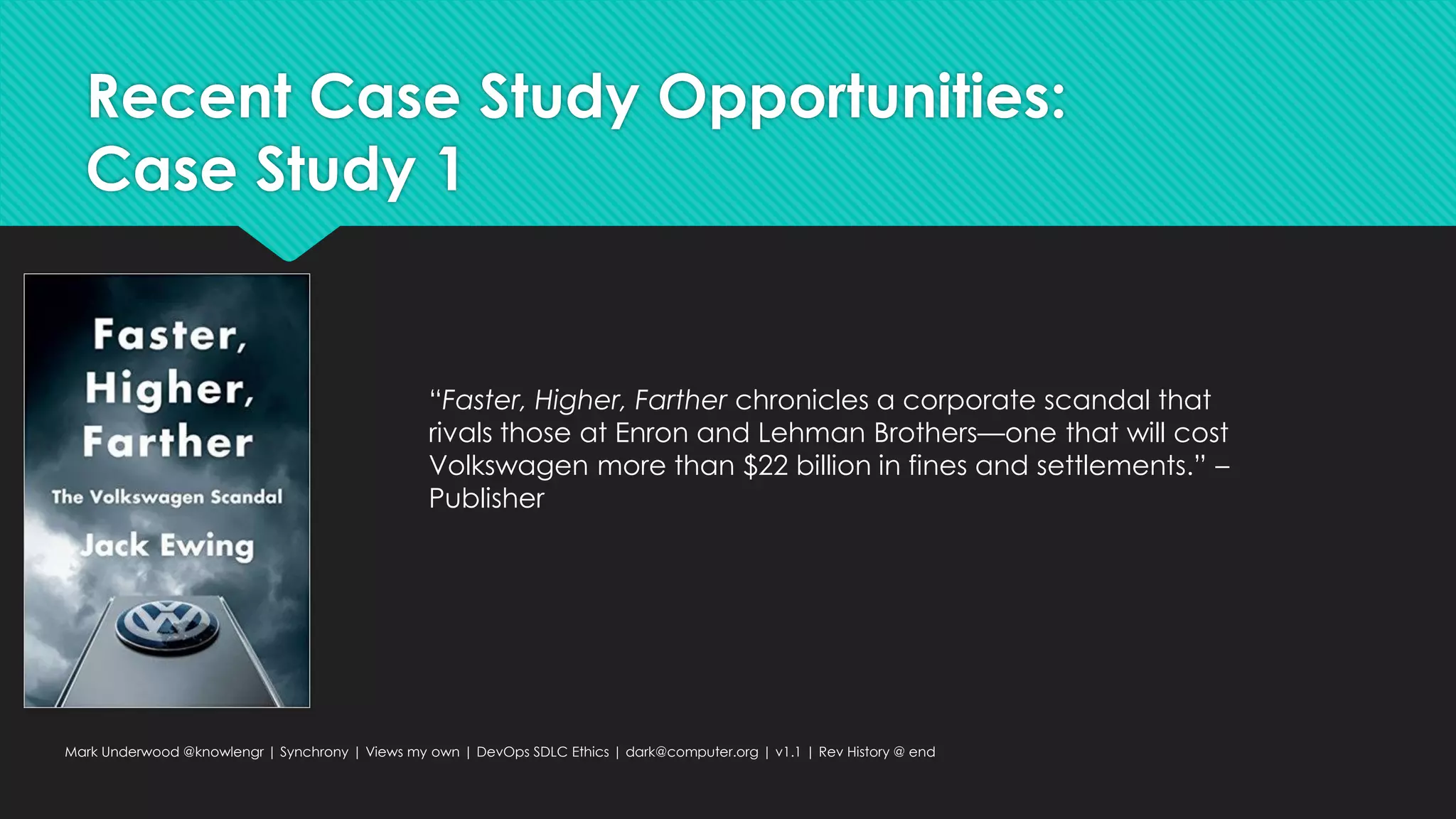
“Faster, Higher, Farther chronicles a corporate scandal that
rivals those at Enron and Lehman Brothers—one that will cost
Volkswagen more than $22 billion in fines and settlements.” –
Publisher
Case Study 2
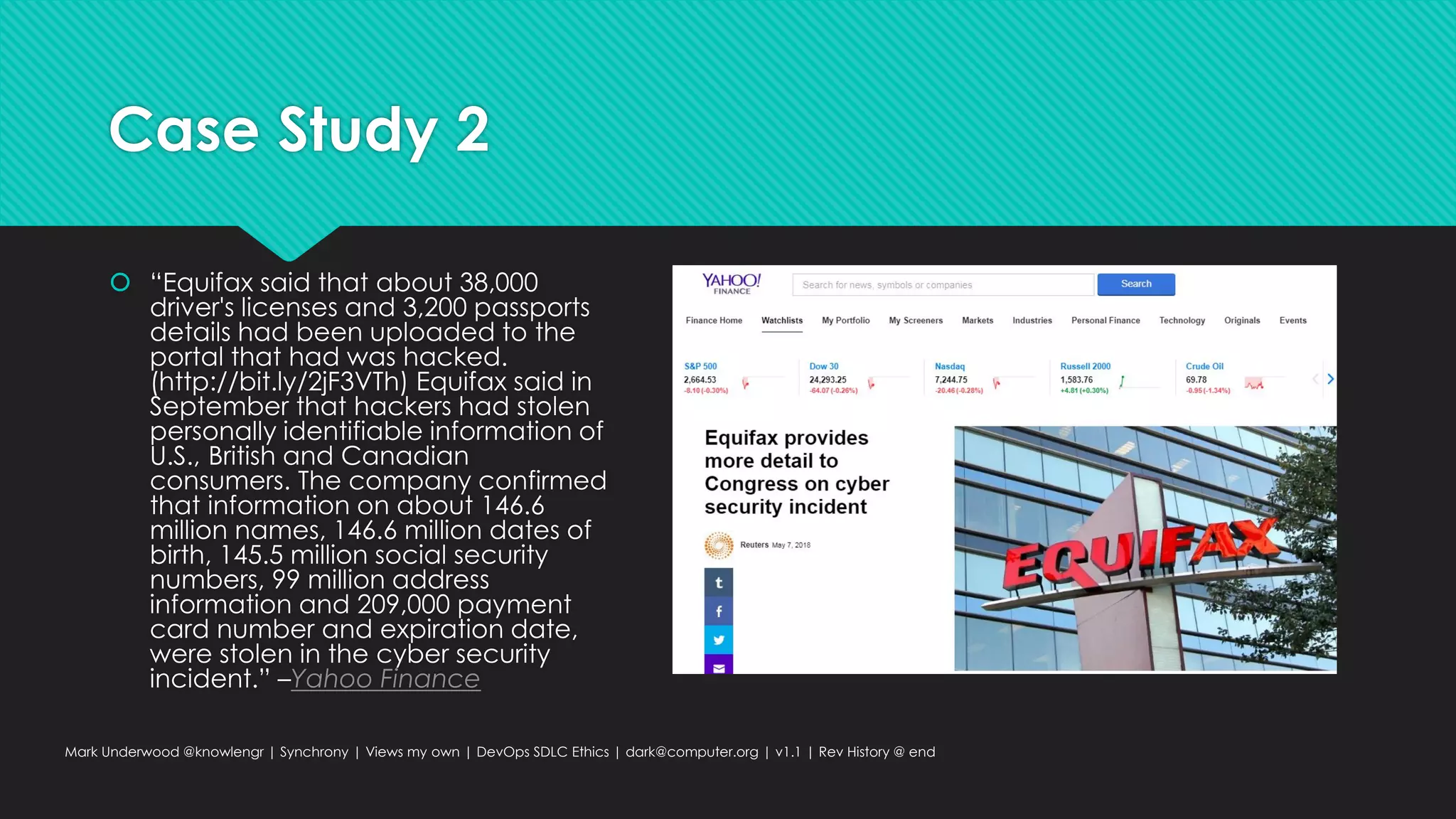
 “Equifax said that about 38,000
driver's licenses and 3,200 passports
details had been uploaded to the
portal that had was hacked.
(http://bit.ly/2jF3VTh) Equifax said in
September that hackers had stolen
personally identifiable information of
U.S., British and Canadian
consumers. The company confirmed
that information on about 146.6
million names, 146.6 million dates of
birth, 145.5 million social security
numbers, 99 million address
information and 209,000 payment
card number and expiration date,
were stolen in the cyber security
incident.” –Yahoo Finance
Mark Underwood @knowlengr | Synchrony | Views my own | DevOps SDLC Ethics | dark@computer.org | v1.1 | Rev History @ end
Case Study 3
Mark Underwood @knowlengr | Synchrony | Views my own | DevOps SDLC Ethics | dark@computer.org | v1.1 | Rev History @ end
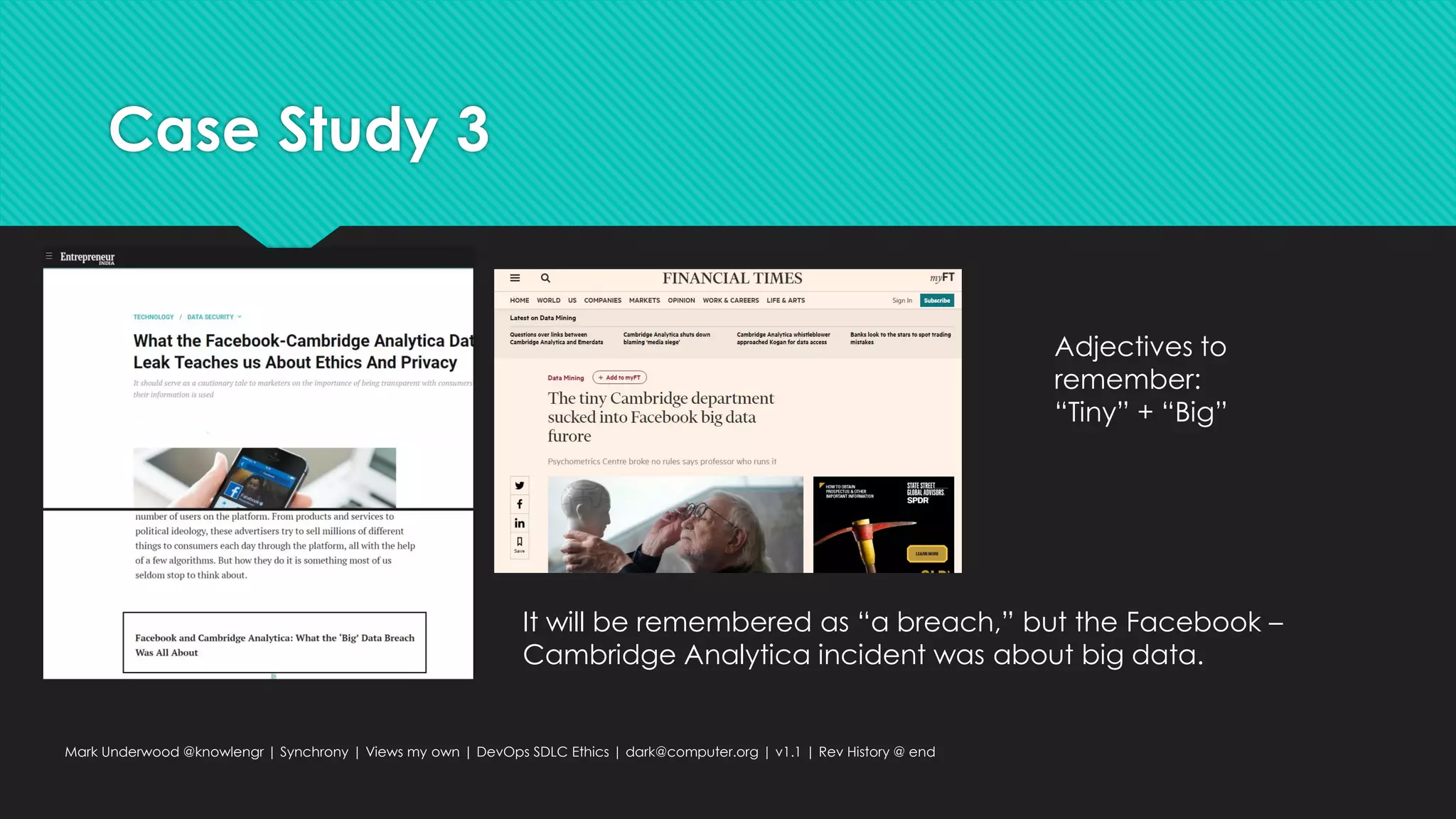
It will be remembered as “a breach,” but the Facebook –
Cambridge Analytica incident was about big data.
Adjectives to
remember:
“Tiny” + “Big”
Case Study 4
Mark Underwood @knowlengr | Synchrony | Views my own | DevOps SDLC Ethics | dark@computer.org | v1.1 | Rev History @ end
Finding: Hispanic-owned and managed Airbnb properties, controlled for
other aspects, receive less revenue than other groups.
Response from Airbnb when contacted by reporters: We already provide
tools to help price listings.
Source: American Public Media Marketplace 8-May-2018
Related stories:
Dan Gorenstein, “Airbnb cracks down on bias – but at what cost?” Marketplace, 2018-09-08
Corporate Europe Observatory, “Unfairbnb” 2-May-2018
Case Study 5
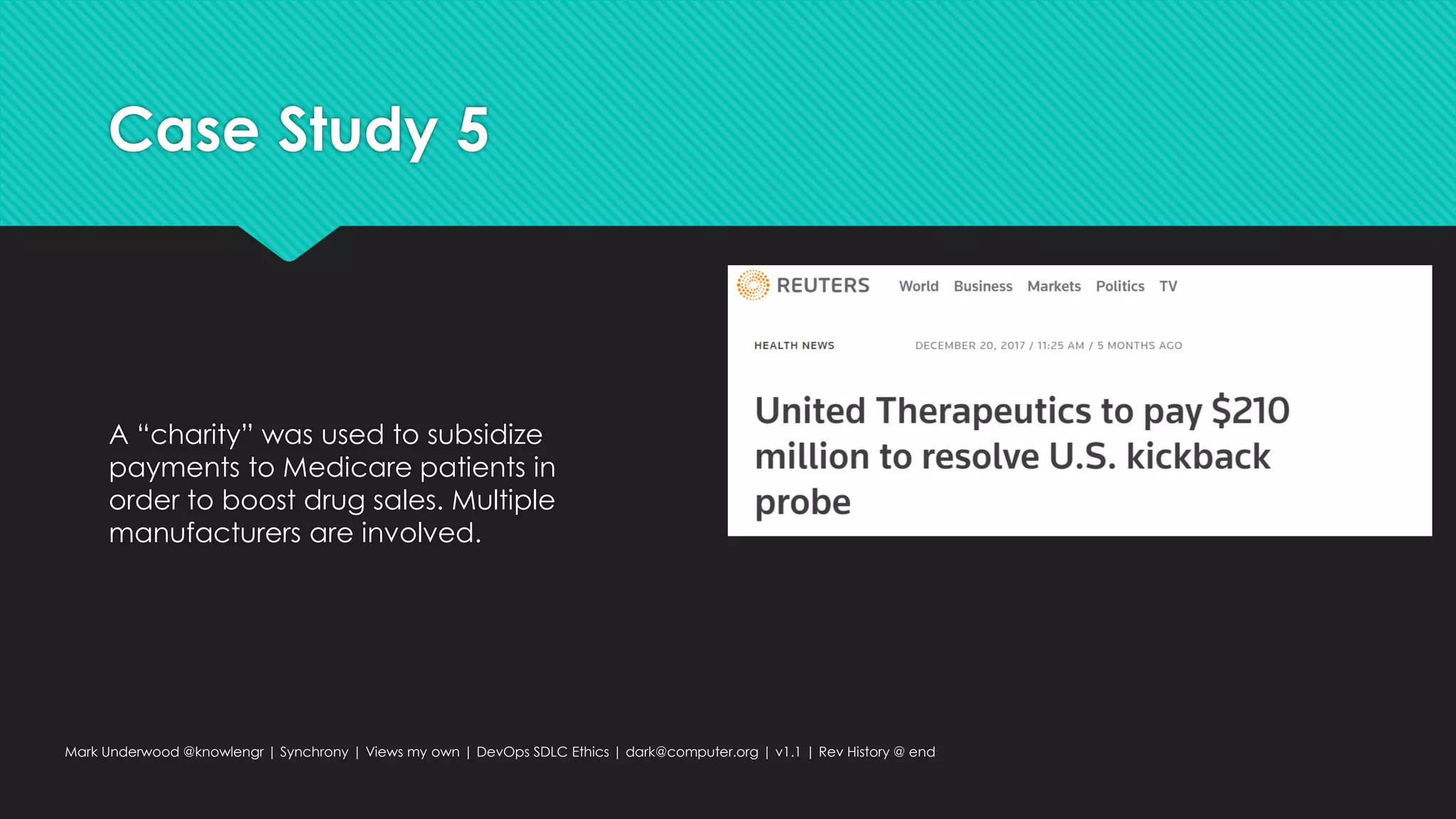
A “charity” was used to subsidize
payments to Medicare patients in
order to boost drug sales. Multiple
manufacturers are involved.
Mark Underwood @knowlengr | Synchrony | Views my own | DevOps SDLC Ethics | dark@computer.org | v1.1 | Rev History @ end
Case Study 6
Mark Underwood @knowlengr | Synchrony | Views my own | DevOps SDLC Ethics | dark@computer.org | v1.1 | Rev History @ end
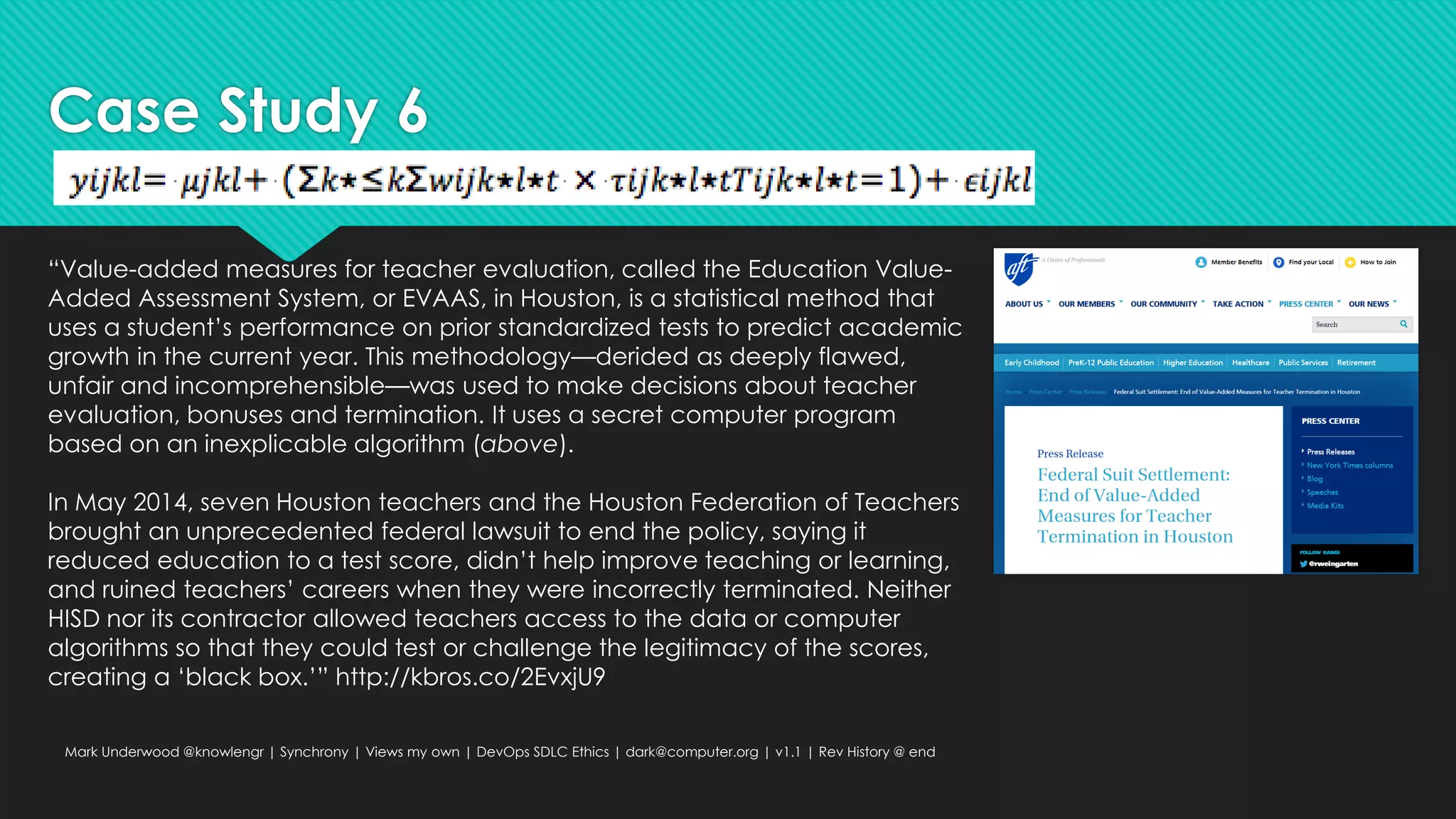
“Value-added measures for teacher evaluation, called the Education Value-
Added Assessment System, or EVAAS, in Houston, is a statistical method that
uses a student’s performance on prior standardized tests to predict academic
growth in the current year. This methodology—derided as deeply flawed,
unfair and incomprehensible—was used to make decisions about teacher
evaluation, bonuses and termination. It uses a secret computer program
based on an inexplicable algorithm (above).
In May 2014, seven Houston teachers and the Houston Federation of Teachers
brought an unprecedented federal lawsuit to end the policy, saying it
reduced education to a test score, didn’t help improve teaching or learning,
and ruined teachers’ careers when they were incorrectly terminated. Neither
HISD nor its contractor allowed teachers access to the data or computer
algorithms so that they could test or challenge the legitimacy of the scores,
creating a ‘black box.’” http://kbros.co/2EvxjU9
Case Study 7
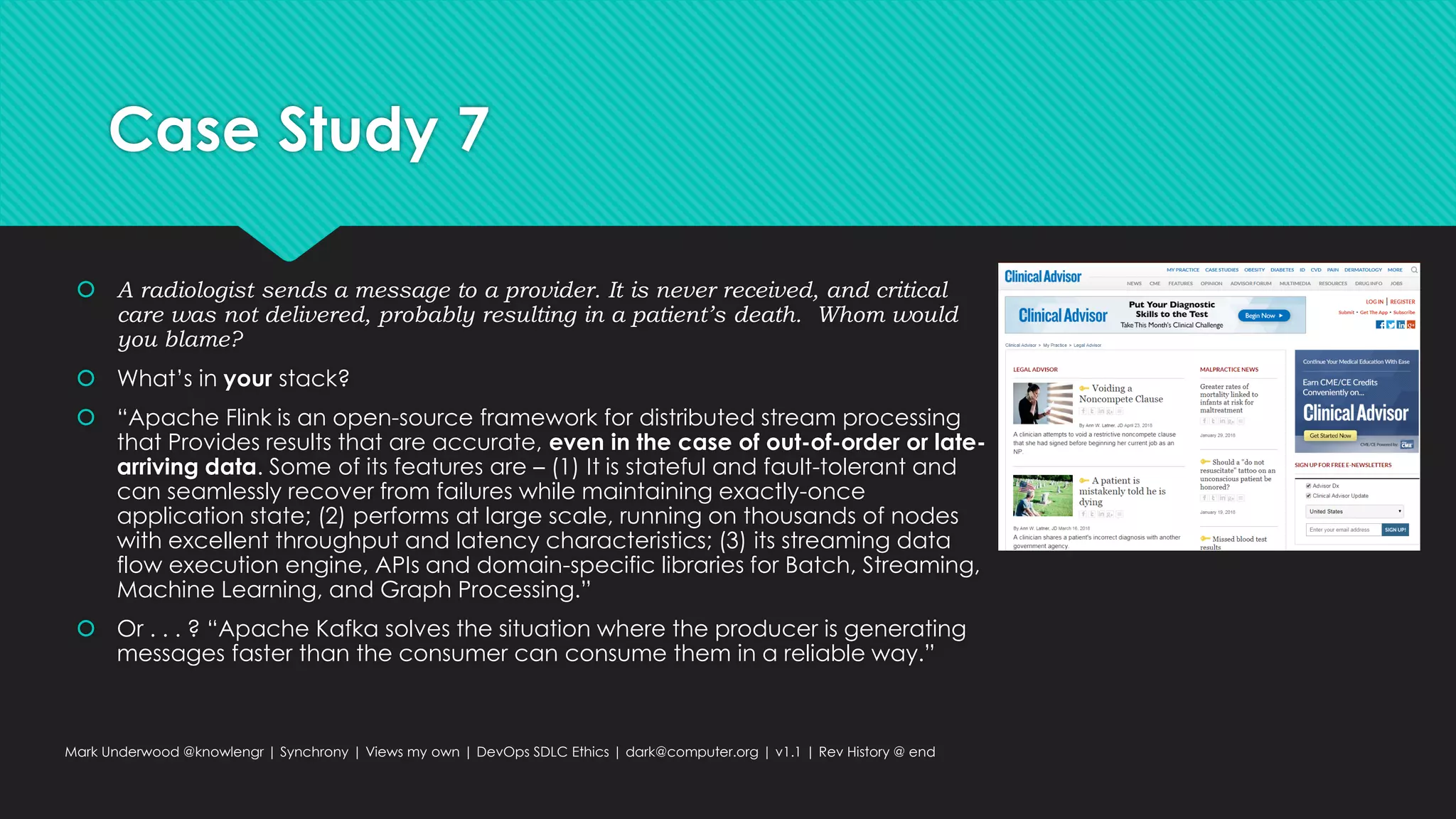
 A radiologist sends a message to a provider. It is never received, and critical
care was not delivered, probably resulting in a patient’s death. Whom would
you blame?
 What’s in your stack?
 “Apache Flink is an open-source framework for distributed stream processing
that Provides results that are accurate, even in the case of out-of-order or late-
arriving data. Some of its features are – (1) It is stateful and fault-tolerant and
can seamlessly recover from failures while maintaining exactly-once
application state; (2) performs at large scale, running on thousands of nodes
with excellent throughput and latency characteristics; (3) its streaming data
flow execution engine, APIs and domain-specific libraries for Batch, Streaming,
Machine Learning, and Graph Processing.”
 Or . . . ? “Apache Kafka solves the situation where the producer is generating
messages faster than the consumer can consume them in a reliable way.”
Mark Underwood @knowlengr | Synchrony | Views my own | DevOps SDLC Ethics | dark@computer.org | v1.1 | Rev History @ end
Related Decks
 NIST Big Data Public Working Group – Overview for Cloud Native SAFE
 Stakeholders for Ethical Systems Design
 DevOps Support for a More Ethical SDLC (this deck)
 GDPR Issues in Security and Privacy
Mark Underwood @knowlengr | Synchrony | Views my own | DevOps SDLC Ethics | dark@computer.org | v1.1 | Rev History @ end
My Perspective
 Chair Ontology / Taxonomy subgroup for P7000
 Occasional participant in IEEE Standards WGs P7007, P7001, P7003, P7002, P7010, P7007
 IEEE Standard P2675 WG Security for DevOps
 IEEE Standards P1915.1 SDN and Network Function Virtualization Security
 Finance large enterprise: supply chain risk, complex playbooks, many InfoSec tools,
workflow automation, big data logging; risks include fraud and regulatory #fail
Mark Underwood @knowlengr | Synchrony | Views my own | DevOps SDLC Ethics | dark@computer.org | v1.1 | Rev History @ end
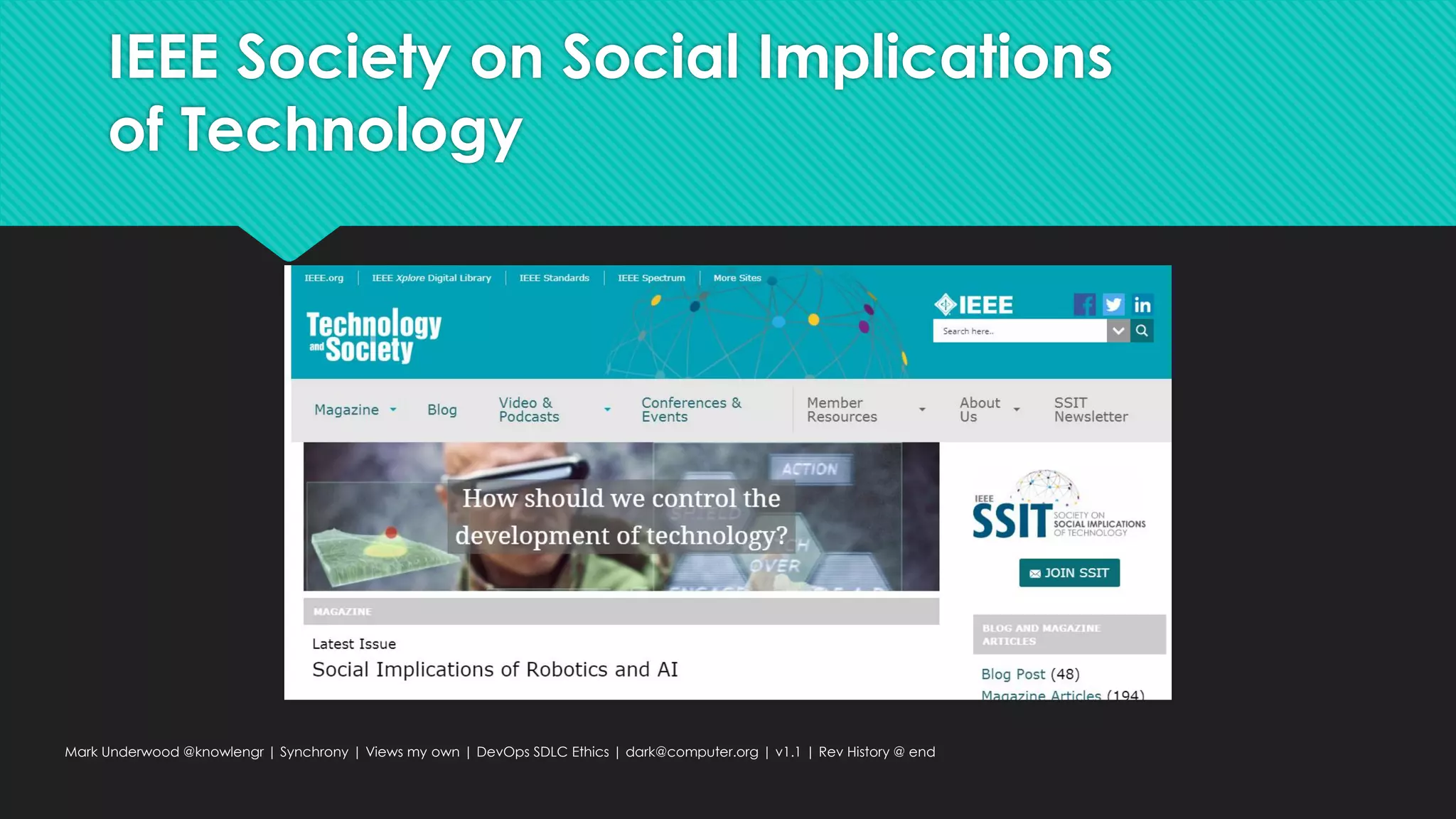
IEEE Society on Social Implications
of Technology
Mark Underwood @knowlengr | Synchrony | Views my own | DevOps SDLC Ethics | dark@computer.org | v1.1 | Rev History @ end
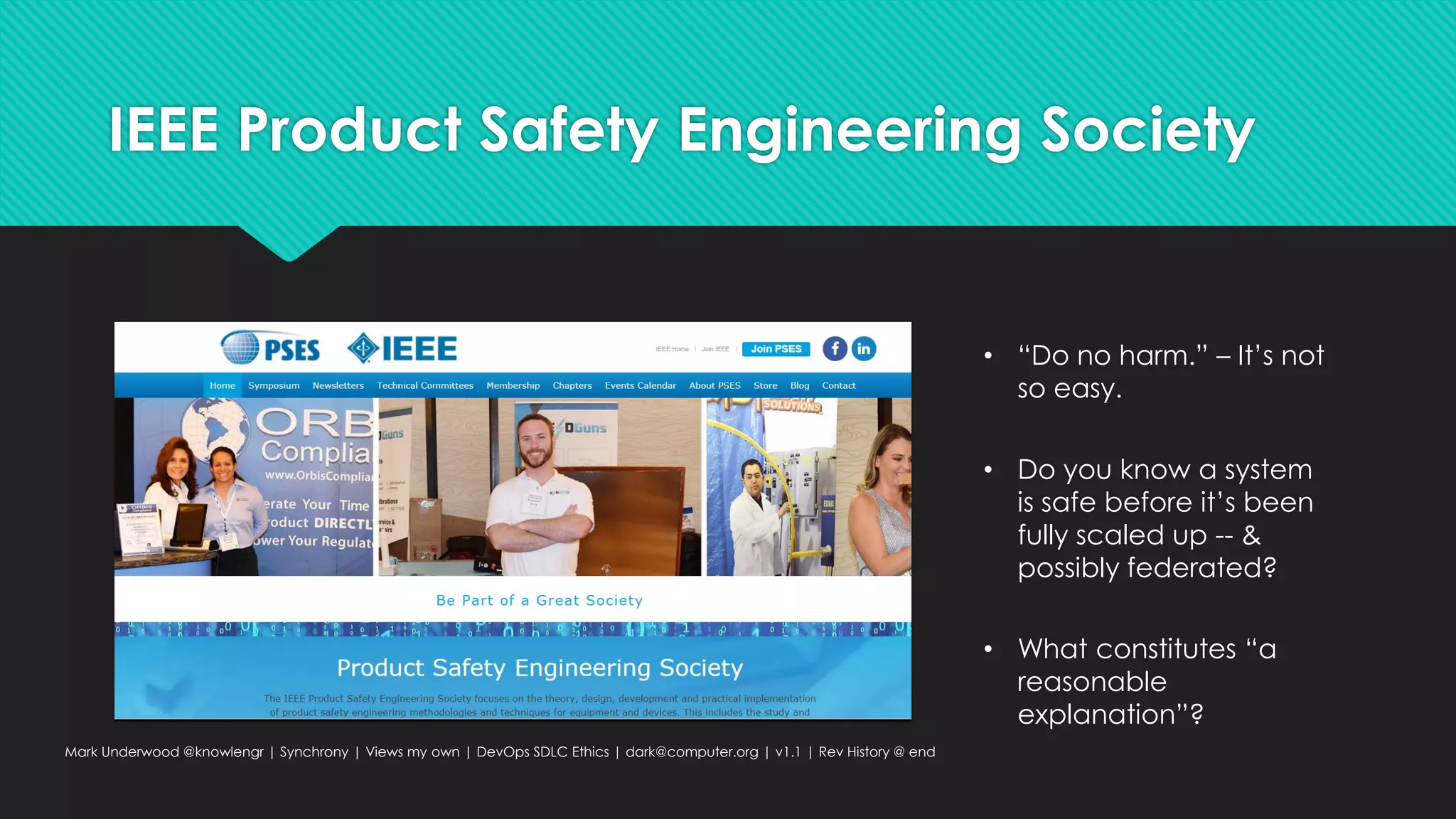
IEEE Product Safety Engineering Society
Mark Underwood @knowlengr | Synchrony | Views my own | DevOps SDLC Ethics | dark@computer.org | v1.1 | Rev History @ end
• “Do no harm.” – It’s not
so easy.
• Do you know a system
is safe before it’s been
fully scaled up -- &
possibly federated?
• What constitutes “a
reasonable
explanation”?
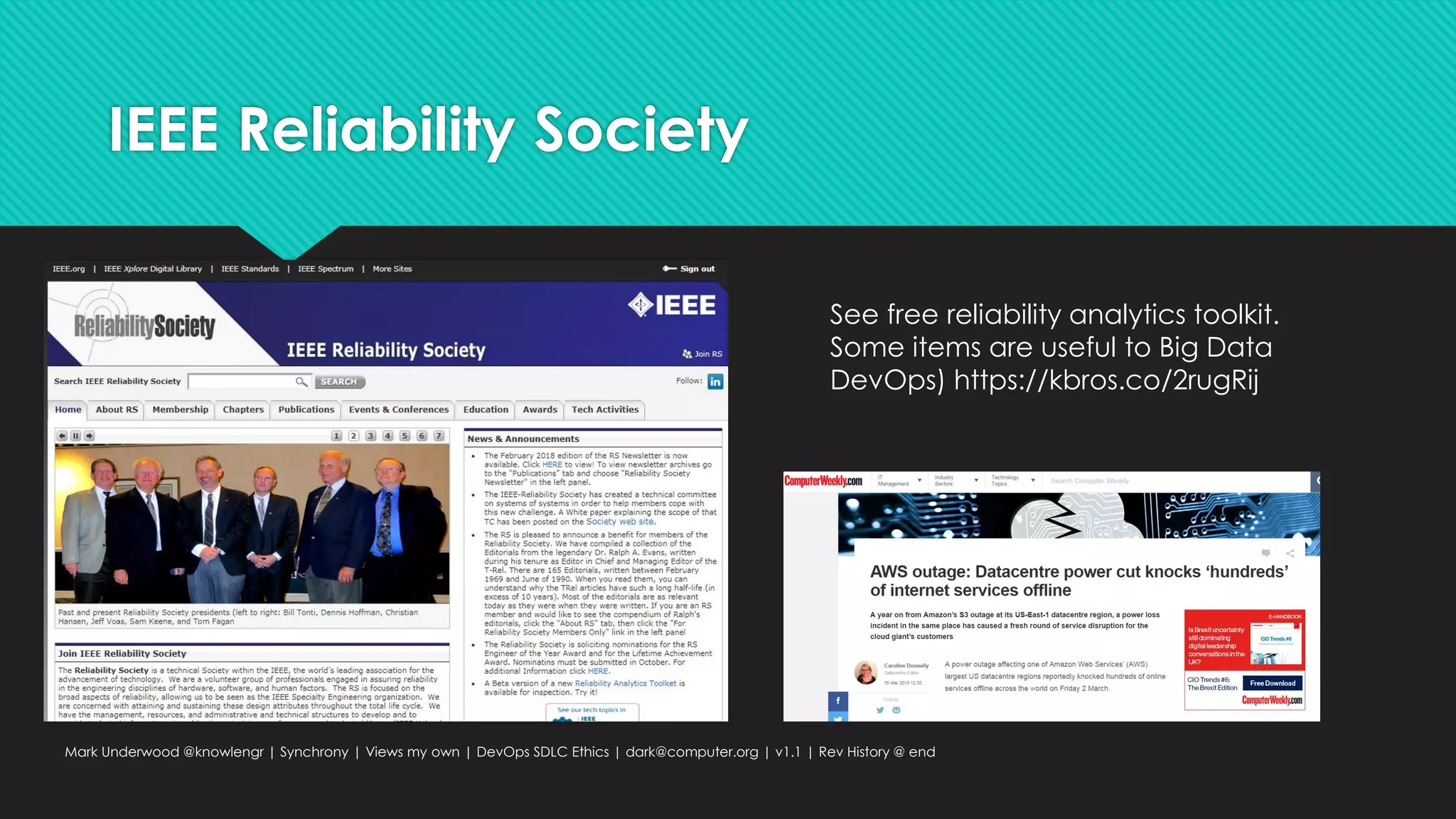
IEEE Reliability Society
Mark Underwood @knowlengr | Synchrony | Views my own | DevOps SDLC Ethics | dark@computer.org | v1.1 | Rev History @ end
See free reliability analytics toolkit.
Some items are useful to Big Data
DevOps) https://kbros.co/2rugRij
IEEE Shill? No.
 Active communities are small.
 Standards documents are not free, though participation for IEEE members is.
 Heavily weighted toward late career participants.
 Despite “Engineering” in title, often not “engineering.”
Mark Underwood @knowlengr | Synchrony | Views my own | DevOps SDLC Ethics | dark@computer.org | v1.1 | Rev History @ end
But IEEE has . . .
 IEEE Digital Library (with cross reference to ACM digital library)
 Multinational reach and engagement
 Reasonable internal advocacy and oversight
 Diversity
 Sometimes good awareness of NIST work
 Often best work in lesser-known conference publications (e.g., vs. IEEE Security)
Mark Underwood @knowlengr | Synchrony | Views my own | DevOps SDLC Ethics | dark@computer.org | v1.1 | Rev History @ end
State of Computing Profession Ethics
@ACM_Ethics
ACM Code of Ethics
(Draft 3, 2018) https://www.acm.org/about-acm/code-of-ethics
Mark Underwood @knowlengr | Synchrony | Views my own | DevOps SDLC Ethics | dark@computer.org | v1.1 | Rev History @ end
Highlights of ACM Ethics v3
 “minimize negative consequences of computing, including threats to health, safety,
personal security, and privacy.”
 When the interests of multiple groups conflict, the needs of the least advantaged should
be given increased attention and priority
 computing professionals should promote environmental sustainability both locally and
globally.
 “. . .the consequences of emergent systems and data aggregation should be carefully
analyzed. Those involved with pervasive or infrastructure systems should also consider
Principle 3.7 (Standard of care when a system is integrated into the infrastructure of
society).
Mark Underwood @knowlengr | Synchrony | Views my own | DevOps SDLC Ethics | dark@computer.org | v1.1 | Rev History @ end
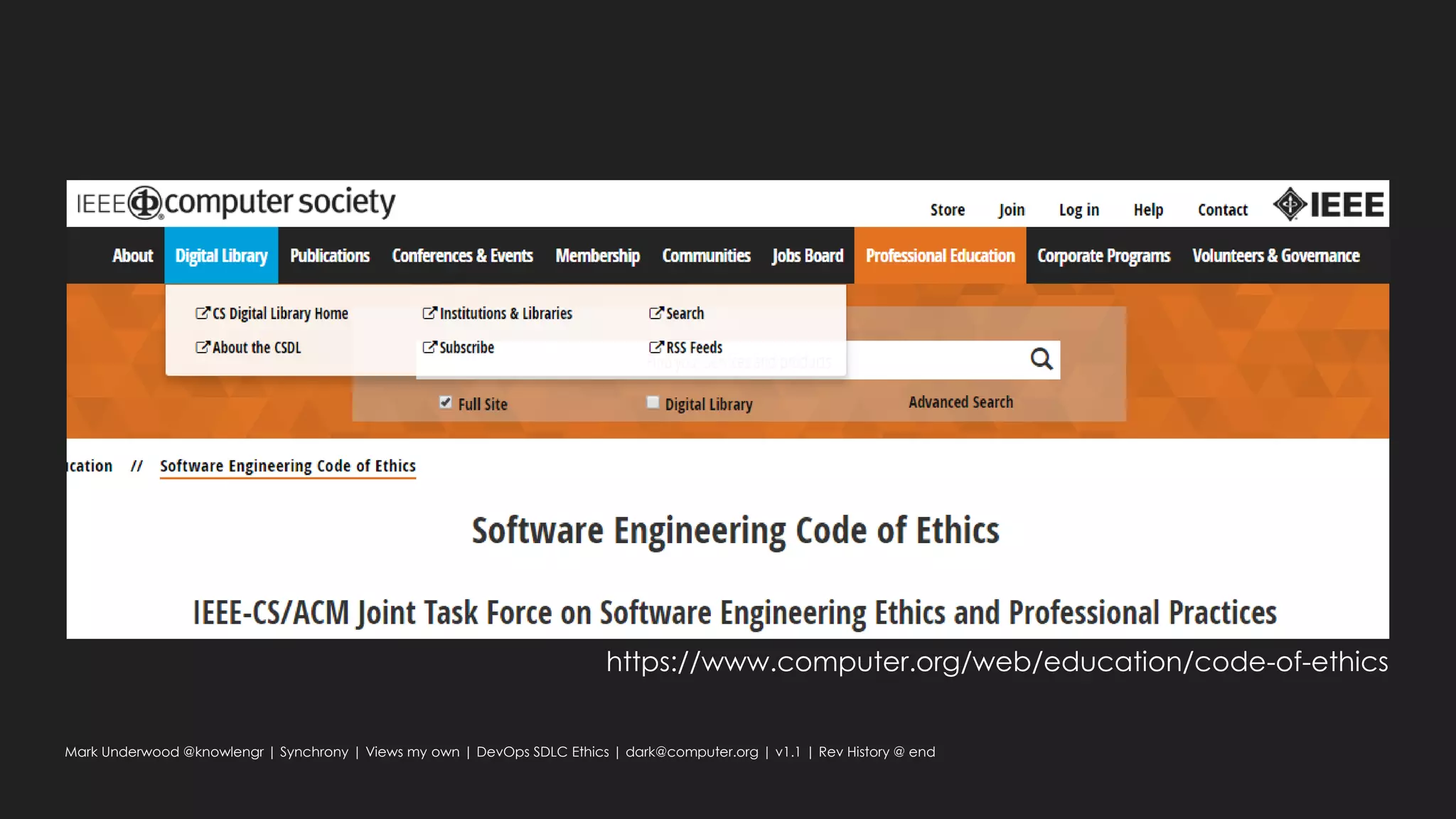
https://www.computer.org/web/education/code-of-ethics
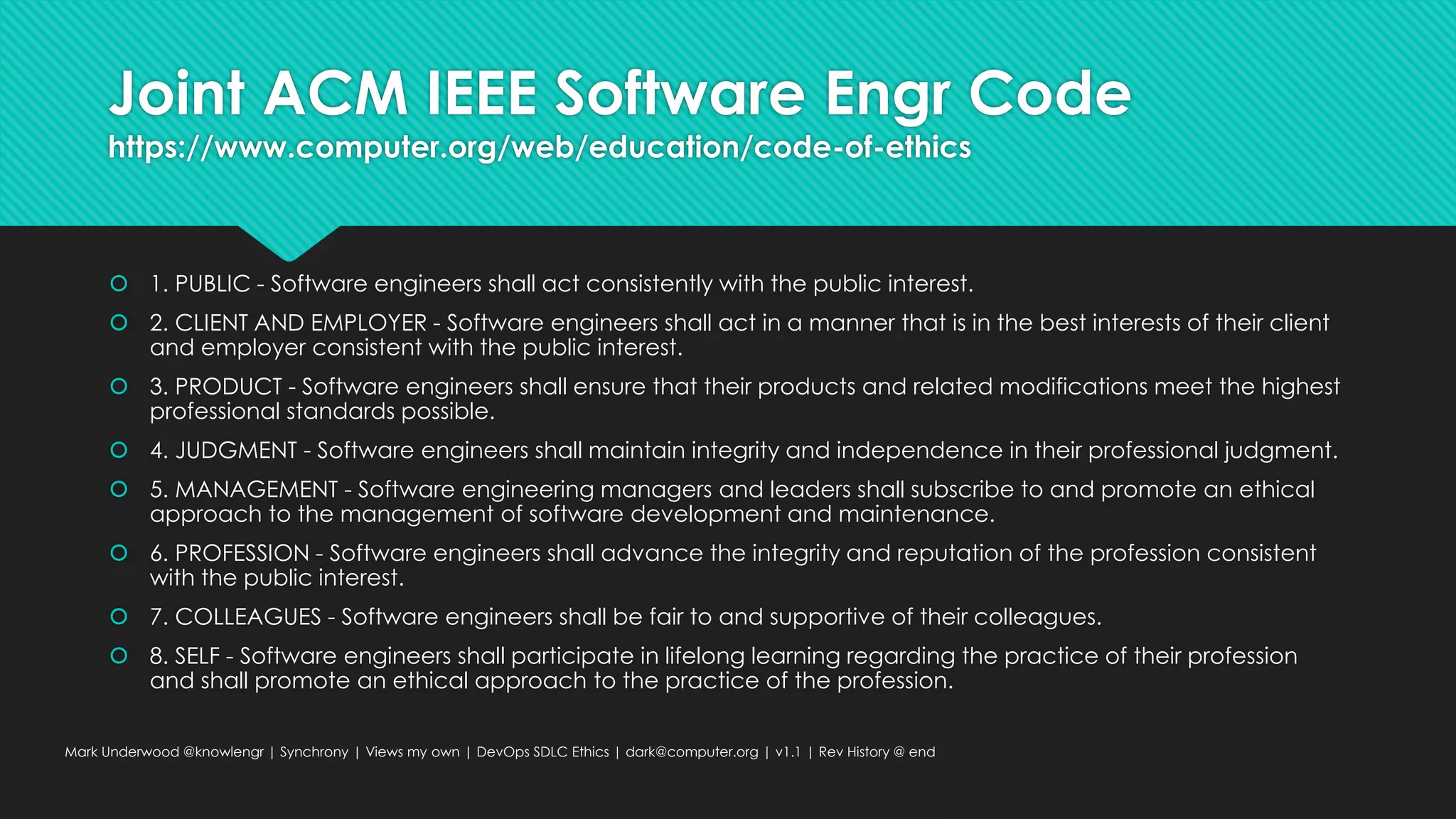
Joint ACM IEEE Software Engr Code
https://www.computer.org/web/education/code-of-ethics
 1. PUBLIC - Software engineers shall act consistently with the public interest.
 2. CLIENT AND EMPLOYER - Software engineers shall act in a manner that is in the best interests of their client
and employer consistent with the public interest.
 3. PRODUCT - Software engineers shall ensure that their products and related modifications meet the highest
professional standards possible.
 4. JUDGMENT - Software engineers shall maintain integrity and independence in their professional judgment.
 5. MANAGEMENT - Software engineering managers and leaders shall subscribe to and promote an ethical
approach to the management of software development and maintenance.
 6. PROFESSION - Software engineers shall advance the integrity and reputation of the profession consistent
with the public interest.
 7. COLLEAGUES - Software engineers shall be fair to and supportive of their colleagues.
 8. SELF - Software engineers shall participate in lifelong learning regarding the practice of their profession
and shall promote an ethical approach to the practice of the profession.
Mark Underwood @knowlengr | Synchrony | Views my own | DevOps SDLC Ethics | dark@computer.org | v1.1 | Rev History @ end
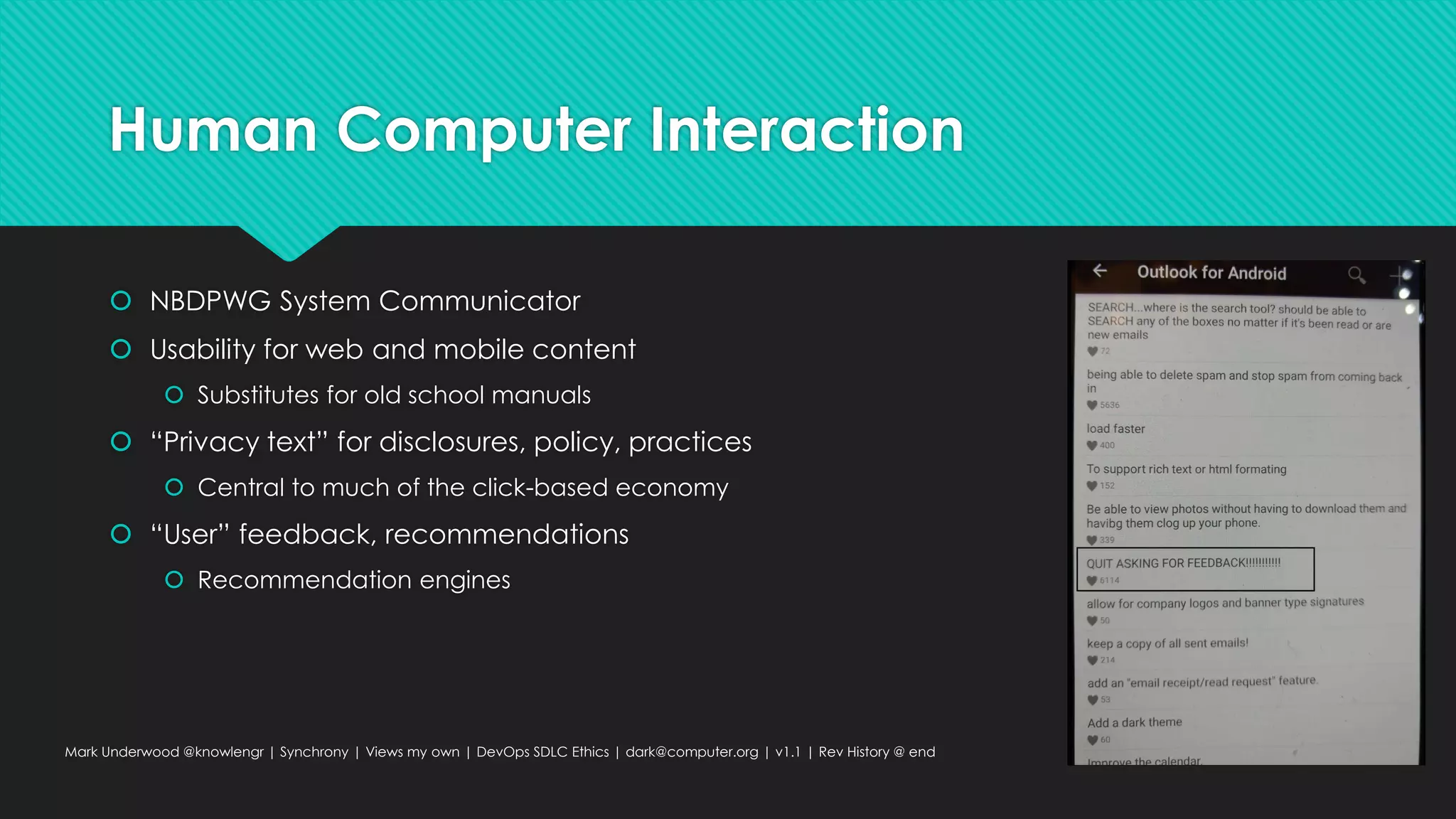
Human Computer Interaction
 NBDPWG System Communicator
 Usability for web and mobile content
 Substitutes for old school manuals
 “Privacy text” for disclosures, policy, practices
 Central to much of the click-based economy
 “User” feedback, recommendations
 Recommendation engines
Mark Underwood @knowlengr | Synchrony | Views my own | DevOps SDLC Ethics | dark@computer.org | v1.1 | Rev History @ end
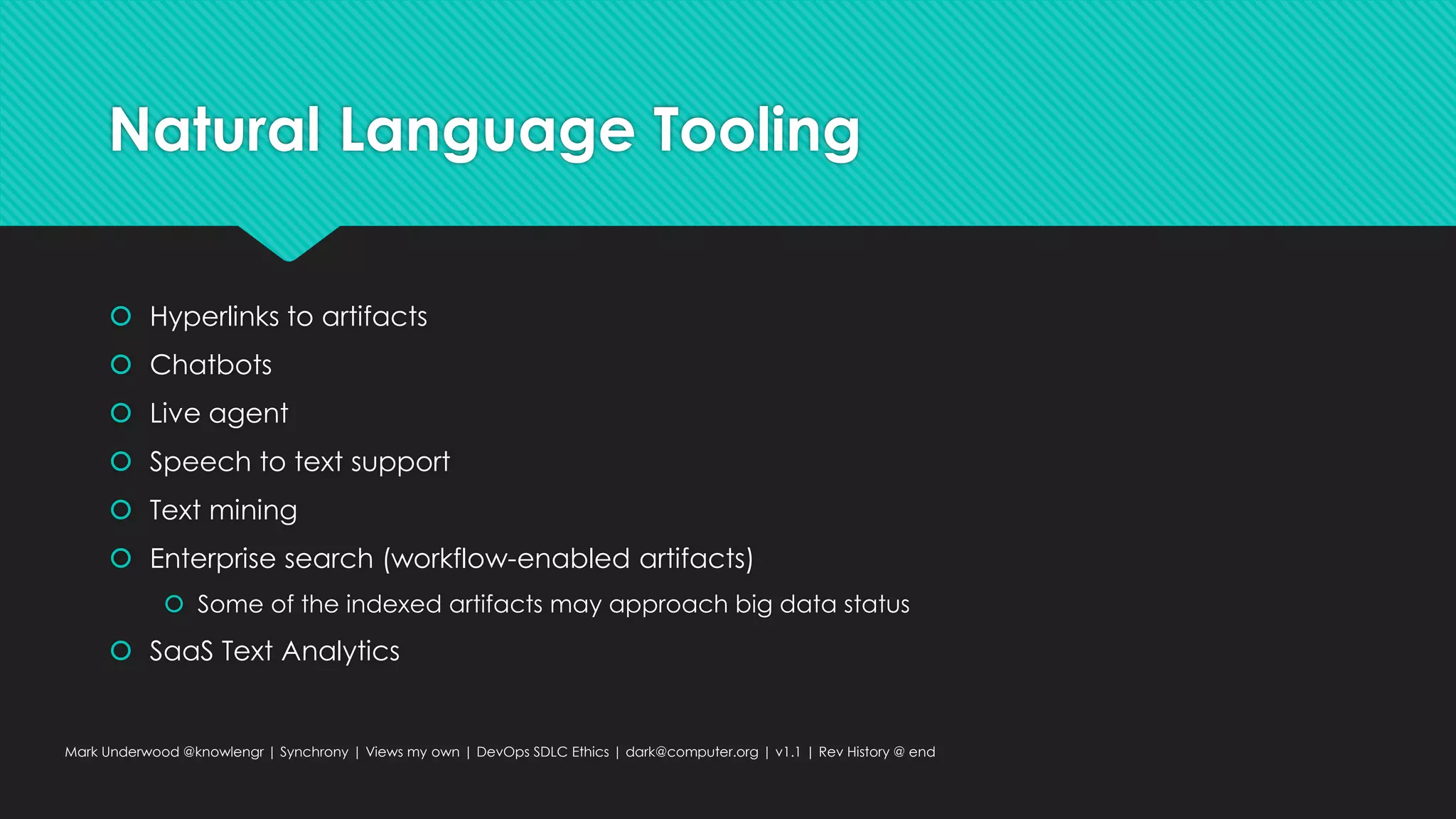
Natural Language Tooling
 Hyperlinks to artifacts
 Chatbots
 Live agent
 Speech to text support
 Text mining
 Enterprise search (workflow-enabled artifacts)
 Some of the indexed artifacts may approach big data status
 SaaS Text Analytics
Mark Underwood @knowlengr | Synchrony | Views my own | DevOps SDLC Ethics | dark@computer.org | v1.1 | Rev History @ end
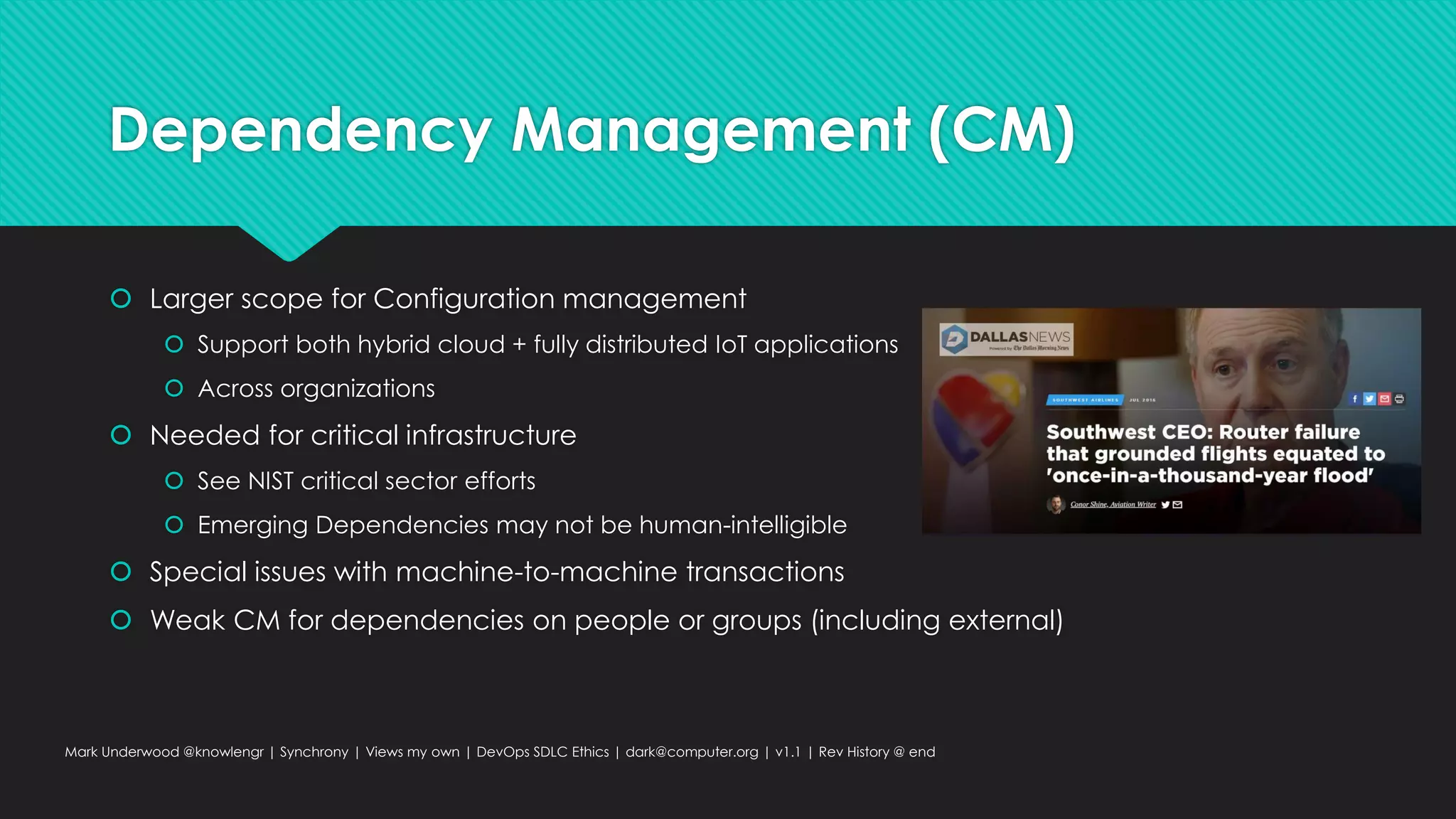
Dependency Management (CM)
 Larger scope for Configuration management
 Support both hybrid cloud + fully distributed IoT applications
 Across organizations
 Needed for critical infrastructure
 See NIST critical sector efforts
 Emerging Dependencies may not be human-intelligible
 Special issues with machine-to-machine transactions
 Weak CM for dependencies on people or groups (including external)
Mark Underwood @knowlengr | Synchrony | Views my own | DevOps SDLC Ethics | dark@computer.org | v1.1 | Rev History @ end
Traceability & Requirements Engineering
 Define what is an ethical requirement
 Possible: big data ethical fabric (transparency, usage)
 Audit
 Traceability requirements
 Can an ethical responsibility be inherited like Personal Data-tagged data elements?
 What about synthetic, algorithm-defined elements?
Note: See EU notion for “Personal Data” vs. PII in the US: P. Schwartz and D. Solove, "Reconciling
Personal Information in the United States and European Union," California Law Review, vol. 102,
no. 4, Aug. 2014. [Online]. Available:
https://scholarship.law.berkeley.edu/californialawreview/vol102/iss4/7
Mark Underwood @knowlengr | Synchrony | Views my own | DevOps SDLC Ethics | dark@computer.org | v1.1 | Rev History @ end
Special Populations
 Disadvantaged
 By regulation (e.g., 8A, SBIR, disability)
 By “common sense” (“fairness” and “equity”)
 By economic / sector (“underserved”)
 Internet Bandwidth inequity
 Children
 “Criminals” / Malware Designers
Mark Underwood @knowlengr | Synchrony | Views my own | DevOps SDLC Ethics | dark@computer.org | v1.1 | Rev History @ end
Transparency
 What does it mean to be “transparent” about ethics?
 What connection to IEEE /ACM professional ethics?
 ACM: “The entire computing profession benefits when the ethical decision making process is
accountable to and transparent to all stakeholders. Open discussions about ethical issues promotes this
accountability and transparency.”
 ACM “A computing professional should be transparent and provide full disclosure of all pertinent system
limitations and potential problems. Making deliberately false or misleading claims, fabricating or
falsifying data, and other dishonest conduct are violations of the Code.”
 ACM “Computing professionals should establish transparent policies and procedures that allow
individuals to give informed consent to automatic data collection, review their personal data, correct
inaccuracies, and, where appropriate, remove data.”
 ACM “Organizational procedures and attitudes oriented toward quality, transparency, and the welfare
of society reduce harm to the public and raise awareness of the influence of technology in our lives.
Therefore, leaders should encourage full participation of all computing professionals in meeting social
responsibilities and discourage tendencies to do otherwise.”
Mark Underwood @knowlengr | Synchrony | Views my own | DevOps SDLC Ethics | dark@computer.org | v1.1 | Rev History @ end
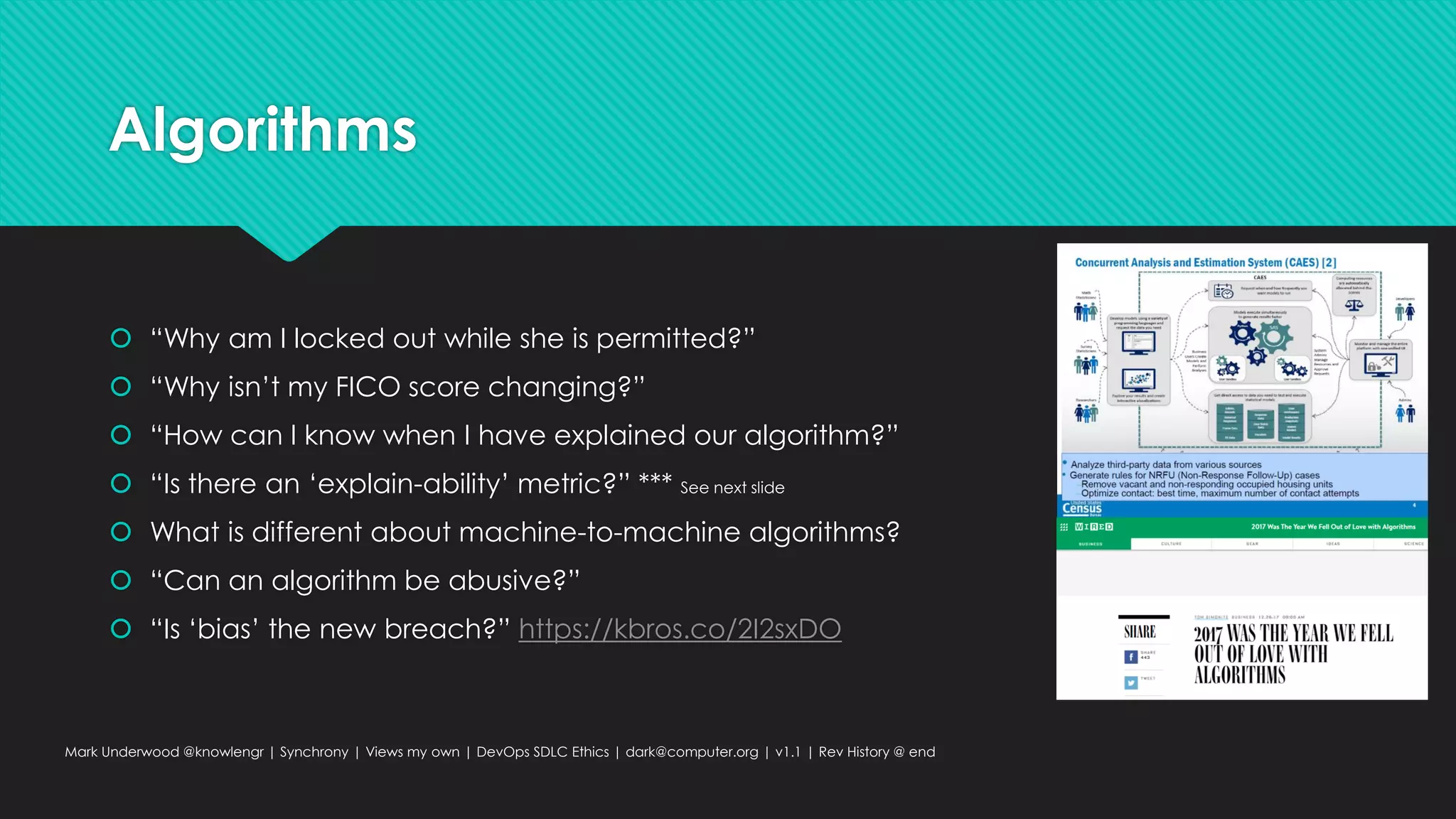
Algorithms
 “Why am I locked out while she is permitted?”
 “Why isn’t my FICO score changing?”
 “How can I know when I have explained our algorithm?”
 “Is there an ‘explain-ability’ metric?” *** See next slide
 What is different about machine-to-machine algorithms?
 “Can an algorithm be abusive?”
 “Is ‘bias’ the new breach?” https://kbros.co/2I2sxDO
Mark Underwood @knowlengr | Synchrony | Views my own | DevOps SDLC Ethics | dark@computer.org | v1.1 | Rev History @ end
Explanation
 “Right to explanation”
 Explanation sufficiency / suitability is not immediately obvious
 Explaining to novices vs. experts; children vs. adults
 Complex topics requiring specialized language, fast-changing technologies (e.g., cloud)
 Explanations may require agent-based technologies
 Directly related to knowledge / learning management (an LMS may be a prerequisite)
 References
 https://en.wikipedia.org/wiki/Explainable_Artificial_Intelligence
 https://en.wikipedia.org/wiki/Explanation#Meta-explanation
 https://en.wikipedia.org/wiki/Abductive_reasoning
Mark Underwood @knowlengr | Synchrony | Views my own | DevOps SDLC Ethics | dark@computer.org | v1.1 | Rev History @ end
Risk Artifact Traceability
 Connect a Risk Framework object (e.g., NIST SP 800-37r2) to code objects
 Hyperlinks
 Embedded text
 Code-to-text macros
 Two-way connectivity
 Configuration changes impact risk
 Risk profile changes (flood, turnover in InfoSec workforce, open source ecosystem) impact code
 Risk shifts must be explained
Mark Underwood @knowlengr | Synchrony | Views my own | DevOps SDLC Ethics | dark@computer.org | v1.1 | Rev History @ end
Function Point Traceability
 Requirements Engineering for Ethics
 Related: Utility (“Tradeoff) Functions
 Profit / Nonprofits
 Capture of ethical aspects of requirements
 Decision-making (function points need to support analytics, function points set by consensus –
meetings, Communities of Interest, or Product Owner requirements)
Mark Underwood @knowlengr | Synchrony | Views my own | DevOps SDLC Ethics | dark@computer.org | v1.1 | Rev History @ end
Cross-Sector Resilience
 Public safety, well-being
 Examples: FS-ISAC, Edison Institute
 Government services
 “Special” Scenarios
 Emergency Services
 Military
 DevOps was probably born in Logistics supply chain before it was called DevOps
Mark Underwood @knowlengr | Synchrony | Views my own | DevOps SDLC Ethics | dark@computer.org | v1.1 | Rev History @ end
The Professions
 Professions as cross-organizational force
 The obvious: software engineers, accountants, safety/reliability engineers
 Less obvious: most domains have specialists who are key: e.g., geneticists, structural engineer,
avionics
 Role is often set by a particular domain context or scenario
 Code of Ethics as RegTech / Story Points / Function Points
Mark Underwood @knowlengr | Synchrony | Views my own | DevOps SDLC Ethics | dark@computer.org | v1.1 | Rev History @ end
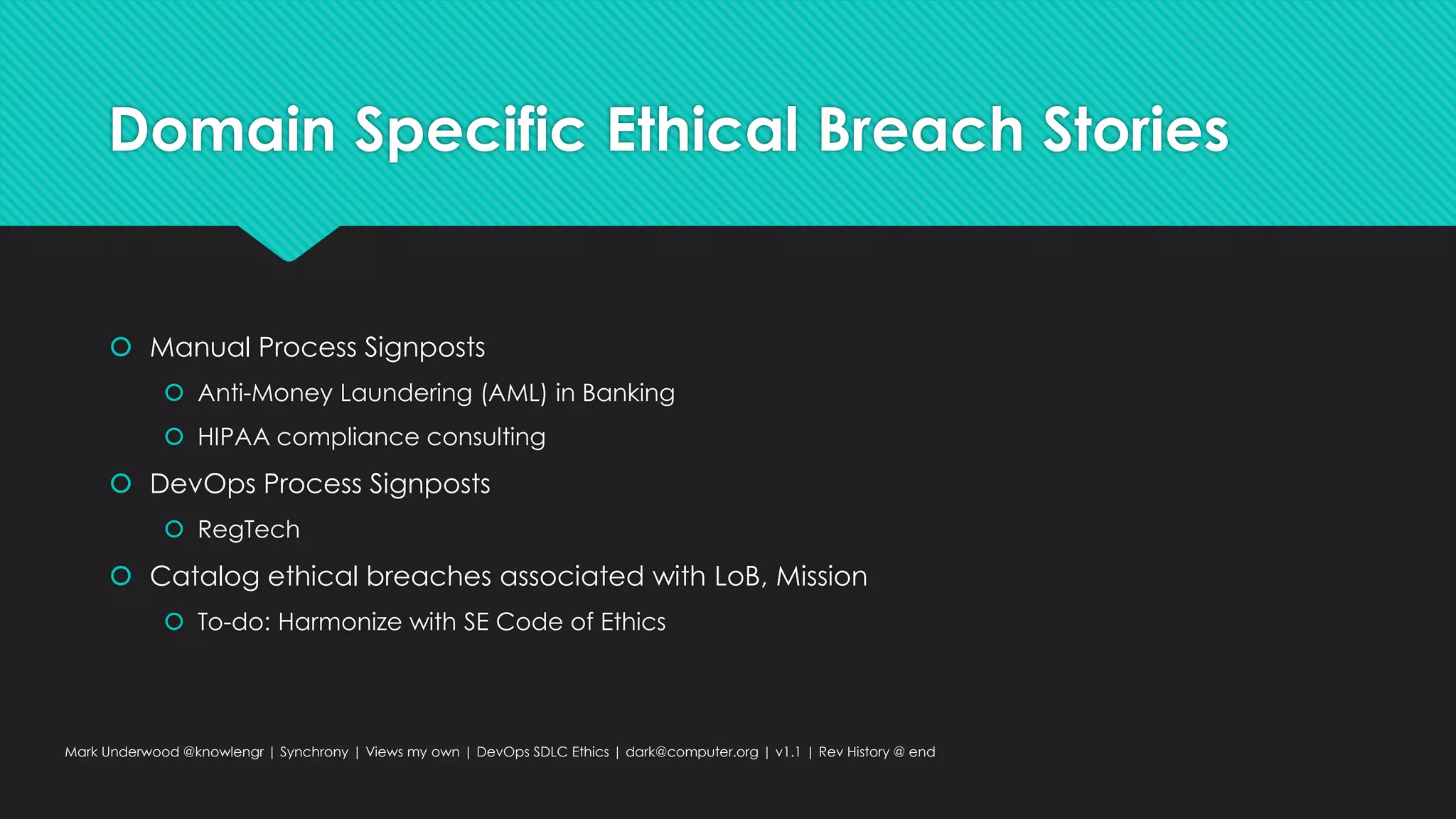
Domain Specific Ethical Breach Stories
 Manual Process Signposts
 Anti-Money Laundering (AML) in Banking
 HIPAA compliance consulting
 DevOps Process Signposts
 RegTech
 Catalog ethical breaches associated with LoB, Mission
 To-do: Harmonize with SE Code of Ethics
Mark Underwood @knowlengr | Synchrony | Views my own | DevOps SDLC Ethics | dark@computer.org | v1.1 | Rev History @ end
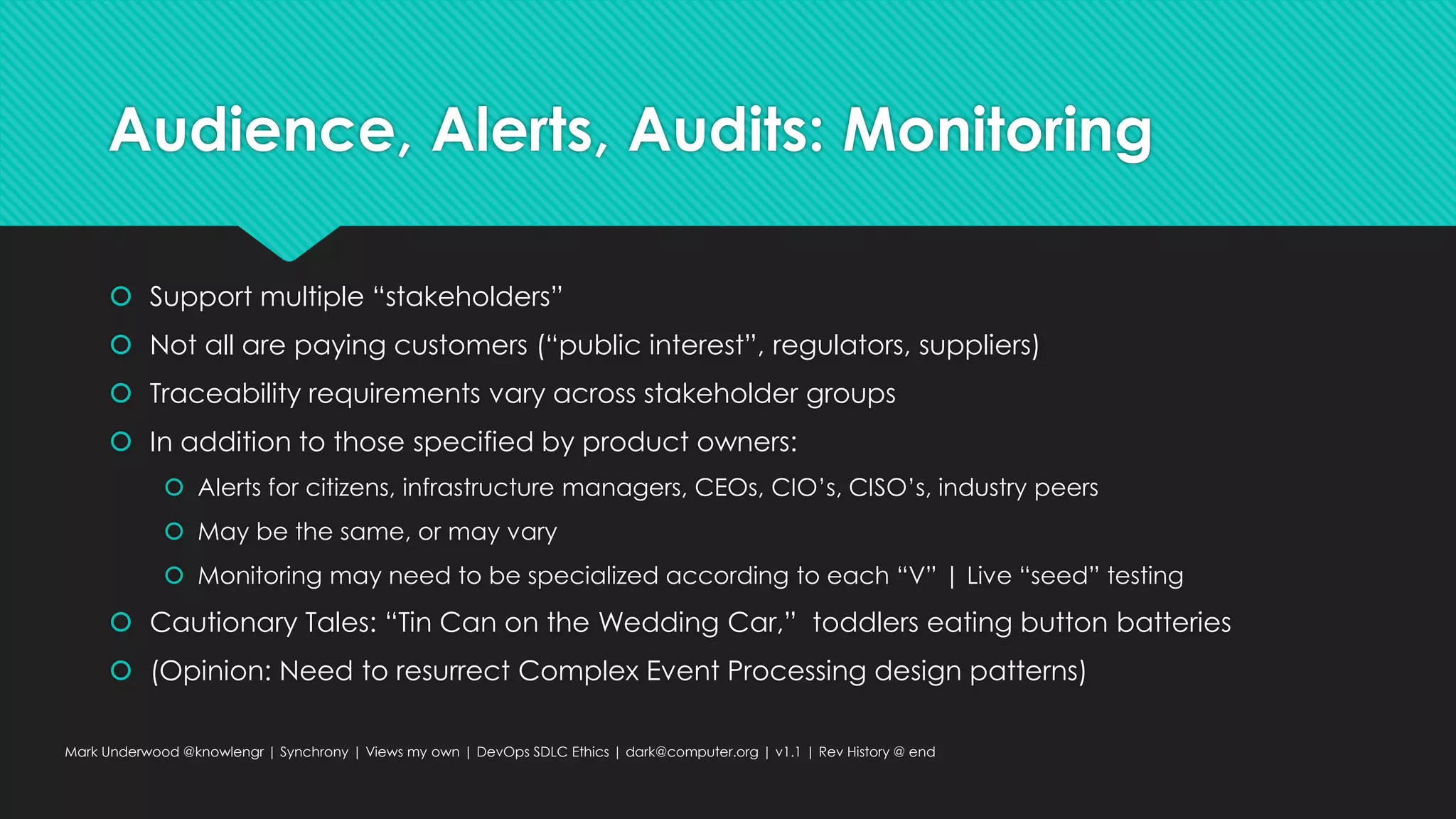
Audience, Alerts, Audits: Monitoring
 Support multiple “stakeholders”
 Not all are paying customers (“public interest”, regulators, suppliers)
 Traceability requirements vary across stakeholder groups
 In addition to those specified by product owners:
 Alerts for citizens, infrastructure managers, CEOs, CIO’s, CISO’s, industry peers
 May be the same, or may vary
 Monitoring may need to be specialized according to each “V” | Live “seed” testing
 Cautionary Tales: “Tin Can on the Wedding Car,” toddlers eating button batteries
 (Opinion: Need to resurrect Complex Event Processing design patterns)
Mark Underwood @knowlengr | Synchrony | Views my own | DevOps SDLC Ethics | dark@computer.org | v1.1 | Rev History @ end
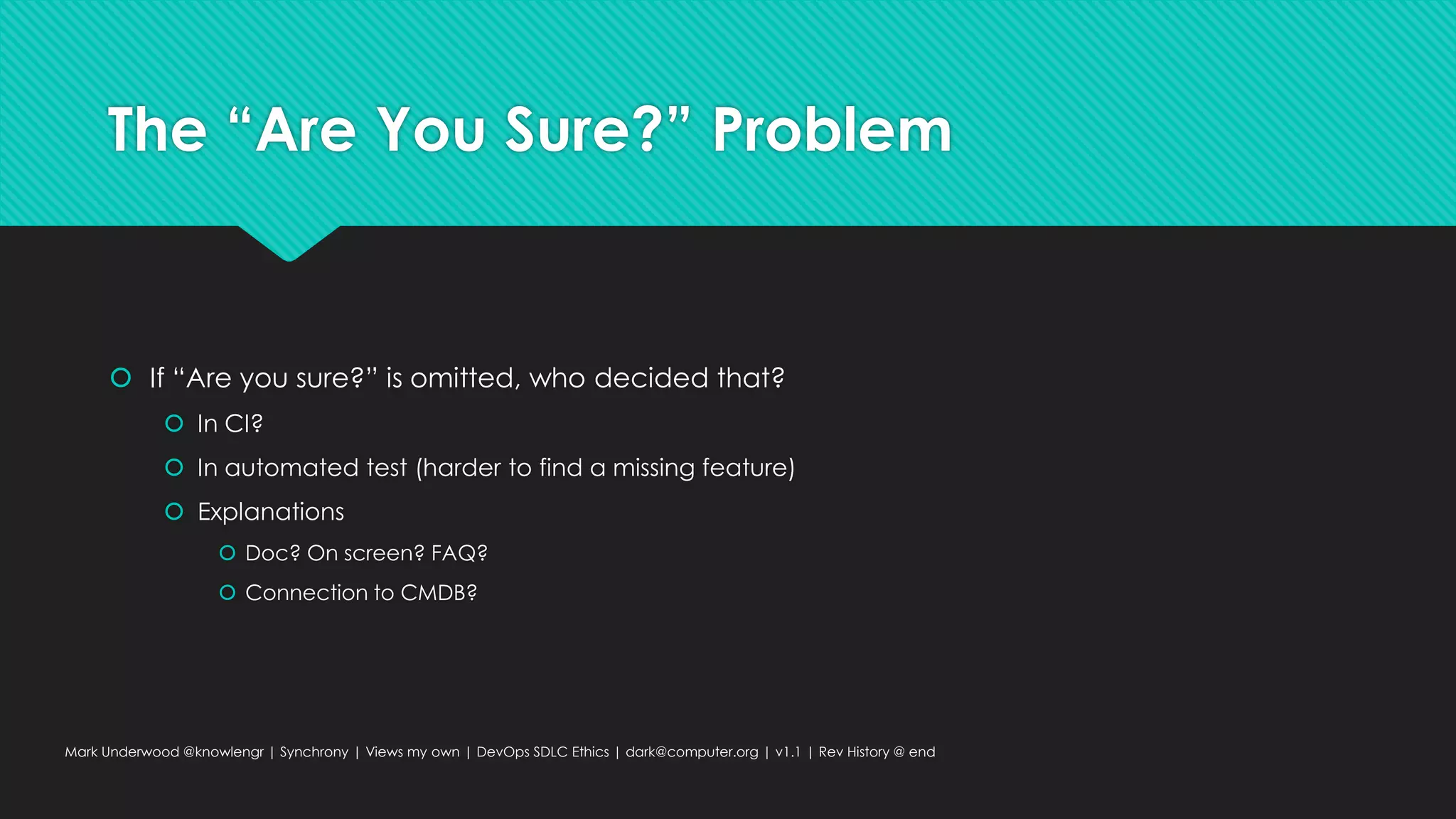
The “Are You Sure?” Problem
 If “Are you sure?” is omitted, who decided that?
 In CI?
 In automated test (harder to find a missing feature)
 Explanations
 Doc? On screen? FAQ?
 Connection to CMDB?
Mark Underwood @knowlengr | Synchrony | Views my own | DevOps SDLC Ethics | dark@computer.org | v1.1 | Rev History @ end
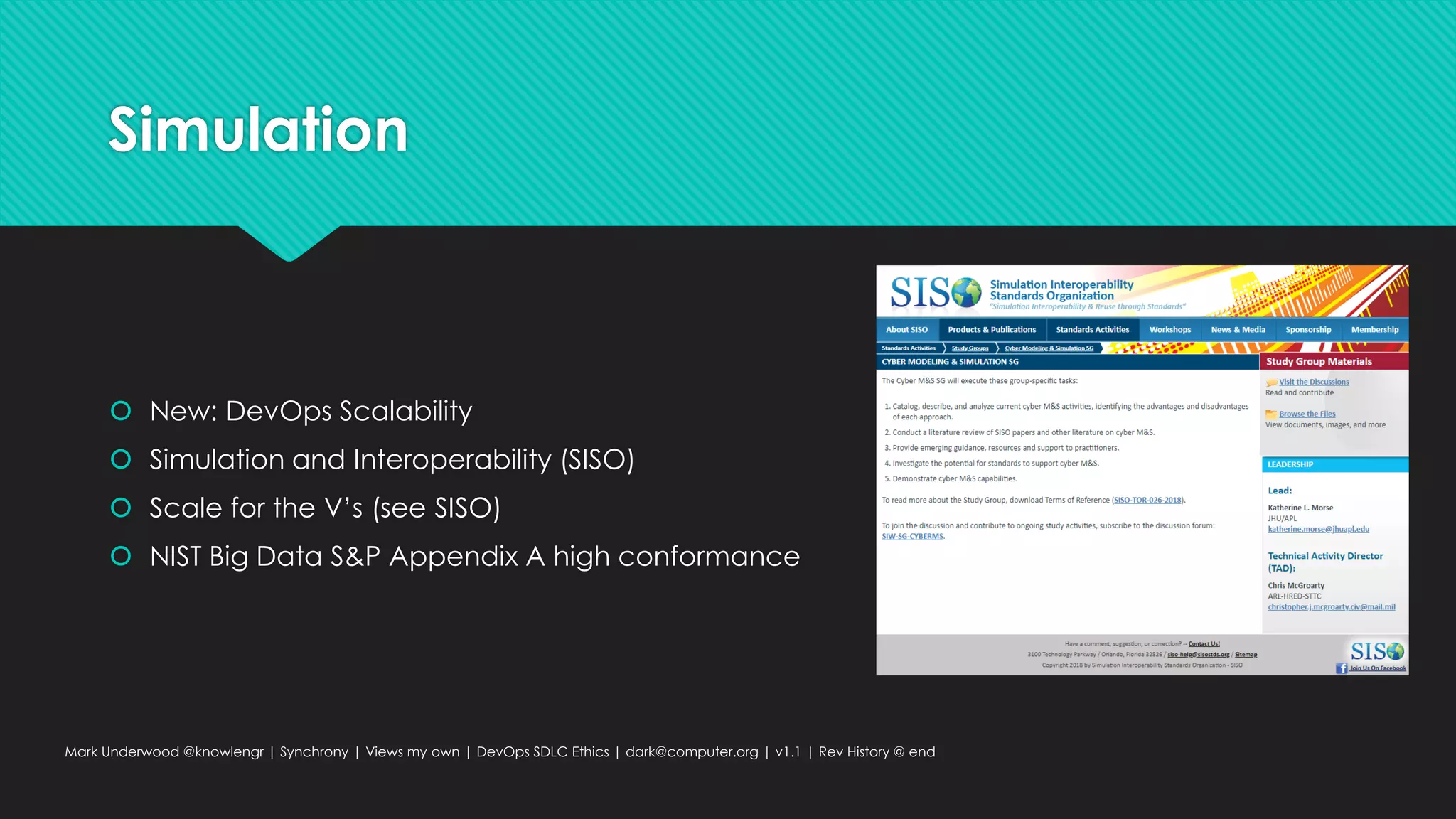
Simulation
 New: DevOps Scalability
 Simulation and Interoperability (SISO)
 Scale for the V’s (see SISO)
 NIST Big Data S&P Appendix A high conformance
Mark Underwood @knowlengr | Synchrony | Views my own | DevOps SDLC Ethics | dark@computer.org | v1.1 | Rev History @ end
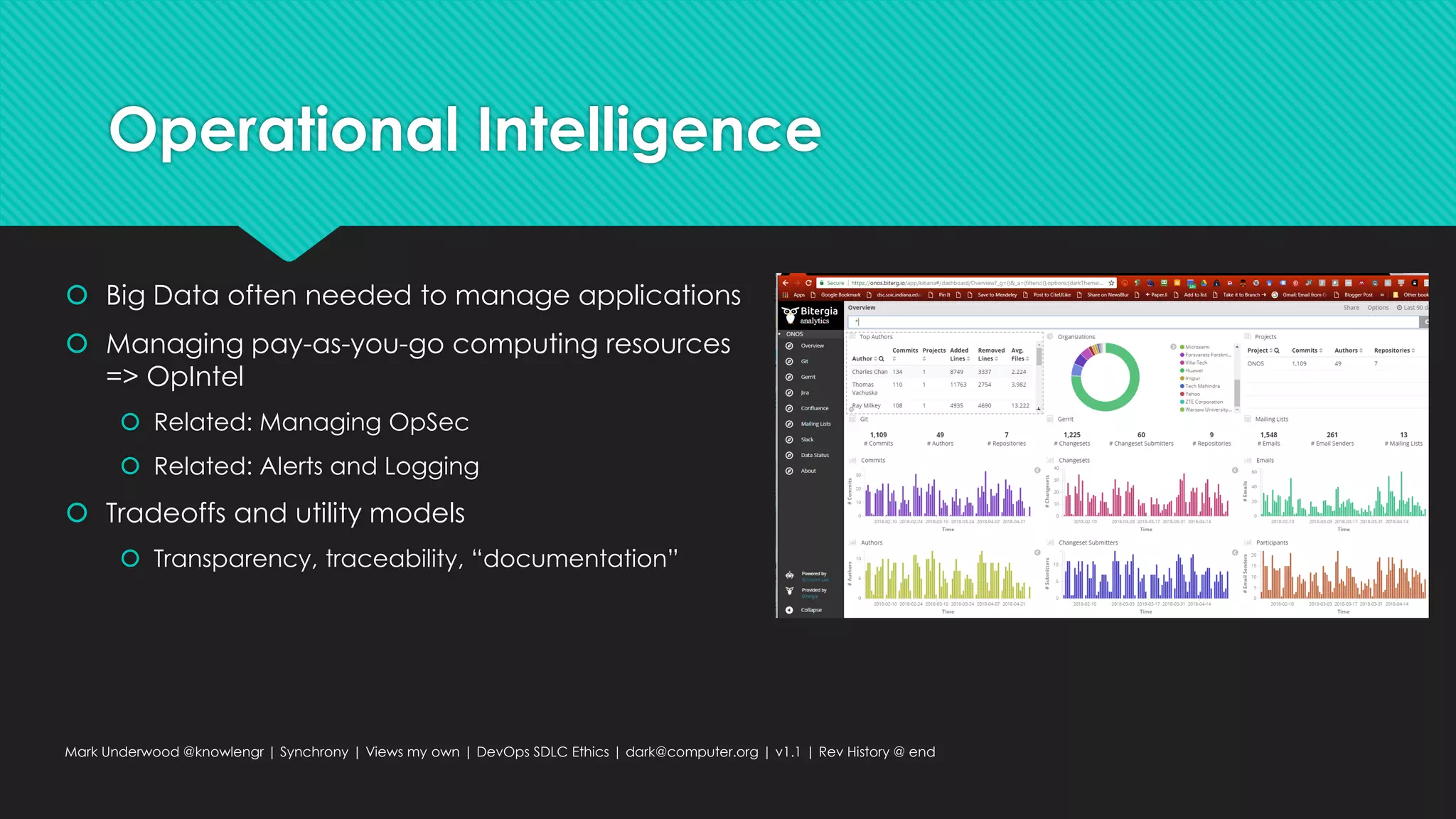
Operational Intelligence
 Big Data often needed to manage applications
 Managing pay-as-you-go computing resources
=> OpIntel
 Related: Managing OpSec
 Related: Alerts and Logging
 Tradeoffs and utility models
 Transparency, traceability, “documentation”
Mark Underwood @knowlengr | Synchrony | Views my own | DevOps SDLC Ethics | dark@computer.org | v1.1 | Rev History @ end
Test Engineering and DevOps
 Continuous Pipeline concepts applied to IoT / Edge / Distributed
 Each platform (or stack “layer”) may introduce different types of ethical concerns
 E.g., Identity Management for children
 Infectious disease statistics -> break glass for public health
 Autonomous vehicles response to fog conditions (see http://web.media.mit.edu/~guysatat/fog/)
 Reliance on less reliable hardware or bandwidth (e.g., cheap sensors, residential wi-fi)
 Left- and right-shift of safety, reliability, regulatory constraints (remember case studies)
 New meaning for “interoperability” – “inter-responsibility”
Mark Underwood @knowlengr | Synchrony | Views my own | DevOps SDLC Ethics | dark@computer.org | v1.1 | Rev History @ end
Forensics
 Big Data may be needed for full stack playback
 Full stack for After Action Review is still immature with forensics professionals
 Even large firms may not be staffed with forensics specialists
 Big surprise may be in store when breach or litigation occurs
Mark Underwood @knowlengr | Synchrony | Views my own | DevOps SDLC Ethics | dark@computer.org | v1.1 | Rev History @ end
Federation & Supply Chain
 Facebook/Cambridge Analytica scenario was forecast in V1
 Supply Chains that have been casual need upgrades
 Risk often increases as organizational size decreases
 Cost of “keeping data around” dangerously close to zero
 Conventional systems taxed to handle volume of identity management
 Access is infrequently leased
 Simplistic network zones fail to isolate subcomponents important to domain experts
Mark Underwood @knowlengr | Synchrony | Views my own | DevOps SDLC Ethics | dark@computer.org | v1.1 | Rev History @ end
Corporate Initiatives
 Environmental Social Governance
 Transparency within employee groups, departments, subsidiaries (See P7005)
 Computing decisions that affect carbon footprint (green data centers, etc.)
 Individual practitioners have greater influence than before
 Disclaimers in developer contract work
 Offshore culture: some workers may be afraid to question requirements, risk-taking
 Whistle-blower (a la Bug Bounty) not working well yet
Mark Underwood @knowlengr | Synchrony | Views my own | DevOps SDLC Ethics | dark@computer.org | v1.1 | Rev History @ end
Who Decides?
Some Opinions
 Requirements Engineering may need a refresher, uplift
 System Architects must continuously place controls in hands of domain experts
 This is counter to the “sysadmin” design pattern
 Risks multiply in part due to the commercial deprecation of documentation, manuals
 Boundaries of safe & manageable release pipelines may have already been exceeded (mobile)
 “Explain this” mentality partly offsets the DIY developer syndrome
 Good for self-education, but the problem is not defining “ethics”
 On-demand microlearning must accompany microservices deployment
 AI Agents: Can ask, “Why?” “Who?” and nudge ethical considerations
Mark Underwood @knowlengr | Synchrony | Views my own | DevOps SDLC Ethics | dark@computer.org | v1.1 | Rev History @ end
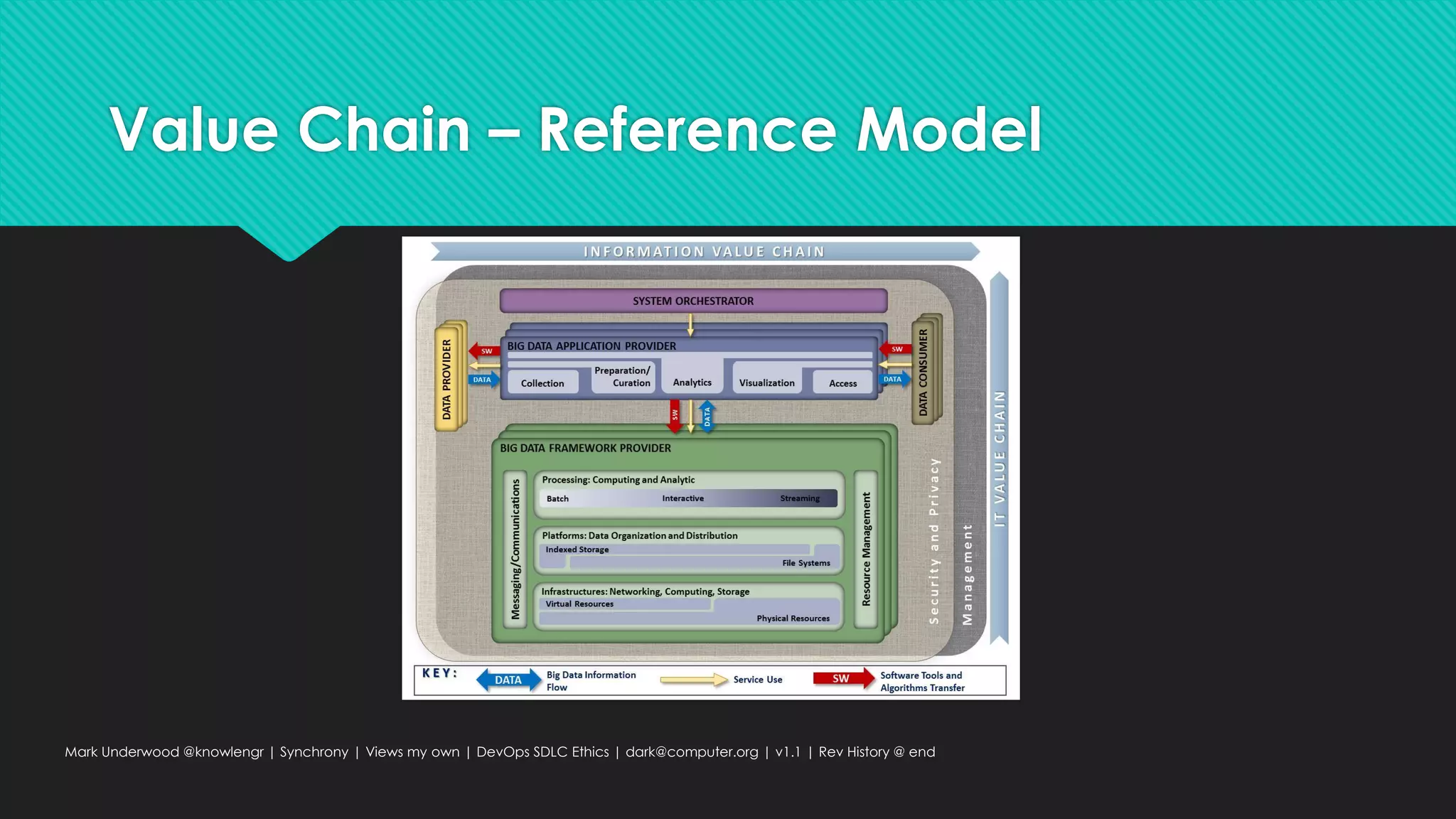
Value Chain – Reference Model
Mark Underwood @knowlengr | Synchrony | Views my own | DevOps SDLC Ethics | dark@computer.org | v1.1 | Rev History @ end
Bibliography
Bo Brinkman, Catherine Flick, Don Gotterbarn, Keith Miller, Kate Vazansky, and Marty J. Wolf.
2017. Listening to professional voices: draft 2 of the ACM code of ethics and professional
conduct. Commun. ACM 60, 5 (April 2017), 105-111. DOI: https://doi.org/10.1145/3072528
Mark Underwood @knowlengr | Synchrony | Views my own | DevOps SDLC Ethics | dark@computer.org | v1.1 | Rev History @ end
Related Work
 NIST 800-53 Rev 5 and others, NIST Cloud Security, NIST RMF
 Building, Auto Automation ISO 29481, 16739, 12006
 https://www.buildingsmart.org/about/what-is-openbim/ifc-introduction
 Uptane
 Ethics and Societal Considerations ISO 26000, IEEE P70nn
 DevOps Security IEEE P2675
 Microsegmentation and NFV IEEE P1915.1
 Safety orientation
 Infrastructure as code
 E.g., security tooling is code, playbooks are code
Mark Underwood @knowlengr | Synchrony | Views my own | DevOps SDLC Ethics | dark@computer.org | v1.1 | Rev History @ end
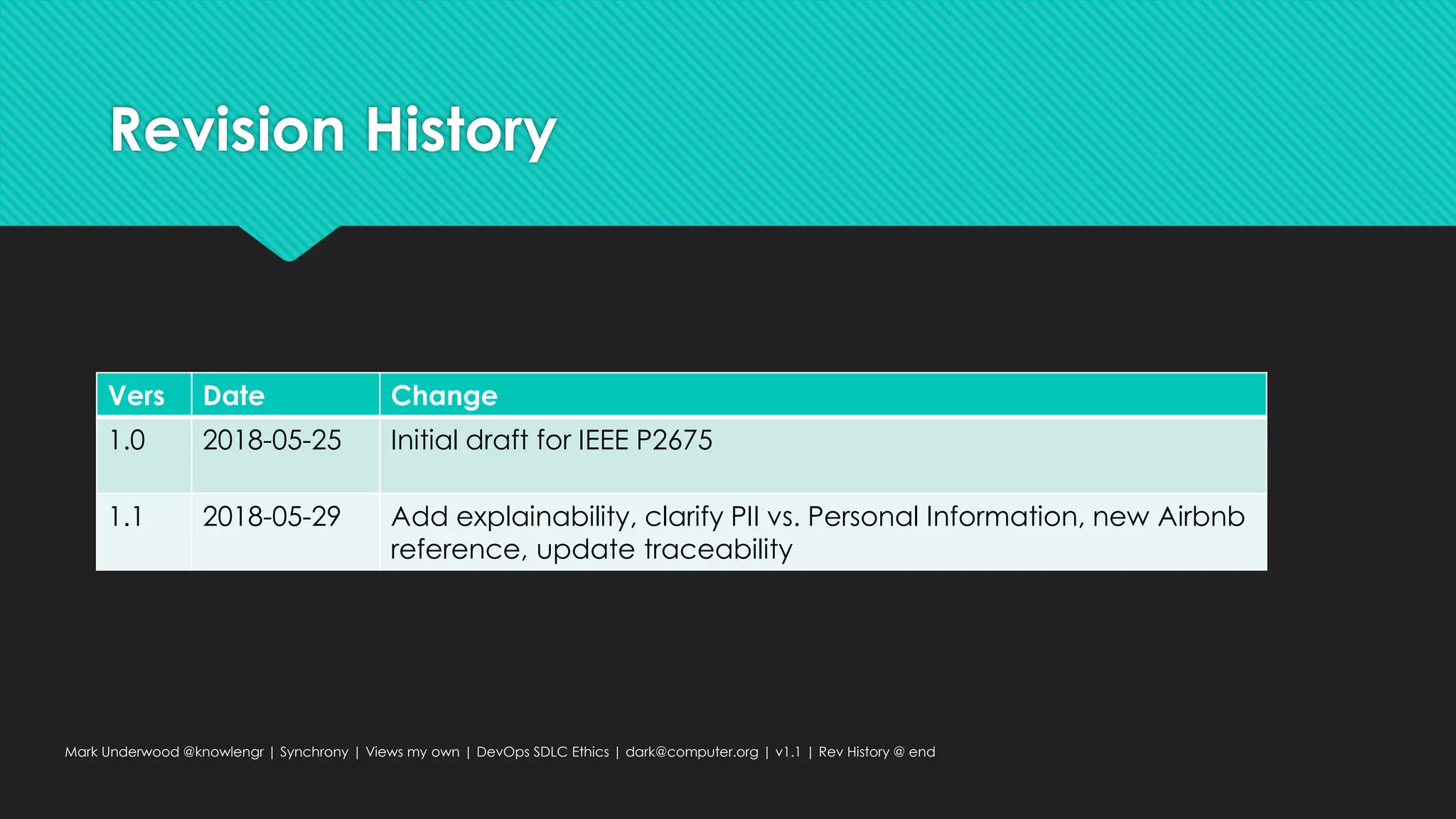
Revision History
Mark Underwood @knowlengr | Synchrony | Views my own | DevOps SDLC Ethics | dark@computer.org | v1.1 | Rev History @ end
Vers Date Change
1.0 2018-05-25 Initial draft for IEEE P2675
1.1 2018-05-29 Add explainability, clarify PII vs. Personal Information, new Airbnb
reference, update traceability
This deck is released under
Creative Commons
Attribution-Share Alike.
Portions of the work summarized was developed by multiple contributors through the NIST
open public working group framework under the leadership of Wo Chang, but this document
represents my views alone. https://bigdatawg.nist.gov | govNISTBig Databig data
securityBig Data SecPriv V2
Mark Underwood @knowlengr | Synchrony | Views my own | DevOps SDLC Ethics | dark@computer.org | v1.1 | Rev History @ end
Background: NIST Big Data PWG
Other insights from the NIST Big Data Public Working Group
Mark Underwood @knowlengr | Synchrony | Views my own | DevOps SDLC Ethics | dark@computer.org | v1.1 | Rev History @ end
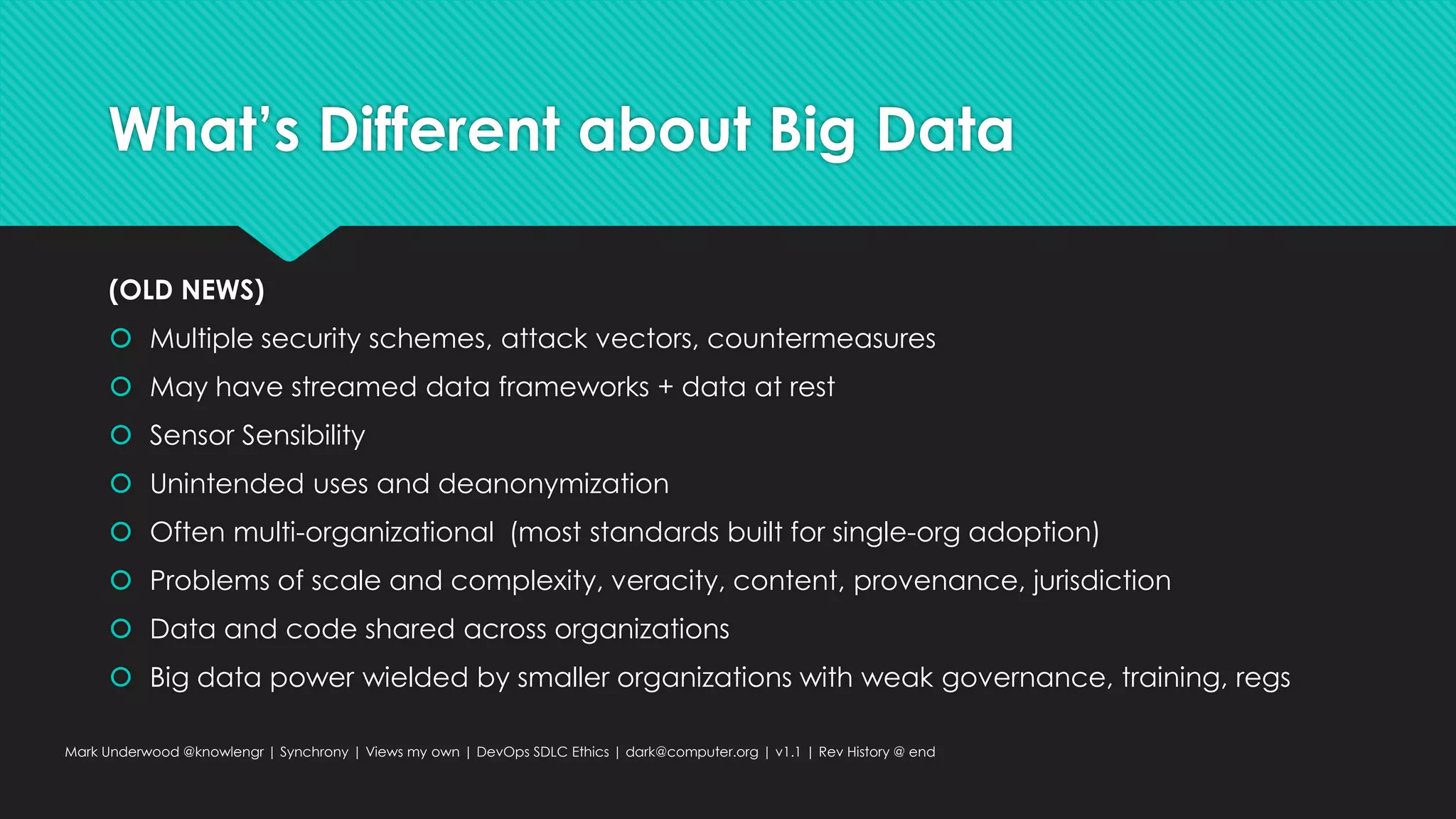
What’s Different about Big Data
(OLD NEWS)
 Multiple security schemes, attack vectors, countermeasures
 May have streamed data frameworks + data at rest
 Sensor Sensibility
 Unintended uses and deanonymization
 Often multi-organizational (most standards built for single-org adoption)
 Problems of scale and complexity, veracity, content, provenance, jurisdiction
 Data and code shared across organizations
 Big data power wielded by smaller organizations with weak governance, training, regs
Mark Underwood @knowlengr | Synchrony | Views my own | DevOps SDLC Ethics | dark@computer.org | v1.1 | Rev History @ end
Fluff
 Security and privacy are affected by all dimensions:
 Volume
 Velocity
 Variety
 Veracity (Provenance)
 Volatility
 Cloud
Mark Underwood @knowlengr | Synchrony | Views my own | DevOps SDLC Ethics | dark@computer.org | v1.1 | Rev History @ end
Less Fluffy
 Big Data partly side effect of SDLC shifts
 Agile
 API-First
 Microservices / Containerization
 Deprecated but not forgotten: Components, Composable Services
 SDN, 5G
 Left Shift (DevOps)
 DevSecOps
 Model portability: CrispDM (IBM SPSS link), OMG DOL (Distributed Ontology, Model & Spec Language, link)
 IoT (Distributed Computing c. 1970-present)
Mark Underwood @knowlengr | Synchrony | Views my own | DevOps SDLC Ethics | dark@computer.org | v1.1 | Rev History @ end
Key Trends
 Cloud (centralization, scale, code-sharing)
 IoT, especially health & safety related
 Mobility and pervasive human-computer interactions (Alexa, etc.)
 Data Center automation (scripting -> DevOps code, “left-shift”)
 Trust and Federation (related: Blockchain)
 Domain automation (E.g., smart buildings, autonomous vehicles, FIBO)
 ABAC more than RBAC
Mark Underwood @knowlengr | Synchrony | Views my own | DevOps SDLC Ethics | dark@computer.org | v1.1 | Rev History @ end
Use Cases
 Network Protection
 Systems Health & Management (AWS metrics, billing, performance)
 Education
 Cargo Shipping
 Aviation (safety)
 UAV, UGV regulation
 Regulated Government Privacy (FERPA, HIPAA, COPPA, GDPR, PCI etc.)
 Healthcare Consent Models
 HL7 FHIR Security and Privacy link
Mark Underwood @knowlengr | Synchrony | Views my own | DevOps SDLC Ethics | dark@computer.org | v1.1 | Rev History @ end
Liaison
 NIST (mostly 1:1 contacts, catalog of cited SPs and standards)
 IEEE P2675 Security for DevOps
 IEEE P1915.1 NFV and SDN Security, 5G (1:1 via AT&T)
 IEEE P7000-P7010 (S&P in robotics: algorithms, student data, safety & resilience, etc.)
 ISO 20546 20547 Big Data
 IEEE Product Safety Engineering Society
 IEEE Reliability Engineering
 IEEE Society for Social Implications of Technology
 HL7 FHIR Security Audit WG
 Cloud Native SAFE Computing (Kubernetes-centric)
 Academic cryptography experts
Mark Underwood @knowlengr | Synchrony | Views my own | DevOps SDLC Ethics | dark@computer.org | v1.1 | Rev History @ end
Contributions of this SP
 Checklists
 Deep bibliography
 Consent and Break-Glass after HL7
 Centrality of Domain Models
 Simulation
 Security/Privacy modeled after Safety frameworks
 E.g., data / code toxicity (after Material Data Safety standard link)
 “System Communicator”
Mark Underwood @knowlengr | Synchrony | Views my own | DevOps SDLC Ethics | dark@computer.org | v1.1 | Rev History @ end
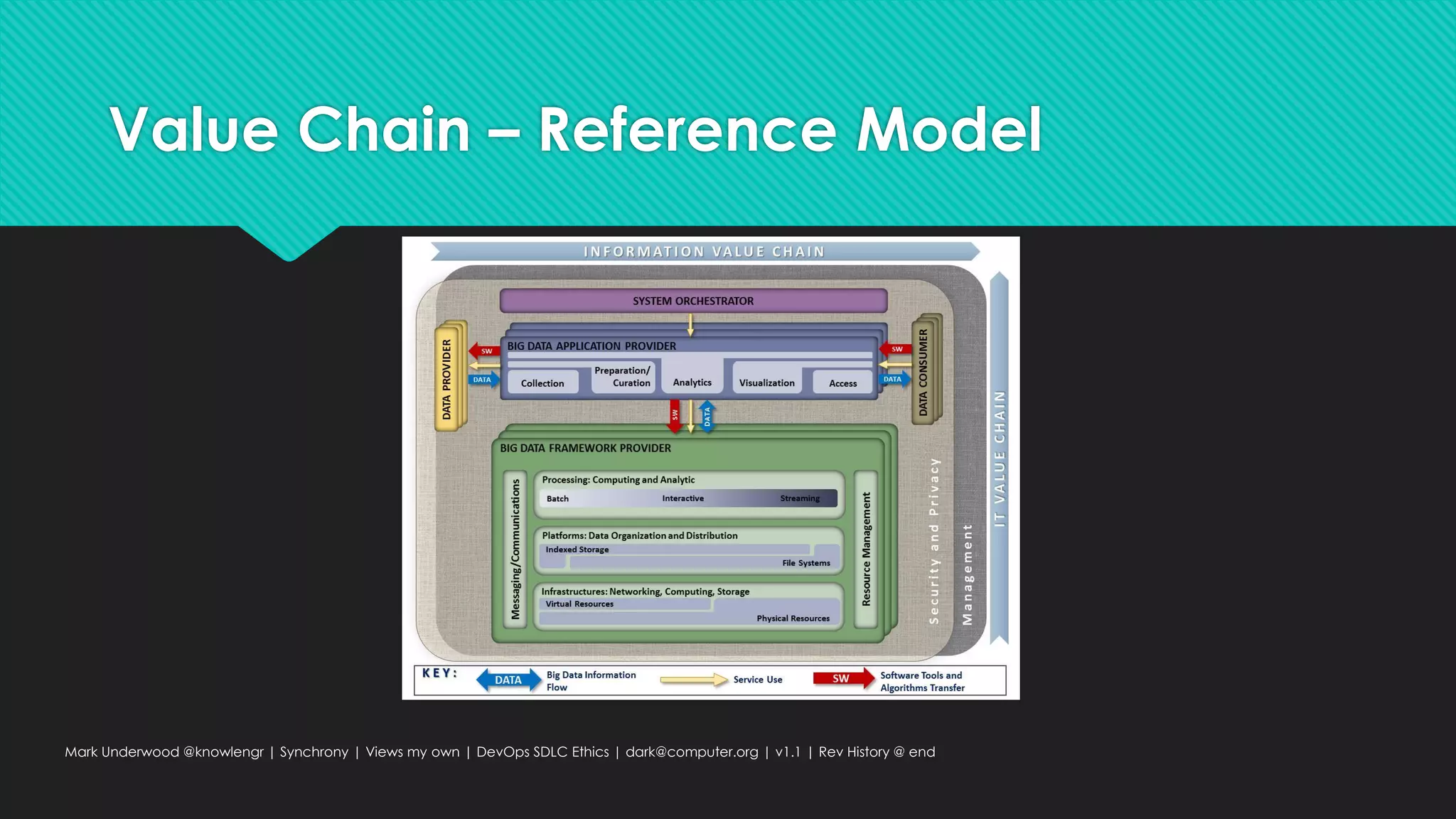
Value Chain – Reference Model
Mark Underwood @knowlengr | Synchrony | Views my own | DevOps SDLC Ethics | dark@computer.org | v1.1 | Rev History @ end
ACM Computing Classification
Security & Privacy Topics
 Database and storage security
 Data anonymization and sanitation
 Management and querying of encrypted data
 Information accountability and usage control
 Database activity monitoring
 Software and application security
 Software security engineering
 Web application security
 Social network security and privacy
 Domain-specific security and privacy architectures
 Software reverse engineering
 Human and societal aspects of security and privacy
 Economics of security and privacy
 Social aspects of security and privacy
 Privacy protections
 Usability in security and privacy
Mark Underwood @knowlengr | Synchrony | Views my own | DevOps SDLC Ethics | dark@computer.org | v1.1 | Rev History @ end
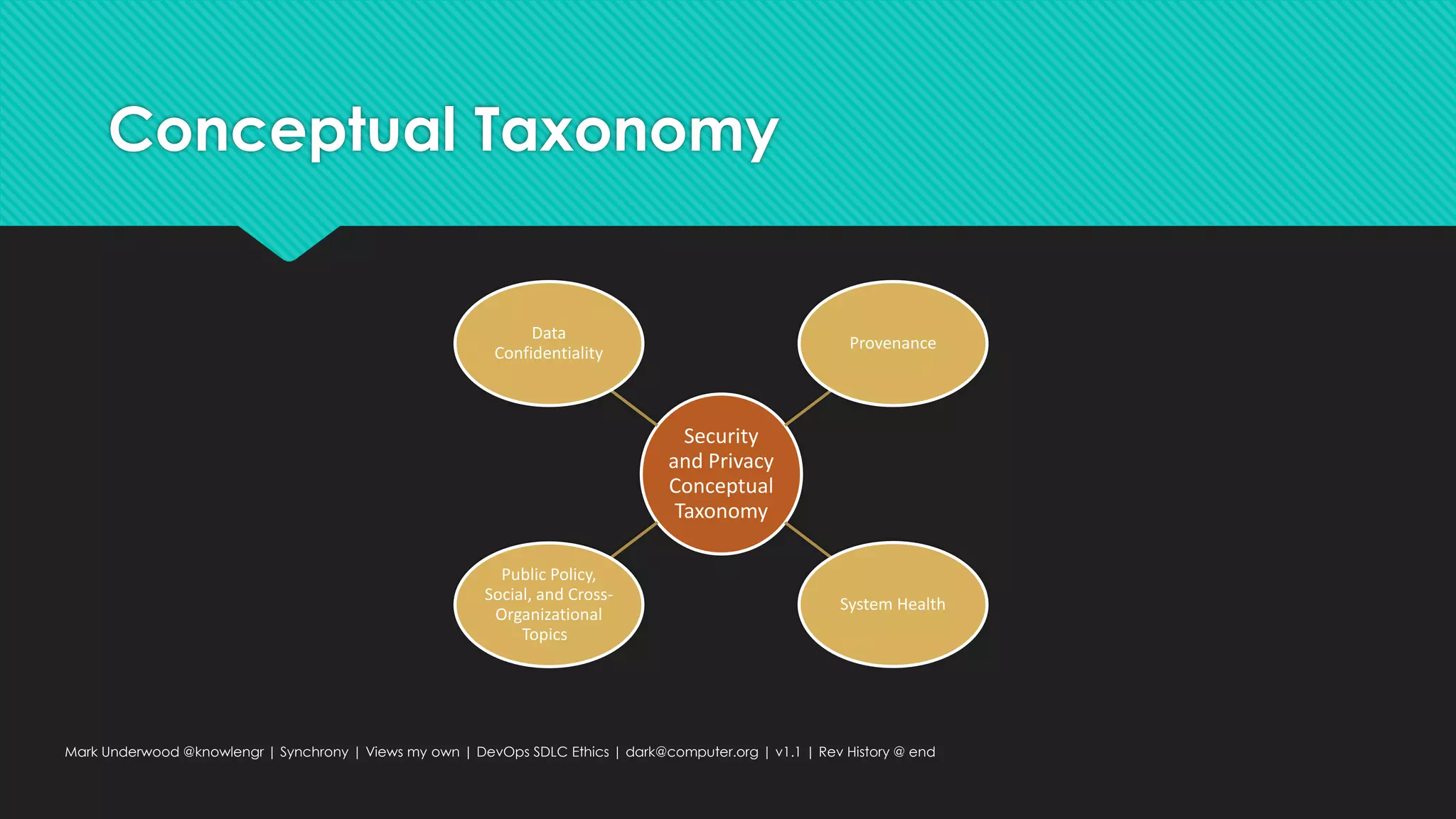
Conceptual Taxonomy
Mark Underwood @knowlengr | Synchrony | Views my own | DevOps SDLC Ethics | dark@computer.org | v1.1 | Rev History @ end
Security
and Privacy
Conceptual
Taxonomy
Data
Confidentiality
Provenance
System Health
Public Policy,
Social, and Cross-
Organizational
Topics
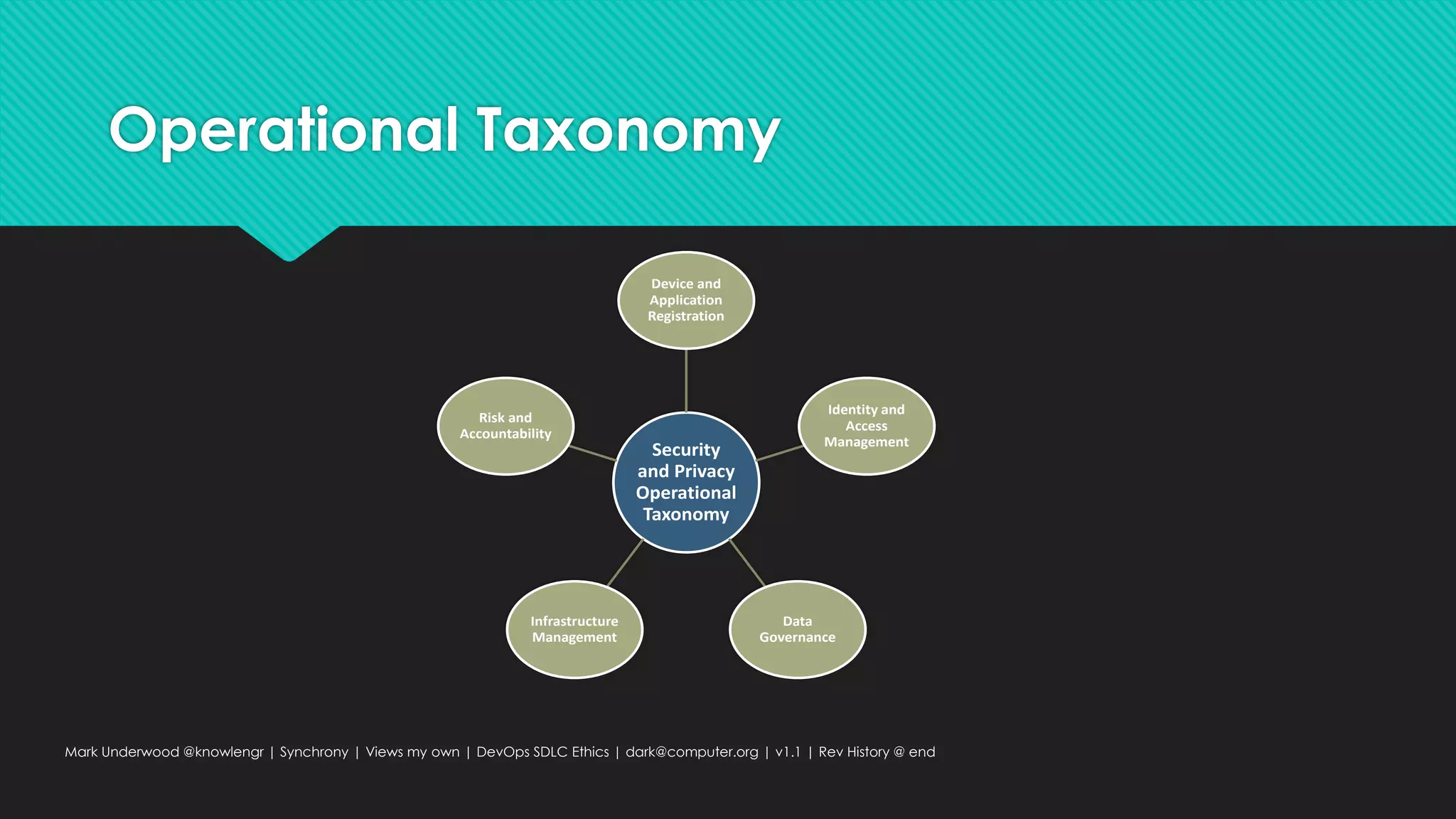
Operational Taxonomy
Mark Underwood @knowlengr | Synchrony | Views my own | DevOps SDLC Ethics | dark@computer.org | v1.1 | Rev History @ end
Security
and Privacy
Operational
Taxonomy
Device and
Application
Registration
Identity and
Access
Management
Data
Governance
Infrastructure
Management
Risk and
Accountability
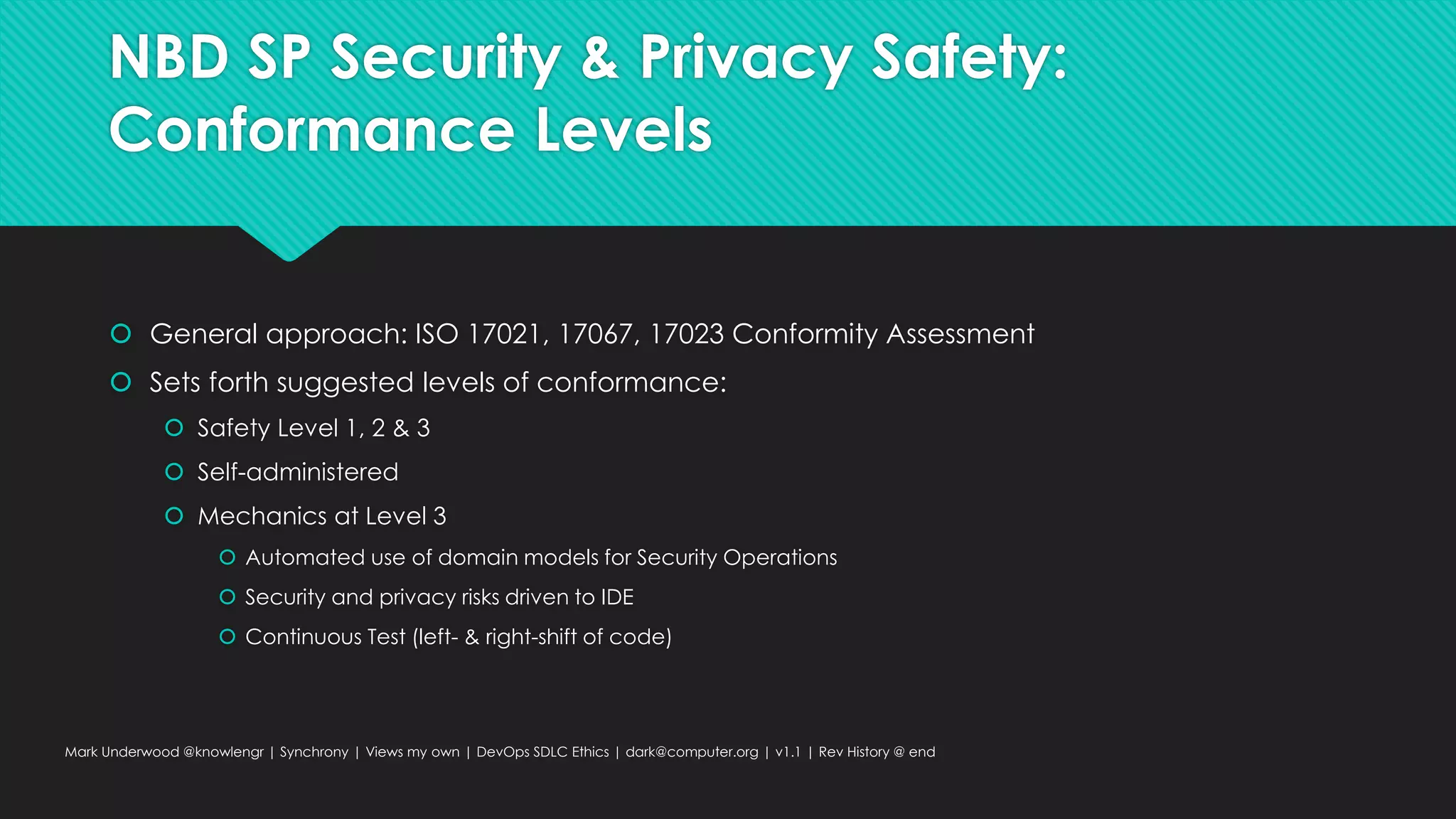
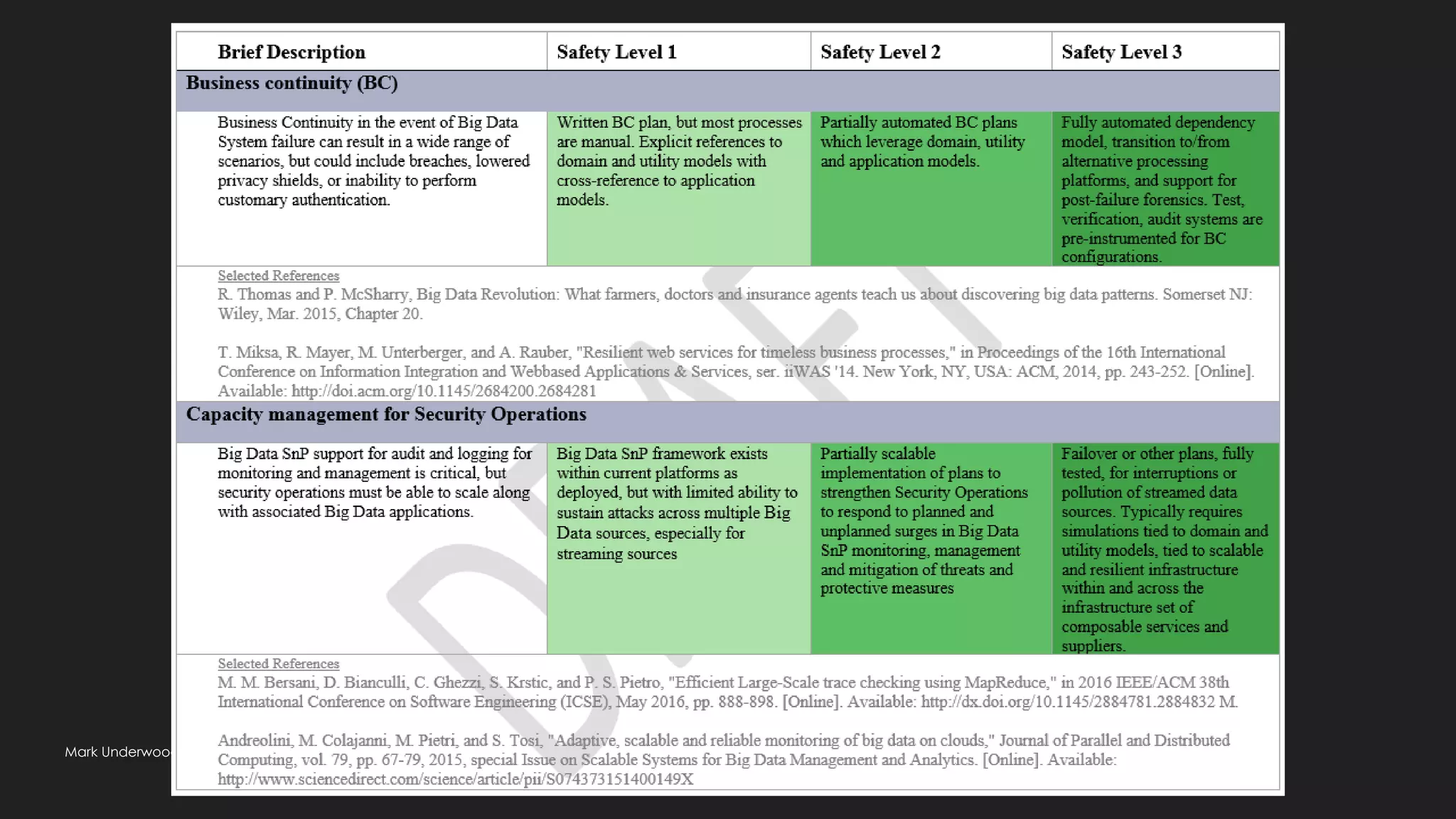
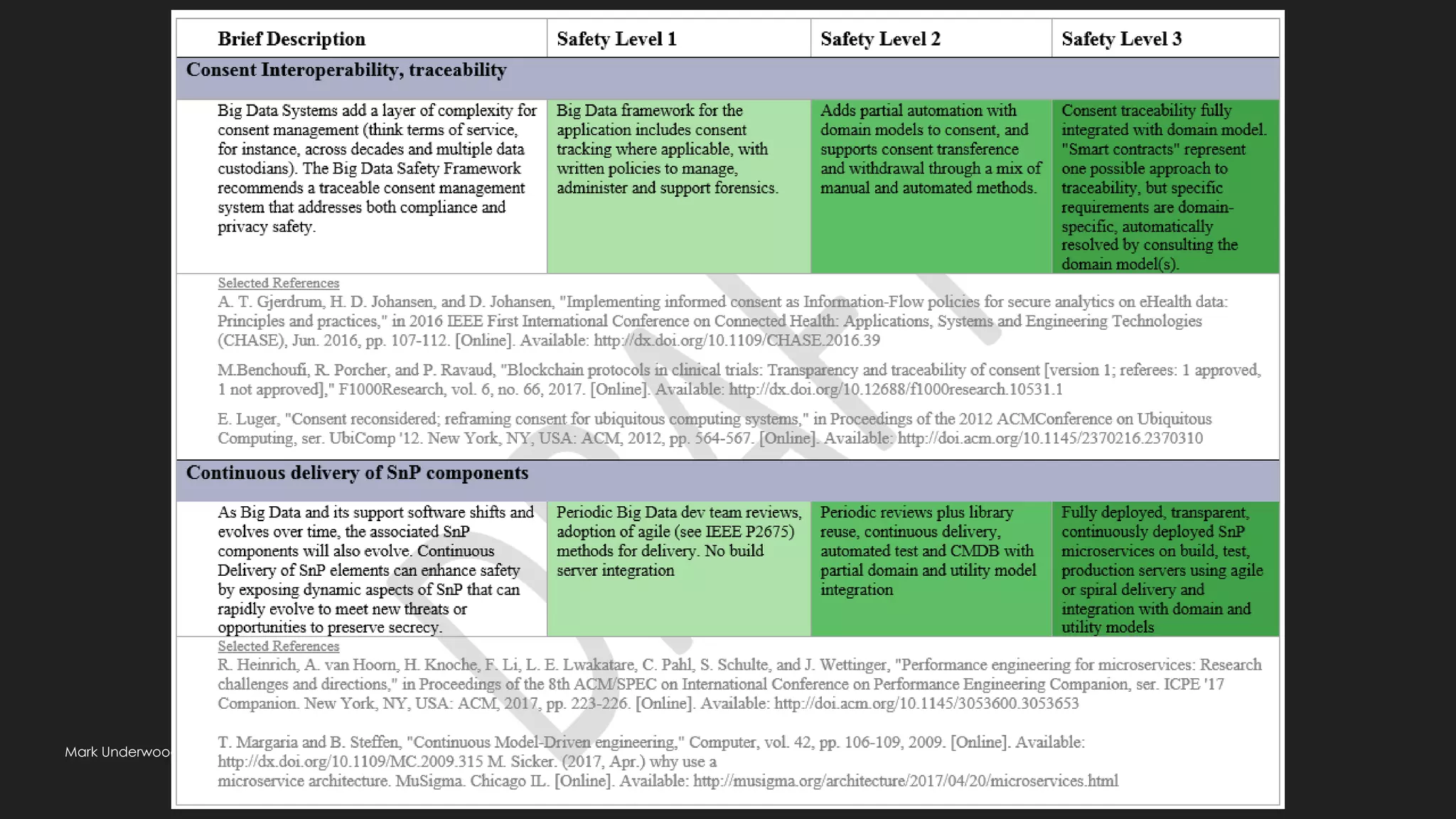
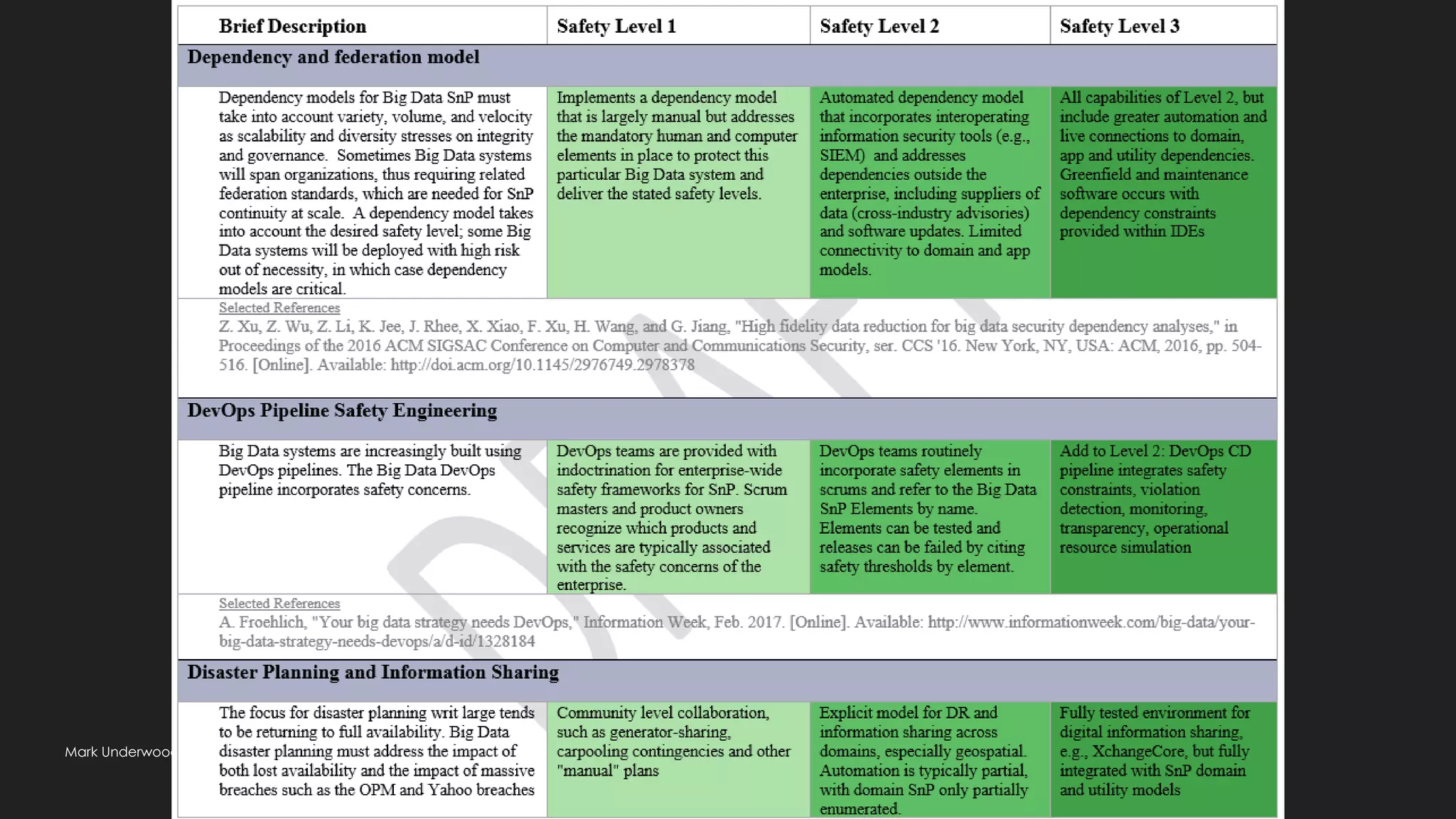
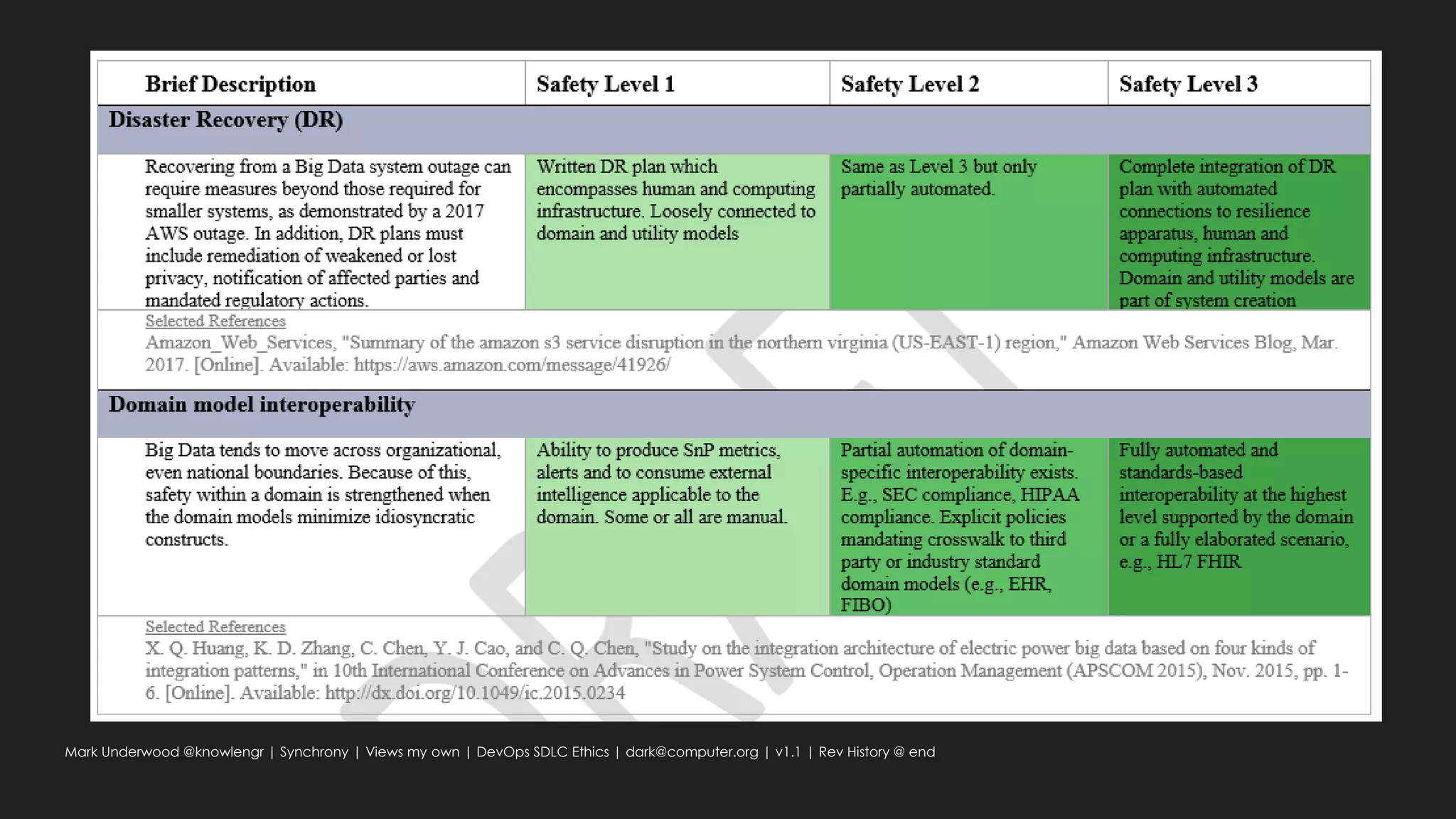
NBD SP Security & Privacy Safety:
Conformance Levels
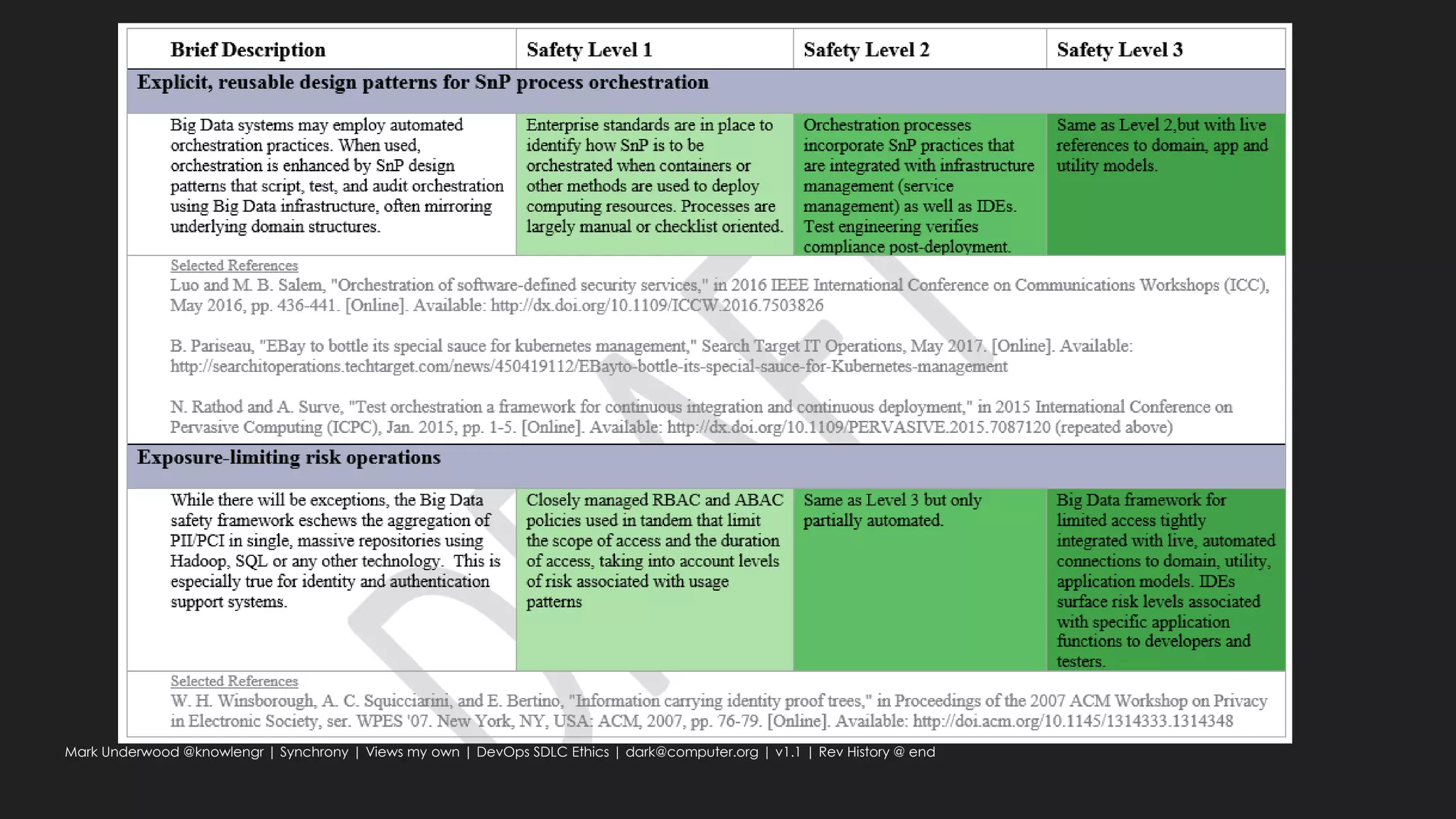
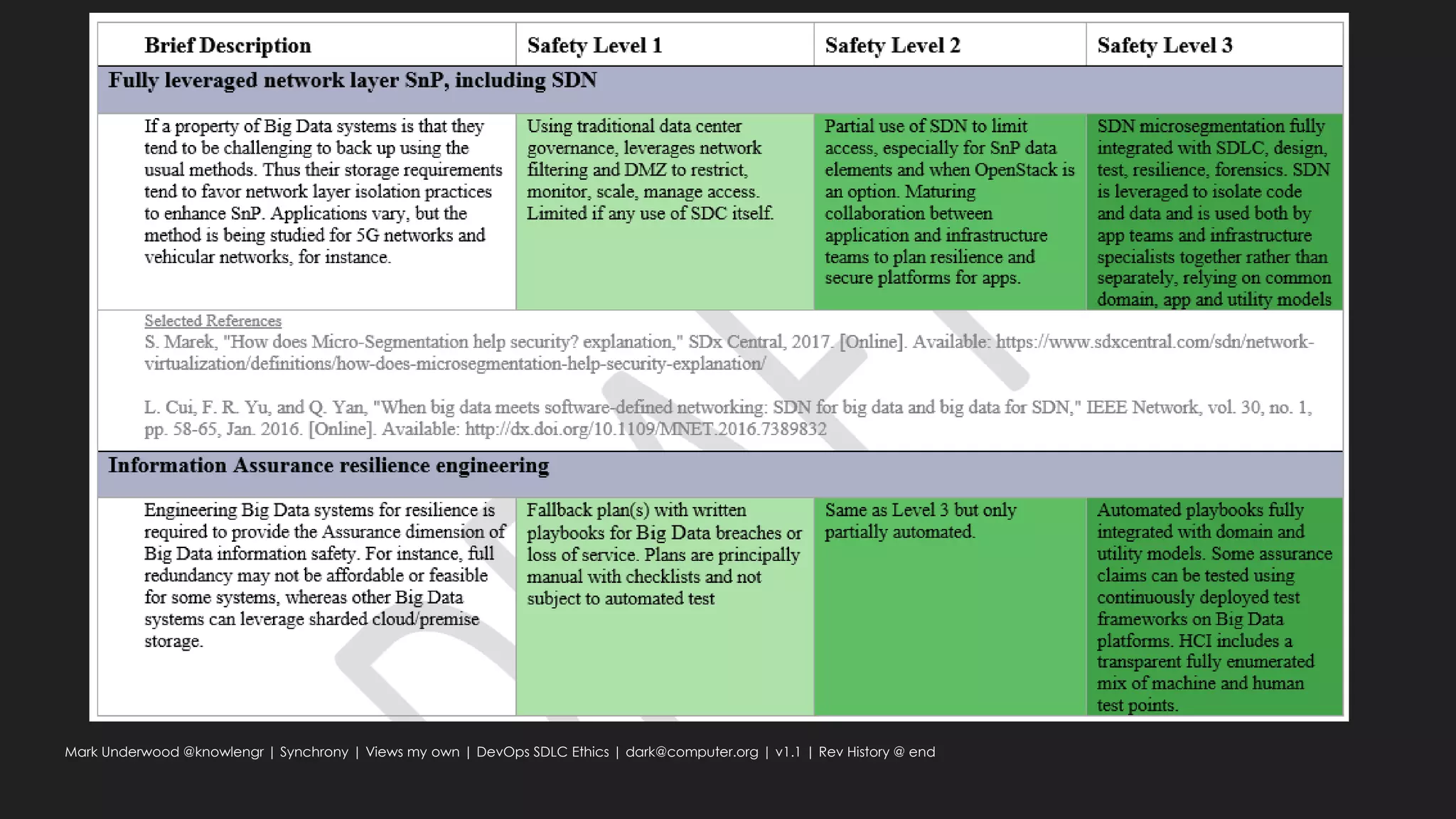
 General approach: ISO 17021, 17067, 17023 Conformity Assessment
 Sets forth suggested levels of conformance:
 Safety Level 1, 2 & 3
 Self-administered
 Mechanics at Level 3
 Automated use of domain models for Security Operations
 Security and privacy risks driven to IDE
 Continuous Test (left- & right-shift of code)
Mark Underwood @knowlengr | Synchrony | Views my own | DevOps SDLC Ethics | dark@computer.org | v1.1 | Rev History @ end
Value of Security Ontologies
(Obrst, Chase, & Markeloff, 2012) Note that systematic use of ontologies could enable
information security tools to process standardized information streams from third parties, using
methods such as the Security Content Automation Protocol (SCAP). This model could enable
automated reasoning to address potential breaches closer to real time, or which have
indirect effects on networks or applications which require a mixture of human and machine
cognition.
Mark Underwood @knowlengr | Synchrony | Views my own | DevOps SDLC Ethics | dark@computer.org | v1.1 | Rev History @ end
Privacy and Security Fabric
 “Fabric” notion adopted by several organizations
 Fabric to cover multiple layers, facets, technologies
 Dissolving distinction between security and privacy
Mark Underwood @knowlengr | Synchrony | Views my own | DevOps SDLC Ethics | dark@computer.org | v1.1 | Rev History @ end
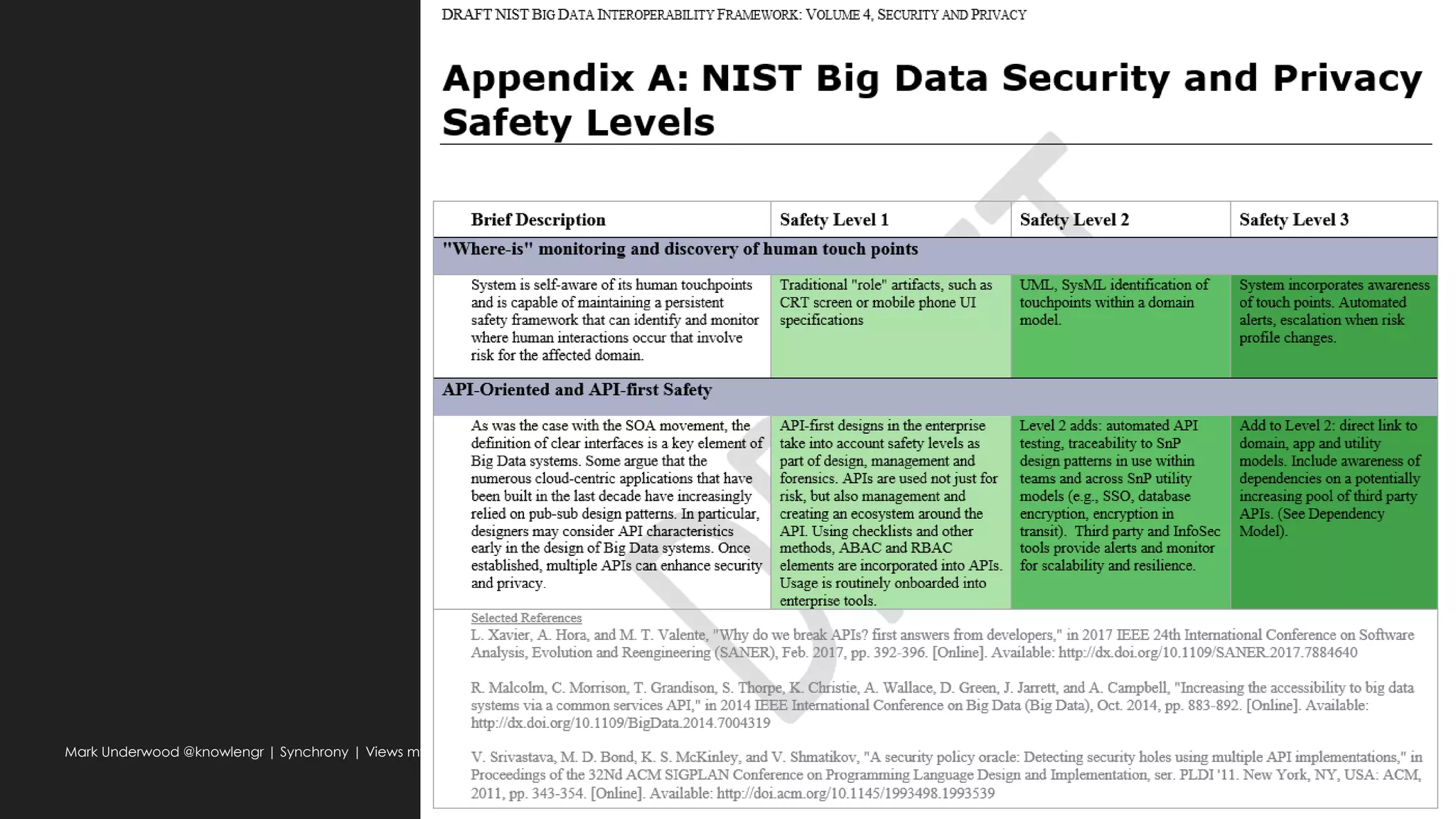
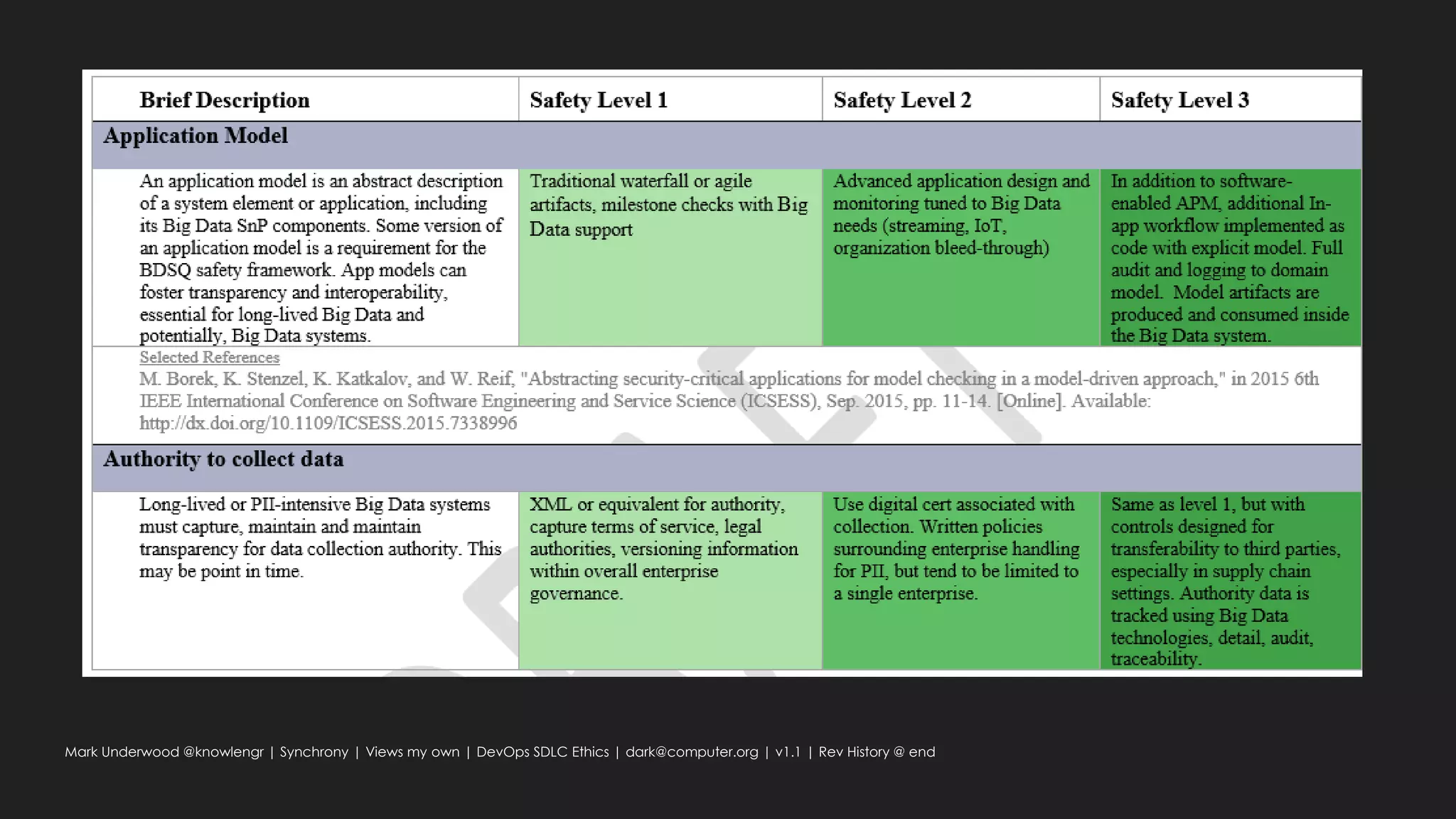
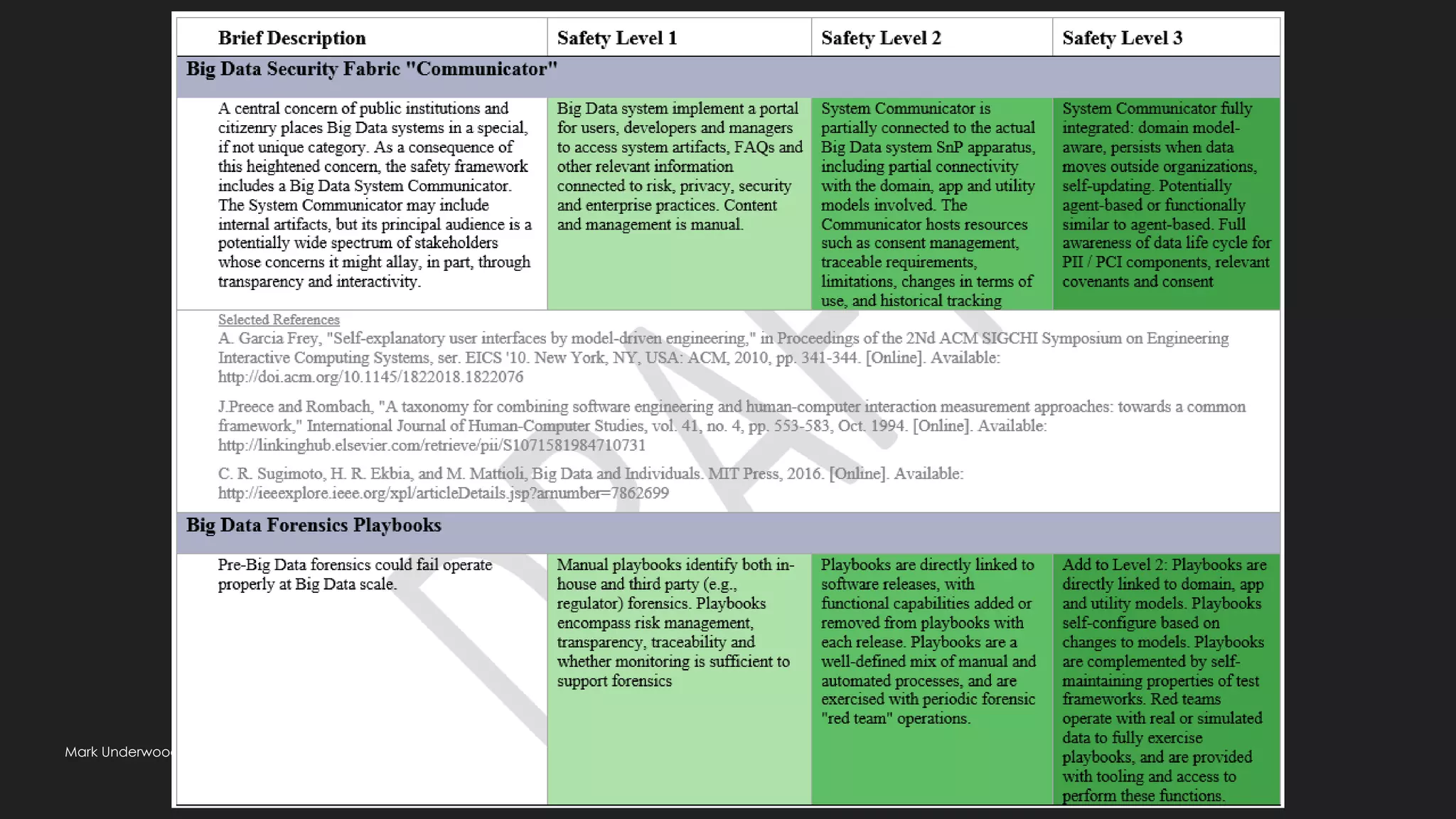
Snips from NBDPWG V2 Appendix A
 Best practices for ABAC
 Integration of legacy RBAC with ABAC
 Derivation of ABAC from other model formats
 Kubernetes walkthrough
 Container and Microservice ABAC
 Log analysis for Splunk Security Operations / Application design patterns
Mark Underwood @knowlengr | Synchrony | Views my own | DevOps SDLC Ethics | dark@computer.org | v1.1 | Rev History @ end
Appendix A
 There is more . . . Refer to Appendix A in the full document. The
preceding slides were an excerpt.
Mark Underwood @knowlengr | Synchrony | Views my own | DevOps SDLC Ethics | dark@computer.org | v1.1 | Rev History @ end
Background Material
NBDPWG Appendix A, Cloud Native SAFE
Mark Underwood @knowlengr | Synchrony | Views my own | DevOps SDLC Ethics | dark@computer.org | v1.1 | Rev History @ end
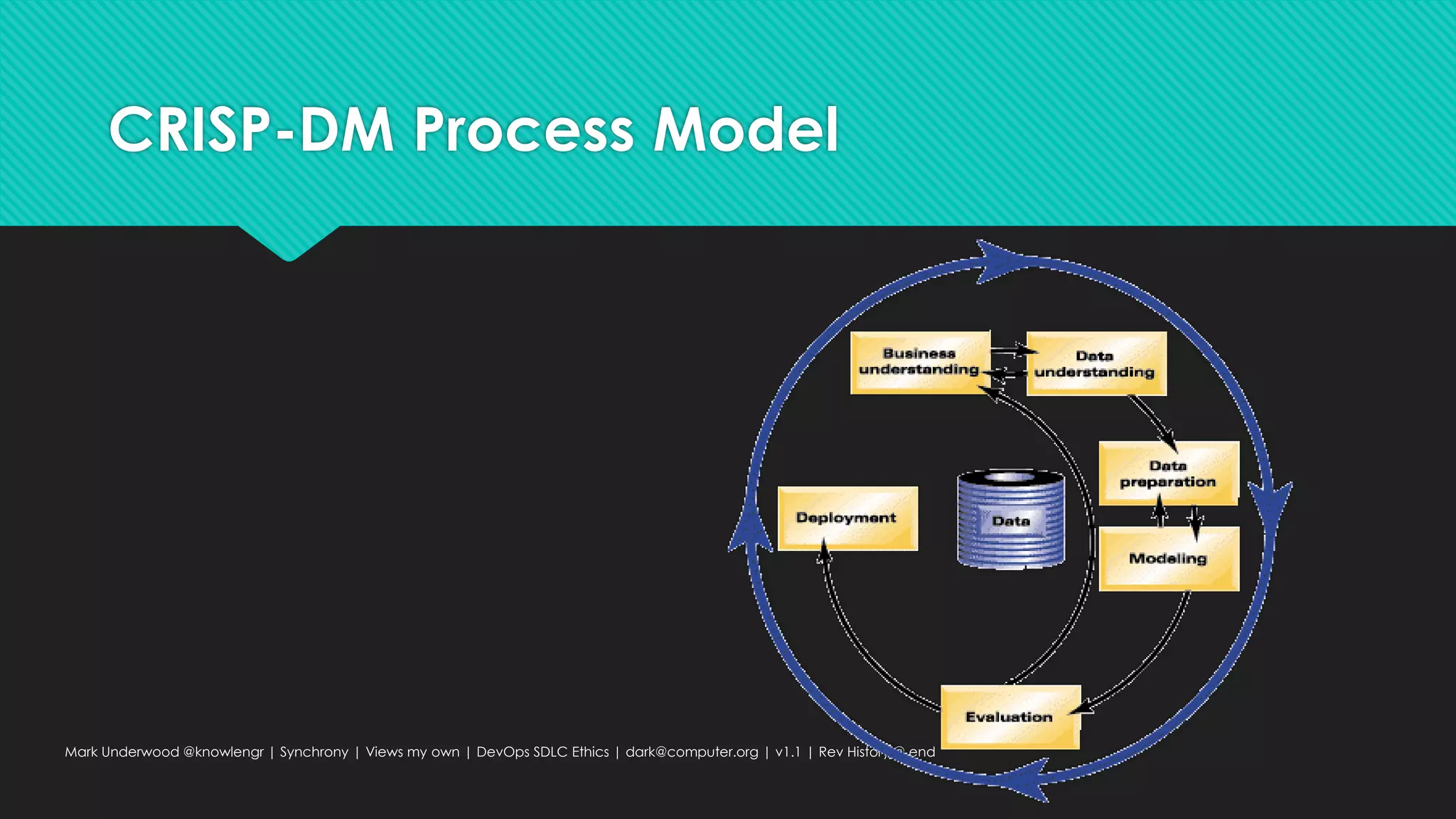
CRISP-DM Process Model
Mark Underwood @knowlengr | Synchrony | Views my own | DevOps SDLC Ethics | dark@computer.org | v1.1 | Rev History @ end
Cloud Native Foundation
Safe Access For Everyone (SAFE)
 https://github.com/cn-security/safe
Mark Underwood @knowlengr | Synchrony | Views my own | DevOps SDLC Ethics | dark@computer.org | v1.1 | Rev History @ end
This deck is released under
Creative Commons
Attribution-Share Alike.
Portions of the work summarized was developed by multiple contributors through the NIST
open public working group framework under the leadership of Wo Chang, but this document
represents my views alone. https://bigdatawg.nist.gov | govNISTBig Databig data
securityBig Data SecPriv V2
Mark Underwood @knowlengr | Synchrony | Views my own | DevOps SDLC Ethics | dark@computer.org | v1.1 | Rev History @ end

DevOps Support for an Ethical Software Development Life Cycle (SDLC)

  • 1.
    DevOps Support for EthicalSDLC Overview of DevOps-related SDLC ethical concerns from IEEE P70nn Working Groups @IEEESA http://sites.ieee.org/sagroups-7000/ Mark Underwood @knowlengr | Synchrony | Views my own | DevOps SDLC Ethics | dark@computer.org | v1.1 | Rev History @ end
  • 2.
    IEEE P7000: MarquisGroup Charter “Scope: The standard establishes a process model by which engineers and technologists can address ethical consideration throughout the various stages of system initiation, analysis and design. Expected process requirements include management and engineering view of new IT product development, computer ethics and IT system design, value-sensitive design, and, stakeholder involvement in ethical IT system design. . .. The purpose of this standard is to enable the pragmatic application of this type of Value-Based System Design methodology which demonstrates that conceptual analysis of values and an extensive feasibility analysis can help to refine ethical system requirements in systems and software life cycles.” Mark Underwood @knowlengr | Synchrony | Views my own | DevOps SDLC Ethics | dark@computer.org | v1.1 | Rev History @ end
  • 3.
    Related IEEE P70nnGroups  IEEE P7000 Ethical Systems Design  IEEE P7001 Transparency of Autonomous Systems  IEEE P7002 Data Privacy Process  IEEE P7003 Algorithmic Bias Considerations  IEEE P7004 Standard for Child and Student Data Governance  IEEE P7005 Standard for Transparent Employer Data Governance  IEEE P7006 Standard for Personal AI Agent  IEEE P7007 Ontological Standard for Ethically Driven Robotics and Automation Systems  IEEE P7008 - Standard for Ethically Driven Nudging for Robotic, Intelligent and Autonomous Systems  IEEE P7009 - Standard for Fail-Safe Design of Autonomous and Semi-Autonomous Systems  IEEE P7010 - Wellbeing Metrics Standard for Ethical Artificial Intelligence and Autonomous Systems  IEEE P7011 - SSIE Standard for Trustworthiness of News Media  IEEE P7012 - SSIE Machine Readable Personal Privacy Terms  IEEE P7013 - Facial Analysis Mark Underwood @knowlengr | Synchrony | Views my own | DevOps SDLC Ethics | dark@computer.org | v1.1 | Rev History @ end
  • 4.
    Key References Mark Underwood@knowlengr | Synchrony | Views my own | DevOps SDLC Ethics | dark@computer.org | v1.1 | Rev History @ end Focus: artificial intelligence and autonomous systems. Havens asks, “How will machines know what we value if we don’t know ourselves?”
  • 5.
    Recent Case StudyOpportunities: Case Study 1 Mark Underwood @knowlengr | Synchrony | Views my own | DevOps SDLC Ethics | dark@computer.org | v1.1 | Rev History @ end “Faster, Higher, Farther chronicles a corporate scandal that rivals those at Enron and Lehman Brothers—one that will cost Volkswagen more than $22 billion in fines and settlements.” – Publisher
  • 6.
    Case Study 2 “Equifax said that about 38,000 driver's licenses and 3,200 passports details had been uploaded to the portal that had was hacked. (http://bit.ly/2jF3VTh) Equifax said in September that hackers had stolen personally identifiable information of U.S., British and Canadian consumers. The company confirmed that information on about 146.6 million names, 146.6 million dates of birth, 145.5 million social security numbers, 99 million address information and 209,000 payment card number and expiration date, were stolen in the cyber security incident.” –Yahoo Finance Mark Underwood @knowlengr | Synchrony | Views my own | DevOps SDLC Ethics | dark@computer.org | v1.1 | Rev History @ end
  • 7.
    Case Study 3 MarkUnderwood @knowlengr | Synchrony | Views my own | DevOps SDLC Ethics | dark@computer.org | v1.1 | Rev History @ end It will be remembered as “a breach,” but the Facebook – Cambridge Analytica incident was about big data. Adjectives to remember: “Tiny” + “Big”
  • 8.
    Case Study 4 MarkUnderwood @knowlengr | Synchrony | Views my own | DevOps SDLC Ethics | dark@computer.org | v1.1 | Rev History @ end Finding: Hispanic-owned and managed Airbnb properties, controlled for other aspects, receive less revenue than other groups. Response from Airbnb when contacted by reporters: We already provide tools to help price listings. Source: American Public Media Marketplace 8-May-2018 Related stories: Dan Gorenstein, “Airbnb cracks down on bias – but at what cost?” Marketplace, 2018-09-08 Corporate Europe Observatory, “Unfairbnb” 2-May-2018
  • 9.
    Case Study 5 A“charity” was used to subsidize payments to Medicare patients in order to boost drug sales. Multiple manufacturers are involved. Mark Underwood @knowlengr | Synchrony | Views my own | DevOps SDLC Ethics | dark@computer.org | v1.1 | Rev History @ end
  • 10.
    Case Study 6 MarkUnderwood @knowlengr | Synchrony | Views my own | DevOps SDLC Ethics | dark@computer.org | v1.1 | Rev History @ end “Value-added measures for teacher evaluation, called the Education Value- Added Assessment System, or EVAAS, in Houston, is a statistical method that uses a student’s performance on prior standardized tests to predict academic growth in the current year. This methodology—derided as deeply flawed, unfair and incomprehensible—was used to make decisions about teacher evaluation, bonuses and termination. It uses a secret computer program based on an inexplicable algorithm (above). In May 2014, seven Houston teachers and the Houston Federation of Teachers brought an unprecedented federal lawsuit to end the policy, saying it reduced education to a test score, didn’t help improve teaching or learning, and ruined teachers’ careers when they were incorrectly terminated. Neither HISD nor its contractor allowed teachers access to the data or computer algorithms so that they could test or challenge the legitimacy of the scores, creating a ‘black box.’” http://kbros.co/2EvxjU9
  • 11.
    Case Study 7 A radiologist sends a message to a provider. It is never received, and critical care was not delivered, probably resulting in a patient’s death. Whom would you blame?  What’s in your stack?  “Apache Flink is an open-source framework for distributed stream processing that Provides results that are accurate, even in the case of out-of-order or late- arriving data. Some of its features are – (1) It is stateful and fault-tolerant and can seamlessly recover from failures while maintaining exactly-once application state; (2) performs at large scale, running on thousands of nodes with excellent throughput and latency characteristics; (3) its streaming data flow execution engine, APIs and domain-specific libraries for Batch, Streaming, Machine Learning, and Graph Processing.”  Or . . . ? “Apache Kafka solves the situation where the producer is generating messages faster than the consumer can consume them in a reliable way.” Mark Underwood @knowlengr | Synchrony | Views my own | DevOps SDLC Ethics | dark@computer.org | v1.1 | Rev History @ end
  • 12.
    Related Decks  NISTBig Data Public Working Group – Overview for Cloud Native SAFE  Stakeholders for Ethical Systems Design  DevOps Support for a More Ethical SDLC (this deck)  GDPR Issues in Security and Privacy Mark Underwood @knowlengr | Synchrony | Views my own | DevOps SDLC Ethics | dark@computer.org | v1.1 | Rev History @ end
  • 13.
    My Perspective  ChairOntology / Taxonomy subgroup for P7000  Occasional participant in IEEE Standards WGs P7007, P7001, P7003, P7002, P7010, P7007  IEEE Standard P2675 WG Security for DevOps  IEEE Standards P1915.1 SDN and Network Function Virtualization Security  Finance large enterprise: supply chain risk, complex playbooks, many InfoSec tools, workflow automation, big data logging; risks include fraud and regulatory #fail Mark Underwood @knowlengr | Synchrony | Views my own | DevOps SDLC Ethics | dark@computer.org | v1.1 | Rev History @ end
  • 14.
    IEEE Society onSocial Implications of Technology Mark Underwood @knowlengr | Synchrony | Views my own | DevOps SDLC Ethics | dark@computer.org | v1.1 | Rev History @ end
  • 15.
    IEEE Product SafetyEngineering Society Mark Underwood @knowlengr | Synchrony | Views my own | DevOps SDLC Ethics | dark@computer.org | v1.1 | Rev History @ end • “Do no harm.” – It’s not so easy. • Do you know a system is safe before it’s been fully scaled up -- & possibly federated? • What constitutes “a reasonable explanation”?
  • 16.
    IEEE Reliability Society MarkUnderwood @knowlengr | Synchrony | Views my own | DevOps SDLC Ethics | dark@computer.org | v1.1 | Rev History @ end See free reliability analytics toolkit. Some items are useful to Big Data DevOps) https://kbros.co/2rugRij
  • 17.
    IEEE Shill? No. Active communities are small.  Standards documents are not free, though participation for IEEE members is.  Heavily weighted toward late career participants.  Despite “Engineering” in title, often not “engineering.” Mark Underwood @knowlengr | Synchrony | Views my own | DevOps SDLC Ethics | dark@computer.org | v1.1 | Rev History @ end
  • 18.
    But IEEE has. . .  IEEE Digital Library (with cross reference to ACM digital library)  Multinational reach and engagement  Reasonable internal advocacy and oversight  Diversity  Sometimes good awareness of NIST work  Often best work in lesser-known conference publications (e.g., vs. IEEE Security) Mark Underwood @knowlengr | Synchrony | Views my own | DevOps SDLC Ethics | dark@computer.org | v1.1 | Rev History @ end
  • 19.
    State of ComputingProfession Ethics @ACM_Ethics ACM Code of Ethics (Draft 3, 2018) https://www.acm.org/about-acm/code-of-ethics Mark Underwood @knowlengr | Synchrony | Views my own | DevOps SDLC Ethics | dark@computer.org | v1.1 | Rev History @ end
  • 20.
    Highlights of ACMEthics v3  “minimize negative consequences of computing, including threats to health, safety, personal security, and privacy.”  When the interests of multiple groups conflict, the needs of the least advantaged should be given increased attention and priority  computing professionals should promote environmental sustainability both locally and globally.  “. . .the consequences of emergent systems and data aggregation should be carefully analyzed. Those involved with pervasive or infrastructure systems should also consider Principle 3.7 (Standard of care when a system is integrated into the infrastructure of society). Mark Underwood @knowlengr | Synchrony | Views my own | DevOps SDLC Ethics | dark@computer.org | v1.1 | Rev History @ end
  • 21.
    Mark Underwood @knowlengr| Synchrony | Views my own | DevOps SDLC Ethics | dark@computer.org | v1.1 | Rev History @ end https://www.computer.org/web/education/code-of-ethics
  • 22.
    Joint ACM IEEESoftware Engr Code https://www.computer.org/web/education/code-of-ethics  1. PUBLIC - Software engineers shall act consistently with the public interest.  2. CLIENT AND EMPLOYER - Software engineers shall act in a manner that is in the best interests of their client and employer consistent with the public interest.  3. PRODUCT - Software engineers shall ensure that their products and related modifications meet the highest professional standards possible.  4. JUDGMENT - Software engineers shall maintain integrity and independence in their professional judgment.  5. MANAGEMENT - Software engineering managers and leaders shall subscribe to and promote an ethical approach to the management of software development and maintenance.  6. PROFESSION - Software engineers shall advance the integrity and reputation of the profession consistent with the public interest.  7. COLLEAGUES - Software engineers shall be fair to and supportive of their colleagues.  8. SELF - Software engineers shall participate in lifelong learning regarding the practice of their profession and shall promote an ethical approach to the practice of the profession. Mark Underwood @knowlengr | Synchrony | Views my own | DevOps SDLC Ethics | dark@computer.org | v1.1 | Rev History @ end
  • 23.
    Human Computer Interaction NBDPWG System Communicator  Usability for web and mobile content  Substitutes for old school manuals  “Privacy text” for disclosures, policy, practices  Central to much of the click-based economy  “User” feedback, recommendations  Recommendation engines Mark Underwood @knowlengr | Synchrony | Views my own | DevOps SDLC Ethics | dark@computer.org | v1.1 | Rev History @ end
  • 24.
    Natural Language Tooling Hyperlinks to artifacts  Chatbots  Live agent  Speech to text support  Text mining  Enterprise search (workflow-enabled artifacts)  Some of the indexed artifacts may approach big data status  SaaS Text Analytics Mark Underwood @knowlengr | Synchrony | Views my own | DevOps SDLC Ethics | dark@computer.org | v1.1 | Rev History @ end
  • 25.
    Dependency Management (CM) Larger scope for Configuration management  Support both hybrid cloud + fully distributed IoT applications  Across organizations  Needed for critical infrastructure  See NIST critical sector efforts  Emerging Dependencies may not be human-intelligible  Special issues with machine-to-machine transactions  Weak CM for dependencies on people or groups (including external) Mark Underwood @knowlengr | Synchrony | Views my own | DevOps SDLC Ethics | dark@computer.org | v1.1 | Rev History @ end
  • 26.
    Traceability & RequirementsEngineering  Define what is an ethical requirement  Possible: big data ethical fabric (transparency, usage)  Audit  Traceability requirements  Can an ethical responsibility be inherited like Personal Data-tagged data elements?  What about synthetic, algorithm-defined elements? Note: See EU notion for “Personal Data” vs. PII in the US: P. Schwartz and D. Solove, "Reconciling Personal Information in the United States and European Union," California Law Review, vol. 102, no. 4, Aug. 2014. [Online]. Available: https://scholarship.law.berkeley.edu/californialawreview/vol102/iss4/7 Mark Underwood @knowlengr | Synchrony | Views my own | DevOps SDLC Ethics | dark@computer.org | v1.1 | Rev History @ end
  • 27.
    Special Populations  Disadvantaged By regulation (e.g., 8A, SBIR, disability)  By “common sense” (“fairness” and “equity”)  By economic / sector (“underserved”)  Internet Bandwidth inequity  Children  “Criminals” / Malware Designers Mark Underwood @knowlengr | Synchrony | Views my own | DevOps SDLC Ethics | dark@computer.org | v1.1 | Rev History @ end
  • 28.
    Transparency  What doesit mean to be “transparent” about ethics?  What connection to IEEE /ACM professional ethics?  ACM: “The entire computing profession benefits when the ethical decision making process is accountable to and transparent to all stakeholders. Open discussions about ethical issues promotes this accountability and transparency.”  ACM “A computing professional should be transparent and provide full disclosure of all pertinent system limitations and potential problems. Making deliberately false or misleading claims, fabricating or falsifying data, and other dishonest conduct are violations of the Code.”  ACM “Computing professionals should establish transparent policies and procedures that allow individuals to give informed consent to automatic data collection, review their personal data, correct inaccuracies, and, where appropriate, remove data.”  ACM “Organizational procedures and attitudes oriented toward quality, transparency, and the welfare of society reduce harm to the public and raise awareness of the influence of technology in our lives. Therefore, leaders should encourage full participation of all computing professionals in meeting social responsibilities and discourage tendencies to do otherwise.” Mark Underwood @knowlengr | Synchrony | Views my own | DevOps SDLC Ethics | dark@computer.org | v1.1 | Rev History @ end
  • 29.
    Algorithms  “Why amI locked out while she is permitted?”  “Why isn’t my FICO score changing?”  “How can I know when I have explained our algorithm?”  “Is there an ‘explain-ability’ metric?” *** See next slide  What is different about machine-to-machine algorithms?  “Can an algorithm be abusive?”  “Is ‘bias’ the new breach?” https://kbros.co/2I2sxDO Mark Underwood @knowlengr | Synchrony | Views my own | DevOps SDLC Ethics | dark@computer.org | v1.1 | Rev History @ end
  • 30.
    Explanation  “Right toexplanation”  Explanation sufficiency / suitability is not immediately obvious  Explaining to novices vs. experts; children vs. adults  Complex topics requiring specialized language, fast-changing technologies (e.g., cloud)  Explanations may require agent-based technologies  Directly related to knowledge / learning management (an LMS may be a prerequisite)  References  https://en.wikipedia.org/wiki/Explainable_Artificial_Intelligence  https://en.wikipedia.org/wiki/Explanation#Meta-explanation  https://en.wikipedia.org/wiki/Abductive_reasoning Mark Underwood @knowlengr | Synchrony | Views my own | DevOps SDLC Ethics | dark@computer.org | v1.1 | Rev History @ end
  • 31.
    Risk Artifact Traceability Connect a Risk Framework object (e.g., NIST SP 800-37r2) to code objects  Hyperlinks  Embedded text  Code-to-text macros  Two-way connectivity  Configuration changes impact risk  Risk profile changes (flood, turnover in InfoSec workforce, open source ecosystem) impact code  Risk shifts must be explained Mark Underwood @knowlengr | Synchrony | Views my own | DevOps SDLC Ethics | dark@computer.org | v1.1 | Rev History @ end
  • 32.
    Function Point Traceability Requirements Engineering for Ethics  Related: Utility (“Tradeoff) Functions  Profit / Nonprofits  Capture of ethical aspects of requirements  Decision-making (function points need to support analytics, function points set by consensus – meetings, Communities of Interest, or Product Owner requirements) Mark Underwood @knowlengr | Synchrony | Views my own | DevOps SDLC Ethics | dark@computer.org | v1.1 | Rev History @ end
  • 33.
    Cross-Sector Resilience  Publicsafety, well-being  Examples: FS-ISAC, Edison Institute  Government services  “Special” Scenarios  Emergency Services  Military  DevOps was probably born in Logistics supply chain before it was called DevOps Mark Underwood @knowlengr | Synchrony | Views my own | DevOps SDLC Ethics | dark@computer.org | v1.1 | Rev History @ end
  • 34.
    The Professions  Professionsas cross-organizational force  The obvious: software engineers, accountants, safety/reliability engineers  Less obvious: most domains have specialists who are key: e.g., geneticists, structural engineer, avionics  Role is often set by a particular domain context or scenario  Code of Ethics as RegTech / Story Points / Function Points Mark Underwood @knowlengr | Synchrony | Views my own | DevOps SDLC Ethics | dark@computer.org | v1.1 | Rev History @ end
  • 35.
    Domain Specific EthicalBreach Stories  Manual Process Signposts  Anti-Money Laundering (AML) in Banking  HIPAA compliance consulting  DevOps Process Signposts  RegTech  Catalog ethical breaches associated with LoB, Mission  To-do: Harmonize with SE Code of Ethics Mark Underwood @knowlengr | Synchrony | Views my own | DevOps SDLC Ethics | dark@computer.org | v1.1 | Rev History @ end
  • 36.
    Audience, Alerts, Audits:Monitoring  Support multiple “stakeholders”  Not all are paying customers (“public interest”, regulators, suppliers)  Traceability requirements vary across stakeholder groups  In addition to those specified by product owners:  Alerts for citizens, infrastructure managers, CEOs, CIO’s, CISO’s, industry peers  May be the same, or may vary  Monitoring may need to be specialized according to each “V” | Live “seed” testing  Cautionary Tales: “Tin Can on the Wedding Car,” toddlers eating button batteries  (Opinion: Need to resurrect Complex Event Processing design patterns) Mark Underwood @knowlengr | Synchrony | Views my own | DevOps SDLC Ethics | dark@computer.org | v1.1 | Rev History @ end
  • 37.
    The “Are YouSure?” Problem  If “Are you sure?” is omitted, who decided that?  In CI?  In automated test (harder to find a missing feature)  Explanations  Doc? On screen? FAQ?  Connection to CMDB? Mark Underwood @knowlengr | Synchrony | Views my own | DevOps SDLC Ethics | dark@computer.org | v1.1 | Rev History @ end
  • 38.
    Simulation  New: DevOpsScalability  Simulation and Interoperability (SISO)  Scale for the V’s (see SISO)  NIST Big Data S&P Appendix A high conformance Mark Underwood @knowlengr | Synchrony | Views my own | DevOps SDLC Ethics | dark@computer.org | v1.1 | Rev History @ end
  • 39.
    Operational Intelligence  BigData often needed to manage applications  Managing pay-as-you-go computing resources => OpIntel  Related: Managing OpSec  Related: Alerts and Logging  Tradeoffs and utility models  Transparency, traceability, “documentation” Mark Underwood @knowlengr | Synchrony | Views my own | DevOps SDLC Ethics | dark@computer.org | v1.1 | Rev History @ end
  • 40.
    Test Engineering andDevOps  Continuous Pipeline concepts applied to IoT / Edge / Distributed  Each platform (or stack “layer”) may introduce different types of ethical concerns  E.g., Identity Management for children  Infectious disease statistics -> break glass for public health  Autonomous vehicles response to fog conditions (see http://web.media.mit.edu/~guysatat/fog/)  Reliance on less reliable hardware or bandwidth (e.g., cheap sensors, residential wi-fi)  Left- and right-shift of safety, reliability, regulatory constraints (remember case studies)  New meaning for “interoperability” – “inter-responsibility” Mark Underwood @knowlengr | Synchrony | Views my own | DevOps SDLC Ethics | dark@computer.org | v1.1 | Rev History @ end
  • 41.
    Forensics  Big Datamay be needed for full stack playback  Full stack for After Action Review is still immature with forensics professionals  Even large firms may not be staffed with forensics specialists  Big surprise may be in store when breach or litigation occurs Mark Underwood @knowlengr | Synchrony | Views my own | DevOps SDLC Ethics | dark@computer.org | v1.1 | Rev History @ end
  • 42.
    Federation & SupplyChain  Facebook/Cambridge Analytica scenario was forecast in V1  Supply Chains that have been casual need upgrades  Risk often increases as organizational size decreases  Cost of “keeping data around” dangerously close to zero  Conventional systems taxed to handle volume of identity management  Access is infrequently leased  Simplistic network zones fail to isolate subcomponents important to domain experts Mark Underwood @knowlengr | Synchrony | Views my own | DevOps SDLC Ethics | dark@computer.org | v1.1 | Rev History @ end
  • 43.
    Corporate Initiatives  EnvironmentalSocial Governance  Transparency within employee groups, departments, subsidiaries (See P7005)  Computing decisions that affect carbon footprint (green data centers, etc.)  Individual practitioners have greater influence than before  Disclaimers in developer contract work  Offshore culture: some workers may be afraid to question requirements, risk-taking  Whistle-blower (a la Bug Bounty) not working well yet Mark Underwood @knowlengr | Synchrony | Views my own | DevOps SDLC Ethics | dark@computer.org | v1.1 | Rev History @ end
  • 44.
    Who Decides? Some Opinions Requirements Engineering may need a refresher, uplift  System Architects must continuously place controls in hands of domain experts  This is counter to the “sysadmin” design pattern  Risks multiply in part due to the commercial deprecation of documentation, manuals  Boundaries of safe & manageable release pipelines may have already been exceeded (mobile)  “Explain this” mentality partly offsets the DIY developer syndrome  Good for self-education, but the problem is not defining “ethics”  On-demand microlearning must accompany microservices deployment  AI Agents: Can ask, “Why?” “Who?” and nudge ethical considerations Mark Underwood @knowlengr | Synchrony | Views my own | DevOps SDLC Ethics | dark@computer.org | v1.1 | Rev History @ end
  • 45.
    Value Chain –Reference Model Mark Underwood @knowlengr | Synchrony | Views my own | DevOps SDLC Ethics | dark@computer.org | v1.1 | Rev History @ end
  • 46.
    Bibliography Bo Brinkman, CatherineFlick, Don Gotterbarn, Keith Miller, Kate Vazansky, and Marty J. Wolf. 2017. Listening to professional voices: draft 2 of the ACM code of ethics and professional conduct. Commun. ACM 60, 5 (April 2017), 105-111. DOI: https://doi.org/10.1145/3072528 Mark Underwood @knowlengr | Synchrony | Views my own | DevOps SDLC Ethics | dark@computer.org | v1.1 | Rev History @ end
  • 47.
    Related Work  NIST800-53 Rev 5 and others, NIST Cloud Security, NIST RMF  Building, Auto Automation ISO 29481, 16739, 12006  https://www.buildingsmart.org/about/what-is-openbim/ifc-introduction  Uptane  Ethics and Societal Considerations ISO 26000, IEEE P70nn  DevOps Security IEEE P2675  Microsegmentation and NFV IEEE P1915.1  Safety orientation  Infrastructure as code  E.g., security tooling is code, playbooks are code Mark Underwood @knowlengr | Synchrony | Views my own | DevOps SDLC Ethics | dark@computer.org | v1.1 | Rev History @ end
  • 48.
    Revision History Mark Underwood@knowlengr | Synchrony | Views my own | DevOps SDLC Ethics | dark@computer.org | v1.1 | Rev History @ end Vers Date Change 1.0 2018-05-25 Initial draft for IEEE P2675 1.1 2018-05-29 Add explainability, clarify PII vs. Personal Information, new Airbnb reference, update traceability
  • 49.
    This deck isreleased under Creative Commons Attribution-Share Alike. Portions of the work summarized was developed by multiple contributors through the NIST open public working group framework under the leadership of Wo Chang, but this document represents my views alone. https://bigdatawg.nist.gov | govNISTBig Databig data securityBig Data SecPriv V2 Mark Underwood @knowlengr | Synchrony | Views my own | DevOps SDLC Ethics | dark@computer.org | v1.1 | Rev History @ end
  • 50.
    Background: NIST BigData PWG Other insights from the NIST Big Data Public Working Group Mark Underwood @knowlengr | Synchrony | Views my own | DevOps SDLC Ethics | dark@computer.org | v1.1 | Rev History @ end
  • 51.
    What’s Different aboutBig Data (OLD NEWS)  Multiple security schemes, attack vectors, countermeasures  May have streamed data frameworks + data at rest  Sensor Sensibility  Unintended uses and deanonymization  Often multi-organizational (most standards built for single-org adoption)  Problems of scale and complexity, veracity, content, provenance, jurisdiction  Data and code shared across organizations  Big data power wielded by smaller organizations with weak governance, training, regs Mark Underwood @knowlengr | Synchrony | Views my own | DevOps SDLC Ethics | dark@computer.org | v1.1 | Rev History @ end
  • 52.
    Fluff  Security andprivacy are affected by all dimensions:  Volume  Velocity  Variety  Veracity (Provenance)  Volatility  Cloud Mark Underwood @knowlengr | Synchrony | Views my own | DevOps SDLC Ethics | dark@computer.org | v1.1 | Rev History @ end
  • 53.
    Less Fluffy  BigData partly side effect of SDLC shifts  Agile  API-First  Microservices / Containerization  Deprecated but not forgotten: Components, Composable Services  SDN, 5G  Left Shift (DevOps)  DevSecOps  Model portability: CrispDM (IBM SPSS link), OMG DOL (Distributed Ontology, Model & Spec Language, link)  IoT (Distributed Computing c. 1970-present) Mark Underwood @knowlengr | Synchrony | Views my own | DevOps SDLC Ethics | dark@computer.org | v1.1 | Rev History @ end
  • 54.
    Key Trends  Cloud(centralization, scale, code-sharing)  IoT, especially health & safety related  Mobility and pervasive human-computer interactions (Alexa, etc.)  Data Center automation (scripting -> DevOps code, “left-shift”)  Trust and Federation (related: Blockchain)  Domain automation (E.g., smart buildings, autonomous vehicles, FIBO)  ABAC more than RBAC Mark Underwood @knowlengr | Synchrony | Views my own | DevOps SDLC Ethics | dark@computer.org | v1.1 | Rev History @ end
  • 55.
    Use Cases  NetworkProtection  Systems Health & Management (AWS metrics, billing, performance)  Education  Cargo Shipping  Aviation (safety)  UAV, UGV regulation  Regulated Government Privacy (FERPA, HIPAA, COPPA, GDPR, PCI etc.)  Healthcare Consent Models  HL7 FHIR Security and Privacy link Mark Underwood @knowlengr | Synchrony | Views my own | DevOps SDLC Ethics | dark@computer.org | v1.1 | Rev History @ end
  • 56.
    Liaison  NIST (mostly1:1 contacts, catalog of cited SPs and standards)  IEEE P2675 Security for DevOps  IEEE P1915.1 NFV and SDN Security, 5G (1:1 via AT&T)  IEEE P7000-P7010 (S&P in robotics: algorithms, student data, safety & resilience, etc.)  ISO 20546 20547 Big Data  IEEE Product Safety Engineering Society  IEEE Reliability Engineering  IEEE Society for Social Implications of Technology  HL7 FHIR Security Audit WG  Cloud Native SAFE Computing (Kubernetes-centric)  Academic cryptography experts Mark Underwood @knowlengr | Synchrony | Views my own | DevOps SDLC Ethics | dark@computer.org | v1.1 | Rev History @ end
  • 57.
    Contributions of thisSP  Checklists  Deep bibliography  Consent and Break-Glass after HL7  Centrality of Domain Models  Simulation  Security/Privacy modeled after Safety frameworks  E.g., data / code toxicity (after Material Data Safety standard link)  “System Communicator” Mark Underwood @knowlengr | Synchrony | Views my own | DevOps SDLC Ethics | dark@computer.org | v1.1 | Rev History @ end
  • 58.
    Value Chain –Reference Model Mark Underwood @knowlengr | Synchrony | Views my own | DevOps SDLC Ethics | dark@computer.org | v1.1 | Rev History @ end
  • 59.
    ACM Computing Classification Security& Privacy Topics  Database and storage security  Data anonymization and sanitation  Management and querying of encrypted data  Information accountability and usage control  Database activity monitoring  Software and application security  Software security engineering  Web application security  Social network security and privacy  Domain-specific security and privacy architectures  Software reverse engineering  Human and societal aspects of security and privacy  Economics of security and privacy  Social aspects of security and privacy  Privacy protections  Usability in security and privacy Mark Underwood @knowlengr | Synchrony | Views my own | DevOps SDLC Ethics | dark@computer.org | v1.1 | Rev History @ end
  • 60.
    Conceptual Taxonomy Mark Underwood@knowlengr | Synchrony | Views my own | DevOps SDLC Ethics | dark@computer.org | v1.1 | Rev History @ end Security and Privacy Conceptual Taxonomy Data Confidentiality Provenance System Health Public Policy, Social, and Cross- Organizational Topics
  • 61.
    Operational Taxonomy Mark Underwood@knowlengr | Synchrony | Views my own | DevOps SDLC Ethics | dark@computer.org | v1.1 | Rev History @ end Security and Privacy Operational Taxonomy Device and Application Registration Identity and Access Management Data Governance Infrastructure Management Risk and Accountability
  • 62.
    NBD SP Security& Privacy Safety: Conformance Levels  General approach: ISO 17021, 17067, 17023 Conformity Assessment  Sets forth suggested levels of conformance:  Safety Level 1, 2 & 3  Self-administered  Mechanics at Level 3  Automated use of domain models for Security Operations  Security and privacy risks driven to IDE  Continuous Test (left- & right-shift of code) Mark Underwood @knowlengr | Synchrony | Views my own | DevOps SDLC Ethics | dark@computer.org | v1.1 | Rev History @ end
  • 63.
    Value of SecurityOntologies (Obrst, Chase, & Markeloff, 2012) Note that systematic use of ontologies could enable information security tools to process standardized information streams from third parties, using methods such as the Security Content Automation Protocol (SCAP). This model could enable automated reasoning to address potential breaches closer to real time, or which have indirect effects on networks or applications which require a mixture of human and machine cognition. Mark Underwood @knowlengr | Synchrony | Views my own | DevOps SDLC Ethics | dark@computer.org | v1.1 | Rev History @ end
  • 64.
    Privacy and SecurityFabric  “Fabric” notion adopted by several organizations  Fabric to cover multiple layers, facets, technologies  Dissolving distinction between security and privacy Mark Underwood @knowlengr | Synchrony | Views my own | DevOps SDLC Ethics | dark@computer.org | v1.1 | Rev History @ end
  • 65.
    Snips from NBDPWGV2 Appendix A  Best practices for ABAC  Integration of legacy RBAC with ABAC  Derivation of ABAC from other model formats  Kubernetes walkthrough  Container and Microservice ABAC  Log analysis for Splunk Security Operations / Application design patterns Mark Underwood @knowlengr | Synchrony | Views my own | DevOps SDLC Ethics | dark@computer.org | v1.1 | Rev History @ end
  • 66.
    Appendix A  Thereis more . . . Refer to Appendix A in the full document. The preceding slides were an excerpt. Mark Underwood @knowlengr | Synchrony | Views my own | DevOps SDLC Ethics | dark@computer.org | v1.1 | Rev History @ end
  • 67.
    Background Material NBDPWG AppendixA, Cloud Native SAFE Mark Underwood @knowlengr | Synchrony | Views my own | DevOps SDLC Ethics | dark@computer.org | v1.1 | Rev History @ end
  • 68.
    Mark Underwood @knowlengr| Synchrony | Views my own | DevOps SDLC Ethics | dark@computer.org | v1.1 | Rev History @ end
  • 69.
    Mark Underwood @knowlengr| Synchrony | Views my own | DevOps SDLC Ethics | dark@computer.org | v1.1 | Rev History @ end
  • 70.
    Mark Underwood @knowlengr| Synchrony | Views my own | DevOps SDLC Ethics | dark@computer.org | v1.1 | Rev History @ end
  • 71.
    Mark Underwood @knowlengr| Synchrony | Views my own | DevOps SDLC Ethics | dark@computer.org | v1.1 | Rev History @ end
  • 72.
    Mark Underwood @knowlengr| Synchrony | Views my own | DevOps SDLC Ethics | dark@computer.org | v1.1 | Rev History @ end
  • 73.
    Mark Underwood @knowlengr| Synchrony | Views my own | DevOps SDLC Ethics | dark@computer.org | v1.1 | Rev History @ end
  • 74.
    Mark Underwood @knowlengr| Synchrony | Views my own | DevOps SDLC Ethics | dark@computer.org | v1.1 | Rev History @ end
  • 75.
    Mark Underwood @knowlengr| Synchrony | Views my own | DevOps SDLC Ethics | dark@computer.org | v1.1 | Rev History @ end
  • 76.
    Mark Underwood @knowlengr| Synchrony | Views my own | DevOps SDLC Ethics | dark@computer.org | v1.1 | Rev History @ end
  • 77.
    CRISP-DM Process Model MarkUnderwood @knowlengr | Synchrony | Views my own | DevOps SDLC Ethics | dark@computer.org | v1.1 | Rev History @ end
  • 78.
    Cloud Native Foundation SafeAccess For Everyone (SAFE)  https://github.com/cn-security/safe Mark Underwood @knowlengr | Synchrony | Views my own | DevOps SDLC Ethics | dark@computer.org | v1.1 | Rev History @ end
  • 79.
    This deck isreleased under Creative Commons Attribution-Share Alike. Portions of the work summarized was developed by multiple contributors through the NIST open public working group framework under the leadership of Wo Chang, but this document represents my views alone. https://bigdatawg.nist.gov | govNISTBig Databig data securityBig Data SecPriv V2 Mark Underwood @knowlengr | Synchrony | Views my own | DevOps SDLC Ethics | dark@computer.org | v1.1 | Rev History @ end