


Ethics of Data Science
Issues Surfaced by IEEE P7003 WG*
Mark Underwood @knowlengr | Views my own | Creative Commons | *Thru 2018-07
Disclaimers
 My views only
 Not view of my employer
 Not view of IEEE or IEEE SA
 Not view of the IEEE P7003 WG
 P7003 standards work still early stage
Mark Underwood @knowlengr | Views my own | Creative Commons | *Thru 2018-07 | v1.6
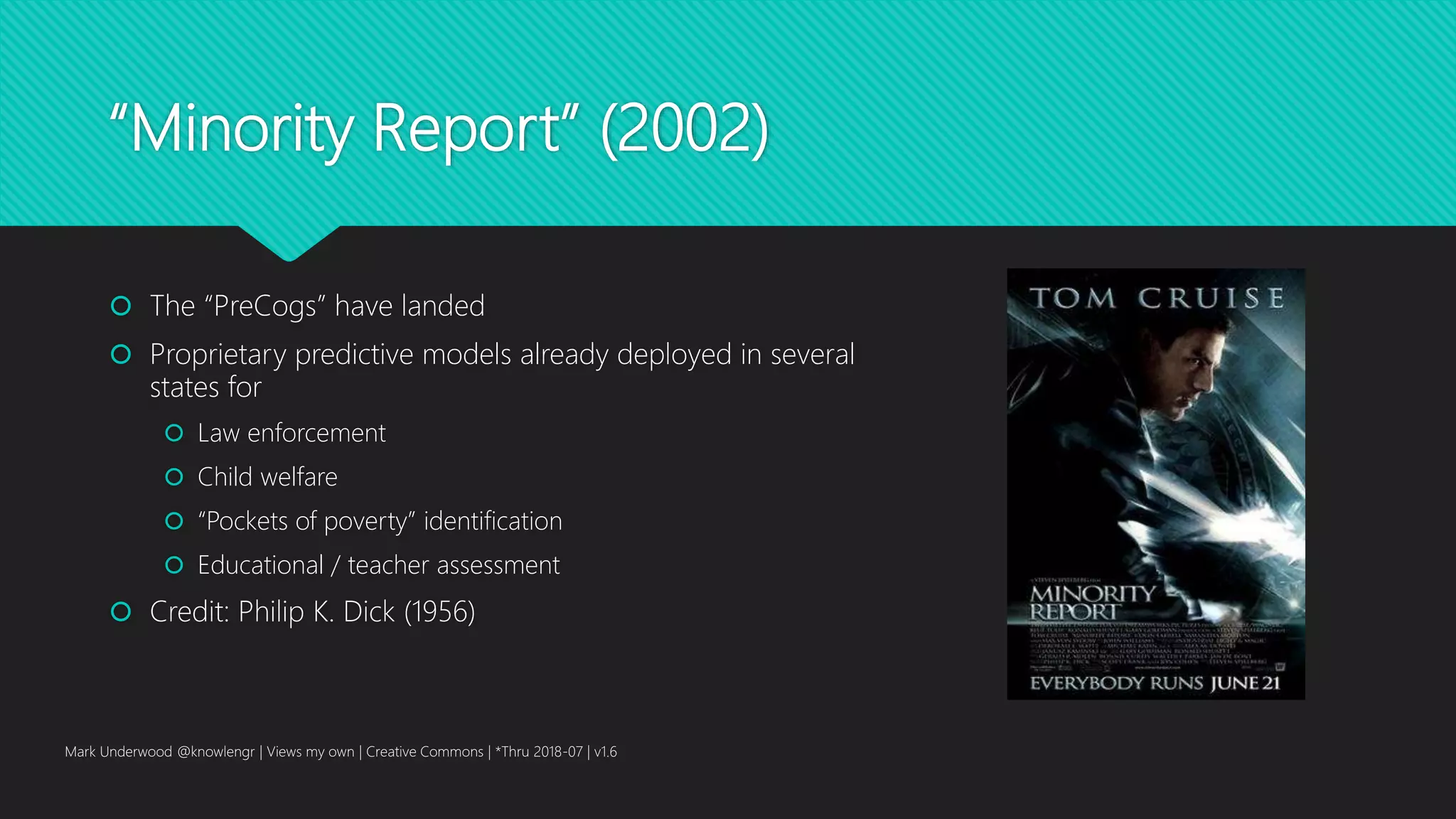
“Minority Report” (2002)
 The “PreCogs” have landed
 Proprietary predictive models already deployed in several
states for
 Law enforcement
 Child welfare
 “Pockets of poverty” identification
 Educational / teacher assessment
 Credit: Philip K. Dick (1956)
Mark Underwood @knowlengr | Views my own | Creative Commons | *Thru 2018-07 | v1.6
Storm Clouds
 Broader social trends impacting application contexts
 ML weak transparency
 Some analytics practitioners may have weak statistical background
 Algorithms may not have faced usability or reproducibility tests
 Computation on encrypted data is still primitive and/or slow
 Anonymization practices may not take big data variety into account
 Lightweight practitioner training
Mark Underwood @knowlengr | Views my own | Creative Commons | *Thru 2018-07 | v1.6
Where Data Science Does Matter
A smattering of impact areas
Mark Underwood @knowlengr | Views my own | Creative Commons | *Thru 2018-07 | v1.6
Use Case Clusters
 Credit worthiness (Offers for balance transfers not extended to minority groups)
 Sales & marketing analytics (Some profitable prospects will be ignored)
 Autonomous vehicles (Fatality, injury accidents)
 Drug trials (Some patients will be rejected, even if potentially life-saving)
 Recommendation engines (Users not given opportunity to fine-tune – You, Netflix)
 Maintenance forecasting (Forecasts may not include loss of life risks)
 Operations Management (Cause cost overrun while managing AWS cost / performance)
 Cybersecurity (False positives could suggest you are an insider threat)
Mark Underwood @knowlengr | Views my own | Creative Commons | *Thru 2018-07 | v1.6
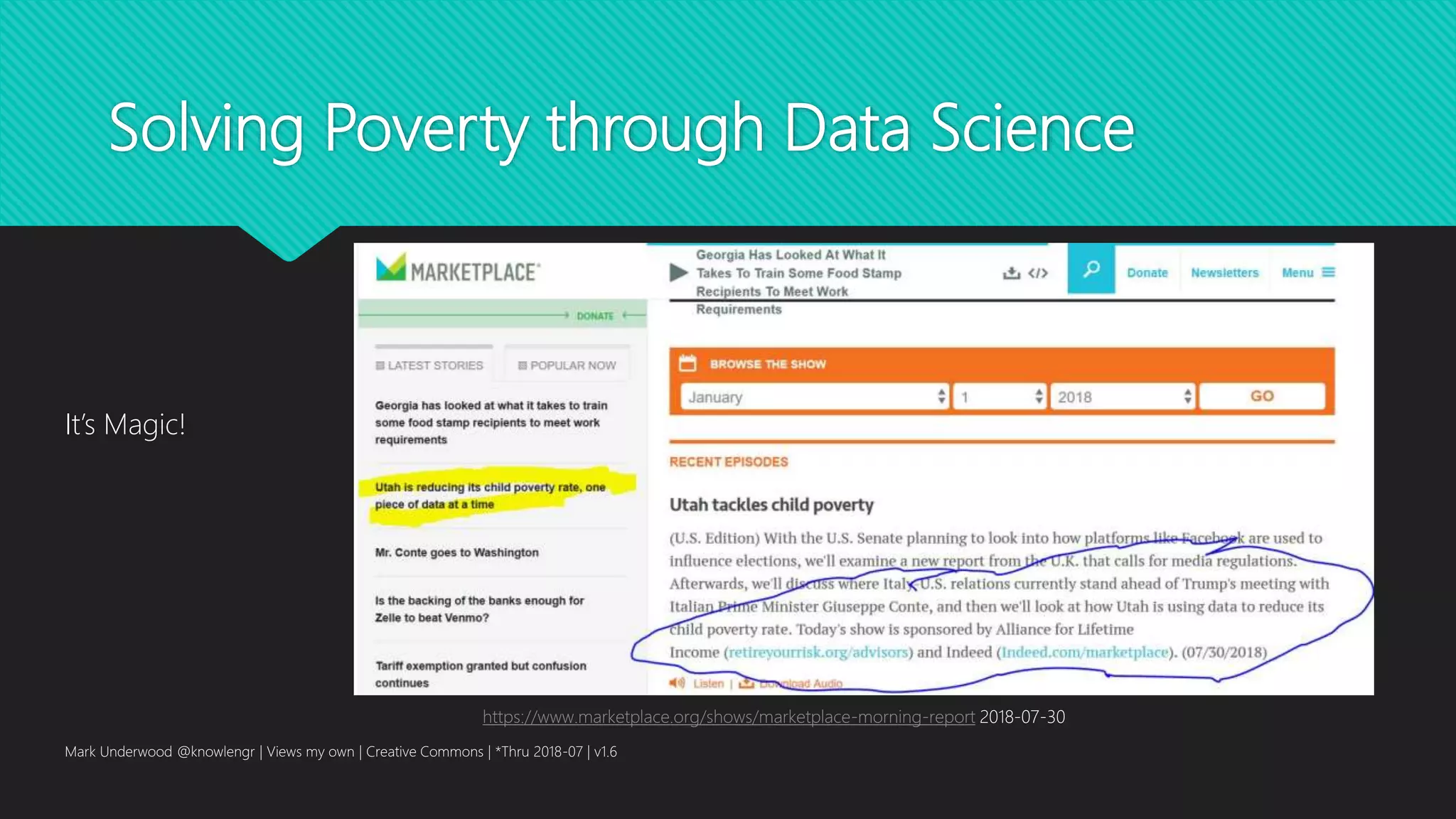
Solving Poverty through Data Science
It’s Magic!
Mark Underwood @knowlengr | Views my own | Creative Commons | *Thru 2018-07 | v1.6
https://www.marketplace.org/shows/marketplace-morning-report 2018-07-30
IEEE Initiative:
Value-Sensitive Design
“. . . to refine ethical system requirements in systems and software life cycles.”
Mark Underwood @knowlengr | Views my own | Creative Commons | *Thru 2018-07 | v1.6
IEEE P7000 WG: Marquis Group Charter
“Scope: The standard establishes a process model by which engineers and technologists can address
ethical consideration throughout the various stages of system initiation, analysis and design.
Expected process requirements include management and engineering view of new IT product
development, computer ethics and IT system design, value-sensitive design, and stakeholder
involvement in ethical IT system design. . .. The purpose of this standard is to enable the pragmatic
application of this type of Value-Based System Design methodology which demonstrates that
conceptual analysis of values and an extensive feasibility analysis can help to refine ethical system
requirements in systems and software life cycles.”
Mark Underwood @knowlengr | Views my own | Creative Commons | *Thru 2018-07 | v1.6
Related IEEE P70nn Groups
 IEEE P7000 Ethical Systems Design
 IEEE P7001 Transparency of Autonomous Systems
 IEEE P7002 Data Privacy Process
 IEEE P7003 Algorithmic Bias Considerations
 IEEE P7004 Standard for Child and Student Data Governance
 IEEE P7005 Standard for Transparent Employer Data Governance
 IEEE P7006 Standard for Personal AI Agent
 IEEE P7007 Ontological Standard for Ethically Driven Robotics and Automation Systems
 IEEE P7008 -Standard for Ethically Driven Nudging for Robotic, Intelligent and Autonomous Systems
 IEEE P7009 Standard for Fail-Safe Design of Autonomous and Semi-Autonomous Systems
 IEEE P7010 Wellbeing Metrics Standard for Ethical Artificial Intelligence and Autonomous Systems
 IEEE P7011 SSIE Standard for Trustworthiness of News Media
 IEEE P7012 SSIE Machine Readable Personal Privacy Terms
 IEEE P7013 Facial Analysis
Mark Underwood @knowlengr | Views my own | Creative Commons | *Thru 2018-07 | v1.6
IEEE P7003 Algorithmic Bias Considerations
“This standard is designed to provide individuals or organizations creating algorithms, largely in
regards to autonomous or intelligent systems, certification oriented methodologies to provide
clearly articulated accountability and clarity around how algorithms are targeting, assessing and
influencing the users and stakeholders of said algorithm. Certification under this standard will
allow algorithm creators to communicate to users, and regulatory authorities, that up-to-date
best practices were used in the design, testing and evaluation of the algorithm to avoid
unjustified differential impact on users.”
IEEE PAR https://standards.ieee.org/develop/project/7003.html
Mark Underwood @knowlengr | Views my own | Creative Commons | *Thru 2018-07 | v1.6
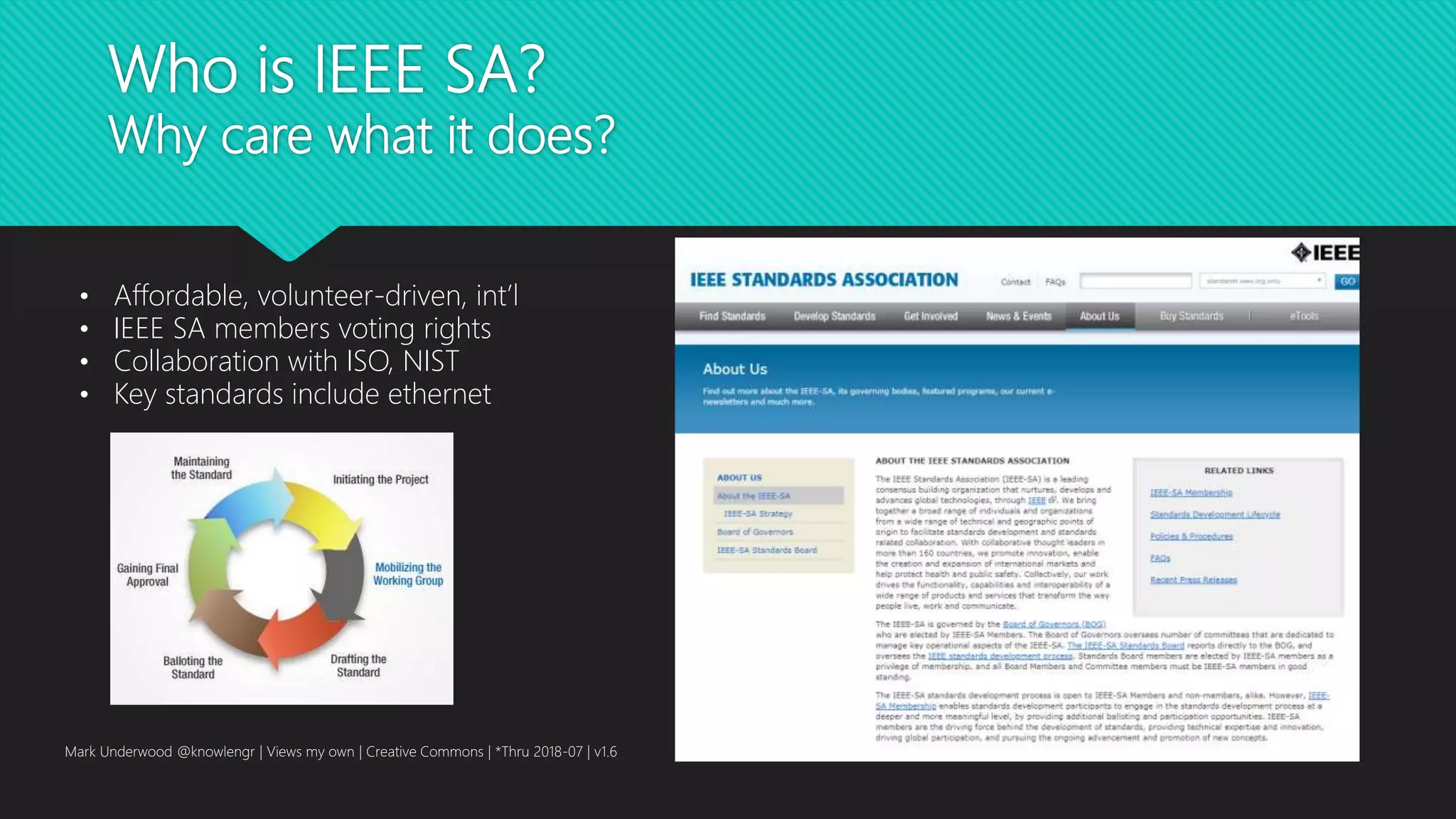
Who is IEEE SA?
Why care what it does?
• Affordable, volunteer-driven, int’l
• IEEE SA members voting rights
• Collaboration with ISO, NIST
• Key standards include ethernet
Mark Underwood @knowlengr | Views my own | Creative Commons | *Thru 2018-07 | v1.6
Broad Social Issues
Cross-cutting Concerns for all Technologists
Mark Underwood @knowlengr | Views my own | Creative Commons | *Thru 2018-07 | v1.6
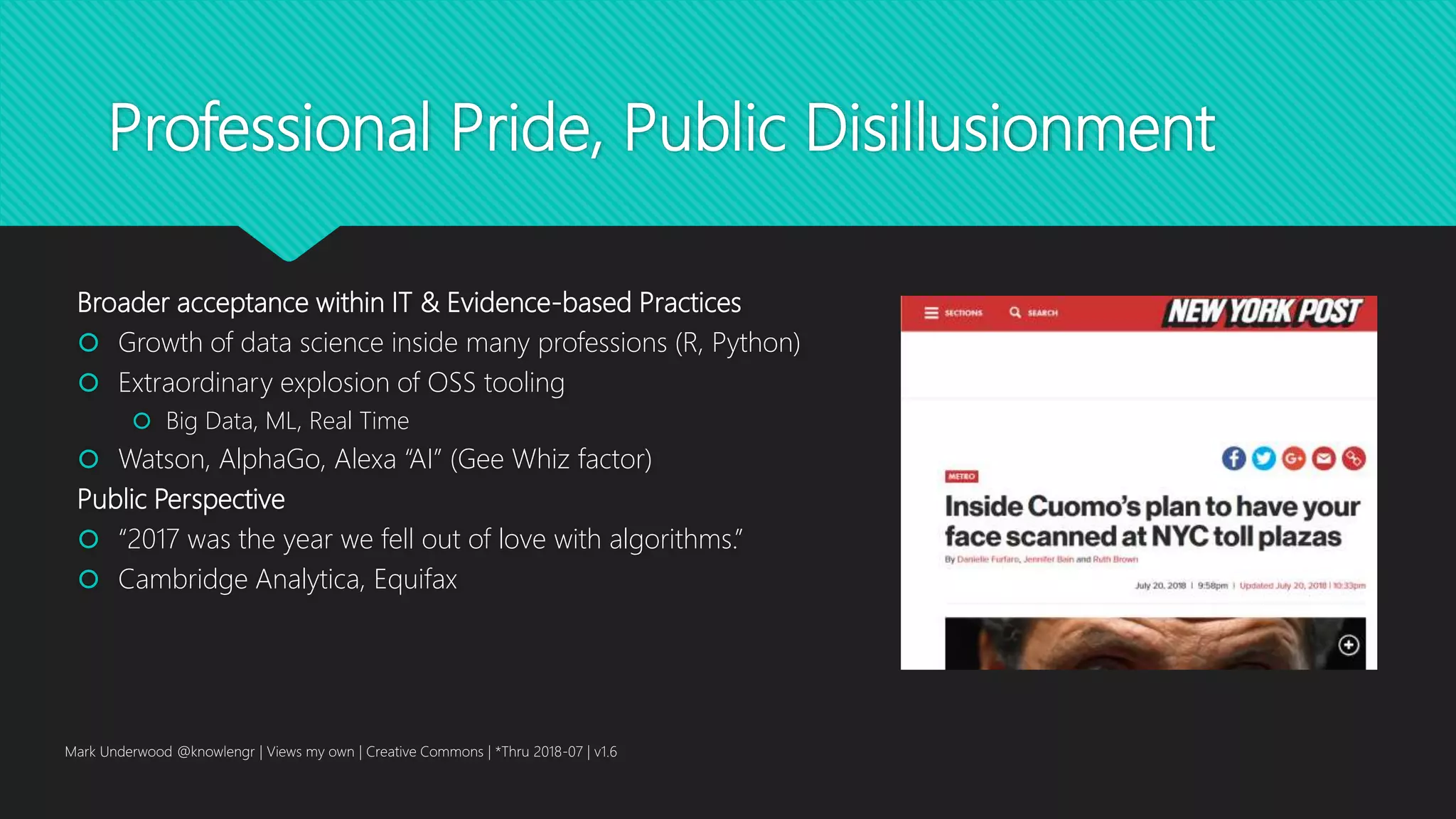
Professional Pride, Public Disillusionment
Broader acceptance within IT & Evidence-based Practices
 Growth of data science inside many professions (R, Python)
 Extraordinary explosion of OSS tooling
 Big Data, ML, Real Time
 Watson, AlphaGo, Alexa “AI” (Gee Whiz factor)
Public Perspective
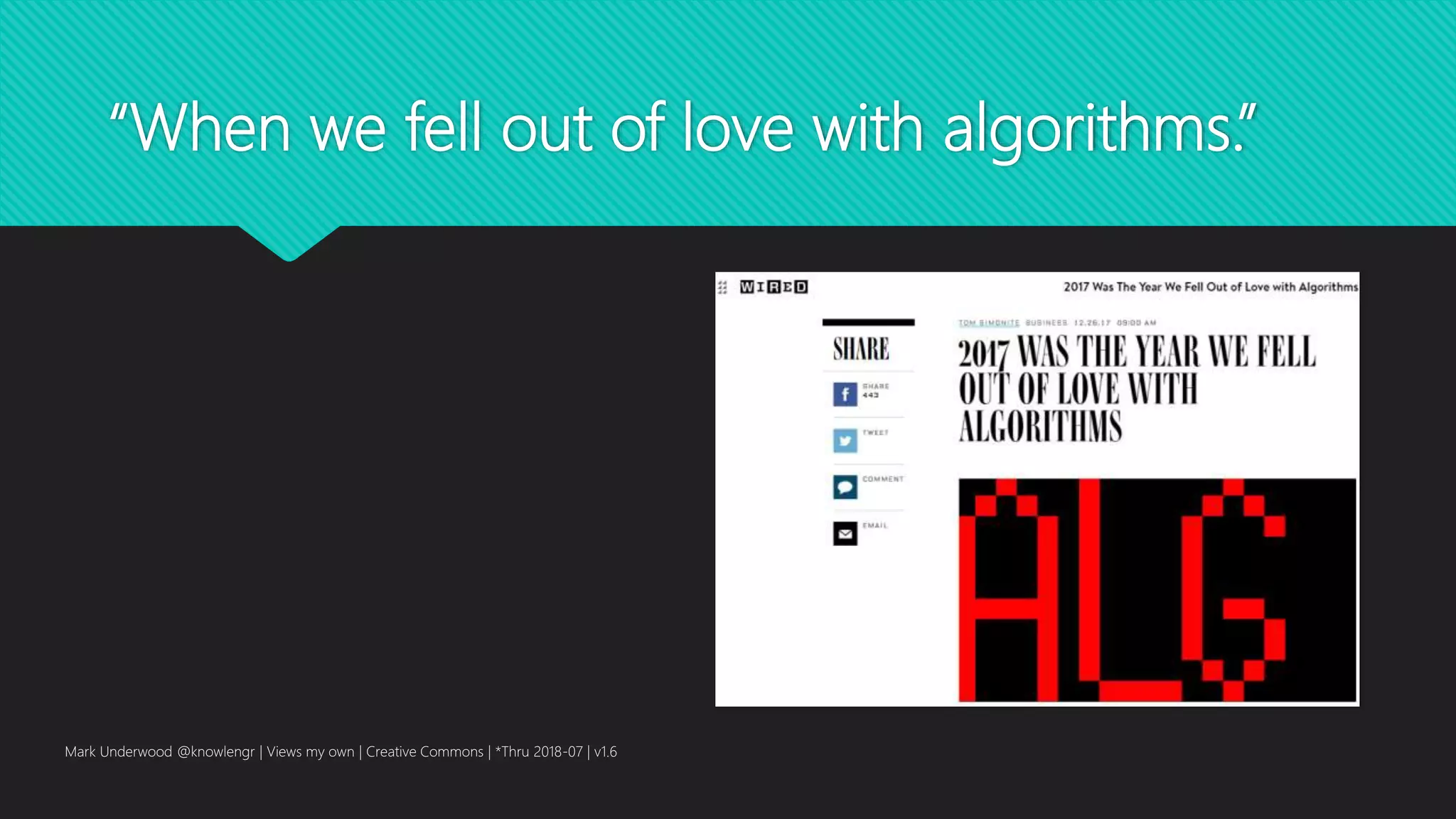
 “2017 was the year we fell out of love with algorithms.”
 Cambridge Analytica, Equifax
Mark Underwood @knowlengr | Views my own | Creative Commons | *Thru 2018-07 | v1.6
“When we fell out of love with algorithms.”
Mark Underwood @knowlengr | Views my own | Creative Commons | *Thru 2018-07 | v1.6
Ethical issues Already in Play
 Sustainability
 Environment
 Climate Change (*data center power consumption)
 Bias concerns in gender, race, free speech
 Social media technology responsibility
 As propaganda platforms
 Excessive use of cell phones by children: ADHD?
 Weakened critical thinking, F2F social skills (Sherry Turkle Reclaiming Conversation 2015)
Mark Underwood @knowlengr | Views my own | Creative Commons | *Thru 2018-07 | v1.6
Some Related ISO Standards
 ISO 26000 “ISO 26000 provides guidance on how businesses and organizations can operate in a socially responsible
way. This means acting in an ethical and transparent way that contributes to the health and welfare of society”
 ISO 27500:2016 is intended for executive board members and policy makers of all types of organizations (whether
large or small) in the private, public and non-profit sectors. It describes the values and beliefs that make an
organization human-centred, the significant business benefits that can be achieved, and explains the risks for the
organization of not being human-centered
 ISO 37101:2016 establishes requirements for a management system for sustainable development in communities,
including cities, using a holistic approach, with a view to ensuring consistency with the sustainable development
policy of communities.
 ISO/IEC JTC 1/SC 39 Standardization related to the intersection of resource efficiency and IT which supports
environmentally and economically viable development, application, operation and management aspects.
 ISO/IEC 31010:2009 – Risk Management – Risk Assessment Techniques
Mark Underwood @knowlengr | Views my own | Creative Commons | *Thru 2018-07 | v1.6
What do you know about these
standards?
To date, a bit hidden among the blockchain and TensorFlow conversations.
Mark Underwood @knowlengr | Views my own | Creative Commons | *Thru 2018-07 | v1.6
Algorithmic Bias in Data Science
*Including finance
Mark Underwood @knowlengr | Views my own | Creative Commons | *Thru 2018-07 | v1.6
Linkage to Privacy, Surveillance, Distrust
Algorithms are bad because they:
 Use data without our knowledge
 Are based on incorrect or misleading knowledge about us
 Are not accountable to individual citizens
 Are used by governments to spy on citizens
 Support drone warfare
 Are built by specialists who do what they are told without asking questions
 Represent a trend to automate jobs out of existence
 Are built by big companies with no public accountability
Mark Underwood @knowlengr | Views my own | Creative Commons | *Thru 2018-07 | v1.6
“Bias is the New Breach”
Mark Underwood @knowlengr | Views my own | Creative Commons | *Thru 2018-07 | v1.6
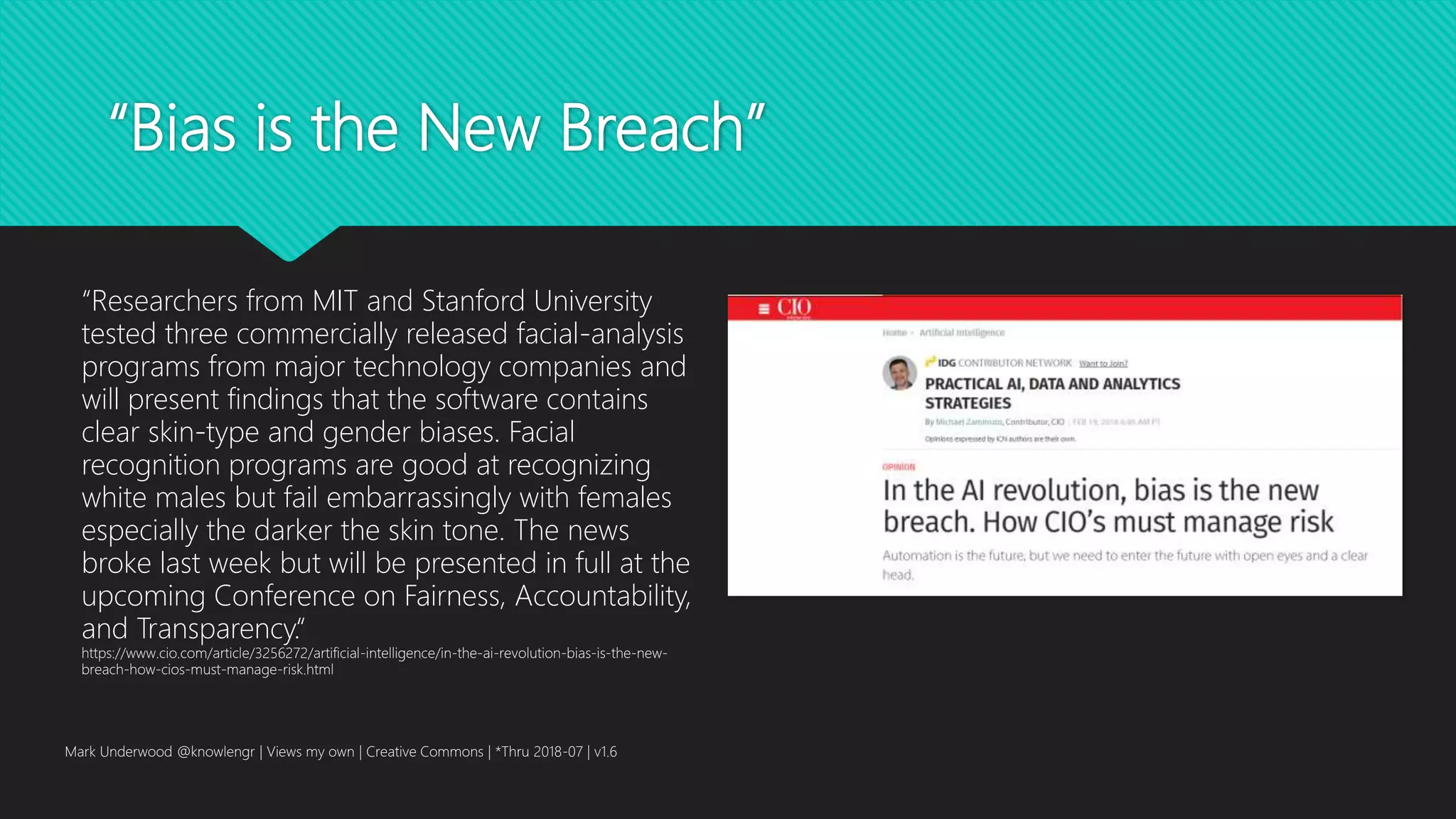
“Researchers from MIT and Stanford University
tested three commercially released facial-analysis
programs from major technology companies and
will present findings that the software contains
clear skin-type and gender biases. Facial
recognition programs are good at recognizing
white males but fail embarrassingly with females
especially the darker the skin tone. The news
broke last week but will be presented in full at the
upcoming Conference on Fairness, Accountability,
and Transparency.“
https://www.cio.com/article/3256272/artificial-intelligence/in-the-ai-revolution-bias-is-the-new-
breach-how-cios-must-manage-risk.html
Decisions vs. Decision Support:
Application Areas
Human-Computer Interactions in Decision-making
Mark Underwood @knowlengr | Views my own | Creative Commons | *Thru 2018-07 | v1.6
Undermining Specialists*
Mark Underwood @knowlengr | Views my own | Creative Commons | *Thru 2018-07 | v1.6
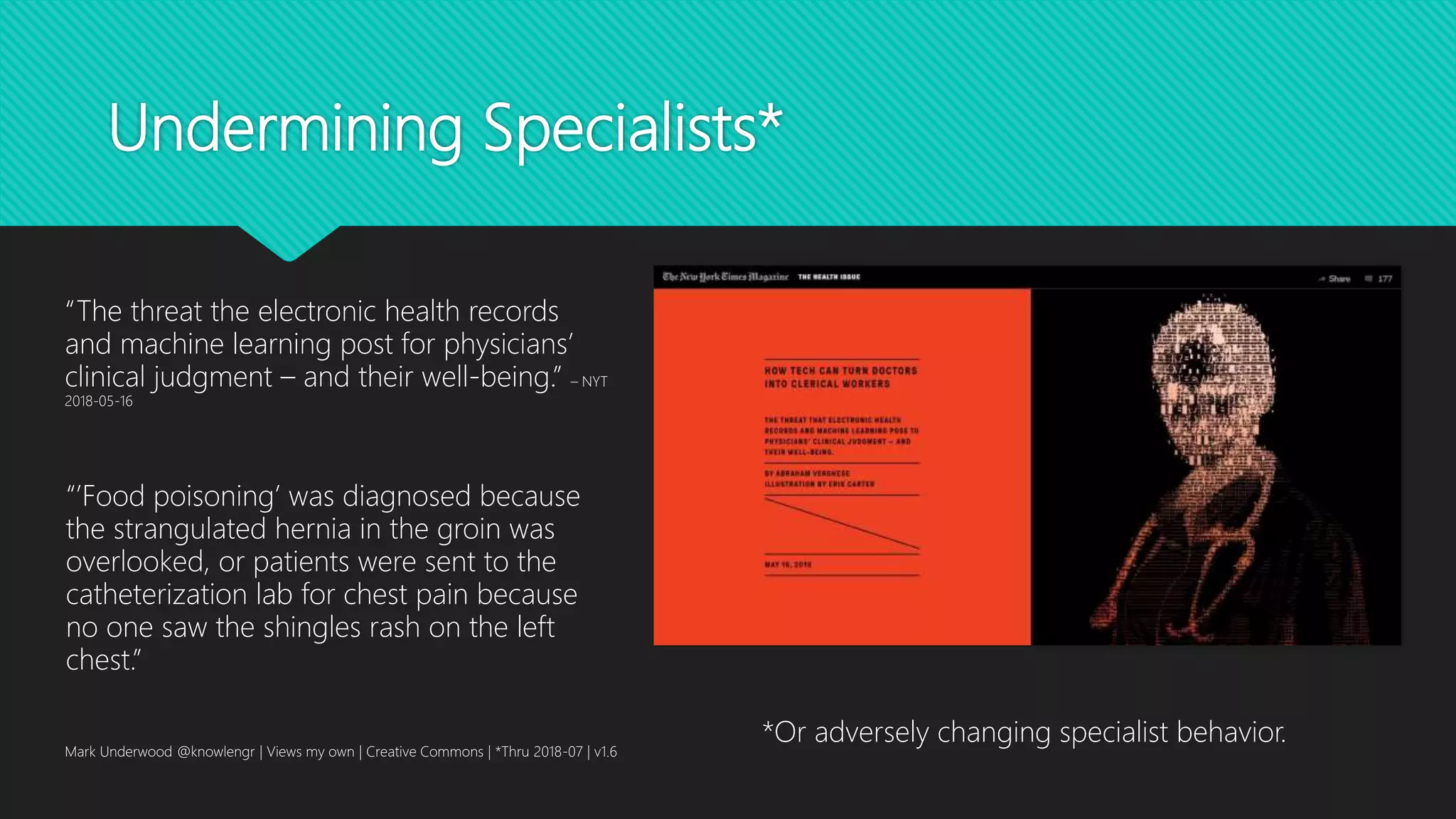
“The threat the electronic health records
and machine learning post for physicians’
clinical judgment – and their well-being.” – NYT
2018-05-16
“’Food poisoning’ was diagnosed because
the strangulated hernia in the groin was
overlooked, or patients were sent to the
catheterization lab for chest pain because
no one saw the shingles rash on the left
chest.”
*Or adversely changing specialist behavior.
“Rote Decision-Making”
Mark Underwood @knowlengr | Views my own | Creative Commons | *Thru 2018-07 | v1.6
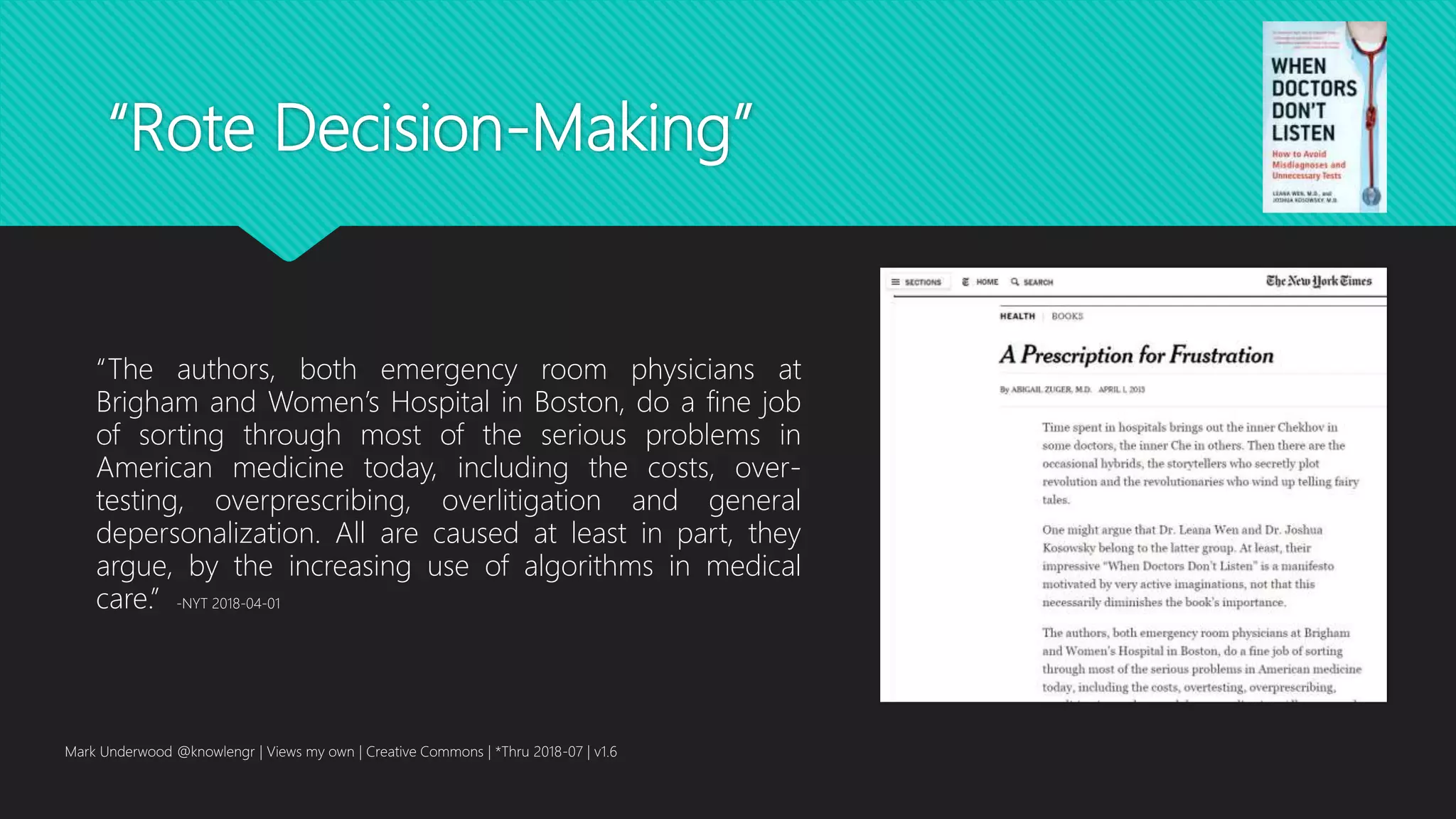
“The authors, both emergency room physicians at
Brigham and Women’s Hospital in Boston, do a fine job
of sorting through most of the serious problems in
American medicine today, including the costs, over-
testing, overprescribing, overlitigation and general
depersonalization. All are caused at least in part, they
argue, by the increasing use of algorithms in medical
care.” -NYT 2018-04-01
Facial Recognition for Law Enforcement
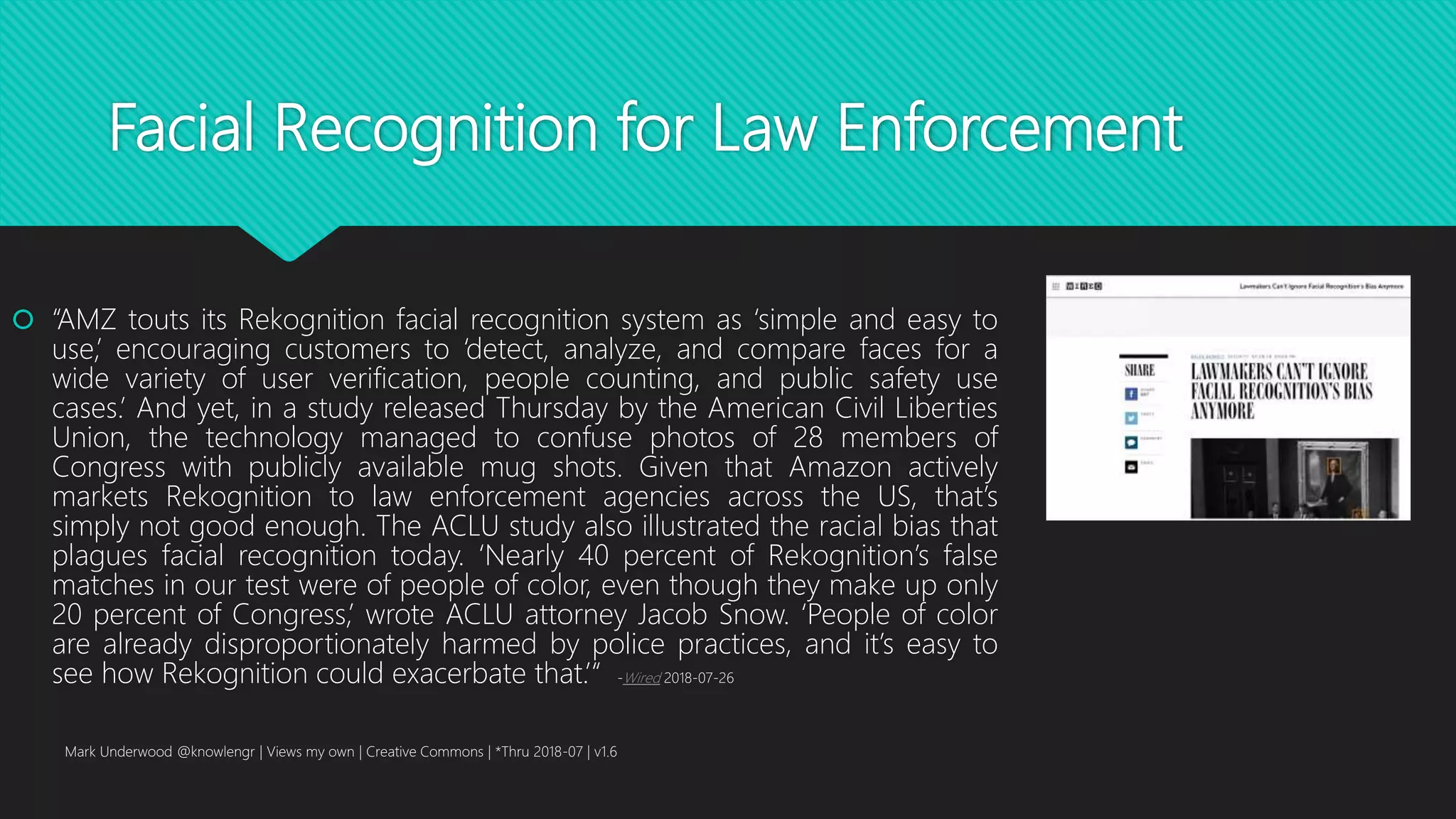
 “AMZ touts its Rekognition facial recognition system as ‘simple and easy to
use,’ encouraging customers to ‘detect, analyze, and compare faces for a
wide variety of user verification, people counting, and public safety use
cases.’ And yet, in a study released Thursday by the American Civil Liberties
Union, the technology managed to confuse photos of 28 members of
Congress with publicly available mug shots. Given that Amazon actively
markets Rekognition to law enforcement agencies across the US, that’s
simply not good enough. The ACLU study also illustrated the racial bias that
plagues facial recognition today. ‘Nearly 40 percent of Rekognition’s false
matches in our test were of people of color, even though they make up only
20 percent of Congress,’ wrote ACLU attorney Jacob Snow. ‘People of color
are already disproportionately harmed by police practices, and it’s easy to
see how Rekognition could exacerbate that.’“ -Wired 2018-07-26
Mark Underwood @knowlengr | Views my own | Creative Commons | *Thru 2018-07 | v1.6
“Family” Impacts
Mark Underwood @knowlengr | Views my own | Creative Commons | *Thru 2018-07 | v1.6
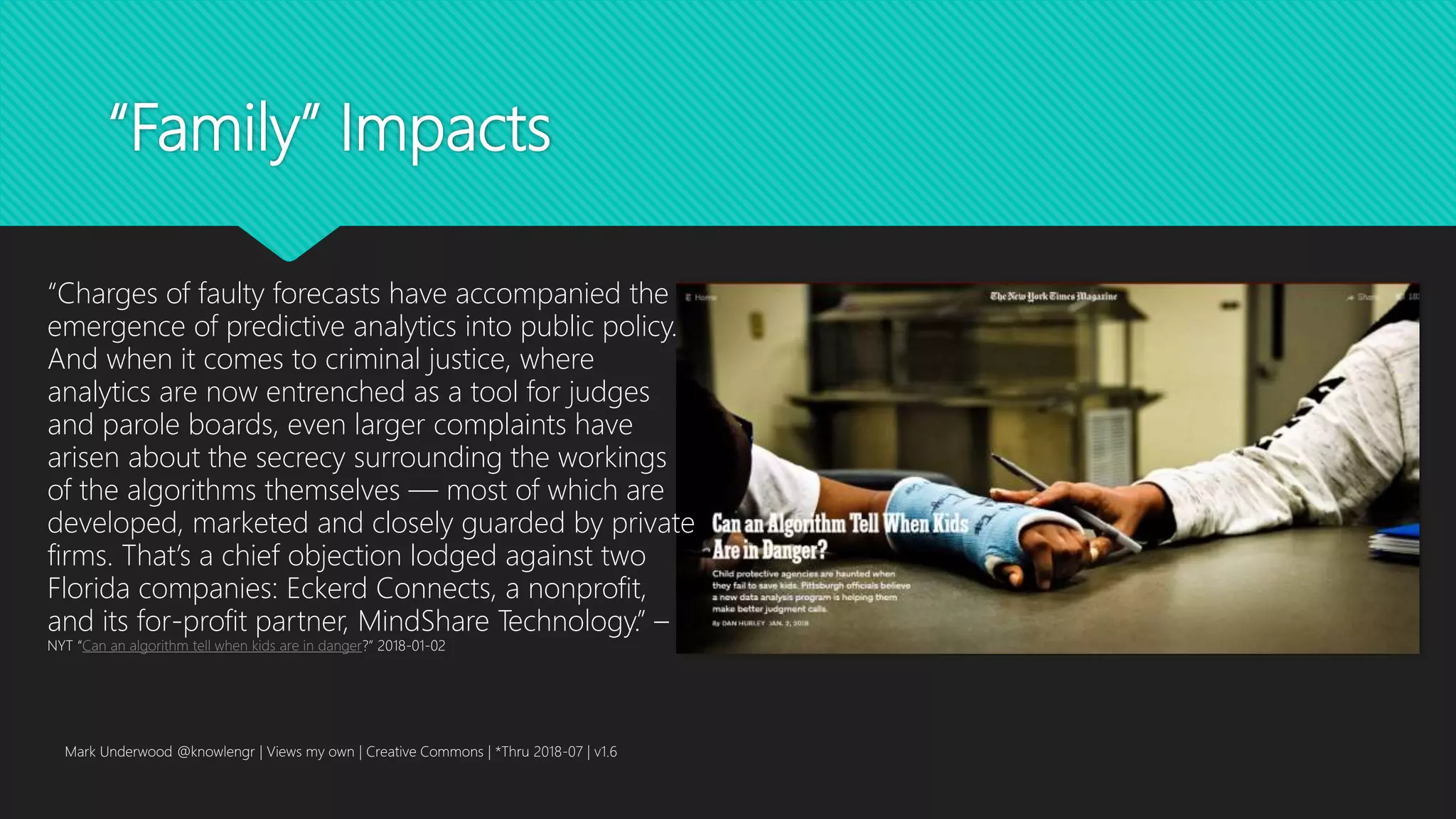
“Charges of faulty forecasts have accompanied the
emergence of predictive analytics into public policy.
And when it comes to criminal justice, where
analytics are now entrenched as a tool for judges
and parole boards, even larger complaints have
arisen about the secrecy surrounding the workings
of the algorithms themselves — most of which are
developed, marketed and closely guarded by private
firms. That’s a chief objection lodged against two
Florida companies: Eckerd Connects, a nonprofit,
and its for-profit partner, MindShare Technology.” –
NYT “Can an algorithm tell when kids are in danger?” 2018-01-02
Lawsuit over Teacher Evaluation Algorithm
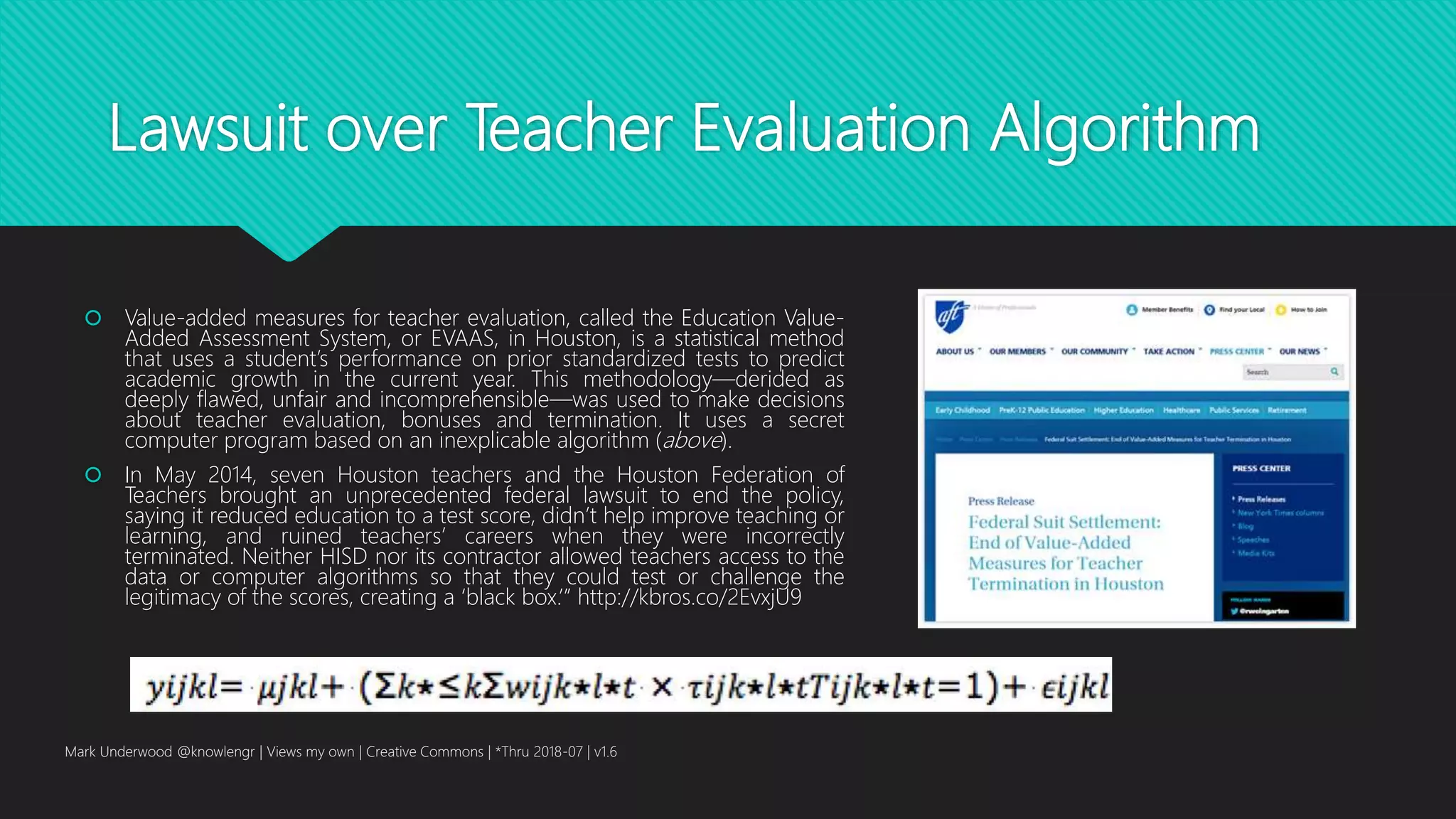
 Value-added measures for teacher evaluation, called the Education Value-
Added Assessment System, or EVAAS, in Houston, is a statistical method
that uses a student’s performance on prior standardized tests to predict
academic growth in the current year. This methodology—derided as
deeply flawed, unfair and incomprehensible—was used to make decisions
about teacher evaluation, bonuses and termination. It uses a secret
computer program based on an inexplicable algorithm (above).
 In May 2014, seven Houston teachers and the Houston Federation of
Teachers brought an unprecedented federal lawsuit to end the policy,
saying it reduced education to a test score, didn’t help improve teaching or
learning, and ruined teachers’ careers when they were incorrectly
terminated. Neither HISD nor its contractor allowed teachers access to the
data or computer algorithms so that they could test or challenge the
legitimacy of the scores, creating a ‘black box.’” http://kbros.co/2EvxjU9
Mark Underwood @knowlengr | Views my own | Creative Commons | *Thru 2018-07 | v1.6
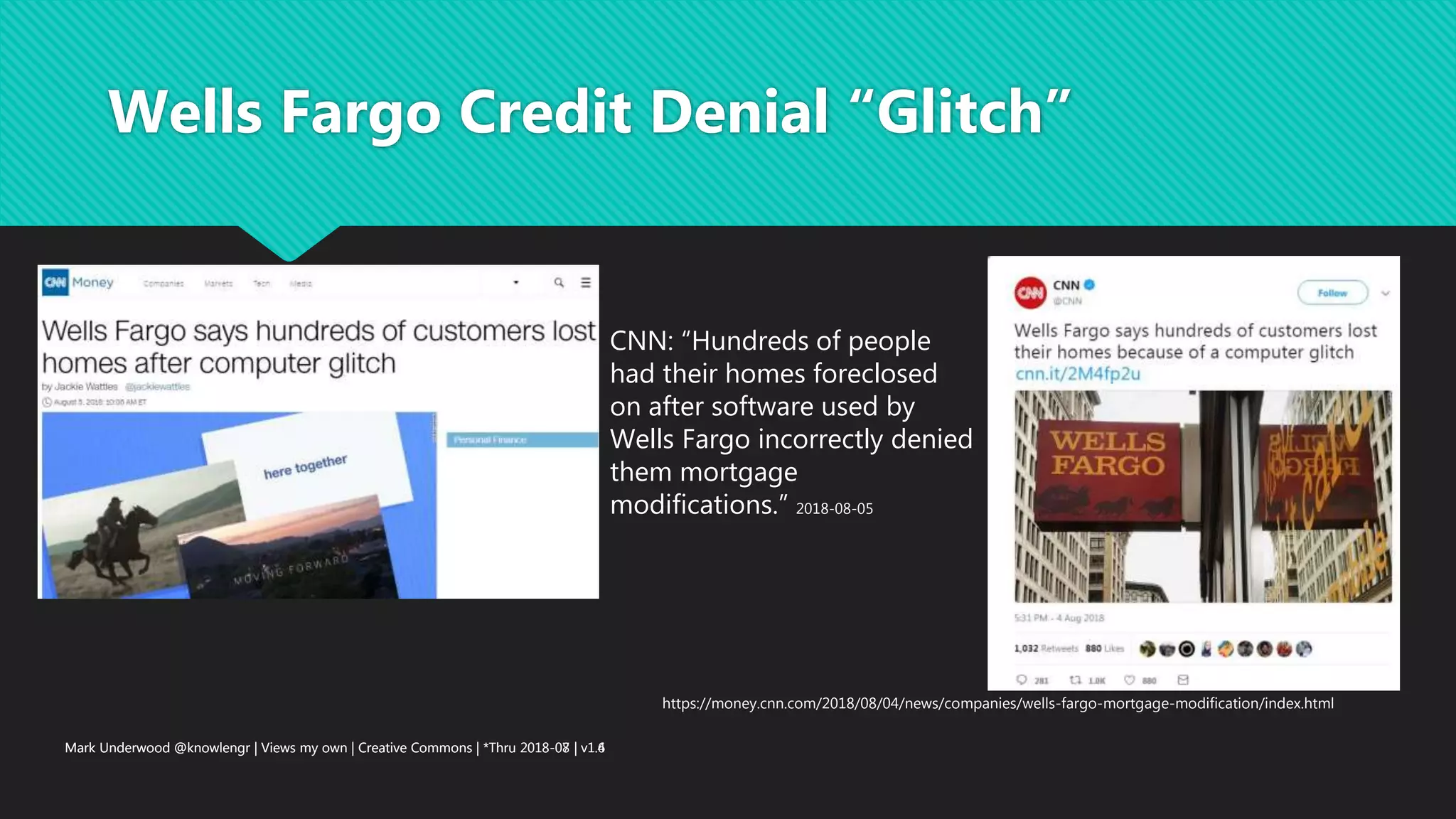
Wells Fargo Credit Denial “Glitch”
Mark Underwood @knowlengr | Views my own | Creative Commons | *Thru 2018-08 | v1.4
CNN: “Hundreds of people
had their homes foreclosed
on after software used by
Wells Fargo incorrectly denied
them mortgage
modifications.” 2018-08-05
https://money.cnn.com/2018/08/04/news/companies/wells-fargo-mortgage-modification/index.html
. . . And not easy to “fix”
Risk mitigation for data science implementations is relatively immature.
Mark Underwood @knowlengr | Views my own | Creative Commons | *Thru 2018-07 | v1.6
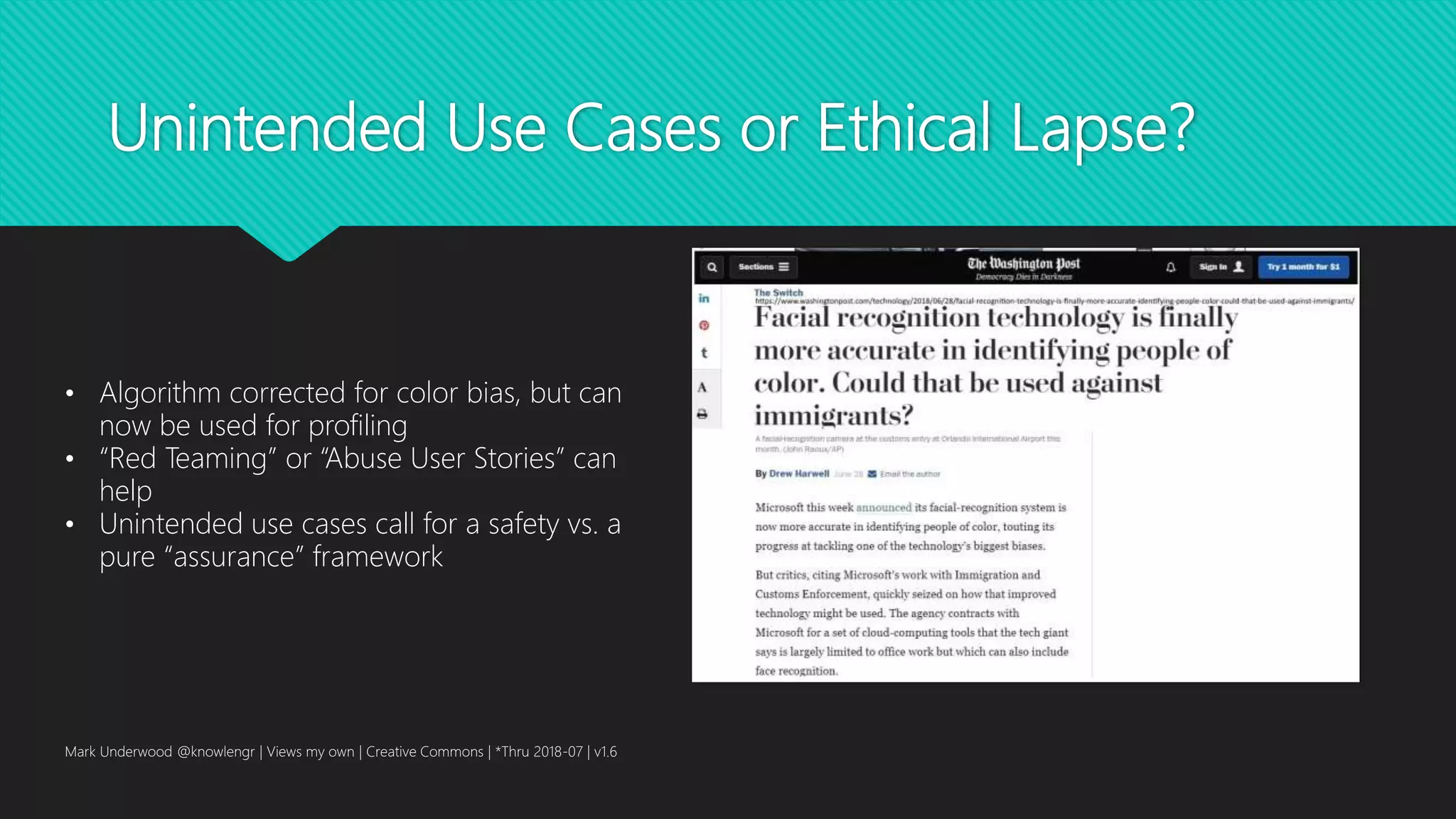
Unintended Use Cases or Ethical Lapse?
Mark Underwood @knowlengr | Views my own | Creative Commons | *Thru 2018-07 | v1.6
• Algorithm corrected for color bias, but can
now be used for profiling
• “Red Teaming” or “Abuse User Stories” can
help
• Unintended use cases call for a safety vs. a
pure “assurance” framework
“Lite” AI Security/Reliability Frameworks
Mark Underwood @knowlengr | Views my own | Creative Commons | *Thru 2018-07 | v1.6
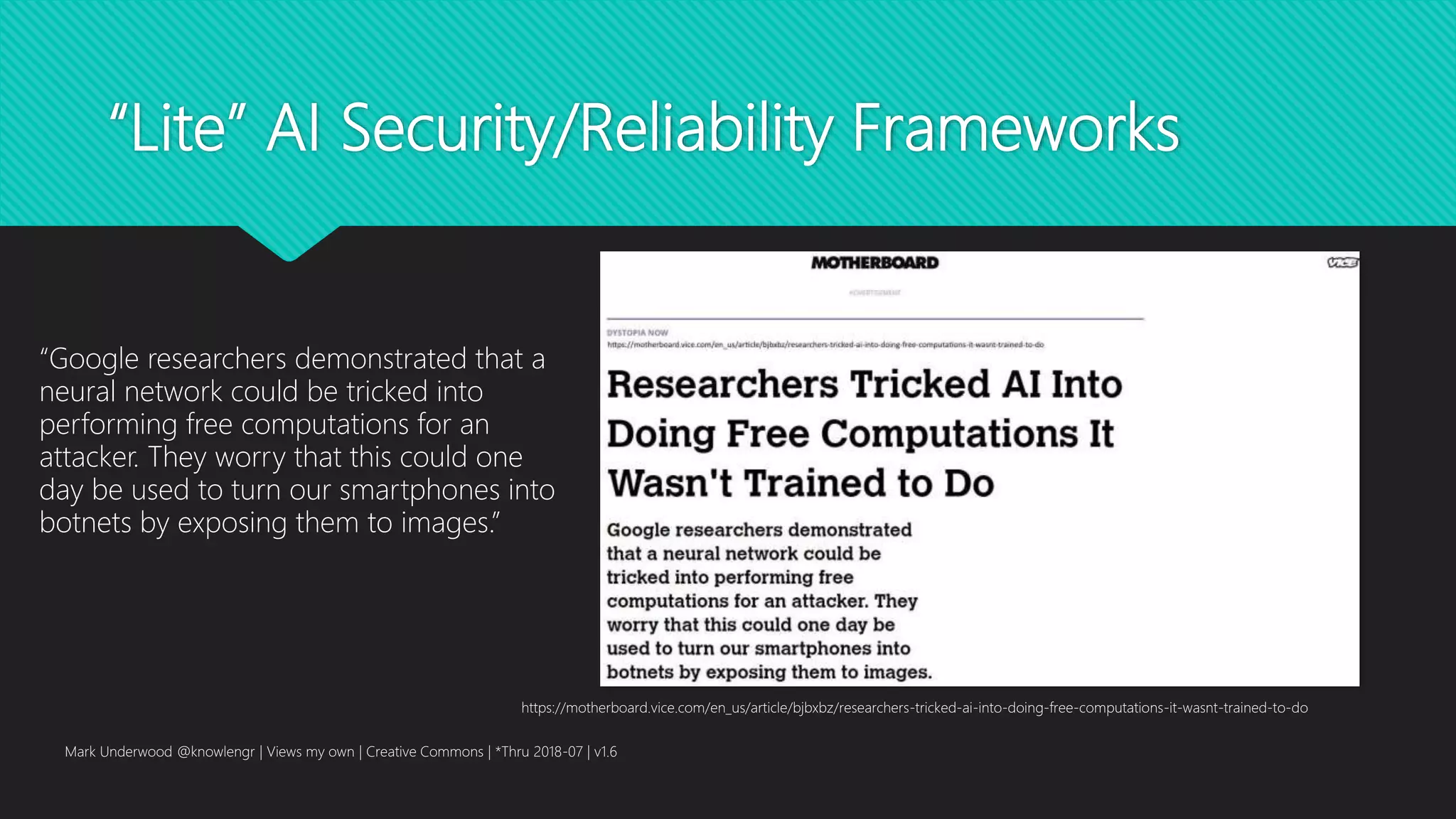
https://motherboard.vice.com/en_us/article/bjbxbz/researchers-tricked-ai-into-doing-free-computations-it-wasnt-trained-to-do
“Google researchers demonstrated that a
neural network could be tricked into
performing free computations for an
attacker. They worry that this could one
day be used to turn our smartphones into
botnets by exposing them to images.”
Machine Learning:
Expanding Impact
Impact across all industries may be difficult to assess.
Mark Underwood @knowlengr | Views my own | Creative Commons | *Thru 2018-07 | v1.6
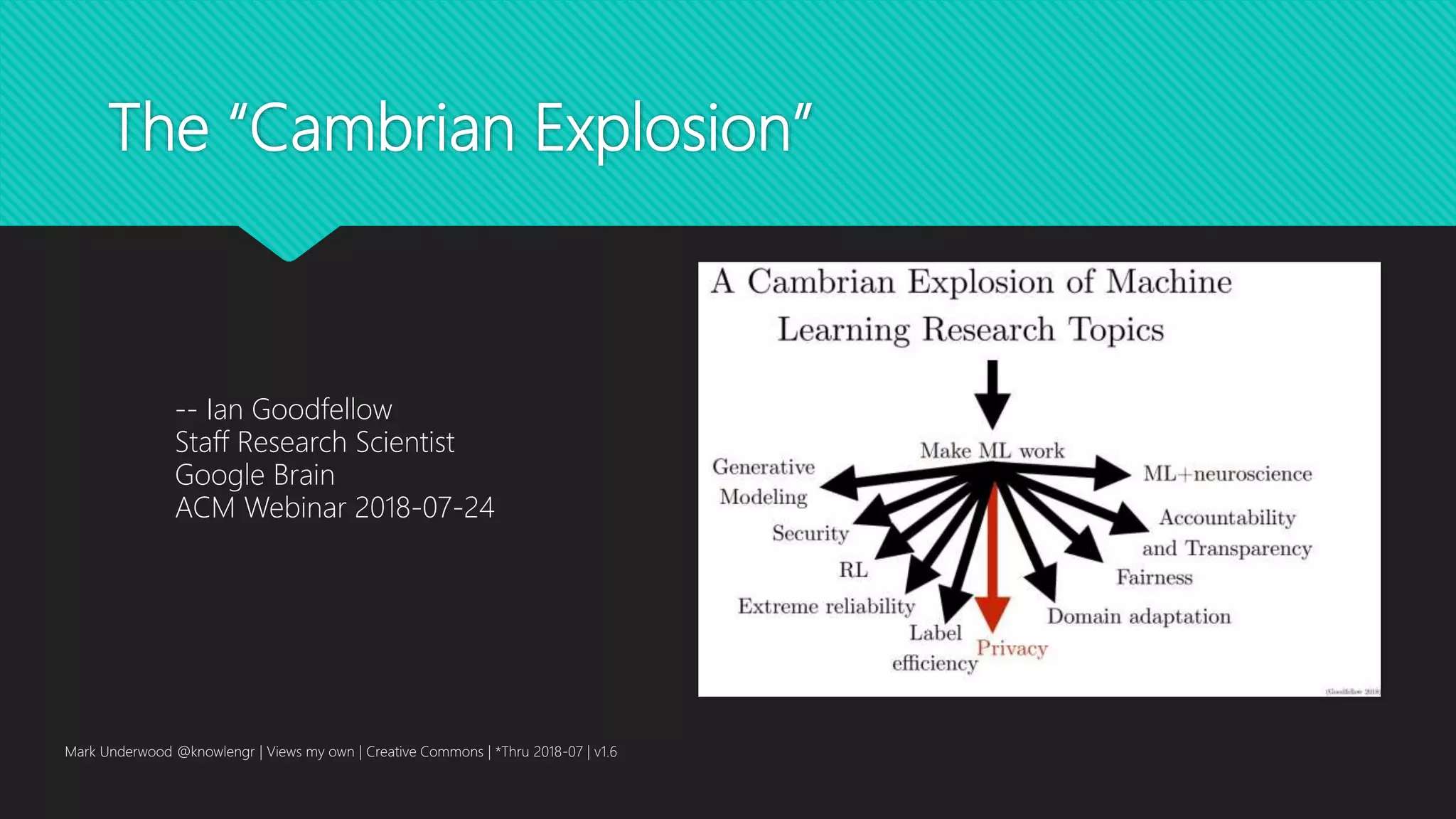
The “Cambrian Explosion”
Mark Underwood @knowlengr | Views my own | Creative Commons | *Thru 2018-07 | v1.6
-- Ian Goodfellow
Staff Research Scientist
Google Brain
ACM Webinar 2018-07-24
Transparency & Interpretability
As Seen by Ian Goodfellow
Findings from adversarial machine learning
Mark Underwood @knowlengr | Views my own | Creative Commons | *Thru 2018-07 | v1.6
Why Ethical Issues Become Secondary
Mark Underwood @knowlengr | Views my own | Creative Commons | *Thru 2018-07 | v1.6
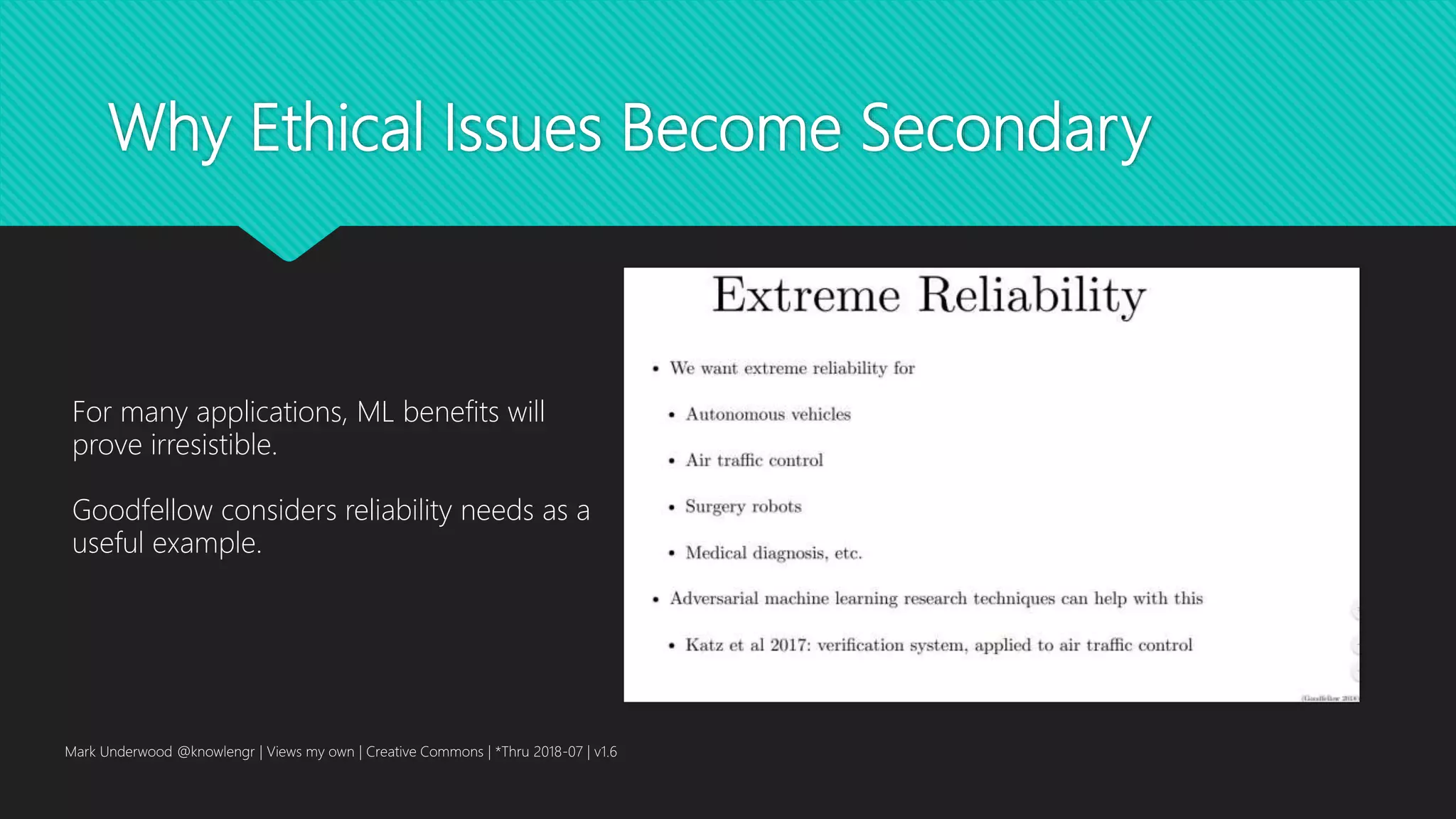
For many applications, ML benefits will
prove irresistible.
Goodfellow considers reliability needs as a
useful example.
Challenges of Interpretability
Mark Underwood @knowlengr | Views my own | Creative Commons | *Thru 2018-07 | v1.6
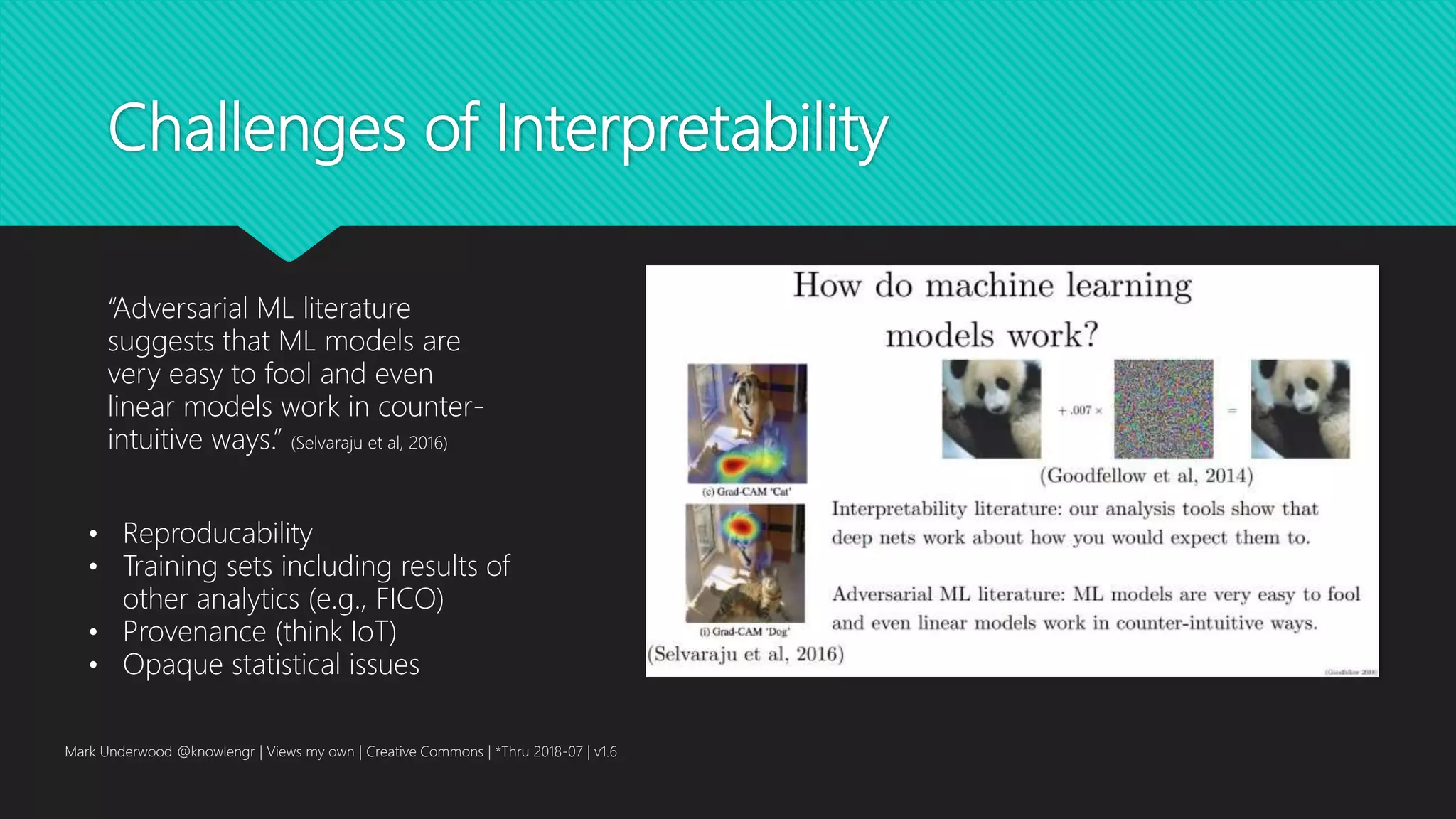
“Adversarial ML literature
suggests that ML models are
very easy to fool and even
linear models work in counter-
intuitive ways.” (Selvaraju et al, 2016)
• Reproducability
• Training sets including results of
other analytics (e.g., FICO)
• Provenance (think IoT)
• Opaque statistical issues
Transparency General Challenges
 Some data, algorithms are intellectual property
 Some training data includes PII
 Predictive analytical models are often “point in time”
 “Transparent” according to whose definition?
 Should algorithms have “opt-in?” Can they?
 Training set big data variety reidentification risks
Mark Underwood @knowlengr | Views my own | Creative Commons | *Thru 2018-07 | v1.6
Explainability / Interpretability
Mark Underwood @knowlengr | Views my own | Creative Commons | *Thru 2018-07 | v1.6
“[We need to] find ways of making techniques like
deep learning more understandable to their creators
and accountable to their users. Otherwise it will be
hard to predict when failures might occur—and it’s
inevitable they will. That’s one reason Nvidia’s car is
still experimental.”
Enterprise Level Risk
 Impact on reputation
 Litigation
 Unintentionally reveal sources, methods, data / interrupted data streams (e.g, web)
 Loss of consumer confidence, impact on public safety
 Misapplication of internally developed models
 Financial losses from data science #fail
 “. . . as long as our training is in the form of someone lecturing about the basics of gender or
racial bias in society, that training is not likely to be effective”.
Dr. Hanie Sedghi, Research Scientist, Google Brain
Mark Underwood @knowlengr | Views my own | Creative Commons | *Thru 2018-07 | v1.6
Risk Management
and Lessons from Others
Aligning with enterprise risk appetite, resilience
Mark Underwood @knowlengr | Views my own | Creative Commons | *Thru 2018-07 | v1.6
Insights from More Mature Settings
 AI Analytics for distributed military coalitions
 “. . . Research has recently started to address such concerns and
prominent directions include explainable AI [4], quantification of
input influence in machine learning algorithms [5], ethics
embedding in decision support systems [6], “interruptability” for
machine learning systems [7], and data transparency [8]. “
 “. . . devices that manage themselves and generate their own
management policies, discussing the similarities between such
systems and Skynet.”
Mark Underwood @knowlengr | Views my own | Creative Commons | *Thru 2018-07 | v1.6
S. Calo, D. Verma, E. Bertino, J. Ingham, and G. Cirincione, "How to prevent skynet
from forming (a perspective from Policy-Based autonomic device management),"
in 2018 IEEE 38th International Conference on Distributed Computing Systems
(ICDCS), Jul. 2018, pp. 1369-1376. [Online]. Available:
http://dx.doi.org/10.1109/ICDCS.2018.00137
Some Fairness Approaches (Sedghi, 2018)
 1) Post processing in terms of calibration of our model. What this means is that, we calibrate
classifiers parameters such that it has the same acceptance ratio for all subgroups of sensitive
features, e.g. race, sex, etc.
 2) Data resampling to remove skewed sample. But, for many reasons, collecting more data is not
very easy and sometimes causes problems for individuals.
 3) Causal reasoning: We capture different paths in a causal graph that can lead to the same
observational data. This basically means to model possible factors such that sex, race and other
sensitive features to make sure their impact is captured and does not directly affect the result
variable.
Mark Underwood @knowlengr | Views my own | Creative Commons | *Thru 2018-07 | v1.6
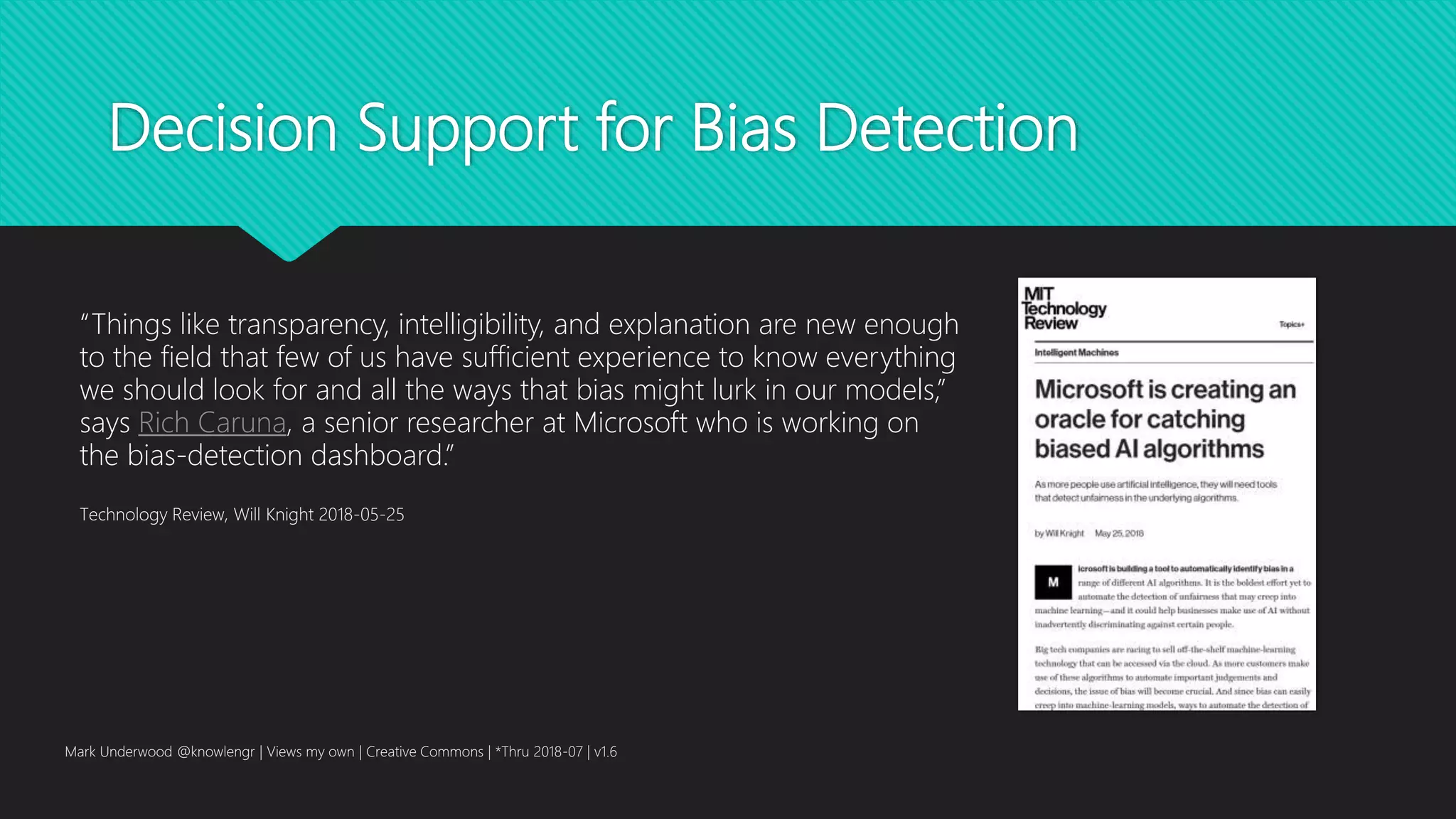
Decision Support for Bias Detection
Mark Underwood @knowlengr | Views my own | Creative Commons | *Thru 2018-07 | v1.6
“Things like transparency, intelligibility, and explanation are new enough
to the field that few of us have sufficient experience to know everything
we should look for and all the ways that bias might lurk in our models,”
says Rich Caruna, a senior researcher at Microsoft who is working on
the bias-detection dashboard.”
Technology Review, Will Knight 2018-05-25
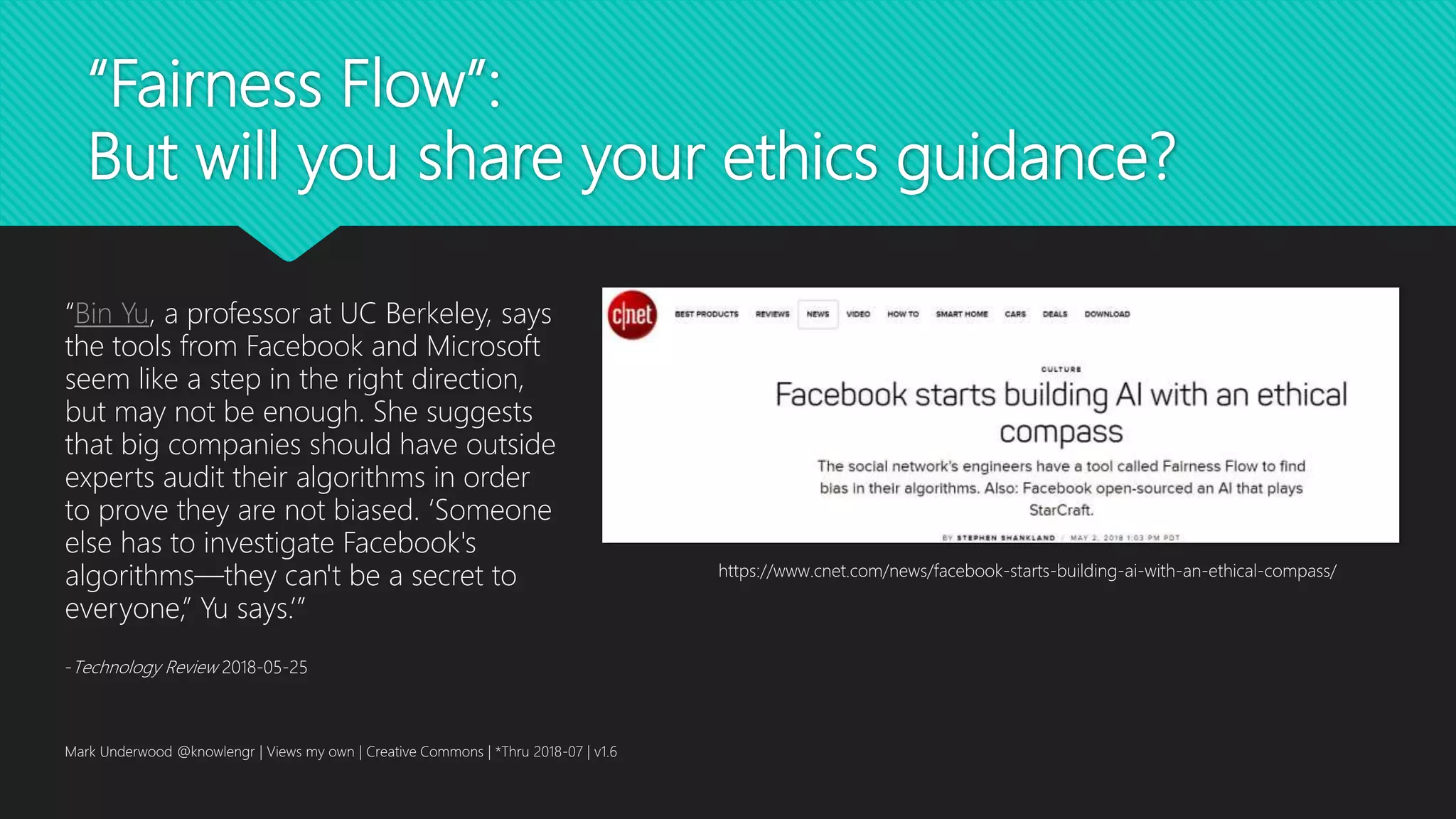
“Fairness Flow”:
But will you share your ethics guidance?
Mark Underwood @knowlengr | Views my own | Creative Commons | *Thru 2018-07 | v1.6
https://www.cnet.com/news/facebook-starts-building-ai-with-an-ethical-compass/
“Bin Yu, a professor at UC Berkeley, says
the tools from Facebook and Microsoft
seem like a step in the right direction,
but may not be enough. She suggests
that big companies should have outside
experts audit their algorithms in order
to prove they are not biased. ‘Someone
else has to investigate Facebook's
algorithms—they can't be a secret to
everyone,” Yu says.’”
-Technology Review 2018-05-25
Professional Level Risk
 Skills obtained at considerable cost/effort will be deprecated
 Alternative approaches will be preferred
 Good, suitable approaches will be discouraged
 -- in order to avoid negative result approaches
Mark Underwood @knowlengr | Views my own | Creative Commons | *Thru 2018-07 | v1.6
Codes of Ethics
IEEE & ACM
Mark Underwood @knowlengr | Views my own | Creative Commons | *Thru 2018-07 | v1.6
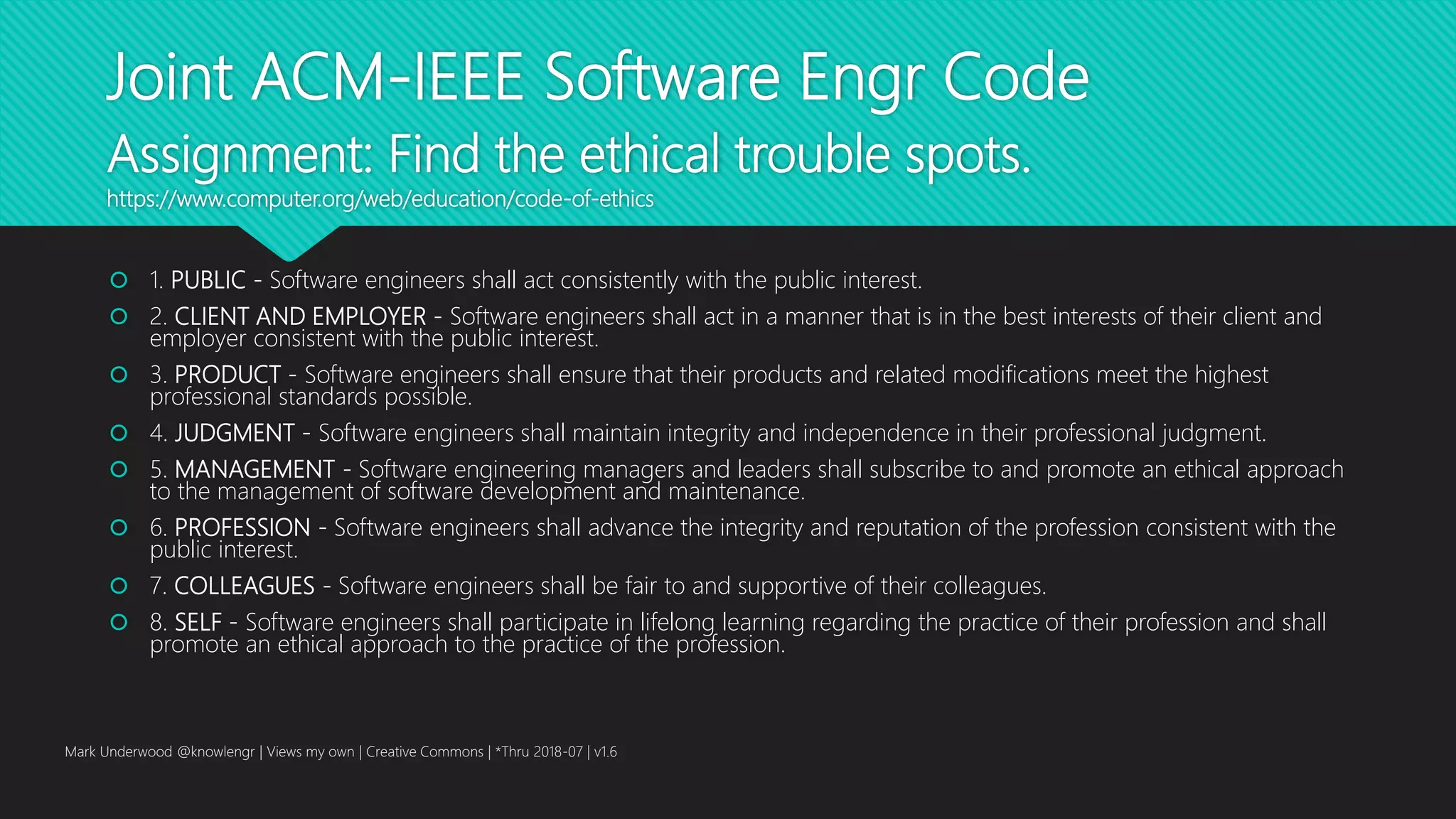
Joint ACM-IEEE Software Engr Code
Assignment: Find the ethical trouble spots.
https://www.computer.org/web/education/code-of-ethics
 1. PUBLIC - Software engineers shall act consistently with the public interest.
 2. CLIENT AND EMPLOYER - Software engineers shall act in a manner that is in the best interests of their client and
employer consistent with the public interest.
 3. PRODUCT - Software engineers shall ensure that their products and related modifications meet the highest
professional standards possible.
 4. JUDGMENT - Software engineers shall maintain integrity and independence in their professional judgment.
 5. MANAGEMENT - Software engineering managers and leaders shall subscribe to and promote an ethical approach
to the management of software development and maintenance.
 6. PROFESSION - Software engineers shall advance the integrity and reputation of the profession consistent with the
public interest.
 7. COLLEAGUES - Software engineers shall be fair to and supportive of their colleagues.
 8. SELF - Software engineers shall participate in lifelong learning regarding the practice of their profession and shall
promote an ethical approach to the practice of the profession.
Mark Underwood @knowlengr | Views my own | Creative Commons | *Thru 2018-07 | v1.6
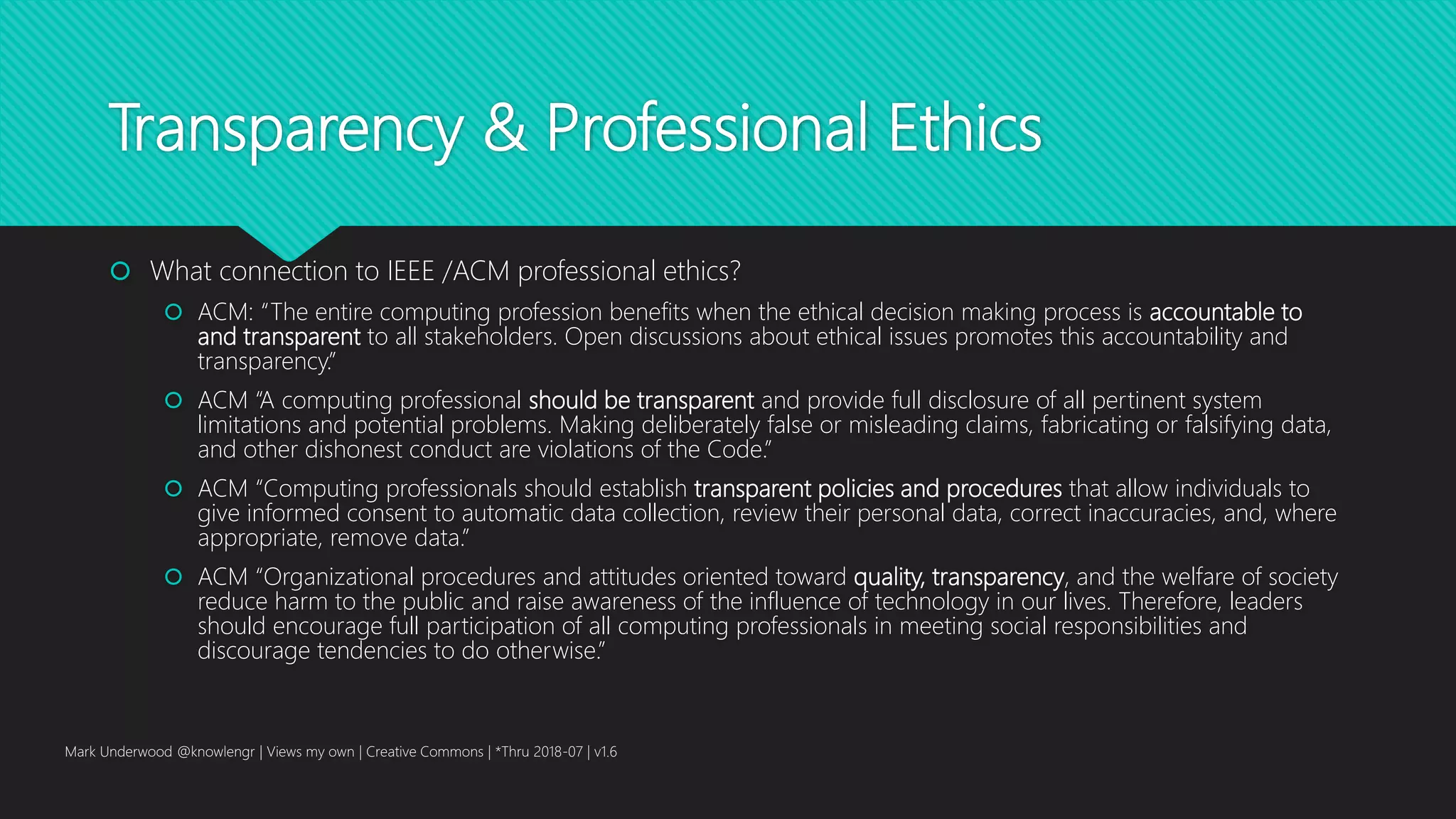
Transparency & Professional Ethics
 What connection to IEEE /ACM professional ethics?
 ACM: “The entire computing profession benefits when the ethical decision making process is accountable to
and transparent to all stakeholders. Open discussions about ethical issues promotes this accountability and
transparency.”
 ACM “A computing professional should be transparent and provide full disclosure of all pertinent system
limitations and potential problems. Making deliberately false or misleading claims, fabricating or falsifying data,
and other dishonest conduct are violations of the Code.”
 ACM “Computing professionals should establish transparent policies and procedures that allow individuals to
give informed consent to automatic data collection, review their personal data, correct inaccuracies, and, where
appropriate, remove data.”
 ACM “Organizational procedures and attitudes oriented toward quality, transparency, and the welfare of society
reduce harm to the public and raise awareness of the influence of technology in our lives. Therefore, leaders
should encourage full participation of all computing professionals in meeting social responsibilities and
discourage tendencies to do otherwise.”
Mark Underwood @knowlengr | Views my own | Creative Commons | *Thru 2018-07 | v1.6
State of Computing Profession Ethics
@ACM_Ethics
 Not part of professional training
 Enterprise ethics training is not technical enough
 Engineers are not challenged with realistic moral dilemmas
 Overlay of employment, profit, team loyalty as potential crosswinds
 Project Management practices dilute responsibility
 Requirements Engineering is more art than engineering
Mark Underwood @knowlengr | Views my own | Creative Commons | *Thru 2018-07 | v1.6
SDLC for Data Science
Life cycle of analytics | Analytics as Code
Mark Underwood @knowlengr | Views my own | Creative Commons | *Thru 2018-07 | v1.6
Analytics as Code
 Requirements Engineering
 Traceability and provenance (training data, code, constraints)
 Audit & Forensics
 Ethical tradeoffs tagged like PII (e.g., sustainability tradeoff for an oil company)
 Test automation (“left-shifted” test engineering, “Test-Driven Development”
 Dependency management
 Supporting infrastructure analogous to other application spaces
 Dashboard integration
Mark Underwood @knowlengr | Views my own | Creative Commons | *Thru 2018-07 | v1.6
Continuously Deployed Algorithms
Impacts of DevOps (IEEE P2675)
Test Harness construction
Workflow for retest, refinement, reproducibility
Mark Underwood @knowlengr | Views my own | Creative Commons | *Thru 2018-07 | v1.6
Training Set Scrutiny
 Training sets can get ethics off on the wrong foot
 Set responsibility for ethical ownership - e.g., similar to Institutional
Review Boards (IRB)
 Be prepared to defend incomplete, tentative, or experimental projects
 “Data” is part of data science “code”
Mark Underwood @knowlengr | Views my own | Creative Commons | *Thru 2018-07 | v1.6
Recognize Ethical, Abuse Scenarios
 For agile SDLC: User stories should include all stakeholders
Often supply chain, OSS, internal customers are omitted from
scenarios
 Add “abuse” or “adversarial” user stories / security stories (Secure Scrum
parlance)
 May require an external sensibility to discover & recite
Mark Underwood @knowlengr | Views my own | Creative Commons | *Thru 2018-07 | v1.6
Other Relevant IEEE Societies
IEEE Groups
Mark Underwood @knowlengr | Views my own | Creative Commons | *Thru 2018-07 | v1.6
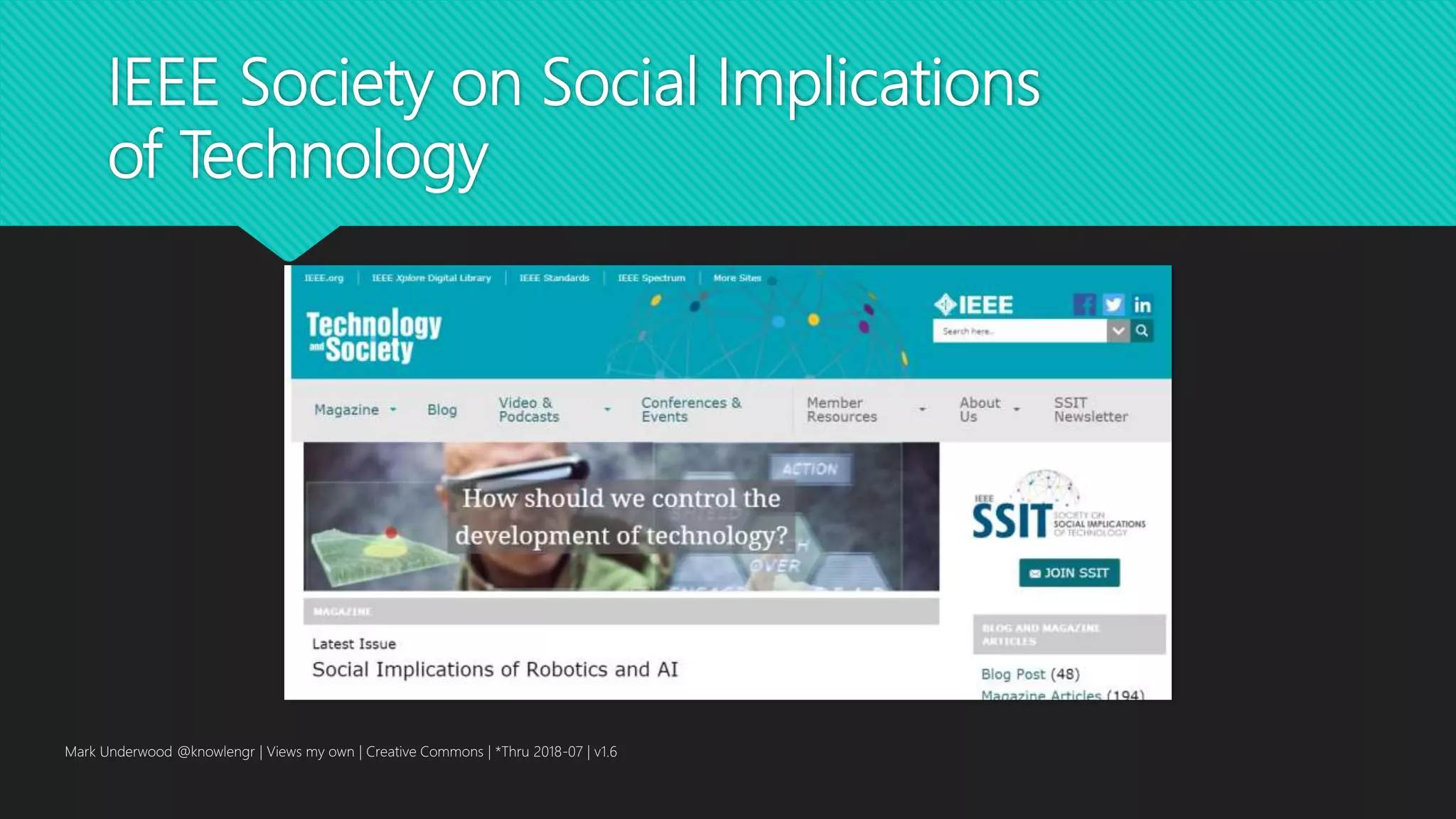
IEEE Society on Social Implications
of Technology
Mark Underwood @knowlengr | Views my own | Creative Commons | *Thru 2018-07 | v1.6
IEEE Product Safety Engineering Society
Mark Underwood @knowlengr | Views my own | Creative Commons | *Thru 2018-07 | v1.6
• “Do no harm.” – It’s not
so easy.
• Do you know a system is
safe before it’s been fully
scaled up -- & possibly
federated?
• What constitutes “a
reasonable explanation”?
IEEE Reliability Society
Mark Underwood @knowlengr | Views my own | Creative Commons | *Thru 2018-07 | v1.6
See free reliability analytics
toolkit
https://kbros.co/2rugRij
Roadmap:
Algorithmic Bias Mitigation
A Roadmap for Specialists
Mark Underwood @knowlengr | Views my own | Creative Commons | *Thru 2018-07 | v1.6
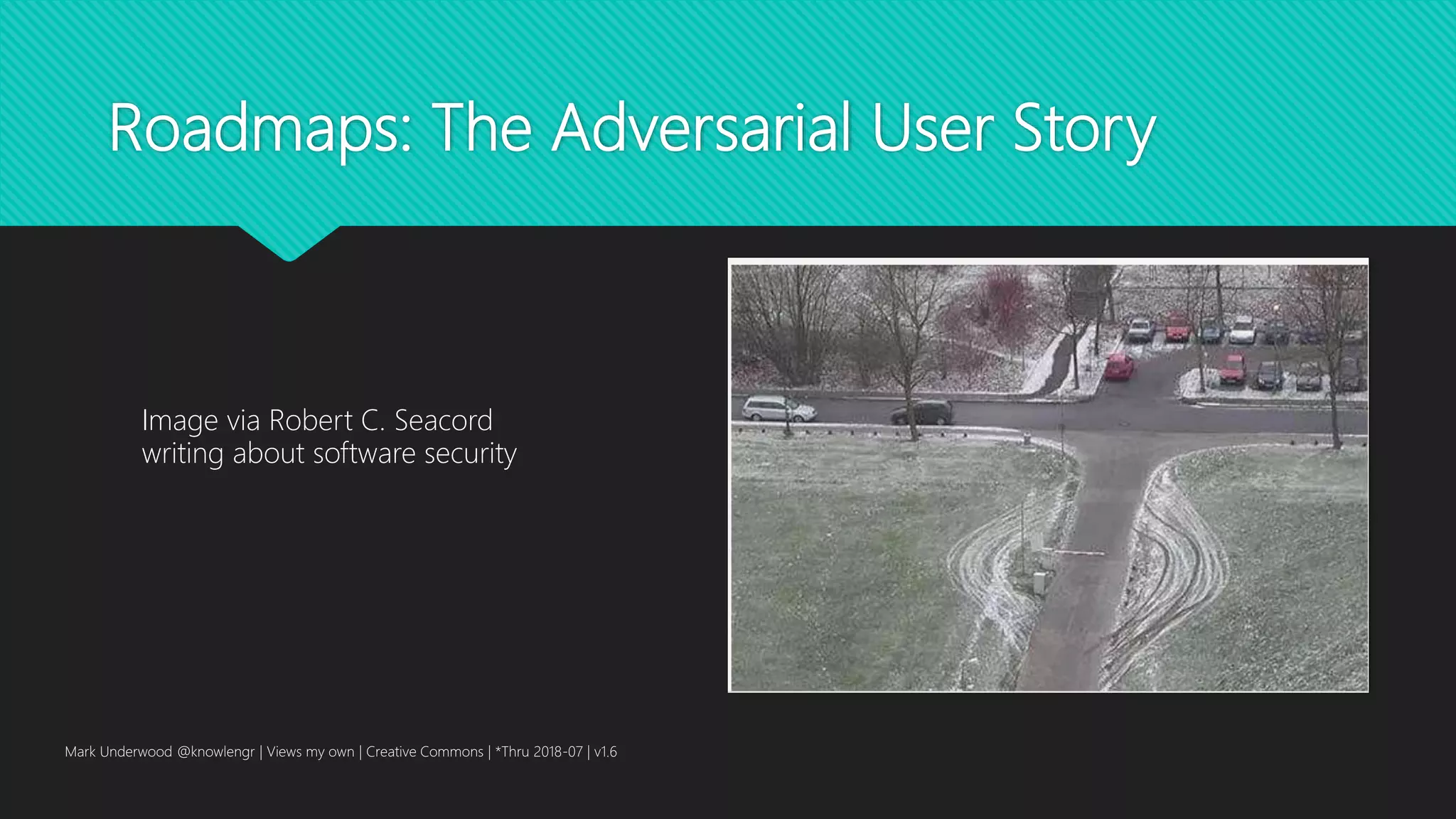
Roadmaps: The Adversarial User Story
Mark Underwood @knowlengr | Views my own | Creative Commons | *Thru 2018-07 | v1.6
Image via Robert C. Seacord
writing about software security
Algorithmic Bias Risk Management
 1. Recognize, socialize groups protected by statute (e.g.,
Equal Credit Opportunity Act)
 2. Creatively consider other affected subpopulations
 Sight impaired – other disabilities
 Children, elderly
 Unusual household settings (elder care, multi-family
housing)
 Part time and workers
 Novice vs. Experienced users
 What counterfactuals are simply not being measured?
Mark Underwood @knowlengr | Views my own | Creative Commons | *Thru 2018-07 | v1.6
Roadmap Attributes
 Engage all stakeholders: consumers, co-workers, shareholders, specialists,
professional CoI’s
 Embrace or consult “traditional” AI
 Tie to enterprise risk appetite
 Align with professional Codes of Ethics
 “User Stories” should include adversarial ethical challenges
 Traceable responsibility for decision-making (e.g., tradeoff analysis)
Mark Underwood @knowlengr | Views my own | Creative Commons | *Thru 2018-07 | v1.6
Suggested Area of Study: Ethical Intent
 Rao, Anand; Georgeff, Michael. 1995. Belief-Desire-Intention Agents: From Theory to
Practice. Australian Artificial Intelligence Institute, Melbourne, Australia. In ICMAS-95.

Casali, A., Godo, L. and Sierra, C., 2011. A graded BDI agent model to represent and reason about
preferences. Artificial Intelligence, 175(7-8), pp.1468-1478.

Xiaowei Wang, Nicola Guarino, Giancarlo Guizzardi, and John Mylopoulos. 2014. Towards an Ontology
of Software: a Requirements Engineering Perspective. FOIS 2014.
https://www.academia.edu/8744511/Towards_an_Ontology_of_Software_A_Requirements_Engineering_
Perspective. [local]

Guarino, N., 2006. Ontology and Terminology. In How can formal ontology help concept modelling
and terminology. Powerpoint in Workshop «Terminology, Concept Modelling and Ontology. Which
approach for which problem.
Mark Underwood @knowlengr | Views my own | Creative Commons | *Thru 2018-07 | v1.6
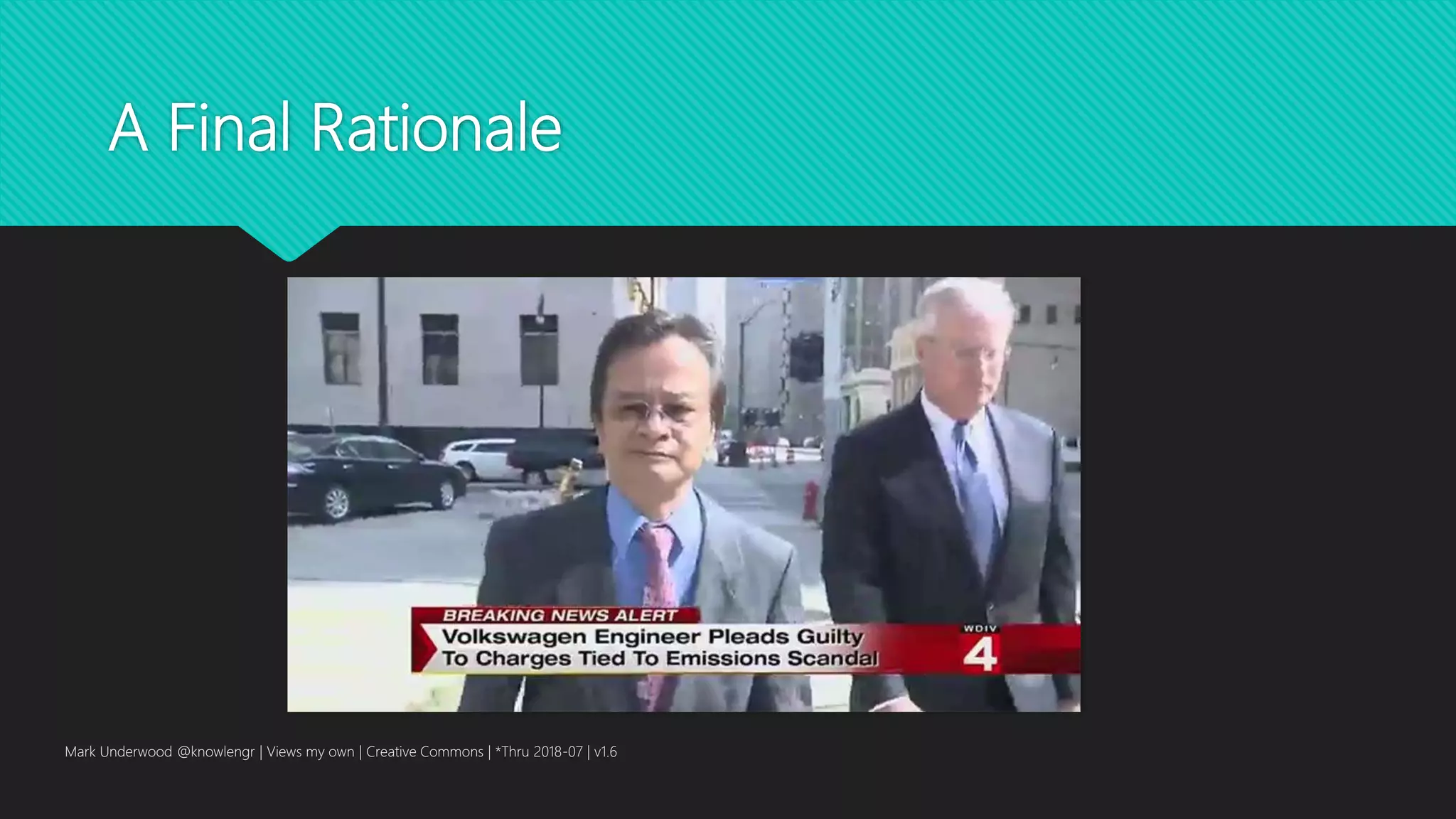
A Final Rationale
Mark Underwood @knowlengr | Views my own | Creative Commons | *Thru 2018-07 | v1.6
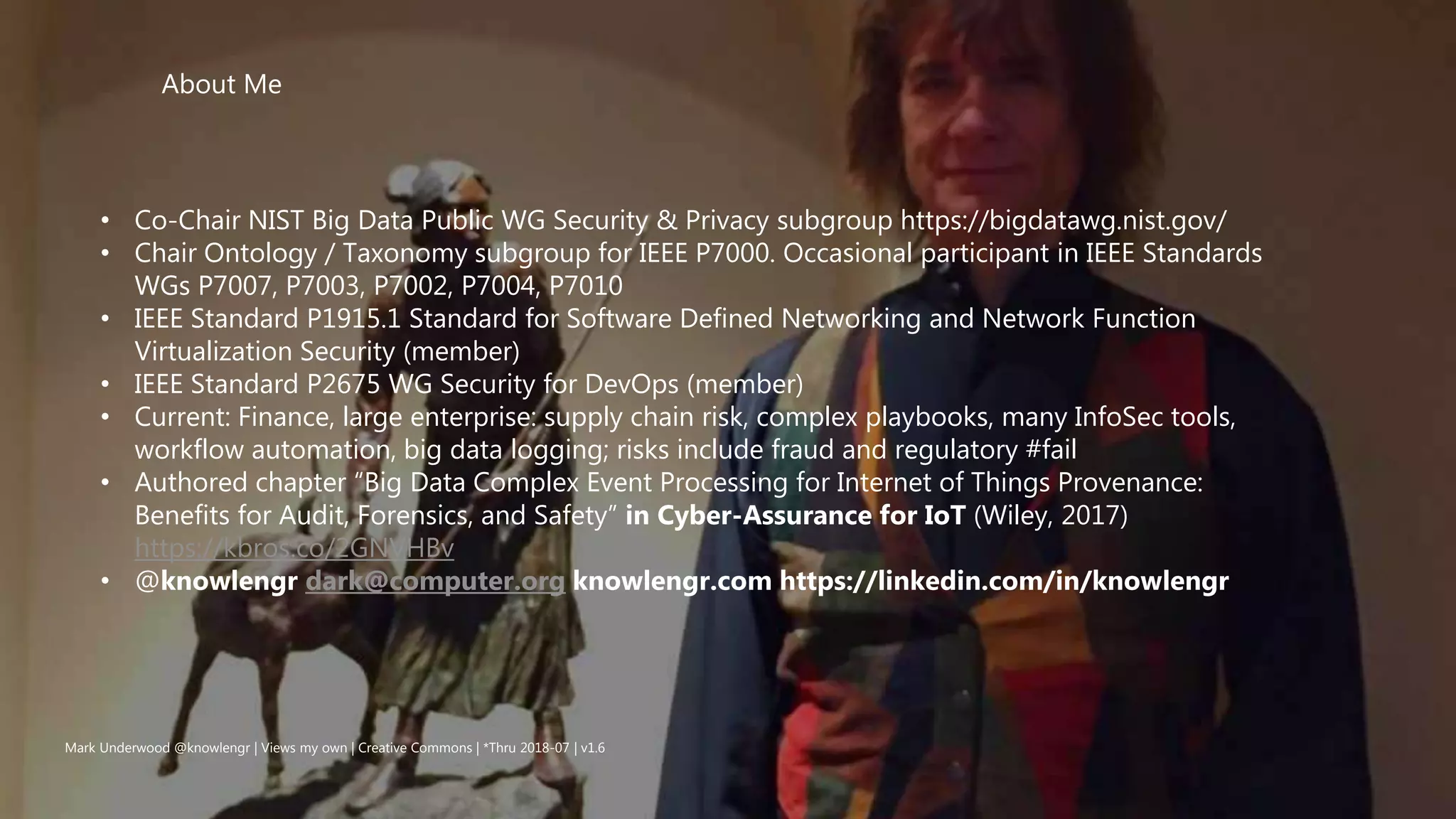
• Co-Chair NIST Big Data Public WG Security & Privacy subgroup https://bigdatawg.nist.gov/
• Chair Ontology / Taxonomy subgroup for IEEE P7000. Occasional participant in IEEE Standards
WGs P7007, P7003, P7002, P7004, P7010
• IEEE Standard P1915.1 Standard for Software Defined Networking and Network Function
Virtualization Security (member)
• IEEE Standard P2675 WG Security for DevOps (member)
• Current: Finance, large enterprise: supply chain risk, complex playbooks, many InfoSec tools,
workflow automation, big data logging; risks include fraud and regulatory #fail
• Authored chapter “Big Data Complex Event Processing for Internet of Things Provenance:
Benefits for Audit, Forensics, and Safety” in Cyber-Assurance for IoT (Wiley, 2017)
https://kbros.co/2GNVHBv
• @knowlengr dark@computer.org knowlengr.com https://linkedin.com/in/knowlengr
About Me
This deck is released under
Creative Commons
Attribution-Share Alike.
See also: Stakeholders in Ethical Systems Design
Mark Underwood @knowlengr | Views my own | Creative Commons | *Thru 2018-07 | v1.6

Ethics of Analytics and Machine Learning

  • 1.
    Ethics of DataScience Issues Surfaced by IEEE P7003 WG* Mark Underwood @knowlengr | Views my own | Creative Commons | *Thru 2018-07
  • 2.
    Disclaimers  My viewsonly  Not view of my employer  Not view of IEEE or IEEE SA  Not view of the IEEE P7003 WG  P7003 standards work still early stage Mark Underwood @knowlengr | Views my own | Creative Commons | *Thru 2018-07 | v1.6
  • 3.
    “Minority Report” (2002) The “PreCogs” have landed  Proprietary predictive models already deployed in several states for  Law enforcement  Child welfare  “Pockets of poverty” identification  Educational / teacher assessment  Credit: Philip K. Dick (1956) Mark Underwood @knowlengr | Views my own | Creative Commons | *Thru 2018-07 | v1.6
  • 4.
    Storm Clouds  Broadersocial trends impacting application contexts  ML weak transparency  Some analytics practitioners may have weak statistical background  Algorithms may not have faced usability or reproducibility tests  Computation on encrypted data is still primitive and/or slow  Anonymization practices may not take big data variety into account  Lightweight practitioner training Mark Underwood @knowlengr | Views my own | Creative Commons | *Thru 2018-07 | v1.6
  • 5.
    Where Data ScienceDoes Matter A smattering of impact areas Mark Underwood @knowlengr | Views my own | Creative Commons | *Thru 2018-07 | v1.6
  • 6.
    Use Case Clusters Credit worthiness (Offers for balance transfers not extended to minority groups)  Sales & marketing analytics (Some profitable prospects will be ignored)  Autonomous vehicles (Fatality, injury accidents)  Drug trials (Some patients will be rejected, even if potentially life-saving)  Recommendation engines (Users not given opportunity to fine-tune – You, Netflix)  Maintenance forecasting (Forecasts may not include loss of life risks)  Operations Management (Cause cost overrun while managing AWS cost / performance)  Cybersecurity (False positives could suggest you are an insider threat) Mark Underwood @knowlengr | Views my own | Creative Commons | *Thru 2018-07 | v1.6
  • 7.
    Solving Poverty throughData Science It’s Magic! Mark Underwood @knowlengr | Views my own | Creative Commons | *Thru 2018-07 | v1.6 https://www.marketplace.org/shows/marketplace-morning-report 2018-07-30
  • 8.
    IEEE Initiative: Value-Sensitive Design “.. . to refine ethical system requirements in systems and software life cycles.” Mark Underwood @knowlengr | Views my own | Creative Commons | *Thru 2018-07 | v1.6
  • 9.
    IEEE P7000 WG:Marquis Group Charter “Scope: The standard establishes a process model by which engineers and technologists can address ethical consideration throughout the various stages of system initiation, analysis and design. Expected process requirements include management and engineering view of new IT product development, computer ethics and IT system design, value-sensitive design, and stakeholder involvement in ethical IT system design. . .. The purpose of this standard is to enable the pragmatic application of this type of Value-Based System Design methodology which demonstrates that conceptual analysis of values and an extensive feasibility analysis can help to refine ethical system requirements in systems and software life cycles.” Mark Underwood @knowlengr | Views my own | Creative Commons | *Thru 2018-07 | v1.6
  • 10.
    Related IEEE P70nnGroups  IEEE P7000 Ethical Systems Design  IEEE P7001 Transparency of Autonomous Systems  IEEE P7002 Data Privacy Process  IEEE P7003 Algorithmic Bias Considerations  IEEE P7004 Standard for Child and Student Data Governance  IEEE P7005 Standard for Transparent Employer Data Governance  IEEE P7006 Standard for Personal AI Agent  IEEE P7007 Ontological Standard for Ethically Driven Robotics and Automation Systems  IEEE P7008 -Standard for Ethically Driven Nudging for Robotic, Intelligent and Autonomous Systems  IEEE P7009 Standard for Fail-Safe Design of Autonomous and Semi-Autonomous Systems  IEEE P7010 Wellbeing Metrics Standard for Ethical Artificial Intelligence and Autonomous Systems  IEEE P7011 SSIE Standard for Trustworthiness of News Media  IEEE P7012 SSIE Machine Readable Personal Privacy Terms  IEEE P7013 Facial Analysis Mark Underwood @knowlengr | Views my own | Creative Commons | *Thru 2018-07 | v1.6
  • 11.
    IEEE P7003 AlgorithmicBias Considerations “This standard is designed to provide individuals or organizations creating algorithms, largely in regards to autonomous or intelligent systems, certification oriented methodologies to provide clearly articulated accountability and clarity around how algorithms are targeting, assessing and influencing the users and stakeholders of said algorithm. Certification under this standard will allow algorithm creators to communicate to users, and regulatory authorities, that up-to-date best practices were used in the design, testing and evaluation of the algorithm to avoid unjustified differential impact on users.” IEEE PAR https://standards.ieee.org/develop/project/7003.html Mark Underwood @knowlengr | Views my own | Creative Commons | *Thru 2018-07 | v1.6
  • 12.
    Who is IEEESA? Why care what it does? • Affordable, volunteer-driven, int’l • IEEE SA members voting rights • Collaboration with ISO, NIST • Key standards include ethernet Mark Underwood @knowlengr | Views my own | Creative Commons | *Thru 2018-07 | v1.6
  • 13.
    Broad Social Issues Cross-cuttingConcerns for all Technologists Mark Underwood @knowlengr | Views my own | Creative Commons | *Thru 2018-07 | v1.6
  • 14.
    Professional Pride, PublicDisillusionment Broader acceptance within IT & Evidence-based Practices  Growth of data science inside many professions (R, Python)  Extraordinary explosion of OSS tooling  Big Data, ML, Real Time  Watson, AlphaGo, Alexa “AI” (Gee Whiz factor) Public Perspective  “2017 was the year we fell out of love with algorithms.”  Cambridge Analytica, Equifax Mark Underwood @knowlengr | Views my own | Creative Commons | *Thru 2018-07 | v1.6
  • 15.
    “When we fellout of love with algorithms.” Mark Underwood @knowlengr | Views my own | Creative Commons | *Thru 2018-07 | v1.6
  • 16.
    Ethical issues Alreadyin Play  Sustainability  Environment  Climate Change (*data center power consumption)  Bias concerns in gender, race, free speech  Social media technology responsibility  As propaganda platforms  Excessive use of cell phones by children: ADHD?  Weakened critical thinking, F2F social skills (Sherry Turkle Reclaiming Conversation 2015) Mark Underwood @knowlengr | Views my own | Creative Commons | *Thru 2018-07 | v1.6
  • 17.
    Some Related ISOStandards  ISO 26000 “ISO 26000 provides guidance on how businesses and organizations can operate in a socially responsible way. This means acting in an ethical and transparent way that contributes to the health and welfare of society”  ISO 27500:2016 is intended for executive board members and policy makers of all types of organizations (whether large or small) in the private, public and non-profit sectors. It describes the values and beliefs that make an organization human-centred, the significant business benefits that can be achieved, and explains the risks for the organization of not being human-centered  ISO 37101:2016 establishes requirements for a management system for sustainable development in communities, including cities, using a holistic approach, with a view to ensuring consistency with the sustainable development policy of communities.  ISO/IEC JTC 1/SC 39 Standardization related to the intersection of resource efficiency and IT which supports environmentally and economically viable development, application, operation and management aspects.  ISO/IEC 31010:2009 – Risk Management – Risk Assessment Techniques Mark Underwood @knowlengr | Views my own | Creative Commons | *Thru 2018-07 | v1.6
  • 18.
    What do youknow about these standards? To date, a bit hidden among the blockchain and TensorFlow conversations. Mark Underwood @knowlengr | Views my own | Creative Commons | *Thru 2018-07 | v1.6
  • 19.
    Algorithmic Bias inData Science *Including finance Mark Underwood @knowlengr | Views my own | Creative Commons | *Thru 2018-07 | v1.6
  • 20.
    Linkage to Privacy,Surveillance, Distrust Algorithms are bad because they:  Use data without our knowledge  Are based on incorrect or misleading knowledge about us  Are not accountable to individual citizens  Are used by governments to spy on citizens  Support drone warfare  Are built by specialists who do what they are told without asking questions  Represent a trend to automate jobs out of existence  Are built by big companies with no public accountability Mark Underwood @knowlengr | Views my own | Creative Commons | *Thru 2018-07 | v1.6
  • 21.
    “Bias is theNew Breach” Mark Underwood @knowlengr | Views my own | Creative Commons | *Thru 2018-07 | v1.6 “Researchers from MIT and Stanford University tested three commercially released facial-analysis programs from major technology companies and will present findings that the software contains clear skin-type and gender biases. Facial recognition programs are good at recognizing white males but fail embarrassingly with females especially the darker the skin tone. The news broke last week but will be presented in full at the upcoming Conference on Fairness, Accountability, and Transparency.“ https://www.cio.com/article/3256272/artificial-intelligence/in-the-ai-revolution-bias-is-the-new- breach-how-cios-must-manage-risk.html
  • 22.
    Decisions vs. DecisionSupport: Application Areas Human-Computer Interactions in Decision-making Mark Underwood @knowlengr | Views my own | Creative Commons | *Thru 2018-07 | v1.6
  • 23.
    Undermining Specialists* Mark Underwood@knowlengr | Views my own | Creative Commons | *Thru 2018-07 | v1.6 “The threat the electronic health records and machine learning post for physicians’ clinical judgment – and their well-being.” – NYT 2018-05-16 “’Food poisoning’ was diagnosed because the strangulated hernia in the groin was overlooked, or patients were sent to the catheterization lab for chest pain because no one saw the shingles rash on the left chest.” *Or adversely changing specialist behavior.
  • 24.
    “Rote Decision-Making” Mark Underwood@knowlengr | Views my own | Creative Commons | *Thru 2018-07 | v1.6 “The authors, both emergency room physicians at Brigham and Women’s Hospital in Boston, do a fine job of sorting through most of the serious problems in American medicine today, including the costs, over- testing, overprescribing, overlitigation and general depersonalization. All are caused at least in part, they argue, by the increasing use of algorithms in medical care.” -NYT 2018-04-01
  • 25.
    Facial Recognition forLaw Enforcement  “AMZ touts its Rekognition facial recognition system as ‘simple and easy to use,’ encouraging customers to ‘detect, analyze, and compare faces for a wide variety of user verification, people counting, and public safety use cases.’ And yet, in a study released Thursday by the American Civil Liberties Union, the technology managed to confuse photos of 28 members of Congress with publicly available mug shots. Given that Amazon actively markets Rekognition to law enforcement agencies across the US, that’s simply not good enough. The ACLU study also illustrated the racial bias that plagues facial recognition today. ‘Nearly 40 percent of Rekognition’s false matches in our test were of people of color, even though they make up only 20 percent of Congress,’ wrote ACLU attorney Jacob Snow. ‘People of color are already disproportionately harmed by police practices, and it’s easy to see how Rekognition could exacerbate that.’“ -Wired 2018-07-26 Mark Underwood @knowlengr | Views my own | Creative Commons | *Thru 2018-07 | v1.6
  • 26.
    “Family” Impacts Mark Underwood@knowlengr | Views my own | Creative Commons | *Thru 2018-07 | v1.6 “Charges of faulty forecasts have accompanied the emergence of predictive analytics into public policy. And when it comes to criminal justice, where analytics are now entrenched as a tool for judges and parole boards, even larger complaints have arisen about the secrecy surrounding the workings of the algorithms themselves — most of which are developed, marketed and closely guarded by private firms. That’s a chief objection lodged against two Florida companies: Eckerd Connects, a nonprofit, and its for-profit partner, MindShare Technology.” – NYT “Can an algorithm tell when kids are in danger?” 2018-01-02
  • 27.
    Lawsuit over TeacherEvaluation Algorithm  Value-added measures for teacher evaluation, called the Education Value- Added Assessment System, or EVAAS, in Houston, is a statistical method that uses a student’s performance on prior standardized tests to predict academic growth in the current year. This methodology—derided as deeply flawed, unfair and incomprehensible—was used to make decisions about teacher evaluation, bonuses and termination. It uses a secret computer program based on an inexplicable algorithm (above).  In May 2014, seven Houston teachers and the Houston Federation of Teachers brought an unprecedented federal lawsuit to end the policy, saying it reduced education to a test score, didn’t help improve teaching or learning, and ruined teachers’ careers when they were incorrectly terminated. Neither HISD nor its contractor allowed teachers access to the data or computer algorithms so that they could test or challenge the legitimacy of the scores, creating a ‘black box.’” http://kbros.co/2EvxjU9 Mark Underwood @knowlengr | Views my own | Creative Commons | *Thru 2018-07 | v1.6
  • 28.
    Mark Underwood @knowlengr| Views my own | Creative Commons | *Thru 2018-07 | v1.6 Wells Fargo Credit Denial “Glitch” Mark Underwood @knowlengr | Views my own | Creative Commons | *Thru 2018-08 | v1.4 CNN: “Hundreds of people had their homes foreclosed on after software used by Wells Fargo incorrectly denied them mortgage modifications.” 2018-08-05 https://money.cnn.com/2018/08/04/news/companies/wells-fargo-mortgage-modification/index.html
  • 29.
    . . .And not easy to “fix” Risk mitigation for data science implementations is relatively immature. Mark Underwood @knowlengr | Views my own | Creative Commons | *Thru 2018-07 | v1.6
  • 30.
    Unintended Use Casesor Ethical Lapse? Mark Underwood @knowlengr | Views my own | Creative Commons | *Thru 2018-07 | v1.6 • Algorithm corrected for color bias, but can now be used for profiling • “Red Teaming” or “Abuse User Stories” can help • Unintended use cases call for a safety vs. a pure “assurance” framework
  • 31.
    “Lite” AI Security/ReliabilityFrameworks Mark Underwood @knowlengr | Views my own | Creative Commons | *Thru 2018-07 | v1.6 https://motherboard.vice.com/en_us/article/bjbxbz/researchers-tricked-ai-into-doing-free-computations-it-wasnt-trained-to-do “Google researchers demonstrated that a neural network could be tricked into performing free computations for an attacker. They worry that this could one day be used to turn our smartphones into botnets by exposing them to images.”
  • 32.
    Machine Learning: Expanding Impact Impactacross all industries may be difficult to assess. Mark Underwood @knowlengr | Views my own | Creative Commons | *Thru 2018-07 | v1.6
  • 33.
    The “Cambrian Explosion” MarkUnderwood @knowlengr | Views my own | Creative Commons | *Thru 2018-07 | v1.6 -- Ian Goodfellow Staff Research Scientist Google Brain ACM Webinar 2018-07-24
  • 34.
    Transparency & Interpretability AsSeen by Ian Goodfellow Findings from adversarial machine learning Mark Underwood @knowlengr | Views my own | Creative Commons | *Thru 2018-07 | v1.6
  • 35.
    Why Ethical IssuesBecome Secondary Mark Underwood @knowlengr | Views my own | Creative Commons | *Thru 2018-07 | v1.6 For many applications, ML benefits will prove irresistible. Goodfellow considers reliability needs as a useful example.
  • 36.
    Challenges of Interpretability MarkUnderwood @knowlengr | Views my own | Creative Commons | *Thru 2018-07 | v1.6 “Adversarial ML literature suggests that ML models are very easy to fool and even linear models work in counter- intuitive ways.” (Selvaraju et al, 2016) • Reproducability • Training sets including results of other analytics (e.g., FICO) • Provenance (think IoT) • Opaque statistical issues
  • 37.
    Transparency General Challenges Some data, algorithms are intellectual property  Some training data includes PII  Predictive analytical models are often “point in time”  “Transparent” according to whose definition?  Should algorithms have “opt-in?” Can they?  Training set big data variety reidentification risks Mark Underwood @knowlengr | Views my own | Creative Commons | *Thru 2018-07 | v1.6
  • 38.
    Explainability / Interpretability MarkUnderwood @knowlengr | Views my own | Creative Commons | *Thru 2018-07 | v1.6 “[We need to] find ways of making techniques like deep learning more understandable to their creators and accountable to their users. Otherwise it will be hard to predict when failures might occur—and it’s inevitable they will. That’s one reason Nvidia’s car is still experimental.”
  • 39.
    Enterprise Level Risk Impact on reputation  Litigation  Unintentionally reveal sources, methods, data / interrupted data streams (e.g, web)  Loss of consumer confidence, impact on public safety  Misapplication of internally developed models  Financial losses from data science #fail  “. . . as long as our training is in the form of someone lecturing about the basics of gender or racial bias in society, that training is not likely to be effective”. Dr. Hanie Sedghi, Research Scientist, Google Brain Mark Underwood @knowlengr | Views my own | Creative Commons | *Thru 2018-07 | v1.6
  • 40.
    Risk Management and Lessonsfrom Others Aligning with enterprise risk appetite, resilience Mark Underwood @knowlengr | Views my own | Creative Commons | *Thru 2018-07 | v1.6
  • 41.
    Insights from MoreMature Settings  AI Analytics for distributed military coalitions  “. . . Research has recently started to address such concerns and prominent directions include explainable AI [4], quantification of input influence in machine learning algorithms [5], ethics embedding in decision support systems [6], “interruptability” for machine learning systems [7], and data transparency [8]. “  “. . . devices that manage themselves and generate their own management policies, discussing the similarities between such systems and Skynet.” Mark Underwood @knowlengr | Views my own | Creative Commons | *Thru 2018-07 | v1.6 S. Calo, D. Verma, E. Bertino, J. Ingham, and G. Cirincione, "How to prevent skynet from forming (a perspective from Policy-Based autonomic device management)," in 2018 IEEE 38th International Conference on Distributed Computing Systems (ICDCS), Jul. 2018, pp. 1369-1376. [Online]. Available: http://dx.doi.org/10.1109/ICDCS.2018.00137
  • 42.
    Some Fairness Approaches(Sedghi, 2018)  1) Post processing in terms of calibration of our model. What this means is that, we calibrate classifiers parameters such that it has the same acceptance ratio for all subgroups of sensitive features, e.g. race, sex, etc.  2) Data resampling to remove skewed sample. But, for many reasons, collecting more data is not very easy and sometimes causes problems for individuals.  3) Causal reasoning: We capture different paths in a causal graph that can lead to the same observational data. This basically means to model possible factors such that sex, race and other sensitive features to make sure their impact is captured and does not directly affect the result variable. Mark Underwood @knowlengr | Views my own | Creative Commons | *Thru 2018-07 | v1.6
  • 43.
    Decision Support forBias Detection Mark Underwood @knowlengr | Views my own | Creative Commons | *Thru 2018-07 | v1.6 “Things like transparency, intelligibility, and explanation are new enough to the field that few of us have sufficient experience to know everything we should look for and all the ways that bias might lurk in our models,” says Rich Caruna, a senior researcher at Microsoft who is working on the bias-detection dashboard.” Technology Review, Will Knight 2018-05-25
  • 44.
    “Fairness Flow”: But willyou share your ethics guidance? Mark Underwood @knowlengr | Views my own | Creative Commons | *Thru 2018-07 | v1.6 https://www.cnet.com/news/facebook-starts-building-ai-with-an-ethical-compass/ “Bin Yu, a professor at UC Berkeley, says the tools from Facebook and Microsoft seem like a step in the right direction, but may not be enough. She suggests that big companies should have outside experts audit their algorithms in order to prove they are not biased. ‘Someone else has to investigate Facebook's algorithms—they can't be a secret to everyone,” Yu says.’” -Technology Review 2018-05-25
  • 45.
    Professional Level Risk Skills obtained at considerable cost/effort will be deprecated  Alternative approaches will be preferred  Good, suitable approaches will be discouraged  -- in order to avoid negative result approaches Mark Underwood @knowlengr | Views my own | Creative Commons | *Thru 2018-07 | v1.6
  • 46.
    Codes of Ethics IEEE& ACM Mark Underwood @knowlengr | Views my own | Creative Commons | *Thru 2018-07 | v1.6
  • 47.
    Joint ACM-IEEE SoftwareEngr Code Assignment: Find the ethical trouble spots. https://www.computer.org/web/education/code-of-ethics  1. PUBLIC - Software engineers shall act consistently with the public interest.  2. CLIENT AND EMPLOYER - Software engineers shall act in a manner that is in the best interests of their client and employer consistent with the public interest.  3. PRODUCT - Software engineers shall ensure that their products and related modifications meet the highest professional standards possible.  4. JUDGMENT - Software engineers shall maintain integrity and independence in their professional judgment.  5. MANAGEMENT - Software engineering managers and leaders shall subscribe to and promote an ethical approach to the management of software development and maintenance.  6. PROFESSION - Software engineers shall advance the integrity and reputation of the profession consistent with the public interest.  7. COLLEAGUES - Software engineers shall be fair to and supportive of their colleagues.  8. SELF - Software engineers shall participate in lifelong learning regarding the practice of their profession and shall promote an ethical approach to the practice of the profession. Mark Underwood @knowlengr | Views my own | Creative Commons | *Thru 2018-07 | v1.6
  • 48.
    Transparency & ProfessionalEthics  What connection to IEEE /ACM professional ethics?  ACM: “The entire computing profession benefits when the ethical decision making process is accountable to and transparent to all stakeholders. Open discussions about ethical issues promotes this accountability and transparency.”  ACM “A computing professional should be transparent and provide full disclosure of all pertinent system limitations and potential problems. Making deliberately false or misleading claims, fabricating or falsifying data, and other dishonest conduct are violations of the Code.”  ACM “Computing professionals should establish transparent policies and procedures that allow individuals to give informed consent to automatic data collection, review their personal data, correct inaccuracies, and, where appropriate, remove data.”  ACM “Organizational procedures and attitudes oriented toward quality, transparency, and the welfare of society reduce harm to the public and raise awareness of the influence of technology in our lives. Therefore, leaders should encourage full participation of all computing professionals in meeting social responsibilities and discourage tendencies to do otherwise.” Mark Underwood @knowlengr | Views my own | Creative Commons | *Thru 2018-07 | v1.6
  • 49.
    State of ComputingProfession Ethics @ACM_Ethics  Not part of professional training  Enterprise ethics training is not technical enough  Engineers are not challenged with realistic moral dilemmas  Overlay of employment, profit, team loyalty as potential crosswinds  Project Management practices dilute responsibility  Requirements Engineering is more art than engineering Mark Underwood @knowlengr | Views my own | Creative Commons | *Thru 2018-07 | v1.6
  • 50.
    SDLC for DataScience Life cycle of analytics | Analytics as Code Mark Underwood @knowlengr | Views my own | Creative Commons | *Thru 2018-07 | v1.6
  • 51.
    Analytics as Code Requirements Engineering  Traceability and provenance (training data, code, constraints)  Audit & Forensics  Ethical tradeoffs tagged like PII (e.g., sustainability tradeoff for an oil company)  Test automation (“left-shifted” test engineering, “Test-Driven Development”  Dependency management  Supporting infrastructure analogous to other application spaces  Dashboard integration Mark Underwood @knowlengr | Views my own | Creative Commons | *Thru 2018-07 | v1.6
  • 52.
    Continuously Deployed Algorithms Impactsof DevOps (IEEE P2675) Test Harness construction Workflow for retest, refinement, reproducibility Mark Underwood @knowlengr | Views my own | Creative Commons | *Thru 2018-07 | v1.6
  • 53.
    Training Set Scrutiny Training sets can get ethics off on the wrong foot  Set responsibility for ethical ownership - e.g., similar to Institutional Review Boards (IRB)  Be prepared to defend incomplete, tentative, or experimental projects  “Data” is part of data science “code” Mark Underwood @knowlengr | Views my own | Creative Commons | *Thru 2018-07 | v1.6
  • 54.
    Recognize Ethical, AbuseScenarios  For agile SDLC: User stories should include all stakeholders Often supply chain, OSS, internal customers are omitted from scenarios  Add “abuse” or “adversarial” user stories / security stories (Secure Scrum parlance)  May require an external sensibility to discover & recite Mark Underwood @knowlengr | Views my own | Creative Commons | *Thru 2018-07 | v1.6
  • 55.
    Other Relevant IEEESocieties IEEE Groups Mark Underwood @knowlengr | Views my own | Creative Commons | *Thru 2018-07 | v1.6
  • 56.
    IEEE Society onSocial Implications of Technology Mark Underwood @knowlengr | Views my own | Creative Commons | *Thru 2018-07 | v1.6
  • 57.
    IEEE Product SafetyEngineering Society Mark Underwood @knowlengr | Views my own | Creative Commons | *Thru 2018-07 | v1.6 • “Do no harm.” – It’s not so easy. • Do you know a system is safe before it’s been fully scaled up -- & possibly federated? • What constitutes “a reasonable explanation”?
  • 58.
    IEEE Reliability Society MarkUnderwood @knowlengr | Views my own | Creative Commons | *Thru 2018-07 | v1.6 See free reliability analytics toolkit https://kbros.co/2rugRij
  • 59.
    Roadmap: Algorithmic Bias Mitigation ARoadmap for Specialists Mark Underwood @knowlengr | Views my own | Creative Commons | *Thru 2018-07 | v1.6
  • 60.
    Roadmaps: The AdversarialUser Story Mark Underwood @knowlengr | Views my own | Creative Commons | *Thru 2018-07 | v1.6 Image via Robert C. Seacord writing about software security
  • 61.
    Algorithmic Bias RiskManagement  1. Recognize, socialize groups protected by statute (e.g., Equal Credit Opportunity Act)  2. Creatively consider other affected subpopulations  Sight impaired – other disabilities  Children, elderly  Unusual household settings (elder care, multi-family housing)  Part time and workers  Novice vs. Experienced users  What counterfactuals are simply not being measured? Mark Underwood @knowlengr | Views my own | Creative Commons | *Thru 2018-07 | v1.6
  • 62.
    Roadmap Attributes  Engageall stakeholders: consumers, co-workers, shareholders, specialists, professional CoI’s  Embrace or consult “traditional” AI  Tie to enterprise risk appetite  Align with professional Codes of Ethics  “User Stories” should include adversarial ethical challenges  Traceable responsibility for decision-making (e.g., tradeoff analysis) Mark Underwood @knowlengr | Views my own | Creative Commons | *Thru 2018-07 | v1.6
  • 63.
    Suggested Area ofStudy: Ethical Intent  Rao, Anand; Georgeff, Michael. 1995. Belief-Desire-Intention Agents: From Theory to Practice. Australian Artificial Intelligence Institute, Melbourne, Australia. In ICMAS-95.  Casali, A., Godo, L. and Sierra, C., 2011. A graded BDI agent model to represent and reason about preferences. Artificial Intelligence, 175(7-8), pp.1468-1478.  Xiaowei Wang, Nicola Guarino, Giancarlo Guizzardi, and John Mylopoulos. 2014. Towards an Ontology of Software: a Requirements Engineering Perspective. FOIS 2014. https://www.academia.edu/8744511/Towards_an_Ontology_of_Software_A_Requirements_Engineering_ Perspective. [local]  Guarino, N., 2006. Ontology and Terminology. In How can formal ontology help concept modelling and terminology. Powerpoint in Workshop «Terminology, Concept Modelling and Ontology. Which approach for which problem. Mark Underwood @knowlengr | Views my own | Creative Commons | *Thru 2018-07 | v1.6
  • 64.
    A Final Rationale MarkUnderwood @knowlengr | Views my own | Creative Commons | *Thru 2018-07 | v1.6
  • 65.
    Mark Underwood @knowlengr| Views my own | Creative Commons | *Thru 2018-07 | v1.6 • Co-Chair NIST Big Data Public WG Security & Privacy subgroup https://bigdatawg.nist.gov/ • Chair Ontology / Taxonomy subgroup for IEEE P7000. Occasional participant in IEEE Standards WGs P7007, P7003, P7002, P7004, P7010 • IEEE Standard P1915.1 Standard for Software Defined Networking and Network Function Virtualization Security (member) • IEEE Standard P2675 WG Security for DevOps (member) • Current: Finance, large enterprise: supply chain risk, complex playbooks, many InfoSec tools, workflow automation, big data logging; risks include fraud and regulatory #fail • Authored chapter “Big Data Complex Event Processing for Internet of Things Provenance: Benefits for Audit, Forensics, and Safety” in Cyber-Assurance for IoT (Wiley, 2017) https://kbros.co/2GNVHBv • @knowlengr dark@computer.org knowlengr.com https://linkedin.com/in/knowlengr About Me
  • 66.
    This deck isreleased under Creative Commons Attribution-Share Alike. See also: Stakeholders in Ethical Systems Design Mark Underwood @knowlengr | Views my own | Creative Commons | *Thru 2018-07 | v1.6

Editor's Notes

  • #31 Reference https://www.washingtonpost.com/technology/2018/06/28/facial-recognition-technology-is-finally-more-accurate-identifying-people-color-could-that-be-used-against-immigrants/?noredirect=on&utm_term=.b639c243cd91