School of Software Engineering
Software Architecture, Spring 2014
1
Software Architecture, Spring 2014 School of Software Engineering
1
Tactics to Achieve Software
Qualities
March 2014
Ying SHEN
SSE, Tongji University
School of Software Engineering
Software Architecture, Spring 2014
2
School of Software Engineering
Software Architecture, Spring 2014
2
Lecture objectives
This lecture will enable students to
• draw concrete scenario of software quality attributes;
• be familiar with tactics for achieving two types of software
qualities.
School of Software Engineering
Software Architecture, Spring 2014
3
School of Software Engineering
Software Architecture, Spring 2014
3
Achieving QAs through tactics
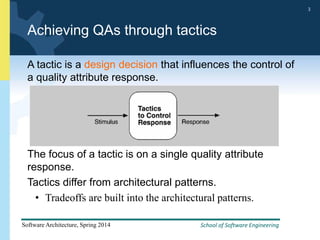
A tactic is a design decision that influences the control of
a quality attribute response.
The focus of a tactic is on a single quality attribute
response.
Tactics differ from architectural patterns.
• Tradeoffs are built into the architectural patterns.
School of Software Engineering
Software Architecture, Spring 2014
4
School of Software Engineering
Software Architecture, Spring 2014
4
Achieving QAs through tactics
Tactics are techniques that an architect can use to
achieve the required quality attributes.
Qualities are achieved via design decisions/tactics.
A system design consists of a collection of decisions.
• Some help control the quality attribute responses.
• Others ensure achievement of functionality.
School of Software Engineering
Software Architecture, Spring 2014
5
School of Software Engineering
Software Architecture, Spring 2014
5
Achieving QAs through tactics
Tactics to achieve two types of quality attributes:
• Availability
• Modifiability
• …
School of Software Engineering
Software Architecture, Spring 2014
6
School of Software Engineering
Software Architecture, Spring 2014
6
Achieving QAs through tactics
Tactics to achieve two types of quality attributes:
• Availability
• Modifiability
• …
School of Software Engineering
Software Architecture, Spring 2014
7
School of Software Engineering
Software Architecture, Spring 2014
7
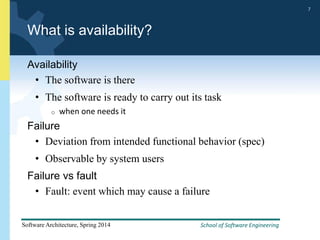
What is availability?
Availability
• The software is there
• The software is ready to carry out its task
o when one needs it
Failure
• Deviation from intended functional behavior (spec)
• Observable by system users
Failure vs fault
• Fault: event which may cause a failure
School of Software Engineering
Software Architecture, Spring 2014
8
School of Software Engineering
Software Architecture, Spring 2014
8
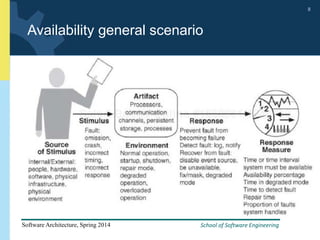
Availability general scenario
School of Software Engineering
Software Architecture, Spring 2014
9
School of Software Engineering
Software Architecture, Spring 2014
9
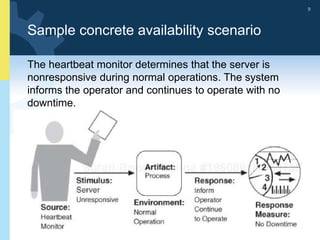
Sample concrete availability scenario
The heartbeat monitor determines that the server is
nonresponsive during normal operations. The system
informs the operator and continues to operate with no
downtime.
School of Software Engineering
Software Architecture, Spring 2014
10
School of Software Engineering
Software Architecture, Spring 2014
10
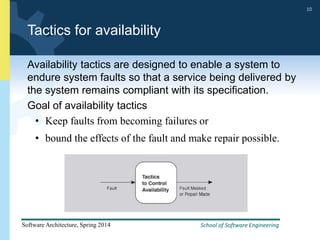
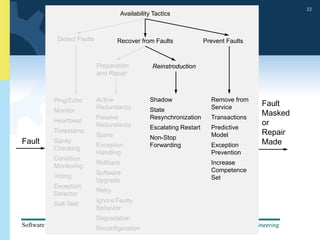
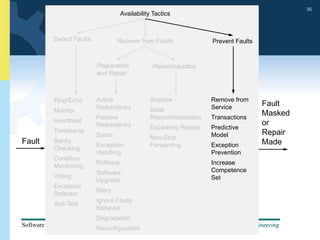
Tactics for availability
Availability tactics are designed to enable a system to
endure system faults so that a service being delivered by
the system remains compliant with its specification.
Goal of availability tactics
• Keep faults from becoming failures or
• bound the effects of the fault and make repair possible.
School of Software Engineering
Software Architecture, Spring 2014
11
School of Software Engineering
Software Architecture, Spring 2014
11
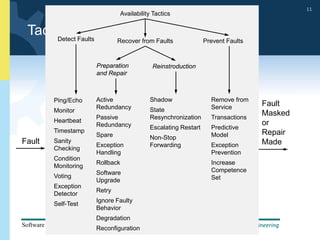
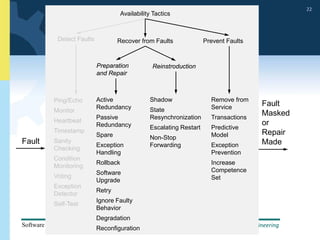
Tactics for availability
Fault
Fault
Masked
or
Repair
Made
Availability Tactics
Detect Faults Recover from Faults Prevent Faults
Ping/Echo
Monitor
Heartbeat
Timestamp
Sanity
Checking
Condition
Monitoring
Voting
Exception
Detector
Self-Test
Preparation
and Repair
Reinstroduction
Active
Redundancy
Passive
Redundancy
Spare
Exception
Handling
Rollback
Software
Upgrade
Retry
Ignore Faulty
Behavior
Degradation
Reconfiguration
Shadow
State
Resynchronization
Escalating Restart
Non-Stop
Forwarding
Remove from
Service
Transactions
Predictive
Model
Exception
Prevention
Increase
Competence
Set
School of Software Engineering
Software Architecture, Spring 2014
12
School of Software Engineering
Software Architecture, Spring 2014
12
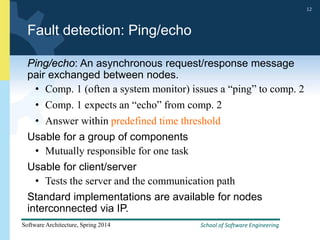
Fault detection: Ping/echo
Ping/echo: An asynchronous request/response message
pair exchanged between nodes.
• Comp. 1 (often a system monitor) issues a “ping” to comp. 2
• Comp. 1 expects an “echo” from comp. 2
• Answer within predefined time threshold
Usable for a group of components
• Mutually responsible for one task
Usable for client/server
• Tests the server and the communication path
Standard implementations are available for nodes
interconnected via IP.
School of Software Engineering
Software Architecture, Spring 2014
13
School of Software Engineering
Software Architecture, Spring 2014
13
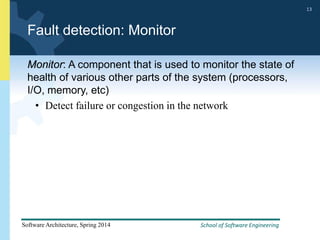
Fault detection: Monitor
Monitor: A component that is used to monitor the state of
health of various other parts of the system (processors,
I/O, memory, etc)
• Detect failure or congestion in the network
School of Software Engineering
Software Architecture, Spring 2014
14
School of Software Engineering
Software Architecture, Spring 2014
14
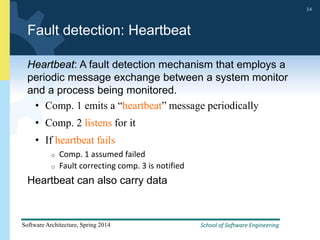
Fault detection: Heartbeat
Heartbeat: A fault detection mechanism that employs a
periodic message exchange between a system monitor
and a process being monitored.
• Comp. 1 emits a “heartbeat” message periodically
• Comp. 2 listens for it
• If heartbeat fails
o Comp. 1 assumed failed
o Fault correcting comp. 3 is notified
Heartbeat can also carry data
School of Software Engineering
Software Architecture, Spring 2014
15
School of Software Engineering
Software Architecture, Spring 2014
15
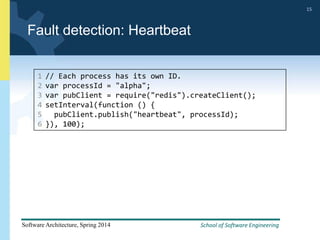
Fault detection: Heartbeat
1
2
3
4
5
6
// Each process has its own ID.
var processId = "alpha";
var pubClient = require("redis").createClient();
setInterval(function () {
pubClient.publish("heartbeat", processId);
}), 100);
School of Software Engineering
Software Architecture, Spring 2014
16
School of Software Engineering
Software Architecture, Spring 2014
16
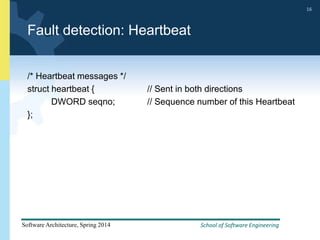
Fault detection: Heartbeat
/* Heartbeat messages */
struct heartbeat { // Sent in both directions
DWORD seqno; // Sequence number of this Heartbeat
};
School of Software Engineering
Software Architecture, Spring 2014
17
School of Software Engineering
Software Architecture, Spring 2014
17
Fault detection: Voting
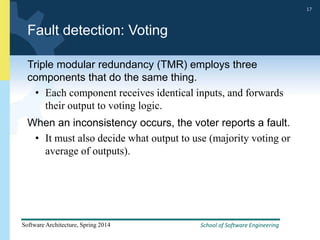
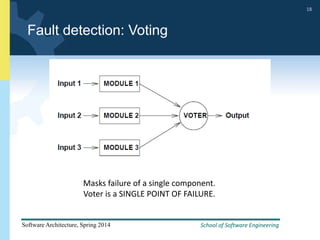
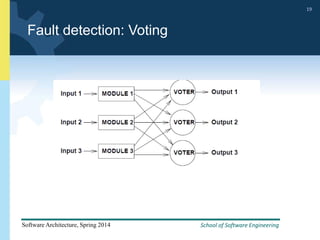
Triple modular redundancy (TMR) employs three
components that do the same thing.
• Each component receives identical inputs, and forwards
their output to voting logic.
When an inconsistency occurs, the voter reports a fault.
• It must also decide what output to use (majority voting or
average of outputs).
School of Software Engineering
Software Architecture, Spring 2014
18
School of Software Engineering
Software Architecture, Spring 2014
18
Fault detection: Voting
Masks failure of a single component.
Voter is a SINGLE POINT OF FAILURE.
School of Software Engineering
Software Architecture, Spring 2014
19
School of Software Engineering
Software Architecture, Spring 2014
19
Fault detection: Voting
School of Software Engineering
Software Architecture, Spring 2014
20
School of Software Engineering
Software Architecture, Spring 2014
20
Fault detection: Voting
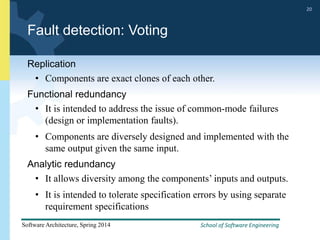
Replication
• Components are exact clones of each other.
Functional redundancy
• It is intended to address the issue of common-mode failures
(design or implementation faults).
• Components are diversely designed and implemented with the
same output given the same input.
Analytic redundancy
• It allows diversity among the components’ inputs and outputs.
• It is intended to tolerate specification errors by using separate
requirement specifications
School of Software Engineering
Software Architecture, Spring 2014
21
School of Software Engineering
Software Architecture, Spring 2014
21
Fault detection: Others
Timestamp: used to detect incorrect sequences of events,
primarily in distributed message-passing systems.
Sanity Checking: checks the validity or reasonableness of
a component’s operations or outputs; typically based on a
knowledge of the internal design, the state of the system,
or the nature of the information under scrutiny.
Condition Monitoring: checking conditions in a process or
device, or validating assumptions made during the
design.
Self-test: procedure for a component to test itself for
correct operation.
School of Software Engineering
Software Architecture, Spring 2014
22
School of Software Engineering
Software Architecture, Spring 2014
22
Fault
Fault
Masked
or
Repair
Made
Availability Tactics
Detect Faults Recover from Faults Prevent Faults
Ping/Echo
Monitor
Heartbeat
Timestamp
Sanity
Checking
Condition
Monitoring
Voting
Exception
Detector
Self-Test
Preparation
and Repair
Reinstroduction
Active
Redundancy
Passive
Redundancy
Spare
Exception
Handling
Rollback
Software
Upgrade
Retry
Ignore Faulty
Behavior
Degradation
Reconfiguration
Shadow
State
Resynchronization
Escalating Restart
Non-Stop
Forwarding
Remove from
Service
Transactions
Predictive
Model
Exception
Prevention
Increase
Competence
Set
School of Software Engineering
Software Architecture, Spring 2014
23
School of Software Engineering
Software Architecture, Spring 2014
23
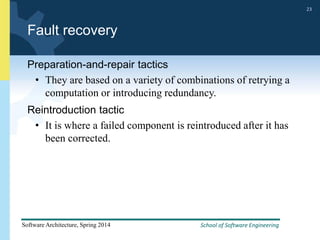
Fault recovery
Preparation-and-repair tactics
• They are based on a variety of combinations of retrying a
computation or introducing redundancy.
Reintroduction tactic
• It is where a failed component is reintroduced after it has
been corrected.
School of Software Engineering
Software Architecture, Spring 2014
24
School of Software Engineering
Software Architecture, Spring 2014
24
Preparation-and-repair: Active redundancy
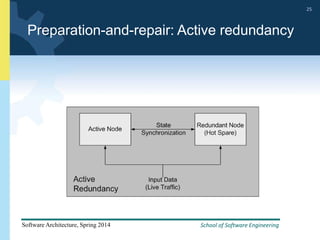
All redundant components respond to events in parallel.
• All in the same state.
Response from only one component is used.
Downtime: switching time to another up-to-date
component (ms)
Used in client-server config (database system)
• Quick responses are important.
Synchronization
• All messages to any redundant component sent to all
redundant components.
School of Software Engineering
Software Architecture, Spring 2014
25
School of Software Engineering
Software Architecture, Spring 2014
25
Preparation-and-repair: Active redundancy
School of Software Engineering
Software Architecture, Spring 2014
26
School of Software Engineering
Software Architecture, Spring 2014
26
Preparation-and-repair: Passive
redundancy
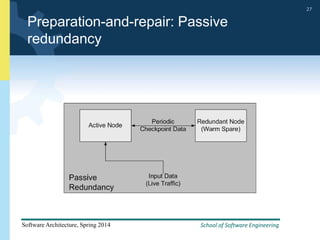
Primary component
• responds to events
• informs standby components of state updates they must
make
Fault occurs:
• System checks if backup sufficiently fresh before resuming
services
Often used in control systems
Periodical switchovers increase availability
School of Software Engineering
Software Architecture, Spring 2014
27
School of Software Engineering
Software Architecture, Spring 2014
27
Preparation-and-repair: Passive
redundancy
School of Software Engineering
Software Architecture, Spring 2014
28
School of Software Engineering
Software Architecture, Spring 2014
28
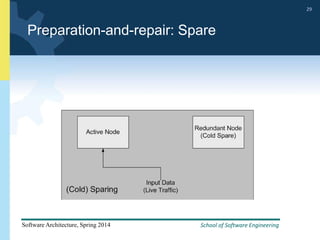
Preparation-and-repair: Spare
Standby spare computing platform configured to replace
many different failed components
• Must be rebooted to appropriate SW config
• Have its state initialized when failure occurs
Checkpoint of system state and state changes to
persistent device periodically.
Downtime: minutes
• Suited for systems having only high-reliability instead of
high-availability.
School of Software Engineering
Software Architecture, Spring 2014
29
School of Software Engineering
Software Architecture, Spring 2014
29
Preparation-and-repair: Spare
School of Software Engineering
Software Architecture, Spring 2014
30
School of Software Engineering
Software Architecture, Spring 2014
30
Preparation-and-repair: Others
Exception Handling: dealing with the exception by
reporting it or handling it, potentially masking the fault by
correcting the cause of the exception and retrying.
Rollback: permits the system to revert to a previous
known good state upon the detection of a failure.
Software Upgrade: in-service upgrades to executable
code images in a non-service-affecting manner.
Retry: where a failure is transient retrying the operation
may lead to success.
School of Software Engineering
Software Architecture, Spring 2014
31
School of Software Engineering
Software Architecture, Spring 2014
31
Preparation-and-repair: Others
Ignore Faulty Behavior: ignoring messages sent from a
source when it is determined that those messages are
spurious.
Degradation: maintains the most critical system functions
in the presence of component failures, dropping less
critical functions.
Reconfiguration: reassigning responsibilities to the
resources left functioning, while maintaining as much
functionality as possible.
School of Software Engineering
Software Architecture, Spring 2014
32
School of Software Engineering
Software Architecture, Spring 2014
32
Fault
Fault
Masked
or
Repair
Made
Availability Tactics
Detect Faults Recover from Faults Prevent Faults
Ping/Echo
Monitor
Heartbeat
Timestamp
Sanity
Checking
Condition
Monitoring
Voting
Exception
Detector
Self-Test
Preparation
and Repair
Reinstroduction
Active
Redundancy
Passive
Redundancy
Spare
Exception
Handling
Rollback
Software
Upgrade
Retry
Ignore Faulty
Behavior
Degradation
Reconfiguration
Shadow
State
Resynchronization
Escalating Restart
Non-Stop
Forwarding
Remove from
Service
Transactions
Predictive
Model
Exception
Prevention
Increase
Competence
Set
School of Software Engineering
Software Architecture, Spring 2014
33
School of Software Engineering
Software Architecture, Spring 2014
33
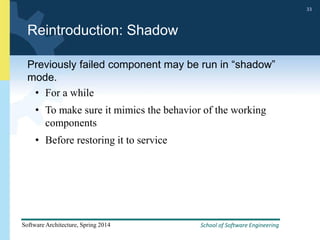
Reintroduction: Shadow
Previously failed component may be run in “shadow”
mode.
• For a while
• To make sure it mimics the behavior of the working
components
• Before restoring it to service
School of Software Engineering
Software Architecture, Spring 2014
34
School of Software Engineering
Software Architecture, Spring 2014
34
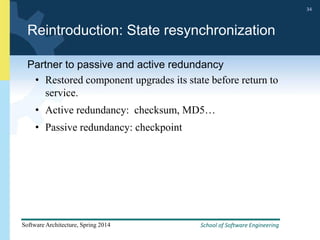
Reintroduction: State resynchronization
Partner to passive and active redundancy
• Restored component upgrades its state before return to
service.
• Active redundancy: checksum, MD5…
• Passive redundancy: checkpoint
School of Software Engineering
Software Architecture, Spring 2014
35
School of Software Engineering
Software Architecture, Spring 2014
35
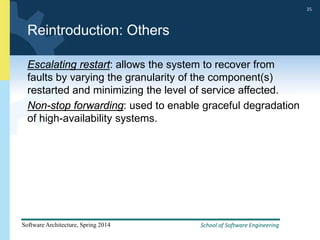
Reintroduction: Others
Escalating restart: allows the system to recover from
faults by varying the granularity of the component(s)
restarted and minimizing the level of service affected.
Non-stop forwarding: used to enable graceful degradation
of high-availability systems.
School of Software Engineering
Software Architecture, Spring 2014
36
School of Software Engineering
Software Architecture, Spring 2014
36
Fault
Fault
Masked
or
Repair
Made
Availability Tactics
Detect Faults Recover from Faults Prevent Faults
Ping/Echo
Monitor
Heartbeat
Timestamp
Sanity
Checking
Condition
Monitoring
Voting
Exception
Detector
Self-Test
Preparation
and Repair
Reinstroduction
Active
Redundancy
Passive
Redundancy
Spare
Exception
Handling
Rollback
Software
Upgrade
Retry
Ignore Faulty
Behavior
Degradation
Reconfiguration
Shadow
State
Resynchronization
Escalating Restart
Non-Stop
Forwarding
Remove from
Service
Transactions
Predictive
Model
Exception
Prevention
Increase
Competence
Set
School of Software Engineering
Software Architecture, Spring 2014
37
School of Software Engineering
Software Architecture, Spring 2014
37
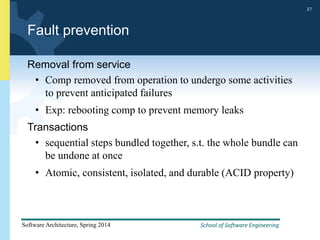
Fault prevention
Removal from service
• Comp removed from operation to undergo some activities
to prevent anticipated failures
• Exp: rebooting comp to prevent memory leaks
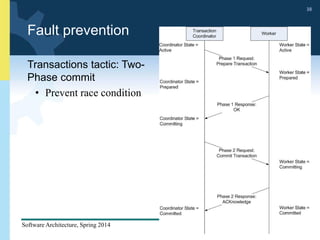
Transactions
• sequential steps bundled together, s.t. the whole bundle can
be undone at once
• Atomic, consistent, isolated, and durable (ACID property)
School of Software Engineering
Software Architecture, Spring 2014
38
School of Software Engineering
Software Architecture, Spring 2014
38
Fault prevention
Transactions tactic: Two-
Phase commit
• Prevent race condition
School of Software Engineering
Software Architecture, Spring 2014
39
School of Software Engineering
Software Architecture, Spring 2014
39
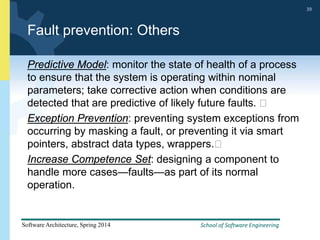
Fault prevention: Others
Predictive Model: monitor the state of health of a process
to ensure that the system is operating within nominal
parameters; take corrective action when conditions are
detected that are predictive of likely future faults. 
Exception Prevention: preventing system exceptions from
occurring by masking a fault, or preventing it via smart
pointers, abstract data types, wrappers.
Increase Competence Set: designing a component to
handle more cases—faults—as part of its normal
operation.
School of Software Engineering
Software Architecture, Spring 2014
40
School of Software Engineering
Software Architecture, Spring 2014
40
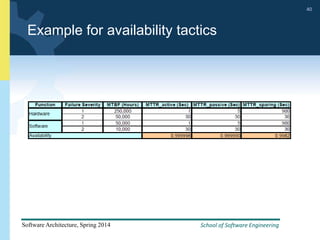
Example for availability tactics
School of Software Engineering
Software Architecture, Spring 2014
41
School of Software Engineering
Software Architecture, Spring 2014
41
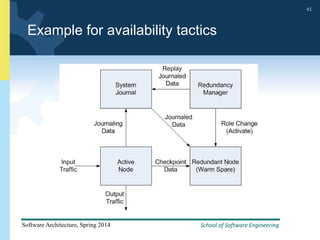
Example for availability tactics
School of Software Engineering
Software Architecture, Spring 2014
42
School of Software Engineering
Software Architecture, Spring 2014
42
Discuss questions
1. Write a concrete availability scenario for a program
like Microsoft Word.
2. Redundancy is often cited as a key strategy for
achieving high availability. Look at the tactics
presented in this chapter and decide how many of
them exploit some form of redundancy and how many
do not.
3. Consider the fault detection tactics (ping/echo,
heartbeat, system monitor, voting, and exception
detection). What are the performance implications of
using these tactics?
School of Software Engineering
Software Architecture, Spring 2014
43
School of Software Engineering
Software Architecture, Spring 2014
43
Achieving QAs through tactics
Tactics to achieve two types of quality attributes:
• Availability
• Modifiability
School of Software Engineering
Software Architecture, Spring 2014
44
School of Software Engineering
Software Architecture, Spring 2014
44
What is modifiability?
Modifiability is about change and our interest in it is the
cost and risk of making changes.
To plan for modifiability, an architect has to consider four
questions:
• What can change?
o functions, platform, environment, system qualities, capacity…
• What is the likelihood of the change?
• When is the change made and who makes it?
o implementation, compile, build, configuration setup, execution
• What is the cost of the change?
o The cost of introducing the mechanism(s) and the cost of using it.
School of Software Engineering
Software Architecture, Spring 2014
45
School of Software Engineering
Software Architecture, Spring 2014
45
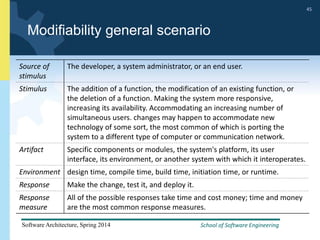
Modifiability general scenario
Source of
stimulus
The developer, a system administrator, or an end user.
Stimulus The addition of a function, the modification of an existing function, or
the deletion of a function. Making the system more responsive,
increasing its availability. Accommodating an increasing number of
simultaneous users. changes may happen to accommodate new
technology of some sort, the most common of which is porting the
system to a different type of computer or communication network.
Artifact Specific components or modules, the system's platform, its user
interface, its environment, or another system with which it interoperates.
Environment design time, compile time, build time, initiation time, or runtime.
Response Make the change, test it, and deploy it.
Response
measure
All of the possible responses take time and cost money; time and money
are the most common response measures.
School of Software Engineering
Software Architecture, Spring 2014
46
School of Software Engineering
Software Architecture, Spring 2014
46
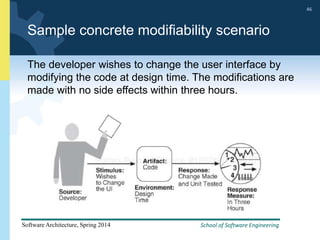
Sample concrete modifiability scenario
The developer wishes to change the user interface by
modifying the code at design time. The modifications are
made with no side effects within three hours.
School of Software Engineering
Software Architecture, Spring 2014
47
School of Software Engineering
Software Architecture, Spring 2014
47
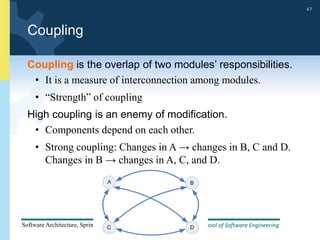
Coupling
Coupling is the overlap of two modules’ responsibilities.
• It is a measure of interconnection among modules.
• “Strength” of coupling
High coupling is an enemy of modification.
• Components depend on each other.
• Strong coupling: Changes in A → changes in B, C and D.
Changes in B → changes in A, C, and D.
School of Software Engineering
Software Architecture, Spring 2014
48
School of Software Engineering
Software Architecture, Spring 2014
48
Cohesion
Cohesion is a measure of the relationship among the
responsibilities of a specific module. It measures
• how strongly the responsibilities of a module are related.
• the module’s “unity of purpose”.
• Example: routine ComputeAndDisplayFibonacci vs.
routines ComputeFibonacci and DisplayFibonacci
The higher the cohesion, the lower the probability that a
given change will affect multiple responsibilities.
School of Software Engineering
Software Architecture, Spring 2014
49
School of Software Engineering
Software Architecture, Spring 2014
49
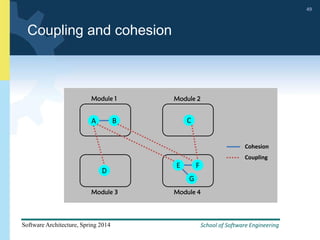
Coupling and cohesion
A B
D
C
E F
G
Cohesion
Coupling
Module 1 Module 2
Module 3 Module 4
School of Software Engineering
Software Architecture, Spring 2014
50
School of Software Engineering
Software Architecture, Spring 2014
50
Tactics for modifiability
Parameters motivate modifiability tactics:
• Size of a module
• Coupling
• Cohesion
• Binding time of modification
o Modification made late in the life cycle will cost less.
School of Software Engineering
Software Architecture, Spring 2014
51
School of Software Engineering
Software Architecture, Spring 2014
51
Tactics for modifiability
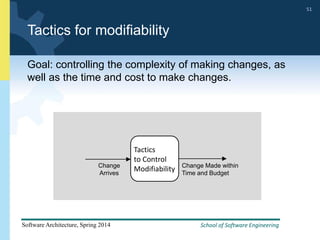
Goal: controlling the complexity of making changes, as
well as the time and cost to make changes.
Tactics
to Control
Modifiability
Change
Arrives
Change Made within
Time and Budget
School of Software Engineering
Software Architecture, Spring 2014
52
School of Software Engineering
Software Architecture, Spring 2014
52
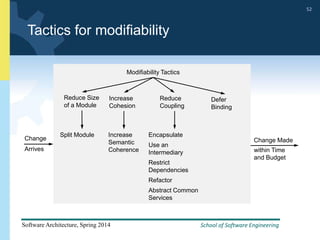
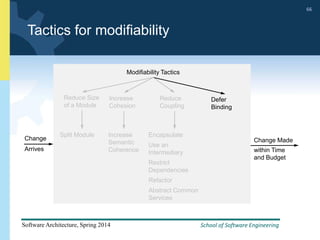
Tactics for modifiability
Change Change Made
Modifiability Tactics
Reduce Size
of a Module
Increase
Cohesion
Defer
Binding
Split Module Increase
Semantic
Coherence
Encapsulate
Use an
Intermediary
Restrict
Dependencies
Refactor
Abstract Common
Services
Reduce
Coupling
within Time
and Budget
Arrives
School of Software Engineering
Software Architecture, Spring 2014
53
School of Software Engineering
Software Architecture, Spring 2014
53
Reduce size of a module: Split module
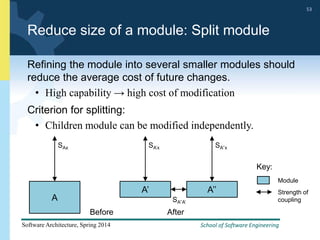
Refining the module into several smaller modules should
reduce the average cost of future changes.
• High capability → high cost of modification
Criterion for splitting:
• Children module can be modified independently.
A
SAx
Before
A’
SA’x
A’’
SA’’x
SA’’A’
After
Key:
Module
Strength of
coupling
School of Software Engineering
Software Architecture, Spring 2014
54
School of Software Engineering
Software Architecture, Spring 2014
54
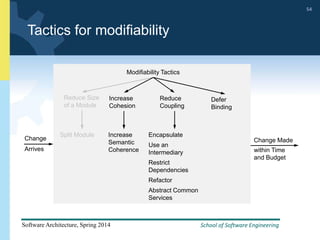
Tactics for modifiability
Change Change Made
Modifiability Tactics
Reduce Size
of a Module
Increase
Cohesion
Defer
Binding
Split Module Increase
Semantic
Coherence
Encapsulate
Use an
Intermediary
Restrict
Dependencies
Refactor
Abstract Common
Services
Reduce
Coupling
within Time
and Budget
Arrives
School of Software Engineering
Software Architecture, Spring 2014
55
School of Software Engineering
Software Architecture, Spring 2014
55
Increase cohesion: Increase semantic
cohesion
If responsibility A and B in a module do not serve the
same purpose,
• place them in different modules.
The purpose of moving responsibilities from one module
to another is to reduce the likelihood of side effects
affecting other responsibilities in one module.
If some responsibilities are not affected by changes,
• they should be removed from the original module.
School of Software Engineering
Software Architecture, Spring 2014
56
School of Software Engineering
Software Architecture, Spring 2014
56
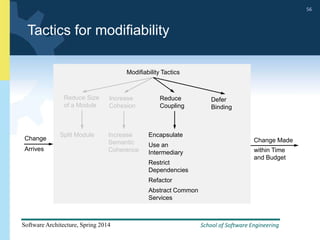
Tactics for modifiability
Change Change Made
Modifiability Tactics
Reduce Size
of a Module
Increase
Cohesion
Defer
Binding
Split Module Increase
Semantic
Coherence
Encapsulate
Use an
Intermediary
Restrict
Dependencies
Refactor
Abstract Common
Services
Reduce
Coupling
within Time
and Budget
Arrives
School of Software Engineering
Software Architecture, Spring 2014
57
School of Software Engineering
Software Architecture, Spring 2014
57
Reduce coupling: Encapsulate
The purpose is to reduce the probability that a change to
one module propagates to other modules
• by introducing an explicit interface.
The interface limits the ways in which external
responsibilities can interact with the module.
Interface should hide details of the module.
School of Software Engineering
Software Architecture, Spring 2014
58
School of Software Engineering
Software Architecture, Spring 2014
58
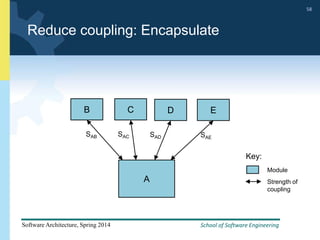
Reduce coupling: Encapsulate
A
B C E
D
SAB SAC SAD SAE
Key:
Module
Strength of
coupling
School of Software Engineering
Software Architecture, Spring 2014
59
School of Software Engineering
Software Architecture, Spring 2014
59
Reduce coupling: Encapsulate
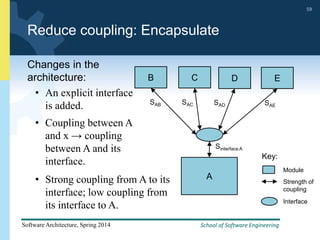
Changes in the
architecture:
• An explicit interface
is added.
• Coupling between A
and x → coupling
between A and its
interface.
A
B C E
D
SAB SAC SAD SAE
Sinterface A
Key:
Module
Strength of
coupling
Interface
• Strong coupling from A to its
interface; low coupling from
its interface to A.
School of Software Engineering
Software Architecture, Spring 2014
60
School of Software Engineering
Software Architecture, Spring 2014
60
Reduce coupling: Use an intermediary
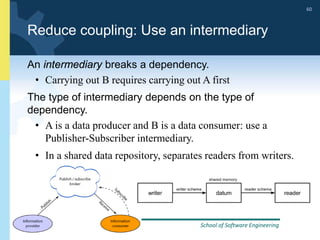
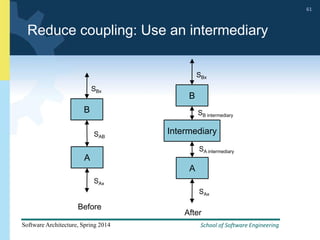
An intermediary breaks a dependency.
• Carrying out B requires carrying out A first
The type of intermediary depends on the type of
dependency.
• A is a data producer and B is a data consumer: use a
Publisher-Subscriber intermediary.
• In a shared data repository, separates readers from writers.
School of Software Engineering
Software Architecture, Spring 2014
61
School of Software Engineering
Software Architecture, Spring 2014
61
Reduce coupling: Use an intermediary
B
A
SAB
SBx
SAx
Before
After
B
A
SA intermediary
SBx
SAx
Intermediary
SB intermediary
School of Software Engineering
Software Architecture, Spring 2014
62
School of Software Engineering
Software Architecture, Spring 2014
62
Reduce coupling: Restrict dependence
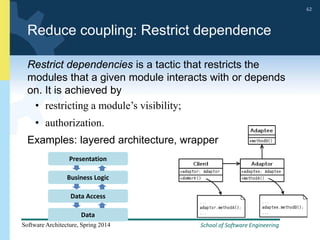
Restrict dependencies is a tactic that restricts the
modules that a given module interacts with or depends
on. It is achieved by
• restricting a module’s visibility;
• authorization.
Examples: layered architecture, wrapper
Presentation
Business Logic
Data Access
Data
School of Software Engineering
Software Architecture, Spring 2014
63
School of Software Engineering
Software Architecture, Spring 2014
63
Reduce coupling: Refactor
Refactor is a tactic undertaken when two modules are
affected by the same change because they are duplicates
of each other.
• Common responsibilities (and the code that implements
them) are “factor out” of the modules.
• By co-locating common responsibilities, the architect can
reduce coupling.
School of Software Engineering
Software Architecture, Spring 2014
64
School of Software Engineering
Software Architecture, Spring 2014
64
Reduce coupling: Abstract common
services
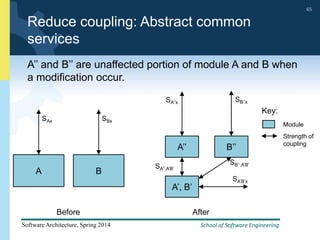
In the case where two modules provide similar services, it
may be cost-effective to implement the services just once
in a more general (abstract) form.
Any modification to the common service would then need
to occur just in one place,
• reducing modification cost.
School of Software Engineering
Software Architecture, Spring 2014
65
School of Software Engineering
Software Architecture, Spring 2014
65
Reduce coupling: Abstract common
services
A’’ and B’’ are unaffected portion of module A and B when
a modification occur.
A
SAx
Before
A’’
SA’’x
B’’
SB’’x
SB’’,A’B’
After
Key:
Module
Strength of
coupling
A’, B’
SA’’,A’B’
SA’B’x
B
SBx
School of Software Engineering
Software Architecture, Spring 2014
66
School of Software Engineering
Software Architecture, Spring 2014
66
Tactics for modifiability
Change Change Made
Modifiability Tactics
Reduce Size
of a Module
Increase
Cohesion
Defer
Binding
Split Module Increase
Semantic
Coherence
Encapsulate
Use an
Intermediary
Restrict
Dependencies
Refactor
Abstract Common
Services
Reduce
Coupling
within Time
and Budget
Arrives
School of Software Engineering
Software Architecture, Spring 2014
67
School of Software Engineering
Software Architecture, Spring 2014
67
Defer binding
Letting computers handle a change as much as possible
will reduce the cost of making that change.
The defer bindings are organized based on the system’s
life cycle:
• Compile time:
o Component replacement (e.g. in a build script or makefile)
o Compile-time parameterization
o Aspect-Oriented programming
• Deployment time:
o configuration-time binding
School of Software Engineering
Software Architecture, Spring 2014
68
School of Software Engineering
Software Architecture, Spring 2014
68
Defer binding
Letting computers handle a change as much as possible
will reduce the cost of making that change.
The defer bindings are organized based on the system’s
life cycle:
• Runtime:
o Runtime registration
o Dynamic lookup (e.g. for services)
o Plug-ins
o Publish-subscribe
o Shared repositories
o Polymorphism
School of Software Engineering
Software Architecture, Spring 2014
69
School of Software Engineering
Software Architecture, Spring 2014
69
Summary
Modifiability deals with change and the cost in time or
money of making a change.
• To which extent this modification affects other functions or
quality attributes.
Tactics to reduce the cost of making a change include
• making modules smaller,
• increasing cohesion, and
• reducing coupling.
• Deferring binding will also reduce the cost of making a
change.
School of Software Engineering
Software Architecture, Spring 2014
70
School of Software Engineering
Software Architecture, Spring 2014
70
Discussion questions
1. In a certain metropolitan subway system, the ticket
machines accept cash but do not give change. There
is a separate machine that dispenses change but
does not sell tickets. In an average station there are
six or eight ticket machines for every change machine.
What modifiability tactics do you see at work in this
arrangement? What can you say about availability?
2. The abstract common services tactic is intended to
reduce coupling, but it also might reduce cohesion.
Discuss.
School of Software Engineering
Software Architecture, Spring 2014
71
School of Software Engineering
Software Architecture, Spring 2014
71
Discussion questions
3. A wrapper is a common aid to modifiability. A wrapper
for a component is the only element allowed to use
that component; every other piece of software uses
the component's services by going through the
wrapper. The wrapper transforms the data or control
information for the component it wraps. For example,
a component may expect input using English
measures but find itself in a system in which all of the
other components produce metric measures. A
wrapper could be employed to translate. What
modifiability tactics does a wrapper embody?
School of Software Engineering
Software Architecture, Spring 2014
72
School of Software Engineering
Software Architecture, Spring 2014
72
The End

Sa03 tactics

  • 1.
    School of SoftwareEngineering Software Architecture, Spring 2014 1 Software Architecture, Spring 2014 School of Software Engineering 1 Tactics to Achieve Software Qualities March 2014 Ying SHEN SSE, Tongji University
  • 2.
    School of SoftwareEngineering Software Architecture, Spring 2014 2 School of Software Engineering Software Architecture, Spring 2014 2 Lecture objectives This lecture will enable students to • draw concrete scenario of software quality attributes; • be familiar with tactics for achieving two types of software qualities.
  • 3.
    School of SoftwareEngineering Software Architecture, Spring 2014 3 School of Software Engineering Software Architecture, Spring 2014 3 Achieving QAs through tactics A tactic is a design decision that influences the control of a quality attribute response. The focus of a tactic is on a single quality attribute response. Tactics differ from architectural patterns. • Tradeoffs are built into the architectural patterns.
  • 4.
    School of SoftwareEngineering Software Architecture, Spring 2014 4 School of Software Engineering Software Architecture, Spring 2014 4 Achieving QAs through tactics Tactics are techniques that an architect can use to achieve the required quality attributes. Qualities are achieved via design decisions/tactics. A system design consists of a collection of decisions. • Some help control the quality attribute responses. • Others ensure achievement of functionality.
  • 5.
    School of SoftwareEngineering Software Architecture, Spring 2014 5 School of Software Engineering Software Architecture, Spring 2014 5 Achieving QAs through tactics Tactics to achieve two types of quality attributes: • Availability • Modifiability • …
  • 6.
    School of SoftwareEngineering Software Architecture, Spring 2014 6 School of Software Engineering Software Architecture, Spring 2014 6 Achieving QAs through tactics Tactics to achieve two types of quality attributes: • Availability • Modifiability • …
  • 7.
    School of SoftwareEngineering Software Architecture, Spring 2014 7 School of Software Engineering Software Architecture, Spring 2014 7 What is availability? Availability • The software is there • The software is ready to carry out its task o when one needs it Failure • Deviation from intended functional behavior (spec) • Observable by system users Failure vs fault • Fault: event which may cause a failure
  • 8.
    School of SoftwareEngineering Software Architecture, Spring 2014 8 School of Software Engineering Software Architecture, Spring 2014 8 Availability general scenario
  • 9.
    School of SoftwareEngineering Software Architecture, Spring 2014 9 School of Software Engineering Software Architecture, Spring 2014 9 Sample concrete availability scenario The heartbeat monitor determines that the server is nonresponsive during normal operations. The system informs the operator and continues to operate with no downtime.
  • 10.
    School of SoftwareEngineering Software Architecture, Spring 2014 10 School of Software Engineering Software Architecture, Spring 2014 10 Tactics for availability Availability tactics are designed to enable a system to endure system faults so that a service being delivered by the system remains compliant with its specification. Goal of availability tactics • Keep faults from becoming failures or • bound the effects of the fault and make repair possible.
  • 11.
    School of SoftwareEngineering Software Architecture, Spring 2014 11 School of Software Engineering Software Architecture, Spring 2014 11 Tactics for availability Fault Fault Masked or Repair Made Availability Tactics Detect Faults Recover from Faults Prevent Faults Ping/Echo Monitor Heartbeat Timestamp Sanity Checking Condition Monitoring Voting Exception Detector Self-Test Preparation and Repair Reinstroduction Active Redundancy Passive Redundancy Spare Exception Handling Rollback Software Upgrade Retry Ignore Faulty Behavior Degradation Reconfiguration Shadow State Resynchronization Escalating Restart Non-Stop Forwarding Remove from Service Transactions Predictive Model Exception Prevention Increase Competence Set
  • 12.
    School of SoftwareEngineering Software Architecture, Spring 2014 12 School of Software Engineering Software Architecture, Spring 2014 12 Fault detection: Ping/echo Ping/echo: An asynchronous request/response message pair exchanged between nodes. • Comp. 1 (often a system monitor) issues a “ping” to comp. 2 • Comp. 1 expects an “echo” from comp. 2 • Answer within predefined time threshold Usable for a group of components • Mutually responsible for one task Usable for client/server • Tests the server and the communication path Standard implementations are available for nodes interconnected via IP.
  • 13.
    School of SoftwareEngineering Software Architecture, Spring 2014 13 School of Software Engineering Software Architecture, Spring 2014 13 Fault detection: Monitor Monitor: A component that is used to monitor the state of health of various other parts of the system (processors, I/O, memory, etc) • Detect failure or congestion in the network
  • 14.
    School of SoftwareEngineering Software Architecture, Spring 2014 14 School of Software Engineering Software Architecture, Spring 2014 14 Fault detection: Heartbeat Heartbeat: A fault detection mechanism that employs a periodic message exchange between a system monitor and a process being monitored. • Comp. 1 emits a “heartbeat” message periodically • Comp. 2 listens for it • If heartbeat fails o Comp. 1 assumed failed o Fault correcting comp. 3 is notified Heartbeat can also carry data
  • 15.
    School of SoftwareEngineering Software Architecture, Spring 2014 15 School of Software Engineering Software Architecture, Spring 2014 15 Fault detection: Heartbeat 1 2 3 4 5 6 // Each process has its own ID. var processId = "alpha"; var pubClient = require("redis").createClient(); setInterval(function () { pubClient.publish("heartbeat", processId); }), 100);
  • 16.
    School of SoftwareEngineering Software Architecture, Spring 2014 16 School of Software Engineering Software Architecture, Spring 2014 16 Fault detection: Heartbeat /* Heartbeat messages */ struct heartbeat { // Sent in both directions DWORD seqno; // Sequence number of this Heartbeat };
  • 17.
    School of SoftwareEngineering Software Architecture, Spring 2014 17 School of Software Engineering Software Architecture, Spring 2014 17 Fault detection: Voting Triple modular redundancy (TMR) employs three components that do the same thing. • Each component receives identical inputs, and forwards their output to voting logic. When an inconsistency occurs, the voter reports a fault. • It must also decide what output to use (majority voting or average of outputs).
  • 18.
    School of SoftwareEngineering Software Architecture, Spring 2014 18 School of Software Engineering Software Architecture, Spring 2014 18 Fault detection: Voting Masks failure of a single component. Voter is a SINGLE POINT OF FAILURE.
  • 19.
    School of SoftwareEngineering Software Architecture, Spring 2014 19 School of Software Engineering Software Architecture, Spring 2014 19 Fault detection: Voting
  • 20.
    School of SoftwareEngineering Software Architecture, Spring 2014 20 School of Software Engineering Software Architecture, Spring 2014 20 Fault detection: Voting Replication • Components are exact clones of each other. Functional redundancy • It is intended to address the issue of common-mode failures (design or implementation faults). • Components are diversely designed and implemented with the same output given the same input. Analytic redundancy • It allows diversity among the components’ inputs and outputs. • It is intended to tolerate specification errors by using separate requirement specifications
  • 21.
    School of SoftwareEngineering Software Architecture, Spring 2014 21 School of Software Engineering Software Architecture, Spring 2014 21 Fault detection: Others Timestamp: used to detect incorrect sequences of events, primarily in distributed message-passing systems. Sanity Checking: checks the validity or reasonableness of a component’s operations or outputs; typically based on a knowledge of the internal design, the state of the system, or the nature of the information under scrutiny. Condition Monitoring: checking conditions in a process or device, or validating assumptions made during the design. Self-test: procedure for a component to test itself for correct operation.
  • 22.
    School of SoftwareEngineering Software Architecture, Spring 2014 22 School of Software Engineering Software Architecture, Spring 2014 22 Fault Fault Masked or Repair Made Availability Tactics Detect Faults Recover from Faults Prevent Faults Ping/Echo Monitor Heartbeat Timestamp Sanity Checking Condition Monitoring Voting Exception Detector Self-Test Preparation and Repair Reinstroduction Active Redundancy Passive Redundancy Spare Exception Handling Rollback Software Upgrade Retry Ignore Faulty Behavior Degradation Reconfiguration Shadow State Resynchronization Escalating Restart Non-Stop Forwarding Remove from Service Transactions Predictive Model Exception Prevention Increase Competence Set
  • 23.
    School of SoftwareEngineering Software Architecture, Spring 2014 23 School of Software Engineering Software Architecture, Spring 2014 23 Fault recovery Preparation-and-repair tactics • They are based on a variety of combinations of retrying a computation or introducing redundancy. Reintroduction tactic • It is where a failed component is reintroduced after it has been corrected.
  • 24.
    School of SoftwareEngineering Software Architecture, Spring 2014 24 School of Software Engineering Software Architecture, Spring 2014 24 Preparation-and-repair: Active redundancy All redundant components respond to events in parallel. • All in the same state. Response from only one component is used. Downtime: switching time to another up-to-date component (ms) Used in client-server config (database system) • Quick responses are important. Synchronization • All messages to any redundant component sent to all redundant components.
  • 25.
    School of SoftwareEngineering Software Architecture, Spring 2014 25 School of Software Engineering Software Architecture, Spring 2014 25 Preparation-and-repair: Active redundancy
  • 26.
    School of SoftwareEngineering Software Architecture, Spring 2014 26 School of Software Engineering Software Architecture, Spring 2014 26 Preparation-and-repair: Passive redundancy Primary component • responds to events • informs standby components of state updates they must make Fault occurs: • System checks if backup sufficiently fresh before resuming services Often used in control systems Periodical switchovers increase availability
  • 27.
    School of SoftwareEngineering Software Architecture, Spring 2014 27 School of Software Engineering Software Architecture, Spring 2014 27 Preparation-and-repair: Passive redundancy
  • 28.
    School of SoftwareEngineering Software Architecture, Spring 2014 28 School of Software Engineering Software Architecture, Spring 2014 28 Preparation-and-repair: Spare Standby spare computing platform configured to replace many different failed components • Must be rebooted to appropriate SW config • Have its state initialized when failure occurs Checkpoint of system state and state changes to persistent device periodically. Downtime: minutes • Suited for systems having only high-reliability instead of high-availability.
  • 29.
    School of SoftwareEngineering Software Architecture, Spring 2014 29 School of Software Engineering Software Architecture, Spring 2014 29 Preparation-and-repair: Spare
  • 30.
    School of SoftwareEngineering Software Architecture, Spring 2014 30 School of Software Engineering Software Architecture, Spring 2014 30 Preparation-and-repair: Others Exception Handling: dealing with the exception by reporting it or handling it, potentially masking the fault by correcting the cause of the exception and retrying. Rollback: permits the system to revert to a previous known good state upon the detection of a failure. Software Upgrade: in-service upgrades to executable code images in a non-service-affecting manner. Retry: where a failure is transient retrying the operation may lead to success.
  • 31.
    School of SoftwareEngineering Software Architecture, Spring 2014 31 School of Software Engineering Software Architecture, Spring 2014 31 Preparation-and-repair: Others Ignore Faulty Behavior: ignoring messages sent from a source when it is determined that those messages are spurious. Degradation: maintains the most critical system functions in the presence of component failures, dropping less critical functions. Reconfiguration: reassigning responsibilities to the resources left functioning, while maintaining as much functionality as possible.
  • 32.
    School of SoftwareEngineering Software Architecture, Spring 2014 32 School of Software Engineering Software Architecture, Spring 2014 32 Fault Fault Masked or Repair Made Availability Tactics Detect Faults Recover from Faults Prevent Faults Ping/Echo Monitor Heartbeat Timestamp Sanity Checking Condition Monitoring Voting Exception Detector Self-Test Preparation and Repair Reinstroduction Active Redundancy Passive Redundancy Spare Exception Handling Rollback Software Upgrade Retry Ignore Faulty Behavior Degradation Reconfiguration Shadow State Resynchronization Escalating Restart Non-Stop Forwarding Remove from Service Transactions Predictive Model Exception Prevention Increase Competence Set
  • 33.
    School of SoftwareEngineering Software Architecture, Spring 2014 33 School of Software Engineering Software Architecture, Spring 2014 33 Reintroduction: Shadow Previously failed component may be run in “shadow” mode. • For a while • To make sure it mimics the behavior of the working components • Before restoring it to service
  • 34.
    School of SoftwareEngineering Software Architecture, Spring 2014 34 School of Software Engineering Software Architecture, Spring 2014 34 Reintroduction: State resynchronization Partner to passive and active redundancy • Restored component upgrades its state before return to service. • Active redundancy: checksum, MD5… • Passive redundancy: checkpoint
  • 35.
    School of SoftwareEngineering Software Architecture, Spring 2014 35 School of Software Engineering Software Architecture, Spring 2014 35 Reintroduction: Others Escalating restart: allows the system to recover from faults by varying the granularity of the component(s) restarted and minimizing the level of service affected. Non-stop forwarding: used to enable graceful degradation of high-availability systems.
  • 36.
    School of SoftwareEngineering Software Architecture, Spring 2014 36 School of Software Engineering Software Architecture, Spring 2014 36 Fault Fault Masked or Repair Made Availability Tactics Detect Faults Recover from Faults Prevent Faults Ping/Echo Monitor Heartbeat Timestamp Sanity Checking Condition Monitoring Voting Exception Detector Self-Test Preparation and Repair Reinstroduction Active Redundancy Passive Redundancy Spare Exception Handling Rollback Software Upgrade Retry Ignore Faulty Behavior Degradation Reconfiguration Shadow State Resynchronization Escalating Restart Non-Stop Forwarding Remove from Service Transactions Predictive Model Exception Prevention Increase Competence Set
  • 37.
    School of SoftwareEngineering Software Architecture, Spring 2014 37 School of Software Engineering Software Architecture, Spring 2014 37 Fault prevention Removal from service • Comp removed from operation to undergo some activities to prevent anticipated failures • Exp: rebooting comp to prevent memory leaks Transactions • sequential steps bundled together, s.t. the whole bundle can be undone at once • Atomic, consistent, isolated, and durable (ACID property)
  • 38.
    School of SoftwareEngineering Software Architecture, Spring 2014 38 School of Software Engineering Software Architecture, Spring 2014 38 Fault prevention Transactions tactic: Two- Phase commit • Prevent race condition
  • 39.
    School of SoftwareEngineering Software Architecture, Spring 2014 39 School of Software Engineering Software Architecture, Spring 2014 39 Fault prevention: Others Predictive Model: monitor the state of health of a process to ensure that the system is operating within nominal parameters; take corrective action when conditions are detected that are predictive of likely future faults.  Exception Prevention: preventing system exceptions from occurring by masking a fault, or preventing it via smart pointers, abstract data types, wrappers. Increase Competence Set: designing a component to handle more cases—faults—as part of its normal operation.
  • 40.
    School of SoftwareEngineering Software Architecture, Spring 2014 40 School of Software Engineering Software Architecture, Spring 2014 40 Example for availability tactics
  • 41.
    School of SoftwareEngineering Software Architecture, Spring 2014 41 School of Software Engineering Software Architecture, Spring 2014 41 Example for availability tactics
  • 42.
    School of SoftwareEngineering Software Architecture, Spring 2014 42 School of Software Engineering Software Architecture, Spring 2014 42 Discuss questions 1. Write a concrete availability scenario for a program like Microsoft Word. 2. Redundancy is often cited as a key strategy for achieving high availability. Look at the tactics presented in this chapter and decide how many of them exploit some form of redundancy and how many do not. 3. Consider the fault detection tactics (ping/echo, heartbeat, system monitor, voting, and exception detection). What are the performance implications of using these tactics?
  • 43.
    School of SoftwareEngineering Software Architecture, Spring 2014 43 School of Software Engineering Software Architecture, Spring 2014 43 Achieving QAs through tactics Tactics to achieve two types of quality attributes: • Availability • Modifiability
  • 44.
    School of SoftwareEngineering Software Architecture, Spring 2014 44 School of Software Engineering Software Architecture, Spring 2014 44 What is modifiability? Modifiability is about change and our interest in it is the cost and risk of making changes. To plan for modifiability, an architect has to consider four questions: • What can change? o functions, platform, environment, system qualities, capacity… • What is the likelihood of the change? • When is the change made and who makes it? o implementation, compile, build, configuration setup, execution • What is the cost of the change? o The cost of introducing the mechanism(s) and the cost of using it.
  • 45.
    School of SoftwareEngineering Software Architecture, Spring 2014 45 School of Software Engineering Software Architecture, Spring 2014 45 Modifiability general scenario Source of stimulus The developer, a system administrator, or an end user. Stimulus The addition of a function, the modification of an existing function, or the deletion of a function. Making the system more responsive, increasing its availability. Accommodating an increasing number of simultaneous users. changes may happen to accommodate new technology of some sort, the most common of which is porting the system to a different type of computer or communication network. Artifact Specific components or modules, the system's platform, its user interface, its environment, or another system with which it interoperates. Environment design time, compile time, build time, initiation time, or runtime. Response Make the change, test it, and deploy it. Response measure All of the possible responses take time and cost money; time and money are the most common response measures.
  • 46.
    School of SoftwareEngineering Software Architecture, Spring 2014 46 School of Software Engineering Software Architecture, Spring 2014 46 Sample concrete modifiability scenario The developer wishes to change the user interface by modifying the code at design time. The modifications are made with no side effects within three hours.
  • 47.
    School of SoftwareEngineering Software Architecture, Spring 2014 47 School of Software Engineering Software Architecture, Spring 2014 47 Coupling Coupling is the overlap of two modules’ responsibilities. • It is a measure of interconnection among modules. • “Strength” of coupling High coupling is an enemy of modification. • Components depend on each other. • Strong coupling: Changes in A → changes in B, C and D. Changes in B → changes in A, C, and D.
  • 48.
    School of SoftwareEngineering Software Architecture, Spring 2014 48 School of Software Engineering Software Architecture, Spring 2014 48 Cohesion Cohesion is a measure of the relationship among the responsibilities of a specific module. It measures • how strongly the responsibilities of a module are related. • the module’s “unity of purpose”. • Example: routine ComputeAndDisplayFibonacci vs. routines ComputeFibonacci and DisplayFibonacci The higher the cohesion, the lower the probability that a given change will affect multiple responsibilities.
  • 49.
    School of SoftwareEngineering Software Architecture, Spring 2014 49 School of Software Engineering Software Architecture, Spring 2014 49 Coupling and cohesion A B D C E F G Cohesion Coupling Module 1 Module 2 Module 3 Module 4
  • 50.
    School of SoftwareEngineering Software Architecture, Spring 2014 50 School of Software Engineering Software Architecture, Spring 2014 50 Tactics for modifiability Parameters motivate modifiability tactics: • Size of a module • Coupling • Cohesion • Binding time of modification o Modification made late in the life cycle will cost less.
  • 51.
    School of SoftwareEngineering Software Architecture, Spring 2014 51 School of Software Engineering Software Architecture, Spring 2014 51 Tactics for modifiability Goal: controlling the complexity of making changes, as well as the time and cost to make changes. Tactics to Control Modifiability Change Arrives Change Made within Time and Budget
  • 52.
    School of SoftwareEngineering Software Architecture, Spring 2014 52 School of Software Engineering Software Architecture, Spring 2014 52 Tactics for modifiability Change Change Made Modifiability Tactics Reduce Size of a Module Increase Cohesion Defer Binding Split Module Increase Semantic Coherence Encapsulate Use an Intermediary Restrict Dependencies Refactor Abstract Common Services Reduce Coupling within Time and Budget Arrives
  • 53.
    School of SoftwareEngineering Software Architecture, Spring 2014 53 School of Software Engineering Software Architecture, Spring 2014 53 Reduce size of a module: Split module Refining the module into several smaller modules should reduce the average cost of future changes. • High capability → high cost of modification Criterion for splitting: • Children module can be modified independently. A SAx Before A’ SA’x A’’ SA’’x SA’’A’ After Key: Module Strength of coupling
  • 54.
    School of SoftwareEngineering Software Architecture, Spring 2014 54 School of Software Engineering Software Architecture, Spring 2014 54 Tactics for modifiability Change Change Made Modifiability Tactics Reduce Size of a Module Increase Cohesion Defer Binding Split Module Increase Semantic Coherence Encapsulate Use an Intermediary Restrict Dependencies Refactor Abstract Common Services Reduce Coupling within Time and Budget Arrives
  • 55.
    School of SoftwareEngineering Software Architecture, Spring 2014 55 School of Software Engineering Software Architecture, Spring 2014 55 Increase cohesion: Increase semantic cohesion If responsibility A and B in a module do not serve the same purpose, • place them in different modules. The purpose of moving responsibilities from one module to another is to reduce the likelihood of side effects affecting other responsibilities in one module. If some responsibilities are not affected by changes, • they should be removed from the original module.
  • 56.
    School of SoftwareEngineering Software Architecture, Spring 2014 56 School of Software Engineering Software Architecture, Spring 2014 56 Tactics for modifiability Change Change Made Modifiability Tactics Reduce Size of a Module Increase Cohesion Defer Binding Split Module Increase Semantic Coherence Encapsulate Use an Intermediary Restrict Dependencies Refactor Abstract Common Services Reduce Coupling within Time and Budget Arrives
  • 57.
    School of SoftwareEngineering Software Architecture, Spring 2014 57 School of Software Engineering Software Architecture, Spring 2014 57 Reduce coupling: Encapsulate The purpose is to reduce the probability that a change to one module propagates to other modules • by introducing an explicit interface. The interface limits the ways in which external responsibilities can interact with the module. Interface should hide details of the module.
  • 58.
    School of SoftwareEngineering Software Architecture, Spring 2014 58 School of Software Engineering Software Architecture, Spring 2014 58 Reduce coupling: Encapsulate A B C E D SAB SAC SAD SAE Key: Module Strength of coupling
  • 59.
    School of SoftwareEngineering Software Architecture, Spring 2014 59 School of Software Engineering Software Architecture, Spring 2014 59 Reduce coupling: Encapsulate Changes in the architecture: • An explicit interface is added. • Coupling between A and x → coupling between A and its interface. A B C E D SAB SAC SAD SAE Sinterface A Key: Module Strength of coupling Interface • Strong coupling from A to its interface; low coupling from its interface to A.
  • 60.
    School of SoftwareEngineering Software Architecture, Spring 2014 60 School of Software Engineering Software Architecture, Spring 2014 60 Reduce coupling: Use an intermediary An intermediary breaks a dependency. • Carrying out B requires carrying out A first The type of intermediary depends on the type of dependency. • A is a data producer and B is a data consumer: use a Publisher-Subscriber intermediary. • In a shared data repository, separates readers from writers.
  • 61.
    School of SoftwareEngineering Software Architecture, Spring 2014 61 School of Software Engineering Software Architecture, Spring 2014 61 Reduce coupling: Use an intermediary B A SAB SBx SAx Before After B A SA intermediary SBx SAx Intermediary SB intermediary
  • 62.
    School of SoftwareEngineering Software Architecture, Spring 2014 62 School of Software Engineering Software Architecture, Spring 2014 62 Reduce coupling: Restrict dependence Restrict dependencies is a tactic that restricts the modules that a given module interacts with or depends on. It is achieved by • restricting a module’s visibility; • authorization. Examples: layered architecture, wrapper Presentation Business Logic Data Access Data
  • 63.
    School of SoftwareEngineering Software Architecture, Spring 2014 63 School of Software Engineering Software Architecture, Spring 2014 63 Reduce coupling: Refactor Refactor is a tactic undertaken when two modules are affected by the same change because they are duplicates of each other. • Common responsibilities (and the code that implements them) are “factor out” of the modules. • By co-locating common responsibilities, the architect can reduce coupling.
  • 64.
    School of SoftwareEngineering Software Architecture, Spring 2014 64 School of Software Engineering Software Architecture, Spring 2014 64 Reduce coupling: Abstract common services In the case where two modules provide similar services, it may be cost-effective to implement the services just once in a more general (abstract) form. Any modification to the common service would then need to occur just in one place, • reducing modification cost.
  • 65.
    School of SoftwareEngineering Software Architecture, Spring 2014 65 School of Software Engineering Software Architecture, Spring 2014 65 Reduce coupling: Abstract common services A’’ and B’’ are unaffected portion of module A and B when a modification occur. A SAx Before A’’ SA’’x B’’ SB’’x SB’’,A’B’ After Key: Module Strength of coupling A’, B’ SA’’,A’B’ SA’B’x B SBx
  • 66.
    School of SoftwareEngineering Software Architecture, Spring 2014 66 School of Software Engineering Software Architecture, Spring 2014 66 Tactics for modifiability Change Change Made Modifiability Tactics Reduce Size of a Module Increase Cohesion Defer Binding Split Module Increase Semantic Coherence Encapsulate Use an Intermediary Restrict Dependencies Refactor Abstract Common Services Reduce Coupling within Time and Budget Arrives
  • 67.
    School of SoftwareEngineering Software Architecture, Spring 2014 67 School of Software Engineering Software Architecture, Spring 2014 67 Defer binding Letting computers handle a change as much as possible will reduce the cost of making that change. The defer bindings are organized based on the system’s life cycle: • Compile time: o Component replacement (e.g. in a build script or makefile) o Compile-time parameterization o Aspect-Oriented programming • Deployment time: o configuration-time binding
  • 68.
    School of SoftwareEngineering Software Architecture, Spring 2014 68 School of Software Engineering Software Architecture, Spring 2014 68 Defer binding Letting computers handle a change as much as possible will reduce the cost of making that change. The defer bindings are organized based on the system’s life cycle: • Runtime: o Runtime registration o Dynamic lookup (e.g. for services) o Plug-ins o Publish-subscribe o Shared repositories o Polymorphism
  • 69.
    School of SoftwareEngineering Software Architecture, Spring 2014 69 School of Software Engineering Software Architecture, Spring 2014 69 Summary Modifiability deals with change and the cost in time or money of making a change. • To which extent this modification affects other functions or quality attributes. Tactics to reduce the cost of making a change include • making modules smaller, • increasing cohesion, and • reducing coupling. • Deferring binding will also reduce the cost of making a change.
  • 70.
    School of SoftwareEngineering Software Architecture, Spring 2014 70 School of Software Engineering Software Architecture, Spring 2014 70 Discussion questions 1. In a certain metropolitan subway system, the ticket machines accept cash but do not give change. There is a separate machine that dispenses change but does not sell tickets. In an average station there are six or eight ticket machines for every change machine. What modifiability tactics do you see at work in this arrangement? What can you say about availability? 2. The abstract common services tactic is intended to reduce coupling, but it also might reduce cohesion. Discuss.
  • 71.
    School of SoftwareEngineering Software Architecture, Spring 2014 71 School of Software Engineering Software Architecture, Spring 2014 71 Discussion questions 3. A wrapper is a common aid to modifiability. A wrapper for a component is the only element allowed to use that component; every other piece of software uses the component's services by going through the wrapper. The wrapper transforms the data or control information for the component it wraps. For example, a component may expect input using English measures but find itself in a system in which all of the other components produce metric measures. A wrapper could be employed to translate. What modifiability tactics does a wrapper embody?
  • 72.
    School of SoftwareEngineering Software Architecture, Spring 2014 72 School of Software Engineering Software Architecture, Spring 2014 72 The End