S.B. Rauniyar
Development of primitive veins
 Visceral & somatic
1.Vitelline veins (omphalomesentric)
-- arise from capillary plexuses o the
splanchnic mesoderm around
yolk sac.
2.Umbilical veins
convey oxygenated blood from
placenta.
3.Cardinal veins
drains from the body wall.
ant.C V--cephalic ,upper limb bud.
post.C V—caudal,lower limb bud
CCV/duct of Cuvier
Development & fate of Umbilical veins
 With the appearance of hepatic
bud right UV disappears.
 Left UV joins at left branch of
portal vein.
 With increase of placental
circulation it causes a direct
communication betn.left UV &
right hepato cardiac channel
->Ductus venosus.
Development & Fate of Vitelline Veins
 Hepatic bud –divides in to
infra, intra & supra hepatic
parts
 INFRA HEPATIC PARTS
 Forms 3 transverse
anastomosis
- Cephalic ventral
- Middle dorsal
- Caudal ventral
 Spleenic vein &
sup.mesentric vein joins at
left end of middle dorsal
anastamosis.
 Formation of trunk of
PORTAL VEIN.
 Right branch of portal
vein.
 Left branch of portal vein
->It receives oxyganated
blood from left umbilical
vein which ends here.
INTRA HEPATIC PART
 With the development of
liver-proximal parts VV &
UV broken in to capillary
plexus & joins to form
hepatic sinusoids
 Afferent vessels—Venae
advehentes, persists as intra
hepatic br. Of portal vein
 Efferent vessels– Venae
revehentes & forms the
tributeries of hepatic veins.
SUPRA HEPATIC PART
 Transverse sub diaphragmatic
anastomosis connects both VV.
 A new vessels grows betn.
Subdiaphragmatic & sub
hepatic cephalic ventral
anastomosis.
 After left part of
subdiaphragmatic anastomosis
& adjoining part of left VV
disappear.
 Right part of VV enlarges to
form common hepatic vein.
Development & fate of ant. Cardinal vein
Cervico thoracic Part.
 It receives intersegmental veins from body wall.
 One enlarged vein from upper limb -Subclavian vein.
Continued ant. Cardinal vein
Development of –SVC,BCV & IJV
Development of – leftsup. Intercostal vein
&2nd,3rd intercostal veins
Applied anatomy of SVC
1.Double SVC-Persistent left ant.& CCV.
2.Left SVC-caudal part of the right ant. Cardinal vein &
CCV disappear.
Development & fate of post.Cardinal vein
Development of IVC, Right & Left Common
iliac vein.
Development of Renal, Suprarenal &
Gonadal Veins
Azygos vein--vein of right azygos line
--right post. Cardinal vein.
Hemiazygos & Acc. Hemiazygos—left azygos
--post aortic anastmosis
Applied Anatomy of IVC
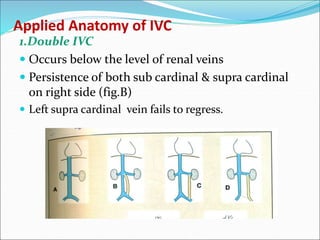
1.Double IVC
 Occurs below the level of renal veins
 Persistence of both sub cardinal & supra cardinal
on right side (fig.B)
 Left supra cardinal vein fails to regress.
2.Left IVC
 Fig.E-Infra renal part of IVC present on left side only.
3.Absence of hepatic segment of IVC
 Fig.G-Non development of anastomosis betn. the right
sub cardinal & hepatocardiac channel.
4.Pre ureteric vena cava
 Here IVC lies post. to right ureter.
 Caused by –when infra renal part of IVC develops from
right sub cardinal & post.cardinal vein instead of supra
cardinal vein.(lies post.to ureter)

Development of venous system

  • 1.
  • 2.
    Development of primitiveveins  Visceral & somatic 1.Vitelline veins (omphalomesentric) -- arise from capillary plexuses o the splanchnic mesoderm around yolk sac. 2.Umbilical veins convey oxygenated blood from placenta. 3.Cardinal veins drains from the body wall. ant.C V--cephalic ,upper limb bud. post.C V—caudal,lower limb bud CCV/duct of Cuvier
  • 3.
    Development & fateof Umbilical veins  With the appearance of hepatic bud right UV disappears.  Left UV joins at left branch of portal vein.  With increase of placental circulation it causes a direct communication betn.left UV & right hepato cardiac channel ->Ductus venosus.
  • 4.
    Development & Fateof Vitelline Veins  Hepatic bud –divides in to infra, intra & supra hepatic parts  INFRA HEPATIC PARTS  Forms 3 transverse anastomosis - Cephalic ventral - Middle dorsal - Caudal ventral  Spleenic vein & sup.mesentric vein joins at left end of middle dorsal anastamosis.
  • 5.
     Formation oftrunk of PORTAL VEIN.  Right branch of portal vein.  Left branch of portal vein ->It receives oxyganated blood from left umbilical vein which ends here.
  • 6.
    INTRA HEPATIC PART With the development of liver-proximal parts VV & UV broken in to capillary plexus & joins to form hepatic sinusoids  Afferent vessels—Venae advehentes, persists as intra hepatic br. Of portal vein  Efferent vessels– Venae revehentes & forms the tributeries of hepatic veins.
  • 7.
    SUPRA HEPATIC PART Transverse sub diaphragmatic anastomosis connects both VV.  A new vessels grows betn. Subdiaphragmatic & sub hepatic cephalic ventral anastomosis.  After left part of subdiaphragmatic anastomosis & adjoining part of left VV disappear.  Right part of VV enlarges to form common hepatic vein.
  • 8.
    Development & fateof ant. Cardinal vein Cervico thoracic Part.  It receives intersegmental veins from body wall.  One enlarged vein from upper limb -Subclavian vein.
  • 9.
  • 10.
  • 11.
    Development of –leftsup. Intercostal vein &2nd,3rd intercostal veins
  • 12.
    Applied anatomy ofSVC 1.Double SVC-Persistent left ant.& CCV. 2.Left SVC-caudal part of the right ant. Cardinal vein & CCV disappear.
  • 13.
    Development & fateof post.Cardinal vein
  • 14.
    Development of IVC,Right & Left Common iliac vein.
  • 15.
    Development of Renal,Suprarenal & Gonadal Veins
  • 16.
    Azygos vein--vein ofright azygos line --right post. Cardinal vein. Hemiazygos & Acc. Hemiazygos—left azygos --post aortic anastmosis
  • 17.
    Applied Anatomy ofIVC 1.Double IVC  Occurs below the level of renal veins  Persistence of both sub cardinal & supra cardinal on right side (fig.B)  Left supra cardinal vein fails to regress.
  • 18.
    2.Left IVC  Fig.E-Infrarenal part of IVC present on left side only. 3.Absence of hepatic segment of IVC  Fig.G-Non development of anastomosis betn. the right sub cardinal & hepatocardiac channel.
  • 19.
    4.Pre ureteric venacava  Here IVC lies post. to right ureter.  Caused by –when infra renal part of IVC develops from right sub cardinal & post.cardinal vein instead of supra cardinal vein.(lies post.to ureter)