INSTITUTE OF EDUCATION
SUBJECT : ADVANCED EDUCATIONAL TECHNOLOGY
Power Point Presentation
On
DEVELOPMENT OF COMPUTER AIDED MATERIALS
Submitted To:
Submitted By:
DR. MAHENDRA KUMAR (Assistant Professor)
SHIVAM KANKANE
DR. DEEPTI KUMARI (Assistant Professor) Course:
M.ED. FINAL YEAR
 To Explore The Use Of Computer-Aided Materials In Education And Its
Impact On Teaching And Learning.
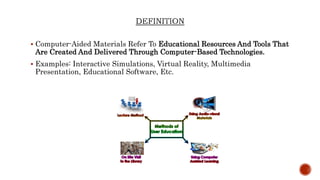
 Computer-Aided Materials Refer To Educational Resources And Tools That
Are Created And Delivered Through Computer-Based Technologies.
 Examples: Interactive Simulations, Virtual Reality, Multimedia
Presentation, Educational Software, Etc.
 IMPROVED ENGAGEMENT: Interactive And Visually Appealing
Materials Capture Student’s Attention And Enhance Their Motivation To
Learn.
 ENHANCED LEARNING EXPERIENCES: Computer-Aided Materials
Provide Immersive And Interactive Experiences That Help Students
Understand Complex Concepts.
 PERSONALIZED LEARNING: Adaptive Technologies In Computer-Aided
Materials Can Tailor Content To Individual Student’s Needs, Pacing, And
Learning Styles.
 ACCESSIBILITY: Computer-Aided Materials Can Be Designed To
Accommodate Diverse Learners, Including Those With Disabilities.
 MULTIMEDIA PRESENTATIONS: Interactive Slideshows And Videos
That Incorporate Multimedia Elements Such As Images, Audio, And Video
Clips.
 SIMULATIONS: Virtual Environments That Stimulate Real-Life
Scenarios, Allowing Students To Explore And Learn Through Hands-On-
Experience.
 VIRTUAL REALITY: Immersive Environments That Provide A Sense Of
Presence, Enabling Students To Interact With Digital Content In 3D.
 EDUCATIONAL SOFTWARE: Applications And Programs Specifically
Designed For Educational Purposes, Including Interactive Exercises And
Educational Games.
 VIRTUAL LABORATORIES: Simulations That Replicate Laboratory
Experiments, Providing A Safe And Cost-Effective Alternative To
Traditional Hands-On-Labs.
 AUGMENTED REALITY (AR): Overlying Digital Onto The Real World,
Enhancing Understanding And Engagement In Various Subjects.
 ONLINE LEARNING PLATFORMS: Platforms That Offer Interactive
Lessons, Quizzes, And Collaborative Features For Remote Or Blended
Learning.
 GAMIFIED LEARNING: Educational Games That Combine
Entertainment And Learning Objectives To Promote Engagement And
Knowledge Retention.
 INFRASTRUCTURE REQUIREMENTS: Availability Of Reliable Internet
Connection And Suitable Hardware Devices To Access Computer-Aided
Materials.
 TRAINING & PROFESSIONAL DEVELOPMENT: Educators Need
Support And Training To Effectively Integrate Computer-Aided Materials
Into Teaching Practices.
 CONTENT QUALITY AND SELECTION: Ensuring That Computer-Aided
Materials Align With Educational Standards And Are Suitable For The
Target Audience.
 ARTIFICIAL INTELLIGENCE (AI) INTEGRATION: AI Technologies Can
Provide Personalized Feedback, Adaptive Learning Paths, And Intelligent
Tutoring.
 EXTENTED REALITY (XR): The Convergence Of Virtual Reality (VR),
Augmented Reality (AR),And Mixed Reality (MR) To Create Immersive
Learning Experiences.
 INTERNET OF THINGS (IoT): Connecting Physical Objects To The
Internet To Enhance Interaction And Enable Data-Driven Insights In
Educational Settings.
 BLOCKCHAIN IN EDUCATION: Securing Academic Records, Verifying
Credentials, And Facilitating Lifelong Learning Through Decentralized
Platforms.
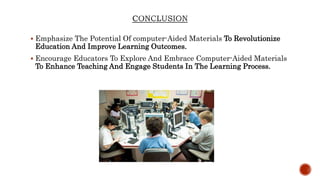
 Emphasize The Potential Of computer-Aided Materials To Revolutionize
Education And Improve Learning Outcomes.
 Encourage Educators To Explore And Embrace Computer-Aided Materials
To Enhance Teaching And Engage Students In The Learning Process.
Development Of Computer Aided Materials.pptx

Development Of Computer Aided Materials.pptx

  • 1.
    INSTITUTE OF EDUCATION SUBJECT: ADVANCED EDUCATIONAL TECHNOLOGY Power Point Presentation On DEVELOPMENT OF COMPUTER AIDED MATERIALS Submitted To: Submitted By: DR. MAHENDRA KUMAR (Assistant Professor) SHIVAM KANKANE DR. DEEPTI KUMARI (Assistant Professor) Course: M.ED. FINAL YEAR
  • 2.
     To ExploreThe Use Of Computer-Aided Materials In Education And Its Impact On Teaching And Learning.
  • 3.
     Computer-Aided MaterialsRefer To Educational Resources And Tools That Are Created And Delivered Through Computer-Based Technologies.  Examples: Interactive Simulations, Virtual Reality, Multimedia Presentation, Educational Software, Etc.
  • 4.
     IMPROVED ENGAGEMENT:Interactive And Visually Appealing Materials Capture Student’s Attention And Enhance Their Motivation To Learn.  ENHANCED LEARNING EXPERIENCES: Computer-Aided Materials Provide Immersive And Interactive Experiences That Help Students Understand Complex Concepts.  PERSONALIZED LEARNING: Adaptive Technologies In Computer-Aided Materials Can Tailor Content To Individual Student’s Needs, Pacing, And Learning Styles.  ACCESSIBILITY: Computer-Aided Materials Can Be Designed To Accommodate Diverse Learners, Including Those With Disabilities.
  • 5.
     MULTIMEDIA PRESENTATIONS:Interactive Slideshows And Videos That Incorporate Multimedia Elements Such As Images, Audio, And Video Clips.  SIMULATIONS: Virtual Environments That Stimulate Real-Life Scenarios, Allowing Students To Explore And Learn Through Hands-On- Experience.  VIRTUAL REALITY: Immersive Environments That Provide A Sense Of Presence, Enabling Students To Interact With Digital Content In 3D.  EDUCATIONAL SOFTWARE: Applications And Programs Specifically Designed For Educational Purposes, Including Interactive Exercises And Educational Games.
  • 6.
     VIRTUAL LABORATORIES:Simulations That Replicate Laboratory Experiments, Providing A Safe And Cost-Effective Alternative To Traditional Hands-On-Labs.  AUGMENTED REALITY (AR): Overlying Digital Onto The Real World, Enhancing Understanding And Engagement In Various Subjects.  ONLINE LEARNING PLATFORMS: Platforms That Offer Interactive Lessons, Quizzes, And Collaborative Features For Remote Or Blended Learning.  GAMIFIED LEARNING: Educational Games That Combine Entertainment And Learning Objectives To Promote Engagement And Knowledge Retention.
  • 8.
     INFRASTRUCTURE REQUIREMENTS:Availability Of Reliable Internet Connection And Suitable Hardware Devices To Access Computer-Aided Materials.  TRAINING & PROFESSIONAL DEVELOPMENT: Educators Need Support And Training To Effectively Integrate Computer-Aided Materials Into Teaching Practices.  CONTENT QUALITY AND SELECTION: Ensuring That Computer-Aided Materials Align With Educational Standards And Are Suitable For The Target Audience.
  • 9.
     ARTIFICIAL INTELLIGENCE(AI) INTEGRATION: AI Technologies Can Provide Personalized Feedback, Adaptive Learning Paths, And Intelligent Tutoring.  EXTENTED REALITY (XR): The Convergence Of Virtual Reality (VR), Augmented Reality (AR),And Mixed Reality (MR) To Create Immersive Learning Experiences.  INTERNET OF THINGS (IoT): Connecting Physical Objects To The Internet To Enhance Interaction And Enable Data-Driven Insights In Educational Settings.  BLOCKCHAIN IN EDUCATION: Securing Academic Records, Verifying Credentials, And Facilitating Lifelong Learning Through Decentralized Platforms.
  • 10.
     Emphasize ThePotential Of computer-Aided Materials To Revolutionize Education And Improve Learning Outcomes.  Encourage Educators To Explore And Embrace Computer-Aided Materials To Enhance Teaching And Engage Students In The Learning Process.