Development of chemo-
enzymatic Process
Biotransformations have been used by humankind for
several thousand years. The classic examples are the
conversion of ethanol to acetic acid by Acetobacter or
ethanol production by sugar‐based fermentations.
However, biocatalysis technology has only emerged as a
powerful tool since the mid-2000s or so and has rapidly
become an established method in organic chemical
synthesis, as evident from the large number of
publications in this area.
This exponential growth is driven by a combination of
factors, which include the following
Introduction
Availability of numerous whole‐genome sequences .
The ability to modify enzymes via enzyme engineering to
meet process targets,
Advances in recombinant protein expression and
fermentation technology .
Successful application of biocatalysis at the manufacturing
scale without the need for specialized equipment or plants.
Biocatalytic processes are often intrinsically “green” and
therefore contribute to waste reduction.
Biocatalysis can generate intellectual property (IP) or
preserve freedom to operate (FTO) by enabling novel
route to active pharmaceutical ingradients
SYNTHETIC ROUTE DESIGN AND INTEGRATION OF BIOCATALYSIS
Synthetic strategies for pharmaceutical intermediates and
APIs have so far shown limited incorporation of the
diverse pool of biocatalysts that are currently available.
This is possibly due to a lack of awareness on the part of
synthetic chemists as to biocatalysis and its applications.
synthetic route design is the critical first step for
incorporating biocatalysis into a synthetic route. This
requires close interaction between biocatalysis experts
and synthetic chemists and should start at the
brainstorming stage to design a new route or enable a
current route.
The scope for biocatalysis integration in a synthetic
route will be highly dependent on
the stage of program,
scope of improvement,
and challenges in the existing route.
The goal of this interaction and the bringing in of a
biocatalytic step should be value driven.
This could be simply providing a solution for a current
challenging chemistry step or developing an altogether
new route.
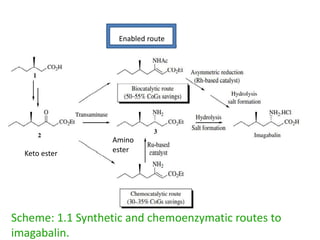
Imagabalin is an example that illustrates the integration
of biocatalysis into synthetic route design.
Imagabalin was a late‐stage candidate with high
projected volumes and high cost of goods (COGs), which
drove process improvement efforts.
The enabling route synthesis (Scheme 1.1) was highly
efficient and was successfully used to produce material
on large scale, for clinical supply .
However, to overcome the high COGs, two new routes
were proposed, including a biocatalytic route
(Scheme 1.1) projected to reduce COGs by 50–55%.
Enabled route
Scheme: 1.1 Synthetic and chemoenzymatic routes to
imagabalin.
Keto ester
Amino
ester
These enzymes can be obtained from vendors or by
cloning and expression from genes of interest, commonly
available in protein data banks. Several companies offer
various enzyme screening kits, including kits where
enzymes are arranged in a 96‐well format and are ready
for screening.
These enzyme kits facilitate rapid feasibility evaluation
with a small amount of substrate (25–100mg). Having a
good analytical assay, with the possibility of running
96‐well plates both for screening and analysis, could
provide a streamlined and faster access to data and
enzyme hits.
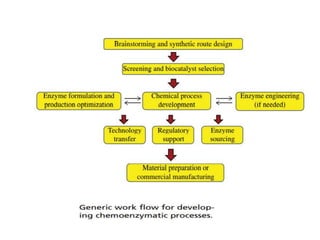
1.SCREENING AND BIOCATALYST SELECTION
2. CHEMOENZYMATIC PROCESS DEVELOPMENT
Identifying an enzyme hit for a desired reaction is a big
leap forward in developing a chemoenzymatic process.
The next step is to access an appropriate enzyme that
fits the current process requirements, which vary
depending upon the stage of the program (i.e.,
discovery, early development, late‐stage development,
or manufacturing).
3.Reaction Engineering versus Enzyme Engineering
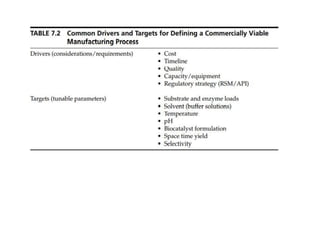
The development of a process is generally determined
by a set of target parameters and drivers, which are
defined by the stage of development of the target
molecule, the specific nature of the process, and
whether it involves a single chemical step or a series of
reactions.
The time available to develop a given process defines
how much reaction or catalyst optimization can be
done and how far a given target parameter such as
substrate or enzyme load can be pushed. Time
available for development is closely linked to the
stage of development of a particular compound and
whether the material is part of a regulatory synthesis
or will ultimately be prepared at a vendor site
One of the most critical factors in the successful
development of an enzymatic manufacturing process
is the throughput or volumetric productivity of the
enzymatic step, which is determined mainly by the
concentration of substrate and the reaction rate.
Identifying an efficient biocatalyst (or at least one that
can be easily engineered) in the initial screen is the
key to achieving the desired volumetric productivity
downstream.
In order to achieve the desired process targets, the level
of optimization required varies depending on how good
the starting enzyme is, both in terms of activity and
operational stability under process conditions. Therefore,
most of the work done in enzymatic process
development centers around the enzyme itself and how
to maintain high reaction rates at substrate loads that are
high enough to enable an economically viable process,
typically ≥50g/L
Enzymatic reaction engineering (or optimization) is
the systematic alteration of reaction components
and/or conditions, such as solvent, additive,
temperature, pH, enzyme formulation, substrate,
etc., to access desired activity. Optimization can be
performed in a linear fashion or using design of
experiment (DOE) approaches.
In terms of the form of biocatalyst used, the main
options are whole cells, stabilized lysate, and
lyophilized enzyme. Alternative conditions that confer
stability to enzymes, such as immobilization, presence
of additives, and cross‐linking, are routinely employed
to maximize the throughput of an enzymatic process
In recent, intensive efforts have been directed toward
the improvement of enzyme activity, selectivity, and
stability via protein engineering.
Achieving a successful throughput target requires an
enzyme with not only the desired activity and
selectivity but also with high stability. The
improvement of enzyme robustness by means of
site‐directed mutagenesis has been reported for
several decades as a means to increase enzyme
thermodynamic stability. More recently, the ability of
an enzyme to maintain its activity under process
conditions (kinetic or process stability) has been the
focus of engineering programs for enzymes used in
industry
The increase in rigidity of regions of the active site
proved to improve the kinetic stability. This and other
studies support the idea that optimizing the correct
conformation of those active site residues playing a key
role in enzyme catalysis is a key to achieving robust
enzyme variants, with kinetic stability in a broad range of
process conditions.
Even with the most robust biocatalysts, what is often
encountered at high substrate loads (>1M concentrations) is
the issue of enzyme inhibition or deactivation. Improving
enzyme activity and stability, as well as overcoming substrate
and product inhibition, is an essential requirement in
ensuring a process with high volumetric productivity. The
use of reactor configurations that minimize enzyme
inhibition has been widely reported and adopted in industry
4.Product Isolation
The types of challenges found in the recovery of
products from both whole cell and isolated enzyme
biocatalytic reactions can vary depending on
the type of reactor (stirred tank or membrane
reactors),
the form of the enzyme (immobilized or free form),
the reaction media (aqueous or organic), and
the amount of biocatalyst used.
In general, reactions performed in organic media offer
easier product recovery as the biocatalyst can be
removed by simple filtration followed by solvent
evaporation
The extractive recovery of products and/or remaining
substrates from aqueous or aqueous/organic reaction
systems is often complicated by the tendency of
enzymes (and other components found in enzyme
preparations) and whole cells to form emulsions
when in contact with aqueous–organic interfaces.
Formation of stable emulsions that hamper product
recovery is one of the challenges encountered when
applying biocatalysis to organic synthesis. Continuous
centrifugation can be used to separate phases from
stable emulsions, but it is not always available in
manufacturing facilities and therefore could require
capital investment.
Scale‐Up of Enzymatic Processes
Equipment Requirements
Pharmaceutical pilot plant and commercial manufacturing
facilities are typically batch manufacturing facilities, and in
general these serve well for enzymatic processes
pH monitoring and control
Continuous centrifugation
refrigerated (4–8°C) or freezer (−20 °C) storage
GC, HPLC, or
spectrophotometers
Gel electrophoresis
equipment
Sourcing of Biocatalysts and Biocatalyst‐Derived Materials
Many of the issues that should be considered in the
sourcing of biocatalysts and biocatalyst‐derived materials
are much the same as for traditional reagents
and chemistry‐derived materials.
Some of these are cost, quality, reliability of the vendor,
control and security of intellectual property (IP), freedom
to operate (FTO), the vendor’s business model, avoidance
of being single sourced
Identity of the Enzyme and Being Single Sourced
There are some special considerations involved with
sourcing of biocatalysts.
The first of these is that in many cases the biocatalyst
is proprietary or a trade secret and its exact identity is
not disclosed to the customer. It is common for
vendors, through the use of rigorous material transfer
agreements (MTAs) and the like, to greatly restrict the
knowledge of the enzyme, its structure, or its amino
acid sequence from the customer.
Enzyme Supply Scenarios
The various issues that arise when sourcing enzymes
and biocatalytic processes can be organized by
examining two major factors.
These are (i) whether the enzyme is commercially
available and
(ii) whether, and how, the customer has the FTO. The
combination of these factors leads to five typical
scenarios
Enzyme Commercially Available; Customer has Freedom
to Operate
Enzyme Not Commercially Available; Customer has Freedom
to Operate
Enzyme Not Commercially Available; Enzyme is Proprietary
to the Customer
First, a production process must be developed, either by
the customer or the vendor
The second issue is one of IP management.
Enzyme Commercially Available;
Enzyme is Proprietary to the Vendor
Enzyme Not Commercially Available;
Enzyme is Proprietary to the Vendor
Manufacture of APIs using Enzymes:
Quality and Safety Aspects
While existing guidance relating to API purity from major
organizations (FDA, European Medicines Agency,
International Conference on Harmonization) deals clearly
with the quality of starting materials, solvents, and
reagents, it does not explicitly address the use of enzymes.
This lack of specific guidance can result in ambiguity
concerning requirements for filing enzyme‐based processes.
This is an important topic since the increasing availability of
enzymes, particularly engineered enzymes, should lead to
more successful applications of enzymes for API
manufacture and the subsequent need for a clear path for
filing enzymatic processes.
Biocatalyst Source and Quality
Since the key input material in an enzymatic
process is the enzyme itself, the source and quality
of the enzyme are obviously important factors to
consider in assessing potential risks to drug quality
and patient safety
Enzymes sourced from vendors should come with a
certificate of analysis (CoA) that provides
information regarding specifications.
THANKS

Development of chemoenzymatic process.pptx

  • 1.
  • 2.
    Biotransformations have beenused by humankind for several thousand years. The classic examples are the conversion of ethanol to acetic acid by Acetobacter or ethanol production by sugar‐based fermentations. However, biocatalysis technology has only emerged as a powerful tool since the mid-2000s or so and has rapidly become an established method in organic chemical synthesis, as evident from the large number of publications in this area. This exponential growth is driven by a combination of factors, which include the following Introduction
  • 3.
    Availability of numerouswhole‐genome sequences . The ability to modify enzymes via enzyme engineering to meet process targets, Advances in recombinant protein expression and fermentation technology . Successful application of biocatalysis at the manufacturing scale without the need for specialized equipment or plants.
  • 4.
    Biocatalytic processes areoften intrinsically “green” and therefore contribute to waste reduction. Biocatalysis can generate intellectual property (IP) or preserve freedom to operate (FTO) by enabling novel route to active pharmaceutical ingradients
  • 5.
    SYNTHETIC ROUTE DESIGNAND INTEGRATION OF BIOCATALYSIS Synthetic strategies for pharmaceutical intermediates and APIs have so far shown limited incorporation of the diverse pool of biocatalysts that are currently available. This is possibly due to a lack of awareness on the part of synthetic chemists as to biocatalysis and its applications. synthetic route design is the critical first step for incorporating biocatalysis into a synthetic route. This requires close interaction between biocatalysis experts and synthetic chemists and should start at the brainstorming stage to design a new route or enable a current route.
  • 6.
    The scope forbiocatalysis integration in a synthetic route will be highly dependent on the stage of program, scope of improvement, and challenges in the existing route. The goal of this interaction and the bringing in of a biocatalytic step should be value driven. This could be simply providing a solution for a current challenging chemistry step or developing an altogether new route.
  • 8.
    Imagabalin is anexample that illustrates the integration of biocatalysis into synthetic route design. Imagabalin was a late‐stage candidate with high projected volumes and high cost of goods (COGs), which drove process improvement efforts. The enabling route synthesis (Scheme 1.1) was highly efficient and was successfully used to produce material on large scale, for clinical supply . However, to overcome the high COGs, two new routes were proposed, including a biocatalytic route (Scheme 1.1) projected to reduce COGs by 50–55%.
  • 9.
    Enabled route Scheme: 1.1Synthetic and chemoenzymatic routes to imagabalin. Keto ester Amino ester
  • 10.
    These enzymes canbe obtained from vendors or by cloning and expression from genes of interest, commonly available in protein data banks. Several companies offer various enzyme screening kits, including kits where enzymes are arranged in a 96‐well format and are ready for screening. These enzyme kits facilitate rapid feasibility evaluation with a small amount of substrate (25–100mg). Having a good analytical assay, with the possibility of running 96‐well plates both for screening and analysis, could provide a streamlined and faster access to data and enzyme hits. 1.SCREENING AND BIOCATALYST SELECTION
  • 11.
    2. CHEMOENZYMATIC PROCESSDEVELOPMENT Identifying an enzyme hit for a desired reaction is a big leap forward in developing a chemoenzymatic process. The next step is to access an appropriate enzyme that fits the current process requirements, which vary depending upon the stage of the program (i.e., discovery, early development, late‐stage development, or manufacturing).
  • 13.
    3.Reaction Engineering versusEnzyme Engineering The development of a process is generally determined by a set of target parameters and drivers, which are defined by the stage of development of the target molecule, the specific nature of the process, and whether it involves a single chemical step or a series of reactions.
  • 15.
    The time availableto develop a given process defines how much reaction or catalyst optimization can be done and how far a given target parameter such as substrate or enzyme load can be pushed. Time available for development is closely linked to the stage of development of a particular compound and whether the material is part of a regulatory synthesis or will ultimately be prepared at a vendor site
  • 16.
    One of themost critical factors in the successful development of an enzymatic manufacturing process is the throughput or volumetric productivity of the enzymatic step, which is determined mainly by the concentration of substrate and the reaction rate. Identifying an efficient biocatalyst (or at least one that can be easily engineered) in the initial screen is the key to achieving the desired volumetric productivity downstream.
  • 17.
    In order toachieve the desired process targets, the level of optimization required varies depending on how good the starting enzyme is, both in terms of activity and operational stability under process conditions. Therefore, most of the work done in enzymatic process development centers around the enzyme itself and how to maintain high reaction rates at substrate loads that are high enough to enable an economically viable process, typically ≥50g/L
  • 18.
    Enzymatic reaction engineering(or optimization) is the systematic alteration of reaction components and/or conditions, such as solvent, additive, temperature, pH, enzyme formulation, substrate, etc., to access desired activity. Optimization can be performed in a linear fashion or using design of experiment (DOE) approaches.
  • 19.
    In terms ofthe form of biocatalyst used, the main options are whole cells, stabilized lysate, and lyophilized enzyme. Alternative conditions that confer stability to enzymes, such as immobilization, presence of additives, and cross‐linking, are routinely employed to maximize the throughput of an enzymatic process In recent, intensive efforts have been directed toward the improvement of enzyme activity, selectivity, and stability via protein engineering.
  • 20.
    Achieving a successfulthroughput target requires an enzyme with not only the desired activity and selectivity but also with high stability. The improvement of enzyme robustness by means of site‐directed mutagenesis has been reported for several decades as a means to increase enzyme thermodynamic stability. More recently, the ability of an enzyme to maintain its activity under process conditions (kinetic or process stability) has been the focus of engineering programs for enzymes used in industry
  • 21.
    The increase inrigidity of regions of the active site proved to improve the kinetic stability. This and other studies support the idea that optimizing the correct conformation of those active site residues playing a key role in enzyme catalysis is a key to achieving robust enzyme variants, with kinetic stability in a broad range of process conditions. Even with the most robust biocatalysts, what is often encountered at high substrate loads (>1M concentrations) is the issue of enzyme inhibition or deactivation. Improving enzyme activity and stability, as well as overcoming substrate and product inhibition, is an essential requirement in ensuring a process with high volumetric productivity. The use of reactor configurations that minimize enzyme inhibition has been widely reported and adopted in industry
  • 22.
    4.Product Isolation The typesof challenges found in the recovery of products from both whole cell and isolated enzyme biocatalytic reactions can vary depending on the type of reactor (stirred tank or membrane reactors), the form of the enzyme (immobilized or free form), the reaction media (aqueous or organic), and the amount of biocatalyst used. In general, reactions performed in organic media offer easier product recovery as the biocatalyst can be removed by simple filtration followed by solvent evaporation
  • 23.
    The extractive recoveryof products and/or remaining substrates from aqueous or aqueous/organic reaction systems is often complicated by the tendency of enzymes (and other components found in enzyme preparations) and whole cells to form emulsions when in contact with aqueous–organic interfaces. Formation of stable emulsions that hamper product recovery is one of the challenges encountered when applying biocatalysis to organic synthesis. Continuous centrifugation can be used to separate phases from stable emulsions, but it is not always available in manufacturing facilities and therefore could require capital investment.
  • 24.
    Scale‐Up of EnzymaticProcesses Equipment Requirements Pharmaceutical pilot plant and commercial manufacturing facilities are typically batch manufacturing facilities, and in general these serve well for enzymatic processes pH monitoring and control Continuous centrifugation refrigerated (4–8°C) or freezer (−20 °C) storage GC, HPLC, or spectrophotometers Gel electrophoresis equipment
  • 25.
    Sourcing of Biocatalystsand Biocatalyst‐Derived Materials Many of the issues that should be considered in the sourcing of biocatalysts and biocatalyst‐derived materials are much the same as for traditional reagents and chemistry‐derived materials. Some of these are cost, quality, reliability of the vendor, control and security of intellectual property (IP), freedom to operate (FTO), the vendor’s business model, avoidance of being single sourced
  • 26.
    Identity of theEnzyme and Being Single Sourced There are some special considerations involved with sourcing of biocatalysts. The first of these is that in many cases the biocatalyst is proprietary or a trade secret and its exact identity is not disclosed to the customer. It is common for vendors, through the use of rigorous material transfer agreements (MTAs) and the like, to greatly restrict the knowledge of the enzyme, its structure, or its amino acid sequence from the customer.
  • 27.
    Enzyme Supply Scenarios Thevarious issues that arise when sourcing enzymes and biocatalytic processes can be organized by examining two major factors. These are (i) whether the enzyme is commercially available and (ii) whether, and how, the customer has the FTO. The combination of these factors leads to five typical scenarios
  • 28.
    Enzyme Commercially Available;Customer has Freedom to Operate Enzyme Not Commercially Available; Customer has Freedom to Operate Enzyme Not Commercially Available; Enzyme is Proprietary to the Customer First, a production process must be developed, either by the customer or the vendor The second issue is one of IP management.
  • 29.
    Enzyme Commercially Available; Enzymeis Proprietary to the Vendor Enzyme Not Commercially Available; Enzyme is Proprietary to the Vendor
  • 30.
    Manufacture of APIsusing Enzymes: Quality and Safety Aspects While existing guidance relating to API purity from major organizations (FDA, European Medicines Agency, International Conference on Harmonization) deals clearly with the quality of starting materials, solvents, and reagents, it does not explicitly address the use of enzymes. This lack of specific guidance can result in ambiguity concerning requirements for filing enzyme‐based processes. This is an important topic since the increasing availability of enzymes, particularly engineered enzymes, should lead to more successful applications of enzymes for API manufacture and the subsequent need for a clear path for filing enzymatic processes.
  • 31.
    Biocatalyst Source andQuality Since the key input material in an enzymatic process is the enzyme itself, the source and quality of the enzyme are obviously important factors to consider in assessing potential risks to drug quality and patient safety Enzymes sourced from vendors should come with a certificate of analysis (CoA) that provides information regarding specifications.
  • 32.