Development of
Assessment Tools
• Assessment tools in the affective domain, those which
are used to assess attitudes, interests, motivations and
self-efficacy, have been developed.
Self-Report
It is the most common measurement tool in the
affective domain.
It essentially requires an individual to provide an
account of his/her attitude or feelings toward a
concept or idea or people.
It is sometimes called “written reflections”.
Rating Scale
• It is a set of categories designed to elicit
information about a quantitative attribute in
social science.
• The basic concept of any rating sale is that it
consists of a number of categories. These are
usually assigned integers.
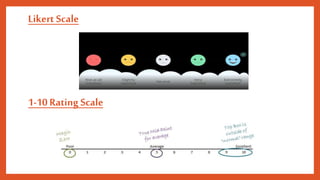
Likert Scale
1-10 Rating Scale
Semantic Differential Scale (SD)
• The SD tries to assess an individual’s reaction to
specific words, ideas, or concepts in terms of
ratings on bipolar scales defined with
contrasting adjectives at each end.
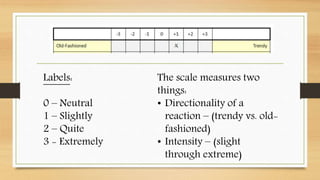
Labels:
0 – Neutral
1 – Slightly
2 – Quite
3 - Extremely
The scale measures two
things:
• Directionality of a
reaction – (trendy vs. old-
fashioned)
• Intensity – (slight
through extreme)
Basicconsiderations involvedin SDmethodology:
Bipolar adjective scales are a simple, economical
means for obtaining data on people’s reactions.
Ratings on bipolar adjective scales tend to be
correlated, and three basic dimensions of response
account for most of the co-variation in ratings.
Evaluation, Potency and Activity (EPA)
For example:
• Evaluation – good or bad
• Potency – powerful or powerless
• Activity – fast or slow
Measurements of a concept on the EPA dimensions are
referred to as the concept’s profile.
The EPA system is notable for being a multi-variate
approach to affective measurement.
The SD has been used as a measure of attitude in a wide
variety of projects.
It has been used by other investigators to study attitude
formation, attitudes toward organizations, attitudes
towards jobs and occupations, and attitudes towards
minorities.
The results in these studies support the validity of the
SD as a technique for attitude measurement.
Thank You!

Development of assessment tools

  • 1.
  • 2.
    • Assessment toolsin the affective domain, those which are used to assess attitudes, interests, motivations and self-efficacy, have been developed.
  • 3.
    Self-Report It is themost common measurement tool in the affective domain. It essentially requires an individual to provide an account of his/her attitude or feelings toward a concept or idea or people. It is sometimes called “written reflections”.
  • 4.
    Rating Scale • Itis a set of categories designed to elicit information about a quantitative attribute in social science. • The basic concept of any rating sale is that it consists of a number of categories. These are usually assigned integers.
  • 5.
  • 6.
    Semantic Differential Scale(SD) • The SD tries to assess an individual’s reaction to specific words, ideas, or concepts in terms of ratings on bipolar scales defined with contrasting adjectives at each end.
  • 7.
    Labels: 0 – Neutral 1– Slightly 2 – Quite 3 - Extremely The scale measures two things: • Directionality of a reaction – (trendy vs. old- fashioned) • Intensity – (slight through extreme)
  • 8.
    Basicconsiderations involvedin SDmethodology: Bipolaradjective scales are a simple, economical means for obtaining data on people’s reactions. Ratings on bipolar adjective scales tend to be correlated, and three basic dimensions of response account for most of the co-variation in ratings.
  • 9.
    Evaluation, Potency andActivity (EPA) For example: • Evaluation – good or bad • Potency – powerful or powerless • Activity – fast or slow Measurements of a concept on the EPA dimensions are referred to as the concept’s profile. The EPA system is notable for being a multi-variate approach to affective measurement.
  • 10.
    The SD hasbeen used as a measure of attitude in a wide variety of projects. It has been used by other investigators to study attitude formation, attitudes toward organizations, attitudes towards jobs and occupations, and attitudes towards minorities. The results in these studies support the validity of the SD as a technique for attitude measurement.
  • 11.