Developing a
Research Question
One of the first steps in the
research process is developing
a research question. The
research question should be a
clear and focused question that
you can answer with information
gathered during the research
process.

Starting with a well thought-out
research question will help to
speed up the research process:
searching for information without
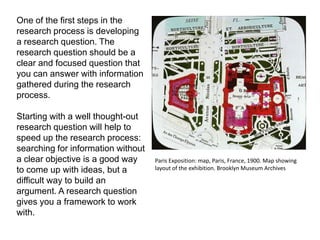
a clear objective is a good way     Paris Exposition: map, Paris, France, 1900. Map showing
to come up with ideas, but a        layout of the exhibition. Brooklyn Museum Archives

difficult way to build an
argument. A research question
gives you a framework to work
with.
Many assignments start with a research topic. This is usually a very broad idea.
Research topics might look like the following:

• Women’s Health                                       • Bullying in schools
• Arts in New York City                                • Video Games
• Pollution and the environment
                                                        In some cases, you may be asked
                                                        to choose a topic that interests
                                                        you. This can be a challenge.
                                                        Research can be a lot of fun,
                                                        especially when you’re
                                                        discovering more about a topic
                                                        you’re interested in. When you
                                                        are thinking about your research
                                                        question, try to think about
                                                        things you’re interested in.


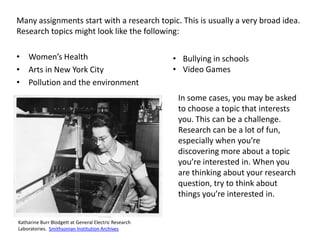
Katharine Burr Blodgett at General Electric Research
Laboratories. Smithsonian Institution Archives
Brainstorming can be
a meaningful part of
the research process.
If you don’t know a
lot about your
research topic, you
can become more
knowledgeable about
it using reference
resources, like
encyclopedias, or by
searching for
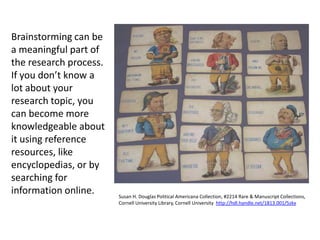
information online.     Susan H. Douglas Political Americana Collection, #2214 Rare & Manuscript Collections,
                        Cornell University Library, Cornell University http://hdl.handle.net/1813.001/5zkx
Once you’ve learned more about your topic, it will be easier to begin
thinking about your research question. Examples of possible research
questions based on the previous topics might look like:

• Women’s Health                  What are the effects of nutrition
  counseling on women’s health in rural communities?
• Art in New York City               How is the Jewish immigrant
  experience in New York City reflected in comic books from the
  golden age of comics?
• Pollution and the environment                  What can urban
  communities do on a grassroots level to lessen the effects of
  pollution?
• Bullying in schools              Is bullying responded to differently
  by teachers based on students’ gender?
• Video Games                How can video games be used to help
  teach language skills to ESL learners?
Once you’ve decided on a
research question, think about
what kinds of information you will
need to answer your question. As
you learn more about your topic,
you may find that you’ll need to
adjust your research question.

When you write a research paper,
you will introduce your research
question to your reader in your
thesis statement.

Your paper will describe how you
used the evidence gathered during
research to come to your
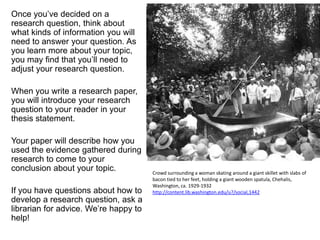
conclusion about your topic.           Crowd surrounding a woman skating around a giant skillet with slabs of
                                       bacon tied to her feet, holding a giant wooden spatula, Chehalis,
                                       Washington, ca. 1929-1932
If you have questions about how to     http://content.lib.washington.edu/u?/social,1442
develop a research question, ask a
librarian for advice. We’re happy to
help!
Need Help?
         Ask a Librarian!
http://library.citytech.cuny.edu/services/ask/

Developing the Research Question

  • 1.
  • 2.
    One of thefirst steps in the research process is developing a research question. The research question should be a clear and focused question that you can answer with information gathered during the research process. Starting with a well thought-out research question will help to speed up the research process: searching for information without a clear objective is a good way Paris Exposition: map, Paris, France, 1900. Map showing to come up with ideas, but a layout of the exhibition. Brooklyn Museum Archives difficult way to build an argument. A research question gives you a framework to work with.
  • 3.
    Many assignments startwith a research topic. This is usually a very broad idea. Research topics might look like the following: • Women’s Health • Bullying in schools • Arts in New York City • Video Games • Pollution and the environment In some cases, you may be asked to choose a topic that interests you. This can be a challenge. Research can be a lot of fun, especially when you’re discovering more about a topic you’re interested in. When you are thinking about your research question, try to think about things you’re interested in. Katharine Burr Blodgett at General Electric Research Laboratories. Smithsonian Institution Archives
  • 4.
    Brainstorming can be ameaningful part of the research process. If you don’t know a lot about your research topic, you can become more knowledgeable about it using reference resources, like encyclopedias, or by searching for information online. Susan H. Douglas Political Americana Collection, #2214 Rare & Manuscript Collections, Cornell University Library, Cornell University http://hdl.handle.net/1813.001/5zkx
  • 5.
    Once you’ve learnedmore about your topic, it will be easier to begin thinking about your research question. Examples of possible research questions based on the previous topics might look like: • Women’s Health What are the effects of nutrition counseling on women’s health in rural communities? • Art in New York City How is the Jewish immigrant experience in New York City reflected in comic books from the golden age of comics? • Pollution and the environment What can urban communities do on a grassroots level to lessen the effects of pollution? • Bullying in schools Is bullying responded to differently by teachers based on students’ gender? • Video Games How can video games be used to help teach language skills to ESL learners?
  • 6.
    Once you’ve decidedon a research question, think about what kinds of information you will need to answer your question. As you learn more about your topic, you may find that you’ll need to adjust your research question. When you write a research paper, you will introduce your research question to your reader in your thesis statement. Your paper will describe how you used the evidence gathered during research to come to your conclusion about your topic. Crowd surrounding a woman skating around a giant skillet with slabs of bacon tied to her feet, holding a giant wooden spatula, Chehalis, Washington, ca. 1929-1932 If you have questions about how to http://content.lib.washington.edu/u?/social,1442 develop a research question, ask a librarian for advice. We’re happy to help!
  • 7.
    Need Help? Ask a Librarian! http://library.citytech.cuny.edu/services/ask/