Developing Your  Research Question I know what general area, but  I’m not sure of my research question? O'Leary, Z. (2004) The Essential Guide to Doing Research. London: Sage.  Chapter Three
The Importance of Good Questions A good research question: Defines the investigation Sets boundaries Provides direction O'Leary, Z. (2004) The Essential Guide to Doing Research. London: Sage.  Chapter Three
Defining Your Topic If you are finding it a challenge to generate a research topic you can: Develop ‘right brain’ skills such as concept mapping  O'Leary, Z. (2004) The Essential Guide to Doing Research. London: Sage.  Chapter Three
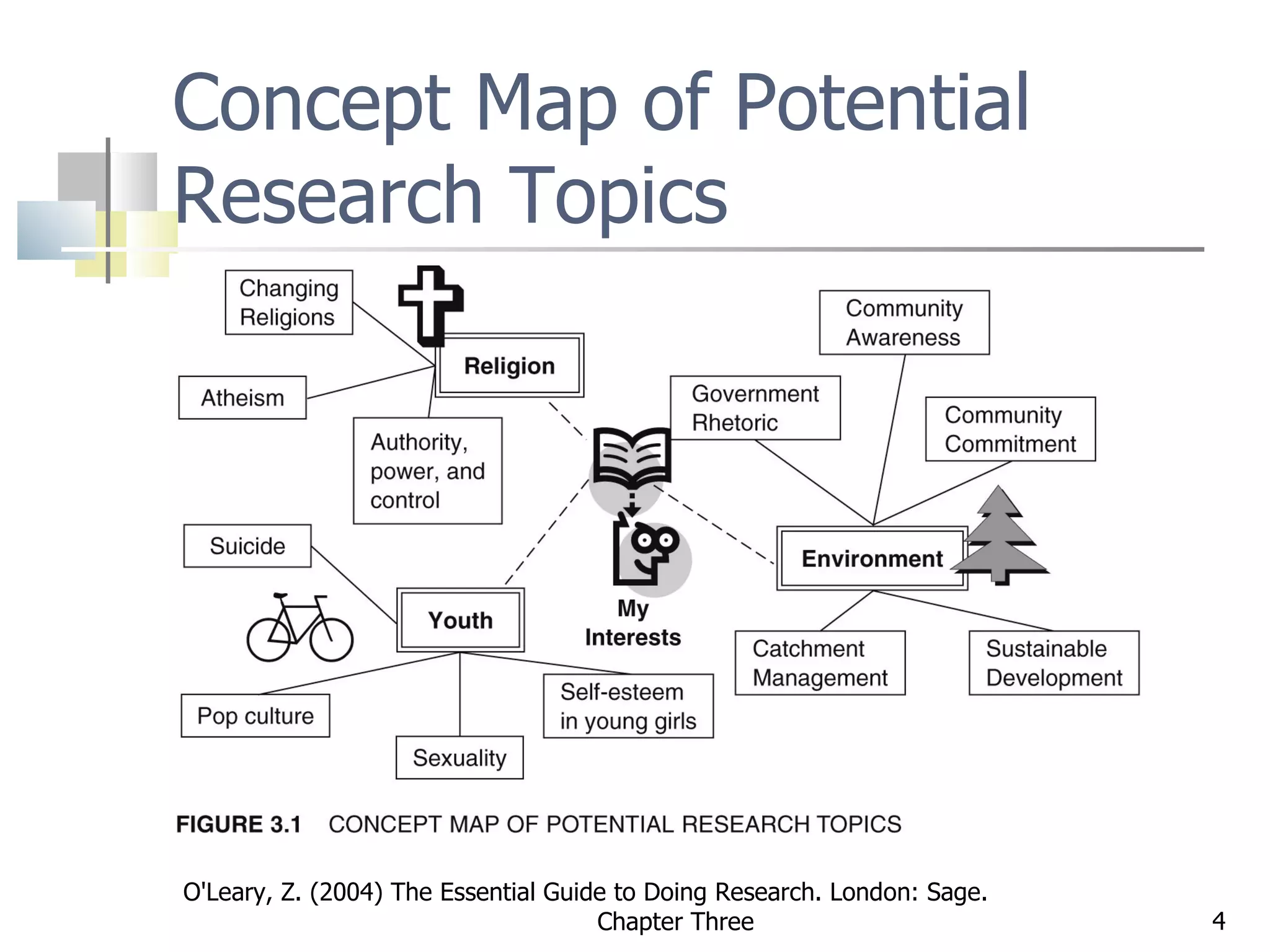
Concept Map of Potential Research Topics O'Leary, Z. (2004) The Essential Guide to Doing Research. London: Sage.  Chapter Three
From Interesting Topics to Researchable Questions An ‘angle’ for your research can come from insights stemming from: personal experience theory observations  contemporary issues  engagement with the literature  O'Leary, Z. (2004) The Essential Guide to Doing Research. London: Sage.  Chapter Three
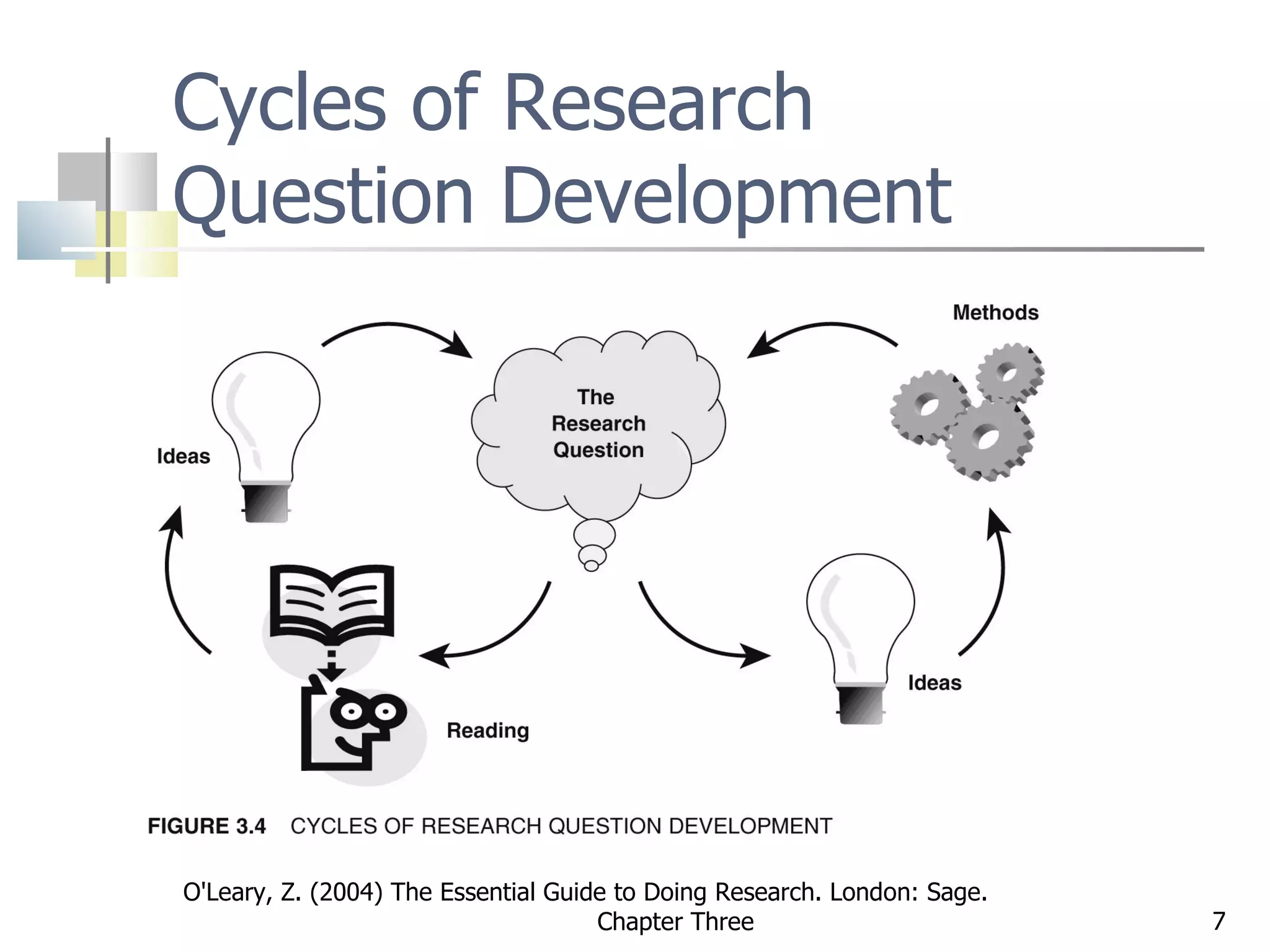
Narrowing and Clarifying Narrowing, clarifying, and even redefining your questions is essential to the research process.  Forming the right ‘questions’ should be seen as an iterative process that is informed by reading and doing at all stages.   O'Leary, Z. (2004) The Essential Guide to Doing Research. London: Sage.  Chapter Three
Cycles of Research Question Development O'Leary, Z. (2004) The Essential Guide to Doing Research. London: Sage.  Chapter Three
Good Question Checklist Is the question right for me? Will the question hold my interest?  Can I manage any potential biases/subjectivities I may have? O'Leary, Z. (2004) The Essential Guide to Doing Research. London: Sage.  Chapter Three
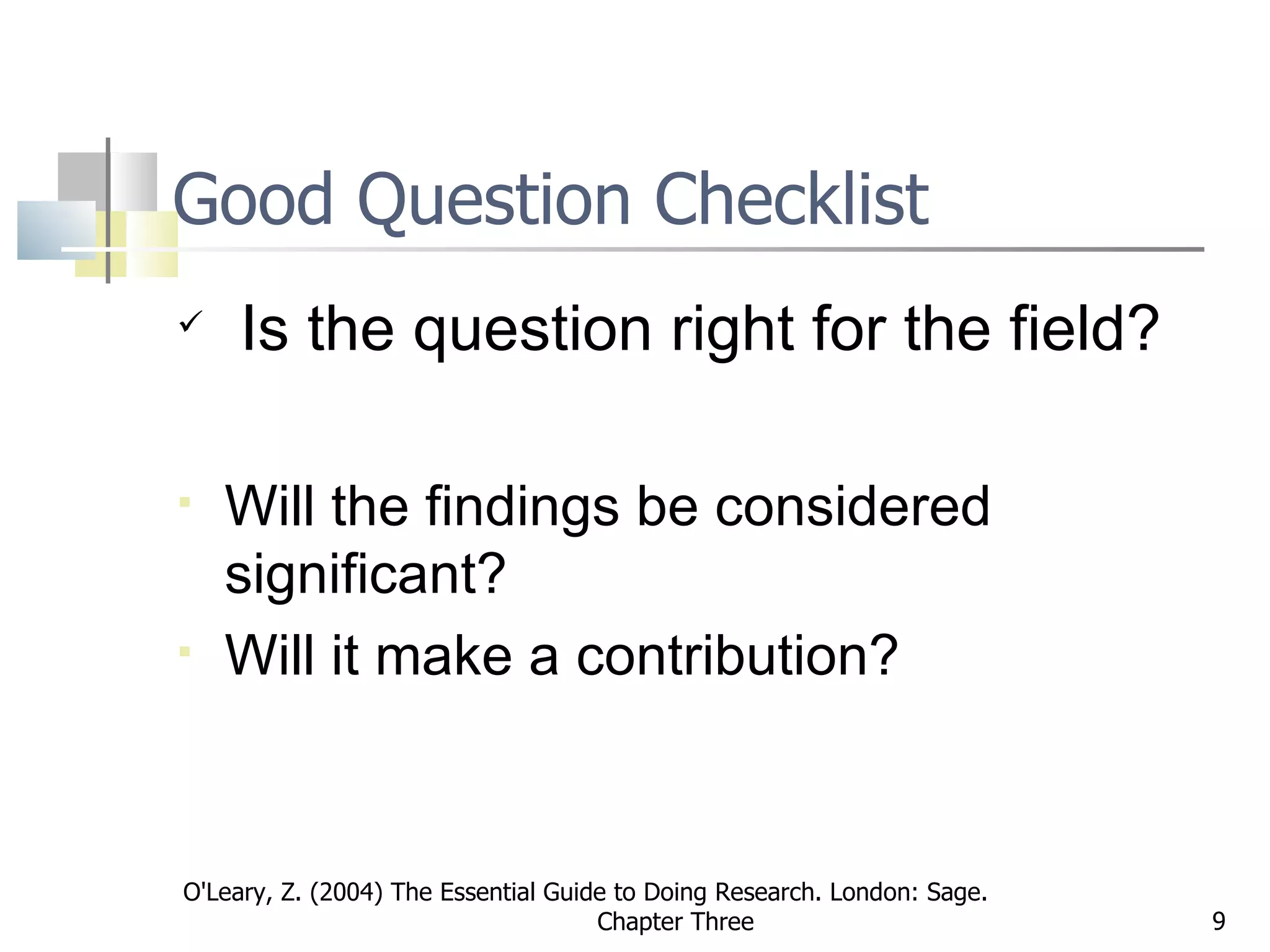
Good Question Checklist   Is the question right for the field? Will the findings be considered significant? Will it make a contribution? O'Leary, Z. (2004) The Essential Guide to Doing Research. London: Sage.  Chapter Three
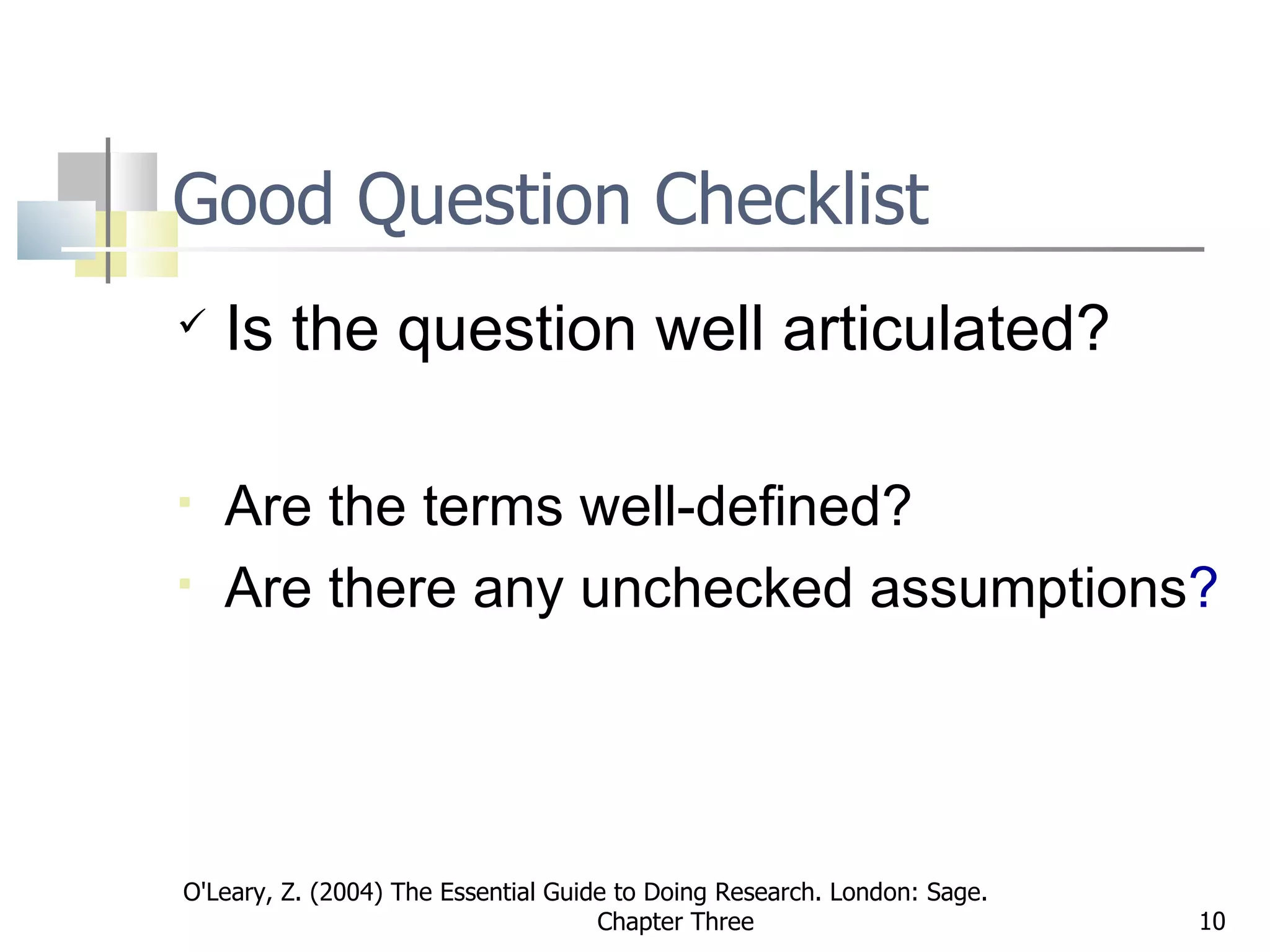
Good Question Checklist Is the question well articulated? Are the terms well-defined? Are there any unchecked assumptions ?   O'Leary, Z. (2004) The Essential Guide to Doing Research. London: Sage.  Chapter Three
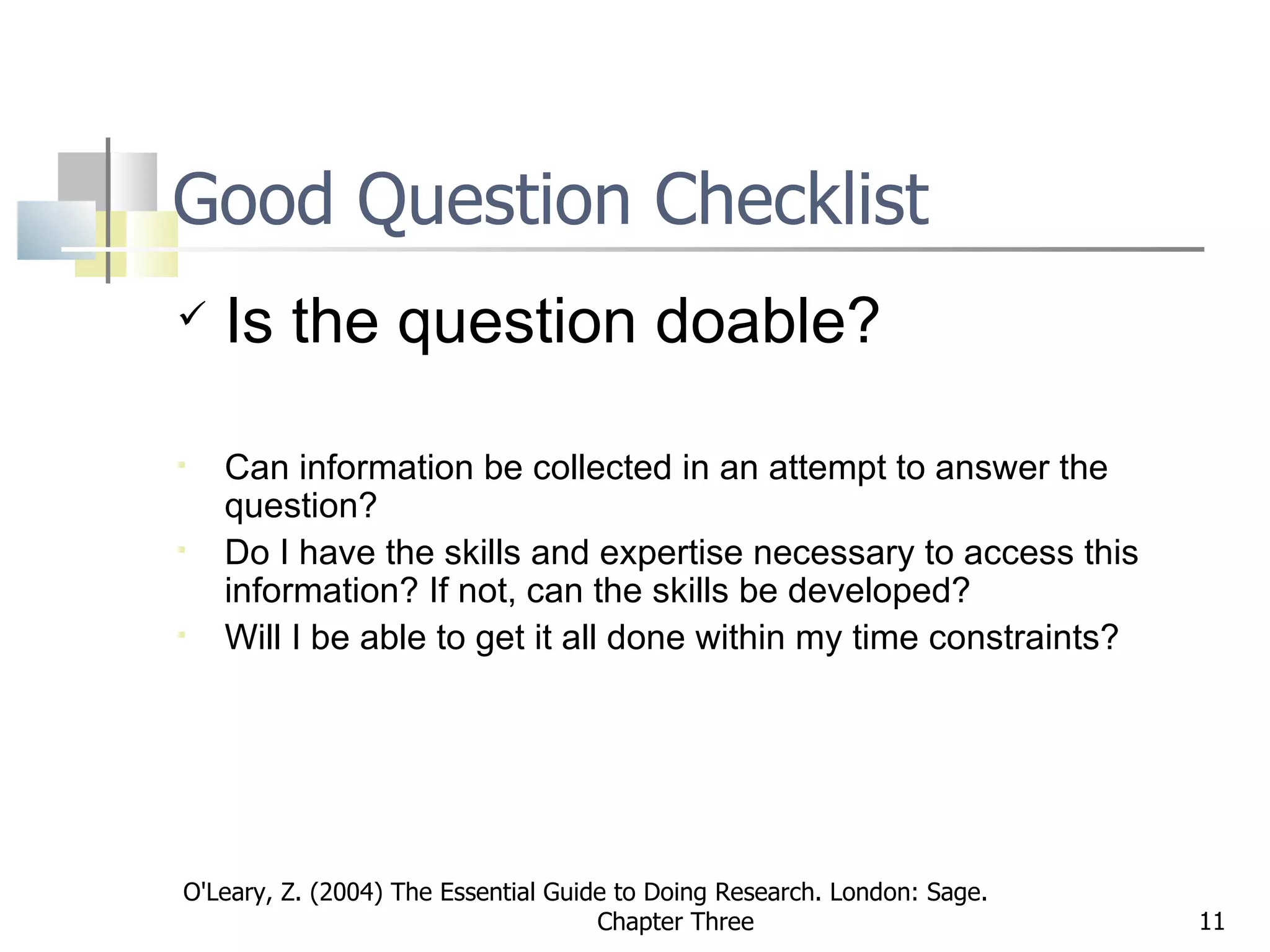
Good Question Checklist Is the question doable? Can information be collected in an attempt to answer the question?  Do I have the skills and expertise necessary to access this information? If not, can the skills be developed? Will I be able to get it all done within my time constraints?   O'Leary, Z. (2004) The Essential Guide to Doing Research. London: Sage.  Chapter Three
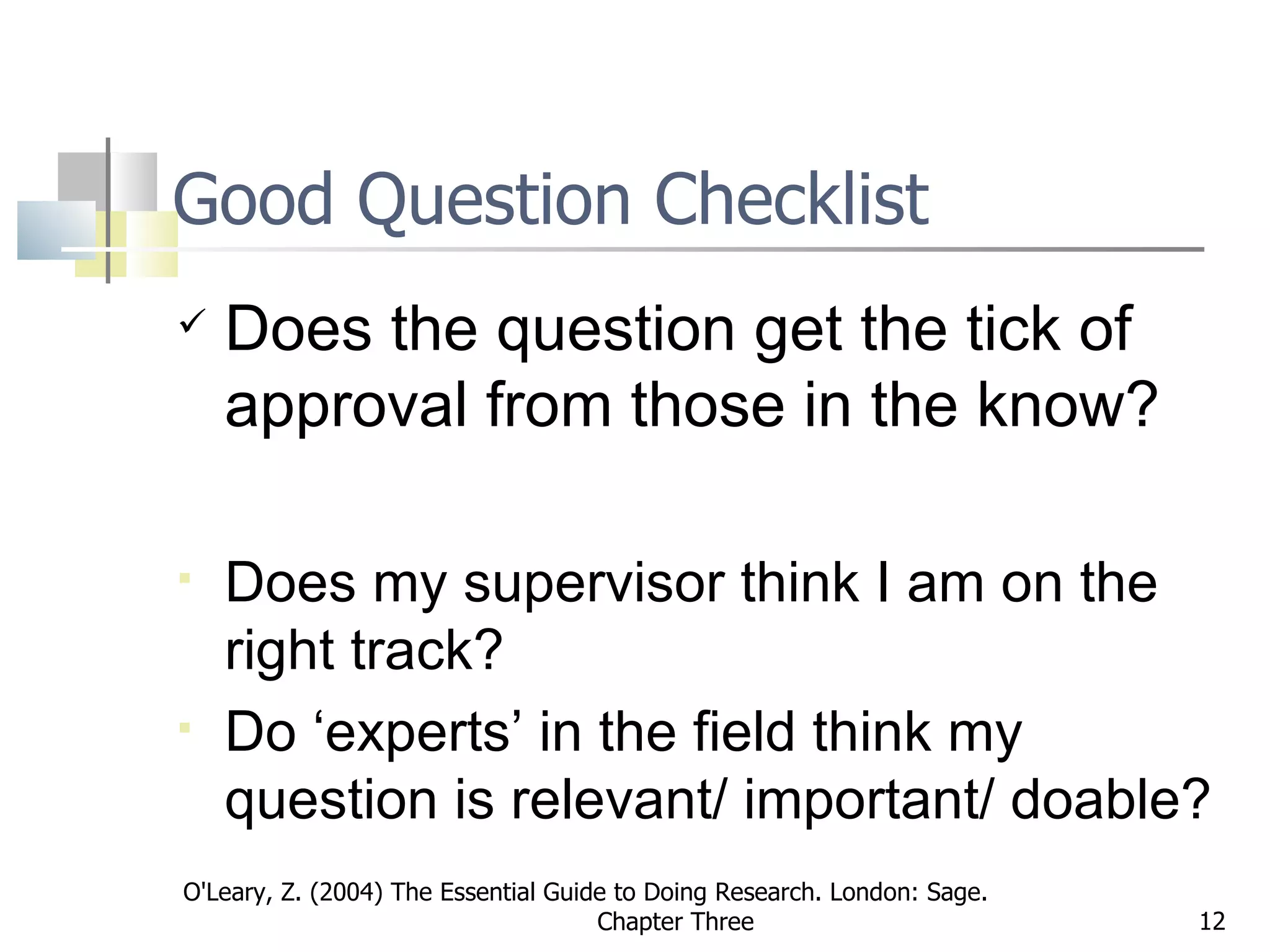
Good Question Checklist Does the question get the tick of approval from those in the know? Does my supervisor think I am on the right track? Do ‘experts’ in the field think my question is relevant/ important/ doable? O'Leary, Z. (2004) The Essential Guide to Doing Research. London: Sage.  Chapter Three

Formulating research questions

  • 1.
    Developing Your Research Question I know what general area, but I’m not sure of my research question? O'Leary, Z. (2004) The Essential Guide to Doing Research. London: Sage. Chapter Three
  • 2.
    The Importance ofGood Questions A good research question: Defines the investigation Sets boundaries Provides direction O'Leary, Z. (2004) The Essential Guide to Doing Research. London: Sage. Chapter Three
  • 3.
    Defining Your TopicIf you are finding it a challenge to generate a research topic you can: Develop ‘right brain’ skills such as concept mapping O'Leary, Z. (2004) The Essential Guide to Doing Research. London: Sage. Chapter Three
  • 4.
    Concept Map ofPotential Research Topics O'Leary, Z. (2004) The Essential Guide to Doing Research. London: Sage. Chapter Three
  • 5.
    From Interesting Topicsto Researchable Questions An ‘angle’ for your research can come from insights stemming from: personal experience theory observations contemporary issues engagement with the literature O'Leary, Z. (2004) The Essential Guide to Doing Research. London: Sage. Chapter Three
  • 6.
    Narrowing and ClarifyingNarrowing, clarifying, and even redefining your questions is essential to the research process. Forming the right ‘questions’ should be seen as an iterative process that is informed by reading and doing at all stages. O'Leary, Z. (2004) The Essential Guide to Doing Research. London: Sage. Chapter Three
  • 7.
    Cycles of ResearchQuestion Development O'Leary, Z. (2004) The Essential Guide to Doing Research. London: Sage. Chapter Three
  • 8.
    Good Question ChecklistIs the question right for me? Will the question hold my interest? Can I manage any potential biases/subjectivities I may have? O'Leary, Z. (2004) The Essential Guide to Doing Research. London: Sage. Chapter Three
  • 9.
    Good Question Checklist  Is the question right for the field? Will the findings be considered significant? Will it make a contribution? O'Leary, Z. (2004) The Essential Guide to Doing Research. London: Sage. Chapter Three
  • 10.
    Good Question ChecklistIs the question well articulated? Are the terms well-defined? Are there any unchecked assumptions ?   O'Leary, Z. (2004) The Essential Guide to Doing Research. London: Sage. Chapter Three
  • 11.
    Good Question ChecklistIs the question doable? Can information be collected in an attempt to answer the question? Do I have the skills and expertise necessary to access this information? If not, can the skills be developed? Will I be able to get it all done within my time constraints?   O'Leary, Z. (2004) The Essential Guide to Doing Research. London: Sage. Chapter Three
  • 12.
    Good Question ChecklistDoes the question get the tick of approval from those in the know? Does my supervisor think I am on the right track? Do ‘experts’ in the field think my question is relevant/ important/ doable? O'Leary, Z. (2004) The Essential Guide to Doing Research. London: Sage. Chapter Three