Developing the Retained Organization Presented by the International Association of Outsourcing Professionals The 2008 Outsourcing World Summit February 18-20, 2008 | Orlando, Florida
Featured Speaker Mark Peacock Principal Chicago, IL (312) 325-2920 [email_address] Leader of the Outsourcing Advisory Practice at Archstone Consulting 15 years of experience assisting clients develop and implement outsourcing and offshoring strategies Mark's experience includes all aspects of outsourcing/offshoring across stages of the lifecycle – strategy, procurement, negotiation, implementation, and restructuring Prior experience – Deloitte Consulting, IBM
Introduction The Retained Organization plays a critical role in mitigating risk and supporting a successful outsourcing implementation 75% of providers in 2007 Duke University survey cited poorly skilled retained organizations as a key reason for the dissolution of outsourcing deals 1 A 2006 AberdeenGroup research report identifies under-staffed and under-skilled retained organizations as one of the Top 5 Challenges in the Transition and Operating phases of outsourcing 2 Leading Companies are identifying necessary skills and knowledge earlier in the outsourcing process Sources: 1  Duke University Offshore Research Network,  2007 Service Provider Survey Debriefing Workshop , 22 Oct 2007 2  AberdeenGroup,  Business Value of IT Outsourcing , Jul 2006
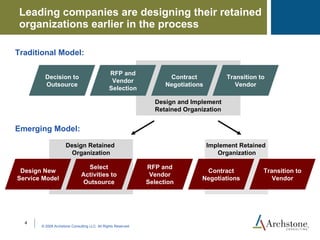
Leading companies are designing their retained organizations earlier in the process Decision to Outsource RFP and Vendor Selection Contract Negotiations Transition to Vendor Select Activities to Outsource RFP and Vendor Selection Contract Negotiations Transition to Vendor Design New Service Model Traditional Model: Emerging Model: Design and Implement  Retained Organization Design Retained  Organization Implement Retained  Organization
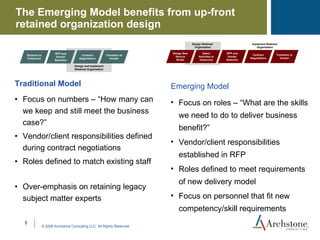
The Emerging Model benefits from up-front retained organization design Traditional Model Focus on numbers – “How many can we keep and still meet the business case?” Vendor/client responsibilities defined during contract negotiations  Roles defined to match existing staff Over-emphasis on retaining legacy subject matter experts Emerging Model Focus on roles – “What are the skills we need to do to deliver business benefit?” Vendor/client responsibilities established in RFP  Roles defined to meet requirements of new delivery model Focus on personnel that fit new competency/skill requirements
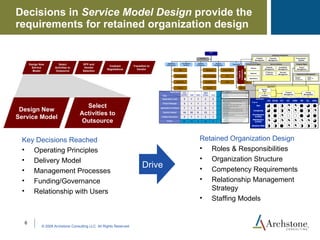
Decisions in  Service Model Design  provide the requirements for retained organization design Select Activities to Outsource Design New Service Model Key Decisions Reached Operating Principles Delivery Model Management Processes Funding/Governance Relationship with Users Retained Organization Design Roles & Responsibilities Organization Structure Competency Requirements Relationship Management Strategy  Staffing Models Drive
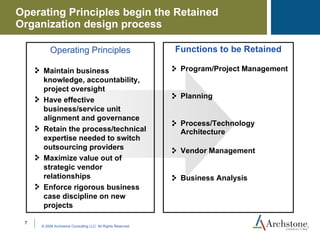
Functions to be Retained Program/Project Management Planning Process/Technology Architecture Vendor Management Business Analysis Operating Principles begin the Retained Organization design process Operating Principles Maintain business knowledge, accountability,  project oversight Have effective business/service unit alignment and governance Retain the process/technical expertise needed to switch outsourcing providers Maximize value out of strategic vendor relationships Enforce rigorous business case discipline on new projects
Delivery Model drives the responsibilities for the Retained Organization and the Outsourcer(s) In this IT example, the industry-standard ITIL framework was used to structure the Delivery Model ITIL – Information Technology Infrastructure Library
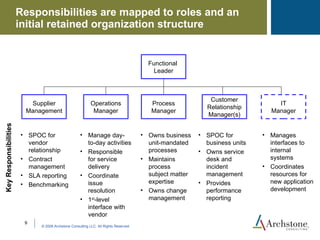
Responsibilities are mapped to roles and an initial retained organization structure Functional  Leader Supplier Management Operations Manager Process Manager Customer Relationship Manager(s) IT Manager SPOC for vendor relationship Contract management SLA reporting Benchmarking Manage day-to-day activities Responsible for service delivery Coordinate issue resolution 1 st -level interface with vendor Owns business unit-mandated processes Maintains process subject matter expertise Owns change management SPOC for business units Owns service desk and incident management Provides performance reporting Manages interfaces to internal systems Coordinates resources for new application development Key Responsibilities
Required retained capabilities are organized into a Competency Framework Sample Competency Framework and Profile:
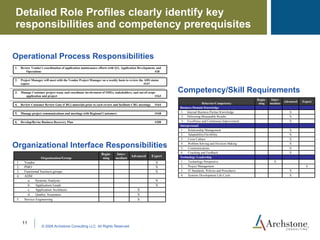
Detailed Role Profiles clearly identify key responsibilities and competency prerequisites  Operational Process Responsibilities Organizational Interface Responsibilities Competency/Skill Requirements
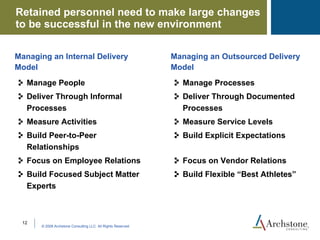
Retained personnel need to make large changes to be successful in the new environment Managing an Internal Delivery  Model Manage People Deliver Through Informal Processes Measure Activities Build Peer-to-Peer Relationships Focus on Employee Relations Build Focused Subject Matter Experts Managing an Outsourced Delivery  Model Manage Processes Deliver Through Documented Processes Measure Service Levels Build Explicit Expectations Focus on Vendor Relations Build Flexible “Best Athletes”
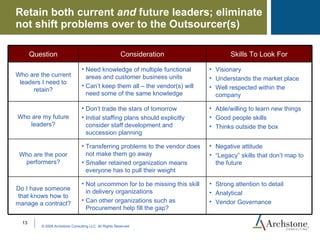
Retain both current  and  future leaders; eliminate not shift problems over to the Outsourcer(s) Not uncommon for to be missing this skill in delivery organizations  Can other organizations such as Procurement help fill the gap? Transferring problems to the vendor does not make them go away  Smaller retained organization means everyone has to pull their weight Don’t trade the stars of tomorrow  Initial staffing plans should explicitly consider staff development and succession planning Need knowledge of multiple functional areas and customer business units Can’t keep them all – the vendor(s) will need some of the same knowledge Consideration Strong attention to detail Analytical Vendor Governance Do I have someone that knows how to manage a contract? Negative attitude “ Legacy” skills that don’t map to the future Who are the poor performers? Able/willing to learn new things Good people skills Thinks outside the box Who are my future leaders? Visionary Understands the market place Well respected within the company Who are the current leaders I need to retain? Skills To Look For Question
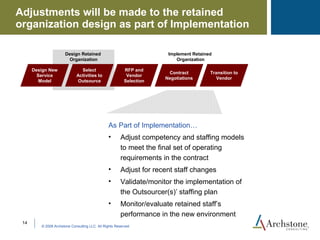
Adjustments will be made to the retained organization design as part of Implementation As Part of Implementation… Adjust competency and staffing models to meet the final set of operating requirements in the contract Adjust for recent staff changes Validate/monitor the implementation of the Outsourcer(s)’ staffing plan Monitor/evaluate retained staff’s performance in the new environment
Summary/Final Words Early retained organization design helps speed the transaction Set vendor expectations up-front Eliminate a contract negotiation topic  Reduce opportunity for last minute pricing “surprises” Early development of competency/skills frameworks improves personnel selection   Place retained staff in the right roles Allow early identification and proactive “embracing” of important high flight-risk staff Identifies critical skill gaps prior to transition/”go-live”

Developing Retained Organization to Support Outsourcing

  • 1.
    Developing the RetainedOrganization Presented by the International Association of Outsourcing Professionals The 2008 Outsourcing World Summit February 18-20, 2008 | Orlando, Florida
  • 2.
    Featured Speaker MarkPeacock Principal Chicago, IL (312) 325-2920 [email_address] Leader of the Outsourcing Advisory Practice at Archstone Consulting 15 years of experience assisting clients develop and implement outsourcing and offshoring strategies Mark's experience includes all aspects of outsourcing/offshoring across stages of the lifecycle – strategy, procurement, negotiation, implementation, and restructuring Prior experience – Deloitte Consulting, IBM
  • 3.
    Introduction The RetainedOrganization plays a critical role in mitigating risk and supporting a successful outsourcing implementation 75% of providers in 2007 Duke University survey cited poorly skilled retained organizations as a key reason for the dissolution of outsourcing deals 1 A 2006 AberdeenGroup research report identifies under-staffed and under-skilled retained organizations as one of the Top 5 Challenges in the Transition and Operating phases of outsourcing 2 Leading Companies are identifying necessary skills and knowledge earlier in the outsourcing process Sources: 1 Duke University Offshore Research Network, 2007 Service Provider Survey Debriefing Workshop , 22 Oct 2007 2 AberdeenGroup, Business Value of IT Outsourcing , Jul 2006
  • 4.
    Leading companies aredesigning their retained organizations earlier in the process Decision to Outsource RFP and Vendor Selection Contract Negotiations Transition to Vendor Select Activities to Outsource RFP and Vendor Selection Contract Negotiations Transition to Vendor Design New Service Model Traditional Model: Emerging Model: Design and Implement Retained Organization Design Retained Organization Implement Retained Organization
  • 5.
    The Emerging Modelbenefits from up-front retained organization design Traditional Model Focus on numbers – “How many can we keep and still meet the business case?” Vendor/client responsibilities defined during contract negotiations Roles defined to match existing staff Over-emphasis on retaining legacy subject matter experts Emerging Model Focus on roles – “What are the skills we need to do to deliver business benefit?” Vendor/client responsibilities established in RFP Roles defined to meet requirements of new delivery model Focus on personnel that fit new competency/skill requirements
  • 6.
    Decisions in Service Model Design provide the requirements for retained organization design Select Activities to Outsource Design New Service Model Key Decisions Reached Operating Principles Delivery Model Management Processes Funding/Governance Relationship with Users Retained Organization Design Roles & Responsibilities Organization Structure Competency Requirements Relationship Management Strategy Staffing Models Drive
  • 7.
    Functions to beRetained Program/Project Management Planning Process/Technology Architecture Vendor Management Business Analysis Operating Principles begin the Retained Organization design process Operating Principles Maintain business knowledge, accountability, project oversight Have effective business/service unit alignment and governance Retain the process/technical expertise needed to switch outsourcing providers Maximize value out of strategic vendor relationships Enforce rigorous business case discipline on new projects
  • 8.
    Delivery Model drivesthe responsibilities for the Retained Organization and the Outsourcer(s) In this IT example, the industry-standard ITIL framework was used to structure the Delivery Model ITIL – Information Technology Infrastructure Library
  • 9.
    Responsibilities are mappedto roles and an initial retained organization structure Functional Leader Supplier Management Operations Manager Process Manager Customer Relationship Manager(s) IT Manager SPOC for vendor relationship Contract management SLA reporting Benchmarking Manage day-to-day activities Responsible for service delivery Coordinate issue resolution 1 st -level interface with vendor Owns business unit-mandated processes Maintains process subject matter expertise Owns change management SPOC for business units Owns service desk and incident management Provides performance reporting Manages interfaces to internal systems Coordinates resources for new application development Key Responsibilities
  • 10.
    Required retained capabilitiesare organized into a Competency Framework Sample Competency Framework and Profile:
  • 11.
    Detailed Role Profilesclearly identify key responsibilities and competency prerequisites Operational Process Responsibilities Organizational Interface Responsibilities Competency/Skill Requirements
  • 12.
    Retained personnel needto make large changes to be successful in the new environment Managing an Internal Delivery Model Manage People Deliver Through Informal Processes Measure Activities Build Peer-to-Peer Relationships Focus on Employee Relations Build Focused Subject Matter Experts Managing an Outsourced Delivery Model Manage Processes Deliver Through Documented Processes Measure Service Levels Build Explicit Expectations Focus on Vendor Relations Build Flexible “Best Athletes”
  • 13.
    Retain both current and future leaders; eliminate not shift problems over to the Outsourcer(s) Not uncommon for to be missing this skill in delivery organizations Can other organizations such as Procurement help fill the gap? Transferring problems to the vendor does not make them go away Smaller retained organization means everyone has to pull their weight Don’t trade the stars of tomorrow Initial staffing plans should explicitly consider staff development and succession planning Need knowledge of multiple functional areas and customer business units Can’t keep them all – the vendor(s) will need some of the same knowledge Consideration Strong attention to detail Analytical Vendor Governance Do I have someone that knows how to manage a contract? Negative attitude “ Legacy” skills that don’t map to the future Who are the poor performers? Able/willing to learn new things Good people skills Thinks outside the box Who are my future leaders? Visionary Understands the market place Well respected within the company Who are the current leaders I need to retain? Skills To Look For Question
  • 14.
    Adjustments will bemade to the retained organization design as part of Implementation As Part of Implementation… Adjust competency and staffing models to meet the final set of operating requirements in the contract Adjust for recent staff changes Validate/monitor the implementation of the Outsourcer(s)’ staffing plan Monitor/evaluate retained staff’s performance in the new environment
  • 15.
    Summary/Final Words Earlyretained organization design helps speed the transaction Set vendor expectations up-front Eliminate a contract negotiation topic Reduce opportunity for last minute pricing “surprises” Early development of competency/skills frameworks improves personnel selection Place retained staff in the right roles Allow early identification and proactive “embracing” of important high flight-risk staff Identifies critical skill gaps prior to transition/”go-live”