Developing  Effective  Pitches and Proposals  Christopher Batio  Director of Marketing & Business Development January 27, 2010
Pitch or Proposal – Which is which? Pitches are: Generally focused on a meeting or face to face opportunity.  Often involve 1 or 2 practices and a small team of attorneys. Usually designed to introduce some (new) aspect of the firm to a client or potential client.  Created primarily by Marketing using stock materials with minimal customization. Often require quick turnaround (2-4 days)
Pitch or Proposal – Which is which? Proposals are: Usually completed in response to an RFP.  Often involve many practice areas and large teams of attorneys. Usually designed to win or retain business with a client or potential client.  Created by a collaboration of Marketing and Attorneys starting with template materials and adding a large amount of customization over subsequent drafts. Longer time frames for completion (2-4 weeks)
What is an RFP? The RFP shows what the issuer wants to buy: Most capable company or organization Most appropriate service or tool Best price  RFP Types: Q&A Narrative Data mining Qualifications + Orals In any Proposal, the winner will be the organization that understands what the client wants and demonstrates a superior ability to deliver it.
Analyzing an RFP Learn the basics: Deadline. Scope of work. Selection criteria. Dive deeper: Stated or implied goals. Opportunity to ask questions. Decisionmaker(s). Look for clues to proposal structure: Link questions to responses. Go or No Go?
The Kickoff Meeting Why is this necessary?: The tug of war between what you know and what you think you know.  Goals of the meeting: Share RFP analysis details. Ask questions of each other and develop questions for client. Develop project team and rough drafting schedule.  Begin to develop a theme for communicating your value.
Understanding begins with questions Have we responded to an RFP in the past? If so, when and what was the outcome? Do we understand their definition of “successful outcome” for this RFP? Do we have any established relationships with any of the client’s decision makers? Are we the incumbent? If not, what are the company’s issues (positive or negative) with the incumbent provider? What are the client’s top five business issues/concerns for the future? Describe their corporate culture.  How does the client perceive us?
How to Construct Your Proposal Executive Summary: Written last. Highlight your value proposition and differentiators. Who we are: Beyond boilerplate please. Focus on accomplishments that are meaningful to the audience.  What we do: Solutions and useful features. What will it feel like to be my client? $$$: Flexibility is the key, predictability is the goal
Use plain English: Avoid jargon, acronyms, lawyerese Use “their” language (i.e. if healthcare is one word in their RFP, use one word) Respect the RFP: If it limits the response to 10 pages, don't submit 11 Think about the presentation early: Even before you are called in, look for proposal themes that work in orals. Debrief, win or lose: Debrief the client and the team (What worked? What could have been better?)  Helpful hints to keep in mind
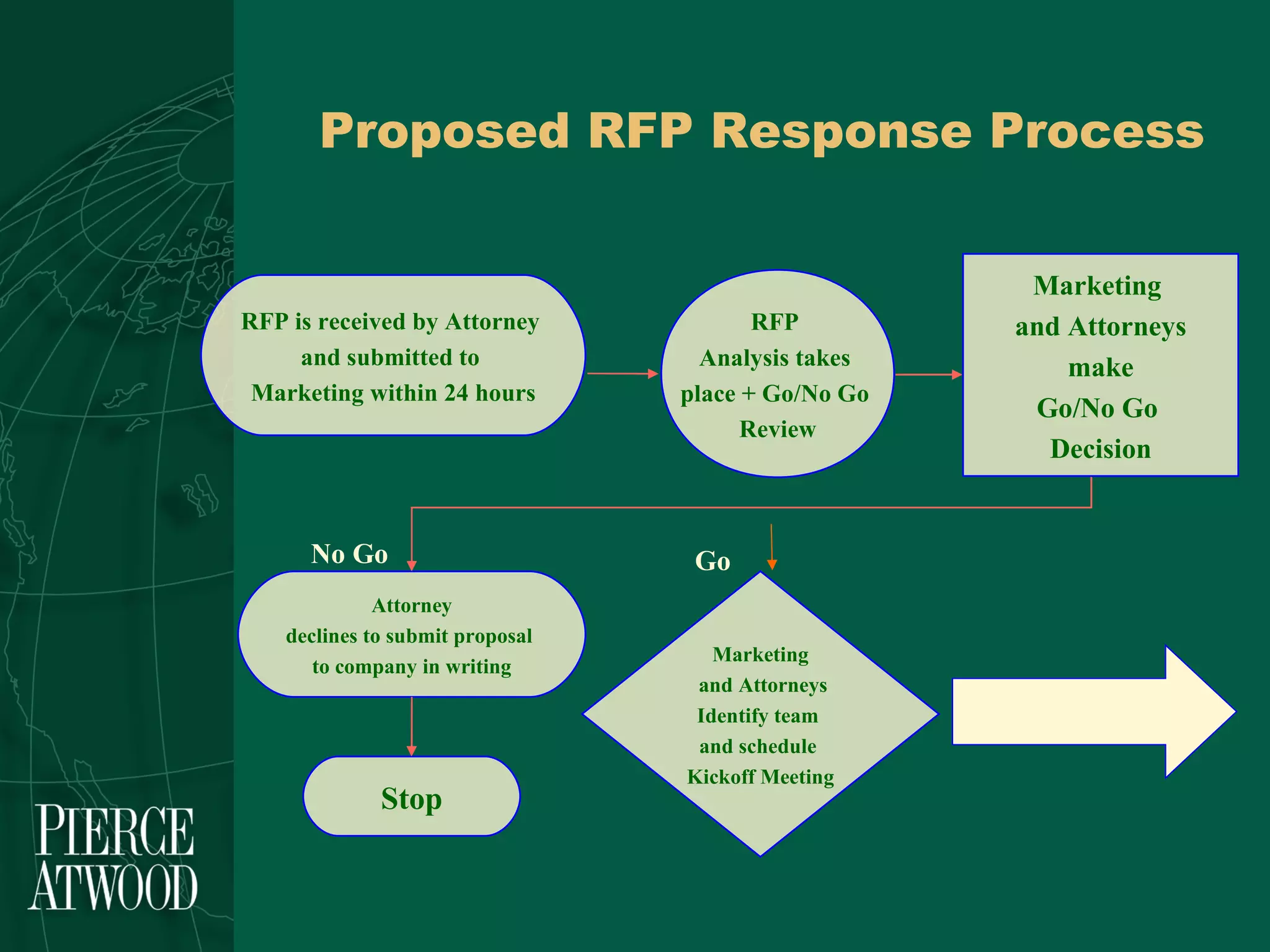
Proposed RFP Response Process RFP is received by Attorney  and submitted to  Marketing within 24 hours RFP  Analysis takes  place + Go/No Go  Review Attorney declines to submit proposal  to company in writing Marketing and Attorneys Identify team  and schedule  Kickoff Meeting No Go Go Stop Marketing  and Attorneys make Go/No Go  Decision
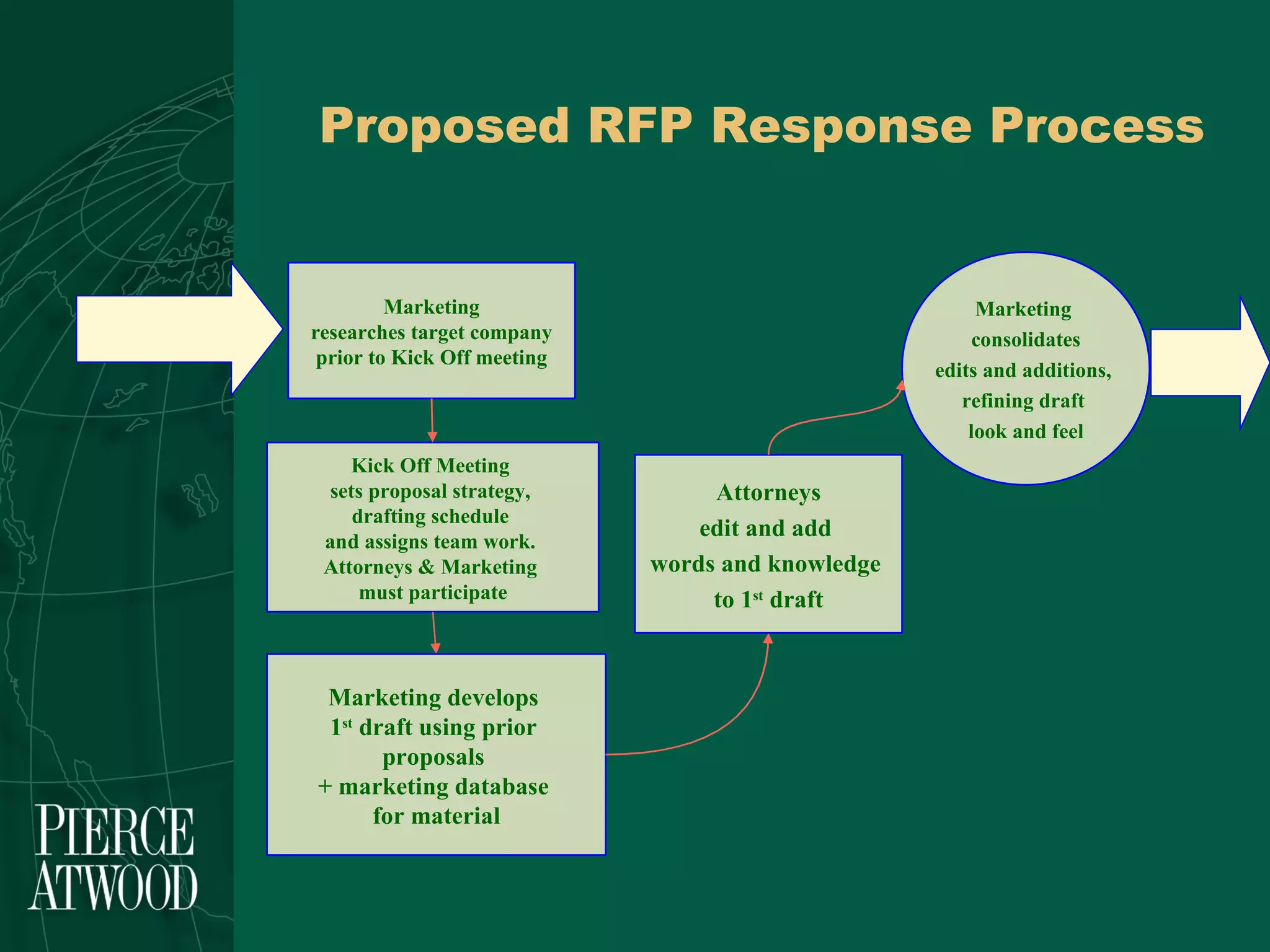
Marketing  consolidates edits and additions,  refining draft  look and feel Marketing researches target company prior to Kick Off meeting Kick Off Meeting  sets proposal strategy,  drafting schedule  and assigns team work.  Attorneys & Marketing  must participate Marketing develops  1 st  draft using prior  proposals  + marketing database  for material Attorneys edit and add  words and knowledge  to 1 st  draft Proposed RFP Response Process
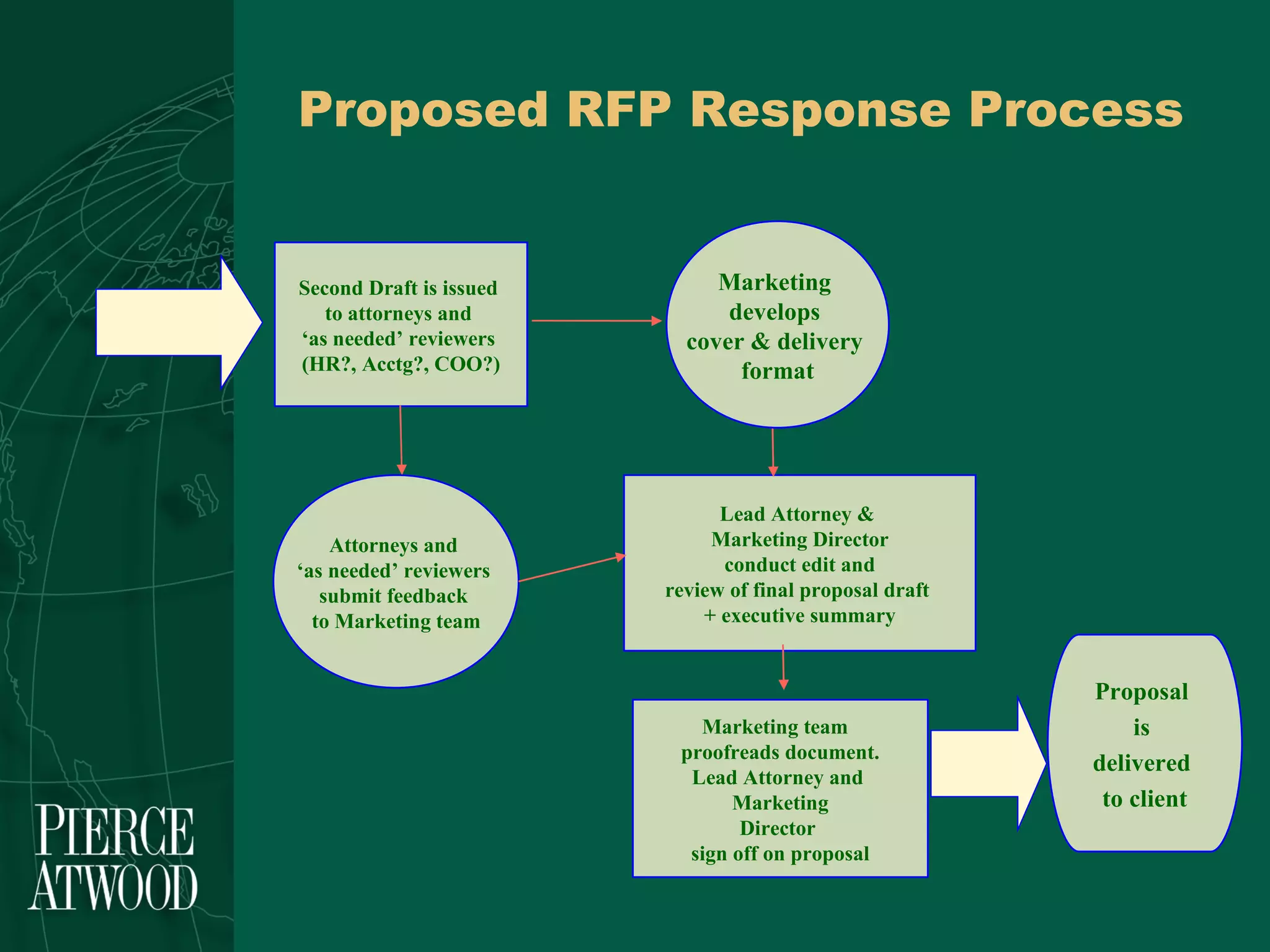
Proposed RFP Response Process Second Draft is issued  to attorneys and  ‘ as needed’ reviewers  (HR?, Acctg?, COO?) Attorneys and  ‘ as needed’ reviewers  submit feedback  to Marketing team Lead Attorney &  Marketing Director conduct edit and review of final proposal draft  + executive summary Marketing  develops  cover & delivery  format Marketing team  proofreads document. Lead Attorney and  Marketing Director  sign off on proposal Proposal  is  delivered  to client

Developing Effective Pitches and Proposals

  • 1.
    Developing Effective Pitches and Proposals Christopher Batio Director of Marketing & Business Development January 27, 2010
  • 2.
    Pitch or Proposal– Which is which? Pitches are: Generally focused on a meeting or face to face opportunity. Often involve 1 or 2 practices and a small team of attorneys. Usually designed to introduce some (new) aspect of the firm to a client or potential client. Created primarily by Marketing using stock materials with minimal customization. Often require quick turnaround (2-4 days)
  • 3.
    Pitch or Proposal– Which is which? Proposals are: Usually completed in response to an RFP. Often involve many practice areas and large teams of attorneys. Usually designed to win or retain business with a client or potential client. Created by a collaboration of Marketing and Attorneys starting with template materials and adding a large amount of customization over subsequent drafts. Longer time frames for completion (2-4 weeks)
  • 4.
    What is anRFP? The RFP shows what the issuer wants to buy: Most capable company or organization Most appropriate service or tool Best price RFP Types: Q&A Narrative Data mining Qualifications + Orals In any Proposal, the winner will be the organization that understands what the client wants and demonstrates a superior ability to deliver it.
  • 5.
    Analyzing an RFPLearn the basics: Deadline. Scope of work. Selection criteria. Dive deeper: Stated or implied goals. Opportunity to ask questions. Decisionmaker(s). Look for clues to proposal structure: Link questions to responses. Go or No Go?
  • 6.
    The Kickoff MeetingWhy is this necessary?: The tug of war between what you know and what you think you know. Goals of the meeting: Share RFP analysis details. Ask questions of each other and develop questions for client. Develop project team and rough drafting schedule. Begin to develop a theme for communicating your value.
  • 7.
    Understanding begins withquestions Have we responded to an RFP in the past? If so, when and what was the outcome? Do we understand their definition of “successful outcome” for this RFP? Do we have any established relationships with any of the client’s decision makers? Are we the incumbent? If not, what are the company’s issues (positive or negative) with the incumbent provider? What are the client’s top five business issues/concerns for the future? Describe their corporate culture. How does the client perceive us?
  • 8.
    How to ConstructYour Proposal Executive Summary: Written last. Highlight your value proposition and differentiators. Who we are: Beyond boilerplate please. Focus on accomplishments that are meaningful to the audience. What we do: Solutions and useful features. What will it feel like to be my client? $$$: Flexibility is the key, predictability is the goal
  • 9.
    Use plain English:Avoid jargon, acronyms, lawyerese Use “their” language (i.e. if healthcare is one word in their RFP, use one word) Respect the RFP: If it limits the response to 10 pages, don't submit 11 Think about the presentation early: Even before you are called in, look for proposal themes that work in orals. Debrief, win or lose: Debrief the client and the team (What worked? What could have been better?) Helpful hints to keep in mind
  • 10.
    Proposed RFP ResponseProcess RFP is received by Attorney and submitted to Marketing within 24 hours RFP Analysis takes place + Go/No Go Review Attorney declines to submit proposal to company in writing Marketing and Attorneys Identify team and schedule Kickoff Meeting No Go Go Stop Marketing and Attorneys make Go/No Go Decision
  • 11.
    Marketing consolidatesedits and additions, refining draft look and feel Marketing researches target company prior to Kick Off meeting Kick Off Meeting sets proposal strategy, drafting schedule and assigns team work. Attorneys & Marketing must participate Marketing develops 1 st draft using prior proposals + marketing database for material Attorneys edit and add words and knowledge to 1 st draft Proposed RFP Response Process
  • 12.
    Proposed RFP ResponseProcess Second Draft is issued to attorneys and ‘ as needed’ reviewers (HR?, Acctg?, COO?) Attorneys and ‘ as needed’ reviewers submit feedback to Marketing team Lead Attorney & Marketing Director conduct edit and review of final proposal draft + executive summary Marketing develops cover & delivery format Marketing team proofreads document. Lead Attorney and Marketing Director sign off on proposal Proposal is delivered to client