The Remote Office:  How to Cultivate a Performance-Driven Sales Team from Afar Presented by:  Jenny Grajpel, text & form  Jessica Rathke, Localisation Sales & Marketing
Agenda How to recruit and interview Factors determining whether candidate is a good fit for your organization Managing a remote sales person
Top Attributes No (or managed) fear of cold calling/handles rejection well Competitive – wants to win Self image of success Sense of urgency/works well under pressure Self-starter/sets personal goals Organized/disciplined Able to work with minimal supervision Problem solver – know what is need to get the job done and how to get it Exceptional listening skills (empathy with client) Persistent (hard work) Takes responsibility for results Focus VALUE not features – helping prospects achieve their goals
Interview Questions to  Discover Attributes What motivates you, why are you in sales? What do you consider your strengths and weakness to be? Explain your greatest career win.  When? Explain how you will fill your pipeline in the first 90 days.  Explain what you know about our company. How do you think you can add value to our company & how would you sell our services?
Questions for Remote Working What experience do you have working remotely? What do you like best/least about it? How do you structure your day? How do you build relationships with co-workers from a remote location? Do you mind after hours commitments to accommodate time zone differences?
More Questions How much support / interaction do you need form your manager? Have you ever worked for someone from another culture that has not done a significant amount of business in your home country? How will you handle these differences? Are you comfortable performing non-sales functions?
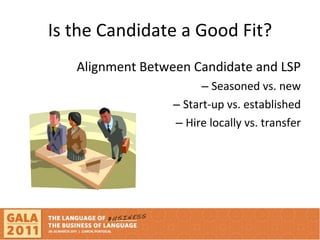
Is the Candidate a Good Fit? Alignment Between Candidate and LSP Seasoned vs. new Start-up vs. established Hire locally vs. transfer
Alignment Between LSP and Candidate Job expectations in alignment  Compensation reflects any non-sales duties Benefit scheme is in synch with market standards Compensation reflects how and what is sold  Hunter vs. farmer Long-term career objectives are in alignment Does remote employee expect a career path? Does LSP expect a sales person in perpetuity?
Seasoned vs. New Seasoned:  Pros Seasoned:  Cons Existing contacts Contractual obligations with former employer Shorter ramp-up time Preconceptions  (unlearning) Remote sales experience Compensation may be higher Industry profile New :  Pros New:  Cons Previous sales training Longer ramp-up time Fewer preconceptions Expectations from previous industry not applicable to ours No "baggage" from previous employer(s) Lack of existing contacts Can train to your specific needs
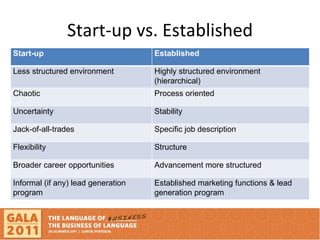
Start-up vs. Established Start-up Established Less structured environment  Highly structured environment (hierarchical) Chaotic Process oriented Uncertainty Stability  Jack-of-all-trades Specific job description Flexibility Structure Broader career opportunities Advancement more structured Informal (if any) lead generation program Established marketing functions & lead generation program
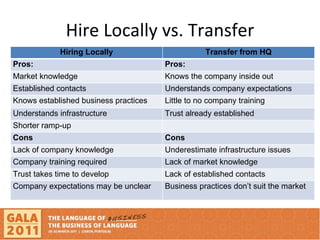
Hire Locally vs. Transfer Hiring Locally Transfer from HQ Pros: Pros: Market knowledge Knows the company inside out Established contacts Understands company expectations Knows established business practices Little to no company training Understands infrastructure Trust already established Shorter ramp-up Cons Cons Lack of company knowledge Underestimate infrastructure issues Company training required Lack of market knowledge Trust takes time to develop Lack of established contacts Company expectations may be unclear Business practices don’t suit the market
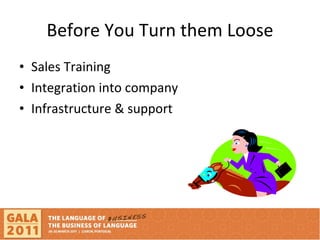
Before You Turn them Loose Sales Training Integration into company  Infrastructure & support
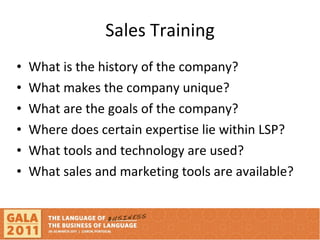
Sales Training What is the history of the company? What makes the company unique? What are the goals of the company? Where does certain expertise lie within LSP? What tools and technology are used? What sales and marketing tools are available?
Integration into LSP Formal induction Meet/speak with key personnel Business processes Expenses Travel  Intranet
IT & Infrastructure Equipment IT support Company-specific
Sales Management Productivity Motivation Cultural differences recognized
Productivity Establish specific, measurable goals Establish formal means of communication Formal 1x1/sales team calls Reporting mechanisms Joint sales calls Informal communication Monitor goals Quarterly business reviews
Motivation Recognize all contributions, not just revenue Ongoing training – product, technology, sales Keep remote sales informed of company developments  Communicate often with relevant information Be available
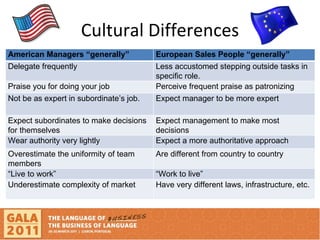
Cultural Differences American Managers “generally” European Sales People “generally” Delegate frequently Less accustomed stepping outside tasks in specific role. Praise you for doing your job Perceive frequent praise as patronizing Not be as expert in subordinate’s job. Expect manager to be more expert Expect subordinates to make decisions for themselves Expect management to make most decisions Wear authority very lightly Expect a more authoritative approach Overestimate the uniformity of team members Are different from country to country “ Live to work”  “ Work to live” Underestimate complexity of market Have very different laws, infrastructure, etc.
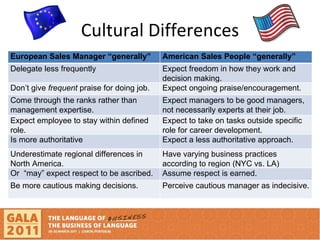
Cultural Differences European Sales Manager “generally” American Sales People “generally” Delegate less frequently Expect freedom in how they work and  decision making. Don’t give  frequent  praise for doing job.  Expect ongoing praise/encouragement. Come through the ranks rather than management expertise. Expect managers to be good managers, not necessarily experts at their job. Expect employee to stay within defined role.  Expect to take on tasks outside specific role for career development. Is more authoritative Expect a less authoritative approach.  Underestimate regional differences in  North America. Have varying business practices according to region (NYC vs. LA) Or  “may” expect respect to be ascribed. Assume respect is earned. Be more cautious making decisions. Perceive cautious manager as indecisive.
Questions? Presented by:  Jenny Grajpel, Text&Form  Jessica Rathke, Jonckers

Performance Driven Sales

  • 1.
    The Remote Office: How to Cultivate a Performance-Driven Sales Team from Afar Presented by: Jenny Grajpel, text & form Jessica Rathke, Localisation Sales & Marketing
  • 2.
    Agenda How torecruit and interview Factors determining whether candidate is a good fit for your organization Managing a remote sales person
  • 3.
    Top Attributes No(or managed) fear of cold calling/handles rejection well Competitive – wants to win Self image of success Sense of urgency/works well under pressure Self-starter/sets personal goals Organized/disciplined Able to work with minimal supervision Problem solver – know what is need to get the job done and how to get it Exceptional listening skills (empathy with client) Persistent (hard work) Takes responsibility for results Focus VALUE not features – helping prospects achieve their goals
  • 4.
    Interview Questions to Discover Attributes What motivates you, why are you in sales? What do you consider your strengths and weakness to be? Explain your greatest career win. When? Explain how you will fill your pipeline in the first 90 days. Explain what you know about our company. How do you think you can add value to our company & how would you sell our services?
  • 5.
    Questions for RemoteWorking What experience do you have working remotely? What do you like best/least about it? How do you structure your day? How do you build relationships with co-workers from a remote location? Do you mind after hours commitments to accommodate time zone differences?
  • 6.
    More Questions Howmuch support / interaction do you need form your manager? Have you ever worked for someone from another culture that has not done a significant amount of business in your home country? How will you handle these differences? Are you comfortable performing non-sales functions?
  • 7.
    Is the Candidatea Good Fit? Alignment Between Candidate and LSP Seasoned vs. new Start-up vs. established Hire locally vs. transfer
  • 8.
    Alignment Between LSPand Candidate Job expectations in alignment Compensation reflects any non-sales duties Benefit scheme is in synch with market standards Compensation reflects how and what is sold Hunter vs. farmer Long-term career objectives are in alignment Does remote employee expect a career path? Does LSP expect a sales person in perpetuity?
  • 9.
    Seasoned vs. NewSeasoned: Pros Seasoned: Cons Existing contacts Contractual obligations with former employer Shorter ramp-up time Preconceptions  (unlearning) Remote sales experience Compensation may be higher Industry profile New : Pros New: Cons Previous sales training Longer ramp-up time Fewer preconceptions Expectations from previous industry not applicable to ours No "baggage" from previous employer(s) Lack of existing contacts Can train to your specific needs
  • 10.
    Start-up vs. EstablishedStart-up Established Less structured environment Highly structured environment (hierarchical) Chaotic Process oriented Uncertainty Stability Jack-of-all-trades Specific job description Flexibility Structure Broader career opportunities Advancement more structured Informal (if any) lead generation program Established marketing functions & lead generation program
  • 11.
    Hire Locally vs.Transfer Hiring Locally Transfer from HQ Pros: Pros: Market knowledge Knows the company inside out Established contacts Understands company expectations Knows established business practices Little to no company training Understands infrastructure Trust already established Shorter ramp-up Cons Cons Lack of company knowledge Underestimate infrastructure issues Company training required Lack of market knowledge Trust takes time to develop Lack of established contacts Company expectations may be unclear Business practices don’t suit the market
  • 12.
    Before You Turnthem Loose Sales Training Integration into company Infrastructure & support
  • 13.
    Sales Training Whatis the history of the company? What makes the company unique? What are the goals of the company? Where does certain expertise lie within LSP? What tools and technology are used? What sales and marketing tools are available?
  • 14.
    Integration into LSPFormal induction Meet/speak with key personnel Business processes Expenses Travel Intranet
  • 15.
    IT & InfrastructureEquipment IT support Company-specific
  • 16.
    Sales Management ProductivityMotivation Cultural differences recognized
  • 17.
    Productivity Establish specific,measurable goals Establish formal means of communication Formal 1x1/sales team calls Reporting mechanisms Joint sales calls Informal communication Monitor goals Quarterly business reviews
  • 18.
    Motivation Recognize allcontributions, not just revenue Ongoing training – product, technology, sales Keep remote sales informed of company developments Communicate often with relevant information Be available
  • 19.
    Cultural Differences AmericanManagers “generally” European Sales People “generally” Delegate frequently Less accustomed stepping outside tasks in specific role. Praise you for doing your job Perceive frequent praise as patronizing Not be as expert in subordinate’s job. Expect manager to be more expert Expect subordinates to make decisions for themselves Expect management to make most decisions Wear authority very lightly Expect a more authoritative approach Overestimate the uniformity of team members Are different from country to country “ Live to work” “ Work to live” Underestimate complexity of market Have very different laws, infrastructure, etc.
  • 20.
    Cultural Differences EuropeanSales Manager “generally” American Sales People “generally” Delegate less frequently Expect freedom in how they work and decision making. Don’t give frequent praise for doing job. Expect ongoing praise/encouragement. Come through the ranks rather than management expertise. Expect managers to be good managers, not necessarily experts at their job. Expect employee to stay within defined role. Expect to take on tasks outside specific role for career development. Is more authoritative Expect a less authoritative approach.  Underestimate regional differences in North America. Have varying business practices according to region (NYC vs. LA) Or “may” expect respect to be ascribed. Assume respect is earned. Be more cautious making decisions. Perceive cautious manager as indecisive.
  • 21.
    Questions? Presented by: Jenny Grajpel, Text&Form Jessica Rathke, Jonckers