PRESENTED BY
Developing and Deploying
Edge Analytics
David Rauschenbach
Nubix.io, CTO
PRESENTED BY
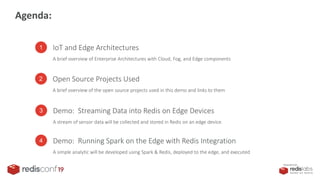
1 IoT and Edge Architectures
A brief overview of Enterprise Architectures with Cloud, Fog, and Edge components
2 Open Source Projects Used
A brief overview of the open source projects used in this demo and links to them
3 Demo: Streaming Data into Redis on Edge Devices
A stream of sensor data will be collected and stored in Redis on an edge device.
Agenda:
4 Demo: Running Spark on the Edge with Redis Integration
A simple analytic will be developed using Spark & Redis, deployed to the edge, and executed
PRESENTED BY
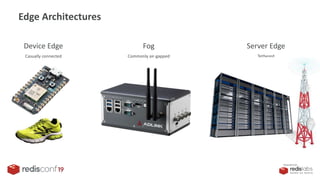
Device Edge
Casually connected
Edge Architectures
Fog
Commonly air-gapped
Server Edge
Tethered
PRESENTED BY
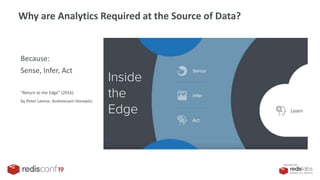
Why are Analytics Required at the Source of Data?
Because:
Sense, Infer, Act
“Return to the Edge” (2016)
by Peter Levine, Andreessen Horowitz
PRESENTED BY
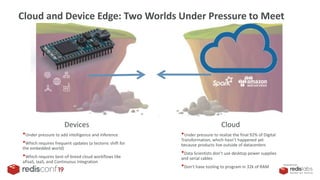
Cloud and Device Edge: Two Worlds Under Pressure to Meet
Devices
•Under pressure to add intelligence and inference
•Which requires frequent updates (a tectonic shift for
the embedded world)
•Which requires best-of-breed cloud workflows like
aPaaS, IaaS, and Continuous Integration
Cloud
•Under pressure to realize the final 92% of Digital
Transformation, which hasn’t happened yet
because products live outside of datacenters
•Data Scientists don’t use desktop power supplies
and serial cables
•Don’t have tooling to program in 32k of RAM
PRESENTED BY
Open Source Projects We Are Going to Use
PRESENTED BY
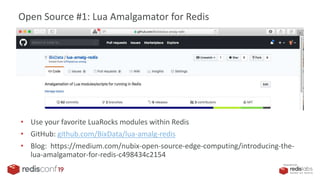
• Use your favorite LuaRocks modules within Redis
• GitHub: github.com/BixData/lua-amalg-redis
• Blog: https://medium.com/nubix-open-source-edge-computing/introducing-the-
lua-amalgamator-for-redis-c498434c2154
Open Source #1: Lua Amalgamator for Redis
PRESENTED BY
PRESENTED BY
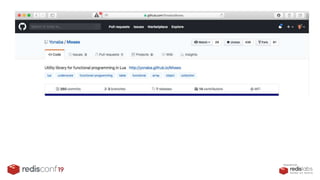
Moses: the Lodash / Underscore of the Lua ecosystem
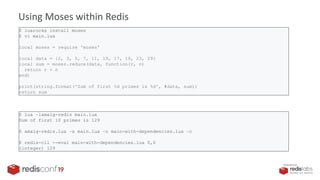
Using Moses within Redis
$ luarocks install moses
$ vi main.lua
local moses = require 'moses'
local data = {2, 3, 5, 7, 11, 13, 17, 19, 23, 29}
local sum = moses.reduce(data, function(r, n)
return r + n
end)
print(string.format('Sum of first %d primes is %d', #data, sum))
return sum
$ lua –lamalg-redis main.lua
Sum of first 10 primes is 129
$ amalg-redis.lua –s main.lua –o main-with-dependencies.lua –c
$ redis-cli --eval main-with-dependencies.lua 0,0
(integer) 129
PRESENTED BY
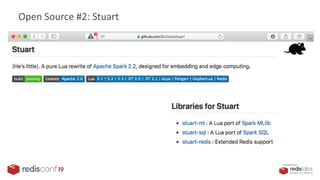
Open Source #2: Stuart
PRESENTED BY
Using Spark ML Vectors within Redis
$ luarocks install stuart-ml
$ vi main.lua
local BLAS = require 'stuart-ml.linalg.BLAS'
local Vectors = require 'stuart-ml.linalg.Vectors'
local a = Vectors.dense({1,2,3})
local b = Vectors.dense({4,-5,6})
local dotProduct = BLAS.dot(a, b)
local isAcuteAngle = dotProduct > 0
print(string.format('The dot product of [{1,2,3}, {4,-5,6}] is %d, which %s an acute angle',
dotProduct, isAcuteAngle and 'is' or 'is not'))
return dotProduct
$ lua –lamalg-redis main.lua
The dot product of [{1,2,3}, {4,-5,6}] is 12, which is an acute angle
$ amalg-redis.lua –s main.lua –o main-with-dependencies.lua –c
$ redis-cli --eval main-with-dependencies.lua 0,0
(integer) 12
PRESENTED BY
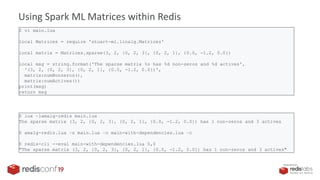
Using Spark ML Matrices within Redis
$ vi main.lua
local Matrices = require 'stuart-ml.linalg.Matrices'
local matrix = Matrices.sparse(3, 2, {0, 2, 3}, {0, 2, 1}, {0.0, -1.2, 0.0})
local msg = string.format('The sparse matrix %s has %d non-zeros and %d actives',
'(3, 2, {0, 2, 3}, {0, 2, 1}, {0.0, -1.2, 0.0})',
matrix:numNonzeros(),
matrix:numActives())
print(msg)
return msg
$ lua –lamalg-redis main.lua
The sparse matrix (3, 2, {0, 2, 3}, {0, 2, 1}, {0.0, -1.2, 0.0}) has 1 non-zeros and 3 actives
$ amalg-redis.lua –s main.lua –o main-with-dependencies.lua –c
$ redis-cli --eval main-with-dependencies.lua 0,0
"The sparse matrix (3, 2, {0, 2, 3}, {0, 2, 1}, {0.0, -1.2, 0.0}) has 1 non-zeros and 3 actives"
PRESENTED BY
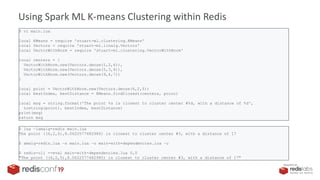
Using Spark ML K-means Clustering within Redis
$ vi main.lua
local KMeans = require 'stuart-ml.clustering.KMeans'
local Vectors = require 'stuart-ml.linalg.Vectors'
local VectorWithNorm = require 'stuart-ml.clustering.VectorWithNorm'
local centers = {
VectorWithNorm.new(Vectors.dense(1,2,6)),
VectorWithNorm.new(Vectors.dense(5,3,9)),
VectorWithNorm.new(Vectors.dense(9,4,7))
}
local point = VectorWithNorm.new(Vectors.dense(6,2,5))
local bestIndex, bestDistance = KMeans.findClosest(centers, point)
local msg = string.format('The point %s is closest to cluster center #%d, with a distance of %d',
tostring(point), bestIndex, bestDistance)
print(msg)
return msg
$ lua –lamalg-redis main.lua
The point ((6,2,5),8.0622577482985) is closest to cluster center #3, with a distance of 17
$ amalg-redis.lua –s main.lua –o main-with-dependencies.lua –c
$ redis-cli --eval main-with-dependencies.lua 0,0
"The point ((6,2,5),8.0622577482985) is closest to cluster center #3, with a distance of 17"
PRESENTED BY
Open Source #3: Stuart-Redis
PRESENTED BY
Reading+Writing Spark RDDs within Redis$ luarocks install stuart-redis
$ vi main.lua
local stuart = require 'stuart'
local stuartRedis = require 'stuart-redis'
local function split(str, pattern)
local res = {}
for s in string.gmatch(str, pattern) do table.insert(res, s) end
return res
end
local sc = stuart.NewContext()
sc = stuartRedis.export(sc)
-- writing
local doc = [[I mean, think about music. Music is all about repetition and patterns.
If you didn’t have repetition in music, it would all just be noise.]]
local words = sc:parallelize(split(doc, '%w+'))
local wordCountsRDD = words
:map(function(word) return {string.lower(word), 1} end)
:reduceByKey(function(r, x) return r+x end)
:map(function(e) return {e[1], e[2]} end)
sc:toRedisZSET(wordCountsRDD, 'wordCounts')
-- reading
local wordFrequencies = sc:fromRedisZSetWithScore('wordCounts')
:map(function(e) return e[1] .. '=' .. e[2] end)
:collect()
local msg = table.concat(wordFrequencies, ', ')
print(msg)
return msg
PRESENTED BY
Reading+Writing Spark RDDs within Redis (continued)
$ redis-cli
monitor
1554135760.154290 [0 127.0.0.1:64608] "EVAL" ”(5,300 lines, 177k not shown)"
1554136904.716402 [0 lua] "ZADD" "wordCounts" "1" "it"
1554136904.716415 [0 lua] "ZADD" "wordCounts" "1" "didn"
1554136904.716420 [0 lua] "ZADD" "wordCounts" "1" "mean"
1554136904.716425 [0 lua] "ZADD" "wordCounts" "1" "is"
1554136904.716429 [0 lua] "ZADD" "wordCounts" "2" "repetition"
1554136904.716435 [0 lua] "ZADD" "wordCounts" "1" "i"
1554136904.716439 [0 lua] "ZADD" "wordCounts" "1" "think"
1554136904.716444 [0 lua] "ZADD" "wordCounts" "1" "would"
1554136904.716449 [0 lua] "ZADD" "wordCounts" "1" "noise"
1554136904.716453 [0 lua] "ZADD" "wordCounts" "1" "just"
1554136904.716458 [0 lua] "ZADD" "wordCounts" "1" "t"
1554136904.716463 [0 lua] "ZADD" "wordCounts" "1" "if"
1554136904.716467 [0 lua] "ZADD" "wordCounts" "1" "you"
1554136904.716472 [0 lua] "ZADD" "wordCounts" "1" "in"
1554136904.716506 [0 lua] "ZADD" "wordCounts" "1" "patterns"
1554136904.716511 [0 lua] "ZADD" "wordCounts" "1" "be"
1554136904.716515 [0 lua] "ZADD" "wordCounts" "1" "have"
1554136904.716520 [0 lua] "ZADD" "wordCounts" "2" "about"
1554136904.716525 [0 lua] "ZADD" "wordCounts" "2" "all"
1554136904.716530 [0 lua] "ZADD" "wordCounts" "1" "and"
1554136904.716534 [0 lua] "ZADD" "wordCounts" "3" "music"
1554136904.716541 [0 lua] "KEYS" "wordCounts"
1554136904.716846 [0 lua] "TYPE" "wordCounts"
1554136904.717252 [0 lua] "ZRANGE" "wordCounts" "0" "-1" "WITHSCORES"
$ lua –lamalg-redis main.lua
and=1, be=1, didn=1, have=1, i=1, if=1,
in=1, is=1, it=1, just=1, mean=1,
noise=1, patterns=1, t=1, think=1,
would=1, you=1, about=2, all=2,
repetition=2, music=3
(… manual edits to amalg.cache …)
$ amalg-redis.lua –s main.lua –o main-
with-dependencies.lua –c
$ redis-cli --eval main-with-
dependencies.lua 0,0
"and=1, be=1, didn=1, have=1, i=1, if=1,
in=1, is=1, it=1, just=1, mean=1,
noise=1, patterns=1, t=1, think=1,
would=1, you=1, about=2, all=2,
repetition=2, music=3"
PRESENTED BY
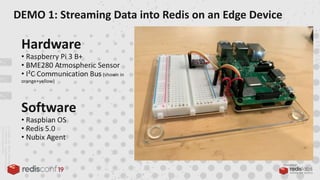
Hardware
• Raspberry Pi 3 B+
• BME280 Atmospheric Sensor
• I²C Communication Bus (shown in
orange+yellow)
Software
• Raspbian OS
• Redis 5.0
• Nubix Agent
DEMO 1: Streaming Data into Redis on an Edge Device
PRESENTED BY
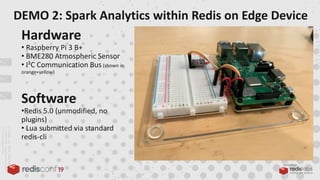
Hardware
• Raspberry Pi 3 B+
• BME280 Atmospheric Sensor
• I²C Communication Bus (shown in
orange+yellow)
Software
•Redis 5.0 (unmodified, no
plugins)
• Lua submitted via standard
redis-cli
DEMO 2: Spark Analytics within Redis on Edge Device
Thank you!
Code examples available at:
https://github.com/BixData/redisconf19
PRESENTED BY

Developing and Deploying Edge Analytics with Redis

  • 1.
    PRESENTED BY Developing andDeploying Edge Analytics David Rauschenbach Nubix.io, CTO
  • 2.
    PRESENTED BY 1 IoTand Edge Architectures A brief overview of Enterprise Architectures with Cloud, Fog, and Edge components 2 Open Source Projects Used A brief overview of the open source projects used in this demo and links to them 3 Demo: Streaming Data into Redis on Edge Devices A stream of sensor data will be collected and stored in Redis on an edge device. Agenda: 4 Demo: Running Spark on the Edge with Redis Integration A simple analytic will be developed using Spark & Redis, deployed to the edge, and executed
  • 3.
    PRESENTED BY Device Edge Casuallyconnected Edge Architectures Fog Commonly air-gapped Server Edge Tethered
  • 4.
    PRESENTED BY Why areAnalytics Required at the Source of Data? Because: Sense, Infer, Act “Return to the Edge” (2016) by Peter Levine, Andreessen Horowitz
  • 5.
    PRESENTED BY Cloud andDevice Edge: Two Worlds Under Pressure to Meet Devices •Under pressure to add intelligence and inference •Which requires frequent updates (a tectonic shift for the embedded world) •Which requires best-of-breed cloud workflows like aPaaS, IaaS, and Continuous Integration Cloud •Under pressure to realize the final 92% of Digital Transformation, which hasn’t happened yet because products live outside of datacenters •Data Scientists don’t use desktop power supplies and serial cables •Don’t have tooling to program in 32k of RAM
  • 6.
    PRESENTED BY Open SourceProjects We Are Going to Use
  • 7.
    PRESENTED BY • Useyour favorite LuaRocks modules within Redis • GitHub: github.com/BixData/lua-amalg-redis • Blog: https://medium.com/nubix-open-source-edge-computing/introducing-the- lua-amalgamator-for-redis-c498434c2154 Open Source #1: Lua Amalgamator for Redis
  • 8.
  • 9.
    PRESENTED BY Moses: theLodash / Underscore of the Lua ecosystem Using Moses within Redis $ luarocks install moses $ vi main.lua local moses = require 'moses' local data = {2, 3, 5, 7, 11, 13, 17, 19, 23, 29} local sum = moses.reduce(data, function(r, n) return r + n end) print(string.format('Sum of first %d primes is %d', #data, sum)) return sum $ lua –lamalg-redis main.lua Sum of first 10 primes is 129 $ amalg-redis.lua –s main.lua –o main-with-dependencies.lua –c $ redis-cli --eval main-with-dependencies.lua 0,0 (integer) 129
  • 10.
  • 11.
    PRESENTED BY Using SparkML Vectors within Redis $ luarocks install stuart-ml $ vi main.lua local BLAS = require 'stuart-ml.linalg.BLAS' local Vectors = require 'stuart-ml.linalg.Vectors' local a = Vectors.dense({1,2,3}) local b = Vectors.dense({4,-5,6}) local dotProduct = BLAS.dot(a, b) local isAcuteAngle = dotProduct > 0 print(string.format('The dot product of [{1,2,3}, {4,-5,6}] is %d, which %s an acute angle', dotProduct, isAcuteAngle and 'is' or 'is not')) return dotProduct $ lua –lamalg-redis main.lua The dot product of [{1,2,3}, {4,-5,6}] is 12, which is an acute angle $ amalg-redis.lua –s main.lua –o main-with-dependencies.lua –c $ redis-cli --eval main-with-dependencies.lua 0,0 (integer) 12
  • 12.
    PRESENTED BY Using SparkML Matrices within Redis $ vi main.lua local Matrices = require 'stuart-ml.linalg.Matrices' local matrix = Matrices.sparse(3, 2, {0, 2, 3}, {0, 2, 1}, {0.0, -1.2, 0.0}) local msg = string.format('The sparse matrix %s has %d non-zeros and %d actives', '(3, 2, {0, 2, 3}, {0, 2, 1}, {0.0, -1.2, 0.0})', matrix:numNonzeros(), matrix:numActives()) print(msg) return msg $ lua –lamalg-redis main.lua The sparse matrix (3, 2, {0, 2, 3}, {0, 2, 1}, {0.0, -1.2, 0.0}) has 1 non-zeros and 3 actives $ amalg-redis.lua –s main.lua –o main-with-dependencies.lua –c $ redis-cli --eval main-with-dependencies.lua 0,0 "The sparse matrix (3, 2, {0, 2, 3}, {0, 2, 1}, {0.0, -1.2, 0.0}) has 1 non-zeros and 3 actives"
  • 13.
    PRESENTED BY Using SparkML K-means Clustering within Redis $ vi main.lua local KMeans = require 'stuart-ml.clustering.KMeans' local Vectors = require 'stuart-ml.linalg.Vectors' local VectorWithNorm = require 'stuart-ml.clustering.VectorWithNorm' local centers = { VectorWithNorm.new(Vectors.dense(1,2,6)), VectorWithNorm.new(Vectors.dense(5,3,9)), VectorWithNorm.new(Vectors.dense(9,4,7)) } local point = VectorWithNorm.new(Vectors.dense(6,2,5)) local bestIndex, bestDistance = KMeans.findClosest(centers, point) local msg = string.format('The point %s is closest to cluster center #%d, with a distance of %d', tostring(point), bestIndex, bestDistance) print(msg) return msg $ lua –lamalg-redis main.lua The point ((6,2,5),8.0622577482985) is closest to cluster center #3, with a distance of 17 $ amalg-redis.lua –s main.lua –o main-with-dependencies.lua –c $ redis-cli --eval main-with-dependencies.lua 0,0 "The point ((6,2,5),8.0622577482985) is closest to cluster center #3, with a distance of 17"
  • 14.
    PRESENTED BY Open Source#3: Stuart-Redis
  • 15.
    PRESENTED BY Reading+Writing SparkRDDs within Redis$ luarocks install stuart-redis $ vi main.lua local stuart = require 'stuart' local stuartRedis = require 'stuart-redis' local function split(str, pattern) local res = {} for s in string.gmatch(str, pattern) do table.insert(res, s) end return res end local sc = stuart.NewContext() sc = stuartRedis.export(sc) -- writing local doc = [[I mean, think about music. Music is all about repetition and patterns. If you didn’t have repetition in music, it would all just be noise.]] local words = sc:parallelize(split(doc, '%w+')) local wordCountsRDD = words :map(function(word) return {string.lower(word), 1} end) :reduceByKey(function(r, x) return r+x end) :map(function(e) return {e[1], e[2]} end) sc:toRedisZSET(wordCountsRDD, 'wordCounts') -- reading local wordFrequencies = sc:fromRedisZSetWithScore('wordCounts') :map(function(e) return e[1] .. '=' .. e[2] end) :collect() local msg = table.concat(wordFrequencies, ', ') print(msg) return msg
  • 16.
    PRESENTED BY Reading+Writing SparkRDDs within Redis (continued) $ redis-cli monitor 1554135760.154290 [0 127.0.0.1:64608] "EVAL" ”(5,300 lines, 177k not shown)" 1554136904.716402 [0 lua] "ZADD" "wordCounts" "1" "it" 1554136904.716415 [0 lua] "ZADD" "wordCounts" "1" "didn" 1554136904.716420 [0 lua] "ZADD" "wordCounts" "1" "mean" 1554136904.716425 [0 lua] "ZADD" "wordCounts" "1" "is" 1554136904.716429 [0 lua] "ZADD" "wordCounts" "2" "repetition" 1554136904.716435 [0 lua] "ZADD" "wordCounts" "1" "i" 1554136904.716439 [0 lua] "ZADD" "wordCounts" "1" "think" 1554136904.716444 [0 lua] "ZADD" "wordCounts" "1" "would" 1554136904.716449 [0 lua] "ZADD" "wordCounts" "1" "noise" 1554136904.716453 [0 lua] "ZADD" "wordCounts" "1" "just" 1554136904.716458 [0 lua] "ZADD" "wordCounts" "1" "t" 1554136904.716463 [0 lua] "ZADD" "wordCounts" "1" "if" 1554136904.716467 [0 lua] "ZADD" "wordCounts" "1" "you" 1554136904.716472 [0 lua] "ZADD" "wordCounts" "1" "in" 1554136904.716506 [0 lua] "ZADD" "wordCounts" "1" "patterns" 1554136904.716511 [0 lua] "ZADD" "wordCounts" "1" "be" 1554136904.716515 [0 lua] "ZADD" "wordCounts" "1" "have" 1554136904.716520 [0 lua] "ZADD" "wordCounts" "2" "about" 1554136904.716525 [0 lua] "ZADD" "wordCounts" "2" "all" 1554136904.716530 [0 lua] "ZADD" "wordCounts" "1" "and" 1554136904.716534 [0 lua] "ZADD" "wordCounts" "3" "music" 1554136904.716541 [0 lua] "KEYS" "wordCounts" 1554136904.716846 [0 lua] "TYPE" "wordCounts" 1554136904.717252 [0 lua] "ZRANGE" "wordCounts" "0" "-1" "WITHSCORES" $ lua –lamalg-redis main.lua and=1, be=1, didn=1, have=1, i=1, if=1, in=1, is=1, it=1, just=1, mean=1, noise=1, patterns=1, t=1, think=1, would=1, you=1, about=2, all=2, repetition=2, music=3 (… manual edits to amalg.cache …) $ amalg-redis.lua –s main.lua –o main- with-dependencies.lua –c $ redis-cli --eval main-with- dependencies.lua 0,0 "and=1, be=1, didn=1, have=1, i=1, if=1, in=1, is=1, it=1, just=1, mean=1, noise=1, patterns=1, t=1, think=1, would=1, you=1, about=2, all=2, repetition=2, music=3"
  • 17.
    PRESENTED BY Hardware • RaspberryPi 3 B+ • BME280 Atmospheric Sensor • I²C Communication Bus (shown in orange+yellow) Software • Raspbian OS • Redis 5.0 • Nubix Agent DEMO 1: Streaming Data into Redis on an Edge Device
  • 18.
    PRESENTED BY Hardware • RaspberryPi 3 B+ • BME280 Atmospheric Sensor • I²C Communication Bus (shown in orange+yellow) Software •Redis 5.0 (unmodified, no plugins) • Lua submitted via standard redis-cli DEMO 2: Spark Analytics within Redis on Edge Device
  • 19.
    Thank you! Code examplesavailable at: https://github.com/BixData/redisconf19
  • 20.