Publication Ethics
George Washington University
September 13, 2021
Dr. Daniel T. Kulp. COPE Chair
Senior Director, Editorial Development
American Chemical Society
Trends and Issues in Publication Ethics
Agenda
• Background on me
• COPE: Who we are
• Current Trends
• Case Studies
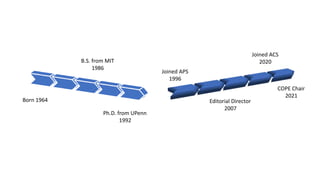
Born 1964
Ph.D. from UPenn
1992
B.S. from MIT
1986
Joined APS
1996
Editorial Director
2007
Joined ACS
2020
COPE Chair
2021
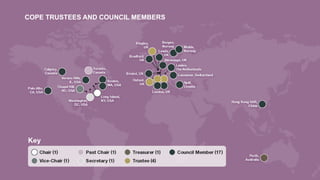
COPE TRUSTEES AND COUNCIL MEMBERS
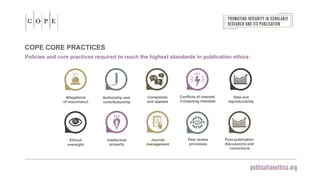
COPE CORE PRACTICES
Policies and core practices required to reach the highest standards in publication ethics:
Ethical
oversight
Intellectual
property
Journal
management
Peer review
processes
Allegations
of misconduct
Authorship and
contributorship
Complaints
and appeals
Conflicts of interest/
Competing interests
Data and
reproducibility
Post-publication
discussions and
corrections
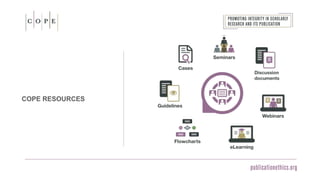
COPE RESOURCES
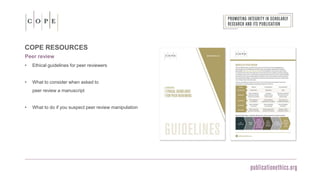
COPE RESOURCES
Peer review
• Ethical guidelines for peer reviewers
• What to consider when asked to
peer review a manuscript
• What to do if you suspect peer review manipulation
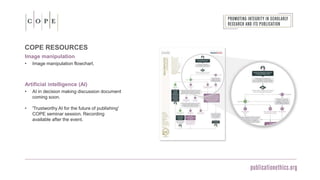
COPE RESOURCES
Image manipulation
• Image manipulation flowchart.
Artificial intelligence (AI)
• AI in decision making discussion document
coming soon.
• 'Trustworthy AI for the future of publishing'
COPE seminar session. Recording
available after the event.
COPE RESOURCES
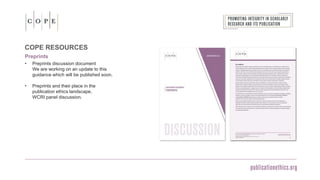
Preprints
• Preprints discussion document
We are working on an update to this
guidance which will be published soon.
• Preprints and their place in the
publication ethics landscape,
WCRI panel discussion.
COPE RESOURCES
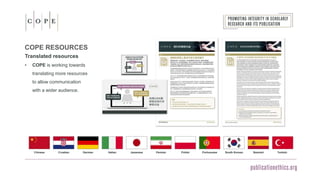
Translated resources
• COPE is working towards
translating more resources
to allow communication
with a wider audience.
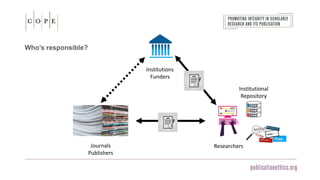
Who’s responsible?
Institutions
Funders
Researchers
Journals
Publishers
Institutional
Repository
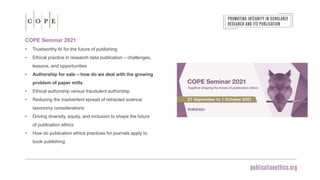
COPE Seminar 2021
• Trustworthy AI for the future of publishing
• Ethical practice in research data publication – challenges,
lessons, and opportunities
• Authorship for sale – how do we deal with the growing
problem of paper mills
• Ethical authorship versus fraudulent authorship
• Reducing the inadvertent spread of retracted science:
taxonomy considerations
• Driving diversity, equity, and inclusion to shape the future
of publication ethics
• How do publication ethics practices for journals apply to
book publishing
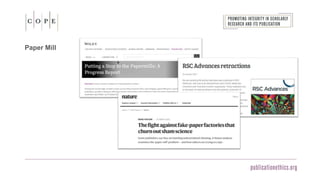
Paper Mill
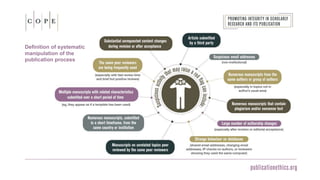
Definition of systematic
manipulation of the
publication process
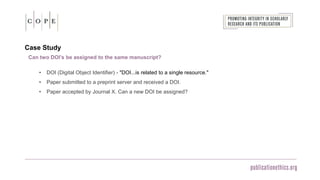
Case Study
• DOI (Digital Object Identifier) - "DOI...is related to a single resource."
• Paper submitted to a preprint server and received a DOI.
• Paper accepted by Journal X. Can a new DOI be assigned?
Can two DOI’s be assigned to the same manuscript?
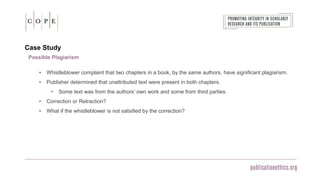
Case Study
Possible Plagiarism
• Whistleblower complaint that two chapters in a book, by the same authors, have significant plagiarism.
• Publisher determined that unattributed text were present in both chapters.
• Some text was from the authors’ own work and some from third parties.
• Correction or Retraction?
• What if the whistleblower is not satisfied by the correction?
Case Study
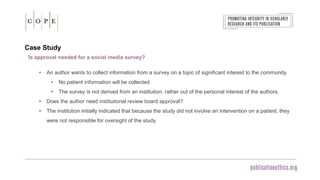
Is approval needed for a social media survey?
• An author wants to collect information from a survey on a topic of significant interest to the community.
• No patient information will be collected.
• The survey is not derived from an institution, rather out of the personal interest of the authors.
• Does the author need institutional review board approval?
• The institution initially indicated that because the study did not involve an intervention on a patient, they
were not responsible for oversight of the study.
Case Study
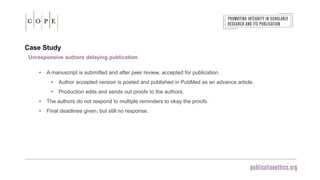
Unresponsive authors delaying publication
• A manuscript is submitted and after peer review, accepted for publication.
• Author accepted version is posted and published in PubMed as an advance article.
• Production edits and sends out proofs to the authors.
• The authors do not respond to multiple reminders to okay the proofs.
• Final deadlines given, but still no response.
Case Study
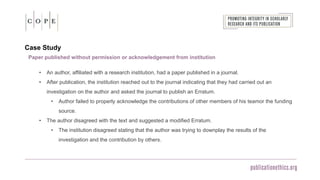
Paper published without permission or acknowledgement from institution
• An author, affiliated with a research institution, had a paper published in a journal.
• After publication, the institution reached out to the journal indicating that they had carried out an
investigation on the author and asked the journal to publish an Erratum.
• Author failed to properly acknowledge the contributions of other members of his teamor the funding
source.
• The author disagreed with the text and suggested a modified Erratum.
• The institution disagreed stating that the author was trying to downplay the results of the
investigation and the contribution by others.
THANK YOU
Daniel Kulp: d_kulp@acs.org
Registered charity No 1123023
Registered in England and Wales, Company No 6389120
Registered office: COPE New Kings Court, Tollgate, Chandler's Ford,
Eastleigh, Hampshire, SO53 3LG, United Kingdom
©2021 Committee on Publication Ethics (CC BY-NC-ND 4.0)
facebook.com/publicationethics
@C0PE LinkedIn

September 20, 2021, George Washington University: Ethics class

  • 1.
    Publication Ethics George WashingtonUniversity September 13, 2021 Dr. Daniel T. Kulp. COPE Chair Senior Director, Editorial Development American Chemical Society
  • 2.
    Trends and Issuesin Publication Ethics Agenda • Background on me • COPE: Who we are • Current Trends • Case Studies
  • 3.
    Born 1964 Ph.D. fromUPenn 1992 B.S. from MIT 1986 Joined APS 1996 Editorial Director 2007 Joined ACS 2020 COPE Chair 2021
  • 4.
    COPE TRUSTEES ANDCOUNCIL MEMBERS
  • 5.
    COPE CORE PRACTICES Policiesand core practices required to reach the highest standards in publication ethics: Ethical oversight Intellectual property Journal management Peer review processes Allegations of misconduct Authorship and contributorship Complaints and appeals Conflicts of interest/ Competing interests Data and reproducibility Post-publication discussions and corrections
  • 6.
  • 7.
    COPE RESOURCES Peer review •Ethical guidelines for peer reviewers • What to consider when asked to peer review a manuscript • What to do if you suspect peer review manipulation
  • 8.
    COPE RESOURCES Image manipulation •Image manipulation flowchart. Artificial intelligence (AI) • AI in decision making discussion document coming soon. • 'Trustworthy AI for the future of publishing' COPE seminar session. Recording available after the event.
  • 9.
    COPE RESOURCES Preprints • Preprintsdiscussion document We are working on an update to this guidance which will be published soon. • Preprints and their place in the publication ethics landscape, WCRI panel discussion.
  • 10.
    COPE RESOURCES Translated resources •COPE is working towards translating more resources to allow communication with a wider audience.
  • 11.
  • 12.
    COPE Seminar 2021 •Trustworthy AI for the future of publishing • Ethical practice in research data publication – challenges, lessons, and opportunities • Authorship for sale – how do we deal with the growing problem of paper mills • Ethical authorship versus fraudulent authorship • Reducing the inadvertent spread of retracted science: taxonomy considerations • Driving diversity, equity, and inclusion to shape the future of publication ethics • How do publication ethics practices for journals apply to book publishing
  • 13.
  • 14.
    Definition of systematic manipulationof the publication process
  • 15.
    Case Study • DOI(Digital Object Identifier) - "DOI...is related to a single resource." • Paper submitted to a preprint server and received a DOI. • Paper accepted by Journal X. Can a new DOI be assigned? Can two DOI’s be assigned to the same manuscript?
  • 16.
    Case Study Possible Plagiarism •Whistleblower complaint that two chapters in a book, by the same authors, have significant plagiarism. • Publisher determined that unattributed text were present in both chapters. • Some text was from the authors’ own work and some from third parties. • Correction or Retraction? • What if the whistleblower is not satisfied by the correction?
  • 17.
    Case Study Is approvalneeded for a social media survey? • An author wants to collect information from a survey on a topic of significant interest to the community. • No patient information will be collected. • The survey is not derived from an institution, rather out of the personal interest of the authors. • Does the author need institutional review board approval? • The institution initially indicated that because the study did not involve an intervention on a patient, they were not responsible for oversight of the study.
  • 18.
    Case Study Unresponsive authorsdelaying publication • A manuscript is submitted and after peer review, accepted for publication. • Author accepted version is posted and published in PubMed as an advance article. • Production edits and sends out proofs to the authors. • The authors do not respond to multiple reminders to okay the proofs. • Final deadlines given, but still no response.
  • 19.
    Case Study Paper publishedwithout permission or acknowledgement from institution • An author, affiliated with a research institution, had a paper published in a journal. • After publication, the institution reached out to the journal indicating that they had carried out an investigation on the author and asked the journal to publish an Erratum. • Author failed to properly acknowledge the contributions of other members of his teamor the funding source. • The author disagreed with the text and suggested a modified Erratum. • The institution disagreed stating that the author was trying to downplay the results of the investigation and the contribution by others.
  • 20.
    THANK YOU Daniel Kulp:d_kulp@acs.org
  • 21.
    Registered charity No1123023 Registered in England and Wales, Company No 6389120 Registered office: COPE New Kings Court, Tollgate, Chandler's Ford, Eastleigh, Hampshire, SO53 3LG, United Kingdom ©2021 Committee on Publication Ethics (CC BY-NC-ND 4.0) facebook.com/publicationethics @C0PE LinkedIn