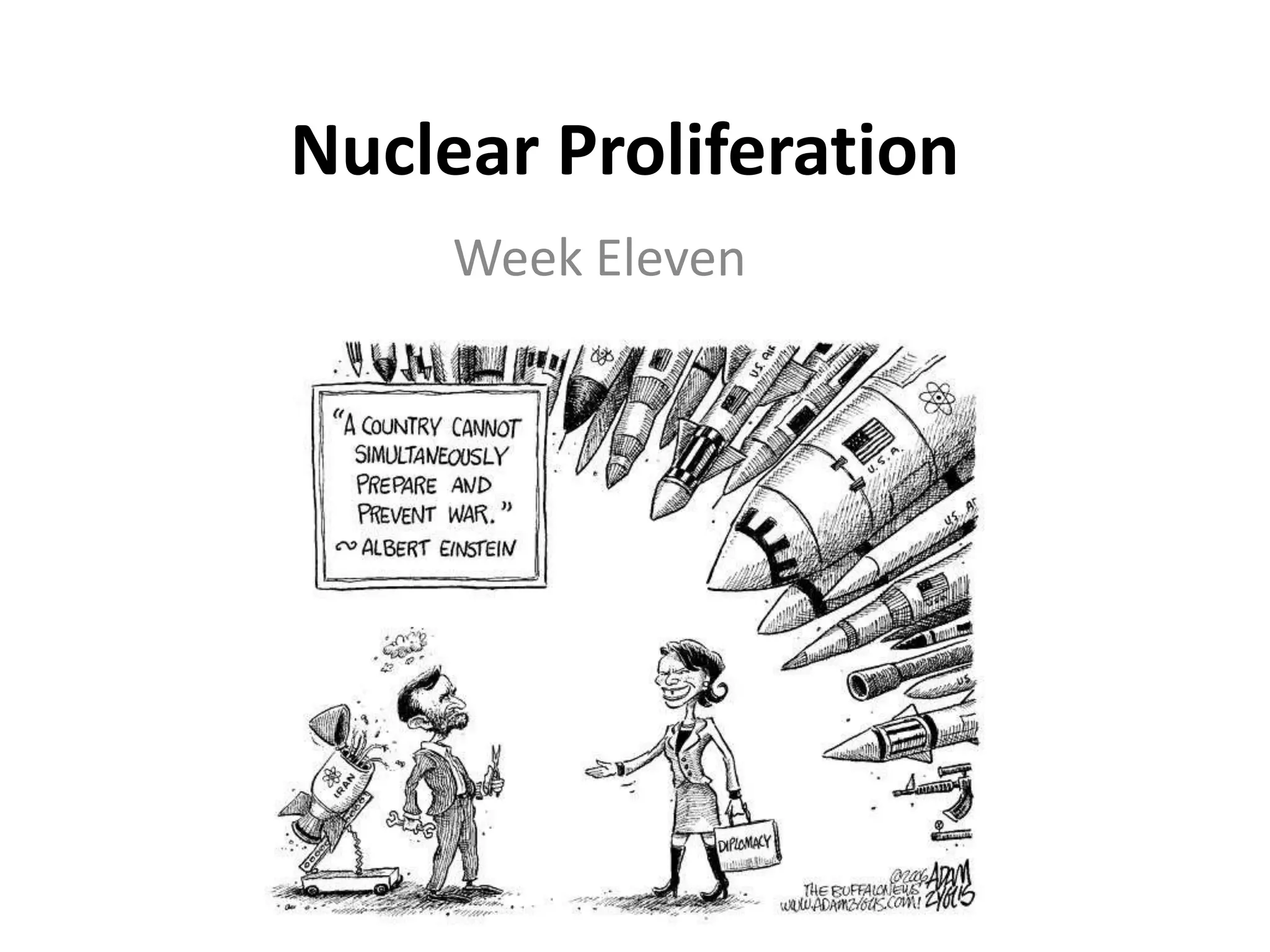






Nuclear Proliferation
Week Eleven
This Week
This is Our Last Week!
This Week
Nuclear Proliferation (Howlett, pp.384 - 397)
- Weaponry
- Proliferation
- Control
Exam Revision
Nuclear Weapons Technology
• Development is a complex process, likely state led
• Very different to nuclear reactors
– Reactors aim for a steady, regulated output
• Heat is removed from the nuclear chain, to generate power

– Weapons aim for uncontrolled, rapid explosion
• Fission Weapons: Atoms split rapidly, causing a chain
reaction and an explosion
• Fusion Weapons: Fission provides the primary ignition, then
compressing/heating hydrogen atoms for volatility
Nuclear Weapons Technology
• Can be acquired ‘off-the-shelf’ by purchase or
theft of a device.
• Nuclear technology is more likely to be acquired
by a range of infrastructural development: –
–
–
–
–

Radiological technologies
Nuclear technologies
Conventional technologies
Computational technologies
Electronic technologies
Nuclear Weapons Technology
• Often ‘delivered’ via ballistic missiles: offers the ability
strike from range. This technology is now
commonplace
• Nuclear weapons do damage in distinctive forms. What
are they?

Blast Damage
Heat/Thermal Radiation
Nuclear Radiation
• These weapons all cause ‘EMP’ disruption. What is
this?
Nuclear Weaponry
• United Nations Commission for Conventional
Armaments created a new classification in
1948 – the ‘WMD’ or ‘Weapon of Mass
Destruction’
• Conceptual focus recently shifted to CBRN –
chemical, biological, radiological and nuclear
to differentiate between these weapon types.
So Who Has Nuclear Weaponary?
There are five states acknowledged as nuclear
states by the Treaty on the Non-Proliferation of
Nuclear Weapons. Who are they?
1.
2.
3.
4.
5.

China (since 1964)
France (since 1960)
Russia/Soviet Union (since 1949)
United Kingdom (since 1952)
USA (since 1945)
So Who Has Nuclear Weaponary?
There are, however, states which have
developed the necessary technology but are not
on the list. Howlett (p.384) list two examples: 1. India
2. Pakistan
They demonstrated this technology by
conducting nuclear tests and ballistic missiles
launches in May 2008
So Who Doesn’t Want Them?
Whilst areas such as South Asia have shown a clear desire
for nuclear capabilities, other regions aim to become a
‘NWFZ’. What is an ‘NWFZ’?

A Nuclear Weapons Free Zone
Which world regions has this encompassed?
Latin America
South Pacific
South East Asia
Central Asia
Africa
Motivations: Why Have Them?
• Strategic: Shift from the perspective that nuclear
weapons are for war-fighting, towards notions of
deterrence. Brodie (1946) argued that these
weapons are only useful in their non-use, as a
deterrent, as cultural norms prohibit their use
• Prestige: Development to raise the strategic
profile of a nation or its leaders – ownership of
‘nukes’ gives a greater influence, preventing
undue outside influence
• Determinism: Once the technology is
developed, why not develop the weapons
Motivations: Why Not Have Them?
• Strategic: alliance with other non-nuclear states.
• Technological difficulties
• Perceived risk : a belief that the weapons would
increase vulnerability – terrorists may attack
nuclear facilities. Events such as 9/11 showed a
willingness to go to such extremes.
• External political pressures
It is sometimes unclear who has and who hasn’t
got these weapons! Iraq and Iran are examples of
this.
Nuclear Control: 1945-1970
• Effort to constraint acquisition began in 1945
• 1946: UN Atomic Energy Commission established
 Aimed to eliminate weapons; safeguarding energy production
 Recommendations ignored due to tensions between the US
and Soviet Russia

• 1953: Atoms for Peace Speech (Eisenhower)


Benefits of atomic power for international community

• 1957: International Atomic Energy Agency established
• 1958-1961: Attempt to negotiation ban on testing
between Soviet Union, UK and USA – no agreement on
testing/disarmament, as there was no means to detect
cheating
Nuclear Control: 1945-1970
• 1963: Partial test ban agreed, prohibiting testing
in the atmosphere, outer space or underwater.
• 1961: UN General Assembly adopts Irish
Resolution – limitations on acquisition/transfer
of weapons
• 1965: Resolution 2028 passed, a forerunner for
NNPT in 1970
• 1967: NWFZ treaty opened for Latin America
• 1970: Nuclear Non-Proliferation treaty enters
force.
Anti-Proliferation Since 1970
• 1971: Initial guidelines established for nuclear trade
by the IAEA.
• 1978: Atomic states gave assurances about weapons
use at UN special session: only China said that they
would not be the first to use them
• 1987: Guidelines established for the sale of nuclear
capable ballistic weapons/cruise missiles: known as
Missile Technology Control Regime and aimed to
limit the risks of nuclear proliferation by controlling
transfers of technology p.392 (since expanded to
many other forms of missile systems)
Anti-Proliferation Since 1970
• 1995: Resolution on the Middle East highlighted
problems with universal adherrance/trust
• 1996: Comprehensive test ban opened for
signatures, but is yet to be ratified by the
necessary 44 states.
• 2002: Hague Code of Conduct developed
mandate behaviour in the transfer of missiles
and missile parts.
• 2010: Nuclear Security Summit convened to
tighten security of radiological/nuclear material
A full chronology is in the textbook!
Pages 394-395
Now for a happier topic!
The Exam!
Exam Revision
Preparing for the January Exams
The Exam
Nine Topics in the Module: 1. Anarchy
2. Realism
3. Liberalism
4. Human Security
5. International Political Economy
6. Middle East
7. Asia-Pacific
8. Terrorism
The Exam
There are only eight questions on the exam:
1. Realism
2. Liberalism
3. Human Security
4. International Political Economy
5. Asia-Pacific
6. Middle East
7. Terrorism
8. Nuclear Proliferation
You will answer two questions, not one on the same
topic as your essay paper!
Approaching the Material
• You only have to answer two questions: that
does not mean you should only revise two of
the subject areas.
• By all means discount some, but prepare more
than two areas in case the questions aren’t
favourable
• Know specifics: What do the theorists say?
What case-study examples are there?
• Summarise the key points: what you know you
will need to know… Fit it all on one page!
General Advice
Some Strategies and Tips
Time
• Don’t leave it until the last
minute: most people don’t
benefit from ‘cramming’
• Know when you are able to
revise. Organise your
studies ahead of time work around the
distractions of hobbies, paid
employment or university
commitments.
• Do you work best in the
morning, or in the evening?
Space
• Have you room for your
textbooks and notes?
• Have you got enough
light? Natural light is
preferable!
• Is your chair comfortable?
• Are any distractions out
of sight? Difficult to revise
around computer games
or the television!
• Do you need order, or
clutter?
Noise
• Can you work in
silence?
• If not, find light
background music that
is unobtrusive – you can
find many playlists on
YouTube
Visual Aids
• Charts and diagrams
can be helpful in
organising your work
• Try to condense your
notes in single pages
Friends and Family
• Revise in groups: you
will be able to keep
each other focussed
• Explain the topics to
housemates, parent, sib
lings or the family cat!
Take a Break!
• Know when to stop! You
can’t revise all day
every day. Optimise
your time and don’t feel
guilty about taking a
break!
Misc.
• Eat well
– Don’t just eat junk food
– Fish, Nuts, Seeds, Yoghurts and Blueberries are all
proven to aid concentration

• Be well prepared on the day
– Get things ready the night before
– Know how long you need to get to the venue
– Drink lots of water
Any Questions?
Any Advice That You Want to Share?
The PowerPoint Presentations
They are now online!
Goodbye and Good Luck!

Nuclear proliferation

  • 1.
  • 2.
    This Week This isOur Last Week!
  • 3.
    This Week Nuclear Proliferation(Howlett, pp.384 - 397) - Weaponry - Proliferation - Control Exam Revision
  • 4.
    Nuclear Weapons Technology •Development is a complex process, likely state led • Very different to nuclear reactors – Reactors aim for a steady, regulated output • Heat is removed from the nuclear chain, to generate power – Weapons aim for uncontrolled, rapid explosion • Fission Weapons: Atoms split rapidly, causing a chain reaction and an explosion • Fusion Weapons: Fission provides the primary ignition, then compressing/heating hydrogen atoms for volatility
  • 5.
    Nuclear Weapons Technology •Can be acquired ‘off-the-shelf’ by purchase or theft of a device. • Nuclear technology is more likely to be acquired by a range of infrastructural development: – – – – – Radiological technologies Nuclear technologies Conventional technologies Computational technologies Electronic technologies
  • 6.
    Nuclear Weapons Technology •Often ‘delivered’ via ballistic missiles: offers the ability strike from range. This technology is now commonplace • Nuclear weapons do damage in distinctive forms. What are they? Blast Damage Heat/Thermal Radiation Nuclear Radiation • These weapons all cause ‘EMP’ disruption. What is this?
  • 7.
    Nuclear Weaponry • UnitedNations Commission for Conventional Armaments created a new classification in 1948 – the ‘WMD’ or ‘Weapon of Mass Destruction’ • Conceptual focus recently shifted to CBRN – chemical, biological, radiological and nuclear to differentiate between these weapon types.
  • 8.
    So Who HasNuclear Weaponary? There are five states acknowledged as nuclear states by the Treaty on the Non-Proliferation of Nuclear Weapons. Who are they? 1. 2. 3. 4. 5. China (since 1964) France (since 1960) Russia/Soviet Union (since 1949) United Kingdom (since 1952) USA (since 1945)
  • 9.
    So Who HasNuclear Weaponary? There are, however, states which have developed the necessary technology but are not on the list. Howlett (p.384) list two examples: 1. India 2. Pakistan They demonstrated this technology by conducting nuclear tests and ballistic missiles launches in May 2008
  • 10.
    So Who Doesn’tWant Them? Whilst areas such as South Asia have shown a clear desire for nuclear capabilities, other regions aim to become a ‘NWFZ’. What is an ‘NWFZ’? A Nuclear Weapons Free Zone Which world regions has this encompassed? Latin America South Pacific South East Asia Central Asia Africa
  • 11.
    Motivations: Why HaveThem? • Strategic: Shift from the perspective that nuclear weapons are for war-fighting, towards notions of deterrence. Brodie (1946) argued that these weapons are only useful in their non-use, as a deterrent, as cultural norms prohibit their use • Prestige: Development to raise the strategic profile of a nation or its leaders – ownership of ‘nukes’ gives a greater influence, preventing undue outside influence • Determinism: Once the technology is developed, why not develop the weapons
  • 12.
    Motivations: Why NotHave Them? • Strategic: alliance with other non-nuclear states. • Technological difficulties • Perceived risk : a belief that the weapons would increase vulnerability – terrorists may attack nuclear facilities. Events such as 9/11 showed a willingness to go to such extremes. • External political pressures It is sometimes unclear who has and who hasn’t got these weapons! Iraq and Iran are examples of this.
  • 13.
    Nuclear Control: 1945-1970 •Effort to constraint acquisition began in 1945 • 1946: UN Atomic Energy Commission established  Aimed to eliminate weapons; safeguarding energy production  Recommendations ignored due to tensions between the US and Soviet Russia • 1953: Atoms for Peace Speech (Eisenhower)  Benefits of atomic power for international community • 1957: International Atomic Energy Agency established • 1958-1961: Attempt to negotiation ban on testing between Soviet Union, UK and USA – no agreement on testing/disarmament, as there was no means to detect cheating
  • 14.
    Nuclear Control: 1945-1970 •1963: Partial test ban agreed, prohibiting testing in the atmosphere, outer space or underwater. • 1961: UN General Assembly adopts Irish Resolution – limitations on acquisition/transfer of weapons • 1965: Resolution 2028 passed, a forerunner for NNPT in 1970 • 1967: NWFZ treaty opened for Latin America • 1970: Nuclear Non-Proliferation treaty enters force.
  • 15.
    Anti-Proliferation Since 1970 •1971: Initial guidelines established for nuclear trade by the IAEA. • 1978: Atomic states gave assurances about weapons use at UN special session: only China said that they would not be the first to use them • 1987: Guidelines established for the sale of nuclear capable ballistic weapons/cruise missiles: known as Missile Technology Control Regime and aimed to limit the risks of nuclear proliferation by controlling transfers of technology p.392 (since expanded to many other forms of missile systems)
  • 16.
    Anti-Proliferation Since 1970 •1995: Resolution on the Middle East highlighted problems with universal adherrance/trust • 1996: Comprehensive test ban opened for signatures, but is yet to be ratified by the necessary 44 states. • 2002: Hague Code of Conduct developed mandate behaviour in the transfer of missiles and missile parts. • 2010: Nuclear Security Summit convened to tighten security of radiological/nuclear material
  • 17.
    A full chronologyis in the textbook! Pages 394-395
  • 18.
    Now for ahappier topic!
  • 19.
  • 20.
    Exam Revision Preparing forthe January Exams
  • 21.
    The Exam Nine Topicsin the Module: 1. Anarchy 2. Realism 3. Liberalism 4. Human Security 5. International Political Economy 6. Middle East 7. Asia-Pacific 8. Terrorism
  • 22.
    The Exam There areonly eight questions on the exam: 1. Realism 2. Liberalism 3. Human Security 4. International Political Economy 5. Asia-Pacific 6. Middle East 7. Terrorism 8. Nuclear Proliferation You will answer two questions, not one on the same topic as your essay paper!
  • 23.
    Approaching the Material •You only have to answer two questions: that does not mean you should only revise two of the subject areas. • By all means discount some, but prepare more than two areas in case the questions aren’t favourable • Know specifics: What do the theorists say? What case-study examples are there? • Summarise the key points: what you know you will need to know… Fit it all on one page!
  • 24.
  • 25.
    Time • Don’t leaveit until the last minute: most people don’t benefit from ‘cramming’ • Know when you are able to revise. Organise your studies ahead of time work around the distractions of hobbies, paid employment or university commitments. • Do you work best in the morning, or in the evening?
  • 26.
    Space • Have youroom for your textbooks and notes? • Have you got enough light? Natural light is preferable! • Is your chair comfortable? • Are any distractions out of sight? Difficult to revise around computer games or the television! • Do you need order, or clutter?
  • 27.
    Noise • Can youwork in silence? • If not, find light background music that is unobtrusive – you can find many playlists on YouTube
  • 28.
    Visual Aids • Chartsand diagrams can be helpful in organising your work • Try to condense your notes in single pages
  • 29.
    Friends and Family •Revise in groups: you will be able to keep each other focussed • Explain the topics to housemates, parent, sib lings or the family cat!
  • 30.
    Take a Break! •Know when to stop! You can’t revise all day every day. Optimise your time and don’t feel guilty about taking a break!
  • 31.
    Misc. • Eat well –Don’t just eat junk food – Fish, Nuts, Seeds, Yoghurts and Blueberries are all proven to aid concentration • Be well prepared on the day – Get things ready the night before – Know how long you need to get to the venue – Drink lots of water
  • 32.
    Any Questions? Any AdviceThat You Want to Share?
  • 33.
  • 34.