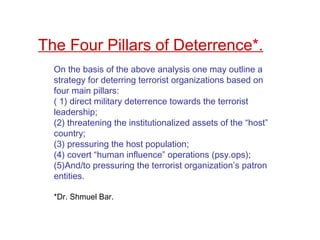
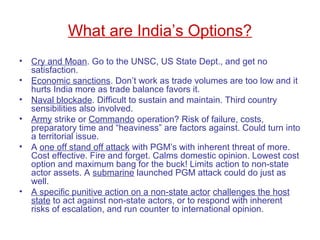
1) The document discusses various strategies and theories related to deterring terrorism and non-state actors, including flexible response, pre-modern doctrines of deterrence, and imposing direct costs on terrorist organizations and states that support them.
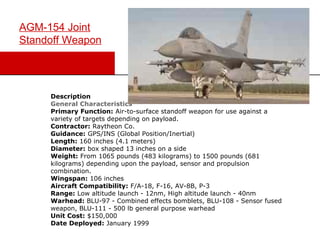
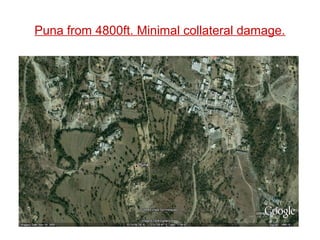
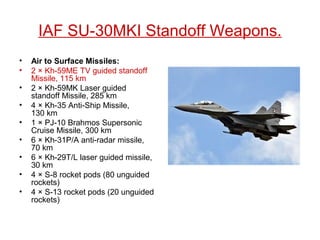
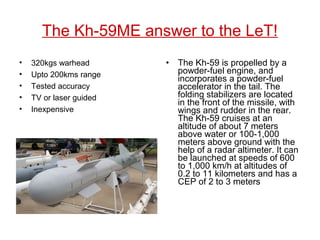
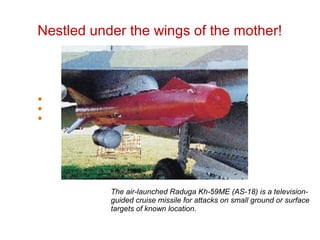
2) It provides examples of stand-off weapons like air-to-surface missiles that could impose such costs from a distance while minimizing collateral damage.
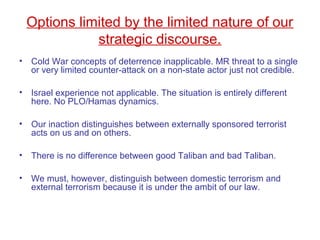
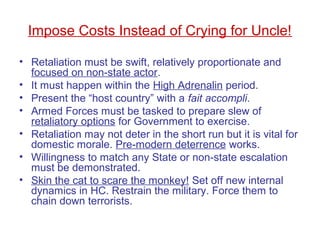
3) The document argues that retaliation against non-state actors must be swift, proportionate, and focus on the organization rather than civilians in order to impact domestic morale and force supporting states to restrain terrorists.

![Propaganda of the deed (or propaganda by the deed, from the French
propagande par le fait) is a concept that promotes physical violence
against political enemies as a way of inspiring the masses and
catalyzing revolution. Propaganda of the deed may take many forms, but
in many cases utilizes violence against people seen as threats to the
working class. It also refers to the use of symbolic acts of violence
against structural targets, in which the act is intended to evoke a broader
meaning.
“We must spread our principles, not with words but with deeds, for this is
the most popular, the most potent, and the most irresistible form of
propaganda."[ Mikhail Bakunin]
“Ideas spring from deeds and not the other way around." [Carlo
Pisacane]
Propaganda by Deed!](https://image.slidesharecdn.com/nmf-iicpresentation11-140811021805-phpapp02/85/Nmf-iic-presentation1-1-3-320.jpg)


![Strategies for the war on terrorism [compatibility mode]](https://cdn.slidesharecdn.com/ss_thumbnails/strategiesforthewaronterrorismcompatibilitymode-120409131534-phpapp02-thumbnail.jpg?width=640&height=640&fit=bounds)


