DETERMINING TRUTH
 DIRECTIONS: Read the selections carefully. Write
whether the statement is FALLACY, ARGUMENTS,
FACTS and OPINION. Write the answer on your
notebook.
1. “People have been trying for centuries to prove that God
exists. But no one has yet been able to prove it. Therefore,
God does not exist.”
2. 50% of humans are female. Pat is human. Therefore,
Pat is female. ...
3. You Need Oxygen to Survive. ...
4. Valentine's Day Is on February 14th. ...
5. That politician is corrupt.
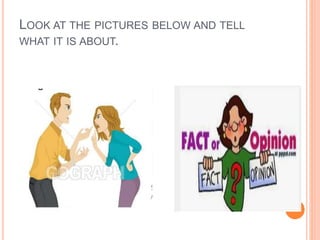
LOOK AT THE PICTURES BELOW AND TELL
WHAT IT IS ABOUT.
How to determine the truth?
• Ideas and claims are often presented in
the form of arguments, and these
arguments are phrased in such a way
that they seem reasonable.
• a number of arguments maybe based
on faulty reasoning.
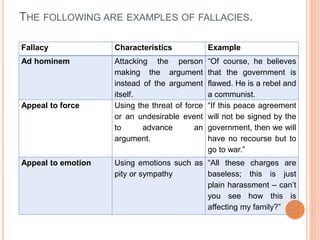
THE FOLLOWING ARE EXAMPLES OF FALLACIES.
Fallacy Characteristics Example
Ad hominem Attacking the person
making the argument
instead of the argument
itself.
“Of course, he believes
that the government is
flawed. He is a rebel and
a communist.
Appeal to force Using the threat of force
or an undesirable event
to advance an
argument.
“If this peace agreement
will not be signed by the
government, then we will
have no recourse but to
go to war.”
Appeal to emotion Using emotions such as
pity or sympathy
“All these charges are
baseless; this is just
plain harassment – can’t
you see how this is
affecting my family?”
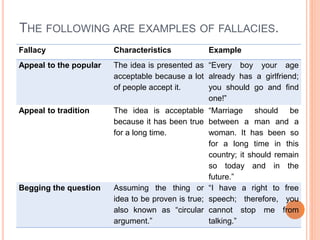
THE FOLLOWING ARE EXAMPLES OF FALLACIES.
Fallacy Characteristics Example
Appeal to the popular The idea is presented as
acceptable because a lot
of people accept it.
“Every boy your age
already has a girlfriend;
you should go and find
one!”
Appeal to tradition The idea is acceptable
because it has been true
for a long time.
“Marriage should be
between a man and a
woman. It has been so
for a long time in this
country; it should remain
so today and in the
future.”
Begging the question Assuming the thing or
idea to be proven is true;
also known as “circular
argument.”
“I have a right to free
speech; therefore, you
cannot stop me from
talking.”
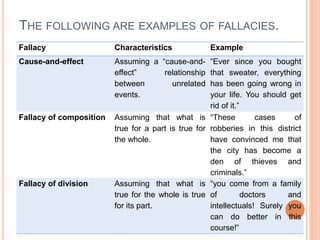
THE FOLLOWING ARE EXAMPLES OF FALLACIES.
Fallacy Characteristics Example
Cause-and-effect Assuming a “cause-and-
effect” relationship
between unrelated
events.
“Ever since you bought
that sweater, everything
has been going wrong in
your life. You should get
rid of it.”
Fallacy of composition Assuming that what is
true for a part is true for
the whole.
“These cases of
robberies in this district
have convinced me that
the city has become a
den of thieves and
criminals.”
Fallacy of division Assuming that what is
true for the whole is true
for its part.
“you come from a family
of doctors and
intellectuals! Surely you
can do better in this
course!”
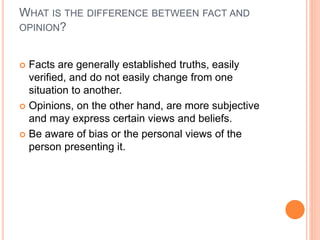
WHAT IS THE DIFFERENCE BETWEEN FACT AND
OPINION?
 Facts are generally established truths, easily
verified, and do not easily change from one
situation to another.
 Opinions, on the other hand, are more subjective
and may express certain views and beliefs.
 Be aware of bias or the personal views of the
person presenting it.
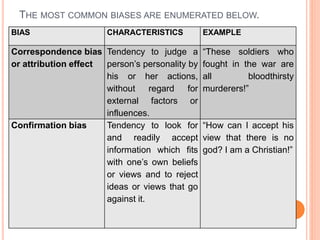
THE MOST COMMON BIASES ARE ENUMERATED BELOW.
BIAS CHARACTERISTICS EXAMPLE
Correspondence bias
or attribution effect
Tendency to judge a
person’s personality by
his or her actions,
without regard for
external factors or
influences.
“These soldiers who
fought in the war are
all bloodthirsty
murderers!”
Confirmation bias Tendency to look for
and readily accept
information which fits
with one’s own beliefs
or views and to reject
ideas or views that go
against it.
“How can I accept his
view that there is no
god? I am a Christian!”
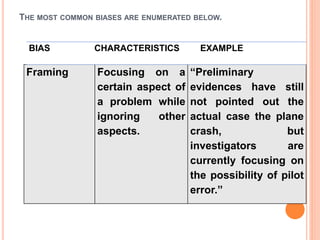
THE MOST COMMON BIASES ARE ENUMERATED BELOW.
Framing Focusing on a
certain aspect of
a problem while
ignoring other
aspects.
“Preliminary
evidences have still
not pointed out the
actual case the plane
crash, but
investigators are
currently focusing on
the possibility of pilot
error.”
BIAS CHARACTERISTICS EXAMPLE
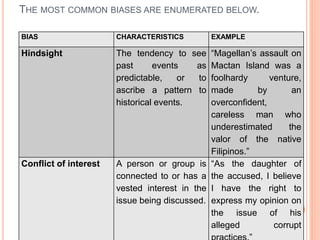
THE MOST COMMON BIASES ARE ENUMERATED BELOW.
BIAS CHARACTERISTICS EXAMPLE
Hindsight The tendency to see
past events as
predictable, or to
ascribe a pattern to
historical events.
“Magellan’s assault on
Mactan Island was a
foolhardy venture,
made by an
overconfident,
careless man who
underestimated the
valor of the native
Filipinos.”
Conflict of interest A person or group is
connected to or has a
vested interest in the
issue being discussed.
“As the daughter of
the accused, I believe
I have the right to
express my opinion on
the issue of his
alleged corrupt
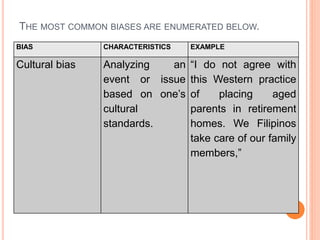
THE MOST COMMON BIASES ARE ENUMERATED BELOW.
BIAS CHARACTERISTICS EXAMPLE
Cultural bias Analyzing an
event or issue
based on one’s
cultural
standards.
“I do not agree with
this Western practice
of placing aged
parents in retirement
homes. We Filipinos
take care of our family
members,”
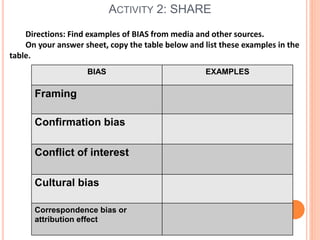
ACTIVITY 2: SHARE
Directions: Find examples of BIAS from media and other sources.
On your answer sheet, copy the table below and list these examples in the
table.
BIAS EXAMPLES
Framing
Confirmation bias
Conflict of interest
Cultural bias
Correspondence bias or
attribution effect

DETERMINING TRUTH week 3 ppt.pptx

  • 1.
  • 2.
     DIRECTIONS: Readthe selections carefully. Write whether the statement is FALLACY, ARGUMENTS, FACTS and OPINION. Write the answer on your notebook. 1. “People have been trying for centuries to prove that God exists. But no one has yet been able to prove it. Therefore, God does not exist.” 2. 50% of humans are female. Pat is human. Therefore, Pat is female. ... 3. You Need Oxygen to Survive. ... 4. Valentine's Day Is on February 14th. ... 5. That politician is corrupt.
  • 3.
    LOOK AT THEPICTURES BELOW AND TELL WHAT IT IS ABOUT.
  • 4.
    How to determinethe truth? • Ideas and claims are often presented in the form of arguments, and these arguments are phrased in such a way that they seem reasonable. • a number of arguments maybe based on faulty reasoning.
  • 5.
    THE FOLLOWING AREEXAMPLES OF FALLACIES. Fallacy Characteristics Example Ad hominem Attacking the person making the argument instead of the argument itself. “Of course, he believes that the government is flawed. He is a rebel and a communist. Appeal to force Using the threat of force or an undesirable event to advance an argument. “If this peace agreement will not be signed by the government, then we will have no recourse but to go to war.” Appeal to emotion Using emotions such as pity or sympathy “All these charges are baseless; this is just plain harassment – can’t you see how this is affecting my family?”
  • 6.
    THE FOLLOWING AREEXAMPLES OF FALLACIES. Fallacy Characteristics Example Appeal to the popular The idea is presented as acceptable because a lot of people accept it. “Every boy your age already has a girlfriend; you should go and find one!” Appeal to tradition The idea is acceptable because it has been true for a long time. “Marriage should be between a man and a woman. It has been so for a long time in this country; it should remain so today and in the future.” Begging the question Assuming the thing or idea to be proven is true; also known as “circular argument.” “I have a right to free speech; therefore, you cannot stop me from talking.”
  • 7.
    THE FOLLOWING AREEXAMPLES OF FALLACIES. Fallacy Characteristics Example Cause-and-effect Assuming a “cause-and- effect” relationship between unrelated events. “Ever since you bought that sweater, everything has been going wrong in your life. You should get rid of it.” Fallacy of composition Assuming that what is true for a part is true for the whole. “These cases of robberies in this district have convinced me that the city has become a den of thieves and criminals.” Fallacy of division Assuming that what is true for the whole is true for its part. “you come from a family of doctors and intellectuals! Surely you can do better in this course!”
  • 8.
    WHAT IS THEDIFFERENCE BETWEEN FACT AND OPINION?  Facts are generally established truths, easily verified, and do not easily change from one situation to another.  Opinions, on the other hand, are more subjective and may express certain views and beliefs.  Be aware of bias or the personal views of the person presenting it.
  • 9.
    THE MOST COMMONBIASES ARE ENUMERATED BELOW. BIAS CHARACTERISTICS EXAMPLE Correspondence bias or attribution effect Tendency to judge a person’s personality by his or her actions, without regard for external factors or influences. “These soldiers who fought in the war are all bloodthirsty murderers!” Confirmation bias Tendency to look for and readily accept information which fits with one’s own beliefs or views and to reject ideas or views that go against it. “How can I accept his view that there is no god? I am a Christian!”
  • 10.
    THE MOST COMMONBIASES ARE ENUMERATED BELOW. Framing Focusing on a certain aspect of a problem while ignoring other aspects. “Preliminary evidences have still not pointed out the actual case the plane crash, but investigators are currently focusing on the possibility of pilot error.” BIAS CHARACTERISTICS EXAMPLE
  • 11.
    THE MOST COMMONBIASES ARE ENUMERATED BELOW. BIAS CHARACTERISTICS EXAMPLE Hindsight The tendency to see past events as predictable, or to ascribe a pattern to historical events. “Magellan’s assault on Mactan Island was a foolhardy venture, made by an overconfident, careless man who underestimated the valor of the native Filipinos.” Conflict of interest A person or group is connected to or has a vested interest in the issue being discussed. “As the daughter of the accused, I believe I have the right to express my opinion on the issue of his alleged corrupt
  • 12.
    THE MOST COMMONBIASES ARE ENUMERATED BELOW. BIAS CHARACTERISTICS EXAMPLE Cultural bias Analyzing an event or issue based on one’s cultural standards. “I do not agree with this Western practice of placing aged parents in retirement homes. We Filipinos take care of our family members,”
  • 13.
    ACTIVITY 2: SHARE Directions:Find examples of BIAS from media and other sources. On your answer sheet, copy the table below and list these examples in the table. BIAS EXAMPLES Framing Confirmation bias Conflict of interest Cultural bias Correspondence bias or attribution effect