Normal distribution
CONCEPT OF NORMAL DISTRIBUTION
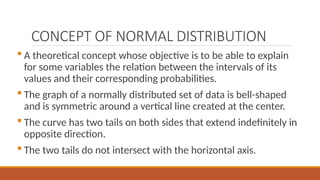
 A theoretical concept whose objective is to be able to explain
for some variables the relation between the intervals of its
values and their corresponding probabilities.
 The graph of a normally distributed set of data is bell-shaped
and is symmetric around a vertical line created at the center.
 The curve has two tails on both sides that extend indefinitely in
opposite direction.
 The two tails do not intersect with the horizontal axis.
Normal Distribution
The curve of a normally
distributed set of data can be
described by the value of the
mean and the standard
deviation.
We shall consider three specific
intervals with which we can
associate three mathematical
facts called the Empirical Rule.
GRAPH OF A NORMALLY DISTRIBUTED SET OF
DATA
Normal Distribution
1. At least 68% of the values in
the given set of data fall within
plus or minus 1 standard
deviation from the mean. In
symbols, the interval is given by
◦( – 1s) – ( + 1s)
SUBDIVISION OF THE HORIZONTAL AXIS INTO EQUAL SUB-
INTERVALS WITH 1 UNIT EQUAL TO 1 STANDARD
DEVIATION
Normal Distribution
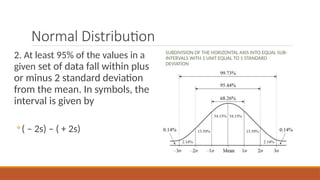
2. At least 95% of the values in a
given set of data fall within plus
or minus 2 standard deviation
from the mean. In symbols, the
interval is given by
◦( – 2s) – ( + 2s)
SUBDIVISION OF THE HORIZONTAL AXIS INTO EQUAL SUB-
INTERVALS WITH 1 UNIT EQUAL TO 1 STANDARD
DEVIATION
Normal Distribution
3. At least 99% of the values in a
given set of data fall within plus
or minus 3 standard deviation
from the mean. In symbols, the
interval is given by
◦( – 3s) – ( + 3s)
SUBDIVISION OF THE HORIZONTAL AXIS INTO EQUAL SUB-
INTERVALS WITH 1 UNIT EQUAL TO 1 STANDARD
DEVIATION
Significance of the Empirical Rule
Consider the NCEE scores of the
students in a certain college whose
mean score is 75 and a standard
deviation of 8. Assuming normality of
the data, we can say that
a) Approximately, 68% of the students
in that college have NCEE scores
between 75 plus or minus 8, that is,
◦(– 1(8) – (+ 1(8)
◦ 67 – 83
THE APPROXIMATE AREAS OF THE INTERVALS
REPRESENTING THE EMPIRICAL RULE
Significance of the Empirical Rule
b) Approximately, 95% of the
students in that college have
NCEE scores between 75 plus
or minus 2 times the standard
deviation, 8. Thus,
◦(– 2(8) – (+ 2(8)
◦ 75 – 16 – 75 + 16
◦ 59 – 91
THE APPROXIMATE AREAS OF THE INTERVALS
REPRESENTING THE EMPIRICAL RULE
Significance of the Empirical Rule
c) Approximately, 99% of the
students in that college have
NCEE scores between 75 plus
or minus 3 times the standard
deviation, 8. Thus,
◦(– 3(8) – (+ 3(8)
◦ 75 – 24 – 75 + 24
◦ 51 – 99
THE GRAPH OF THE NCEE SCORES OF THE
STUDENTS IN A CERTAIN COLLEGE
51 59 67 75 83
91 99
Properties of the Normal Distribution
1. Symmetrical. A theoretical normal distribution is symmetrical about its mode,
median, and mean. In a normal distribution, then, the mode, median, and mean are
equal to each other.
2. Asymptotic. The tails of the normal distribution approach closer to the base line, or
abscissa, as they get farther away from µ. The distribution, however, is asymptotic;
the tails never touch the base line, regardless of the distance from µ.
3. Continuous. The normal distribution is continuous for all scores between plus and
minus infinity. This means that, for any two scores, I can always obtain another
score that lies between them.
Area under the Normal Distribution
 In normal distribution, specific
proportions of scores are within
certain intervals about the mean.
 In any normally distributed
population, .3413 of the scores is in
an internal between µ and µ plus one
standard deviation.
 The proportion .3413 can be
expressed as a percent by multiplying
it by 100; thus .3413 equals 34.13
percent.
Subdivision of the horizontal axis into equal sub-
intervals with 1 unit equal to 1 standard deviation
Area under the Normal Distribution
To summarize, in a normal distribution the following relations hold between
µ, , the proportion of scores, and the percentage of scores contained in
certain intervals about the mean:
Interval Proportion of Scores in Interval Percentage of Scores in Interval
µ - 1 to µ + 1 .6826 68.26
µ - 2 to µ + 2 .9544 95.44
µ - 3 to µ + 3 .9974 99.74
Standard Normal Distribution
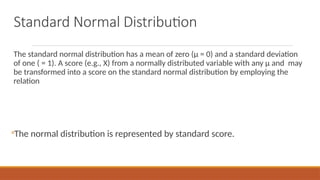
The standard normal distribution has a mean of zero (µ = 0) and a standard deviation
of one ( = 1). A score (e.g., X) from a normally distributed variable with any µ and may
be transformed into a score on the standard normal distribution by employing the
relation
◦The normal distribution is represented by standard score.
Standard Score
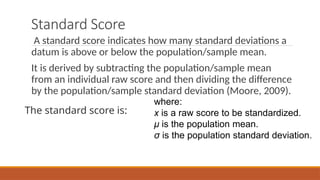
A standard score indicates how many standard deviations a
datum is above or below the population/sample mean.
It is derived by subtracting the population/sample mean
from an individual raw score and then dividing the difference
by the population/sample standard deviation (Moore, 2009).
The standard score is:
where:
x is a raw score to be standardized.
μ is the population mean.
σ is the population standard deviation.
Standard Normal Distribution (SND)
To demonstrate SND, suppose that a
score of 115 (i.e., X = 115) is obtained
from a normally distributed set of
scores with µ = 100 and =15. This
score is converted to a z score by
= +1.0
Standard Normal Distribution
Location of a score of 115 from a
normal distribution with µ = 100
and = 15 on the standard normal
distribution. The labels on the X
axis show (a) the raw scores, (b) z
scores corresponding to the raw
scores, and (c) the proportion of
scores from z = -∞ to z = 0 and
from z = 0 to z = +1.
(a) 55 70 85 100 115
130 145
(b) -3 -2 -1 0 +1
+2 +3
(c) .5000
Z = + 1.0
Standard Normal Distribution
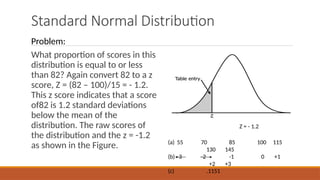
What proportion of scores in this
distribution is equal to or less
than 82? Again convert 82 to a z
score, Z = (82 – 100)/15 = - 1.2.
This z score indicates that a score
of82 is 1.2 standard deviations
below the mean of the
distribution. The raw scores of
the distribution and the z = -1.2
as shown in the Figure. (a) 55 70 85 100 115
130 145
(b) -3 -2 -1 0 +1
+2 +3
(c) .1151
Z = - 1.2
Problem:
Standard Normal Distribution
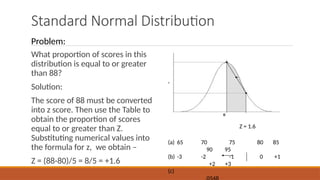
What proportion of scores in this
distribution is equal to or greater
than 88?
Solution:
The score of 88 must be converted
into z score. Then use the Table to
obtain the proportion of scores
equal to or greater than Z.
Substituting numerical values into
the formula for z, we obtain –
Z = (88-80)/5 = 8/5 = +1.6
(a) 65 70 75 80 85
90 95
(b) -3 -2 -1 0 +1
+2 +3
(c)
Z = 1.6
Problem:
Standard Normal Distribution
What proportion of scores in this
distribution is between 83 and 87?
Solution:
Both 83 and 87 must be converted to z
scores. Then obtain the area of the
standard normal distribution between
the two values of z. Substituting
numerical values, we obtain –
Z = (83-80)/5 = 3/5 = +0.6
Z= (87-80)/5 = 7/5 = +1.4
(a) 65 70 75 80 85
90 95
(b) -3 -2 -1 0 +1
+2 +3
(c)
Z = 0.6 Z = +1.4
Problem:
Standard Normal Distribution
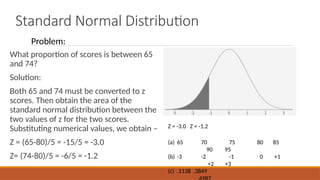
What proportion of scores is between 65
and 74?
Solution:
Both 65 and 74 must be converted to z
scores. Then obtain the area of the
standard normal distribution between the
two values of z for the two scores.
Substituting numerical values, we obtain –
Z = (65-80)/5 = -15/5 = -3.0
Z= (74-80)/5 = -6/5 = -1.2
(a) 65 70 75 80 85
90 95
(b) -3 -2 -1 0 +1
+2 +3
(c) .1138 .3849
Z = -3.0 Z = -1.2
Problem:
Standard Normal Distribution
The area between z = 0 and z = -3.0
is .4987. For z = -1.2, .3849 of the
scores between z = 0 and z = -1.2.
Obtain the proportion of scores
between z = -3.0 and z = -1.2 by
subtracting .3849 from .4987. This
value is .1138. The proportion of
scores in the interval from 65 to 74
is .1138 or 11.38 percent. For every
1000 scores in the population, 113.8
are between 65 to 74.
(a) 65 70 75 80 85
90 95
(b) -3 -2 -1 0 +1
+2 +3
(c) .1138 .3849
Z = -3.0 Z = -1.2
Problem:
Standard Normal Distribution
What range of scores includes the
middle 80 percent of the scores on the
distribution?
Solution:
Find areas in column 0.08 of Table in
slide 24 that include a proportion
of .40 or 40% of the scores on each
side of the mean. Determine the z
value for these scores, and then solve
the formula for z to obtain values of X.
(a) 65 70 75 80 85
90 95
(b) -3 -2 -1 0 +1
+2 +3
(c) .40 .40
Z = -1.28 Z = +1.28
Problem:
80% of scores
Standard Normal Distribution
To find z that includes .40 of the scores
between z=0 and its value, run down
column 0.08 until you find the
proportion closest to .40. This area
is .3997, which corresponds to a z of
1.28. Thus scores that result in z values
between 0 to +1.28 occur with a
relative frequency of .3997 and scores
that result in z values between 0 to -
1.28 also occur with a relative
frequency of .3997.
(a) 65 70 75 80 85
90 95
(b) -3 -2 -1 0 +1
+2 +3
(c) .40 .40
.80
Z = -1.28 Z = +1.28
Solution continued:
80% of scores
Standard Normal Distribution
The total area encompassed by
scores between z = -1.28 to z = +1.28
is .3997 + 3.997 = .7994, or
approximately .80.
The last step is to obtain the values
of x that correspond to z = -1.28 and
z = +1.28. To find these values,
substitute numerical values of z,µ,
and into the formula.
◦ +1.28 =
Solution continued:
Standard Normal Distribution
◦ Solving the equation for x
◦ +1.28 = = (+1.28)5 = X – 80
X = 5(1.28) + 80
= 86.4
For z score = -1.28
◦ Solving this equation for x
◦ (-1.28 = = (-1.28)5 = X – 80
X = 5(-1.28) + 80
= -6.4 + 80 = 73.6
Solution continued:
Normal Distribution and Skewed Distribution
The normal distribution is a bell-
shaped, symmetrical distribution in
which the mean, median and mode
are all equal. If the mean, median and
mode are unequal, the distribution
will be either positively or negatively
skewed.
A skewed distribution occurs when
one tail is longer than the other.
Skewness defines the asymmetry of a
distribution. Unlike the familiar
normal distribution with its bell-
shaped curve, these distributions are
asymmetric.
Skewed Distribution
A left-skewed distribution has a long left
tail. Left-skewed distributions are also
called negatively-skewed distributions.
That’s because there is a long tail in the
negative direction on the number line. The
mean is also to the left of the peak.
A right-skewed distribution has a long right
tail. Right-skewed distributions are also
called positive-skew distributions. That’s
because there is a long tail in the positive
direction on the number line. The mean is
also to the right of the peak.
Kurtosis
Kurtosis is a measure of the tailedness of a distribution. Tailedness is how often
outliers occur. Excess kurtosis is the tailedness of a distribution relative to a
normal distribution.
Distributions with medium kurtosis (medium tails) are mesokurtic.
Distributions with low kurtosis (thin tails) are platykurtic.
Distributions with high kurtosis (fat tails) are leptokurtic.
Tails are the tapering ends on either side of a distribution. They represent the
probability or frequency of values that are extremely high or low compared to the
mean. In other words, tails represent how often outliers occur.
Kurtosis
Kurtosis
Mesokurtic distribution example
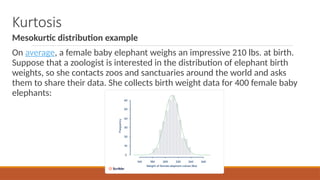
On average, a female baby elephant weighs an impressive 210 lbs. at birth.
Suppose that a zoologist is interested in the distribution of elephant birth
weights, so she contacts zoos and sanctuaries around the world and asks
them to share their data. She collects birth weight data for 400 female baby
elephants:
Kurtosis
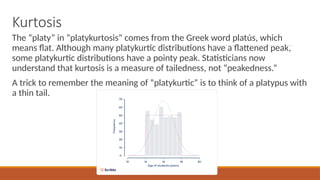
The “platy” in “platykurtosis” comes from the Greek word platús, which
means flat. Although many platykurtic distributions have a flattened peak,
some platykurtic distributions have a pointy peak. Statisticians now
understand that kurtosis is a measure of tailedness, not “peakedness.”
A trick to remember the meaning of “platykurtic” is to think of a platypus with
a thin tail.
Kurtosis
A leptokurtic distribution is fat-tailed, meaning that there are a lot of outliers.
Leptokurtic distributions are more kurtotic than a normal distribution. They
have: a) A kurtosis of more than 3 b) An excess kurtosis of more than 0 c)
Leptokurtosis is sometimes called positive kurtosis, since the excess kurtosis
is positive
Leptokurtic distribution example
Imagine that four astronomers are all trying to measure the distance between
the Earth and Nu2 Draconis A, a blue star that’s part of the Draco
constellation. Each of the four astronomers measures the distance 100 times,
and they put their data together in the same dataset:
Kurtosis
References:
Ela N. Regondola, Ed. D.
Professor

Normal distribution.pptx aaaaaaaaaaaaaaa

  • 1.
  • 2.
    CONCEPT OF NORMALDISTRIBUTION  A theoretical concept whose objective is to be able to explain for some variables the relation between the intervals of its values and their corresponding probabilities.  The graph of a normally distributed set of data is bell-shaped and is symmetric around a vertical line created at the center.  The curve has two tails on both sides that extend indefinitely in opposite direction.  The two tails do not intersect with the horizontal axis.
  • 3.
    Normal Distribution The curveof a normally distributed set of data can be described by the value of the mean and the standard deviation. We shall consider three specific intervals with which we can associate three mathematical facts called the Empirical Rule. GRAPH OF A NORMALLY DISTRIBUTED SET OF DATA
  • 4.
    Normal Distribution 1. Atleast 68% of the values in the given set of data fall within plus or minus 1 standard deviation from the mean. In symbols, the interval is given by ◦( – 1s) – ( + 1s) SUBDIVISION OF THE HORIZONTAL AXIS INTO EQUAL SUB- INTERVALS WITH 1 UNIT EQUAL TO 1 STANDARD DEVIATION
  • 5.
    Normal Distribution 2. Atleast 95% of the values in a given set of data fall within plus or minus 2 standard deviation from the mean. In symbols, the interval is given by ◦( – 2s) – ( + 2s) SUBDIVISION OF THE HORIZONTAL AXIS INTO EQUAL SUB- INTERVALS WITH 1 UNIT EQUAL TO 1 STANDARD DEVIATION
  • 6.
    Normal Distribution 3. Atleast 99% of the values in a given set of data fall within plus or minus 3 standard deviation from the mean. In symbols, the interval is given by ◦( – 3s) – ( + 3s) SUBDIVISION OF THE HORIZONTAL AXIS INTO EQUAL SUB- INTERVALS WITH 1 UNIT EQUAL TO 1 STANDARD DEVIATION
  • 7.
    Significance of theEmpirical Rule Consider the NCEE scores of the students in a certain college whose mean score is 75 and a standard deviation of 8. Assuming normality of the data, we can say that a) Approximately, 68% of the students in that college have NCEE scores between 75 plus or minus 8, that is, ◦(– 1(8) – (+ 1(8) ◦ 67 – 83 THE APPROXIMATE AREAS OF THE INTERVALS REPRESENTING THE EMPIRICAL RULE
  • 8.
    Significance of theEmpirical Rule b) Approximately, 95% of the students in that college have NCEE scores between 75 plus or minus 2 times the standard deviation, 8. Thus, ◦(– 2(8) – (+ 2(8) ◦ 75 – 16 – 75 + 16 ◦ 59 – 91 THE APPROXIMATE AREAS OF THE INTERVALS REPRESENTING THE EMPIRICAL RULE
  • 9.
    Significance of theEmpirical Rule c) Approximately, 99% of the students in that college have NCEE scores between 75 plus or minus 3 times the standard deviation, 8. Thus, ◦(– 3(8) – (+ 3(8) ◦ 75 – 24 – 75 + 24 ◦ 51 – 99 THE GRAPH OF THE NCEE SCORES OF THE STUDENTS IN A CERTAIN COLLEGE 51 59 67 75 83 91 99
  • 10.
    Properties of theNormal Distribution 1. Symmetrical. A theoretical normal distribution is symmetrical about its mode, median, and mean. In a normal distribution, then, the mode, median, and mean are equal to each other. 2. Asymptotic. The tails of the normal distribution approach closer to the base line, or abscissa, as they get farther away from µ. The distribution, however, is asymptotic; the tails never touch the base line, regardless of the distance from µ. 3. Continuous. The normal distribution is continuous for all scores between plus and minus infinity. This means that, for any two scores, I can always obtain another score that lies between them.
  • 11.
    Area under theNormal Distribution  In normal distribution, specific proportions of scores are within certain intervals about the mean.  In any normally distributed population, .3413 of the scores is in an internal between µ and µ plus one standard deviation.  The proportion .3413 can be expressed as a percent by multiplying it by 100; thus .3413 equals 34.13 percent. Subdivision of the horizontal axis into equal sub- intervals with 1 unit equal to 1 standard deviation
  • 12.
    Area under theNormal Distribution To summarize, in a normal distribution the following relations hold between µ, , the proportion of scores, and the percentage of scores contained in certain intervals about the mean: Interval Proportion of Scores in Interval Percentage of Scores in Interval µ - 1 to µ + 1 .6826 68.26 µ - 2 to µ + 2 .9544 95.44 µ - 3 to µ + 3 .9974 99.74
  • 13.
    Standard Normal Distribution Thestandard normal distribution has a mean of zero (µ = 0) and a standard deviation of one ( = 1). A score (e.g., X) from a normally distributed variable with any µ and may be transformed into a score on the standard normal distribution by employing the relation ◦The normal distribution is represented by standard score.
  • 14.
    Standard Score A standardscore indicates how many standard deviations a datum is above or below the population/sample mean. It is derived by subtracting the population/sample mean from an individual raw score and then dividing the difference by the population/sample standard deviation (Moore, 2009). The standard score is: where: x is a raw score to be standardized. μ is the population mean. σ is the population standard deviation.
  • 15.
    Standard Normal Distribution(SND) To demonstrate SND, suppose that a score of 115 (i.e., X = 115) is obtained from a normally distributed set of scores with µ = 100 and =15. This score is converted to a z score by = +1.0
  • 16.
    Standard Normal Distribution Locationof a score of 115 from a normal distribution with µ = 100 and = 15 on the standard normal distribution. The labels on the X axis show (a) the raw scores, (b) z scores corresponding to the raw scores, and (c) the proportion of scores from z = -∞ to z = 0 and from z = 0 to z = +1. (a) 55 70 85 100 115 130 145 (b) -3 -2 -1 0 +1 +2 +3 (c) .5000 Z = + 1.0
  • 17.
    Standard Normal Distribution Whatproportion of scores in this distribution is equal to or less than 82? Again convert 82 to a z score, Z = (82 – 100)/15 = - 1.2. This z score indicates that a score of82 is 1.2 standard deviations below the mean of the distribution. The raw scores of the distribution and the z = -1.2 as shown in the Figure. (a) 55 70 85 100 115 130 145 (b) -3 -2 -1 0 +1 +2 +3 (c) .1151 Z = - 1.2 Problem:
  • 18.
    Standard Normal Distribution Whatproportion of scores in this distribution is equal to or greater than 88? Solution: The score of 88 must be converted into z score. Then use the Table to obtain the proportion of scores equal to or greater than Z. Substituting numerical values into the formula for z, we obtain – Z = (88-80)/5 = 8/5 = +1.6 (a) 65 70 75 80 85 90 95 (b) -3 -2 -1 0 +1 +2 +3 (c) Z = 1.6 Problem:
  • 19.
    Standard Normal Distribution Whatproportion of scores in this distribution is between 83 and 87? Solution: Both 83 and 87 must be converted to z scores. Then obtain the area of the standard normal distribution between the two values of z. Substituting numerical values, we obtain – Z = (83-80)/5 = 3/5 = +0.6 Z= (87-80)/5 = 7/5 = +1.4 (a) 65 70 75 80 85 90 95 (b) -3 -2 -1 0 +1 +2 +3 (c) Z = 0.6 Z = +1.4 Problem:
  • 20.
    Standard Normal Distribution Whatproportion of scores is between 65 and 74? Solution: Both 65 and 74 must be converted to z scores. Then obtain the area of the standard normal distribution between the two values of z for the two scores. Substituting numerical values, we obtain – Z = (65-80)/5 = -15/5 = -3.0 Z= (74-80)/5 = -6/5 = -1.2 (a) 65 70 75 80 85 90 95 (b) -3 -2 -1 0 +1 +2 +3 (c) .1138 .3849 Z = -3.0 Z = -1.2 Problem:
  • 21.
    Standard Normal Distribution Thearea between z = 0 and z = -3.0 is .4987. For z = -1.2, .3849 of the scores between z = 0 and z = -1.2. Obtain the proportion of scores between z = -3.0 and z = -1.2 by subtracting .3849 from .4987. This value is .1138. The proportion of scores in the interval from 65 to 74 is .1138 or 11.38 percent. For every 1000 scores in the population, 113.8 are between 65 to 74. (a) 65 70 75 80 85 90 95 (b) -3 -2 -1 0 +1 +2 +3 (c) .1138 .3849 Z = -3.0 Z = -1.2 Problem:
  • 22.
    Standard Normal Distribution Whatrange of scores includes the middle 80 percent of the scores on the distribution? Solution: Find areas in column 0.08 of Table in slide 24 that include a proportion of .40 or 40% of the scores on each side of the mean. Determine the z value for these scores, and then solve the formula for z to obtain values of X. (a) 65 70 75 80 85 90 95 (b) -3 -2 -1 0 +1 +2 +3 (c) .40 .40 Z = -1.28 Z = +1.28 Problem: 80% of scores
  • 23.
    Standard Normal Distribution Tofind z that includes .40 of the scores between z=0 and its value, run down column 0.08 until you find the proportion closest to .40. This area is .3997, which corresponds to a z of 1.28. Thus scores that result in z values between 0 to +1.28 occur with a relative frequency of .3997 and scores that result in z values between 0 to - 1.28 also occur with a relative frequency of .3997. (a) 65 70 75 80 85 90 95 (b) -3 -2 -1 0 +1 +2 +3 (c) .40 .40 .80 Z = -1.28 Z = +1.28 Solution continued: 80% of scores
  • 25.
    Standard Normal Distribution Thetotal area encompassed by scores between z = -1.28 to z = +1.28 is .3997 + 3.997 = .7994, or approximately .80. The last step is to obtain the values of x that correspond to z = -1.28 and z = +1.28. To find these values, substitute numerical values of z,µ, and into the formula. ◦ +1.28 = Solution continued:
  • 26.
    Standard Normal Distribution ◦Solving the equation for x ◦ +1.28 = = (+1.28)5 = X – 80 X = 5(1.28) + 80 = 86.4 For z score = -1.28 ◦ Solving this equation for x ◦ (-1.28 = = (-1.28)5 = X – 80 X = 5(-1.28) + 80 = -6.4 + 80 = 73.6 Solution continued:
  • 27.
    Normal Distribution andSkewed Distribution The normal distribution is a bell- shaped, symmetrical distribution in which the mean, median and mode are all equal. If the mean, median and mode are unequal, the distribution will be either positively or negatively skewed. A skewed distribution occurs when one tail is longer than the other. Skewness defines the asymmetry of a distribution. Unlike the familiar normal distribution with its bell- shaped curve, these distributions are asymmetric.
  • 28.
    Skewed Distribution A left-skeweddistribution has a long left tail. Left-skewed distributions are also called negatively-skewed distributions. That’s because there is a long tail in the negative direction on the number line. The mean is also to the left of the peak. A right-skewed distribution has a long right tail. Right-skewed distributions are also called positive-skew distributions. That’s because there is a long tail in the positive direction on the number line. The mean is also to the right of the peak.
  • 29.
    Kurtosis Kurtosis is ameasure of the tailedness of a distribution. Tailedness is how often outliers occur. Excess kurtosis is the tailedness of a distribution relative to a normal distribution. Distributions with medium kurtosis (medium tails) are mesokurtic. Distributions with low kurtosis (thin tails) are platykurtic. Distributions with high kurtosis (fat tails) are leptokurtic. Tails are the tapering ends on either side of a distribution. They represent the probability or frequency of values that are extremely high or low compared to the mean. In other words, tails represent how often outliers occur.
  • 30.
  • 31.
    Kurtosis Mesokurtic distribution example Onaverage, a female baby elephant weighs an impressive 210 lbs. at birth. Suppose that a zoologist is interested in the distribution of elephant birth weights, so she contacts zoos and sanctuaries around the world and asks them to share their data. She collects birth weight data for 400 female baby elephants:
  • 32.
    Kurtosis The “platy” in“platykurtosis” comes from the Greek word platús, which means flat. Although many platykurtic distributions have a flattened peak, some platykurtic distributions have a pointy peak. Statisticians now understand that kurtosis is a measure of tailedness, not “peakedness.” A trick to remember the meaning of “platykurtic” is to think of a platypus with a thin tail.
  • 33.
    Kurtosis A leptokurtic distributionis fat-tailed, meaning that there are a lot of outliers. Leptokurtic distributions are more kurtotic than a normal distribution. They have: a) A kurtosis of more than 3 b) An excess kurtosis of more than 0 c) Leptokurtosis is sometimes called positive kurtosis, since the excess kurtosis is positive Leptokurtic distribution example Imagine that four astronomers are all trying to measure the distance between the Earth and Nu2 Draconis A, a blue star that’s part of the Draco constellation. Each of the four astronomers measures the distance 100 times, and they put their data together in the same dataset:
  • 34.
  • 35.