Bending electrical
conduits
february 06, 2024
Performance objectives
• Given the necessary equipment, tools
and materials, bend the electrical pipe
in line with the job requirements.
Bending conduits
Conduit bending is truly one of the
fundamental tasks of the electrical construction
industry. Whether EMT, galvanized rigid steel
conduit, or intermediate conduit, you will need to
bend it. Bends will be required as part of your
installation.
90 degree bend
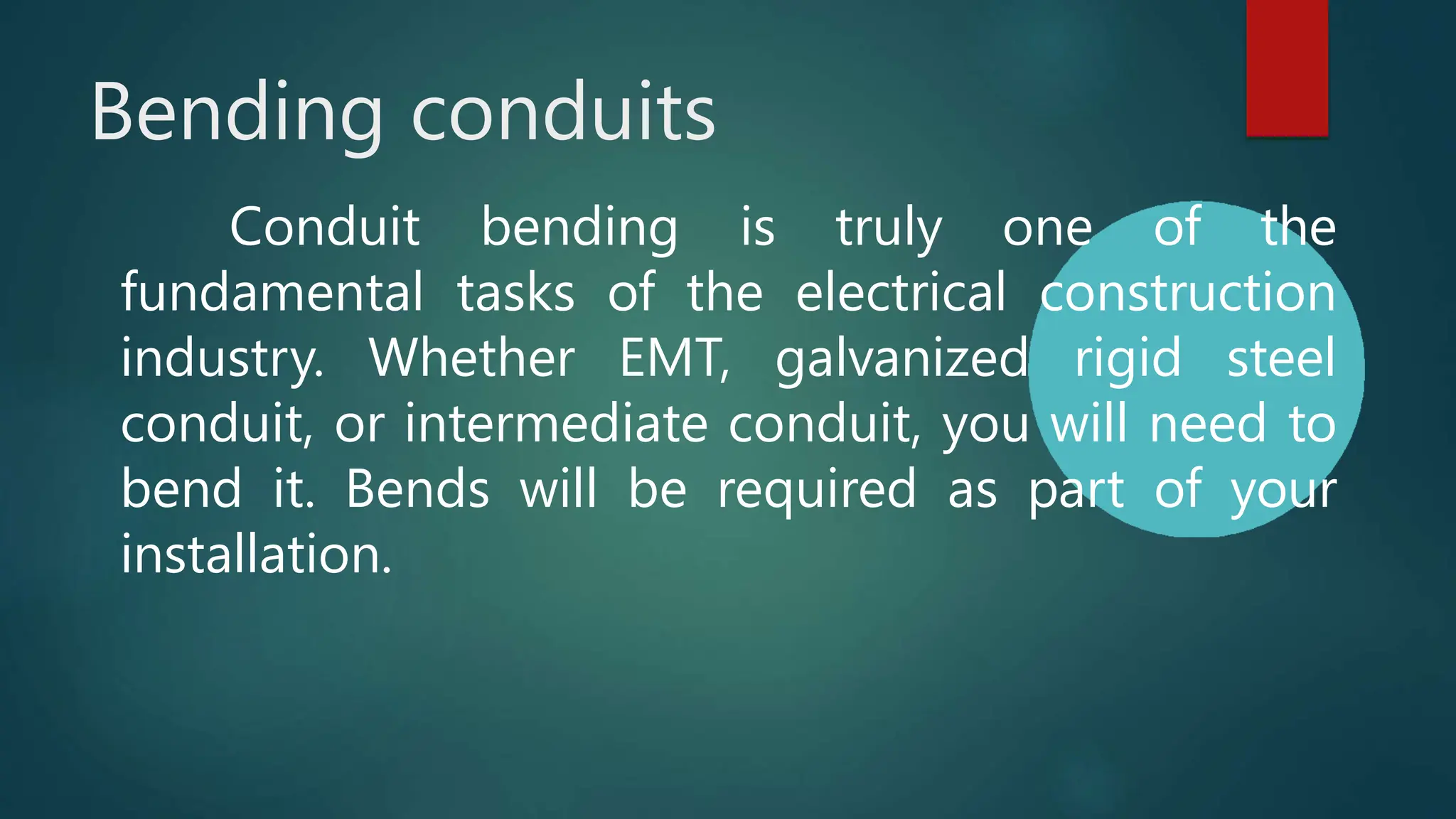
A 90 degree stub up bend is made by
bending a piece of piping into a 90
degree or 'L' shape. It is the bend
most commonly used by electricians
and plumbers. This bend is frequently
used to run conduit into electrical
boxes, run pipes up and down walls
and to run pipe into walls through
floors and ceilings.
Offset bend
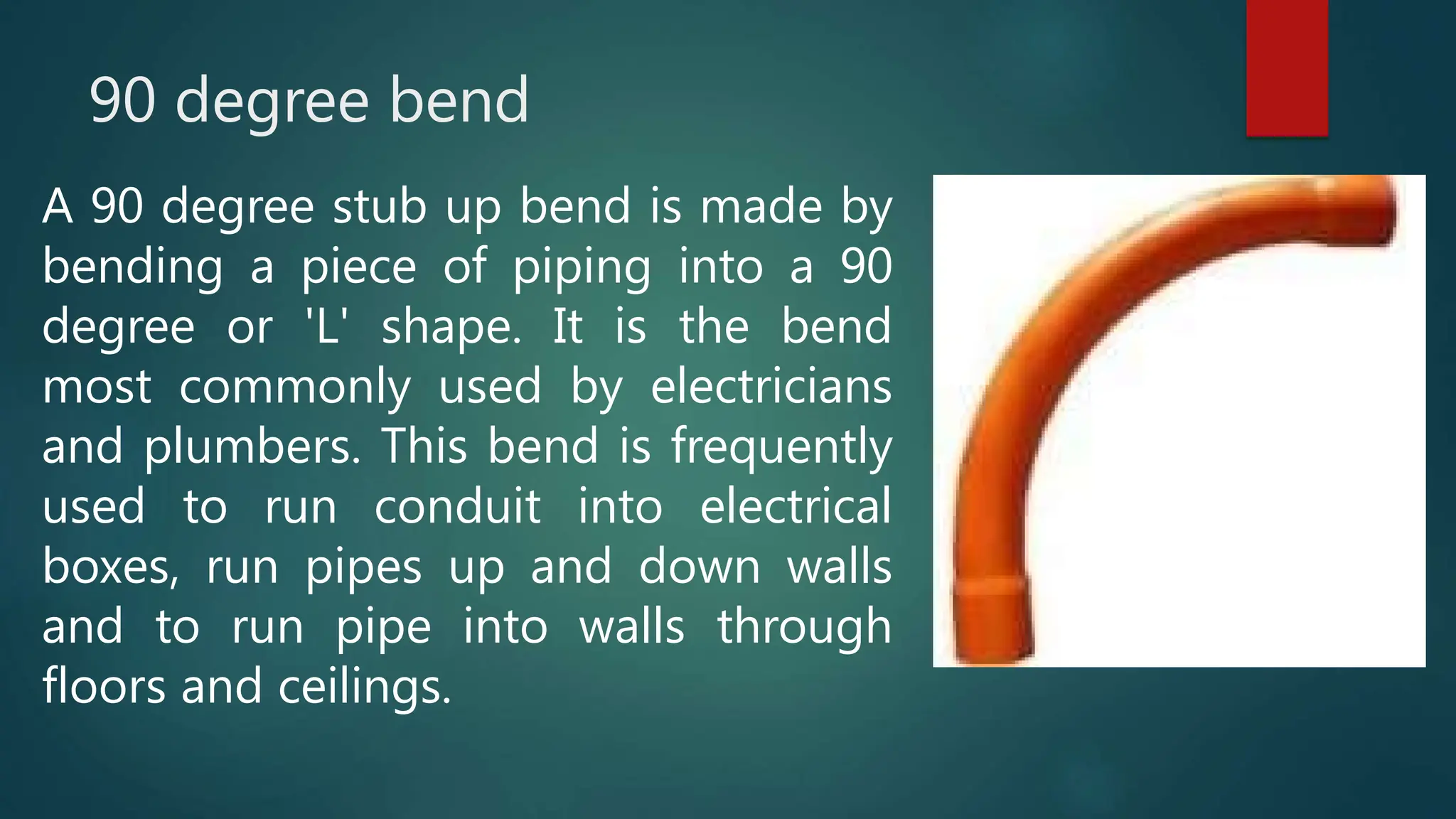
Offset bend is a style of
bend that is built
independently of the 90° stub
and the Back to Back
bend and is an important
bend to know when running
conduit. It is common to shift
the conduit a certain
distance while continuing
to run parallel in the same
direction as the pre-shift
portion of the conduit.
Three saddle point bend
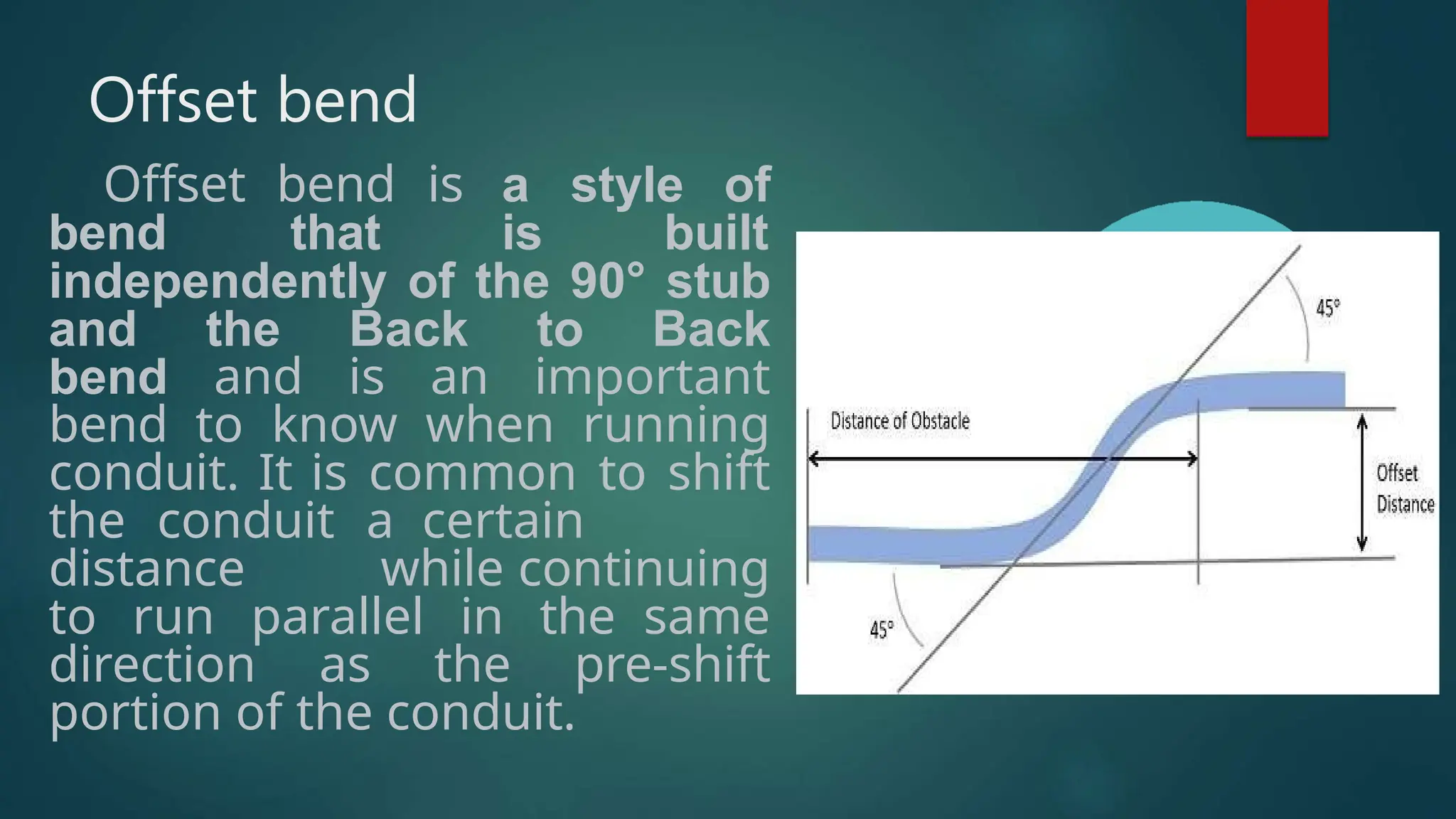
Three bend saddles are often used to cross or saddle a small
obstruction that would prevent the electrician from installing
conduit in a straight line. One of the obstructions that the
electrician most often has to saddle is another run of electrical
conduit or pipe that has been installed by a different trade.
Coupling
join materials of the same type
to form a longer straight line of
Coupling
s
together
conduit
PROCEDURES IN BENDING ELECTRICAL NON-METALLIC CONDUIT
MAKE A 90’ BEND
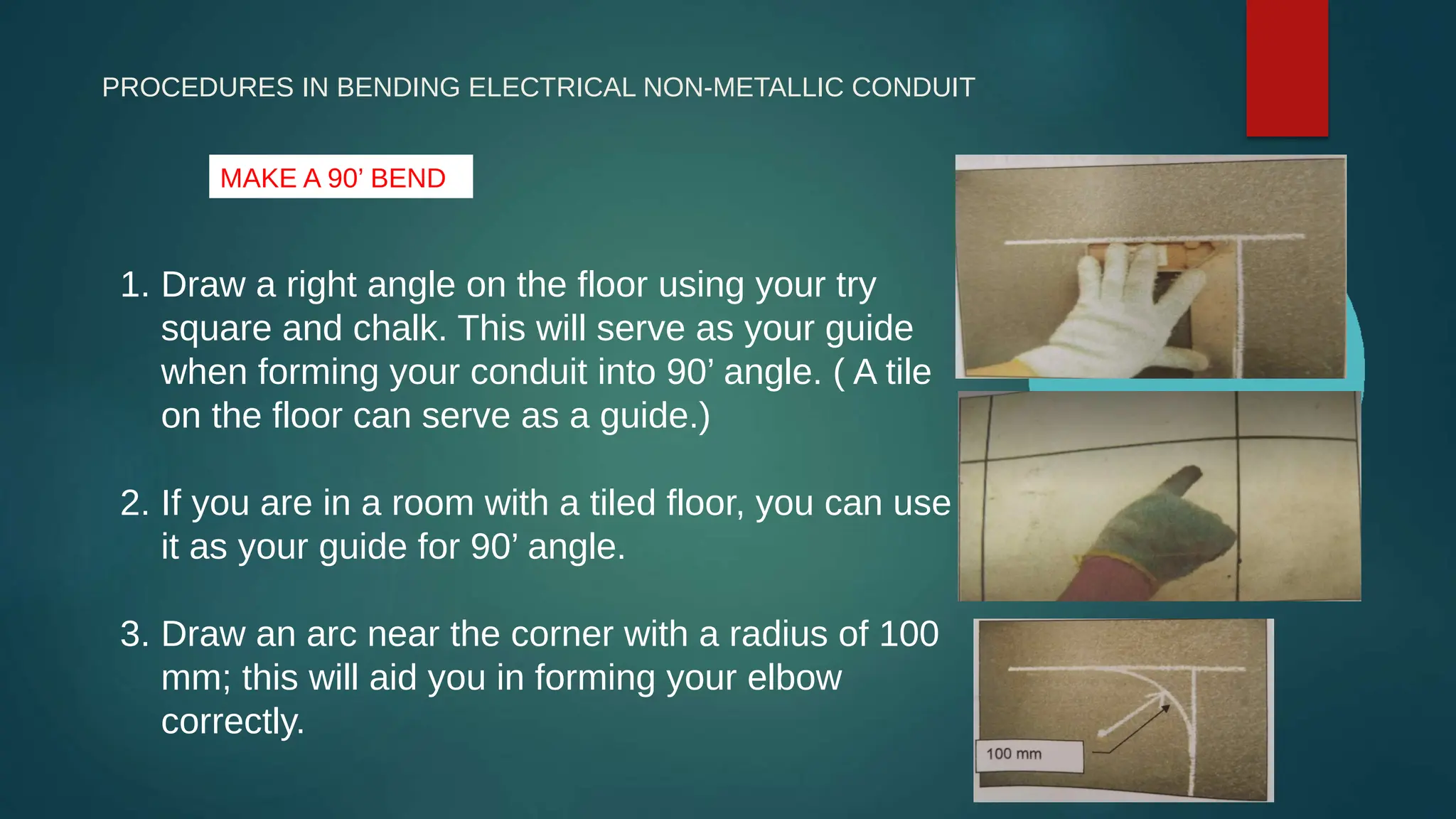
1. Draw a right angle on the floor using your try
square and chalk. This will serve as your guide
when forming your conduit into 90’ angle. ( A tile
on the floor can serve as a guide.)
2. If you are in a room with a tiled floor, you can use
it as your guide for 90’ angle.
3. Draw an arc near the corner with a radius of 100
mm; this will aid you in forming your elbow
correctly.
PROCEDURES IN BENDING ELECTRICAL NON-METALLIC CONDUIT
MAKE A 90’ BEND
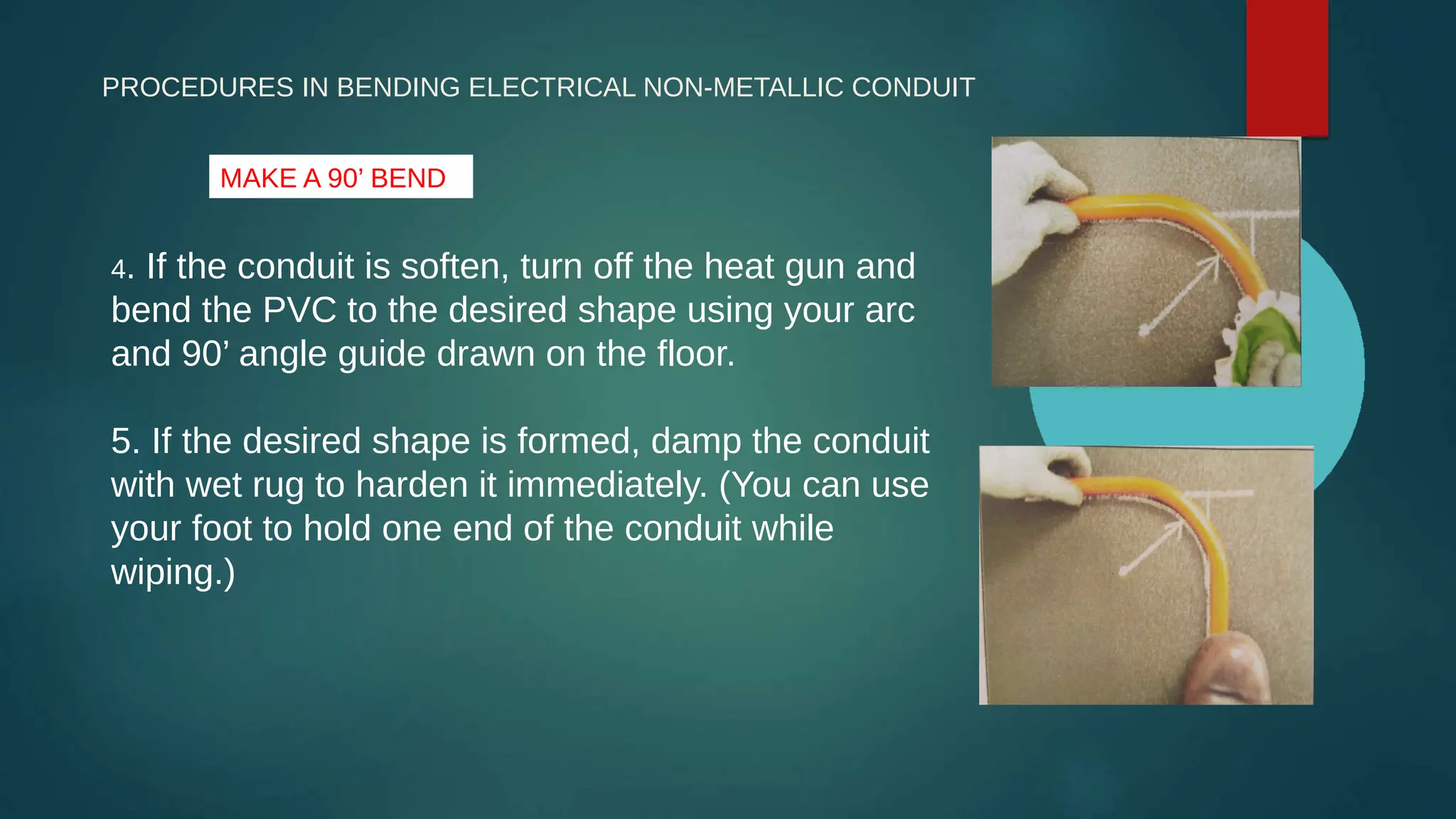
4. If the conduit is soften, turn off the heat gun and
bend the PVC to the desired shape using your arc
and 90’ angle guide drawn on the floor.
5. If the desired shape is formed, damp the conduit
with wet rug to harden it immediately. (You can use
your foot to hold one end of the conduit while
wiping.)
PROCEDURES IN BENDING ELECTRICAL NON-METALLIC CONDUIT
MAKE A PVC OFFSET BEND
1. Measure the elevation of the obstruction. In this case, let’s use
this wooden box.
Note: Remember, offset bent is used if the conduit crosses an
obstruction. In this case, the elevation is about 70mm.
2. Draw the depth of elevation on the floor as shown in the figure
using your try square and chalk. This will guide you how high your
offset bend would be.
3. Put mark of about 10mm and put another mark of about 200 mm
from your first marker.
PROCEDURES IN BENDING ELECTRICAL NON-METALLIC CONDUIT
MAKE A PVC OFFSET BEND
4. Plug – in the heat gun and apply heat to the conduit. Apply heat
between your markers. Apply heat evenly by turning over the conduit
while swaying your heat gun back and forth to avoid kinks during
bending.
5. If the conduit is soften, bend the PVC to the desired shape using
your guide drawn on the floor or in actual location. Pull the left portion
of the conduit while pushing the other end.
6. If the desired shape is formed, damp the conduit with wet rug to
harden it immediately. (You can use your foot to hold one end of the
conduit while wiping.)
Proper bending of conduit eim.ppt sssssx

Proper bending of conduit eim.ppt sssssx

  • 1.
  • 2.
    Performance objectives • Giventhe necessary equipment, tools and materials, bend the electrical pipe in line with the job requirements.
  • 3.
    Bending conduits Conduit bendingis truly one of the fundamental tasks of the electrical construction industry. Whether EMT, galvanized rigid steel conduit, or intermediate conduit, you will need to bend it. Bends will be required as part of your installation.
  • 4.
    90 degree bend A90 degree stub up bend is made by bending a piece of piping into a 90 degree or 'L' shape. It is the bend most commonly used by electricians and plumbers. This bend is frequently used to run conduit into electrical boxes, run pipes up and down walls and to run pipe into walls through floors and ceilings.
  • 5.
    Offset bend Offset bendis a style of bend that is built independently of the 90° stub and the Back to Back bend and is an important bend to know when running conduit. It is common to shift the conduit a certain distance while continuing to run parallel in the same direction as the pre-shift portion of the conduit.
  • 6.
    Three saddle pointbend Three bend saddles are often used to cross or saddle a small obstruction that would prevent the electrician from installing conduit in a straight line. One of the obstructions that the electrician most often has to saddle is another run of electrical conduit or pipe that has been installed by a different trade.
  • 7.
    Coupling join materials ofthe same type to form a longer straight line of Coupling s together conduit
  • 8.
    PROCEDURES IN BENDINGELECTRICAL NON-METALLIC CONDUIT MAKE A 90’ BEND 1. Draw a right angle on the floor using your try square and chalk. This will serve as your guide when forming your conduit into 90’ angle. ( A tile on the floor can serve as a guide.) 2. If you are in a room with a tiled floor, you can use it as your guide for 90’ angle. 3. Draw an arc near the corner with a radius of 100 mm; this will aid you in forming your elbow correctly.
  • 9.
    PROCEDURES IN BENDINGELECTRICAL NON-METALLIC CONDUIT MAKE A 90’ BEND 4. If the conduit is soften, turn off the heat gun and bend the PVC to the desired shape using your arc and 90’ angle guide drawn on the floor. 5. If the desired shape is formed, damp the conduit with wet rug to harden it immediately. (You can use your foot to hold one end of the conduit while wiping.)
  • 10.
    PROCEDURES IN BENDINGELECTRICAL NON-METALLIC CONDUIT MAKE A PVC OFFSET BEND 1. Measure the elevation of the obstruction. In this case, let’s use this wooden box. Note: Remember, offset bent is used if the conduit crosses an obstruction. In this case, the elevation is about 70mm. 2. Draw the depth of elevation on the floor as shown in the figure using your try square and chalk. This will guide you how high your offset bend would be. 3. Put mark of about 10mm and put another mark of about 200 mm from your first marker.
  • 11.
    PROCEDURES IN BENDINGELECTRICAL NON-METALLIC CONDUIT MAKE A PVC OFFSET BEND 4. Plug – in the heat gun and apply heat to the conduit. Apply heat between your markers. Apply heat evenly by turning over the conduit while swaying your heat gun back and forth to avoid kinks during bending. 5. If the conduit is soften, bend the PVC to the desired shape using your guide drawn on the floor or in actual location. Pull the left portion of the conduit while pushing the other end. 6. If the desired shape is formed, damp the conduit with wet rug to harden it immediately. (You can use your foot to hold one end of the conduit while wiping.)