DETERMINING
The first concept about truth is rooted in an
ancient Greek philosophy’s concept of knowledge
as “Justified, the belief”. This concept rests on
three conditions: true things can be known, something
is true because you believe it to be true, and that there
is justification for such belief. A belief may be
justified by using one’s perception and sences and
appealing to authority or using reasoning. Later
philosophers developed more theories on the nature of
knowledge and truth, each providing a basis for
establishings if a statement or an idea is true.
THE CORRESPONDENCE THEORY
States that something is true if
corresponding to reality or the actual state of
affairs. This theory assumes a direct
relationship between an idea and reality to
be able to take a statement as fact.
THE COHERENCE THEORY
Proposes that something is true if it makes sense
when placed in a certain situation or context .
RELATIVISM – is a philosophical concept which
contends that there are no absulote truths. An idea or
principle is only true within a particular context, it
differs with every knowing individual and thus, it is
possible for alternative truths to exist in various
contexts or situations.
THE CONSTRUCTIVIST THEORY
Holds that knowledge is shaped by social
forces and influence by culture and history.
The Constructivist Perspective also
believes that knowledge is gained as part of
social experience and requires interaction and
collaboration. Also this perspective holds that it
is true maybe influenced by historical
development and social struggles.
THE CONSENSUS THEORY
Vies knowledge as based on
agreement, and that something is true if
almost everyone agrees that is it true.
Consensus is also use to determine the
truth of scientific claims, where experts
must agree on a certain phenomenon
before it can be established as true.
THE PRAGMATIC THEORY
Holds the view that something is true if
we can put it into practice or is useful in real
life. It also believes that ideas should be
continually tested to confirm their validity. A
related theory, verificationism, considers that
ideas must be verified using the senses or
experience.
Other things should we consider in
determining the truth
ARGUMENTS- are phrased in such a way that
they seem reasonable. However, may be based
on faulty argumentation, and these are called
fallacies.
FALLACIES- is errors in reasoning may be
intentional, as the person making the claim is
desperate to convince you to accept his or her
argument.
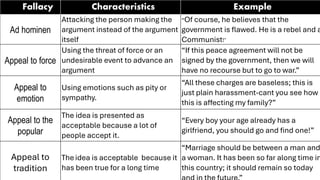
Fallacy Characteristics Example
Ad hominen
Attacking the person making the
argument instead of the argument
itself
“Of course, he believes that the
government is flawed. He is a rebel and a
Communist!’
Appeal to force
Using the threat of force or an
undesirable event to advance an
argument
“If this peace agreement will not be
signed by the government, then we will
have no recourse but to go to war.”
Appeal to
emotion
Using emotions such as pity or
sympathy.
“All these charges are baseless; this is
just plain harassment-cant you see how
this is affecting my family?”
Appeal to the
popular
The idea is presented as
acceptable because a lot of
people accept it.
“Every boy your age already has a
girlfriend, you should go and find one!”
Appeal to
tradition
The idea is acceptable because it
has been true for a long time
“Marriage should be between a man and
a woman. It has been so far along time in
this country; it should remain so today
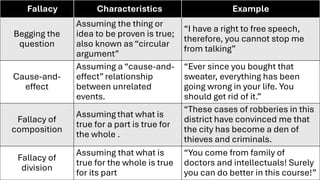
Fallacy Characteristics Example
Begging the
question
Assuming the thing or
idea to be proven is true;
also known as “circular
argument”
“I have a right to free speech,
therefore, you cannot stop me
from talking”
Cause-and-
effect
Assuming a “cause-and-
effect” relationship
between unrelated
events.
“Ever since you bought that
sweater, everything has been
going wrong in your life. You
should get rid of it.”
Fallacy of
composition
Assuming that what is
true for a part is true for
the whole .
“These cases of robberies in this
district have convinced me that
the city has become a den of
thieves and criminals.
Fallacy of
division
Assuming that what is
true for the whole is true
for its part
“You come from family of
doctors and intellectuals! Surely
you can do better in this course!”
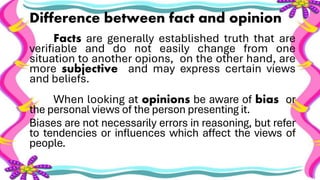
Difference between fact and opinion
Facts are generally established truth that are
verifiable and do not easily change from one
situation to another opions, on the other hand, are
more subjective and may express certain views
and beliefs.
When looking at opinions be aware of bias or
the personal views of the person presenting it.
Biases are not necessarily errors in reasoning, but refer
to tendencies or influences which affect the views of
people.
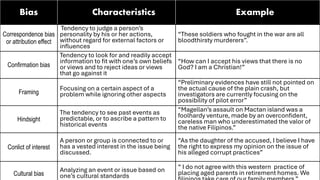
Bias Characteristics Example
Correspondence bias
or attribution effect
Tendency to judge a person’s
personality by his or her actions,
without regard for external factors or
influences
“These soldiers who fought in the war are all
bloodthirsty murderers”.
Confirmation bias
Tendency to look for and readily accept
information to fit with one’s own beliefs
or views and to reject ideas or views
that go against it
“How can I accept his views that there is no
God? I am a Christian!”
Framing
Focusing on a certain aspect of a
problem while ignoring other aspects
“Preliminary evidences have still not pointed on
the actual cause of the plain crash, but
investigators are currently focusing on the
possibility of pilot error”
Hindsight
The tendency to see past events as
predictable, or to ascribe a pattern to
historical events
“Magellan’s assault on Mactan island was a
foolhardy venture, made by an overconfident,
careless man who underestimated the valor of
the native Filipinos.”
Conlict of interest
A person or group is connected to or
has a vested interest in the issue being
discussed.
“As the daughter of the accused, I believe I have
the right to express my opinion on the issue of
his alleged corrupt practices”
Cultural bias
Analyzing an event or issue based on
one’s cultural standards
“ I do not agree with this western practice of
placing aged parents in retirement homes. We

Determining the Truth about correspondence.pdf

  • 1.
  • 2.
    The first conceptabout truth is rooted in an ancient Greek philosophy’s concept of knowledge as “Justified, the belief”. This concept rests on three conditions: true things can be known, something is true because you believe it to be true, and that there is justification for such belief. A belief may be justified by using one’s perception and sences and appealing to authority or using reasoning. Later philosophers developed more theories on the nature of knowledge and truth, each providing a basis for establishings if a statement or an idea is true.
  • 3.
    THE CORRESPONDENCE THEORY Statesthat something is true if corresponding to reality or the actual state of affairs. This theory assumes a direct relationship between an idea and reality to be able to take a statement as fact.
  • 4.
    THE COHERENCE THEORY Proposesthat something is true if it makes sense when placed in a certain situation or context . RELATIVISM – is a philosophical concept which contends that there are no absulote truths. An idea or principle is only true within a particular context, it differs with every knowing individual and thus, it is possible for alternative truths to exist in various contexts or situations.
  • 5.
    THE CONSTRUCTIVIST THEORY Holdsthat knowledge is shaped by social forces and influence by culture and history. The Constructivist Perspective also believes that knowledge is gained as part of social experience and requires interaction and collaboration. Also this perspective holds that it is true maybe influenced by historical development and social struggles.
  • 6.
    THE CONSENSUS THEORY Viesknowledge as based on agreement, and that something is true if almost everyone agrees that is it true. Consensus is also use to determine the truth of scientific claims, where experts must agree on a certain phenomenon before it can be established as true.
  • 7.
    THE PRAGMATIC THEORY Holdsthe view that something is true if we can put it into practice or is useful in real life. It also believes that ideas should be continually tested to confirm their validity. A related theory, verificationism, considers that ideas must be verified using the senses or experience.
  • 8.
    Other things shouldwe consider in determining the truth ARGUMENTS- are phrased in such a way that they seem reasonable. However, may be based on faulty argumentation, and these are called fallacies. FALLACIES- is errors in reasoning may be intentional, as the person making the claim is desperate to convince you to accept his or her argument.
  • 9.
    Fallacy Characteristics Example Adhominen Attacking the person making the argument instead of the argument itself “Of course, he believes that the government is flawed. He is a rebel and a Communist!’ Appeal to force Using the threat of force or an undesirable event to advance an argument “If this peace agreement will not be signed by the government, then we will have no recourse but to go to war.” Appeal to emotion Using emotions such as pity or sympathy. “All these charges are baseless; this is just plain harassment-cant you see how this is affecting my family?” Appeal to the popular The idea is presented as acceptable because a lot of people accept it. “Every boy your age already has a girlfriend, you should go and find one!” Appeal to tradition The idea is acceptable because it has been true for a long time “Marriage should be between a man and a woman. It has been so far along time in this country; it should remain so today
  • 10.
    Fallacy Characteristics Example Beggingthe question Assuming the thing or idea to be proven is true; also known as “circular argument” “I have a right to free speech, therefore, you cannot stop me from talking” Cause-and- effect Assuming a “cause-and- effect” relationship between unrelated events. “Ever since you bought that sweater, everything has been going wrong in your life. You should get rid of it.” Fallacy of composition Assuming that what is true for a part is true for the whole . “These cases of robberies in this district have convinced me that the city has become a den of thieves and criminals. Fallacy of division Assuming that what is true for the whole is true for its part “You come from family of doctors and intellectuals! Surely you can do better in this course!”
  • 11.
    Difference between factand opinion Facts are generally established truth that are verifiable and do not easily change from one situation to another opions, on the other hand, are more subjective and may express certain views and beliefs. When looking at opinions be aware of bias or the personal views of the person presenting it. Biases are not necessarily errors in reasoning, but refer to tendencies or influences which affect the views of people.
  • 12.
    Bias Characteristics Example Correspondencebias or attribution effect Tendency to judge a person’s personality by his or her actions, without regard for external factors or influences “These soldiers who fought in the war are all bloodthirsty murderers”. Confirmation bias Tendency to look for and readily accept information to fit with one’s own beliefs or views and to reject ideas or views that go against it “How can I accept his views that there is no God? I am a Christian!” Framing Focusing on a certain aspect of a problem while ignoring other aspects “Preliminary evidences have still not pointed on the actual cause of the plain crash, but investigators are currently focusing on the possibility of pilot error” Hindsight The tendency to see past events as predictable, or to ascribe a pattern to historical events “Magellan’s assault on Mactan island was a foolhardy venture, made by an overconfident, careless man who underestimated the valor of the native Filipinos.” Conlict of interest A person or group is connected to or has a vested interest in the issue being discussed. “As the daughter of the accused, I believe I have the right to express my opinion on the issue of his alleged corrupt practices” Cultural bias Analyzing an event or issue based on one’s cultural standards “ I do not agree with this western practice of placing aged parents in retirement homes. We