Quarter 1 – Module 8
Media and
Information
Literacy(MIL)
Review of the
past lesson
LO 1 – put into practice their
understanding of the intellectual
property, copyright, and fair use
guidelines (MIL11/12LESI-IIIg17);
and
LO 2 – Cite practical situations when to
apply knowledge in intellectual
property, copyright, and fair-use
guidelines. (MIL11/12LESI-IIIg20)
● After going through this module, you are
expected to:
a. Explain intellectual properties;
b. Recognize the different types of
intellectual property; and
c. Discuss current issues related to
intellectual property.
pre – test
1. What protects the intellectual property created by
artists?
a. Copyright c. Patents
b. Geographical Indications d. Trade Marks
The correct answer is: a
2. What protects the intellectual property created by
designers?
a. Copyright c. Registered Designs
b. Geographical Indications d. Trade Marks
The correct answer is: c
What I Know
What I Know
3. What protects the intellectual property created by
inventors?
a. Copyright c. Patents
b. Geographical Indications d. Trade Marks
The correct answer is: c
4. Which of these is a geographical indication?
a. BMW c. Hogwarts
b. Champagne d. Play Station
The correct answer is: b
What I Know
5.What does a trademark protect?
a. An Invention c. Logo, names and brands
b. A work of art d. The look, shape and feel of a
product
The correct answer is: c
Quarter 1 – Module 8
Intellectual
Property
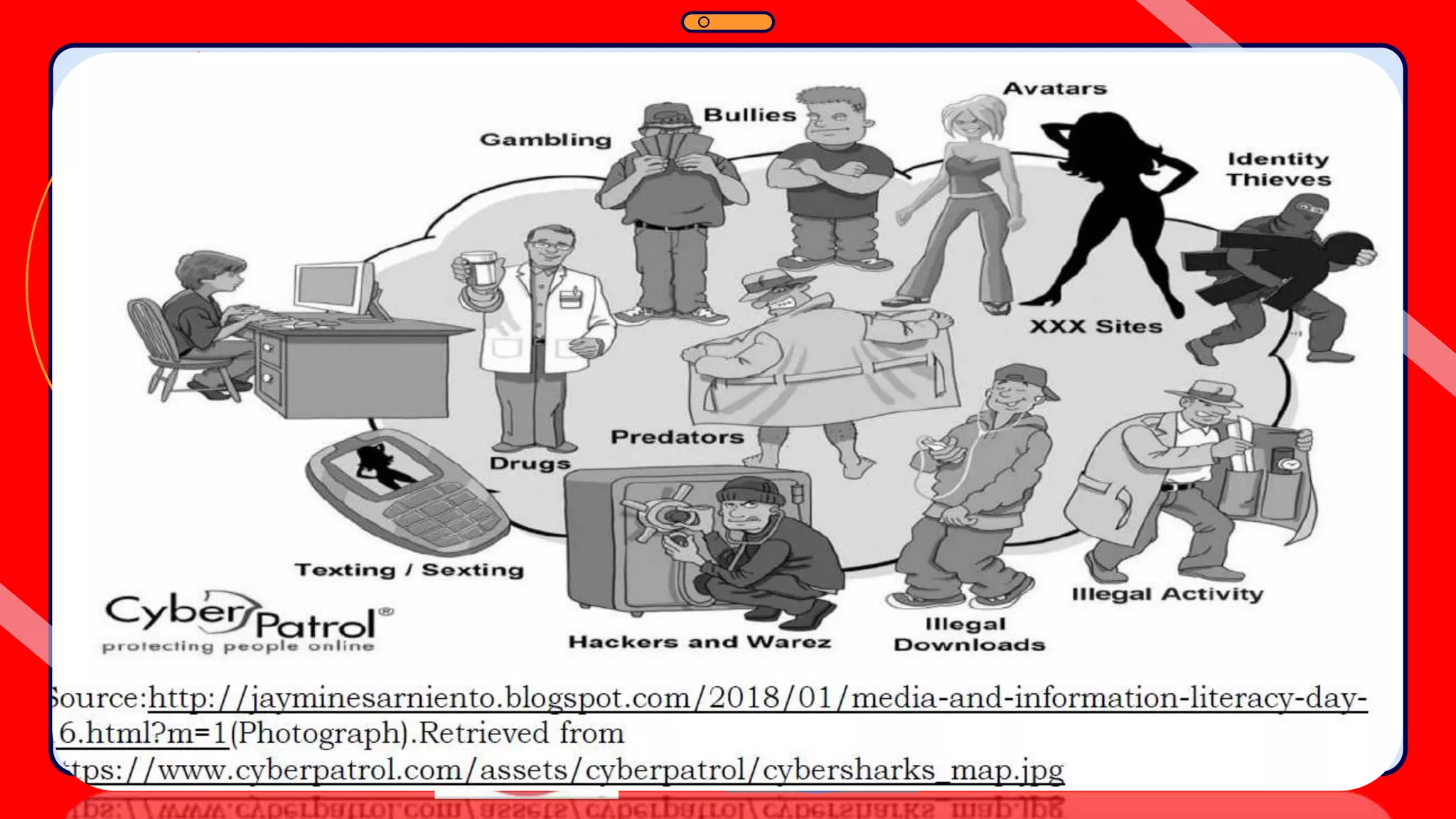
Activity 1:
1. What issues do you see in the poster?
2. Which ones do you understand? Which ones do
you not know?
3. What possible dangers and issues of unguarded
use of the internet are depicted in the picture?
4. Which of these issues have happened to you or
to your friends? Why did they happen?
Intellectual
Property
What is it?
Intellectual Property
 The World Intellectual Property Organization
(WIPO) defined Intellectual property as creations
of the mind, such as inventions; literary and
artistic works; designs; and symbols, names, and
images used in commerce.
What is it?
Republic Act 8293
 also known as the Intellectual Property Code of
the Philippines was created to combat illegal use
and owning of original work without legal
permission.
What is it?
Republic Act 8293
 This law covers the following types of intellectual
property: copyright, patent, trademark, industrial
design, and geographical origin.
What is it?
Copyright ©
is a legal term used to describe the rights
that creators have over their literary and
artistic works. Works covered by
copyright range from books, music,
paintings, sculpture and films, to
computer programs, databases,
advertisements, maps, and technical
drawings.
What is it?
What is it?
Copyright Symbol
©
What is it?
Patent
is an exclusive right granted for an
invention.
What is it?
Trade Mark
™
is a sign capable of distinguishing
the goods or services of one
enterprise from those of other
enterprises.
What is it?
Industrial Design
constitutes the ornamental or
aesthetic aspect of an article. May
consist of three-dimensional
features, such as the shape or
surface of an article, or of two-
dimensional features, such as
patterns, lines or color.
What is it?
Geographical Indications
are signs used on goods that have
a specific geographical origin
and possess qualities, a
reputation or characteristics that
are essentially attributable to that
place of origin.
What is it?
Plagiarism
According to Auraria Library (2020), defines Plagiarism as
“one form of academic dishonesty. It is claiming, or
appearing to claim, another’s work as your own by not
acknowledging it.”
What Is It?
Plagiarism
Plagiarism is classified into types:
sources cited and sources not cited.
Plagiarism
Sources not cited
1. “The Ghost Writer” The writer turns in another’s
work, word-for-word, as his or
her own.
2. “The Photocopy”
The writer copies significant
portions of text straight from a
single source, without
alteration.
Plagiarism
Sources not cited
3. “The Potluck Paper”
The writer copies from
several different sources,
tweaking the sentences to
make them fit together while
retaining most of the original
phrasing.
Plagiarism
Sources not cited
4. “The Poor Disguise” The writer has altered the
paper’s appearance slightly
by changing key words and
phrases.
Plagiarism
Sources not cited
5. “The Labor of Laziness”
The writer takes the time
to paraphrase most of
the paper from other
sources and make it all fit
together.
Plagiarism
Sources not cited
6. “The Self-Stealer”
The writer “borrows”
generously from his or
her previous work.
Plagiarism
Sources cited (but still plagiarized)
1. “The Forgotten Footnote”
The writer mentions an
author’s name for a
source, but neglects to
include specific
information on the
location of the material
referenced.
Plagiarism
Sources cited (but still plagiarized)
2. “The Misinformer”
The writer provides
inaccurate information
regarding the sources,
making it impossible to
find them.
Plagiarism
Sources cited (but still plagiarized)
3. “The Too-Perfect
Paraphrase”
The writer properly cites
a source, but neglects to
put in quotation marks on
text that has been copied
word-for-word, or close
to it
Plagiarism
Sources cited (but still plagiarized)
4. “The Resourceful Citer”
The writer properly cites
all sources,
paraphrasing and using
quotations appropriately.
The catch? The paper
contains almost no
original work!
Plagiarism
Sources cited (but still plagiarized)
5. “The Perfect Crime”
The writer properly
quotes and cites sources
in some places, but goes
on to paraphrase other
arguments from those
sources without citation.
What is it?
In an article titled “What is
Plagiarism?” by p.org published on
May 2017, the following activities
are considered plagiarism.
 Copying media (especially images) from
other websites to paste them into your
own papers or websites.
What is it?
In an article titled “What is
Plagiarism?” by p.org published on
May 2017, the following activities
are considered plagiarism.
 Making a video using footage from others’
videos or using copyrighted music as part
of the soundtrack.
What is it?
In an article titled “What is
Plagiarism?” by p.org published on
May 2017, the following activities
are considered plagiarism.
 Performing another person’s
copyrighted music (i.e., playing a
cover).
What is it?
For example:
-A photograph or scan of a copyrighted
image (for example: using a photograph of
a book cover to represent that book on
one’s website)
-Recording audio or video in which
copyrighted music or video is playing in
the background.
What is it?
For example:
-Re-creating a visual work in the same
medium. (for example: shooting a
photograph that uses the same
composition and subject matter as
someone else’s photograph)
-Re-creating a visual work in a different
medium (for example: making a painting that
closely resembles another person’s
photograph).
What is it?
For example:
-Re-mixing or altering copyrighted images,
video or audio, even if done so in an original
way”.
What is it?
The two safest approaches to
take them in regards to these
situations is:
1. Avoid them altogether or
2. confirm the work’s usage permissions and
cite them properly.” (p.org, 2017).
What is it?
Violation of intellectual property law is
called Infringement and is
punishable by law.
Piracy - It refers to the unauthorized use,
copying, reproduction or distribution of
products that have IP rights protection. It
may include stealing, transmitting, selling,
and copying without the express consent
and/or written approval. It may also involve
not paying royalties to the rights owned.
What is it?
Fair Use - It refers to the use of
copyrighted material
without a license
only for certain purposes. These
include: Commentary, Criticism,
Reporting, Research and Teaching.
What is it?
The following are guidelines to be
considered for Fair use:
- A majority of the content you create must be
your own.
- Give credit to the copyright holder.
- Don't make money off of the copyrighted
work.
What is it?
Creative Commons
 is an American non-profit
organization devoted to expanding
the range of creative works
available for others to build upon
legally and to share. They released
several copyright-licenses known
as Creative Commons licenses free
of charge to the public.
What I Can Do
Identify the type of intellectual property violated in each
number and state how to avoid them.
1. 2.
What I Can Do
Identify the type of intellectual property violated in each
number and state how to avoid them.
3. 4.
What I Have Learned
Answer the following questions on page 13 - 14 on
your module.
1. Intellectual Property refers to _______ ?
2. Intellectual Property has five types, namely
_______?
3. The similarities of fair-use and creative
commons are ________?
What I Have Learned
Answer the following questions on page 13 - 14 on
your module.
4. Infringement happens when ______?
5. Plagiarism is unethical because _______?
Post - Test
____1.Using copyrighted materials without license to
do so for a certain purpose is possible through?
_____2. A symbol that represents copyright.
____3. Books, music and films are intellectual
property under?
_____4. Refers to the unauthorized use, copying,
reproduction or distribution of products that
have IP rights protection.
Post - Test
____5. Features such as patterns and color can be
protected by law under___?
_____6. Validity period for sound recording lasts up to?
_____7. Violation of Intellectual Property refers to?
____8. American Organization that allows to use
legally registered creative works without
compromising the law.
Post - Test
____9. Mike invented a new version of a lamp, to
protect his intellectual property he can apply for
what right?
_____10. Type of plagiarism where someone copies
huge portion from his/her own previous work
without due process.
Post – Test Answer Key
1. Fair use
2. ©
3. Copyright
4. Piracy
5. Industrial design
6. 50 years
7. Infringement
8. Creative commons
9. Patent
10. Self- Stealer
● Quarter 1 Module 9
● Challenges in the
Virtual World
● Ma’am Fretzie
Cambiado
Dec. 02,
2021
at 1:00 PM
See you
next week.
CREDITS: This presentation template was
created by Slidesgo, including icons by
Flaticon, infographics & images by Freepik
Thank you
for learning
with me Keep safe
everyone , stay
healthy and
strong always

MIL-Q1M8.pptx

  • 1.
    Quarter 1 –Module 8 Media and Information Literacy(MIL)
  • 2.
  • 3.
    LO 1 –put into practice their understanding of the intellectual property, copyright, and fair use guidelines (MIL11/12LESI-IIIg17); and
  • 4.
    LO 2 –Cite practical situations when to apply knowledge in intellectual property, copyright, and fair-use guidelines. (MIL11/12LESI-IIIg20)
  • 5.
    ● After goingthrough this module, you are expected to: a. Explain intellectual properties; b. Recognize the different types of intellectual property; and c. Discuss current issues related to intellectual property.
  • 6.
  • 7.
    1. What protectsthe intellectual property created by artists? a. Copyright c. Patents b. Geographical Indications d. Trade Marks The correct answer is: a 2. What protects the intellectual property created by designers? a. Copyright c. Registered Designs b. Geographical Indications d. Trade Marks The correct answer is: c What I Know
  • 8.
    What I Know 3.What protects the intellectual property created by inventors? a. Copyright c. Patents b. Geographical Indications d. Trade Marks The correct answer is: c 4. Which of these is a geographical indication? a. BMW c. Hogwarts b. Champagne d. Play Station The correct answer is: b
  • 9.
    What I Know 5.Whatdoes a trademark protect? a. An Invention c. Logo, names and brands b. A work of art d. The look, shape and feel of a product The correct answer is: c
  • 10.
    Quarter 1 –Module 8 Intellectual Property
  • 12.
    Activity 1: 1. Whatissues do you see in the poster? 2. Which ones do you understand? Which ones do you not know? 3. What possible dangers and issues of unguarded use of the internet are depicted in the picture? 4. Which of these issues have happened to you or to your friends? Why did they happen?
  • 13.
  • 14.
    What is it? IntellectualProperty  The World Intellectual Property Organization (WIPO) defined Intellectual property as creations of the mind, such as inventions; literary and artistic works; designs; and symbols, names, and images used in commerce.
  • 15.
    What is it? RepublicAct 8293  also known as the Intellectual Property Code of the Philippines was created to combat illegal use and owning of original work without legal permission.
  • 16.
    What is it? RepublicAct 8293  This law covers the following types of intellectual property: copyright, patent, trademark, industrial design, and geographical origin.
  • 17.
    What is it? Copyright© is a legal term used to describe the rights that creators have over their literary and artistic works. Works covered by copyright range from books, music, paintings, sculpture and films, to computer programs, databases, advertisements, maps, and technical drawings.
  • 18.
  • 19.
  • 20.
    What is it? Patent isan exclusive right granted for an invention.
  • 21.
    What is it? TradeMark ™ is a sign capable of distinguishing the goods or services of one enterprise from those of other enterprises.
  • 22.
    What is it? IndustrialDesign constitutes the ornamental or aesthetic aspect of an article. May consist of three-dimensional features, such as the shape or surface of an article, or of two- dimensional features, such as patterns, lines or color.
  • 23.
    What is it? GeographicalIndications are signs used on goods that have a specific geographical origin and possess qualities, a reputation or characteristics that are essentially attributable to that place of origin.
  • 24.
    What is it? Plagiarism Accordingto Auraria Library (2020), defines Plagiarism as “one form of academic dishonesty. It is claiming, or appearing to claim, another’s work as your own by not acknowledging it.”
  • 25.
    What Is It? Plagiarism Plagiarismis classified into types: sources cited and sources not cited.
  • 26.
    Plagiarism Sources not cited 1.“The Ghost Writer” The writer turns in another’s work, word-for-word, as his or her own. 2. “The Photocopy” The writer copies significant portions of text straight from a single source, without alteration.
  • 27.
    Plagiarism Sources not cited 3.“The Potluck Paper” The writer copies from several different sources, tweaking the sentences to make them fit together while retaining most of the original phrasing.
  • 28.
    Plagiarism Sources not cited 4.“The Poor Disguise” The writer has altered the paper’s appearance slightly by changing key words and phrases.
  • 29.
    Plagiarism Sources not cited 5.“The Labor of Laziness” The writer takes the time to paraphrase most of the paper from other sources and make it all fit together.
  • 30.
    Plagiarism Sources not cited 6.“The Self-Stealer” The writer “borrows” generously from his or her previous work.
  • 31.
    Plagiarism Sources cited (butstill plagiarized) 1. “The Forgotten Footnote” The writer mentions an author’s name for a source, but neglects to include specific information on the location of the material referenced.
  • 32.
    Plagiarism Sources cited (butstill plagiarized) 2. “The Misinformer” The writer provides inaccurate information regarding the sources, making it impossible to find them.
  • 33.
    Plagiarism Sources cited (butstill plagiarized) 3. “The Too-Perfect Paraphrase” The writer properly cites a source, but neglects to put in quotation marks on text that has been copied word-for-word, or close to it
  • 34.
    Plagiarism Sources cited (butstill plagiarized) 4. “The Resourceful Citer” The writer properly cites all sources, paraphrasing and using quotations appropriately. The catch? The paper contains almost no original work!
  • 35.
    Plagiarism Sources cited (butstill plagiarized) 5. “The Perfect Crime” The writer properly quotes and cites sources in some places, but goes on to paraphrase other arguments from those sources without citation.
  • 36.
    What is it? Inan article titled “What is Plagiarism?” by p.org published on May 2017, the following activities are considered plagiarism.  Copying media (especially images) from other websites to paste them into your own papers or websites.
  • 37.
    What is it? Inan article titled “What is Plagiarism?” by p.org published on May 2017, the following activities are considered plagiarism.  Making a video using footage from others’ videos or using copyrighted music as part of the soundtrack.
  • 38.
    What is it? Inan article titled “What is Plagiarism?” by p.org published on May 2017, the following activities are considered plagiarism.  Performing another person’s copyrighted music (i.e., playing a cover).
  • 39.
    What is it? Forexample: -A photograph or scan of a copyrighted image (for example: using a photograph of a book cover to represent that book on one’s website) -Recording audio or video in which copyrighted music or video is playing in the background.
  • 40.
    What is it? Forexample: -Re-creating a visual work in the same medium. (for example: shooting a photograph that uses the same composition and subject matter as someone else’s photograph) -Re-creating a visual work in a different medium (for example: making a painting that closely resembles another person’s photograph).
  • 41.
    What is it? Forexample: -Re-mixing or altering copyrighted images, video or audio, even if done so in an original way”.
  • 42.
    What is it? Thetwo safest approaches to take them in regards to these situations is: 1. Avoid them altogether or 2. confirm the work’s usage permissions and cite them properly.” (p.org, 2017).
  • 43.
    What is it? Violationof intellectual property law is called Infringement and is punishable by law. Piracy - It refers to the unauthorized use, copying, reproduction or distribution of products that have IP rights protection. It may include stealing, transmitting, selling, and copying without the express consent and/or written approval. It may also involve not paying royalties to the rights owned.
  • 44.
    What is it? FairUse - It refers to the use of copyrighted material without a license only for certain purposes. These include: Commentary, Criticism, Reporting, Research and Teaching.
  • 45.
    What is it? Thefollowing are guidelines to be considered for Fair use: - A majority of the content you create must be your own. - Give credit to the copyright holder. - Don't make money off of the copyrighted work.
  • 46.
    What is it? CreativeCommons  is an American non-profit organization devoted to expanding the range of creative works available for others to build upon legally and to share. They released several copyright-licenses known as Creative Commons licenses free of charge to the public.
  • 48.
    What I CanDo Identify the type of intellectual property violated in each number and state how to avoid them. 1. 2.
  • 49.
    What I CanDo Identify the type of intellectual property violated in each number and state how to avoid them. 3. 4.
  • 50.
    What I HaveLearned Answer the following questions on page 13 - 14 on your module. 1. Intellectual Property refers to _______ ? 2. Intellectual Property has five types, namely _______? 3. The similarities of fair-use and creative commons are ________?
  • 51.
    What I HaveLearned Answer the following questions on page 13 - 14 on your module. 4. Infringement happens when ______? 5. Plagiarism is unethical because _______?
  • 52.
    Post - Test ____1.Usingcopyrighted materials without license to do so for a certain purpose is possible through? _____2. A symbol that represents copyright. ____3. Books, music and films are intellectual property under? _____4. Refers to the unauthorized use, copying, reproduction or distribution of products that have IP rights protection.
  • 53.
    Post - Test ____5.Features such as patterns and color can be protected by law under___? _____6. Validity period for sound recording lasts up to? _____7. Violation of Intellectual Property refers to? ____8. American Organization that allows to use legally registered creative works without compromising the law.
  • 54.
    Post - Test ____9.Mike invented a new version of a lamp, to protect his intellectual property he can apply for what right? _____10. Type of plagiarism where someone copies huge portion from his/her own previous work without due process.
  • 55.
    Post – TestAnswer Key 1. Fair use 2. © 3. Copyright 4. Piracy 5. Industrial design 6. 50 years 7. Infringement 8. Creative commons 9. Patent 10. Self- Stealer
  • 56.
    ● Quarter 1Module 9 ● Challenges in the Virtual World ● Ma’am Fretzie Cambiado Dec. 02, 2021 at 1:00 PM See you next week.
  • 58.
    CREDITS: This presentationtemplate was created by Slidesgo, including icons by Flaticon, infographics & images by Freepik Thank you for learning with me Keep safe everyone , stay healthy and strong always