HIGH JUMP
Introduction
The high jump is a track and field event in
which competitors must jump unaided over
a horizontal bar placed at measured
heights without dislodging it. In its modern
most practised format, a bar is placed
between two standards with a crash mat
for landing. At the elite level, athletes run
towards the bar and use the Fosbury
Flop method of jumping, leaping head first
with their back to the bar. Performed since
ancient times, competitors have introduced
increasingly more effective techniques to
arrive at the current form.
 The discipline is, alongside the pole vault, one of
two vertical clearance events to feature on
the Olympic athletics programme. It is contested at
the World Championships in Athletics and IAAF
World Indoor Championships, and is a common
occurrence at track and field meetings. The high
jump was among the first events deemed
acceptable for women, having been held at
the 1928 Olympic Games.
 Javier Sotomayor (Cuba) is the current men's
record holder with a jump of 2.45 m (8 ft 01⁄4 in) set
in 1993 – the longest standing record in the history
of the men's high jump. Stefka
Kostadinova (Bulgaria) has held the women's
world record at 2.09 m (6 ft 101⁄4 in) since 1987,
also the longest-held record in the event.
Competitors jump unaided and take off from one foot over a
four-metre long horizontal bar. They seek to clear the
greatest height without knocking the bar to the ground.
All competitors have three attempts per height, although they
can elect to ‘pass’, i.e. advance to a greater height despite
not having cleared the current one. Three consecutive
failures at the same height, or combination of heights, cause
a competitor’s elimination.
If competitors are tied on the same height, the winner will
have had the fewest failures at that height. If competitors are
still tied, the winner will have had the fewest failures across
the entire competition. Thereafter, a jump-off will decide the
winner.
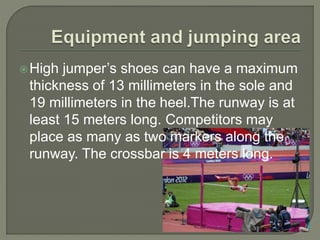
High jumper’s shoes can have a maximum
thickness of 13 millimeters in the sole and
19 millimeters in the heel.The runway is at
least 15 meters long. Competitors may
place as many as two markers along the
runway. The crossbar is 4 meters long.
Twelve jumpers participate in the Olympic
high jump final. In the 2004 Athens
Games, 38 men and 34 women
participated in their respective qualifying
rounds trying to earn a spot in the final.
Qualification results do not carry over into
the final.
 Jumpers must take off on one
foot.A successful jump is one in which the
crossbar remains in place when the jumper
has left the landing area.
 Competitors may begin jumping at any height
announced by the chief judge, or may pass,
at their own discretion. Three consecutive
missed jumps, at any height or combination of
heights, will eliminate the jumper from
competition.
 The victory goes to the jumper who clears the
greatest height during the final.
 If two or more jumpers tie for first place, the
tie-breakers are: 1) The fewest misses at the
height at which the tie occurred; and 2) The
fewest misses throughout the competition.
 If the event remains tied, the jumpers have a
jump-off, beginning at the next greater height.
Each jumper has one attempt. The bar is then
alternately lowered and raised until only one
jumper succeeds at a given height.
Schools High Jump Mat Pro – 3 modules
Cantabrian Competition High Jump Mat
Schools High Jump Mat – 7 modules
 The schools high jump mat pro consists of 3
separate modules which are connected together to
form a 5m x 2.5m x 510mmlanding area.
 Each module is only 2.5m x 1.66m x 510mm and
weighing approx. 35kg each making them easy to
transport and put in storage
 The Schools Pro High jump mat comes with cut
outs for the high jump stands and comes with
either a PVC coverall or 50mm thick spike resistant
wear sheet to make the thickness of the mat
560mm
 All landing areas come with carry handles,
connecting straps and breather holes to allow rapid
air displacement for a softer landing
All Cantabrian Landing Areas are
manufactured in house by our parent
company Foams4sports Ltd.
Foams4sports Ltd has over 100 years of
combined experience in designing and
manufacturing High Jump and Pole Vault
Mats for the UK market and beyond. This
allows us to maintain the highest quality
whilst offering competitive prices for all of
our customers.
The School High Jump Mat
is manufactured by our parent
company, Foams4sports Ltd, who have
had years of experience in designing
and manufacturing landing areas in the
UK for specialist Athletics Stadiums
and school sports equipment. This
allows us offer the best prices in the
market place while maintaining the
highest
 This Schools high jump mat is ideal for use in
both primary and secondary schools. It
consists of 7 separate modules that can be
connected together to make a 5m x 2.5m x
510mm area. Not only does the smaller
modules allow it to be easier for the High
Jump Area to be put back into storage,
but the modules can also be used as small
crash mats for other sports like Gymnastics
and Karate etc.
 The module dimensions are:
 2.5m x 1.66m x 255mm A Modules ( 3 off )
 2.5m x 1.25m x 255mm B Modules ( 4 off )
 The schools high jump mat comes with a
PVC coverall or 50mm thick spike resistant
wear sheet to bring the total height of the
landing mat to 560mm
 Please feel free to contact us for a full
product specification of the high jump mat.
Diving
Hurdles
Steeplechase
Long Jump
Triple Jump
Hurdles are a track and field event that
requires runners to jump over hurdles
along the track. The hurdles are spaced
apart evenly to allow the runner to create a
steady rhythm and cadence. There are
three hurdle race distances: the women
100 m, men 110 m and men and women
400 m
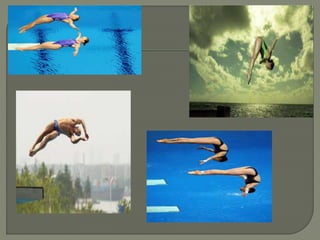
Divers use the spring board to help propel
them into the air to reach a height that
allows them to perform a variety of
maneuvers. A diver jumps on the spring
board several times to create momentum.
Once enough momentum is created, the
diver jumps up high and slightly forward to
perform his dive, then lands in the water.
he steeplechase is a race around a track
with four oversize hurdles. One hurdle
features a water pit behind it. Runners
must jump over the hurdles and are
allowed to step on the hurdle to help
propel themselves over
Long jumpers sprint along a narrow track
toward a line, which the athlete cannot
step over. Good long jumpers can time
their runs with precision and step as close
to the back edge of the line without going
over as they jump and propel themselves
forward into a sandbox.
Much like the long jump, the triple jump
begins along a narrow track. The athlete
must sprint toward three designated zones
-- that are marked by lines -- before
jumping for distance. The jumper must
touch down with one foot in each zone
before launching for distance into the
sandbox. The jumping sequence is
commonly referred to as the hop, step and
jump phase.
Maria Kuchina - Russian
Canada’s Derek Drouin

Destiny high-jump-2

  • 1.
  • 2.
    The high jumpis a track and field event in which competitors must jump unaided over a horizontal bar placed at measured heights without dislodging it. In its modern most practised format, a bar is placed between two standards with a crash mat for landing. At the elite level, athletes run towards the bar and use the Fosbury Flop method of jumping, leaping head first with their back to the bar. Performed since ancient times, competitors have introduced increasingly more effective techniques to arrive at the current form.
  • 3.
     The disciplineis, alongside the pole vault, one of two vertical clearance events to feature on the Olympic athletics programme. It is contested at the World Championships in Athletics and IAAF World Indoor Championships, and is a common occurrence at track and field meetings. The high jump was among the first events deemed acceptable for women, having been held at the 1928 Olympic Games.  Javier Sotomayor (Cuba) is the current men's record holder with a jump of 2.45 m (8 ft 01⁄4 in) set in 1993 – the longest standing record in the history of the men's high jump. Stefka Kostadinova (Bulgaria) has held the women's world record at 2.09 m (6 ft 101⁄4 in) since 1987, also the longest-held record in the event.
  • 5.
    Competitors jump unaidedand take off from one foot over a four-metre long horizontal bar. They seek to clear the greatest height without knocking the bar to the ground. All competitors have three attempts per height, although they can elect to ‘pass’, i.e. advance to a greater height despite not having cleared the current one. Three consecutive failures at the same height, or combination of heights, cause a competitor’s elimination. If competitors are tied on the same height, the winner will have had the fewest failures at that height. If competitors are still tied, the winner will have had the fewest failures across the entire competition. Thereafter, a jump-off will decide the winner.
  • 6.
    High jumper’s shoescan have a maximum thickness of 13 millimeters in the sole and 19 millimeters in the heel.The runway is at least 15 meters long. Competitors may place as many as two markers along the runway. The crossbar is 4 meters long.
  • 7.
    Twelve jumpers participatein the Olympic high jump final. In the 2004 Athens Games, 38 men and 34 women participated in their respective qualifying rounds trying to earn a spot in the final. Qualification results do not carry over into the final.
  • 8.
     Jumpers musttake off on one foot.A successful jump is one in which the crossbar remains in place when the jumper has left the landing area.  Competitors may begin jumping at any height announced by the chief judge, or may pass, at their own discretion. Three consecutive missed jumps, at any height or combination of heights, will eliminate the jumper from competition.  The victory goes to the jumper who clears the greatest height during the final.
  • 9.
     If twoor more jumpers tie for first place, the tie-breakers are: 1) The fewest misses at the height at which the tie occurred; and 2) The fewest misses throughout the competition.  If the event remains tied, the jumpers have a jump-off, beginning at the next greater height. Each jumper has one attempt. The bar is then alternately lowered and raised until only one jumper succeeds at a given height.
  • 10.
    Schools High JumpMat Pro – 3 modules Cantabrian Competition High Jump Mat Schools High Jump Mat – 7 modules
  • 11.
     The schoolshigh jump mat pro consists of 3 separate modules which are connected together to form a 5m x 2.5m x 510mmlanding area.  Each module is only 2.5m x 1.66m x 510mm and weighing approx. 35kg each making them easy to transport and put in storage  The Schools Pro High jump mat comes with cut outs for the high jump stands and comes with either a PVC coverall or 50mm thick spike resistant wear sheet to make the thickness of the mat 560mm  All landing areas come with carry handles, connecting straps and breather holes to allow rapid air displacement for a softer landing
  • 13.
    All Cantabrian LandingAreas are manufactured in house by our parent company Foams4sports Ltd. Foams4sports Ltd has over 100 years of combined experience in designing and manufacturing High Jump and Pole Vault Mats for the UK market and beyond. This allows us to maintain the highest quality whilst offering competitive prices for all of our customers.
  • 15.
    The School HighJump Mat is manufactured by our parent company, Foams4sports Ltd, who have had years of experience in designing and manufacturing landing areas in the UK for specialist Athletics Stadiums and school sports equipment. This allows us offer the best prices in the market place while maintaining the highest
  • 16.
     This Schoolshigh jump mat is ideal for use in both primary and secondary schools. It consists of 7 separate modules that can be connected together to make a 5m x 2.5m x 510mm area. Not only does the smaller modules allow it to be easier for the High Jump Area to be put back into storage, but the modules can also be used as small crash mats for other sports like Gymnastics and Karate etc.
  • 17.
     The moduledimensions are:  2.5m x 1.66m x 255mm A Modules ( 3 off )  2.5m x 1.25m x 255mm B Modules ( 4 off )  The schools high jump mat comes with a PVC coverall or 50mm thick spike resistant wear sheet to bring the total height of the landing mat to 560mm  Please feel free to contact us for a full product specification of the high jump mat.
  • 19.
  • 20.
    Hurdles are atrack and field event that requires runners to jump over hurdles along the track. The hurdles are spaced apart evenly to allow the runner to create a steady rhythm and cadence. There are three hurdle race distances: the women 100 m, men 110 m and men and women 400 m
  • 22.
    Divers use thespring board to help propel them into the air to reach a height that allows them to perform a variety of maneuvers. A diver jumps on the spring board several times to create momentum. Once enough momentum is created, the diver jumps up high and slightly forward to perform his dive, then lands in the water.
  • 24.
    he steeplechase isa race around a track with four oversize hurdles. One hurdle features a water pit behind it. Runners must jump over the hurdles and are allowed to step on the hurdle to help propel themselves over
  • 26.
    Long jumpers sprintalong a narrow track toward a line, which the athlete cannot step over. Good long jumpers can time their runs with precision and step as close to the back edge of the line without going over as they jump and propel themselves forward into a sandbox.
  • 28.
    Much like thelong jump, the triple jump begins along a narrow track. The athlete must sprint toward three designated zones -- that are marked by lines -- before jumping for distance. The jumper must touch down with one foot in each zone before launching for distance into the sandbox. The jumping sequence is commonly referred to as the hop, step and jump phase.
  • 31.
  • 32.