Curriculum Development W2
Learning Objectives
· What is a goal-based model of curriculum planning, and how
does one determine the locus of planning decisions and
organizational structures that are needed?
· What is the importance of establishing a curriculum
framework?
· How can we identify and allocate leadership functions as well
as align goals with curricular fields?
· How do we organize, evaluate, change, and provide curriculum
resources?
Assignment Two
Select a college or university and provide the information listed
below for the university.
· History of the Institution
· Mission Statement
· Accreditation Status of the Institution
· Institutions Goals and Objectives
Discussion Board 2
How can community members be involved in curriculum
planning?
*
How Do We Define Curriculum?Curriculum is that which is
taught at school.Curriculum is a set of subjects.Curriculum is
content.Curriculum is a sequence of courses.Curriculum is a set
of performance objectives.
*
How Do We Define Curriculum?Curriculum is all planned
learning for which the school is responsible.Curriculum is all
the experiences learners have under the guidance of the school.
John Delnay (1959.)
*
How Do We Define Curriculum?According to Bandi & Wales
(2005), the most common definition derived from the word
Latin root, which means “racecourse.” Bandi & Wales (2005)
also stated that “ for many students, the school curriculum is a
race to be run, a series of obstacles or hurdles (subjects) to be
passed.”
*
How Do We Define Curriculum?It is important to keep in mind
that schools in the Western Civilization have been heavily
influenced since the fourth century B.C. by the philosophies of
Plato and Aristotle and the word curriculum has been used
historically to describe the subjects that are being taught during
the classical period of Greek Civilization.
*
How Do We Define Curriculum?The interpretation of the word
curriculum has broaden in the 20th century to include subjects
other that the Classics. Today school documents, newspaper
articles, committee reports, and many academic textbooks refer
to any and all subjects offered are prescribed as the curriculum
of the school.
*
Curriculum as a Discipline
Curriculum as a discipline is a subject of study, and on the
Graduate level of Higher Education a major field of study.
*
Curriculum as a Discipline
Graduate and undergraduate students take
courses in:Curriculum developmentCurriculum
theoryCurriculum EvaluationSecondary School
CurriculumElementary School CurriculumMiddle School
CurriculumCommunity College CurriculumCurriculum in
Higher Education
*
History of Curriculum
Three focus points for Curriculum Decisions
*
History of Curriculum
1. The Nature of Subject MatterContent of the curriculum, and
what subject matter to include in
the curriculum.The subject matter of history should be
based on evens that
actually happened in the past.
2. The Nature of the SocietyIf the curriculum is to have
utilitarian values, then it must lead the student not only to
knowledge of the external world for its own sake, but also to
knowledge that can be applied in the world.
*
History of Curriculum
The Nature of the IndividualsThe third basic focal point around
which decisions about curricula can be made is the nature of the
individual.The curriculum is also a set of suggestions to the
teacher about how to take advantage of the present opportunities
worthwhile, growth for each student in the long run.The History
of Curricula of American school during the 20th century is,
therefore, a history of these three focal points for deciding on
content ad making other curriculum decisions.
*
History of Curriculum
Colonial Era and the Early United StatesCurriculum was not an
issue in Colonial America during the early years of the United
States.Colonies along the Atlantic seaboard were under British
control during the 17th/18th centuries. These immigrants were
from many European nations. Despite their differences the
settlers shared common assumptions about education.
*
History of Curriculum
First Common Assumptions:Few people needed formal
Education.Mass Education was not heard.
Second Common Assumptions:Formal Education should be
directed at bringing people into conformity with some
prevailing idea of what and Educated person should be.
*
History of Curriculum
Given these assumptions about education and how
they worked out in schools of colonial America, the
focus point of the curriculum was the nature
of subject matter.
*
Colonial America
The Harvard
CurriculumLogicPhysicsRhetoricHistoryEthnicPoliticsGeometry
AstronomyLiteracy Studies
*
Colonial America
Franklin’s Academy1749. Benjamin Franklin challenge
prevailing beliefs about education and the
curriculum.Curriculum –focused on Latin & Greek for those
preparing to
be ministersFrench, German, and Spanish for those
preparing to be merchants.Everyone would study English,
through reading, writing, and orating.
*
19th Century
Common School MovementThe expansion of the curriculum.
Reports of the National Education Association.1876. A course
of study from primary school to university.1893. The
Committee of Ten1895. The Committee of 15
*
20th Century
The Cardinal Principals of Secondary Education
Seven Objectives:HealthCommand of fundamental
processWorthy Home MembershipVacationCitizenshipWorthy
use of leisureEthical Character
*
20th Century
Franklin Bobbit Actively AnalysisCurriculum OrganizationNew
principles for guiding curriculum decisionsChild Center
Pedagogy1927 Yearbook
The Eight Year StudyNew Idea about curricula
*
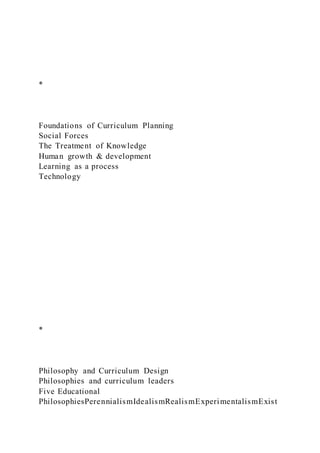
Foundations of Curriculum Planning
Social Forces
The Treatment of Knowledge
Human growth & development
Learning as a process
Technology
*
20th Century
After World War IIProgressive Education influenced curriculum
and practicesSputnik and the National ResponseCurriculum
Reform movementA Nation at Risk
*
Foundations of Curriculum Planning
Social Forces
The Treatment of Knowledge
Human growth & development
Learning as a process
Technology
*
Philosophy and Curriculum Design
Philosophies and curriculum leaders
Five Educational
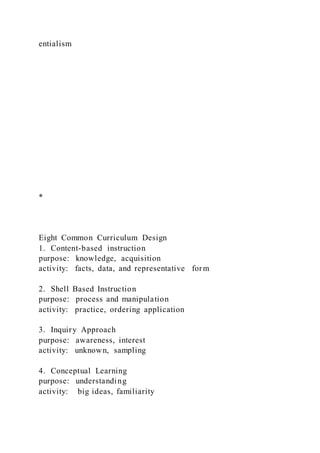
PhilosophiesPerennialismIdealismRealismExperimentalismExist
entialism
*
Eight Common Curriculum Design
1. Content-based instruction
purpose: knowledge, acquisition
activity: facts, data, and representative form
2. Shell Based Instruction
purpose: process and manipulation
activity: practice, ordering application
3. Inquiry Approach
purpose: awareness, interest
activity: unknown, sampling
4. Conceptual Learning
purpose: understanding
activity: big ideas, familiarity
*
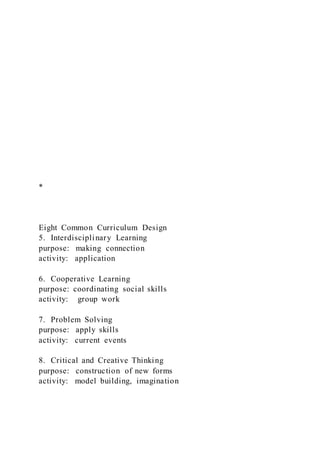
Eight Common Curriculum Design
5. Interdisciplinary Learning
purpose: making connection
activity: application
6. Cooperative Learning
purpose: coordinating social skills
activity: group work
7. Problem Solving
purpose: apply skills
activity: current events
8. Critical and Creative Thinking
purpose: construction of new forms
activity: model building, imagination
*

Curriculum Development W2Learning Objectives· What is a goal-b

  • 1.
    Curriculum Development W2 LearningObjectives · What is a goal-based model of curriculum planning, and how does one determine the locus of planning decisions and organizational structures that are needed? · What is the importance of establishing a curriculum framework? · How can we identify and allocate leadership functions as well as align goals with curricular fields? · How do we organize, evaluate, change, and provide curriculum resources? Assignment Two Select a college or university and provide the information listed below for the university. · History of the Institution · Mission Statement · Accreditation Status of the Institution · Institutions Goals and Objectives Discussion Board 2 How can community members be involved in curriculum planning?
  • 2.
    * How Do WeDefine Curriculum?Curriculum is that which is taught at school.Curriculum is a set of subjects.Curriculum is content.Curriculum is a sequence of courses.Curriculum is a set of performance objectives. * How Do We Define Curriculum?Curriculum is all planned learning for which the school is responsible.Curriculum is all the experiences learners have under the guidance of the school. John Delnay (1959.) * How Do We Define Curriculum?According to Bandi & Wales (2005), the most common definition derived from the word Latin root, which means “racecourse.” Bandi & Wales (2005) also stated that “ for many students, the school curriculum is a race to be run, a series of obstacles or hurdles (subjects) to be passed.”
  • 3.
    * How Do WeDefine Curriculum?It is important to keep in mind that schools in the Western Civilization have been heavily influenced since the fourth century B.C. by the philosophies of Plato and Aristotle and the word curriculum has been used historically to describe the subjects that are being taught during the classical period of Greek Civilization. * How Do We Define Curriculum?The interpretation of the word curriculum has broaden in the 20th century to include subjects other that the Classics. Today school documents, newspaper articles, committee reports, and many academic textbooks refer to any and all subjects offered are prescribed as the curriculum of the school. * Curriculum as a Discipline Curriculum as a discipline is a subject of study, and on the Graduate level of Higher Education a major field of study.
  • 4.
    * Curriculum as aDiscipline Graduate and undergraduate students take courses in:Curriculum developmentCurriculum theoryCurriculum EvaluationSecondary School CurriculumElementary School CurriculumMiddle School CurriculumCommunity College CurriculumCurriculum in Higher Education * History of Curriculum Three focus points for Curriculum Decisions * History of Curriculum 1. The Nature of Subject MatterContent of the curriculum, and what subject matter to include in the curriculum.The subject matter of history should be based on evens that actually happened in the past.
  • 5.
    2. The Natureof the SocietyIf the curriculum is to have utilitarian values, then it must lead the student not only to knowledge of the external world for its own sake, but also to knowledge that can be applied in the world. * History of Curriculum The Nature of the IndividualsThe third basic focal point around which decisions about curricula can be made is the nature of the individual.The curriculum is also a set of suggestions to the teacher about how to take advantage of the present opportunities worthwhile, growth for each student in the long run.The History of Curricula of American school during the 20th century is, therefore, a history of these three focal points for deciding on content ad making other curriculum decisions. * History of Curriculum Colonial Era and the Early United StatesCurriculum was not an issue in Colonial America during the early years of the United States.Colonies along the Atlantic seaboard were under British
  • 6.
    control during the17th/18th centuries. These immigrants were from many European nations. Despite their differences the settlers shared common assumptions about education. * History of Curriculum First Common Assumptions:Few people needed formal Education.Mass Education was not heard. Second Common Assumptions:Formal Education should be directed at bringing people into conformity with some prevailing idea of what and Educated person should be. * History of Curriculum
  • 7.
    Given these assumptionsabout education and how they worked out in schools of colonial America, the focus point of the curriculum was the nature of subject matter. * Colonial America The Harvard CurriculumLogicPhysicsRhetoricHistoryEthnicPoliticsGeometry AstronomyLiteracy Studies
  • 8.
    * Colonial America Franklin’s Academy1749.Benjamin Franklin challenge prevailing beliefs about education and the curriculum.Curriculum –focused on Latin & Greek for those preparing to be ministersFrench, German, and Spanish for those preparing to be merchants.Everyone would study English, through reading, writing, and orating. * 19th Century Common School MovementThe expansion of the curriculum. Reports of the National Education Association.1876. A course of study from primary school to university.1893. The Committee of Ten1895. The Committee of 15
  • 9.
    * 20th Century The CardinalPrincipals of Secondary Education Seven Objectives:HealthCommand of fundamental processWorthy Home MembershipVacationCitizenshipWorthy use of leisureEthical Character *
  • 10.
    20th Century Franklin BobbitActively AnalysisCurriculum OrganizationNew principles for guiding curriculum decisionsChild Center Pedagogy1927 Yearbook The Eight Year StudyNew Idea about curricula * Foundations of Curriculum Planning Social Forces The Treatment of Knowledge Human growth & development Learning as a process
  • 11.
    Technology * 20th Century After WorldWar IIProgressive Education influenced curriculum and practicesSputnik and the National ResponseCurriculum Reform movementA Nation at Risk
  • 12.
    * Foundations of CurriculumPlanning Social Forces The Treatment of Knowledge Human growth & development Learning as a process Technology * Philosophy and Curriculum Design Philosophies and curriculum leaders Five Educational PhilosophiesPerennialismIdealismRealismExperimentalismExist
  • 13.
    entialism * Eight Common CurriculumDesign 1. Content-based instruction purpose: knowledge, acquisition activity: facts, data, and representative form 2. Shell Based Instruction purpose: process and manipulation activity: practice, ordering application 3. Inquiry Approach purpose: awareness, interest activity: unknown, sampling 4. Conceptual Learning purpose: understanding activity: big ideas, familiarity
  • 14.
    * Eight Common CurriculumDesign 5. Interdisciplinary Learning purpose: making connection activity: application 6. Cooperative Learning purpose: coordinating social skills activity: group work 7. Problem Solving purpose: apply skills activity: current events 8. Critical and Creative Thinking purpose: construction of new forms activity: model building, imagination
  • 15.