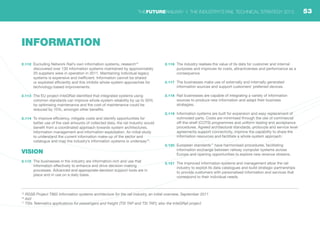
THEFUTURERAILWAY
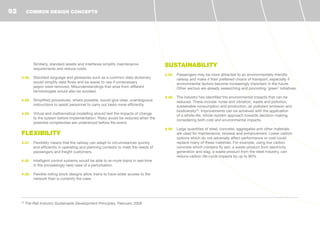
THE INDUSTRY’S RAIL TECHNICAL STRATEGY 2012
SUPPORTING RAILWAY BUSINESS
TSLG is an RSSB-facilitated cross-industry expert body made up of senior
executive staff, charged with developing and championing implementation of the
Rail Technical Strategy, supporting communication, managing strategic research,
identifying opportunities, barriers and actions.
TSLG engages with the Rail Delivery Group (which endorses this strategy) and with
other industry groups with a leadership role including the Planning Oversight Group
and National Task Force. TSLG’s remit and terms of reference are agreed by the Board
of RSSB.
TSLG members
THE RAIL TECHNICAL STRATEGY 2012
IS PRODUCED BY THE TECHNICAL
STRATEGY LEADERSHIP GROUP (TSLG)
FOR, AND ON BEHALF OF, THE RAIL
INDUSTRY IN GREAT BRITAIN.
The railway industry in Great Britain is undergoing a renaissance, with growth in passenger and freight
custom to levels not seen for almost a hundred years. The industry is responding by providing ever better
levels of service, underpinned by investment in trains, stations, infrastructure and service provision. At
the same time, it is improving its financial performance and efficiency so railway users and taxpayers get
better value for money.
To support this drive for improvement, the industry has developed this technical strategy, which describes
a range of solutions to its principal technical challenges over the next thirty years. In doing so, it offers the
prospect of a radical transformation of the technical landscape of the railway. This technical improvement
is not an end in itself, but a means to secure the railway’s business base and to provide its current and
future customers with an unparalleled service and further value for money.
This edition of the Rail Technical Strategy (RTS), developed by the industry, builds on the first edition
published by the Department for Transport in 2007. It recognises that we are in a new environment in
which the government is funding a rolling programme of electrification and supporting the development
of a new high-speed rail network. The new edition, RTS 2012, takes account of the work during the
intervening five years led by the Technical Strategy Leadership Group (TSLG), addressing ways to improve
the railway’s performance in four primary areas: customer satisfaction, capacity increase, cost reduction
and carbon reduction. In addition to the continuous efforts to improve levels of safety, TSLG’s work
demonstrates how industry, working together and with the valued support of government, can map out
and pursue a course of actions that offer major improvements in each of these areas.
RTS 2012 supports delivery of the railway industry’s forthcoming Strategic Business Plan and its more
detailed Route Utilisation Strategies. In taking a longer-term view, RTS 2012 also offers the potential for
the industry to deliver an even better railway.
FOREWORD
FROM THE CHAIR OF THE TECHNICAL
STRATEGY LEADERSHIP GROUP
STEVE YIANNI
RTS 2012 recognises that its strategies have to be delivered within the context of
a disaggregated industry structure, the five-yearly regulatory planning process,
the commercial arrangements associated with passenger rail franchises and
private freight operations. These aspects present both opportunities and
constraints such as letting longer franchises. RTS 2012 presents a prospectus
that encourages all in the industry to take advantage of the opportunities and
overcome the constraints, to gain and share the large prizes available.
Customers of the railway, both passengers and freight users, are at the heart of
RTS 2012 and the technical innovation it promotes. Everything in the strategy
is intended to enable service providers to produce a future railway that fulfils
customers’ needs and expectations.
RTS 2012 is intended to be particularly valuable for suppliers to the railway, by
presenting an industry view of the direction of technical developments over the
coming decades. Even in areas where certainty is not possible, a sense of the
options to be explored should provide useful indicators of where the industry
would expect effort to have most potential to yield value.
For those within the core railway companies, RTS 2012 provides a long-term
holistic vision of the future railway from a technical perspective, not readily
available in any single part of the industry. I hope that by doing so, it will inspire
the industry to collaborate effectively to deliver that future, for the benefit of all.
Steve Yianni
Chair of the Technical Strategy Leadership Group
FOREWORDCONTINUED
On behalf of the Rail Delivery Group I am delighted to endorse this second edition of the Rail Technical
Strategy. It represents a significant component of the rail industry’s vision to improve the efficiency,
health, safety, commercial and operational performance of Britain’s railways over the decades to come.
Railway companies recognise that catering for the burgeoning growth in demand for our services within
the physical and economic constraints we face in Britain requires new and innovative ways to deliver
what our customers want. Technical initiatives, such as those described in this strategy, will enhance
our ability to meet the challenges over the coming years to improve railways’ competitive position and
contribute to the health and wealth of our society.
Technical innovation through applying new technologies or changing processes can enable the railway
to deliver increased capacity at reduced costs, both highlighted in the Rail Value for Money study and
of prime importance to our customers.
I commend the way the whole industry, through the Technical Strategy Leadership Group, has come
together and taken the responsibility to produce this strategy. It is now a live document which can be
used to guide shared industry and company delivery plans.
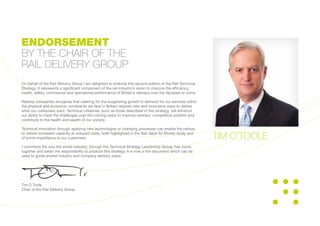
Tim O’Toole
Chair of the Rail Delivery Group
ENDORSEMENT
BY THE CHAIR OF THE
RAIL DELIVERY GROUP
TIM O’TOOLE
CONTENTS
	 EXECUTIVE SUMMARY  . . . . . . . . . . . . . . . . . . . . . . . . . . . . . . . . . . . . . . . . . . . . . . . . . . . . . . . . . . . . . . . . . . . . . . . . 08
1	INTRODUCTION  . . . . . . . . . . . . . . . . . . . . . . . . . . . . . . . . . . . . . . . . . . . . . . . . . . . . . . . . . . . . . . . . . . . . . . . . . . . . . . . . . . . . . . 11
BACKGROUND  . . . . . . . . . . . . . . . . . . . . . . . . . . . . . . . . . . . . . . . . . . . . . . . . . . . . . . . . . . . . . . . . . . . . . . . . . . . . . . . . . . . . . . . . . .  11
AIMS  . . . . . . . . . . . . . . . . . . . . . . . . . . . . . . . . . . . . . . . . . . . . . . . . . . . . . . . . . . . . . . . . . . . . . . . . . . . . . . . . . . . . . . . . . . . . . . . . . . . . . . . . . . . .  11
SCOPE  . . . . . . . . . . . . . . . . . . . . . . . . . . . . . . . . . . . . . . . . . . . . . . . . . . . . . . . . . . . . . . . . . . . . . . . . . . . . . . . . . . . . . . . . . . . . . . . . . . . . . . . .  11
POLICY AND PLANNING CONTEXT  . . . . . . . . . . . . . . . . . . . . . . . . . . . . . . . . . . . . . . . . . . . . . . . . . . . . . . .  11
SUPPORT FOR RAILWAY BUSINESSES  . . . . . . . . . . . . . . . . . . . . . . . . . . . . . . . . . . . . . . . . . . . . . . . .  12
OWNERSHIP AND IMPLEMENTATION  . . . . . . . . . . . . . . . . . . . . . . . . . . . . . . . . . . . . . . . . . . . . . . . . . . .  12
A VISION OF THE RAILWAY IN 2040  . . . . . . . . . . . . . . . . . . . . . . . . . . . . . . . . . . . . . . . . . . . . . . . . . . . . . .  13
RTS 2012 STRUCTURE  . . . . . . . . . . . . . . . . . . . . . . . . . . . . . . . . . . . . . . . . . . . . . . . . . . . . . . . . . . . . . . . . . . . . . . . . . . . .  14
2	THEMES  . . . . . . . . . . . . . . . . . . . . . . . . . . . . . . . . . . . . . . . . . . . . . . . . . . . . . . . . . . . . . . . . . . . . . . . . . . . . . . . . . . . . . . . . . . . . . . . . . . . . 17
CONTROL, COMMAND AND COMMUNICATION  . . . . . . . . . . . . . . . . . . . . . . . . . . 17
ENERGY  . . . . . . . . . . . . . . . . . . . . . . . . . . . . . . . . . . . . . . . . . . . . . . . . . . . . . . . . . . . . . . . . . . . . . . . . . . . . . . . . . . . . . . . . . . . . . . . . . . . . . 25
INFRASTRUCTURE  . . . . . . . . . . . . . . . . . . . . . . . . . . . . . . . . . . . . . . . . . . . . . . . . . . . . . . . . . . . . . . . . . . . . . . . . . . . . . . . . 33
ROLLING STOCK  . . . . . . . . . . . . . . . . . . . . . . . . . . . . . . . . . . . . . . . . . . . . . . . . . . . . . . . . . . . . . . . . . . . . . . . . . . . . . . . . . . . . 43
INFORMATION  . . . . . . . . . . . . . . . . . . . . . . . . . . . . . . . . . . . . . . . . . . . . . . . . . . . . . . . . . . . . . . . . . . . . . . . . . . . . . . . . . . . . . . . . . 51
CUSTOMER EXPERIENCE  . . . . . . . . . . . . . . . . . . . . . . . . . . . . . . . . . . . . . . . . . . . . . . . . . . . . . . . . . . . . . . . . . . 57
3	 COMMON FOUNDATIONS  . . . . . . . . . . . . . . . . . . . . . . . . . . . . . . . . . . . . . . . . . . . . . . . . . . . . . . . . . . . . . . . . . . . 65
WHOLE-SYSTEM APPROACH  . . . . . . . . . . . . . . . . . . . . . . . . . . . . . . . . . . . . . . . . . . . . . . . . . . . . . . . . . . . . 65
INNOVATION  . . . . . . . . . . . . . . . . . . . . . . . . . . . . . . . . . . . . . . . . . . . . . . . . . . . . . . . . . . . . . . . . . . . . . . . . . . . . . . . . . . . . . . . . . . . . . 73
PEOPLE  . . . . . . . . . . . . . . . . . . . . . . . . . . . . . . . . . . . . . . . . . . . . . . . . . . . . . . . . . . . . . . . . . . . . . . . . . . . . . . . . . . . . . . . . . . . . . . . . . . . . . 83
4	 COMMON DESIGN CONCEPTS  . . . . . . . . . . . . . . . . . . . . . . . . . . . . . . . . . . . . . . . . . . . . . . . . . . . . . . . . . 89
5	 ABBREVIATIONS AND ACRONYMS  . . . . . . . . . . . . . . . . . . . . . . . . . . . . . . . . . . . . . . . . . . . . . . . . . . 93
6	GLOSSARY  . . . . . . . . . . . . . . . . . . . . . . . . . . . . . . . . . . . . . . . . . . . . . . . . . . . . . . . . . . . . . . . . . . . . . . . . . . . . . . . . . . . . . . . . . . . . . . . . 95
7	ACKNOWLEDGEMENTS . . . . . . . . . . . . . . . . . . . . . . . . . . . . . . . . . . . . . . . . . . . . . . . . . . . . . . . . . . . . . . . . . . . 100
EXECUTIVE SUMMARY
TRANSFORMING THE RAILWAY –
THE 30-YEAR VISION
Britain’s railway sets the benchmark for service quality, customer satisfaction,
and value for money by being safe, reliable and resilient, meeting capacity and
service requirements and contributing to the growth of the economy.
The purpose of the railway is to satisfy its customers. To maintain the ability to
do so and continue to attract more passenger and freight business, it needs to
remove barriers and find more innovative and cost-effective ways to increase
capacity and improve performance.
The rewards available to a railway that takes advantage of technical and
technological developments are huge. The Rail Value for Money study
put forward potential savings of £3.5bn through incremental changes by
2019. The Rail Technical Strategy 2012 (RTS 2012) is based on a different
paradigm. It seeks to transform the cost base by eliminating many of the
causes of cost, including: lineside signalling, oil-based traction fuel, service
interruptions caused by asset failure, frequent unplanned maintenance,
customer experiences of unreliability in the system, compensation for failure.
The numbers are big, for example, traction energy costs £600m/year and
rising; system reliability £600m/year and lineside signalling maintenance
costs £100m/year. But the prize is not just cost reduction. Equally important
is the opportunity to win new business and revenue by increasing capacity,
satisfying existing customers and attracting new ones.
RTS 2012 sets out the technical strategies in six themes to support the
transformation of the railway and deliver rewards over the next 30 years.
CONTROL, COMMAND AND
COMMUNICATION
Real-time intelligent traffic management systems deliver a high-capacity,
energy-efficient, on-time railway. In-cab signalling has largely displaced
the need for lineside signalling infrastructure. Communication systems are
optimised for operations and customer services.
ENERGY
An extensively electrified network has reduced reliance on fossil fuels and non-
renewable resources. Asset specification drives energy efficiency. Sensors,
energy storage technologies and smart grid technologies monitor and manage
energy use for maximum efficiency.
INFRASTRUCTURE
A resilient 7-day railway with world-class asset management which improves
reliability, increases capacity and service levels and reduces delays. Trains and
track equipment are specified through a whole-system approach to monitor
each other and cause less damage. Intelligent maintenance provides accurate
timely information for condition-based intervention.
The industry’s Sustainable Development Principles are embedded in technical
and operational designs. The railway is carbon-neutral and resilient to the
impact of climate change.
An extensive high-capability strategic freight network connected to future-
proofed terminals provides freight customers with flexible and timely
responses to their operational and planning requests.
8
ROLLING STOCK
Reliable, energy-efficient, low whole-life cost rolling stock is based on
modular designs to meet the evolving needs of rail customers. Rolling stock/
infrastructure interfaces are optimised to minimise costs. Plug-and-play train
fitments for sub-systems simplify replacements and upgrades without costly,
time-consuming refits. Improved, more efficient braking systems and bogie
designs are deployed.
INFORMATION
Integrated modular information systems improve customer service, reduce
operating costs and generate value through commercial exploitation. Data and
information management, based on common architectures and open source
technology, make information available in useable form when and where
needed.
CUSTOMER EXPERIENCE
Rail is the customers’ mode of choice for reliability and ease-of-use,
integrating with adjacent modes to create seamless door-to-door journeys.
Passenger-friendly stations without queues or physical barriers feature
revenue collection and security controls based on electronic systems.
RTS 2012 also describes three common foundations to support a cultural shift
towards achieving the technical development and implementation.
WHOLE-SYSTEM APPROACH
A whole-system approach features coordinated planning and operations,
consistent and aligned asset management and the adoption of an industry-
wide framework to help the industry to implement change and improve
reliability, availability, maintainability and safety (RAMS).
INNOVATION
The rail industry has overcome inhibitors to innovation, including the
misalignment of risk and reward, to become dynamic and attractive to
entrepreneurial talent. Support for innovators includes identified priorities and
test and trial facilities to simplify the introduction of novel technical solutions
for operations and engineering applications.
PEOPLE
Skilled, committed, adaptable people are attracted to working in the
customer-focused, efficient rail industry. The leadership and technical skills are
supported by learning and development systems. Repetitive tasks have been
automated. A reliable supply chain provides specialist people support.
The themes and their common foundations are not independent, but aspects
of the industry’s holistic approach to transformation. Each chapter of RTS
2012 describes how this can come about in its particular area. Together, they
express the passion of the industry to succeed for its customers.
9THEFUTURERAILWAY | THE INDUSTRY’S RAIL TECHNICAL STRATEGY 2012
Delivery of RTS 2012 will come from its integration within industry planning
processes:
•	 Industry Strategic Business Plan (ISBP)
•	 Concerted actions of government in setting and delivering related policies
and plans
•	 Office of Rail Regulation’s industry reform programme to align incentives
•	 Opportunities afforded by longer franchises
The industry’s Technical Strategy Leadership Group has overseen the
development of RTS 2012. The Rail Delivery Group has endorsed these
strategies, which are also reflected in the current work being developed by the
Planning Oversight Group, in the ISBP, Route Utilisation Strategies and Long
Term Planning Framework.
EXECUTIVE SUMMARY10
INTRODUCTION
BACKGROUND
1.1	 The first edition of the Rail Technical Strategy (RTS) was published
by the Department for Transport in 2007 in conjunction with the white
paper Delivering a Sustainable Railway. It set out a long-term vision of
the railway as a system and explored how technologies and technical
approaches could help respond to key challenges.
1.2	 A cross-industry group of senior stakeholders – the Technical Strategy
Advisory Group (TSAG) – was established to develop and implement
the strategy. Now renamed the Technical Strategy Leadership
Group (TSLG), it has produced this new edition to reflect progress in
technology and technical processes since 2007.
AIMS
1.3	 The Rail Technical Strategy 2012 (RTS 2012) aims to assist the
industry’s strategic planning processes, inform policy makers
and funders about the potential benefits of new techniques and
technologies and provide suppliers with guidance on the future
technical direction of the industry.
1.4	 TSLG has based the development of RTS 2012 around its 4C
challenges of increased capacity, reduced carbon, lower costs
and improved customer satisfaction. Responses to TSLG’s 2010
consultation about the railway’s strategy confirmed widespread
stakeholder support for continuing to focus on the 4Cs as strategic
objectives. They are also consistent with government policy objectives.
1.5	 The ultimate aim is to benefit railway customers, on whom the whole
industry depends, by helping the industry to provide services that meet
their needs and to go beyond that where possible.
SCOPE
1.6	 The geographical scope of RTS 2012 is the mainline railway in Great
Britain and its interoperability with continental European networks.
1.7	 The 30-year timeframe of the strategy reflects a balance of the varying
life-spans of railway assets, which range from 100 years or more for
stations and structures, to 25-40 years for rolling stock and much fewer
years for electronic equipment and software.
POLICY AND PLANNING CONTEXT
1.8	 Since the first edition of the RTS, the policy environment has changed
significantly. The Rail Value for Money study and the government’s
response to this1
acknowledged the challenge facing the industry
to deliver a more affordable railway with lower costs and improved
efficiency. The government continues to recognise the value of the
railway as part of the country’s economic development. To this end, it
is funding a major rolling programme of electrification and supporting
the development of a high-speed rail network. It has introduced longer
franchises for passenger services and is supporting innovation through
the new Transport Catapult and Enabling Innovation Team. All of these
developments offer opportunities for the industry to deliver a better-
performing, more sustainable railway.
1
Reforming our Railways: Putting the Customer First, DfT. March 2012
11THEFUTURERAILWAY | THE INDUSTRY’S RAIL TECHNICAL STRATEGY 2012
1.9	 The broader policy context for RTS 2012 includes the European
Commission’s white paper Roadmap to a single European transport
area (2011). This identifies the need for railways to shift passenger
and freight traffic away from the road to ease congestion, reduce
environmental harm and facilitate economic development. In the face of
growing global competition, the paper asserts that delayed action and
timid introduction of new technologies could condemn the European
transport industry to irreversible decline2
.
1.10	 RTS 2012 does not make independent forecasts for the development
of the strategies, but relies on assumptions set out in the Network RUS.
These assumptions broadly indicate the continuing need for a core
mixed traffic railway with some dedicated high-speed and freight-only
operation. The RTS 2012 technical developments also support other
scenarios. One example is the Foresight Studies for the Sustainable
Rail Programme (T713) in which the scenarios are based on different
future economic outcomes and societal attitudes.
SUPPORT FOR RAILWAY BUSINESSES
AND THE ECONOMY
1.11	 RTS 2012 is intended to be particularly valuable to railway suppliers by
presenting a unified view of where the industry is expected to direct its
technical development over the coming decades. It also intends to help
operators, infrastructure managers and industry planners understand
how technical developments could support them in delivering a
higher-capacity, better-performing and more cost-effective railway.
This is important as the railway could play a bigger role in supporting
economic growth if it could be more attractive and affordable for its
passengers and freight customers and attract new business.
1.12	 RTS 2012 recognises the context of a disaggregated industry structure,
the five-yearly regulatory planning process, commercial arrangements
associated with primarily franchised passenger operations and private
freight operations. This organisational and commercial mix presents
both opportunities and constraints for delivery of the strategy. RTS
2012 works with the Office of Rail Regulation’s industry reform
programme to reduce the effect of misaligned commercial incentives.
OWNERSHIP AND IMPLEMENTATION
1.13	 RTS 2012 has been developed by TSLG with significant contributions
from the industry’s System Interface Committees (SICs) and
representatives from government and suppliers.
1.14	 The Rail Delivery Group (RDG), which provides leadership for the
industry and direction for the objectives and priorities for the TSLG, has
endorsed RTS 2012.
1.15	 RDG will promote the implementation of RTS 2012 and TSLG will lead
its ongoing development.
1.16	 TSLG will maintain RTS 2012, evaluate new concepts and support
those with potential to the point where industry is ready to implement
them as part of its day-to-day business.
INTRODUCTION
2
COM (2011) 144 final: Roadmap to a single European transport area – Towards a competitive and resource efficient transport system
12
1.17	 Many technical developments focus on the interfaces between systems
and span the boundaries of traditional technical domains. The SICs
will continue to be important to the implementation and delivery of
integrated solutions.
A VISION OF THE RAILWAY IN 2040
1.18	 The transformed railway is available seven days a week and is reliable,
resilient, safe and sustainable.
1.19	 A whole-system approach across the industry has fostered innovation
and attracted the best talent. Entrepreneurs and innovators have the
right conditions to develop new products and services and the export
market is expanding.
1.20	 Network capacity is optimised to meet all requirements for passengers
and freight. Intelligent maintenance has increased train and track
availability and reduced perturbations and delays. World-class asset
management is aligned across the industry to improve performance,
lower costs and reduce business risk.
1.21	 Flexible, real-time intelligent traffic management and in-cab signalling
has reduced headways and decreased traction energy consumption.
Control centres know the precise location, speed, braking and load of
every train on the network to optimise operational performance and
keep passengers informed.
1.22	 Carbon emissions have decreased through the widespread
electrification of the network and sustainable, energy-efficient solutions
for the remaining non-electrified routes. Energy recovery systems in
rolling stock and alternative fuels allow trains to lower costs and run on
and off the electrified network. Sustainable Development Principles are
embedded in the design, construction and operation of infrastructure
and rolling stock assets and the railway is resilient to climate change.
1.23	 The industry is increasingly cost-effective as more efficiencies are
introduced. Unplanned maintenance and damage to track and train
are minimised through enhanced industry-wide condition monitoring.
Generic designs for buildings and rolling stock interfaces are used
instead of costly bespoke solutions to simplify expansion, upgrades
and replacements. Operational and customer communications are
supported by equipment that can be updated with plug-and-play
fitments.
1.24	 Rail services are integrated with other transport modes so that
passengers have seamless door-to-door journeys. Station information
systems and personalised messaging offer passengers all the relevant
information to travel easily and reliably to their destinations. Passenger-
friendly stations eliminate the need for queues or physical barriers.
Revenue collection and security are based on electronic systems.
High-speed 1 links to the continent and is augmented nationally by
High-Speed 2 which provides high-capacity, high-speed links between
London, Birmingham, Leeds and Manchester and direct links to
Heathrow Airport.
1.25	 An extensive high-capability strategic freight network with increased
route availability provides freight customers with flexible and timely
responses to their operational and planning requests. The selective
availability of higher axle loads and greater loading gauge have
improved intermodal traffic.
13THEFUTURERAILWAY | THE INDUSTRY’S RAIL TECHNICAL STRATEGY 2012
RTS 2012 STRUCTURE
1.26	 RTS 2012 is organised into three main sections:
•	 Themes
•	 Common foundations
•	 Common design concepts
1.27	 The themes and common foundations work together to facilitate the
realisation of technical and technological developments to create a
future railway.
THEMES
1.28	 Strategies addressing the main operational and engineering technical
domains in the rail industry are described as themes:
•	 Control, command and communication
•	 Energy
•	 Infrastructure
•	 Rolling stock
•	 Information
•	 Customer experience
1.29	 Although the strategies are presented separately, they are not
independent of each other. Together they form the industry’s desire to
transform the railway for the highest possible customer satisfaction.
1.30	 The Themes are described in chapter 2.
COMMON FOUNDATIONS
1.31	 Common foundations support all the themes:
•	 Whole-system approach
•	 Innovation
•	 People
1.32	 Common foundations are described in chapter 3.
COMMON DESIGN CONCEPTS
1.33	 Common design concepts are technical issues that stakeholders have
consistently identified as applicable to all the themes:
•	 Whole-system reliability
•	 Resilience
•	 Security
•	 Automation
•	 Simplicity
•	 Flexibility
•	 Sustainability
1.34	 Common design concepts are described in chapter 4.
INTRODUCTION14
VISION, OBJECTIVES, STRATEGY AND
ENABLERS
1.35	 Four elements, vision, objectives, strategy and enablers (VOSE), are
used to address each theme and common foundation:
•	 Vision - What would a really good future look like?
•	 Objectives - What are the specific outcomes to be achieved?
•	 Strategies - How will the objectives be delivered?
•	 Enablers - What tools and/or techniques are required to achieve the
strategy?
1.36	 A VOSE is presented as an overview of the main criteria for each theme
and common foundation.
15THEFUTURERAILWAY | THE INDUSTRY’S RAIL TECHNICAL STRATEGY 2012
16
CONTROL, COMMAND
AND COMMUNICATION
17THEFUTURERAILWAY | THE INDUSTRY’S RAIL TECHNICAL STRATEGY 2012
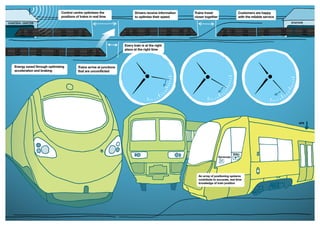
An array of positioning systems
contribute to accurate, real time
knowledge of train position
Drivers receive information
to optimise their speed
Energy saved through optimising
acceleration and braking
Control centre optimises the
positions of trains in real time
Trains arrive at junctions
that are unconflicted
Every train is at the right
place at the right time
Customers are happy
with the reliable service
Trains travel
closer together
GPS
Gyroscope
Video
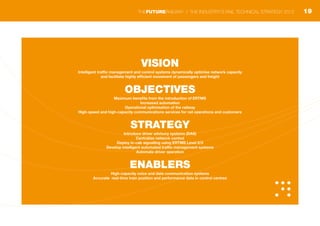
VISION
Intelligent traffic management and control systems dynamically optimise network capacity
and facilitate highly efficient movement of passengers and freight
OBJECTIVES
Maximum benefits from the introduction of ERTMS
Increased automation
Operational optimisation of the railway
High-speed and high-capacity communications services for rail operations and customers
STRATEGY
Introduce driver advisory systems (DAS)
Centralise network control
Deploy in-cab signalling using ERTMS Level 2/3
Develop intelligent automated traffic management systems
Automate driver operation
ENABLERS
High-capacity voice and data communication systems
Accurate real-time train position and performance data in control centres
19THEFUTURERAILWAY | THE INDUSTRY’S RAIL TECHNICAL STRATEGY 2012
CONTEXT
2.1	 Control, command and communication (CCC) systems are a key
strategic technological capability for the delivery of the 4Cs over the
next 30 years. New technologies are challenging the existing principles
of how train movements are controlled, for example, control of the
proximity of trains could allow train convoying. The application of these
technologies has the potential to deliver improved capacity, decrease
traction energy consumption and carbon emissions, reduce operational
costs and provide better onboard communications for passengers.
2.2	 New CCC systems will also offer opportunities for benefits in
other areas such as crashworthiness in rolling stock design, driver
route knowledge and reduced wear and tear on track and trains.
Consequently, a whole-system approach will be the best way to deploy
solutions for these issues and for related technological developments.
2.3	 Since 2007, progress in CCC systems includes:
•	 Progressive rollout of GSM-R
•	 Commissioning of the first European Rail Traffic Management
System (ERTMS) project
•	 Initiation of Network Rail’s control centre consolidation strategy
•	 Pilot projects for Driver Advisory Systems (DAS)
•	 Planned use of automatic train operation (ATO) on Thameslink and
Crossrail
VISION
2.4	 Highly reliable and resilient CCC systems offer network-wide traffic
management capabilities for intelligent, predictive and adaptive
operational control of train movements. The systems track the precise
location and current status of every train on the network. Data for
speed, acceleration, braking and load is available at all control centres
for improved operational decision-making. Train movements are
optimised to meet a variety of goals and perturbations are resolved
rapidly so that there is a minimum impact on customers.
2.5	 High-speed, high-bandwidth communications networks are in
use across the rail network and on trains and provide dependable
connectivity for both operational and customer-facing applications for
the railway and customers. Data is made openly available to support
door-to-door journey information.
2.6	 In-cab signalling is used instead of lineside signals and the only
traditional features of lineside signalling are point operating equipment
and level crossings. Signalling system designs are standardised and
the design, testing and commissioning procedures are automated.
2.7	 The use of ATO is widespread across the network. Fully automatic
operation of trains is possible on some parts of the network.
CONTROL, COMMAND AND COMMUNICATION
20
OBJECTIVES
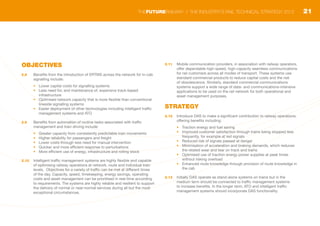
2.8	 Benefits from the introduction of ERTMS across the network for in-cab
signalling include:
•	 Lower capital costs for signalling systems
•	 Less need for, and maintenance of, expensive track-based
infrastructure
•	 Optimised network capacity that is more flexible than conventional
lineside signalling systems
•	 Easier deployment of other technologies including intelligent traffic
management systems and ATO
2.9	 Benefits from automation of routine tasks associated with traffic
management and train driving include:
•	 Greater capacity from consistently predictable train movements
•	 Higher reliability for passengers and freight
•	 Lower costs through less need for manual intervention
•	 Quicker and more efficient response to perturbations
•	 More efficient use of energy, infrastructure and rolling stock
2.10	 Intelligent traffic management systems are highly flexible and capable
of optimising railway operations at network, route and individual train
levels. Objectives for a variety of traffic can be met at different times
of the day. Capacity, speed, timekeeping, energy savings, operating
costs and asset management can be prioritised in real-time according
to requirements. The systems are highly reliable and resilient to support
the delivery of normal or near-normal services during all but the most
exceptional circumstances.
2.11	 Mobile communication providers, in association with railway operators,
offer dependable high-speed, high-capacity seamless communications
for rail customers across all modes of transport. These systems use
standard commercial products to reduce capital costs and the risk
of obsolescence. Similarly, standard commercial communications
systems support a wide range of data- and communications-intensive
applications to be used on the rail network for both operational and
asset management purposes.
STRATEGY
2.12	 Introduce DAS to make a significant contribution to railway operations,
offering benefits including:
•	 Traction energy and fuel saving
•	 Improved customer satisfaction through trains being stopped less
frequently, for example at red signals
•	 Reduced risk of signals passed at danger
•	 Minimisation of acceleration and braking demands, which reduces
the related wear and tear on track and trains
•	 Optimised use of traction energy power supplies at peak times
without risking overload
•	 Enhanced route knowledge through provision of route knowledge in
the cab
2.13	 Initially DAS operate as stand-alone systems on trains but in the
medium term should be connected to traffic management systems
to increase benefits. In the longer term, ATO and intelligent traffic
management systems should incorporate DAS functionality.
21THEFUTURERAILWAY | THE INDUSTRY’S RAIL TECHNICAL STRATEGY 2012
2.14	 Network control should be centralised into a small number of major
control centres to eliminate the need for about 800 small signal boxes
and relay interlockings. This would lower operating costs, improve
regulation of traffic and perturbation management and simplify the
deployment of intelligent traffic management systems.
2.15	 ERTMS Level 2 without lineside signals should be deployed across
the network to replace lineside signals3
. Level 3 could be introduced
on some routes to eliminate the need for track-based train detection
equipment and offer significant further benefits in maintenance
costs and reliability. At the same time, the rail industry in GB should
continue to work with the European Railway Agency and others
on the technological development of ERTMS and the evolution of
Command, Control and Signalling (CCS) Technical Specifications for
Interoperability (TSI). Developments should include:
•	 Increasing the system capacity on routes where there are large
numbers of traffic movements in small geographical areas, for
example stations
•	 Deployment of 4G/LTE4
mobile communications to replace GSM-R,
which is currently used for ERTMS
•	 Technological and functional convergence with communications-
based train control systems (CBTC) that are currently in use on
metro systems
2.16	 Advanced intelligent and automated traffic management systems
should progressively replace existing systems in control centres.
TSLG’s FuTRO project is developing the frameworks for the concepts,
requirements and architectures of next generation traffic management
systems. These systems should be dynamic and able to optimise the
use of the rail network, minimise delay, optimise traction energy use
and maintain train connections for passengers. Data from trains and the
infrastructure should predict where and when conflicts are likely to arise
and offer/implement solutions in real-time. Operating data should also
be used to feed automated long-term planning systems to optimise
train timetabling and infrastructure use. The FuTRO business case
estimates that the current value of benefits will be £200-£400m/year by
2035 derived from capacity increase, better information and operational
efficiencies.
2.17	 ATO should be deployed widely across the network to provide
considerable benefits in standardising the driving operation. This is
particularly important as metro-style and urban/suburban operations
require predictable timekeeping to deliver intensive services. Combined
with intelligent traffic management systems, ATO could offer benefits
on other types of routes.
3
DfT ERTMS National Implementation Plan, September 2007, states that rollout should be completed by 2038.
4
4G: Fourth generation telecommunications standard for mobile communications; LTE: Long-term evolution, a telecommunications standard for wireless high-
speed data communication; GSM-R: Global System for Mobile Communications - Rail
THEMES - CONTROL, COMMAND AND COMMUNICATION22
ENABLERS
2.18	 The provision of appropriate high-speed, high-capacity data and voice
communications systems is important for many CCC developments
and for customer-facing services. GSM-R and publicly available Wi-Fi
on trains is unlikely to meet operational demands in the future. 4G /LTE
offers an industry standard that should meet the foreseeable needs of
the railway and its customers. It will need to be adopted when GSM-R
becomes obsolete and unsupported by suppliers, as expected from
~2024 onwards.
2.19	 Intelligent traffic management systems require accurate and real-
time data to make correct decisions. For this, train communications
systems need to relay the precise location of each train, its velocity,
acceleration, braking capability, operational performance and other
items of data. This data also facilitates a variety of other capabilities,
including:
•	 Providing information to customers
•	 Dynamic adjustment of the distances between consecutive trains to
optimise capacity
•	 Tracking freight movements
•	 Enhanced level-crossing protection
•	 Improved on-track personnel safety
•	 Support for remote condition monitoring of train and infrastructure
assets
•	 The facilitation of third-party development of new products and
services associated with train operations
23THEFUTURERAILWAY | THE INDUSTRY’S RAIL TECHNICAL STRATEGY 2012
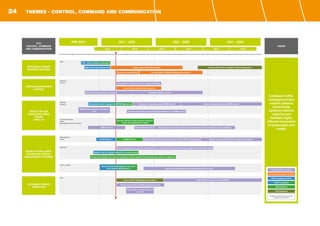
THEMES - CONTROL, COMMAND AND COMMUNICATION
DAS
Network
control
ERTMS
General
Communications
Layer
(Operational and Passenger)
Management
Layer
Capacity
Train Location
ATO
INTRODUCE DRIVER
ADVISORY SYSTEMS
RTS
CONTROL, COMMAND
AND COMMUNICATION
VISION
Intelligent traffic
management and
control systems
dynamically
optimise network
capacity and
facilitate highly
efficient movement
of passengers and
freight
PRE 2010 2011 - 2020
CP 4 CP 5 CP 6 CP 7 CP 8 CP 9
2021 - 2030 2031 - 2040
CENTRALISE NETWORK
CONTROL
DEPLOY IN-CAB
SIGNALLING USING
ERTMS
LEVEL 2/3
DEVELOP INTELLIGENT
AUTOMATED TRAFFIC
MANAGEMENT SYSTEMS
AUTOMATE DRIVER
OPERATION
Intellige
Industry Delivery Activity
Develop traffic management systems to meet FuTRO requirements
Planned programme of capacity enhancements: inc. Crossrail, Thameslink, Reading, gauging work on freight routes
Deploy accurate geospatial positioning systems for trains
Deploy ATO in conjunction with ERTMS
Deploy next generation traffic management systems
Optimisation of network control through modelling
Develop NR Control Centre strategy
Develop can signalling using ERTMS Level 2
Develop engineering and operational requirements for ERTMS Level 3
GSM-R roll out
Network-wide ATO Feasibility & Business cases
Deploy ATO on Thameslink and
Crossrail
4G/LTE pilot projects High speed, high capacity mobile communications systems deployed on trains (4G/LTE)
ERTMS implemented on Cambrian
Line
Deploy cab signalling using ERTMS Level 3
Centralise network control
Industry Development Activity
Deploy stand-alone DAS systems
Develop connected DAS
Control Centre algorithm development
Connect DAS to TRAFFIC Management Centres
TSLG Completed activity
FuTRO Phase 1
DAS Pilot Projects (Research)
TSLG In progress
T724 - Driver Advisory Information
Development work in support of ERTMS deployment
Studies: how to increase capacity of current network
Research into technologies for accurate
train location determination
TSLG Planned
FuTRO Phase 2
Develop and deploy new ways of increasing network capacity through improved traffic management
Develop 4G/LTE communications business
model and deployment strategy
TSLG Potential
Improved ATO Modelling and simulation
Combine DAS, ATO & Intelligent Traffic Management
All dates and durations should be
regarded as indicative
24
ENERGY
25THEFUTURERAILWAY | THE INDUSTRY’S RAIL TECHNICAL STRATEGY 2012
Using lightweight trains with
alternative specifications for
track and train
Less intensive operation
could mean alternative
signalling solutions
Away from the mainline, there could be
additional lower-spec energy options alongside
AC electrification, including battery-power
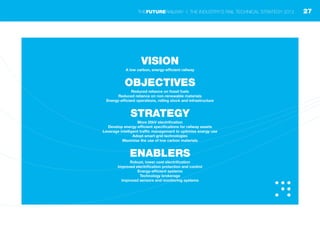
VISION
A low carbon, energy-efficient railway
OBJECTIVES
Reduced reliance on fossil fuels
Reduced reliance on non-renewable materials
Energy-efficient operations, rolling stock and infrastructure
STRATEGY
More 25kV electrification
Develop energy-efficient specifications for railway assets
Leverage intelligent traffic management to optimise energy use
Adopt smart grid technologies
Maximise the use of low carbon materials
ENABLERS
Robust, lower cost electrification
Improved electrification protection and control
Energy-efficient systems
Technology brokerage
Improved sensors and monitoring systems
27THEFUTURERAILWAY | THE INDUSTRY’S RAIL TECHNICAL STRATEGY 2012
CONTEXT
2.20	 Rail is an energy-intensive industry. Between 80 and 90% of the energy
that rail uses – over 3 TWh of electricity – and more than 680 million
litres of diesel are used for traction purposes5
at a cost of over £600m.
The remaining 10-20% of energy consumption is for stations, depots,
control centres and for signalling, communications and other rail
systems.
2.21	 Large amounts of energy are also required to maintain, renew and
enhance the railway. This includes the production, transportation and
installation of materials and products such as concrete and steel and
processes such as tamping and rail grinding.
2.22	 More energy will be used in absolute terms in the future to
accommodate passenger and freight growth and new high-speed rail
services. The industry’s main focus should be to operate in an energy-
efficient way and to encourage a shift away from less efficient and more
carbon-intensive modes.
2.23	 Progress in the railway’s approach to energy since 2007 includes:
•	 Government electrification programme including the Great Western
Main Line, the Trans-Pennine route between Manchester and Leeds
and the Midland Main Line
•	 Enabling regenerative braking on both alternating and direct current
rolling stock
•	 Successful trials of DAS
•	 Fitment of energy meters to several electric rolling stock fleets
•	 Energy efficiency targets in new rolling stock specifications
•	 Diesel rolling stock modifications including the fitment of more
efficient engines and control systems that switch off one or more
engines on diesel multiple units (DMUs) according to power demand
•	 Widespread use of eco-driver training
•	 Installation of renewable energy technologies at some network sites
•	 Energy efficiency improvements at depots and stations, for example,
Accrington Eco-station
•	 Successful trials with fuel containing up to 20% biodiesel on existing
diesel rolling stock
•	 Research on innovative electrification, DC to AC conversion and
reducing electrical losses
VISION
2.24	 The railway has expanded in an energy-efficient way, reducing unit
costs to attract passengers and freight from other modes. The vast
majority of journeys are on electrified routes. Low carbon and recycled
materials are used where safety, reliability and practicality allow.
OBJECTIVES
2.25	 Rail relies less on conventional fossil fuels which will become
increasingly scarce, expensive and environmentally unsustainable.
ENERGY
5
ORR National Rail Trends 2010 –11 Yearbook, Table 9.1a
28
2.26	 Materials from renewable sources and/or with low-embedded carbon
are used for building, maintaining and renewing rolling stock and
infrastructure.
2.27	 New and refurbished rolling stock and infrastructure are designed,
built and maintained to deliver high levels of energy efficiency. Energy-
efficient operations include avoiding unnecessary stopping, starting
and empty running of trains and keeping load factors up.
2.28	 Accurate and timely information shows how energy is being used
across the industry. This can be used for procurement strategies,
as support for operational measures to improve energy efficiency
and to help the infrastructure manager get more out of electrification
infrastructure.
STRATEGY
2.29	 Further electrification would reduce the direct use of fossil fuels and
provide a secure supply of energy that will become less carbon-
intensive as the power generation sector decarbonises. Electric trains
are cheaper than diesel to buy, operate and maintain and are more
efficient, quieter, cleaner and comfortable. Electric freight locomotives
have a higher power to weight ratio than their diesel equivalents. They
can haul longer loads and/or travel faster and regenerate energy when
braking. Research6
estimated a potential reduction of 56% in the
carbon footprint of the railway by 2050. This is based on current and
proposed initiatives and takes into account the decarbonisation of the
grid.
2.30	 The 750V direct current (DC) third-rail network is limited in the amount
of power it can provide efficiently for train services. It could be replaced
progressively with the more resilient 25kV alternating current (AC)
overhead system for better energy efficiency. Research7
estimated the
net benefit of converting the current DC network to 25kV AC overhead
line equipment (OLE) to be £2bn. This includes conversion costs and
benefits accrued over 60 years, but not potential capacity or linespeed
benefits, which would further strengthen the case for conversion.
2.31	 Train specifications should drive improvements in energy efficiency
and weight reductions. Installed power should be appropriate to the
type of operation with the ability to recover as much braking energy
as practicable, whether by regenerative braking or onboard energy
storage. Train performance should adapt by location to optimise
energy efficiency with, for example, higher accelerations on intensively-
used routes. For lightly-used parts of the network that are unlikely
to be electrified in the near future, trains should be self-powered, for
example:
•	 Life-extended DMUs with more energy-efficient engines or
transmission systems
•	 Lighter and more efficient new diesel trains
•	 Hybrid DMUs with additional onboard energy storage to capture
kinetic energy while braking
6
RSSB T913 Whole life carbon footprint of the rail industry, September 2010
7
RSSB T950 Investigating the economics of the third-rail DC system compared to other electrification systems, August 2011
29THEFUTURERAILWAY | THE INDUSTRY’S RAIL TECHNICAL STRATEGY 2012
•	 Bi-mode trains which use electrical infrastructure where available
and run on diesel elsewhere
•	 If the technology develops sufficiently to be cost-effective, larger
scale energy storage on electric trains to provide them with the
ability to run on non-electrified routes
•	 In the longer term, conventional fossil-based diesel may be replaced
by more sustainable alternatives such as biofuels or hydrogen
2.32	 Existing electric rolling stock with significant residual life could be
made more energy-efficient during refurbishment by upgrading traction
equipment and providing regenerative braking capability. Diesel trains
with similar life-spans could be fitted with more efficient engines,
transmissions and possibly energy recovery and storage systems.
Recent DfT research8
suggested, for example, that fitting more efficient
transmission systems and better turbo-chargers to older DMUs could
deliver fuel savings of up to 13% and 3% respectively.
2.33	 Onboard heating, lighting and ventilation systems should be energy-
efficient and adjust to ambient conditions and passenger loads. Better
system specifications could reduce mass and energy consumption and
improve reliability.
2.34	 Pantograph cameras and/or monitoring systems should be fitted to an
increasing number of trains. These will provide valuable evidence of
failure modes and equip the industry with the knowledge to develop
more resilient designs. Pattern recognition technologies will help to
automate the inspection process.
2.35	 Infrastructure layouts could be designed to minimise energy
consumption, for example by enabling trains to maintain optimum
speed at junctions and avoid unnecessary stops. Careful location of
depots, refuelling and stabling points could also help to reduce empty
running. Stations, depots, offices and other infrastructure assets should
be designed to maximise energy efficiency. High levels of insulation and
materials with low-embedded carbon, for example recycled and locally
sourced materials could be used. Efficient and intelligent heating/
cooling and lighting systems and renewable energy generation would
deliver further benefits.
2.36	 Intelligent traffic management programmes such as FuTRO could
generate energy-efficient timetables for a better match between
passenger demand and train capacity. By optimising traffic flows in
real-time, such systems can also reduce conflicts between services,
minimising delays and improving energy efficiency. Extending the
concept to automatic control of train acceleration and speed could
deliver additional energy and reliability benefits.
2.37	 Smart grid technologies could provide improved real-time information
on rail energy consumption and generation, for example from
regenerative braking or renewable energy sources, as well as on
the performance and spare capacity of electrification assets such
as transformers. This information could inform energy management
strategies and the replacement or upgrade of electrification assets.
THEMES - ENERGY
8
GB Rail Powertrain Efficiency Improvements, TRL & Ricardo, March 2012
30
2.38	 Energy generation and storage techniques could reduce energy costs.
For example, parts of the rail estate could be suitable for wind turbines
or photovoltaic arrays which would provide commercially attractive
rates of return, especially if the electrification infrastructure allowed
these locations to be connected economically to the electricity grid.
Similarly, hydrogen fuel cells are a cost-effective solution for remote
power for maintenance activities or emergency back-up.
ENABLERS
2.39	 Reducing electrification costs, for example through standard designs
of common building blocks, new technologies, economies of scale
and a rolling programme of work would improve the case for further
electrification. Tailoring the design of new electrification so that it is
not over-specified for a particular route may also offer opportunities to
reduce costs.
2.40	 Where an existing route is being electrified, building techniques are
needed to allow rapid OLE installation, with minimum disruption to
the working railway. The electrification system design could support
improved energy efficiency, for example through the choice of
transformers, power electronics, monitoring systems and conductor
wire.
2.41	 Longer, higher speed commuter and intercity services on conventional
lines require electrification for trains running at up to 140mph, with
multiple pantographs at a range of spacings from ~85 to 200m. This
may require lightweight, possibly active pantographs or alternatively,
high voltage auto-couplers.
2.42	 Rationalised electrification system design offers considerable
savings in distribution equipment costs and provides a sub-station
infrastructure compatible with smart grid technology for future
benefits. Using industry standard IEC61850 Ethernet protocol to
communicate between circuit breakers and sub-stations allows offsite
pre-commissioning and reduces access requirements to deploy new
equipment.
2.43	 Initiatives in the section Innovation could identify technologies being
deployed in other sectors that may be adaptable for railway use, for
example:
•	 Energy storage technologies and appropriate control systems
suitable for on-train or lineside applications that deliver robust, cost-
effective energy storage
•	 Biofuel technology, when sustainable and cost-effective, for existing
diesel rolling stock
•	 Technologies such as energy storage and hydrogen fuel cells as
alternatives to conventional diesel traction
•	 Low carbon, lightweight materials, innovative building and
construction techniques, lighting/heating technologies and
renewable energy generation could be applied to both rolling stock
and infrastructure applications such as stations and depots
2.44	 Low-cost sensors and monitoring systems for rolling stock and
infrastructure are required to help the railway manage its energy
consumption more effectively. These must be easy to install, require
minimum maintenance and deliver robust data streams using standard
communication protocols. Harvested ambient energy, for example,
heat, light or vibration could power these devices and avoid the need
for batteries or additional power supplies.
31THEFUTURERAILWAY | THE INDUSTRY’S RAIL TECHNICAL STRATEGY 2012
THEMES - ENERGY
Electrification
25kV
Electrification
DC
Systems
Rolling
Stock
Infrastructure
Sustainability
Traffic
Management
Measurement
Sensors
Storage and
Generation
Innovation
Low
Carbon
MORE 25kV
ELECTRIFICATION
RTS
ENERGY
VISION
A low carbon,
energy efficient
railway
PRE 2010 2011 - 2020
CP 4 CP 5 CP 6 CP 7 CP 8 CP 9
2021 - 2030 2031 - 2040
DEVELOP ENERGY
EFFICIENT
SPECIFICATIONS FOR
RAILWAY ASSETS
LEVERAGE INTELLIGENT TRAFFIC
MANAGEMENT SYSTEMS TO
OPTIMISE ENERGY USE
ADAPT SMART GRID
TECHNOLOGIES
MAXIMISE THE USE OF
LOW CARBON MATERIALS
Intellige
Industry Delivery Activity
Rolling programme of electrification
Examine business case for DC to AC Conversion
DAS Prototypes trialled
Eco driving used
Energy metering in service
Regenerative braking in-service
Continue to Roll out energy metering on trains
Implement range of metering and measurement technology
Embed consideration of whole life carbon impacts in industry specifications and procurement processes
Improve understanding of whole life carbon impacts and identify scope for reduction
Accrington Eco-station concept
Bio-diesel in-service trials
Specify and procure more energy efficient rolling stock
Convert parts of DC network where there is a strong business case
Provide direction for new rail infrastructure specifications
Industry Development Activity
Develop and implement methods to reduce electrification costs
TSLG Completed activity
TSLG In progress
TSLG Planned
TSLG Potential
Improve monitoring of electrification infrastructure
Develop and embed guidance for rail industry on incorporating whole life carbon issues into decision making
Increase rail use of biofuels where cost effective and sustainable
All dates and durations should be
regarded as indicative
Develop and trial discontinuos/low cost electrification systems
Implement discontinuous/low cost electrification where strong business case exists
Introduce improved electrification protection and control systems
V/TE SIC programme of work to investigate energy reduction opportunities - passenger trains, freight trains and operations
Research into lightweight, energy efficient rolling stock design
Introduce onboard HOTEL systems that adjust to passenger numbers
Embed whole system energy efficiency in development of new infrastructure
Infrastructure layouts to a minimise energy consumption
Embed rail industry’s sustainability principles in industry decision making processes
Technology watch: monitor cross sector developments in powertrain, energy storage and fuel
technologies and implement in rolling stock when cost-effective
Install sensors on rolling stock and infrastructure to monitor
energy consumption and asset condition
Energy efficient refurbishment of existing diesel and electric rolling stock
Implement intelligent traffic management system
Implement energy management strategies to balance supply and demand
Develop and implement new approaches to time-tabling to reflect energy costs
Continue to roll out driver advisory systems supporting ‘eco-driving’
Install systems to monitor performance of pantograph and interface with overhead electrification
Monitor development of energy storage technologies and implement in rail when cost-effective
Monitor development of energy generation and harvesting technologies and implement in rail when cost-effective
Operations optimised for energy efficiency, including time-tabling and eco-driving.
Support innovation on energy related issues (e.g. storage, generation, fuel, materials)
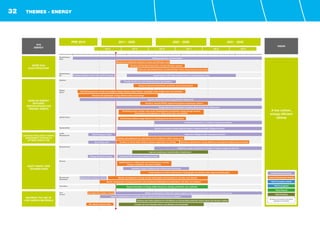
32
INFRASTRUCTURE
33THEFUTURERAILWAY | THE INDUSTRY’S RAIL TECHNICAL STRATEGY 2012
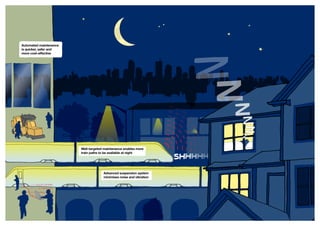
Automated maintenance
is quicker, safer and
more cost-effective
Well-targeted maintenance enables more
train paths to be available at night
Advanced suspension system
minimises noise and vibration
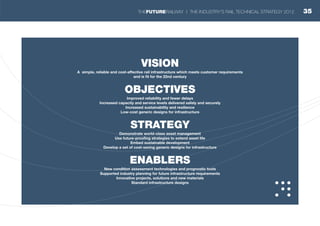
VISION
A simple, reliable and cost-effective rail infrastructure which meets customer requirements
and is fit for the 22nd century
OBJECTIVES
Improved reliability and fewer delays
Increased capacity and service levels delivered safely and securely
Increased sustainability and resilience
Low-cost generic designs for infrastructure
STRATEGY
Demonstrate world-class asset management
Use future-proofing strategies to extend asset life
Embed sustainable development
Develop a set of cost-saving generic designs for infrastructure
ENABLERS
New condition assessment technologies and prognostic tools
Supported industry planning for future infrastructure requirements
Innovative projects, solutions and new materials
Standard infrastructure designs
35THEFUTURERAILWAY | THE INDUSTRY’S RAIL TECHNICAL STRATEGY 2012
CONTEXT
2.45	 Infrastructure accounts for approximately one-third of the railway’s
operating costs. In 2009/10, £1bn was spent on renewals, £2bn on
maintenance and £1bn on enhancements within a total of £12bn.
Network Rail (NR), where the largest portion of costs lie, has been
lowering costs since 2007 and aims to cut a further £2bn against a
background of rapidly increasing passenger numbers. Proposals for
this are included in the Initial Industry Plan (IIP) for CP5 which ends in
2019.
2.46	 Most track maintenance is periodic preventive maintenance based on
long-established rules and augmented by ad hoc intervention when
faults occur. Traffic requirements demand that most of this labour-
intensive work is carried out at night generally by low-skilled staff under
pressure. These staff are the most ‘at risk’ on the railway.
2.47	 Unplanned maintenance has high costs. Research9
has estimated that
reducing this type of maintenance can save up to £130m/year.
2.48	 As passenger volumes increase, some stations are nearing maximum
capacity. For example, East Croydon will be too overcrowded by 2020
to function successfully without intervention. Passenger numbers are
rising at an average of around 3% per year. To cater for further modal
change, the industry needs to accommodate more passengers without
necessarily increasing station sizes. Research10
has identified an extra
10% handling capacity through gate-line, ticketing and information
solutions at stations. This would extend the capacity of stations without
the need for larger space and could save in the region of £140m/year.
Further changes to station design and operation would be needed to
cope with more intensive train service patterns.
VISION
2.49	 Asset management is world-class. Lean methodologies have
streamlined maintenance cycles and automated machines carry out
routine activities. High-speed tamping and other processes have
reduced maintenance requirements further. Progressively short-cycle
maintenance operations have been introduced between service trains.
Asset failures seldom occur and track availability is rarely impeded.
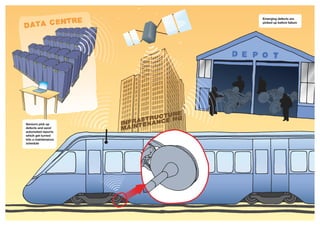
2.50	 Intelligent maintenance based on trainborne inspection provides
accurate, timely information for condition-based intervention and
reduces the need for workers to be on or about the operating railway.
2.51	 Network resilience and integrity are high as tolerance of adverse
conditions is designed at inception. Natural hazards and unforeseen
occurrences cause minimal disruption.
2.52	 Low carbon materials and processes are used without impeding
performance, cost or safety. Environmental factors such as vibration
and noise are included at the design stage.
2.53	 Generic designs are used for cost-efficient, holistic infrastructure
layouts. Train suspension characteristics are included in track designs
INFRASTRUCTURE
9
RSSB T935 Making the case for a whole-system strategic approach to reliability improvement, July 2011
10
RSSB T916 Research into station design and crowd management, April 2012
36
to minimise damage on train/infrastructure interfaces and optimise
system-level costs.
2.54	 Infrastructure and signalling systems increase network availability for
freight and facilitate the fast introduction of new connections to meet
the changing freight business requirements as more traffic switches
to rail. Freight terminal designs are future-proofed, for example,
by incorporating automated cargo handling, 1500m sidings, fast
connections to main lines and electrification of freight routes. Gauge
clearances to W10/12 are available on more routes and Continental
Gauge is introduced where there is a business case for increasing
intermodal traffic.
2.55	 In the longer term, signalling systems use nanotechnology to become
self-healing and have the capabilities to remedy some of their own
defects. Infrastructure is designed with provision for integrated power
systems and communications and to sense and report on its condition.
As train designs become more sophisticated and market needs
change, infrastructure can accommodate increasingly demanding
operational requirements.
OBJECTIVES
2.56	 Preventive and predictive maintenance techniques are deployed
to avoid limitations to track availability. More diversionary routes
bring greater redundancy to the network. Reliability is improved and
passengers rarely experience delays or disruptions.
2.57	 Intelligent asset management maximises the operational benefits at
minimal cost through automation, the knowledge to predict intervention
needs and the use of intelligent maintenance techniques.
2.58	 New designs of switches and crossings reduce failures to negligible
levels and reduce the costs and disruptions associated with
maintenance interventions.
2.59	 New assets are future-proofed to support increased capacity and
service delivery requirements. Life-cycle analysis is applied to existing
infrastructure assets to evaluate the costs for maintenance, inspection
and support in comparison to the cost of replacement.
2.60	 Platforms, train doors, train positioning and escalator siting are
synchronised to help passengers transit busy stations. Full advantage
is taken of e-business transactions to minimise the need for traditional
ticket offices and barriers.
2.61	 The infrastructure is resilient to degradation from climate change
and extreme weather conditions. Measures for noise reduction,
vibration and low carbon construction processes have increased the
sustainability of the infrastructure.
2.62	 Innovative track designs combine the maintainability and initial low
cost of traditional ballasted track with the stability of slab track. Better
geometry, reduced tamping and improved longevity combine to
minimise long-term costs.
2.63	 A suite of standard designs is created for 80-90% of infrastructure
assets. Low-cost bespoke designs are created for the remaining 10-
20%. Electronic systems are equipped with standard interfaces for
easy replacement and technologies with short life-spans have proactive
life-cycle management. Whole-life savings offset possible higher capital
costs.
37THEFUTURERAILWAY | THE INDUSTRY’S RAIL TECHNICAL STRATEGY 2012
THEMES - INFRASTRUCTURE
STRATEGY
2.64	 Asset management capability should continue to be developed to
achieve world-class standards. Specific actions should include:
•	 Compile and maintain a single industry-wide infrastructure asset
register
•	 Improve the understanding of life-cycle costs and degradation to
move towards fewer inspections and reduce intervention times
•	 Apply in-depth theoretical modelling to give accurate predictions of
the minimum life or failure of assets to make more efficient ‘maintain
or renew’ decisions
•	 Optimise deployment and site management to target the tamping
workload better
•	 Improve location accuracy of defects and fault-finding for quicker
problem resolution
•	 Improve the identification of problem sources rather than the
symptoms, for example, an extensive sleeper re-padding
programme prevents much more expensive damage to rail assets
•	 Maintenance of telecoms, electrification and plant assets is part of
the risk-based inspection and servicing regimes
2.65	 To create a sustainable infrastructure, design criteria for assets
should include a whole-system approach for track and train interfaces
and long-term use. Modest increases to capital costs for new or
replacement infrastructure could be offset by significant through-life
savings.
2.66	 Research into vibration, noise reduction and low carbon construction
processes should be carried out to minimise the impacts of new and
current lines on the surroundings and the environment. Buildings
should be designed environmentally for reuse to reduce the impact
of embedded carbon. Materials that function in normal operating
conditions with only visual inspections should be investigated and
promoted.
2.67	 New and more effective ways of delivering standard designs of
infrastructure, including modular designs for bridges, could reduce
project timescales and costs. A range of innovative station buildings
based on common design parameters could be scaled or expanded
to allow for growth in passenger numbers. Consistent materials
and layouts across the network would simplify planning authorities’
acceptance.
ENABLERS
2.68	 Industry-sponsored research provides a clear impetus for using remote
condition monitoring (RCM) across the railway to save significant costs
and improve performance. Recommendations include:
•	 Adopt international RCM standards across the rail industry
•	 Integrate existing and isolated RCM models and practices
•	 Integrate RCM with business modelling for whole-life cost estimates
•	 Use infrastructure fixed points to monitor rolling stock and use
rolling stock to monitor fixed infrastructure
2.69	 The development of intelligent infrastructure maintenance offers the
prospect that automated systems could carry out routine maintenance
checks in areas where trains would have to be stopped for manual
checks. Automation could also be used for other repetitive tasks, for
example track relaying, ballast renewal, tamping and alignment.
38
2.70	 Every few months, an ultrasonic train unit analyses all the track in the
country and identifies potential rail defects, which then need to be
verified by a trained ultrasonic tester. Defect verification carried out by
remote sensors could remove the safety risk and reduce the chance of
human error.
2.71	 The introduction of Non Destructive Testing (NDT) is vital for proactive
maintenance. Using service trains – both passenger and freight – to
monitor the infrastructure could offer a huge opportunity.
2.72	 Europe-wide research through the EC Framework Programmes
and initiatives such as Shift2Rail will examine new infrastructure
technologies. This will include new track forms, switches and crossings
and their potential for commercial development and introduction and
consideration of the interfaces between infrastructure and trains,
energy and more.
2.73	 Coordinated planning for infrastructure, rolling stock and a wider
operational strategy is needed to prepare the infrastructure
requirements to accommodate traffic growth.
2.74	 For new infrastructure, there is a need for modelling tools to analyse
whole-life, whole-system energy and carbon impacts. The application
of new materials and construction techniques could offer significant
improvements in infrastructure performance as well as delivering
reductions in cost and embedded carbon.
2.75	 Track 21 is a project to improve understanding of the complex
mechanisms of railway track governing stiffness, robustness,
longevity and noise and vibration performance. This could optimise
track performance in terms of engineering, the environment and the
economy.
2.76	 A specific example of the work covered in Track 21 is tampless track.
Tamping causes damage to the ballast and surrounding infrastructure
and having to tamp the track to restore ideal geometry can be costly
and time-consuming. Ballast that requires little or no tamping will help
to drive down costs.
2.77	 Understanding the condition of substructure is vital for maintaining
good track geometry. Techniques such as better ground-penetrating
radar and stiffness measurements will provide the best information
for remediation of embankments and cuttings and for determining
the most suitable type of track - ballast or slab. Work is underway to
improve the understanding of slab and ballasted track and the potential
benefits of each will be essential to run the network in the most efficient
manner. Better track geometry and drainage will increase resilience to
flooding.
2.78	 The development of new premium steels offers exciting prospects to
reduce maintenance costs. As more of these materials are produced,
the industry needs to understand the benefits and costs to make
informed decisions for the future infrastructure capability.
2.79	 The use of plastics and composite materials on the railway, for example
for sleepers and fastening systems, will help lower carbon emissions
and reduce asset management activities.
2.80	 Replacing bespoke infrastructure designs with modular systems
and fast-change components will facilitate the introduction of more
automated maintenance.
39THEFUTURERAILWAY | THE INDUSTRY’S RAIL TECHNICAL STRATEGY 2012
THEMES - INFRASTRUCTURE
2.81	 The range of modular station buildings currently being trialled in
Coulsdon South and Uckfield stations will provide useful lessons for
further implementation of modular buildings.
2.82	 Right-sizing existing infrastructure and new designs could reduce
initial costs. Preferential over-engineering for buildings, signalling,
electrification and plant, telecoms and track, should be avoided.
Redundant assets could be removed.
2.83	 The Shift2Rail Joint Technology Initiative aims to provide a Europe-wide
focus for the development of infrastructure.
40
Asset
Management
Infrastructure
Reliability
Design
Criteria
Remote
Condition
Monitoring
Infrastructure
Stations
Environment
Carbon
Designs
DEMONSTRATE
WORLD-CLASS ASSET
MANAGEMENT
RTS
INFRASTRUCTURE
VISION
A simple, reliable
and cost effective
rail infrastructure
which meets
customer
requirements and
is fit for the 22nd
Century
PRE 2010 2011 - 2020
CP 4 CP 5 CP 6 CP 7 CP 8 CP 9
2021 - 2030 2031 - 2040
USE FUTURE-PROOFING
STRATEGIES TO EXTEND
ASSET LIFE
EMBED SUSTAINABLE
DEVELOPMENT
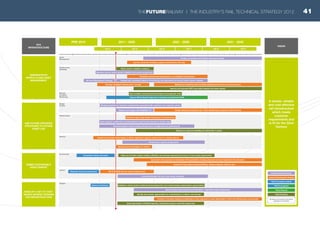
DEVELOP A SET OF COST-
SAVING GENERIC DESIGNS
FOR INFRASTRUCTURE
Intellige
Industry Delivery Activity
Business case for whole system reliability improvement programme
NR Asset Management strategy Phased and coordinated delivery of technology and approaches to improve whole system reliability
Industry Development Activity
TSLG Completed activity
Sustainable railway principles
Materials research programmes
System Architecture TSLG In progress
TSLG Planned
TSLG Potential
Whole system reliability modelling
Improve and automate NDT, associated analysis and asset upkeep
New condition assessment technologies and prognostic tools
Research to improve reliability and extend life of assets
All dates and durations should be
regarded as indicative
Produce & maintain and Industry wide asset register
Improve whole life modelling, analysis and predictive tool-sets
Reliability improvement programmes, e.g. intelligent infrastructure
Develop ‘intelligent infrastructure’ concept Methods of monitoring and recording reliability performance over the long term
Support Whole System Approach to develop and implement RCM
Strategic guidance on long term requirements associated with customer, cost, capacity, carbon
Support and engage with Shift2Rail JTI Design criteria for long term use - fit for infrastructure purpose to 22nd Century
Introduce right-sizing design techniques for infrastructure
Asset upgrade, modification and development requirements imposed at design stage
Renewal projects aimed at aiding infrastructure management and optimising life
Identify and evaluate technologies to deliver significant capacity enhancement to existing stations
Infrastructure upgrade programmes
Promote/subsidise the use of low carbon materials
Develop new technologies for stations
Systematic and organised consideration of the potential to employ advanced and new materials in the rail sector
Implement Track improvements (stiffness, ballast, longevity, material, etc.)
Influence incentive regime, industry attitudes, procurement approaches to focus on cost saving opportunities
Establish a whole system architectural description (for use in determining modularisation opportunities)
NR & EU R&D into low carbon infrastructure
Adopt industry-wide practices and standards - regarding modular approaches
Identify and evaluate opportunities for modularisation to deliver cost savings
Inclusion of modular designs/consideration of new approach to asset optimisation in fleet and infrastructure procurement
Asset optimisation: COTS/rail specific, standard/innovative, whole life/capital cost
41THEFUTURERAILWAY | THE INDUSTRY’S RAIL TECHNICAL STRATEGY 2012
42
ROLLING STOCK
43THEFUTURERAILWAY | THE INDUSTRY’S RAIL TECHNICAL STRATEGY 2012
Sensors pick up
defects and send
automated reports
which get turned
into a maintenance
schedule
Emerging defects are
picked up before failure
VISION
Mass- and energy-efficient, low whole-life cost rolling stock meets the evolving needs of its customers
OBJECTIVES
Rolling stock designed, built and operated to minimise whole-life, whole-system costs
Continuous improvement of rolling stock mass, energy and carbon efficiency
Optimised rolling stock interface with infrastructure systems
Rolling stock better adapted to meet passenger and freight requirements
STRATEGY
Continue to adopt and adapt new technologies for cost and operational improvements
Develop a range of appropriate alternative traction power sources
Produce standard architectures for rolling stock sub-systems
Improve the operational capabilities of freight rolling stock
ENABLERS
Improved sub-systems
Open interface standards to facilitate plug-and-play technologies
Guidance documents – Key Technical Requirements for Rolling Stock
Shift2Rail Joint Technology Initiative
Cross-interface remote condition monitoring
45THEFUTURERAILWAY | THE INDUSTRY’S RAIL TECHNICAL STRATEGY 2012
CONTEXT
2.84	 The maintenance and financing of rolling stock in the UK is valued at
£1.8bn/year, approximately 15% of the total railway operating cost11
.
The passenger fleet consists of 64 classes with 12,000 vehicles and
an average age of 17.3 years12
. The purchase of rolling stock for
Thameslink, Crossrail and the Inter City Express Programme (IEP) is
likely to reduce the overall average age of rolling stock and will increase
carrying capacity markedly.
2.85	 The supply chain for rolling stock is international, with the UK a
relatively small part of the market for major manufacturers. This
strategy assumes that train operators work in conjunction with rolling
stock asset owners. Train operators, who understand their markets,
will specify requirements and suppliers will deliver product and service
solutions from their portfolios. To promote system optimisation, TSLG
can support the development for a better understanding of interface
issues and the introduction of appropriate market incentives into
technical requirements, franchise agreements and other commercial
contracts.
2.86	 The continuing success of rail freight, up by more than half over two
decades, risks being trammelled by technical limitations. Freight
rolling stock is designed for and operated on, standard 60 and 75 mph
services, which are increasingly out-of-step with line speeds on mixed
traffic routes. Poor acceleration and deceleration causes freight trains
to be held back on loop lines, waiting for paths that will not interfere
with faster traffic.
VISION
2.87	 Rolling stock is mass- and energy-efficient and engineered for flexible
use under a range of operating concepts, including approaches such
as train convoying. Whole-life costs are reduced continuously through
the rapid introduction of new technologies that improve reliability and
operation.
2.88	 Optimising at a whole-system level, rolling stock design takes account
of the interfaces with infrastructure. Standardised sub-system
interfaces contribute to improved cross-system efficiency.
2.89	 Efficient drive-trains are powered by a range of sources with associated
energy recovery systems, which allow locomotives and multiple
units to operate on and off the electrified network. Adhesion-aware
braking systems have been introduced and contribute to reduced train
headways and increased network capacity.
2.90	 A new generation of freight rolling stock is designed to optimise the
gauge and allows more freight trains to operate compatibly with
intensive passenger train operation.
2.91	 Comfortable and attractive train interiors create a more satisfying
environment for passengers. Cabin layouts make the best use of
available gauge and the capabilities of new materials.
ROLLING STOCK
11
Rail Value for Money study, 2010/2011
12
National Rail Trends Yearbook, 2010/2011
46
OBJECTIVES
2.92	 Rolling stock is designed to meet business requirements and takes
account of the whole-life cycle. Standard system architectures have
flexible designs for cost-effective upgrades and fewer maintenance
processes. Couplings, train control and onboard systems support
diverse operating approaches such as train convoying.
2.93	 Rolling stock design and operation is improved continuously, for
example:
•	 Mass efficiency balances strength, safety and capacity
•	 Energy for traction and recovered from braking systems is optimised
continuously
•	 Energy losses from other systems are minimised
•	 Upgradeable rolling stock designs encourage the use of new low
carbon materials and processes
2.94	 A whole-system approach, which optimises the interfaces between
rolling stock and other systems, reduces track wear, suspension
and body fatigue, improves condition monitoring and minimises
environmental impacts such as noise, vibration and waste disposal.
2.95	 New vehicle interior layouts reflect changing patterns of demand and
passenger demographics. The interiors are optimised for purpose, such
as fast boarding and alighting for commuters, or comfort and facilities
for long-distance high-speed or rural trains. New materials are used to
reduce mass and increase durability and attractiveness.
STRATEGY
2.96	 The adoption and adaptation of new technologies, processes and tools
should continue to optimise whole-system, whole-life performance, for
example:
•	 Components and sub-systems would be designed to meet
performance objectives
•	 The ability to upgrade vehicles through their life would be developed
to improve mass and energy efficiency
•	 Reliability, availability and maintainability would be improved
2.97	 Good links with developments in materials science should be
maintained, for example through the Transport Systems Catapult and
evaluation should be sponsored to understand how new materials can
be adapted for rolling stock use.
2.98	 In collaboration with the supply chain, rolling stock drive trains should
be developed with multi, dual or hybrid energy sources that are capable
of working on or off electrified parts of the railway. This work should
include:
•	 Low or zero carbon fuels
•	 Stored energy
•	 Multi-fuel engines
•	 An active, constant watch and assessment of traction solutions and
hybrid engines from around the world
47THEFUTURERAILWAY | THE INDUSTRY’S RAIL TECHNICAL STRATEGY 2012
2.99	 Diesel engine efficiency and lifespan should be improved to
maximise the life of current diesel-powered rolling stock. Adjacent
diesel technology, especially marine, should be assessed for the
transferability of developing technologies.
2.100	 Modular build using standard designs could further reduce costs.
The European project MODTRAIN identified a 15% cost reduction
for manufacturing and a drastically reduced number of parts on
standardised components.
2.101	 A vehicle-based functional architecture should be produced and
maintained. This should be supported by appropriate common sub-
system architectures and open interface standards for hardware and
software that promote the development of modular approaches to
system design, development, upgrade and maintenance.
2.102	 Work should be undertaken with freight operators to specify the next
generation of freight rolling stock.
ENABLERS
2.103	 The overall efficiency and effectiveness of rolling stock will be delivered
increasingly through progressive improvements in sub-systems,
including:
•	 Mechatronic bogies
•	 Adaptive braking systems
•	 Improved passenger compartments
•	 Integrated diagnostic systems
2.104	 Innovative bogies designs could minimise track impact and wear while
extending the operating range of trains and reducing track access
charges and energy use.
2.105	 Matching braking forces with adhesion and speed while maximising
energy recovery may be achieved through using a combination of
braking systems such as pneumatic, magnetic and eddy current13
.
2.106	 New materials may allow thinner, thermally-efficient passenger
compartment ‘skins’ to reduce weight and energy loss.
2.107	 Technical Specifications for Interoperability (TSI) and other standards
and guidelines for the development and qualification of railway systems
are being developed, updated and consolidated. This, coupled with
work by the Enabling Innovation Team (EIT) to present common sub-
system architectures, will promote the development of efficient plug-
and-play equipment and sub-systems.
13
RSSB T860 Benefits of all-electric braking (in progress)
THEMES - ROLLING STOCK48
2.108	 Key Technical Requirements for Rolling Stock, an ATOC publication,
assists procurers of new rolling stock by providing guidance on key
requirements under a range of headings: technical, performance,
passenger-facing, driver-facing and communications/diagnostics.
2.109	 The Shift2Rail Joint Technology Initiative aims to provide a Europe-
wide focus for the development of rolling stock.
2.110	 A cross-industry commercial and technical framework needs to be
established to allow asset condition data to be shared and exploited
across all infrastructure and rolling stock asset types. This could
improve asset performance and reduce asset maintenance costs.
2.111	 Deployment of RCM technology and associated analytical toolsets
improves rolling stock reliability and maintainability. This would lead to
increased availability, which would reduce cost and capture potential
revenue. Cross-interface RCM (XIRCM)14
has identified significant
savings by associating train and infrastructure RCM – trains monitor
infrastructure and vice-versa.
14
RSSB T1010 Cross-interface Remote Condition Monitoring Programme (in progress)
49THEFUTURERAILWAY | THE INDUSTRY’S RAIL TECHNICAL STRATEGY 2012
THEMES - ROLLING STOCK
New
Technologies
New
Processes
New Tools
Rolling Stock
Sub-systems
Traction
Power
General
Trains
Sub-Systems
Freight
Rolling
Stock
CONTINUE TO ADOPT
AND ADAPT NEW
TECHNOLOGIES
THAT PROVIDE COST
AND OPERATIONAL
IMPROVEMENTS
DEVELOP A RANGE
OF APPROPRIATE
ALTERNATIVE TRACTION
POWER SOURCES
RTS
ROLLING STOCK
VISION
Mass and energy
efficient, low whole-
life cost rolling
stock meets the
evolving needs of its
customers
PRE 2010 2011 - 2020
CP 4 CP 5 CP 6 CP 7 CP 8 CP 9
2021 - 2030 2031 - 2040
IMPROVE THE
OPERATIONAL
CAPABILITIES OF FREIGHT
ROLLING STOCK
PRODUCE STANDARD
ARCHITECTURES FOR
ROLLING STOCK SUB-
SYSTEMS
Intellige
Industry Delivery Activity
LOC, PAS, PRM, RST TSIs
RST TSI (High Speed)
EU MODTRAIN Project
WAG TSI
Determine and advise on use of open standards within the rail industry
Support & engage with ‘Shift2Rail Joint Technology Initiative
Industry Development Activity
Catapult to evaluate new technologies
TSLG Completed activity
TSLG In progress
TSLG Planned
TSLG Potential
Evaluate, develop and apply adhesion-independent & other braking technologies
Agreed on-board systems architecture (including definitions and interfaces)
Develop whole system modelling to examine interactions
Advance modelling techniques
All dates and durations should be
regarded as indicative
Maintain technology watch
Deploy new remote condition monitoring technologies
DRACAS Development
Employ Remote Condition Monitoring on rolling stock
Mechatronic bogies - identification and development of applications with a business case
Energy efficient drive systems
Improve passenger train interior designs for comfort, access, durability
Multi, dual & hybrid traction drives
Monitor and evaluate new fuels
Active monitoring of traction solutions and hybrid engines being/employed around the world
Cross industry RCM Group
Improve diesel engine efficiency and life
Design criteria for versatile passenger rolling stock
Design criteria for versatile freight rolling stock
Promote right-mass train design
Improve overall operational capability of freight trains & wagons
Produce freight specific system requirements
Improve freight trains and locomotive performance (speed, acceleration, braking)
50
INFORMATION
51THEFUTURERAILWAY | THE INDUSTRY’S RAIL TECHNICAL STRATEGY 2012
VISION
Information is a valued rail asset that improves customer services, reduces operating costs and gener-
ates revenue
OBJECTIVES
New revenue streams from the exploitation of rail information
Improved customer services
Reduced operating costs
STRATEGY
Define common information architectures and protocols
Produce an optimised cross-industry information flow model
Exploit rail information through commercial partnerships
ENABLERS
National Information Systems Catalogue (NISC)
Open architectural standards
Data management
Resilient systems
52
15
RSSB Project T962 Information systems architecture for the rail industry, an initial overview, September 2011
16
ibid
17
TSIs Telematics applications for passengers and freight (TSI TAP and TSI TAF); also the InteGRail project
2.112	 Excluding Network Rail’s own information systems, research15
discovered over 130 information systems maintained by approximately
20 suppliers were in operation in 2011. Maintaining individual legacy
systems is expensive and inefficient. Information cannot be shared
or exploited efficiently and this inhibits whole-system approaches for
technology-based improvements.
2.113	 The EU project InteGRail identified that integrated systems using
common standards can improve whole-system reliability by up to 50%
by optimising maintenance and the cost of maintenance could be
reduced by 10%, amongst other benefits.
2.114	 To improve efficiency, mitigate costs and identify opportunities for
better use of the vast amounts of collected data, the rail industry would
benefit from a coordinated approach towards system architectures,
information management and information exploitation. An initial study
to understand the current information make-up of the sector and
catalogue and map the industry’s information systems is underway16
.
VISION
2.115	 The businesses in the industry are information-rich and use that
information effectively to enhance and drive decision-making
processes. Advanced and appropriate decision support tools are in
place and in use on a daily basis.
2.116	 The industry realises the value of its data for customer and internal
purposes and improves its costs, attractiveness and performance as a
consequence.
2.117	 The businesses make use of externally and internally generated
information sources and support customers’ preferred devices.
2.118	 Rail businesses are capable of integrating a variety of information
sources to produce new information and adapt their business
strategies.
2.119	 Information systems are built for expansion and easy replacement of
outmoded parts. Costs are minimised through the use of commercial
off-the-shelf (COTS) programmes and uniform testing and acceptance
procedures. Agreed architectural standards, protocols and service level
agreements support connectivity, improve the capability to share the
information resources and facilitate a whole-system approach.
2.120	 European standards17
have harmonised procedures, facilitating
information exchange between railway computer systems across
Europe and opening opportunities to explore new revenue streams.
2.121	 The improved information systems and management allow the rail
industry to exploit its data catalogues and build strategic partnerships
to provide customers with personalised information and services that
correspond to their individual needs.
INFORMATION
53THEFUTURERAILWAY | THE INDUSTRY’S RAIL TECHNICAL STRATEGY 2012
OBJECTIVES
2.122	 The value of information gathered in the rail sector is recognised and
exploited as new revenue streams are identified.
2.123	 Rail businesses collaborate to make the best use of information
sources. New business models are developed to exploit data. Vendors
are able to develop applications and services to generate income and
improve customer services.
2.124	 Information-sharing and exploitation to reduce costs, including
transaction costs such as ticketing, are facilitated by common
architectures, protocols and dictionaries. Duplication of effort and
information is avoided. Bespoke products are replaced with lower
cost COTS technologies and applications, which are also more cost-
effective to maintain.
STRATEGY
2.125	 Common architectures and protocols would facilitate integration and
information-sharing. Costs would be lowered and services improved. A
suite of common and open standards would allow COTS products and
services to be implemented with fewer specific industry modifications.
Suppliers would be encouraged to invest in developing new systems
as the marketplace becomes effectively larger. A common information
framework would allow the industry to benefit from new technologies
more quickly and efficiently.
2.126	 To facilitate the development of common architectures, existing data
and information flows need to be mapped to create a cross-industry
information flow model. The key requirements to create and maintain a
future dynamic architecture are:
•	 Agreed information systems architecture and standards
•	 Common ontology and data dictionaries
•	 Security classifications for data
•	 Storage requirements
•	 Agreed suites of data types, for example asset and rolling stock
data
2.127	 Commercial partnerships would focus on mutual benefits and shared
opportunities and risks. The Innovation section describes opportunities
for innovators and commercial developers to exploit railway data and
create new revenue streams.
ENABLERS
2.128	 Completing the National Information Systems Catalogue (NISC),
started by TSLG, provides an important baseline. The NISC will help
the industry to understand and analyse current railway data and
architectures as the basis for a new holistic architecture and a whole-
system approach to data and information management. The analysis
will identify duplication and gaps and facilitate solutions for integrating
new systems into the existing architecture.
THEMES - INFORMATION54
2.129	 The common standards proposed in InteGRail and the TSIs Telematics
applications for passenger services (TAP) and Telematics applications
for freight (TAF) would support European interoperability as well as
provide useful guidelines for the development of open architectures for
the rail sector in Britain.
2.130	 Coherent management policies, protocols and clear identification of
data owners are needed to support a whole-system approach and
maximise the benefits of data sharing, analysis and exploitation.
2.131	 All information systems must be resilient to cyber-attacks and
appropriate protective measures based on risk assessment must be
built into the systems within the common framework.
55THEFUTURERAILWAY | THE INDUSTRY’S RAIL TECHNICAL STRATEGY 2012
Information
System
Architecture
(Design)
Information
System
Architecture
(Delivery)
Information
Security
Information
Resilience
Information
Management
Information
Exploitation
Information
Innovation
DEFINE COMMON
INFORMATION
ARCHITECTURES AND
PROTOCOLS
PRODUCE AN
OPTIMISED CROSS-RAIL
INFORMATION FLOW
MODEL
RTS
INFORMATION
VISION
Information is a
valued asset that
improves customer
services, reduces
operating costs and
generates revenue
PRE 2010 2011 - 2020
CP 4 CP 5 CP 6 CP 7 CP 8 CP 9
2021 - 2030 2031 - 2040
EXPLOIT RAIL
INFORMATION
THROUGH COMMERCIAL
PARTNERSHIPS
Intellige
Industry Delivery Activity
EU TAF TSI, IntegGrail, RS RIS
ORBIS
Date management strategy covering protocols, standards, architecture, common data requirements, business conditions etc.
Industry Development Activity
TSLG Completed activity
Rolling Stock Information
System research (T962)
TSLG In progress
Active and open Information innovation culture
Attract innovation
Map current data architecture and
complete NISC
Produce a rail sector ‘whole system’ information architecture
TSLG Planned
Define future data architecture using open architectural standards
TSLG Potential
Instigate of rail sector information data standards
Undertake information systems benchmarking exercises
Produce and implement data architecture transformation plan (Migration plan)
Common data set structures (data dictionaries and ontologies
Develop range of data and information exploitations business cases
Attract information exploitation partners
Strategic partnerships with data and information domain experts
Establish the value of data and information
Publish sector common data and
information standards
Data and information storage requirements: capacity and endurance
Progressive introduction of federated data and information systems
All dates and durations should be
regarded as indicative
Rail sector and supply chain adapt and adopt COTS information technologies in support of operational communications, traffic management, asset management, sensors storage etc
Establish cyber security architecture
Determine security classifications for data
Improve the resilience of information systems
Rail data and information requirements for operations, asset management
THEMES - INFORMATION56
CUSTOMER EXPERIENCE
57THEFUTURERAILWAY | THE INDUSTRY’S RAIL TECHNICAL STRATEGY 2012
WiFi WiFi WiFi
Phone
PhonePhone
Mobile communications
gateway prioritises data
transmission for
multi-media services
The trains have downloaded
bulk data from the previous
station using WiFi Max
Customers receive real-time updates,
tailored to their specific journey
Communications are
supported for video/
surveillance/CCTV and driver,
crew, operator and maintainer
oriented services Safety-related control
data prioritised over
customer infotainment
On-train communication network selector
decides optimum data transmission, e.g.
3G, 4G, LTE, satellite to support laptops,
mobile phones, iPhones, tablets, iPads, etc.
On board multi-media
systems and telematics
VISION
Rail is customers’ preferred form of transport for reliability, ease-of-use and perceived value
OBJECTIVES
Continuous improvement of customer satisfaction
Seamless journeys
Accurate and timely information
Freight customers have a competitive advantage
STRATEGY
Improve the door-to-door journey experience
Improve customer access
Control health, safety and security risks
Provide information to distribution channels
Integrate rail and freight customer information systems
ENABLERS
Customer information systems
Demographics and behavioural modelling
Contactless ticketing technologies
Sensor technology
IT solutions for freight system integration
59THEFUTURERAILWAY | THE INDUSTRY’S RAIL TECHNICAL STRATEGY 2012
CONTEXT
2.132	 Passenger journeys have almost doubled to approximately 1.5bn in
the 15 years to 2011/12 and are expected to continue to increase.
Similarly, passenger demands of value for money, comfort and facilities
are expected to rise.
2.133	 Freight use of rail has also increased significantly over the same period
by approximately 50% by tonne-miles although rather less in terms of
tonnes lifted and unevenly among commodities. Parallel to passenger
expectations, freight shippers expect ever higher levels of service
quality and reliability and greater integration of rail services within their
overall logistics.
2.134	 Responses to the 2010 RTS consultation document suggest wide
support for the rail industry to address the 4C challenge of raising
passenger satisfaction to the highest possible levels by 2037. As a first
step the IIP for CP5 set a target of at least 90% customer satisfaction
to be achieved by 2019.
2.135	 RTS 2012 is ultimately for the customers’ benefit, addressing customer
requirements such as punctuality, reliability and higher network and
passenger capacity through system improvements. This section covers
aspects which contribute to the overall customer experience.
VISION
2.136	 Rail is the preferred form of transport for passengers and freight
customers. Every customer can rely on excellent service provision
that is consistently punctual, reliable and good value and offers easy
interchanges with other forms of transport.
2.137	 Rail offers personalised, convenient yet mass transit-based services
that meet customers’ needs. Information about journeys, related travel
and other added-value services are readily available and customer-
focused staff are helpful at all times.
2.138	 Passengers arriving, departing and changing trains have smooth
transitions through stations. Clearly defined and spatially efficient
routes maximise throughputs and minimise delays.
OBJECTIVES
2.139	 All rail customers, passenger or freight, receive consistently
outstanding levels of service and reliability from rail businesses. The
train-lengthening programme has increased passenger capacity and
real-time traffic management has optimised network capacity. Market
sectors may have different demands but overall, train interior designs
and upgradable facilities will aim to satisfy the needs of customers in all
sectors.
2.140	 Rail services will be fully integrated within the transport system so
that a customer can plan and purchase door-to-door journeys with
confidence. Interchanges, including those with other transport modes,
make transfers easy, comfortable and reliable and timetables are
planned to minimise inconvenience.
2.141	 Improved information technology, management and exploitation and
cross-industry collaboration provide passengers with personalised
services for journey and ticket information, entertainment and
communication services. Station and staff information systems and
personalised messaging help passengers to find the right platform and
carriage to board their train quickly and get a seat, which will also help
CUSTOMER EXPERIENCE
60
to reduce dwell times. During a rare disruption, train operators keep
passengers informed – at home or on the move – and offer alternative
arrangements.
2.142	 The integration of service scheduling, real-time traffic management and
terminals’ management systems with customers’ own systems, allows
the railway to be a fully effective part of the management process for
freight customers. Consignments are tracked throughout the journey
and real-time information is available for consignees. Rescheduling
is easily facilitated if required. Information systems help business
performance reviews. The removal of lineside signalling allows faster
and less expensive planning and implementation of connections for
new freight terminals. These are either bespoke facilities or multi-modal
consolidation centres outside major cities to facilitate environmentally-
friendly urban distribution, as required. Rail freight satisfies an
increasing share of non-traditional markets, in line with European white
paper aspirations.
STRATEGY
2.143	 Door-to-door journeys are typified by seamless modal changes,
with multimodal services available from a single booking. Improved
interchanges between modes are required to reduce overall travel time
and associated risk, with easy-access transport hubs and informative
signage.
2.144	 Stations and trains should continue to improve onsite customer
accessibility and services. Wheelchair users and passengers with
pushchairs or cumbersome luggage should have step-free access to
trains and platforms.
2.145	 Access to information, tickets and best prices should be improved
and simplified. Reading devices for tickets with codes that can be
displayed on mobile devices would be a useful initial solution. Later,
one-stop online shops for all ticketing requirements would simplify
the process and reduce the time a customer spends purchasing
tickets. Paper tickets should be phased out and replaced with a single
smartcard technology that offers interoperability between all transport
modes in the UK and Europe. Reading devices on trains could also be
introduced. Passengers would be offered the best available fare when
boarding and leaving a train without having to purchase a ticket in
advance.
2.146	 Passengers could be kept better informed through intelligent traffic
management systems that identify real-time train location and
distribute this information to passengers. Personal mobile devices
could automatically receive updates about train positions and other
relevant information. Through strategic relationships, technological
advances in the telecoms and entertainment industries could be
exploited to provide rail customers with better information and onboard
entertainment services.
2.147	 Improved relationships between passengers and service providers
could lead to the ability to establish and update passenger profiles
automatically for bespoke services. If journey carbon content is given
at the planning stage and shown in the ticket information, customers
could also make ‘carbon-wise’ choices.
61THEFUTURERAILWAY | THE INDUSTRY’S RAIL TECHNICAL STRATEGY 2012
2.148	 Through information technology (IT) developments, the logistics
industry is making continuous improvements to its operational
efficiency but the rail components of the distribution system have
often been excluded. Overcoming this deficiency would encourage rail
business growth. As railway IT systems are developed, including those
for train positioning, intelligent trains and intelligent infrastructure, there
is a big opportunity to integrate fully with customer systems to provide
a seamless service to the customer and drive costs further out of the
operation.
ENABLERS
2.149	 As far as possible, IT platforms that interact with customers’ existing
technology without compromising the security of railway operating
systems should be developed. Bespoke systems for non-safety critical
information are unnecessary and inconvenient for customers. The

EU’s draft TSI TAP will allow the harmonisation and standardisation of
procedures, data and messages between railway computer systems,
infrastructure managers and ticket vendors to provide reliable
information for passengers.
2.150	 In 30 years, demographic changes will result in a generally older
population. The implications this could have for customer accessibility
and mobility should be considered when designing and operating
public services. Individuals, on average, are also becoming larger.
Demographic modelling of the likely impact of these trends is required
as part of a review of key assumptions in the Passenger Demand
Forecasting Handbook, a business planning reference document used
by industry and government.
2.151	 Technologies for seamless ticketing are progressing. Regional systems
offering intermodal electronic ticketing are in use and expanding. To
counteract the diversity of ticketing systems - over 9,000 in the UK
in March 201218
- initiatives such as the European Interoperable Fare
Management project are providing valuable standardisation for a single
technology framework to improve door-to-door ticketing, including
journeys beyond the UK and for more than one mode of transport.
2.152	 With simpler fare structures, contactless card technology could evolve
to the point where passengers purchase travel by walking past a
sensor by the train doors, or registering the start and finish of a journey.
Evidence of purchase, including a breakdown of ticket price could be
sent automatically to the passenger’s personal mobile device.
2.153	 Countering security threats could benefit from the increased use of
passive electromagnetic, chemical and acoustic sensor technologies.
These technologies would provide a sensor grid which assesses threats
and is monitored automatically. Human interaction is signalled only
when the conditions of defined threat levels have been detected.
18
The next steps for mobile ticketing hardware, in Rail Technology magazine, Feb/Mar 2012.
THEMES - CUSTOMER EXPERIENCE62
2.154	 Finding the most effective and efficient means to align IT with freight
customers’ systems will be complex as there are many freight
customers and many systems. Generic IT platforms would be the
simplest solution for integration but this requires careful assessment
and planning. Collaboration between businesses to examine the
feasibility would be an initial step towards producing heterogeneous
results. Benefits could be derived at local and system levels. Similar to
the TSI TAP, the TSI TAF will harmonise the functional and technical
standards for exchanging information between the parties involved in
rail freight transport.
63THEFUTURERAILWAY | THE INDUSTRY’S RAIL TECHNICAL STRATEGY 2012
THEMES - CUSTOMER EXPERIENCE
Door to Door
Journey
Demographic
Research
Infrastructure Access
Health
And
Safety
Ticketing
Security
Passenger
Information
Freight
Customers
IMPROVE THE END
TO END JOURNEY
EXPERIENCE
IMPROVE CUSTOMER
ACCESS
RTS
CUSTOMER EXPERIENCE
VISION
Rail is customers’
preferred form
of transport for
reliability, ease of
use and perceived
value
PRE 2010 2011 - 2020
CP 4 CP 5 CP 6 CP 7 CP 8 CP 9
2021 - 2030 2031 - 2040
CONTROL HEALTH,
SAFETY AND SECURITY
RISKS
INTEGRATE RAIL AND
FREIGHT CUSTOMER
INFORMATION SYSTEMS
PROVIDE INFORMATION
TO DISTRIBUTION
CHANNELS
Intellige
Industry Delivery Activity
Government direction on security constraints and requirements
Railway as a key part of a (holistic) national and international transport system
Develop one-to-one relationship between customer and providers
PRM TSI Rail system made PRM compatible
Enhance ticketing options and delivery architecture
Develop strategic relationships with other transport providers
Industry Development Activity
Improve transport hubs: efficient movement of passengers and freight between modes
Improve web-based end to end journey booking and information systems
Anti-fraud and information protection technology
Intelligent Traffic management systems feed real time Customer information
Integrate freight scheduling & traffic managementAlign freight IT systems
Real-time cross network consignment tracking
Continue to improve ticketing and information systems for passengers
TSLG Completed activity
TSLG In progress
RSSB continue to provide focus to ensure safe customer environment
TSLG Planned
TSLG Potential
Understand door to door journey through a whole system approach
Demographic research
Determine future customer needs & trends
Intelligent monitoring of passengers for stations and trains
Enhance sensor technology coupled with predictive algorithms
Real time networking and automation (real time analysis) of sensors
Identify and evaluate technologies/approaches to support rail freight integration
Understand the future customer: passenger and freight, preferences, parameters and practices
Passive customer recognition for automated ticketing
All dates and durations should be
regarded as indicative
Deploy contactless technology across the networkCommon smartcard definition
Mandated incident response
TAF TSI
Customer ‘App’ & web services available
Establish relationships with information providers
Use of customer-based technologies (e.g. personal communications) to improve customer experience on the railway
RSSB established
Improve decision making through better information flow
64
WHOLE-SYSTEM
APPROACH
65THEFUTURERAILWAY | THE INDUSTRY’S RAIL TECHNICAL STRATEGY 2012
Specifying assets in a whole-system
context and a whole-life perspective, they
will initially cost more...
...but the components will work well
together, the system will be reliable and
passenger needs fulfilled...
...customers will be impressed
and more will arrive
Train tuned to track,
track tuned to train
Pantagraphs and wires
work in harmony
Sensors send signal
from the track and
train to satellite
...subsystems will be ‘tuned’ to the wider system,
assets last longer, maintainance cheaper, less
downtime, safer and more reliable railway
VISION
A whole-system approach enables the rail industry to implement change easily and improve
reliability, availability, maintainability and safety
OBJECTIVES
An industry-wide framework for a whole-system approach
Coordinated planning, delivery and operations
Integrated asset management techniques
STRATEGY
Adopt a whole-system approach
Improve industry whole-system modelling capability and tools
Develop a set of aligned asset management plans for the railway
ENABLERS
Effective cross-functional and cross-industry communication
Common modelling and planning tools
Common asset information systems
Best practices in whole-systems approaches
67THEFUTURERAILWAY | THE INDUSTRY’S RAIL TECHNICAL STRATEGY 2012
CONTEXT
3.1	 The RTS 2012 whole-system is the rail sector, its assets, organisations,
operations and stakeholders. It is the railway’s people, processes and
systems. The railway has many thousands of assets owned, operated
and maintained by a range of organisations, each with their own
business objectives, priorities, timescales, policies and incentives.
3.2	 The inherited railway was often designed as single sub-systems and
not as a whole. This legacy presents many constraints on service
quality and requires a whole-system approach for a cost-effective and
efficient upgrade.
3.3	 The whole-system engineering challenge has been recognised:
•	 TSLG has been formed to provide technical leadership for the
industry
•	 System Interface Committees (SICs) have been established to
examine and improve performance and cost across sub-system
boundaries
•	 The Rail Delivery Group (RDG) has been established
•	 Industry initiatives for a whole-system approach are increasing, such
as RTS 2012, cross-industry remote condition monitoring (XIRCM),
cross-industry information systems (XIIS) and whole-life and cost
asset management.
•	 The RUS process supports planning on a whole-industry basis (eg
Network RUS: Passenger Rolling stock)
VISION
3.4	 The rail industry adapts easily to change and implements innovative
new designs and methods using a whole-system approach.
3.5	 The industry’s embedded whole-system approach has increased
reliability, availability and safety at reduced cost and is easier to
maintain. Advanced signalling and traffic control systems have reduced
the likelihood of train collisions and a whole-system approach has
reduced the rolling stock collision requirements and saved train weight,
cost and energy consumption.
3.6	 Cross-industry coordination of the design and development of sub-
systems and components reduces duplication and minimises negative
cross-system impacts.
3.7	 Improved remote asset monitoring, including RCM and fewer asset
failures increases the reliability of infrastructure and rolling stock.
Across the industry, updated maintenance policies and tested
contingency plans result in customers rarely experiencing disruption.
OBJECTIVES
3.8	 A whole-system framework has been established within which
suppliers can develop products with confidence to meet the industry’s
requirements. Cross-industry strategic planning allows new solutions to
be developed and implemented easily. The diverse planning horizons
within the industry are aligned to deliver whole-system, whole-life
solutions.
WHOLE-SYSTEM APPROACH
68
3.9	 Greater collaboration within the industry fosters coordinated planning
and operations which has led to increased levels of reliability and
resilience. Customer satisfaction is raised through the improved service
levels.
3.10	 Asset management is aligned across the industry. Excellent
asset knowledge and evidence-based decision-making improves
performance at lower cost and with less business risk.
STRATEGY
3.11	 A cross-industry, whole-system approach to design, maintenance,
delivery and safe operation should be adopted. A holistic
understanding of the railway is needed to identify risk factors during
design stages to allow for any necessary adjustments. This approach
would avoid duplication of effort, reduce negative impacts and simplify
the introduction of new components and processes.
3.12	 Effective whole-system planning requires models suitable for industry,
innovators, academia, suppliers and investors. These models could be
used to understand the impact of changes to the whole system and
support whole-system research and development by:
•	 Using a virtual design and development environment
•	 Defining requirements, especially across sub-system boundaries
•	 Analysing priorities between competing options
•	 Testing resilience
•	 Optimising the system
3.13	 Life-cycle costing tools would optimise decision-making processes
for maintenance and renewal. The tools should be able to model a
variety of options, including the impact on services, passengers and
technicians, to provide comprehensive assessments for work volumes,
costs and outputs.
3.14	 The industry should collaborate to develop a set of aligned asset
management plans for the railway. Common policies and strategies,
that encompass a full range of outputs ranging from service delivery to
environmental impacts, are required to manage the industry’s assets.
Aligned asset management plans should facilitate the implementation
for other parts of the industry, operations and external parties.
ENABLERS
3.15	 Better organisational structure and communication channels between
all industry stakeholders are necessary to improve technical and asset
interfaces. Improved collaboration between rail operators, engineers
and asset managers and close interaction with planners will help to
develop and deliver appropriate rail technologies.
3.16	 Cross-industry alignment and planning need to remove constraints on
operations and services for future infrastructure requirements - be it
passenger, freight or international traffic. Alterations to infrastructure
system capability/flexibility should be within the prevailing processes
and procedures and adhere to whole industry requirements.
69THEFUTURERAILWAY | THE INDUSTRY’S RAIL TECHNICAL STRATEGY 2012
3.17	 Infrastructure routes and train operating companies (TOC) should form
alliances to communicate better and work towards common goals.
Collaboration could address issues at the wheel/rail interface, such
as rolling contact fatigue (RCF) more efficiently through Vehicle-Track
Interaction Strategic Model (VTISM) and TrackEx19
. Work carried out
by the five SICs, including VTISM, demonstrate the importance of
understanding the impact of operational change on individual railway
assets.
3.18	 The industry needs to establish a common standard language and
catalogue for sub-components. Currently, each railway asset is
assigned a code by each organisation that uses it. For example, a
set of automatic doors at a station may be numbered DR001 in NR’s
asset register and SEF102 in the TOC’s register. A single industry asset
register which is accessible, accurate and provides real-time updates is
very likely to simplify and improve the quality of asset information.
3.19	 Asset information underpins a modern approach to asset management.
Adopting ISO 55000, the international development of the British PAS
55 standard for asset management, would offer a more consistent
approach throughout the rail sector and improve the flow of information
for risk-based safety, maintenance and other operational decisions.
Consolidating existing system types of asset information, for example,
ORBIS (Offering Rail Better Information Services) would also improve
consistency across the sector.
3.20	 Careful attention should be given to learning from proven best
practices. For example, different approaches to route-based alliances
could provide useful best practice lessons to aid the development of a
whole-system approach for the railway. This would help the rail industry
to adapt faster to changes in technology and accelerate potential cost
savings.
19
TrackEx is a systems analysis tool used to plan and manage track degradation. It is an NR bespoke product and used by the industry.
COMMON FOUNDATIONS - WHOLE-SYSTEM APPROACH70
Approach
Planning
Business
Models
Management
Knowledge
System Models & Tools
Benchmarking
System
Tools
System
Models
ISO55000
(PAS55)
Asset
Management
Asset
Information
Asset
Programmes
ADOPT A WHOLE-SYSTEM
APPROACH
RTS
WHOLE SYSTEM
APPROACH
VISION
A whole-system
approach enables
the rail industry
to implement
change easily and
improve reliability,
availability,
maintainability and
safety
PRE 2010 2011 - 2020
CP 4 CP 5 CP 6 CP 7 CP 8 CP 9
2021 - 2030 2031 - 2040
IMPROVE INDUSTRY
WHOLE-SYSTEM
MODELLING CAPABILITY
AND TOOLS
DEVELOP A SET OF
ALIGNED ASSET
MANAGEMENT PLANS
FOR THE RAILWAY Intellige
Industry Delivery Activity
ISO55000 established Sector-wide adoption of ISO5500
Initial ISO5500 audit of whole industry
Produce set of cross-industry aligned asset plans
Second ISO55000 audit of whole industry
Rail Delivery Group
Rail Value for Money Study
Assimilate best practice from other sectors
Benchmark railway programme management capability against recognised industry leader
Greater collaboration towards coordinated planning
Coordinate across railway planning cycles
Learn lessons from early route based alliances
Transport KTN established Vision and leadership feeding into and from
Transport Catapult, Innovation Funds ERRAC/JTI
Cross industry alignment of planning
Develop whole system business models
Continuous improvement in interface optimisation via fleet and infrastructure procurement & management
Industry Development Activity
Asset information sharing Coordinate asset registers
Consistent approach to asset information (storing & sharing)
Establish knowledge exchange practices
TSLG Completed activity
System Interface Committees formed
TSLG In progress
Effective cross functional and cross industry communication
Develop and promote a holistic view of the railway
TSLG Planned
Cross-industry whole systems leadership
Improve cross-system boundary knowledge exchange
TSLG Potential
Implement common approach to naming and managing components
Define optimal and further develop models and tools for optimisation
Development programme for modelling tools
Identify gaps in whole system modelling capability
Produce whole system models
Produce life-cycle costing tools
Whole railway system models to aid simulation/experimentation
Whole system, whole life, whole cost modelling capability
Implement rail industry standard for whole system management
All dates and durations should be
regarded as indicative
VTISM Model Developed
FMECA
Whole system reliability monitoring
Cross Industry Remote Condition Monitoring
DRACAS
71THEFUTURERAILWAY | THE INDUSTRY’S RAIL TECHNICAL STRATEGY 2012
72
INNOVATION
73THEFUTURERAILWAY | THE INDUSTRY’S RAIL TECHNICAL STRATEGY 2012
VISION
A dynamic industry that innovates to evolve, grow and attract the best entrepreneurial talent
OBJECTIVES
Innovation makes a significant and continuing contribution to rail business success
An industry with an international reputation for innovation, which contributes to an expanding export market
An integrated cross-industry system for innovation
Innovation requirements are fully supported
STRATEGY
Continue to remove barriers to innovation
Achieve Innovation Capability Maturity Model Level 5 amongst leading rail companies during CP6
Develop commercial models to facilitate the use and exploitation of intellectual property
Support innovators with facilities, identified priorities and funding
ENABLERS
Guidance on standards for the benefit of innovators
Identification of priority technical areas
74
CONTEXT
3.21	 Transport is an increasingly competitive sector which needs to innovate
constantly to produce future products, systems and services and
to become more attractive to new investors. Railway investment in
innovation has been less than in other transport sectors, reported
as 0.5%20
against international best practice of 3.5%21
. The railway
must continue to foster innovation across the industry to realise the
significant cost savings identified in the RVfM by 2019 and contribute
to the longer term 4C challenges.
3.22	 The railway is capable of learning from other industries and transport
sectors. The Transport Knowledge Transfer Network (KTN) and the
proposed Transport Systems Catapult Centre show that there is much
common ground in both the challenges and the potential solutions.
Other sectors have been successful in achieving substantial investment
to develop and secure the UK capability in key technologies and
improve business prospects. For example, over £400m of government
funding supports the automotive industry in its extensive demonstration
programme for low carbon vehicles. Aerospace has secured £200m of
government research and innovation funding since 2011 to ensure that
the UK retains a world-class aerospace industry.
3.23	 Research on barriers to innovation22
identified actions (see Table 1)
and led TSLG to make the case for innovation funding in CP5, which
has been recognised in the High Level Output Statement (2012). To
take this initiative forward, TSLG has now established the Rail Industry
Enabling Innovation Team (EIT) and the Rail Innovation Fund.
3.24	 TSLG has collaborated with the Technical Strategy Board in three
significant initiatives:
•	 The launch of the Transport KTN to encourage and facilitate
communication between research bodies and suppliers to embed
new knowledge and ideas
•	 The jointly funded £10m R&D Accelerating Innovation in Rail
competition, to develop projects between companies
•	 The case for the £30m/year Transport Systems Catapult technology
innovation centre
3.25	 TSLG is actively supporting complementary initiatives, including:
•	 The Rail Industry Association’s (RIA) Unlocking Innovation
programme
•	 The European Rail Association’s Shift2Rail proposal for a joint
technology initiative, which has potential funding of £800m for the
railway
3.26	 EIT has been established to assist the industry to match challenges
with potential solutions and secure funding where appropriate. This
innovation may be led by business, technology or the supply chain. The
challenge may include an approach, perhaps technology-enabled, from
another domain or railway and prove the case for its adoption in the rail
industry in the UK.
20
Rail Value for Money study, 2010: estimated investment in £11bn turnover in 2009/10
21
RSSB T934 Enabling Technical Innovation in the Industry – Barriers and Solutions, 2010
22
ibid
INNOVATION
75THEFUTURERAILWAY | THE INDUSTRY’S RAIL TECHNICAL STRATEGY 2012
VISION
3.27	 The railway in the UK is recognised as a dynamic and key contributor
to the world-wide integrated transport sector, excelling at delivering
cost-effective and timely innovative products, services and systems.
Maintaining Level 5 of the Innovation Capability Maturity Model (ICMM)
demonstrates the industry’s continuous improvement approach to
enabling innovation.
3.28	 The rail industry is a magnet for the best entrepreneurial talent,
attracted by opportunities to develop, implement and use leading-edge
technical applications for business benefit.
3.29	 A holistic approach is embedded in the rail industry, with a wide range
and quantity of innovative ideas progressing rapidly through technical
readiness levels (TRL) through increasingly rigorous business cases.
Innovators are supported further by:
•	 Clarity on the priority areas for innovation
•	 Access to industry experts
•	 Access to development and test facilities
•	 A range of funding sources
3.30	 EIT, on behalf of the rail industry, provides innovators and investors with
knowledge of risk and expected rewards associated with innovative
concepts. Incentives within and between industry players have been
aligned by matching investment cycles and provision of value transfer
mechanisms between stakeholders.
OBJECTIVES
3.31	 Clear direction and guidance from EIT provides the basis for innovators
to make valuable contributions to the rail industry. This helps the
railway to address the 4Cs and maximise timely business success for
its stakeholders.
3.32	 Achievement by leading rail companies of ICMM Level 5 during CP6
(2019-2024) demonstrates the rail industry’s commitment to enabling a
persistent innovative culture. The commercialisation of innovation leads
to increased export sales for UK-based businesses.
3.33	 A pan-industry system, designed to achieve a step-change in the
innovation ecosystem, allows the full scale and scope of RTS 2012
to be realised. Innovation operates across functional and commercial
boundaries and along the supply chain, from component SMEs to
customers. Effective mechanisms evaluate and apportion benefit, cost
and risk.
3.34	 To support investors, technical priority areas are identified,
development and test facilities are available and adequate funding is
secured. UK academic and industrial capabilities are understood so
that investment can be prioritised to achieve the maximum benefits.
COMMON FOUNDATIONS - INNOVATION76
STRATEGY
3.35	 Research23
has identified barriers to innovation in leadership, industry
capability and risk reduction. The actions begun in 2010 should
continue to address these barriers. Table 1 summarises the progress
and actions remaining.
Table 1: Actions for three specific areas of strategic interventions
23
RSSB T934 Enabling technical innovation in the GB rail industry – barriers and solutions, 2010
24
Open Innovation is a concept/paradigm that encourages sharing and trading of knowledge across and between organisations to improve an industry and/or
organisation’s innovation and know how capabilities.
INTERVENTION ACTION STATUS DECEMBER 2012
Create system
leadership
1. Establish a rail system leadership function.
2. Establish a top-level sponsor function.
3. Create cascaded specifications for contract conditions to align
industry incentives.
1. Done. TSLG provides the leadership function; EIT leads
the everyday activities.
2. Done. RDG provides the top-level sponsor function.
3. To be started. EIT will develop commercial models to
encourage alignment of incentives and clear ownership of
intellectual property.
Enhance industry
capability for innovation
1. Design and develop effective mechanisms to translate ideas into
demonstrable, de-risked, system-level radical innovation projects.
2. Build upon existing materials and disseminate models of good
practice.
3. Promote and provide culture change programmes.
Promote Open Innovation24
for the front end of the innovation process.
All to start: EIT will support the industry to address these
issues and increase the industry innovation capability.
Progress should be measured against the ICMM.
77THEFUTURERAILWAY | THE INDUSTRY’S RAIL TECHNICAL STRATEGY 2012
25
http://www.ice.org.uk/News-Public-Affairs/Media-and-press-centre/Specifying-Successful-Standards
26
RSSB T965 Testing and trialling. A good practice guide for testing and trialling new technology for Britain’s railways, November 2011
27
Foreground IP is the intellectual property developed or acquired from the start of the contractual agreement.
28
Background IP is the intellectual property that has been developed or acquired before the start of the contractual agreement.
COMMON FOUNDATIONS - INNOVATION
Table 1 Continued
INTERVENTION ACTION STATUS DECEMBER 2012
Reduce the risks of
introducing innovation
to the system
1. Create support and coaching resources/ombudsman for
acceptance processes and standards.
2. Develop industry agreement on acceptable types of test results
from other environments.
3. Take steps to ensure good access to appropriate test facilities.
4. Find mechanisms to manage the commercial risk of testing on the
operating railway.
1. In progress: RSSB is exploring what type of leadership
role it can take on behalf of the industry to rationalise and
harmonise railway interface standards as proposed in the
report Specifying Successful Standards25
.
2. In progress: TSLG has commissioned research.
3. In progress: TSLG has published a guide on access to
test facilities26
as a first step.
4. To be addressed by EIT.
3.36	 RIA has developed the general five-level ICMM for the railway’s
approach to innovation. An overview of the ICMM and the growth curve
that leading rail companies should aim to follow to achieve Level 5
during CP6 is shown in figure 1.
3.37	 The scale and ambition of RTS 2012 demands a fit-for-purpose
innovation system. A new approach should be defined, drawing on
emerging concepts from industries recognised as best-in-class for
innovation.
3.38	 The railway’s innovation system should develop commercial models
to allow intellectual property (IP) to be accessed, shared and evolved
for cross-industry benefits. These models need to ensure that rights
in and ownership of foreground IP27
, where appropriate, are secured.
Background IP28
should be protected but support the exploitation of
foreground IP. The commercial model and returns should be based
on the respective level of investment made in background and
foreground IP to be acceptable for all parties. Further, the commercial
model should support a quicker development cycle. This would allow
products and services to enter the market more quickly and provide
opportunities for wider exploitation throughout the rail industry and
beyond.
78
3.39	 Facilities owned by or available to the rail industry29
should be open to
innovators, researchers and developers. Where facilities do not exist,
the case to develop new facilities should be explored so that innovative
projects have the necessary environment to progress rapidly.
3.40	 TSLG, through EIT, should define technical architectures by operational
concept, using these to identify priority technical areas for innovation.
This would allow the rail industry to focus on the developments that
deliver the best business and technical results and meet the long-term
rail strategy. These priority areas should identify, build on and where
appropriate, develop the rail industry’s technological strengths.
3.41	 The railway should continue to secure funding sources for innovation
and set benchmarks again other more successful innovating sectors.
ENABLERS
3.42	 The railway has a necessary range of standards that need to be
considered when developing new products, services and systems. The
breadth and depth of these standards is often cited by innovators as
a barrier to innovation. To remove this barrier, guidance will be given
about these standards, how they fit into the railway system and how
the standards processes contribute to innovation.
3.43	 Priority areas with the potential to drive economic growth and
exports will be determined through analysis of industry and academia
capabilities in the rail sector. The results will be used to enable both EIT
and industry innovators and investors to make informed decisions on
where to employ their financial and technical resources. EIT will provide
guidance and information to allow the innovator to understand the early
business case and process for such innovation.
29
RSSB T965, November 2011
79THEFUTURERAILWAY | THE INDUSTRY’S RAIL TECHNICAL STRATEGY 2012
Figure 1: Using initiatives to raise
the innovation maturity level
COMMON FOUNDATIONS - INNOVATION
Level 5:
Integrated/Adaptive
Feature:
Integrated and
strategic approach
across transport
sectors
CP4 (2009:2014) CP5 (2014:2019) CP6 (2019:2024)
Characterisation: Rail sector technology and innovation strategy is visible and
used by organisations to set direction. System perspectives prioritise and pursue
best options. Research and technology base is integrated with supply chain
innovation. Technology demonstrators are extensively used to reduce risk.
Innovation within and between organisations is widespread and methodologies
are continuously refined. Good facilities and resources
Characterisation: Organisations are developing their individual
innovation strategies based on their understanding of
customers’ needs. Bilateral relationships within supply
chains are being formed to support innovation.
Research outputs are disseminated for wider benefit
Characterisation: Organisations innovate effectively individually but find it difficult to
manage up and down the supply chain. Integration and testing/trialling of new products
and systems is difficult and few mechanisms manage the risks of introduction
Characterisation: Innovation is ad-hoc, conducted by individual
organisations independently with in-house facilities.
Little use of UK research base
Level 4:
Optimised
Feature:
Rail sector fully
coordinated and
focused
Level 3:
Managed
Feature:
Limited
coordination within
supply chain and
with key clients
Level 2:
Competent
Feature:
Competent but
uncoordinated
Level 1:
Initial
Feature:
Inconsistent
Characterisation: Widely used mechanisms across systems and down supply
chains direct innovation efforts. Sector strategy and capability are pursued.
The strategy is integrated with other national strategies, e.g. transport,
energy, communications, manufacturing and exports.
Integrated national infrastructure strategies
Support for integrated and large scale demonstrators
Extended commercial horizons
Enabling Innovation Team formed
New collaborative business models
Initiatives for testing to reduce risks
with new technology
Transport Systems
Catapult established
Knowledge transfer, open innovation and
sharing needs, priorities and strategies
Whole system / cross industry demonstrators
for integrated approach to 4Cs
80
Leadership
Increase
Capability
Risk
Reduction
ICMM
Approach
Commercial
Facilities
Funding
Priorities
CONTINUE TO REMOVE
BARRIERS TO INNOVATION
RTS
INNOVATION
VISION
A dynamic industry
that innovates to
evolve, grow and
attract the best
entrepreneurial
talent
PRE 2010 2011 - 2020
CP 4 CP 5 CP 6 CP 7 CP 8 CP 9
2021 - 2030 2031 - 2040
ACHIEVE INNOVATION
CAPABILITY MATURITY
MODEL LEVEL 5
AMONGST LEADING RAIL
COMPANIES DURING CP6
SUPPORT INNOVATORS
WITH FACILITIES,
IDENTIFIED PRIORITIES
AND FUNDING
DEVELOP COMMERCIAL
MODELS THAT FACILITATE
THE USE AND EXPLOITATION
OF INTELLECTUAL PROPERTY
Intellige
Industry Delivery Activity
Maintain appropriate access to test facilities
Align innovation activity with long term planning for the industry
Transform Industry Innovation Leadership
Industry Development Activity
Identify priority areas for railway innovation
Develop mechanisms to enable and de-risk innovation programmes
Promote ‘open innovation’
TSLG Completed activity
Test & trial facilities web-
site established
T934 Enabling Innovation
(Barriers to Innovation Research
TSLG In progress
Secure funding to develop appropriate test/trial/development facilities
ICMM Level 1: initial
ICMM Level 2: Competent
ICMM Level 3: Managed
EIT to develop commercial models to support innovation and align incentives
Address the barriers identified in TSLG’s ‘Enabling Innovation Report
TSLG Planned
Innovation policies established: standards, resources, knowledge base
TSLG Potential
Develop mechanisms to manage risk of testing on the operating railway
Provide guidance on railway standards for innovators
Support collaborative working to develop whole system solutions
All dates and durations should be
regarded as indicative
Disseminate models of good practice
Transport KTN Established
RIA Industry Maturity Model Achieve ICMM Level 5
Range of established funding sources Continue to secure funding sources for innovators
ICMM Level 5: Integrated & Adaptive
Develop commercial models to allow IP to be used for cross industry benefits
Establish Transport Systems Catapult
Reduce the risks of (introducing) innovation to the system
ICMM Level 4: Optimised
Cross Industry Technology watch
Technology requirements list maintained
81THEFUTURERAILWAY | THE INDUSTRY’S RAIL TECHNICAL STRATEGY 2012
82
PEOPLE
83THEFUTURERAILWAY | THE INDUSTRY’S RAIL TECHNICAL STRATEGY 2012
VISION
Skilled, committed and adaptable people delivering an efficient and customer-focused railway
OBJECTIVES
A culture of continuous improvement, effectiveness and customer service
Excellent leadership and a workforce supporting all aspects of the railway
A reliable supply chain for high-quality skills provision
STRATEGY
Assess the skills requirements for the future railway
Adopt a common standard for effective collaboration between organisations
Improve learning methods to maximise benefits from new technology
Design technology and roles with people in mind
Automate repetitive and arduous tasks
ENABLERS
Skills forecasting
Partnerships with education providers
Employee skills passport
National competencies database
Decision-support tools
84
3.44	 People are key drivers as well as enablers in business. As the pace of
technological and technical changes accelerates, people working in the
rail industry must be equipped with the necessary skills to cope with
the new technologies and techniques. With a whole-system approach,
people need to understand and adapt to new working practices.
3.45	 International competition and uncertainty about demand is risking
the availability of suitably skilled people for the industry, although not
all the required skills are railway-specific. Sometimes availability is
low and costs are artificially high because technical and professional
competence is not recognised without railway experience or
qualifications.
3.46	 Work carried out by NSARE30
suggests that a major gap in engineering
skills is likely to develop unless remedial action is undertaken. It
identified that only 17% of the engineering workforce has qualifications
at higher academic levels (above ‘A’ level).
VISION
3.47	 Lifelong learning is an expectation within the industry, with learning
and competence seen as part of a continual professional development
(CPD) continuum from novice to expert.
3.48	 Learning programmes take full account of the implications of
technological transitions and training prepares staff for technology-
driven changes. Virtual learning environments and simulations are used
to rehearse responses to both routine work and unplanned situations.
3.49	 Strategic relationships with other sectors include learning from
industries that have made radical technological transitions to
understand the skills that are required and minimise the risk in adopting
new skill sets. Railway companies have confidence in the supply chain
to provide qualified additional or specialist resources.
3.50	 Leaders drive the industry towards achieving the 4Cs and facilitate
the technological changes. There is a shared vision of customer focus
across the industry and a common desire to optimise performance.
Rail is the employer of choice and knowledge is transferred with people
from other sectors into the rail industry.
OBJECTIVES
3.51	 The culture and leadership style inspires staff to strive for continuous
improvement in all aspects of the railway’s business. This is
demonstrated by efficiency, effectiveness, quality and value in all
operations and a palpable ethos of customer service.
30
NSARE is the National Skills Academy for Railway Engineering, a key facilitator for matching specialised training requirements for rail employees with appropriate
providers
PEOPLE
85THEFUTURERAILWAY | THE INDUSTRY’S RAIL TECHNICAL STRATEGY 2012
3.52	 The future railway is likely to be technologically complex, more
automated and managed by fewer but highly skilled people. A
coordinated long-term view of the required skills, competencies and
potential has identified skill sets and defined roles. These skill sets
enhance mobility of personnel and career development and present
opportunities to fine-tune skill mixes across the industry.
3.53	 A reliable supply chain secures a consistently high-quality level of
expertise for the industry.
STRATEGY
3.54	 The operation, maintenance and development of a more technically
advanced railway will require a suitably adapted management style. A
systematic approach to career development, adopted by companies
across the industry, would equip the Class of 2020 with the technical
and leadership skills to run the railway in 2030 and beyond. These
skills need to include an appreciation of cross-organisational business
requirements and how to practise a whole-system approach.
3.55	 Realising the potential of new technologies, adapting to the pace of
change and the expectation of longer working lifetimes will require
appropriate staff training. The industry will need to pay attention to
the core skills of potential employees, engage with those who set the
curriculum and teach in schools, colleges and universities and influence
them to develop the skill sets that meet the needs of the industry.
3.56	 Coherent standards for collaboration would lead to more effective
cooperation between organisations to improve operational and
business performance. Benefits of cooperation would include:
•	 An established common language and consistent approach
•	 Improved risk management
•	 Clear paths for continued improvement
•	 If certification were introduced, a mutual understanding of an
organisation’s base capability
3.57	 Skills to handle an increasingly rich data environment and to manage
the real-world environment efficiently will require appropriate training
methods. Improved methods could include virtual reality and
simulation, role play and improved on-the-job training.
3.58	 Design and introduction of new technology should take careful account
of the people who will use it and match the planned level of human
engagement. The effect of this interface on success is often under-
appreciated, with detrimental business consequences. Understanding
the people dimension is fundamental to planning new schemes.
3.59	 New technologies in the industry will alter the workplace and
automation could take over repetitive and arduous tasks. The railway
has the opportunity to use these techniques and technologies to create
an attractive work environment that makes it the employment sector of
choice.
COMMON FOUNDATIONS - PEOPLE86
ENABLERS
3.60	 Forecasts of the skills the railway will need in the future and analysis of
any gaps in skills is essential to direct the planning effort. A continual
process of resource planning and preparation is necessary to develop
people with the appropriate range of skills to meet future requirements.
3.61	 Workforce education, training and CPD will be enabled through:
•	 Widening the scope of NSARE beyond engineering, working
across the industry and in partnership with independent education
providers
•	 Development of continuous learning programmes
3.62	 NSARE is also involved in developing tools designed to increase the
flexibility of railway staff to work across the industry. These include:
•	 Skills passports showing portable competencies to support
academic and professional qualifications
•	 A national database of competencies in core areas such as
engineering
3.63	 These educational initiatives could also improve the industry’s retention
of corporate memory and guard against skills fade.
3.64	 New technology will bring increased amounts of data, information and
intelligence which require enhanced interpretation skills for decision-
making. The workforce will also be assisted by the introduction of a
new generation of decision support tools, including timetabling and
maintenance schedule planning.
87THEFUTURERAILWAY | THE INDUSTRY’S RAIL TECHNICAL STRATEGY 2012
COMMON FOUNDATIONS - PEOPLE
Management
Career
Development
Manpower
Planning
NSARE
Decision
making
Collaboration
Culture
Human
Factors
Automation
ASSESS THE SKILLS
REQUIREMENTS FOR THE
FUTURE RAILWAY
RTS
PEOPLE
VISION
Skilled, commited
and adaptable
people delivering
an efficient and
customer-focused
railway
PRE 2010 2011 - 2020
CP 4 CP 5 CP 6 CP 7 CP 8 CP 9
2021 - 2030 2031 - 2040
ADOPT A COMMON
STANDARD
FOR EFFECTIVE
COLLABORATION
BETWEEN
ORGANISATIONS
IMPROVE LEARNING
METHODS TO MAXIMISE
BENEFITS FROM NEW
TECHNOLOGY
AUTOMATE REPETITIVE
AND ARDUOUS TASKS
DESIGN TECHNOLOGY
AND ROLES WITH PEOPLE
IN MIND
Intellige
Industry Delivery Activity
Cross rail sector adoption of BS11000 principles and practices
Develop coherent standards for collaboration (Human Resources)
Skills passports: recognising and exporting capability
Implement National Competencies database
Continue development (Evolution) of National Skills Academy for Railway Engineers (NSARE)
Partnerships with education providers
Long term skills and resource planning & forecasting across the industry
NSARE established
Industry Development Activity
Develop Human Factor Engineering discipline across the industry
TSLG Completed activity
TSLG In progress
TSLG Planned
TSLG Potential
All dates and durations should be
regarded as indicative
Examine potential future technologies that are able to automate rail activities
Use innovation to propose future automation
Decision Support tools and aides
Create virtual and simulation (‘safe’) environments to practice decision making skills and understand consequences
Understand the range and type of decisions that need to be made to sustain future railway operations
Improve resilience of rail operations through improved decision making
Prevent skill fade by developing corporate memory capability
Promote Graduate engineering careers in railway engineering
Encourage personal development by making it easier for people to move within the industry
Systematic approach to career development
Identify skills categories implied by future railway use/employment of technology
Management styles for more technically advanced railway
88
4.1	 Common design concepts traverse the specific rail strategies and are
relevant to the development plans that may result from RTS 2012.
WHOLE-SYSTEM RELIABILITY
4.2	 Reliability is fundamental for customer satisfaction and lower costs
and each part of the system contributes to the overall reliability.
Reliable assets mean fewer delays for customers and less unplanned
maintenance for technicians. If the approach to reliability were the
same as for safety, there would be a step change in performance.
4.3	 Explorative studies sponsored by TSLG sought to understand
how reliability as a business objective could be improved and how
unreliability constrains the ability to increase network capacity. Two
distinct areas for reliability improvement emerged: operations and
assets.
4.4	 Performance targets addressing both railway assets and operations
need to be set at system level if improvements are to be optimised.
4.5	 Detailed modelling work has shown that the existing railway could
double its capacity and still provide the current levels of public
performance measures if these conditions were met:
•	 Some key infrastructure, such as points, underwent a step change
in performance
•	 Train reliability performance at the level of the best
•	 A significant reduction in vandalism, cable thefts, suicides
•	 Shorter and more tightly controlled dwell and turnaround times
•	 Trains running at two-minute headways, at the right place and speed
everywhere to reduce the three-minute tolerance significantly
4.6	 Testing and trialling is an important factor for reliability – for assets,
timetables and people. Innovative technologies need to be thoroughly
tested and demonstrated at sub-system, then system level – away from
the live railway and in environments that will be experienced in service.
RESILIENCE
4.7	 The future railway should be resilient to:
•	 Operational disruption
•	 Externally caused disruption
•	 Climate change, extreme weather and other climate issues
4.8	 A flexible timetable and network-wide control systems contribute
to a resilient rail by minimising the effects of perturbations, allowing
operations to continue as normal across the wider network, without
causing secondary delays.
4.9	 A whole-system approach would reduce asset failure and enhance
the overall resilience and reliability of infrastructure and rolling stock.
Improved asset monitoring, for example by RCM and maintenance
policies have the potential to eliminate many in-service asset failures.
Research31
estimated a potential reduction of 15% delay, valued at
£90m/year, if RCM were effectively deployed. Of this, £12m/year is
derived from sharing RCM data across industry boundaries.
31
RSSB T844 Mapping current remote condition monitoring, April 2009
COMMON DESIGN CONCEPTS
89THEFUTURERAILWAY | THE INDUSTRY’S RAIL TECHNICAL STRATEGY 2012
4.10	 Automated and manual contingency plans that are regularly updated
and practised could improve response times. Disruptions to passenger
journeys would be minimised and the majority of customers would
experience no reduction in service levels.
4.11	 The railway’s resilience to external events, normally outside its control,
could be augmented through strategic relationships with supply, service
and security sectors. For example, an electrified railway draws about
1% of the UK output. Distributed and alternative power routing could
provide options for power supplies. Self-powered rolling stock should
be able to sustain short-term operations until normal service can be
resumed.
4.12	 Planning and design tools for resilience, together with a more
integrated approach to managing risk, aim to reduce the consequences
of extreme external events caused for example, by terrorism. Without
detracting from the primary function of rail, resilience engineering and
materials could be deployed to mitigate risks in key areas.
4.13	 Tomorrow’s Rail and Climate Change Adaptation (TRaCCA) report32
provides the basis for understanding the expected impacts on asset
management of climate changes over the next 20 years. Areas covered
in the report include:
•	 Climate risk assessment for rail operations
•	 Mathematical models to assess climate change impact by areas
•	 Preliminary asset management policies for climate change
4.14	 Adapting to climate change is increasingly important and needs to be
embedded in the core of railway businesses. Potential solutions need
to be evaluated from a whole-system perspective for sustainability. For
the electrification programme, for example, overhead power systems
are more resilient to extreme rainfall than third-rail above-ground
systems but may need to be re-evaluated for resilience to extreme heat.
SECURITY AND RISK MITIGATION
4.15	 Britain has one of the best safety records when compared to other
national rail organisations and this record will need to be maintained
and improved in the face of new threats, challenges and risks. Several
programmes are underway and more are outlined for delivery in CP5.
Continuous improvement and preparation to cope with new and
emerging threats, whether from terrorism or crime, are integral in RTS
2012.
4.16	 In the longer term, technologies such as automatic facial recognition
could be deployed for preventative security. The cost of complying
with safety, security and health requirements is already embedded in
operating costs. Careful choice of deployment and whole-life strategies
could offset initial cost drivers for new risk mitigation initiatives.
4.17	 System security should be maintained and continually checked and
tested against a number of security threats, for example:
•	 Cyber threats could be minimised by resilient architectures and
by additional layers of security including sophisticated firewalls
between operational systems
32
RSSB T925 Adapting to extreme climate change (TRaCCA)
COMMON DESIGN CONCEPTS90
•	 Automatic back-up and dual redundancy should be built into all key
systems
•	 Emergency use of the UK internet backbone might be possible in
certain circumstances for data and communication systems
•	 Customer service IT, such as on-train internet access should be
isolated from key systems
•	 Active and passive systems could provide constant vigilance against
terrorism and cyber-attacks, supplemented by trained staff and
Transport Police with additional capabilities to call on if necessary
4.18	 For health, the increasing world population and mobility heighten
the risk of pandemic viruses. Rapid responses to mitigate outbreaks
are already in place but the longer term strategy requires increased
preparedness for such an event. Preparations could include: cleaning
technologies, anti-viral technologies and increased sensors.
4.19	 Contingency plans should be in place and rehearsed to respond to a
variety of security alerts. Governance procedures should be reviewed
regularly and periodic staff training carried out to keep personnel up-to-
date and aware of risks.
4.20	 Train and station designs should be revised regularly to include new
safety measures and materials where appropriate.
AUTOMATION
4.21	 The introduction of automated systems should be based on analyses
to show which systems should be operated by staff, which should be
partially automated and which should be fully automated to maximise
efficiencies and service quality.
4.22	 Increased levels of automation could provide benefits in three main
areas:
•	 Operations
•	 Customer service
•	 Maintenance and asset management
4.23	 Driver aids, such as ATO, improve predictability of train movements and
precise control of traction energy and fuel usage, as well as potentially
increasing network capacity. Similarly, intelligent traffic management
systems are expected to enable significant improvements for network
capacity and offer greater flexibility to meet customer demands, resolve
perturbations and reduce operational costs.
4.24	 Automation of a wider range of maintenance operations lowers the
risk to maintenance personnel. Automated asset data provision would
improve asset management and maintenance schedules. Better
predictability subsequently increases the flexibility to respond to
unpredicted events more efficiently.
SIMPLICITY
4.25	 Many of the strategies in the themes offer concepts supporting a
simple railway.
4.26	 A whole-system approach for rolling stock and infrastructure should
reduce asset failures and maintenance requirements.
4.27	 Standard modular systems architectures would reduce the unnecessary
complexity of working with bespoke systems and requirements.
91THEFUTURERAILWAY | THE INDUSTRY’S RAIL TECHNICAL STRATEGY 2012
Similarly, standard assets and interfaces simplify maintenance
requirements and reduce costs.
4.28	 Standard language and glossaries such as a common data dictionary
would simplify data flows and be easier to use if unnecessary
jargon were removed. Misunderstandings that arise from different
terminologies would also be avoided.
4.29	 Simplified procedures, where possible, would give clear, unambiguous
instructions to assist personnel to carry out tasks more efficiently.
4.30	 Virtual and mathematical modelling should test the impacts of change
to the system before implementation. Risks would be reduced when the
potential complexities are understood before the event.
FLEXIBILITY
4.31	 Flexibility means that the railway can adapt to circumstances quickly
and efficiently in operating and planning contexts to meet the needs of
passengers and freight customers.
4.32	 Intelligent control systems would be able to re-route trains in real-time
in the (increasingly rare) case of a perturbation.
4.33	 Flexible rolling stock designs allow trains to have wider access to the
network than is currently the case.
SUSTAINABILITY
4.34	 Passengers may be more attracted to an environmentally-friendly
railway and make it their preferred choice of transport, especially if
environmental factors become increasingly important in the future.
Other sectors are already researching and promoting ‘green’ initiatives.
4.35	 The industry has identified the environmental impacts that can be
reduced. These include: noise and vibration, waste and pollution,
sustainable consumption and production, air pollutant emission and
biodiversity33
. Improvements can be achieved with the application
of a whole-life, whole-system approach towards decision-making,
considering both cost and environmental impacts.
4.36	 Large quantities of steel, concrete, aggregates and other materials
are used for maintenance, renewal and enhancement. Lower carbon
options which do not adversely affect performance or cost could
replace many of these materials. For example, using low carbon
concrete which contains fly ash, a waste product from electricity
generation and slag, a waste product from the steel industry, can
reduce carbon life-cycle impacts by up to 80%.
33
The Rail Industry Sustainable Development Principles, February 2009
COMMON DESIGN CONCEPTS92
4Cs		 Cost, carbon, capacity and customer satisfaction
4G		 Fourth generation of mobile communications standards
AC		 Alternating current
ATO		 Automatic train operation
ATOC		 Association of Train Operating Companies
bn		Billion
CCS		 Control and Command Systems
CCC		 Control, command and communication
COTS		 Commercial off-the-shelf
CP		 Control period
CPD		 Continuing professional development
DAS		 Driver advisory systems
DC		 Direct current
DfT		 Department for Transport
DMU		 Diesel multiple units
EC		 European Commission
EMU		 Electrical multiple units
ERTMS		 European Rail Traffic Management System
ETCS 		 European Train Control System
FuTRO		 Future Traffic Regulation Optimisation
GPS		 Global positioning system
GSM-R		 Global System for Mobile Communications - Rail
HLOS		 High Level Output Specification
HS		High-speed
ICMM		 Innovation Capability Maturity Model
IEP		 Intercity Express Programme
IP		 Intellectual property; internet protocol
IT		 Information technology
KTN		 Knowledge Transfer Network
kV		Kilovolt
m		Million
mph		 Miles per hour
ABBREVIATIONS AND ACRONYMS
93THEFUTURERAILWAY | THE INDUSTRY’S RAIL TECHNICAL STRATEGY 2012
LTE		 Long-term evolution
NDT		 Non Destructive Testing
NISC		 National Information Systems Catalogue
NR		 Network Rail
NSARE 		 National Skills Academy for Railway Engineering
OLE		 Overhead line equipment
ORBIS		 Offering Rail Better Information Services
ORR		 Office of Rail Regulation
R&D		 Research and development
RAMS		 Reliability, availability, maintainability, safety
RCF		 Rolling contact fatigue
RCM		 Remote condition monitoring
RDG		 Rail Delivery Group
RoSCo		 Rolling stock companies
RSSB		 Rail Safety and Standards Board
RTS		 Rail Technical Strategy
RUS		 Route Utilisation Strategies
RVfM		Rail Value for Money
SIC		 Systems Interface Committees
SME		 Subject matter expert; small and medium enterprises
TAF		 Telematics applications for freight services
TAP		 Telematics applications for passenger services
TOC		 Train operating companies
TRaCCA		 Tomorrow’s Railway and Climate Change Adaption
TRL		 Technology readiness level
TSAG		 Technical Strategy Advisory Group
TSLG		 Technical Strategy Leadership Group
TSI		 Technical Specifications for Interoperability
VOSE		 Vision, Objectives, Strategy and Enablers
VTISM		 Vehicle-Track Interaction Strategic Model
XIRCM		 Cross-interface RCM
XIIS		 Cross-industry information systems
ABBREVIATIONS AND ACRONYMS94
4Cs
The rail industry’s key strategic challenges: cost and carbon reduction,
increased capacity and improved customer satisfaction.
Automatic train operation (ATO)
Control of train propulsion and braking without intervention of a driver.
Axle counter
An alternative to track circuits for track-based train detection.
Axle load
Axle load refers to the maximum weight permitted on a single axle. A four-axle
vehicle weighing 60 t (metric tonnes) would have an axle load of approximately
15 t depending on how the weight was distributed. In the UK the maximum
axle load is 25 t on most main lines. The European maximum is 22.5 t.
Balise
A track-mounted device for communicating with passing trains. Balises have
six different types: inductive, radio-based, active, passive, intelligent and
dumb.
Ballast
Selected material place on the sub-grade to support and hold the track with
respect to its alignment within the bounds of specified top (vertical) and line
(horizontal).
Cab signalling
Display of signal indications or other movement authorities within the cab.
Communication-based train control (CBTC)
A continuous automatic train control system also known in the UK as
transmission-based signalling (TBS) and in Europe as ERTMS Level 3. The
characteristics are: high-resolution train location measurement, independent
of track circuits; continuous high-capacity bi-directional train-to-track radio
frequency data communications; trainborne and wayside processors capable
of implementing vital functions.
Dwell time
The interval between when a vehicle comes to a stand at a station and
restarts.
Sources: Rail Lexicon Mark 24, University of Birmingham and Network Rail, 2011
Glossary of railway terminology, European Railway Agency, www.railway-technical.com, RTS 2007
GLOSSARY
95THEFUTURERAILWAY | THE INDUSTRY’S RAIL TECHNICAL STRATEGY 2012
Eddy current
A localised electric current induced in a conductor by a varying magnetic field.
Eddy current technology offers the potential for frictionless braking at high
speeds but in practice relies on external factors such as signalling and train
control systems and track structure.
Electric multiple unit (EMU)
The generic term for an electrically-powered train where traction drive and
control system is contained under or in the roof space of various carriages.
Electrification
The installation of overhead wire or third (or fourth) rail power distribution
facilities to enable operation of EMU trains, or trains hauled by electric
locomotives.
European Integrated Railways Radio Enhanced Network (EIRENE)
An International Union of Railway’s project to develop GSM-R specifications
for a train radio system suitable for transmitting the information required by
ERTMS and facilitate its standardisation. It uses GSM in the 900 MHz band for
railways.
European Rail Traffic Management System (ERTMS)
Signalling and operation management system using ETCS for cab-based
speed control and GSM-R for voice and data transmission. There are three
levels of ERTMS: Levels 1 and 2 use track-based equipment for train detection
and Level 3 uses onboard equipment in the cab.
European Train Control System (ETCS)
A train-based computer which provides the signalling aspect of ERTMS. There
are three levels of train control: Level 1 is a standardised ATP system with
lineside signals. Levels 2 and 3 require output from project EIRENE to assure
transmission of movement authority by radio.
GSM-R
Specialised global system for mobile communications with cellular personal
mobile radio (PMR) for railways using 900 MHz band with higher reliability and
safety and more features than GSM.
Headway
Minimum interval between trains on the same line in the same direction
allowed by the signalling system.
Hotel power
The part of a train’s power consumption used for air-conditioning, lighting,
heating and kitchen facilities. It is often greater than 10-20% of the total
energy requirement.
Hybrids
Hybrid technology combines a diesel engine/generator and batteries to
produce a more efficient means of powering trains, using electric power to
move a train at low speed, with the engine cutting in to provide extra power
for acceleration. The kinetic energy from braking would be converted into
electrical energy to recharge the batteries.
GLOSSARY96
Interlocking
A system of logically linking points and signal operation to prevent route
conflict. Interlockings are now largely computerised using a two-in-three
voting system, diverse hardware and software or protocols.
Intermodal
Descriptive term for freight traffic involving transfer of containers to and from
road and rail vehicles. Sometimes referred to as container traffic.
Interoperability
The ability of the trans-European conventional rail system to allow the safe
and uninterrupted movement of trains which accomplish the required levels
of performance for these lines. This ability rests on all the regulatory, technical
and operational conditions which must be met to satisfy the essential
requirements.
Metro
An urban railway running exclusively on its own right of way, often
underground.
Movement authority
Information given by the signalling system as to how far a train can proceed.
Multiple unit (MU)
The practice of distributing traction power to units along the length of the train
and for coupling two or more power units. MUs can be EMU (electrical) or
DMU (diesel).
Network capacity
The Institution of Railway Operators define network capacity as: The number
of trains that can be incorporated into a timetable that is conflict-free,
commercially attractive, compliant with regulatory requirements and can be
operated whilst meeting agreed performance targets in the face of anticipated
levels of primary delay.
Network modelling framework
A comprehensive set of models developed by the industry under the
leadership of the DfT to predict the impact of changes to the network and
services operated on cost, performance, safety and crowding.
Passenger capacity
The number of passengers that can be accommodated in a passenger vehicle.
The network modelling framework defines the capacity of a vehicle as the
number of seats plus the number of passengers who can be accommodated
in the available standing space at a given allocation of space per standing
passenger. The total capacity of the railway system to carry passengers is then
the resultant of the passenger capacity of each vehicle, the number of vehicles
on each train and the network capacity.
97THEFUTURERAILWAY | THE INDUSTRY’S RAIL TECHNICAL STRATEGY 2012
Path
A possible schedule for a train along its route that reflects the achievable
sectional running times and does not infringe the permitted planning
separations from schedules of other trains.
Primary delay
Delay to trains arising directly from an incident such as a technical failure or
line blockage through an external cause, as opposed to a secondary delay.
Regenerative braking
A way of slowing an electrically-powered train by using the motors as brakes.
The motors act as generators and return the surplus energy as electricity into
the supply rail or overhead wire.
Remote condition monitoring
The use of telemetry and complex algorithms to assess the state of railway
infrastructure and rolling stock remotely and manage maintenance effort so
that assets cannot deteriorate to the point that affects safety and reliability.
Robustness
The ability of a timetable and network to experience primary delay without
introducing a secondary delay.
Route availability (RA)
A code to indicate which rolling stock can use which routes; must be used in
conjunction with loading gauge availability and axle load.
Secondary delay
Delay caused by one train to another, remote from the incident location, which
itself would not have delayed the other train.
Slab track
Rails secured to or cast into a continuous concrete slab instead of intermittent
sleepers.
Smart grid
An electric grid that analyses consumption and automatically makes
adjustments according to demand to improve the efficiency, reliability,
economics and sustainability of the production and distribution of electricity.
Switches
Movable rails that direct trains from one line to another at junctions.
System capacity
The total capacity of the railway system to carry passengers or freight. This
is the resultant of the passenger capacity of each vehicle or payload of each
freight wagon, the number of vehicles on each train and the network capacity,
or that part of it allocated to either passenger or freight traffic. Unless line,
network or passenger capacity is specified, capacity can be understood to
denote system capacity.
GLOSSARY98
System Interface Committees (SICs)
The five cross-industry groups whose purpose is to identify opportunities for
improving efficiency at the interface between vehicles and infrastructure and
to consider ways to develop and implement these solutions. The SICs are:
Vehicle/Structures SIC, Vehicle/Track SIC, Vehicle/Train Energy SIC, Vehicle/
Train Control and Command SIC and Vehicle/Vehicle SIC.
Tamping
The process that pushes ballast under sleepers to fill voids so as to maintain
the correct geometry of the track. Tamping can damage the ballast and may
not be effective due to ‘ballast memory’, that is, the tendency for ballast to
return to the mutual positions existing before tamping.
Through ticketing
The ability to buy a ticket in one transaction for a journey using more than one
operator.
Train detection
The function of the signalling system that identifies train location on the
network to ensure physical separation from other trains.
Whole-system approach
A whole-system approach considers all parts within an integral whole.
Decisions are reached by evaluating the impact of any change on all aspects
in the system and with the recognition that isolated changes to parts may have
negative effects on other parts.
99THEFUTURERAILWAY | THE INDUSTRY’S RAIL TECHNICAL STRATEGY 2012
TSLG would like to thank the following bodies, who have contributed their expertise and supported the development of RTS 2012:
Association of Train Operating Companies (ATOC)
ATOC Engineering Council
ATOC Operations Council
ATOC Technical Strategy Group
DB Schenker Rail (UK) Ltd
Department for Transport
Freightliner Ltd
Institute of Asset Management
Institute of Logistics and Transport
National Skills Academy for Railway Engineering
National Task Force
Network Rail
Office of Rail Regulation
Passenger Focus
Passenger train operators
Planning Oversight Group
Rail Delivery Group
Rail Freight Group
Rail Freight Operations Managers Group
Railway Industry Association (RIA)
RIA Electrification Technical Interest Group
RIA Engineering Committee
RIA Signalling and Telecommunications Technical Interest Group
RIA Traction and Rolling Stock Standards Group
RIA Traction and Rolling Stock Technical Interest Group
RoSCo Technical Liaison Group
Rail Research UK Association (RRUKA)
RSSB
The five System Interface Committees
Transport Scotland
Welsh Assembly Government
TSLG would also like to thank all the individuals who have participated in, or
responded to the industry workshops and all who served as members of the
Steering Group for the RTS 2012 project.
ACKNOWLEDGEMENTS
100
101THEFUTURERAILWAY | THE INDUSTRY’S RAIL TECHNICAL STRATEGY 2012
THEFUTURERAILWAY | THE INDUSTRY’S RAIL TECHNICAL STRATEGY 2012
PRODUCED BY RSSB ON BEHALF OF TSLG
RSSB Block 2 Angel Square 1 Torrens Street London EC1V 1NY
www.rssb.co.uk T: 020 3142 5300

RTS 2012 The Future Railway

  • 1.
    THEFUTURERAILWAY THE INDUSTRY’S RAILTECHNICAL STRATEGY 2012 SUPPORTING RAILWAY BUSINESS
  • 2.
    TSLG is anRSSB-facilitated cross-industry expert body made up of senior executive staff, charged with developing and championing implementation of the Rail Technical Strategy, supporting communication, managing strategic research, identifying opportunities, barriers and actions. TSLG engages with the Rail Delivery Group (which endorses this strategy) and with other industry groups with a leadership role including the Planning Oversight Group and National Task Force. TSLG’s remit and terms of reference are agreed by the Board of RSSB. TSLG members THE RAIL TECHNICAL STRATEGY 2012 IS PRODUCED BY THE TECHNICAL STRATEGY LEADERSHIP GROUP (TSLG) FOR, AND ON BEHALF OF, THE RAIL INDUSTRY IN GREAT BRITAIN.
  • 3.
    The railway industryin Great Britain is undergoing a renaissance, with growth in passenger and freight custom to levels not seen for almost a hundred years. The industry is responding by providing ever better levels of service, underpinned by investment in trains, stations, infrastructure and service provision. At the same time, it is improving its financial performance and efficiency so railway users and taxpayers get better value for money. To support this drive for improvement, the industry has developed this technical strategy, which describes a range of solutions to its principal technical challenges over the next thirty years. In doing so, it offers the prospect of a radical transformation of the technical landscape of the railway. This technical improvement is not an end in itself, but a means to secure the railway’s business base and to provide its current and future customers with an unparalleled service and further value for money. This edition of the Rail Technical Strategy (RTS), developed by the industry, builds on the first edition published by the Department for Transport in 2007. It recognises that we are in a new environment in which the government is funding a rolling programme of electrification and supporting the development of a new high-speed rail network. The new edition, RTS 2012, takes account of the work during the intervening five years led by the Technical Strategy Leadership Group (TSLG), addressing ways to improve the railway’s performance in four primary areas: customer satisfaction, capacity increase, cost reduction and carbon reduction. In addition to the continuous efforts to improve levels of safety, TSLG’s work demonstrates how industry, working together and with the valued support of government, can map out and pursue a course of actions that offer major improvements in each of these areas. RTS 2012 supports delivery of the railway industry’s forthcoming Strategic Business Plan and its more detailed Route Utilisation Strategies. In taking a longer-term view, RTS 2012 also offers the potential for the industry to deliver an even better railway. FOREWORD FROM THE CHAIR OF THE TECHNICAL STRATEGY LEADERSHIP GROUP STEVE YIANNI
  • 4.
    RTS 2012 recognisesthat its strategies have to be delivered within the context of a disaggregated industry structure, the five-yearly regulatory planning process, the commercial arrangements associated with passenger rail franchises and private freight operations. These aspects present both opportunities and constraints such as letting longer franchises. RTS 2012 presents a prospectus that encourages all in the industry to take advantage of the opportunities and overcome the constraints, to gain and share the large prizes available. Customers of the railway, both passengers and freight users, are at the heart of RTS 2012 and the technical innovation it promotes. Everything in the strategy is intended to enable service providers to produce a future railway that fulfils customers’ needs and expectations. RTS 2012 is intended to be particularly valuable for suppliers to the railway, by presenting an industry view of the direction of technical developments over the coming decades. Even in areas where certainty is not possible, a sense of the options to be explored should provide useful indicators of where the industry would expect effort to have most potential to yield value. For those within the core railway companies, RTS 2012 provides a long-term holistic vision of the future railway from a technical perspective, not readily available in any single part of the industry. I hope that by doing so, it will inspire the industry to collaborate effectively to deliver that future, for the benefit of all. Steve Yianni Chair of the Technical Strategy Leadership Group FOREWORDCONTINUED
  • 5.
    On behalf ofthe Rail Delivery Group I am delighted to endorse this second edition of the Rail Technical Strategy. It represents a significant component of the rail industry’s vision to improve the efficiency, health, safety, commercial and operational performance of Britain’s railways over the decades to come. Railway companies recognise that catering for the burgeoning growth in demand for our services within the physical and economic constraints we face in Britain requires new and innovative ways to deliver what our customers want. Technical initiatives, such as those described in this strategy, will enhance our ability to meet the challenges over the coming years to improve railways’ competitive position and contribute to the health and wealth of our society. Technical innovation through applying new technologies or changing processes can enable the railway to deliver increased capacity at reduced costs, both highlighted in the Rail Value for Money study and of prime importance to our customers. I commend the way the whole industry, through the Technical Strategy Leadership Group, has come together and taken the responsibility to produce this strategy. It is now a live document which can be used to guide shared industry and company delivery plans. Tim O’Toole Chair of the Rail Delivery Group ENDORSEMENT BY THE CHAIR OF THE RAIL DELIVERY GROUP TIM O’TOOLE
  • 7.
    CONTENTS EXECUTIVE SUMMARY . . . . . . . . . . . . . . . . . . . . . . . . . . . . . . . . . . . . . . . . . . . . . . . . . . . . . . . . . . . . . . . . . . . . . . . . 08 1 INTRODUCTION . . . . . . . . . . . . . . . . . . . . . . . . . . . . . . . . . . . . . . . . . . . . . . . . . . . . . . . . . . . . . . . . . . . . . . . . . . . . . . . . . . . . . . 11 BACKGROUND . . . . . . . . . . . . . . . . . . . . . . . . . . . . . . . . . . . . . . . . . . . . . . . . . . . . . . . . . . . . . . . . . . . . . . . . . . . . . . . . . . . . . . . . . . 11 AIMS . . . . . . . . . . . . . . . . . . . . . . . . . . . . . . . . . . . . . . . . . . . . . . . . . . . . . . . . . . . . . . . . . . . . . . . . . . . . . . . . . . . . . . . . . . . . . . . . . . . . . . . . . . . . 11 SCOPE . . . . . . . . . . . . . . . . . . . . . . . . . . . . . . . . . . . . . . . . . . . . . . . . . . . . . . . . . . . . . . . . . . . . . . . . . . . . . . . . . . . . . . . . . . . . . . . . . . . . . . . . 11 POLICY AND PLANNING CONTEXT . . . . . . . . . . . . . . . . . . . . . . . . . . . . . . . . . . . . . . . . . . . . . . . . . . . . . . . 11 SUPPORT FOR RAILWAY BUSINESSES . . . . . . . . . . . . . . . . . . . . . . . . . . . . . . . . . . . . . . . . . . . . . . . . 12 OWNERSHIP AND IMPLEMENTATION . . . . . . . . . . . . . . . . . . . . . . . . . . . . . . . . . . . . . . . . . . . . . . . . . . . 12 A VISION OF THE RAILWAY IN 2040 . . . . . . . . . . . . . . . . . . . . . . . . . . . . . . . . . . . . . . . . . . . . . . . . . . . . . . 13 RTS 2012 STRUCTURE . . . . . . . . . . . . . . . . . . . . . . . . . . . . . . . . . . . . . . . . . . . . . . . . . . . . . . . . . . . . . . . . . . . . . . . . . . . . 14 2 THEMES . . . . . . . . . . . . . . . . . . . . . . . . . . . . . . . . . . . . . . . . . . . . . . . . . . . . . . . . . . . . . . . . . . . . . . . . . . . . . . . . . . . . . . . . . . . . . . . . . . . . 17 CONTROL, COMMAND AND COMMUNICATION . . . . . . . . . . . . . . . . . . . . . . . . . . 17 ENERGY . . . . . . . . . . . . . . . . . . . . . . . . . . . . . . . . . . . . . . . . . . . . . . . . . . . . . . . . . . . . . . . . . . . . . . . . . . . . . . . . . . . . . . . . . . . . . . . . . . . . . 25 INFRASTRUCTURE . . . . . . . . . . . . . . . . . . . . . . . . . . . . . . . . . . . . . . . . . . . . . . . . . . . . . . . . . . . . . . . . . . . . . . . . . . . . . . . . 33 ROLLING STOCK . . . . . . . . . . . . . . . . . . . . . . . . . . . . . . . . . . . . . . . . . . . . . . . . . . . . . . . . . . . . . . . . . . . . . . . . . . . . . . . . . . . . 43 INFORMATION . . . . . . . . . . . . . . . . . . . . . . . . . . . . . . . . . . . . . . . . . . . . . . . . . . . . . . . . . . . . . . . . . . . . . . . . . . . . . . . . . . . . . . . . . 51 CUSTOMER EXPERIENCE . . . . . . . . . . . . . . . . . . . . . . . . . . . . . . . . . . . . . . . . . . . . . . . . . . . . . . . . . . . . . . . . . . 57 3 COMMON FOUNDATIONS . . . . . . . . . . . . . . . . . . . . . . . . . . . . . . . . . . . . . . . . . . . . . . . . . . . . . . . . . . . . . . . . . . . 65 WHOLE-SYSTEM APPROACH . . . . . . . . . . . . . . . . . . . . . . . . . . . . . . . . . . . . . . . . . . . . . . . . . . . . . . . . . . . . 65 INNOVATION . . . . . . . . . . . . . . . . . . . . . . . . . . . . . . . . . . . . . . . . . . . . . . . . . . . . . . . . . . . . . . . . . . . . . . . . . . . . . . . . . . . . . . . . . . . . . 73 PEOPLE . . . . . . . . . . . . . . . . . . . . . . . . . . . . . . . . . . . . . . . . . . . . . . . . . . . . . . . . . . . . . . . . . . . . . . . . . . . . . . . . . . . . . . . . . . . . . . . . . . . . . 83 4 COMMON DESIGN CONCEPTS . . . . . . . . . . . . . . . . . . . . . . . . . . . . . . . . . . . . . . . . . . . . . . . . . . . . . . . . . 89 5 ABBREVIATIONS AND ACRONYMS . . . . . . . . . . . . . . . . . . . . . . . . . . . . . . . . . . . . . . . . . . . . . . . . . . 93 6 GLOSSARY . . . . . . . . . . . . . . . . . . . . . . . . . . . . . . . . . . . . . . . . . . . . . . . . . . . . . . . . . . . . . . . . . . . . . . . . . . . . . . . . . . . . . . . . . . . . . . . . 95 7 ACKNOWLEDGEMENTS . . . . . . . . . . . . . . . . . . . . . . . . . . . . . . . . . . . . . . . . . . . . . . . . . . . . . . . . . . . . . . . . . . . 100
  • 8.
    EXECUTIVE SUMMARY TRANSFORMING THERAILWAY – THE 30-YEAR VISION Britain’s railway sets the benchmark for service quality, customer satisfaction, and value for money by being safe, reliable and resilient, meeting capacity and service requirements and contributing to the growth of the economy. The purpose of the railway is to satisfy its customers. To maintain the ability to do so and continue to attract more passenger and freight business, it needs to remove barriers and find more innovative and cost-effective ways to increase capacity and improve performance. The rewards available to a railway that takes advantage of technical and technological developments are huge. The Rail Value for Money study put forward potential savings of £3.5bn through incremental changes by 2019. The Rail Technical Strategy 2012 (RTS 2012) is based on a different paradigm. It seeks to transform the cost base by eliminating many of the causes of cost, including: lineside signalling, oil-based traction fuel, service interruptions caused by asset failure, frequent unplanned maintenance, customer experiences of unreliability in the system, compensation for failure. The numbers are big, for example, traction energy costs £600m/year and rising; system reliability £600m/year and lineside signalling maintenance costs £100m/year. But the prize is not just cost reduction. Equally important is the opportunity to win new business and revenue by increasing capacity, satisfying existing customers and attracting new ones. RTS 2012 sets out the technical strategies in six themes to support the transformation of the railway and deliver rewards over the next 30 years. CONTROL, COMMAND AND COMMUNICATION Real-time intelligent traffic management systems deliver a high-capacity, energy-efficient, on-time railway. In-cab signalling has largely displaced the need for lineside signalling infrastructure. Communication systems are optimised for operations and customer services. ENERGY An extensively electrified network has reduced reliance on fossil fuels and non- renewable resources. Asset specification drives energy efficiency. Sensors, energy storage technologies and smart grid technologies monitor and manage energy use for maximum efficiency. INFRASTRUCTURE A resilient 7-day railway with world-class asset management which improves reliability, increases capacity and service levels and reduces delays. Trains and track equipment are specified through a whole-system approach to monitor each other and cause less damage. Intelligent maintenance provides accurate timely information for condition-based intervention. The industry’s Sustainable Development Principles are embedded in technical and operational designs. The railway is carbon-neutral and resilient to the impact of climate change. An extensive high-capability strategic freight network connected to future- proofed terminals provides freight customers with flexible and timely responses to their operational and planning requests. 8
  • 9.
    ROLLING STOCK Reliable, energy-efficient,low whole-life cost rolling stock is based on modular designs to meet the evolving needs of rail customers. Rolling stock/ infrastructure interfaces are optimised to minimise costs. Plug-and-play train fitments for sub-systems simplify replacements and upgrades without costly, time-consuming refits. Improved, more efficient braking systems and bogie designs are deployed. INFORMATION Integrated modular information systems improve customer service, reduce operating costs and generate value through commercial exploitation. Data and information management, based on common architectures and open source technology, make information available in useable form when and where needed. CUSTOMER EXPERIENCE Rail is the customers’ mode of choice for reliability and ease-of-use, integrating with adjacent modes to create seamless door-to-door journeys. Passenger-friendly stations without queues or physical barriers feature revenue collection and security controls based on electronic systems. RTS 2012 also describes three common foundations to support a cultural shift towards achieving the technical development and implementation. WHOLE-SYSTEM APPROACH A whole-system approach features coordinated planning and operations, consistent and aligned asset management and the adoption of an industry- wide framework to help the industry to implement change and improve reliability, availability, maintainability and safety (RAMS). INNOVATION The rail industry has overcome inhibitors to innovation, including the misalignment of risk and reward, to become dynamic and attractive to entrepreneurial talent. Support for innovators includes identified priorities and test and trial facilities to simplify the introduction of novel technical solutions for operations and engineering applications. PEOPLE Skilled, committed, adaptable people are attracted to working in the customer-focused, efficient rail industry. The leadership and technical skills are supported by learning and development systems. Repetitive tasks have been automated. A reliable supply chain provides specialist people support. The themes and their common foundations are not independent, but aspects of the industry’s holistic approach to transformation. Each chapter of RTS 2012 describes how this can come about in its particular area. Together, they express the passion of the industry to succeed for its customers. 9THEFUTURERAILWAY | THE INDUSTRY’S RAIL TECHNICAL STRATEGY 2012
  • 10.
    Delivery of RTS2012 will come from its integration within industry planning processes: • Industry Strategic Business Plan (ISBP) • Concerted actions of government in setting and delivering related policies and plans • Office of Rail Regulation’s industry reform programme to align incentives • Opportunities afforded by longer franchises The industry’s Technical Strategy Leadership Group has overseen the development of RTS 2012. The Rail Delivery Group has endorsed these strategies, which are also reflected in the current work being developed by the Planning Oversight Group, in the ISBP, Route Utilisation Strategies and Long Term Planning Framework. EXECUTIVE SUMMARY10
  • 11.
    INTRODUCTION BACKGROUND 1.1 The firstedition of the Rail Technical Strategy (RTS) was published by the Department for Transport in 2007 in conjunction with the white paper Delivering a Sustainable Railway. It set out a long-term vision of the railway as a system and explored how technologies and technical approaches could help respond to key challenges. 1.2 A cross-industry group of senior stakeholders – the Technical Strategy Advisory Group (TSAG) – was established to develop and implement the strategy. Now renamed the Technical Strategy Leadership Group (TSLG), it has produced this new edition to reflect progress in technology and technical processes since 2007. AIMS 1.3 The Rail Technical Strategy 2012 (RTS 2012) aims to assist the industry’s strategic planning processes, inform policy makers and funders about the potential benefits of new techniques and technologies and provide suppliers with guidance on the future technical direction of the industry. 1.4 TSLG has based the development of RTS 2012 around its 4C challenges of increased capacity, reduced carbon, lower costs and improved customer satisfaction. Responses to TSLG’s 2010 consultation about the railway’s strategy confirmed widespread stakeholder support for continuing to focus on the 4Cs as strategic objectives. They are also consistent with government policy objectives. 1.5 The ultimate aim is to benefit railway customers, on whom the whole industry depends, by helping the industry to provide services that meet their needs and to go beyond that where possible. SCOPE 1.6 The geographical scope of RTS 2012 is the mainline railway in Great Britain and its interoperability with continental European networks. 1.7 The 30-year timeframe of the strategy reflects a balance of the varying life-spans of railway assets, which range from 100 years or more for stations and structures, to 25-40 years for rolling stock and much fewer years for electronic equipment and software. POLICY AND PLANNING CONTEXT 1.8 Since the first edition of the RTS, the policy environment has changed significantly. The Rail Value for Money study and the government’s response to this1 acknowledged the challenge facing the industry to deliver a more affordable railway with lower costs and improved efficiency. The government continues to recognise the value of the railway as part of the country’s economic development. To this end, it is funding a major rolling programme of electrification and supporting the development of a high-speed rail network. It has introduced longer franchises for passenger services and is supporting innovation through the new Transport Catapult and Enabling Innovation Team. All of these developments offer opportunities for the industry to deliver a better- performing, more sustainable railway. 1 Reforming our Railways: Putting the Customer First, DfT. March 2012 11THEFUTURERAILWAY | THE INDUSTRY’S RAIL TECHNICAL STRATEGY 2012
  • 12.
    1.9 The broaderpolicy context for RTS 2012 includes the European Commission’s white paper Roadmap to a single European transport area (2011). This identifies the need for railways to shift passenger and freight traffic away from the road to ease congestion, reduce environmental harm and facilitate economic development. In the face of growing global competition, the paper asserts that delayed action and timid introduction of new technologies could condemn the European transport industry to irreversible decline2 . 1.10 RTS 2012 does not make independent forecasts for the development of the strategies, but relies on assumptions set out in the Network RUS. These assumptions broadly indicate the continuing need for a core mixed traffic railway with some dedicated high-speed and freight-only operation. The RTS 2012 technical developments also support other scenarios. One example is the Foresight Studies for the Sustainable Rail Programme (T713) in which the scenarios are based on different future economic outcomes and societal attitudes. SUPPORT FOR RAILWAY BUSINESSES AND THE ECONOMY 1.11 RTS 2012 is intended to be particularly valuable to railway suppliers by presenting a unified view of where the industry is expected to direct its technical development over the coming decades. It also intends to help operators, infrastructure managers and industry planners understand how technical developments could support them in delivering a higher-capacity, better-performing and more cost-effective railway. This is important as the railway could play a bigger role in supporting economic growth if it could be more attractive and affordable for its passengers and freight customers and attract new business. 1.12 RTS 2012 recognises the context of a disaggregated industry structure, the five-yearly regulatory planning process, commercial arrangements associated with primarily franchised passenger operations and private freight operations. This organisational and commercial mix presents both opportunities and constraints for delivery of the strategy. RTS 2012 works with the Office of Rail Regulation’s industry reform programme to reduce the effect of misaligned commercial incentives. OWNERSHIP AND IMPLEMENTATION 1.13 RTS 2012 has been developed by TSLG with significant contributions from the industry’s System Interface Committees (SICs) and representatives from government and suppliers. 1.14 The Rail Delivery Group (RDG), which provides leadership for the industry and direction for the objectives and priorities for the TSLG, has endorsed RTS 2012. 1.15 RDG will promote the implementation of RTS 2012 and TSLG will lead its ongoing development. 1.16 TSLG will maintain RTS 2012, evaluate new concepts and support those with potential to the point where industry is ready to implement them as part of its day-to-day business. INTRODUCTION 2 COM (2011) 144 final: Roadmap to a single European transport area – Towards a competitive and resource efficient transport system 12
  • 13.
    1.17 Many technicaldevelopments focus on the interfaces between systems and span the boundaries of traditional technical domains. The SICs will continue to be important to the implementation and delivery of integrated solutions. A VISION OF THE RAILWAY IN 2040 1.18 The transformed railway is available seven days a week and is reliable, resilient, safe and sustainable. 1.19 A whole-system approach across the industry has fostered innovation and attracted the best talent. Entrepreneurs and innovators have the right conditions to develop new products and services and the export market is expanding. 1.20 Network capacity is optimised to meet all requirements for passengers and freight. Intelligent maintenance has increased train and track availability and reduced perturbations and delays. World-class asset management is aligned across the industry to improve performance, lower costs and reduce business risk. 1.21 Flexible, real-time intelligent traffic management and in-cab signalling has reduced headways and decreased traction energy consumption. Control centres know the precise location, speed, braking and load of every train on the network to optimise operational performance and keep passengers informed. 1.22 Carbon emissions have decreased through the widespread electrification of the network and sustainable, energy-efficient solutions for the remaining non-electrified routes. Energy recovery systems in rolling stock and alternative fuels allow trains to lower costs and run on and off the electrified network. Sustainable Development Principles are embedded in the design, construction and operation of infrastructure and rolling stock assets and the railway is resilient to climate change. 1.23 The industry is increasingly cost-effective as more efficiencies are introduced. Unplanned maintenance and damage to track and train are minimised through enhanced industry-wide condition monitoring. Generic designs for buildings and rolling stock interfaces are used instead of costly bespoke solutions to simplify expansion, upgrades and replacements. Operational and customer communications are supported by equipment that can be updated with plug-and-play fitments. 1.24 Rail services are integrated with other transport modes so that passengers have seamless door-to-door journeys. Station information systems and personalised messaging offer passengers all the relevant information to travel easily and reliably to their destinations. Passenger- friendly stations eliminate the need for queues or physical barriers. Revenue collection and security are based on electronic systems. High-speed 1 links to the continent and is augmented nationally by High-Speed 2 which provides high-capacity, high-speed links between London, Birmingham, Leeds and Manchester and direct links to Heathrow Airport. 1.25 An extensive high-capability strategic freight network with increased route availability provides freight customers with flexible and timely responses to their operational and planning requests. The selective availability of higher axle loads and greater loading gauge have improved intermodal traffic. 13THEFUTURERAILWAY | THE INDUSTRY’S RAIL TECHNICAL STRATEGY 2012
  • 14.
    RTS 2012 STRUCTURE 1.26 RTS 2012 is organised into three main sections: • Themes • Common foundations • Common design concepts 1.27 The themes and common foundations work together to facilitate the realisation of technical and technological developments to create a future railway. THEMES 1.28 Strategies addressing the main operational and engineering technical domains in the rail industry are described as themes: • Control, command and communication • Energy • Infrastructure • Rolling stock • Information • Customer experience 1.29 Although the strategies are presented separately, they are not independent of each other. Together they form the industry’s desire to transform the railway for the highest possible customer satisfaction. 1.30 The Themes are described in chapter 2. COMMON FOUNDATIONS 1.31 Common foundations support all the themes: • Whole-system approach • Innovation • People 1.32 Common foundations are described in chapter 3. COMMON DESIGN CONCEPTS 1.33 Common design concepts are technical issues that stakeholders have consistently identified as applicable to all the themes: • Whole-system reliability • Resilience • Security • Automation • Simplicity • Flexibility • Sustainability 1.34 Common design concepts are described in chapter 4. INTRODUCTION14
  • 15.
    VISION, OBJECTIVES, STRATEGYAND ENABLERS 1.35 Four elements, vision, objectives, strategy and enablers (VOSE), are used to address each theme and common foundation: • Vision - What would a really good future look like? • Objectives - What are the specific outcomes to be achieved? • Strategies - How will the objectives be delivered? • Enablers - What tools and/or techniques are required to achieve the strategy? 1.36 A VOSE is presented as an overview of the main criteria for each theme and common foundation. 15THEFUTURERAILWAY | THE INDUSTRY’S RAIL TECHNICAL STRATEGY 2012
  • 16.
  • 17.
    CONTROL, COMMAND AND COMMUNICATION 17THEFUTURERAILWAY| THE INDUSTRY’S RAIL TECHNICAL STRATEGY 2012
  • 18.
    An array ofpositioning systems contribute to accurate, real time knowledge of train position Drivers receive information to optimise their speed Energy saved through optimising acceleration and braking Control centre optimises the positions of trains in real time Trains arrive at junctions that are unconflicted Every train is at the right place at the right time Customers are happy with the reliable service Trains travel closer together GPS Gyroscope Video
  • 19.
    VISION Intelligent traffic managementand control systems dynamically optimise network capacity and facilitate highly efficient movement of passengers and freight OBJECTIVES Maximum benefits from the introduction of ERTMS Increased automation Operational optimisation of the railway High-speed and high-capacity communications services for rail operations and customers STRATEGY Introduce driver advisory systems (DAS) Centralise network control Deploy in-cab signalling using ERTMS Level 2/3 Develop intelligent automated traffic management systems Automate driver operation ENABLERS High-capacity voice and data communication systems Accurate real-time train position and performance data in control centres 19THEFUTURERAILWAY | THE INDUSTRY’S RAIL TECHNICAL STRATEGY 2012
  • 20.
    CONTEXT 2.1 Control, commandand communication (CCC) systems are a key strategic technological capability for the delivery of the 4Cs over the next 30 years. New technologies are challenging the existing principles of how train movements are controlled, for example, control of the proximity of trains could allow train convoying. The application of these technologies has the potential to deliver improved capacity, decrease traction energy consumption and carbon emissions, reduce operational costs and provide better onboard communications for passengers. 2.2 New CCC systems will also offer opportunities for benefits in other areas such as crashworthiness in rolling stock design, driver route knowledge and reduced wear and tear on track and trains. Consequently, a whole-system approach will be the best way to deploy solutions for these issues and for related technological developments. 2.3 Since 2007, progress in CCC systems includes: • Progressive rollout of GSM-R • Commissioning of the first European Rail Traffic Management System (ERTMS) project • Initiation of Network Rail’s control centre consolidation strategy • Pilot projects for Driver Advisory Systems (DAS) • Planned use of automatic train operation (ATO) on Thameslink and Crossrail VISION 2.4 Highly reliable and resilient CCC systems offer network-wide traffic management capabilities for intelligent, predictive and adaptive operational control of train movements. The systems track the precise location and current status of every train on the network. Data for speed, acceleration, braking and load is available at all control centres for improved operational decision-making. Train movements are optimised to meet a variety of goals and perturbations are resolved rapidly so that there is a minimum impact on customers. 2.5 High-speed, high-bandwidth communications networks are in use across the rail network and on trains and provide dependable connectivity for both operational and customer-facing applications for the railway and customers. Data is made openly available to support door-to-door journey information. 2.6 In-cab signalling is used instead of lineside signals and the only traditional features of lineside signalling are point operating equipment and level crossings. Signalling system designs are standardised and the design, testing and commissioning procedures are automated. 2.7 The use of ATO is widespread across the network. Fully automatic operation of trains is possible on some parts of the network. CONTROL, COMMAND AND COMMUNICATION 20
  • 21.
    OBJECTIVES 2.8 Benefits fromthe introduction of ERTMS across the network for in-cab signalling include: • Lower capital costs for signalling systems • Less need for, and maintenance of, expensive track-based infrastructure • Optimised network capacity that is more flexible than conventional lineside signalling systems • Easier deployment of other technologies including intelligent traffic management systems and ATO 2.9 Benefits from automation of routine tasks associated with traffic management and train driving include: • Greater capacity from consistently predictable train movements • Higher reliability for passengers and freight • Lower costs through less need for manual intervention • Quicker and more efficient response to perturbations • More efficient use of energy, infrastructure and rolling stock 2.10 Intelligent traffic management systems are highly flexible and capable of optimising railway operations at network, route and individual train levels. Objectives for a variety of traffic can be met at different times of the day. Capacity, speed, timekeeping, energy savings, operating costs and asset management can be prioritised in real-time according to requirements. The systems are highly reliable and resilient to support the delivery of normal or near-normal services during all but the most exceptional circumstances. 2.11 Mobile communication providers, in association with railway operators, offer dependable high-speed, high-capacity seamless communications for rail customers across all modes of transport. These systems use standard commercial products to reduce capital costs and the risk of obsolescence. Similarly, standard commercial communications systems support a wide range of data- and communications-intensive applications to be used on the rail network for both operational and asset management purposes. STRATEGY 2.12 Introduce DAS to make a significant contribution to railway operations, offering benefits including: • Traction energy and fuel saving • Improved customer satisfaction through trains being stopped less frequently, for example at red signals • Reduced risk of signals passed at danger • Minimisation of acceleration and braking demands, which reduces the related wear and tear on track and trains • Optimised use of traction energy power supplies at peak times without risking overload • Enhanced route knowledge through provision of route knowledge in the cab 2.13 Initially DAS operate as stand-alone systems on trains but in the medium term should be connected to traffic management systems to increase benefits. In the longer term, ATO and intelligent traffic management systems should incorporate DAS functionality. 21THEFUTURERAILWAY | THE INDUSTRY’S RAIL TECHNICAL STRATEGY 2012
  • 22.
    2.14 Network controlshould be centralised into a small number of major control centres to eliminate the need for about 800 small signal boxes and relay interlockings. This would lower operating costs, improve regulation of traffic and perturbation management and simplify the deployment of intelligent traffic management systems. 2.15 ERTMS Level 2 without lineside signals should be deployed across the network to replace lineside signals3 . Level 3 could be introduced on some routes to eliminate the need for track-based train detection equipment and offer significant further benefits in maintenance costs and reliability. At the same time, the rail industry in GB should continue to work with the European Railway Agency and others on the technological development of ERTMS and the evolution of Command, Control and Signalling (CCS) Technical Specifications for Interoperability (TSI). Developments should include: • Increasing the system capacity on routes where there are large numbers of traffic movements in small geographical areas, for example stations • Deployment of 4G/LTE4 mobile communications to replace GSM-R, which is currently used for ERTMS • Technological and functional convergence with communications- based train control systems (CBTC) that are currently in use on metro systems 2.16 Advanced intelligent and automated traffic management systems should progressively replace existing systems in control centres. TSLG’s FuTRO project is developing the frameworks for the concepts, requirements and architectures of next generation traffic management systems. These systems should be dynamic and able to optimise the use of the rail network, minimise delay, optimise traction energy use and maintain train connections for passengers. Data from trains and the infrastructure should predict where and when conflicts are likely to arise and offer/implement solutions in real-time. Operating data should also be used to feed automated long-term planning systems to optimise train timetabling and infrastructure use. The FuTRO business case estimates that the current value of benefits will be £200-£400m/year by 2035 derived from capacity increase, better information and operational efficiencies. 2.17 ATO should be deployed widely across the network to provide considerable benefits in standardising the driving operation. This is particularly important as metro-style and urban/suburban operations require predictable timekeeping to deliver intensive services. Combined with intelligent traffic management systems, ATO could offer benefits on other types of routes. 3 DfT ERTMS National Implementation Plan, September 2007, states that rollout should be completed by 2038. 4 4G: Fourth generation telecommunications standard for mobile communications; LTE: Long-term evolution, a telecommunications standard for wireless high- speed data communication; GSM-R: Global System for Mobile Communications - Rail THEMES - CONTROL, COMMAND AND COMMUNICATION22
  • 23.
    ENABLERS 2.18 The provisionof appropriate high-speed, high-capacity data and voice communications systems is important for many CCC developments and for customer-facing services. GSM-R and publicly available Wi-Fi on trains is unlikely to meet operational demands in the future. 4G /LTE offers an industry standard that should meet the foreseeable needs of the railway and its customers. It will need to be adopted when GSM-R becomes obsolete and unsupported by suppliers, as expected from ~2024 onwards. 2.19 Intelligent traffic management systems require accurate and real- time data to make correct decisions. For this, train communications systems need to relay the precise location of each train, its velocity, acceleration, braking capability, operational performance and other items of data. This data also facilitates a variety of other capabilities, including: • Providing information to customers • Dynamic adjustment of the distances between consecutive trains to optimise capacity • Tracking freight movements • Enhanced level-crossing protection • Improved on-track personnel safety • Support for remote condition monitoring of train and infrastructure assets • The facilitation of third-party development of new products and services associated with train operations 23THEFUTURERAILWAY | THE INDUSTRY’S RAIL TECHNICAL STRATEGY 2012
  • 24.
    THEMES - CONTROL,COMMAND AND COMMUNICATION DAS Network control ERTMS General Communications Layer (Operational and Passenger) Management Layer Capacity Train Location ATO INTRODUCE DRIVER ADVISORY SYSTEMS RTS CONTROL, COMMAND AND COMMUNICATION VISION Intelligent traffic management and control systems dynamically optimise network capacity and facilitate highly efficient movement of passengers and freight PRE 2010 2011 - 2020 CP 4 CP 5 CP 6 CP 7 CP 8 CP 9 2021 - 2030 2031 - 2040 CENTRALISE NETWORK CONTROL DEPLOY IN-CAB SIGNALLING USING ERTMS LEVEL 2/3 DEVELOP INTELLIGENT AUTOMATED TRAFFIC MANAGEMENT SYSTEMS AUTOMATE DRIVER OPERATION Intellige Industry Delivery Activity Develop traffic management systems to meet FuTRO requirements Planned programme of capacity enhancements: inc. Crossrail, Thameslink, Reading, gauging work on freight routes Deploy accurate geospatial positioning systems for trains Deploy ATO in conjunction with ERTMS Deploy next generation traffic management systems Optimisation of network control through modelling Develop NR Control Centre strategy Develop can signalling using ERTMS Level 2 Develop engineering and operational requirements for ERTMS Level 3 GSM-R roll out Network-wide ATO Feasibility & Business cases Deploy ATO on Thameslink and Crossrail 4G/LTE pilot projects High speed, high capacity mobile communications systems deployed on trains (4G/LTE) ERTMS implemented on Cambrian Line Deploy cab signalling using ERTMS Level 3 Centralise network control Industry Development Activity Deploy stand-alone DAS systems Develop connected DAS Control Centre algorithm development Connect DAS to TRAFFIC Management Centres TSLG Completed activity FuTRO Phase 1 DAS Pilot Projects (Research) TSLG In progress T724 - Driver Advisory Information Development work in support of ERTMS deployment Studies: how to increase capacity of current network Research into technologies for accurate train location determination TSLG Planned FuTRO Phase 2 Develop and deploy new ways of increasing network capacity through improved traffic management Develop 4G/LTE communications business model and deployment strategy TSLG Potential Improved ATO Modelling and simulation Combine DAS, ATO & Intelligent Traffic Management All dates and durations should be regarded as indicative 24
  • 25.
    ENERGY 25THEFUTURERAILWAY | THEINDUSTRY’S RAIL TECHNICAL STRATEGY 2012
  • 26.
    Using lightweight trainswith alternative specifications for track and train Less intensive operation could mean alternative signalling solutions Away from the mainline, there could be additional lower-spec energy options alongside AC electrification, including battery-power
  • 27.
    VISION A low carbon,energy-efficient railway OBJECTIVES Reduced reliance on fossil fuels Reduced reliance on non-renewable materials Energy-efficient operations, rolling stock and infrastructure STRATEGY More 25kV electrification Develop energy-efficient specifications for railway assets Leverage intelligent traffic management to optimise energy use Adopt smart grid technologies Maximise the use of low carbon materials ENABLERS Robust, lower cost electrification Improved electrification protection and control Energy-efficient systems Technology brokerage Improved sensors and monitoring systems 27THEFUTURERAILWAY | THE INDUSTRY’S RAIL TECHNICAL STRATEGY 2012
  • 28.
    CONTEXT 2.20 Rail isan energy-intensive industry. Between 80 and 90% of the energy that rail uses – over 3 TWh of electricity – and more than 680 million litres of diesel are used for traction purposes5 at a cost of over £600m. The remaining 10-20% of energy consumption is for stations, depots, control centres and for signalling, communications and other rail systems. 2.21 Large amounts of energy are also required to maintain, renew and enhance the railway. This includes the production, transportation and installation of materials and products such as concrete and steel and processes such as tamping and rail grinding. 2.22 More energy will be used in absolute terms in the future to accommodate passenger and freight growth and new high-speed rail services. The industry’s main focus should be to operate in an energy- efficient way and to encourage a shift away from less efficient and more carbon-intensive modes. 2.23 Progress in the railway’s approach to energy since 2007 includes: • Government electrification programme including the Great Western Main Line, the Trans-Pennine route between Manchester and Leeds and the Midland Main Line • Enabling regenerative braking on both alternating and direct current rolling stock • Successful trials of DAS • Fitment of energy meters to several electric rolling stock fleets • Energy efficiency targets in new rolling stock specifications • Diesel rolling stock modifications including the fitment of more efficient engines and control systems that switch off one or more engines on diesel multiple units (DMUs) according to power demand • Widespread use of eco-driver training • Installation of renewable energy technologies at some network sites • Energy efficiency improvements at depots and stations, for example, Accrington Eco-station • Successful trials with fuel containing up to 20% biodiesel on existing diesel rolling stock • Research on innovative electrification, DC to AC conversion and reducing electrical losses VISION 2.24 The railway has expanded in an energy-efficient way, reducing unit costs to attract passengers and freight from other modes. The vast majority of journeys are on electrified routes. Low carbon and recycled materials are used where safety, reliability and practicality allow. OBJECTIVES 2.25 Rail relies less on conventional fossil fuels which will become increasingly scarce, expensive and environmentally unsustainable. ENERGY 5 ORR National Rail Trends 2010 –11 Yearbook, Table 9.1a 28
  • 29.
    2.26 Materials fromrenewable sources and/or with low-embedded carbon are used for building, maintaining and renewing rolling stock and infrastructure. 2.27 New and refurbished rolling stock and infrastructure are designed, built and maintained to deliver high levels of energy efficiency. Energy- efficient operations include avoiding unnecessary stopping, starting and empty running of trains and keeping load factors up. 2.28 Accurate and timely information shows how energy is being used across the industry. This can be used for procurement strategies, as support for operational measures to improve energy efficiency and to help the infrastructure manager get more out of electrification infrastructure. STRATEGY 2.29 Further electrification would reduce the direct use of fossil fuels and provide a secure supply of energy that will become less carbon- intensive as the power generation sector decarbonises. Electric trains are cheaper than diesel to buy, operate and maintain and are more efficient, quieter, cleaner and comfortable. Electric freight locomotives have a higher power to weight ratio than their diesel equivalents. They can haul longer loads and/or travel faster and regenerate energy when braking. Research6 estimated a potential reduction of 56% in the carbon footprint of the railway by 2050. This is based on current and proposed initiatives and takes into account the decarbonisation of the grid. 2.30 The 750V direct current (DC) third-rail network is limited in the amount of power it can provide efficiently for train services. It could be replaced progressively with the more resilient 25kV alternating current (AC) overhead system for better energy efficiency. Research7 estimated the net benefit of converting the current DC network to 25kV AC overhead line equipment (OLE) to be £2bn. This includes conversion costs and benefits accrued over 60 years, but not potential capacity or linespeed benefits, which would further strengthen the case for conversion. 2.31 Train specifications should drive improvements in energy efficiency and weight reductions. Installed power should be appropriate to the type of operation with the ability to recover as much braking energy as practicable, whether by regenerative braking or onboard energy storage. Train performance should adapt by location to optimise energy efficiency with, for example, higher accelerations on intensively- used routes. For lightly-used parts of the network that are unlikely to be electrified in the near future, trains should be self-powered, for example: • Life-extended DMUs with more energy-efficient engines or transmission systems • Lighter and more efficient new diesel trains • Hybrid DMUs with additional onboard energy storage to capture kinetic energy while braking 6 RSSB T913 Whole life carbon footprint of the rail industry, September 2010 7 RSSB T950 Investigating the economics of the third-rail DC system compared to other electrification systems, August 2011 29THEFUTURERAILWAY | THE INDUSTRY’S RAIL TECHNICAL STRATEGY 2012
  • 30.
    • Bi-mode trainswhich use electrical infrastructure where available and run on diesel elsewhere • If the technology develops sufficiently to be cost-effective, larger scale energy storage on electric trains to provide them with the ability to run on non-electrified routes • In the longer term, conventional fossil-based diesel may be replaced by more sustainable alternatives such as biofuels or hydrogen 2.32 Existing electric rolling stock with significant residual life could be made more energy-efficient during refurbishment by upgrading traction equipment and providing regenerative braking capability. Diesel trains with similar life-spans could be fitted with more efficient engines, transmissions and possibly energy recovery and storage systems. Recent DfT research8 suggested, for example, that fitting more efficient transmission systems and better turbo-chargers to older DMUs could deliver fuel savings of up to 13% and 3% respectively. 2.33 Onboard heating, lighting and ventilation systems should be energy- efficient and adjust to ambient conditions and passenger loads. Better system specifications could reduce mass and energy consumption and improve reliability. 2.34 Pantograph cameras and/or monitoring systems should be fitted to an increasing number of trains. These will provide valuable evidence of failure modes and equip the industry with the knowledge to develop more resilient designs. Pattern recognition technologies will help to automate the inspection process. 2.35 Infrastructure layouts could be designed to minimise energy consumption, for example by enabling trains to maintain optimum speed at junctions and avoid unnecessary stops. Careful location of depots, refuelling and stabling points could also help to reduce empty running. Stations, depots, offices and other infrastructure assets should be designed to maximise energy efficiency. High levels of insulation and materials with low-embedded carbon, for example recycled and locally sourced materials could be used. Efficient and intelligent heating/ cooling and lighting systems and renewable energy generation would deliver further benefits. 2.36 Intelligent traffic management programmes such as FuTRO could generate energy-efficient timetables for a better match between passenger demand and train capacity. By optimising traffic flows in real-time, such systems can also reduce conflicts between services, minimising delays and improving energy efficiency. Extending the concept to automatic control of train acceleration and speed could deliver additional energy and reliability benefits. 2.37 Smart grid technologies could provide improved real-time information on rail energy consumption and generation, for example from regenerative braking or renewable energy sources, as well as on the performance and spare capacity of electrification assets such as transformers. This information could inform energy management strategies and the replacement or upgrade of electrification assets. THEMES - ENERGY 8 GB Rail Powertrain Efficiency Improvements, TRL & Ricardo, March 2012 30
  • 31.
    2.38 Energy generationand storage techniques could reduce energy costs. For example, parts of the rail estate could be suitable for wind turbines or photovoltaic arrays which would provide commercially attractive rates of return, especially if the electrification infrastructure allowed these locations to be connected economically to the electricity grid. Similarly, hydrogen fuel cells are a cost-effective solution for remote power for maintenance activities or emergency back-up. ENABLERS 2.39 Reducing electrification costs, for example through standard designs of common building blocks, new technologies, economies of scale and a rolling programme of work would improve the case for further electrification. Tailoring the design of new electrification so that it is not over-specified for a particular route may also offer opportunities to reduce costs. 2.40 Where an existing route is being electrified, building techniques are needed to allow rapid OLE installation, with minimum disruption to the working railway. The electrification system design could support improved energy efficiency, for example through the choice of transformers, power electronics, monitoring systems and conductor wire. 2.41 Longer, higher speed commuter and intercity services on conventional lines require electrification for trains running at up to 140mph, with multiple pantographs at a range of spacings from ~85 to 200m. This may require lightweight, possibly active pantographs or alternatively, high voltage auto-couplers. 2.42 Rationalised electrification system design offers considerable savings in distribution equipment costs and provides a sub-station infrastructure compatible with smart grid technology for future benefits. Using industry standard IEC61850 Ethernet protocol to communicate between circuit breakers and sub-stations allows offsite pre-commissioning and reduces access requirements to deploy new equipment. 2.43 Initiatives in the section Innovation could identify technologies being deployed in other sectors that may be adaptable for railway use, for example: • Energy storage technologies and appropriate control systems suitable for on-train or lineside applications that deliver robust, cost- effective energy storage • Biofuel technology, when sustainable and cost-effective, for existing diesel rolling stock • Technologies such as energy storage and hydrogen fuel cells as alternatives to conventional diesel traction • Low carbon, lightweight materials, innovative building and construction techniques, lighting/heating technologies and renewable energy generation could be applied to both rolling stock and infrastructure applications such as stations and depots 2.44 Low-cost sensors and monitoring systems for rolling stock and infrastructure are required to help the railway manage its energy consumption more effectively. These must be easy to install, require minimum maintenance and deliver robust data streams using standard communication protocols. Harvested ambient energy, for example, heat, light or vibration could power these devices and avoid the need for batteries or additional power supplies. 31THEFUTURERAILWAY | THE INDUSTRY’S RAIL TECHNICAL STRATEGY 2012
  • 32.
    THEMES - ENERGY Electrification 25kV Electrification DC Systems Rolling Stock Infrastructure Sustainability Traffic Management Measurement Sensors Storageand Generation Innovation Low Carbon MORE 25kV ELECTRIFICATION RTS ENERGY VISION A low carbon, energy efficient railway PRE 2010 2011 - 2020 CP 4 CP 5 CP 6 CP 7 CP 8 CP 9 2021 - 2030 2031 - 2040 DEVELOP ENERGY EFFICIENT SPECIFICATIONS FOR RAILWAY ASSETS LEVERAGE INTELLIGENT TRAFFIC MANAGEMENT SYSTEMS TO OPTIMISE ENERGY USE ADAPT SMART GRID TECHNOLOGIES MAXIMISE THE USE OF LOW CARBON MATERIALS Intellige Industry Delivery Activity Rolling programme of electrification Examine business case for DC to AC Conversion DAS Prototypes trialled Eco driving used Energy metering in service Regenerative braking in-service Continue to Roll out energy metering on trains Implement range of metering and measurement technology Embed consideration of whole life carbon impacts in industry specifications and procurement processes Improve understanding of whole life carbon impacts and identify scope for reduction Accrington Eco-station concept Bio-diesel in-service trials Specify and procure more energy efficient rolling stock Convert parts of DC network where there is a strong business case Provide direction for new rail infrastructure specifications Industry Development Activity Develop and implement methods to reduce electrification costs TSLG Completed activity TSLG In progress TSLG Planned TSLG Potential Improve monitoring of electrification infrastructure Develop and embed guidance for rail industry on incorporating whole life carbon issues into decision making Increase rail use of biofuels where cost effective and sustainable All dates and durations should be regarded as indicative Develop and trial discontinuos/low cost electrification systems Implement discontinuous/low cost electrification where strong business case exists Introduce improved electrification protection and control systems V/TE SIC programme of work to investigate energy reduction opportunities - passenger trains, freight trains and operations Research into lightweight, energy efficient rolling stock design Introduce onboard HOTEL systems that adjust to passenger numbers Embed whole system energy efficiency in development of new infrastructure Infrastructure layouts to a minimise energy consumption Embed rail industry’s sustainability principles in industry decision making processes Technology watch: monitor cross sector developments in powertrain, energy storage and fuel technologies and implement in rolling stock when cost-effective Install sensors on rolling stock and infrastructure to monitor energy consumption and asset condition Energy efficient refurbishment of existing diesel and electric rolling stock Implement intelligent traffic management system Implement energy management strategies to balance supply and demand Develop and implement new approaches to time-tabling to reflect energy costs Continue to roll out driver advisory systems supporting ‘eco-driving’ Install systems to monitor performance of pantograph and interface with overhead electrification Monitor development of energy storage technologies and implement in rail when cost-effective Monitor development of energy generation and harvesting technologies and implement in rail when cost-effective Operations optimised for energy efficiency, including time-tabling and eco-driving. Support innovation on energy related issues (e.g. storage, generation, fuel, materials) 32
  • 33.
    INFRASTRUCTURE 33THEFUTURERAILWAY | THEINDUSTRY’S RAIL TECHNICAL STRATEGY 2012
  • 34.
    Automated maintenance is quicker,safer and more cost-effective Well-targeted maintenance enables more train paths to be available at night Advanced suspension system minimises noise and vibration
  • 35.
    VISION A simple, reliableand cost-effective rail infrastructure which meets customer requirements and is fit for the 22nd century OBJECTIVES Improved reliability and fewer delays Increased capacity and service levels delivered safely and securely Increased sustainability and resilience Low-cost generic designs for infrastructure STRATEGY Demonstrate world-class asset management Use future-proofing strategies to extend asset life Embed sustainable development Develop a set of cost-saving generic designs for infrastructure ENABLERS New condition assessment technologies and prognostic tools Supported industry planning for future infrastructure requirements Innovative projects, solutions and new materials Standard infrastructure designs 35THEFUTURERAILWAY | THE INDUSTRY’S RAIL TECHNICAL STRATEGY 2012
  • 36.
    CONTEXT 2.45 Infrastructure accountsfor approximately one-third of the railway’s operating costs. In 2009/10, £1bn was spent on renewals, £2bn on maintenance and £1bn on enhancements within a total of £12bn. Network Rail (NR), where the largest portion of costs lie, has been lowering costs since 2007 and aims to cut a further £2bn against a background of rapidly increasing passenger numbers. Proposals for this are included in the Initial Industry Plan (IIP) for CP5 which ends in 2019. 2.46 Most track maintenance is periodic preventive maintenance based on long-established rules and augmented by ad hoc intervention when faults occur. Traffic requirements demand that most of this labour- intensive work is carried out at night generally by low-skilled staff under pressure. These staff are the most ‘at risk’ on the railway. 2.47 Unplanned maintenance has high costs. Research9 has estimated that reducing this type of maintenance can save up to £130m/year. 2.48 As passenger volumes increase, some stations are nearing maximum capacity. For example, East Croydon will be too overcrowded by 2020 to function successfully without intervention. Passenger numbers are rising at an average of around 3% per year. To cater for further modal change, the industry needs to accommodate more passengers without necessarily increasing station sizes. Research10 has identified an extra 10% handling capacity through gate-line, ticketing and information solutions at stations. This would extend the capacity of stations without the need for larger space and could save in the region of £140m/year. Further changes to station design and operation would be needed to cope with more intensive train service patterns. VISION 2.49 Asset management is world-class. Lean methodologies have streamlined maintenance cycles and automated machines carry out routine activities. High-speed tamping and other processes have reduced maintenance requirements further. Progressively short-cycle maintenance operations have been introduced between service trains. Asset failures seldom occur and track availability is rarely impeded. 2.50 Intelligent maintenance based on trainborne inspection provides accurate, timely information for condition-based intervention and reduces the need for workers to be on or about the operating railway. 2.51 Network resilience and integrity are high as tolerance of adverse conditions is designed at inception. Natural hazards and unforeseen occurrences cause minimal disruption. 2.52 Low carbon materials and processes are used without impeding performance, cost or safety. Environmental factors such as vibration and noise are included at the design stage. 2.53 Generic designs are used for cost-efficient, holistic infrastructure layouts. Train suspension characteristics are included in track designs INFRASTRUCTURE 9 RSSB T935 Making the case for a whole-system strategic approach to reliability improvement, July 2011 10 RSSB T916 Research into station design and crowd management, April 2012 36
  • 37.
    to minimise damageon train/infrastructure interfaces and optimise system-level costs. 2.54 Infrastructure and signalling systems increase network availability for freight and facilitate the fast introduction of new connections to meet the changing freight business requirements as more traffic switches to rail. Freight terminal designs are future-proofed, for example, by incorporating automated cargo handling, 1500m sidings, fast connections to main lines and electrification of freight routes. Gauge clearances to W10/12 are available on more routes and Continental Gauge is introduced where there is a business case for increasing intermodal traffic. 2.55 In the longer term, signalling systems use nanotechnology to become self-healing and have the capabilities to remedy some of their own defects. Infrastructure is designed with provision for integrated power systems and communications and to sense and report on its condition. As train designs become more sophisticated and market needs change, infrastructure can accommodate increasingly demanding operational requirements. OBJECTIVES 2.56 Preventive and predictive maintenance techniques are deployed to avoid limitations to track availability. More diversionary routes bring greater redundancy to the network. Reliability is improved and passengers rarely experience delays or disruptions. 2.57 Intelligent asset management maximises the operational benefits at minimal cost through automation, the knowledge to predict intervention needs and the use of intelligent maintenance techniques. 2.58 New designs of switches and crossings reduce failures to negligible levels and reduce the costs and disruptions associated with maintenance interventions. 2.59 New assets are future-proofed to support increased capacity and service delivery requirements. Life-cycle analysis is applied to existing infrastructure assets to evaluate the costs for maintenance, inspection and support in comparison to the cost of replacement. 2.60 Platforms, train doors, train positioning and escalator siting are synchronised to help passengers transit busy stations. Full advantage is taken of e-business transactions to minimise the need for traditional ticket offices and barriers. 2.61 The infrastructure is resilient to degradation from climate change and extreme weather conditions. Measures for noise reduction, vibration and low carbon construction processes have increased the sustainability of the infrastructure. 2.62 Innovative track designs combine the maintainability and initial low cost of traditional ballasted track with the stability of slab track. Better geometry, reduced tamping and improved longevity combine to minimise long-term costs. 2.63 A suite of standard designs is created for 80-90% of infrastructure assets. Low-cost bespoke designs are created for the remaining 10- 20%. Electronic systems are equipped with standard interfaces for easy replacement and technologies with short life-spans have proactive life-cycle management. Whole-life savings offset possible higher capital costs. 37THEFUTURERAILWAY | THE INDUSTRY’S RAIL TECHNICAL STRATEGY 2012
  • 38.
    THEMES - INFRASTRUCTURE STRATEGY 2.64 Asset management capability should continue to be developed to achieve world-class standards. Specific actions should include: • Compile and maintain a single industry-wide infrastructure asset register • Improve the understanding of life-cycle costs and degradation to move towards fewer inspections and reduce intervention times • Apply in-depth theoretical modelling to give accurate predictions of the minimum life or failure of assets to make more efficient ‘maintain or renew’ decisions • Optimise deployment and site management to target the tamping workload better • Improve location accuracy of defects and fault-finding for quicker problem resolution • Improve the identification of problem sources rather than the symptoms, for example, an extensive sleeper re-padding programme prevents much more expensive damage to rail assets • Maintenance of telecoms, electrification and plant assets is part of the risk-based inspection and servicing regimes 2.65 To create a sustainable infrastructure, design criteria for assets should include a whole-system approach for track and train interfaces and long-term use. Modest increases to capital costs for new or replacement infrastructure could be offset by significant through-life savings. 2.66 Research into vibration, noise reduction and low carbon construction processes should be carried out to minimise the impacts of new and current lines on the surroundings and the environment. Buildings should be designed environmentally for reuse to reduce the impact of embedded carbon. Materials that function in normal operating conditions with only visual inspections should be investigated and promoted. 2.67 New and more effective ways of delivering standard designs of infrastructure, including modular designs for bridges, could reduce project timescales and costs. A range of innovative station buildings based on common design parameters could be scaled or expanded to allow for growth in passenger numbers. Consistent materials and layouts across the network would simplify planning authorities’ acceptance. ENABLERS 2.68 Industry-sponsored research provides a clear impetus for using remote condition monitoring (RCM) across the railway to save significant costs and improve performance. Recommendations include: • Adopt international RCM standards across the rail industry • Integrate existing and isolated RCM models and practices • Integrate RCM with business modelling for whole-life cost estimates • Use infrastructure fixed points to monitor rolling stock and use rolling stock to monitor fixed infrastructure 2.69 The development of intelligent infrastructure maintenance offers the prospect that automated systems could carry out routine maintenance checks in areas where trains would have to be stopped for manual checks. Automation could also be used for other repetitive tasks, for example track relaying, ballast renewal, tamping and alignment. 38
  • 39.
    2.70 Every fewmonths, an ultrasonic train unit analyses all the track in the country and identifies potential rail defects, which then need to be verified by a trained ultrasonic tester. Defect verification carried out by remote sensors could remove the safety risk and reduce the chance of human error. 2.71 The introduction of Non Destructive Testing (NDT) is vital for proactive maintenance. Using service trains – both passenger and freight – to monitor the infrastructure could offer a huge opportunity. 2.72 Europe-wide research through the EC Framework Programmes and initiatives such as Shift2Rail will examine new infrastructure technologies. This will include new track forms, switches and crossings and their potential for commercial development and introduction and consideration of the interfaces between infrastructure and trains, energy and more. 2.73 Coordinated planning for infrastructure, rolling stock and a wider operational strategy is needed to prepare the infrastructure requirements to accommodate traffic growth. 2.74 For new infrastructure, there is a need for modelling tools to analyse whole-life, whole-system energy and carbon impacts. The application of new materials and construction techniques could offer significant improvements in infrastructure performance as well as delivering reductions in cost and embedded carbon. 2.75 Track 21 is a project to improve understanding of the complex mechanisms of railway track governing stiffness, robustness, longevity and noise and vibration performance. This could optimise track performance in terms of engineering, the environment and the economy. 2.76 A specific example of the work covered in Track 21 is tampless track. Tamping causes damage to the ballast and surrounding infrastructure and having to tamp the track to restore ideal geometry can be costly and time-consuming. Ballast that requires little or no tamping will help to drive down costs. 2.77 Understanding the condition of substructure is vital for maintaining good track geometry. Techniques such as better ground-penetrating radar and stiffness measurements will provide the best information for remediation of embankments and cuttings and for determining the most suitable type of track - ballast or slab. Work is underway to improve the understanding of slab and ballasted track and the potential benefits of each will be essential to run the network in the most efficient manner. Better track geometry and drainage will increase resilience to flooding. 2.78 The development of new premium steels offers exciting prospects to reduce maintenance costs. As more of these materials are produced, the industry needs to understand the benefits and costs to make informed decisions for the future infrastructure capability. 2.79 The use of plastics and composite materials on the railway, for example for sleepers and fastening systems, will help lower carbon emissions and reduce asset management activities. 2.80 Replacing bespoke infrastructure designs with modular systems and fast-change components will facilitate the introduction of more automated maintenance. 39THEFUTURERAILWAY | THE INDUSTRY’S RAIL TECHNICAL STRATEGY 2012
  • 40.
    THEMES - INFRASTRUCTURE 2.81 The range of modular station buildings currently being trialled in Coulsdon South and Uckfield stations will provide useful lessons for further implementation of modular buildings. 2.82 Right-sizing existing infrastructure and new designs could reduce initial costs. Preferential over-engineering for buildings, signalling, electrification and plant, telecoms and track, should be avoided. Redundant assets could be removed. 2.83 The Shift2Rail Joint Technology Initiative aims to provide a Europe-wide focus for the development of infrastructure. 40
  • 41.
    Asset Management Infrastructure Reliability Design Criteria Remote Condition Monitoring Infrastructure Stations Environment Carbon Designs DEMONSTRATE WORLD-CLASS ASSET MANAGEMENT RTS INFRASTRUCTURE VISION A simple,reliable and cost effective rail infrastructure which meets customer requirements and is fit for the 22nd Century PRE 2010 2011 - 2020 CP 4 CP 5 CP 6 CP 7 CP 8 CP 9 2021 - 2030 2031 - 2040 USE FUTURE-PROOFING STRATEGIES TO EXTEND ASSET LIFE EMBED SUSTAINABLE DEVELOPMENT DEVELOP A SET OF COST- SAVING GENERIC DESIGNS FOR INFRASTRUCTURE Intellige Industry Delivery Activity Business case for whole system reliability improvement programme NR Asset Management strategy Phased and coordinated delivery of technology and approaches to improve whole system reliability Industry Development Activity TSLG Completed activity Sustainable railway principles Materials research programmes System Architecture TSLG In progress TSLG Planned TSLG Potential Whole system reliability modelling Improve and automate NDT, associated analysis and asset upkeep New condition assessment technologies and prognostic tools Research to improve reliability and extend life of assets All dates and durations should be regarded as indicative Produce & maintain and Industry wide asset register Improve whole life modelling, analysis and predictive tool-sets Reliability improvement programmes, e.g. intelligent infrastructure Develop ‘intelligent infrastructure’ concept Methods of monitoring and recording reliability performance over the long term Support Whole System Approach to develop and implement RCM Strategic guidance on long term requirements associated with customer, cost, capacity, carbon Support and engage with Shift2Rail JTI Design criteria for long term use - fit for infrastructure purpose to 22nd Century Introduce right-sizing design techniques for infrastructure Asset upgrade, modification and development requirements imposed at design stage Renewal projects aimed at aiding infrastructure management and optimising life Identify and evaluate technologies to deliver significant capacity enhancement to existing stations Infrastructure upgrade programmes Promote/subsidise the use of low carbon materials Develop new technologies for stations Systematic and organised consideration of the potential to employ advanced and new materials in the rail sector Implement Track improvements (stiffness, ballast, longevity, material, etc.) Influence incentive regime, industry attitudes, procurement approaches to focus on cost saving opportunities Establish a whole system architectural description (for use in determining modularisation opportunities) NR & EU R&D into low carbon infrastructure Adopt industry-wide practices and standards - regarding modular approaches Identify and evaluate opportunities for modularisation to deliver cost savings Inclusion of modular designs/consideration of new approach to asset optimisation in fleet and infrastructure procurement Asset optimisation: COTS/rail specific, standard/innovative, whole life/capital cost 41THEFUTURERAILWAY | THE INDUSTRY’S RAIL TECHNICAL STRATEGY 2012
  • 42.
  • 43.
    ROLLING STOCK 43THEFUTURERAILWAY |THE INDUSTRY’S RAIL TECHNICAL STRATEGY 2012
  • 44.
    Sensors pick up defectsand send automated reports which get turned into a maintenance schedule Emerging defects are picked up before failure
  • 45.
    VISION Mass- and energy-efficient,low whole-life cost rolling stock meets the evolving needs of its customers OBJECTIVES Rolling stock designed, built and operated to minimise whole-life, whole-system costs Continuous improvement of rolling stock mass, energy and carbon efficiency Optimised rolling stock interface with infrastructure systems Rolling stock better adapted to meet passenger and freight requirements STRATEGY Continue to adopt and adapt new technologies for cost and operational improvements Develop a range of appropriate alternative traction power sources Produce standard architectures for rolling stock sub-systems Improve the operational capabilities of freight rolling stock ENABLERS Improved sub-systems Open interface standards to facilitate plug-and-play technologies Guidance documents – Key Technical Requirements for Rolling Stock Shift2Rail Joint Technology Initiative Cross-interface remote condition monitoring 45THEFUTURERAILWAY | THE INDUSTRY’S RAIL TECHNICAL STRATEGY 2012
  • 46.
    CONTEXT 2.84 The maintenanceand financing of rolling stock in the UK is valued at £1.8bn/year, approximately 15% of the total railway operating cost11 . The passenger fleet consists of 64 classes with 12,000 vehicles and an average age of 17.3 years12 . The purchase of rolling stock for Thameslink, Crossrail and the Inter City Express Programme (IEP) is likely to reduce the overall average age of rolling stock and will increase carrying capacity markedly. 2.85 The supply chain for rolling stock is international, with the UK a relatively small part of the market for major manufacturers. This strategy assumes that train operators work in conjunction with rolling stock asset owners. Train operators, who understand their markets, will specify requirements and suppliers will deliver product and service solutions from their portfolios. To promote system optimisation, TSLG can support the development for a better understanding of interface issues and the introduction of appropriate market incentives into technical requirements, franchise agreements and other commercial contracts. 2.86 The continuing success of rail freight, up by more than half over two decades, risks being trammelled by technical limitations. Freight rolling stock is designed for and operated on, standard 60 and 75 mph services, which are increasingly out-of-step with line speeds on mixed traffic routes. Poor acceleration and deceleration causes freight trains to be held back on loop lines, waiting for paths that will not interfere with faster traffic. VISION 2.87 Rolling stock is mass- and energy-efficient and engineered for flexible use under a range of operating concepts, including approaches such as train convoying. Whole-life costs are reduced continuously through the rapid introduction of new technologies that improve reliability and operation. 2.88 Optimising at a whole-system level, rolling stock design takes account of the interfaces with infrastructure. Standardised sub-system interfaces contribute to improved cross-system efficiency. 2.89 Efficient drive-trains are powered by a range of sources with associated energy recovery systems, which allow locomotives and multiple units to operate on and off the electrified network. Adhesion-aware braking systems have been introduced and contribute to reduced train headways and increased network capacity. 2.90 A new generation of freight rolling stock is designed to optimise the gauge and allows more freight trains to operate compatibly with intensive passenger train operation. 2.91 Comfortable and attractive train interiors create a more satisfying environment for passengers. Cabin layouts make the best use of available gauge and the capabilities of new materials. ROLLING STOCK 11 Rail Value for Money study, 2010/2011 12 National Rail Trends Yearbook, 2010/2011 46
  • 47.
    OBJECTIVES 2.92 Rolling stockis designed to meet business requirements and takes account of the whole-life cycle. Standard system architectures have flexible designs for cost-effective upgrades and fewer maintenance processes. Couplings, train control and onboard systems support diverse operating approaches such as train convoying. 2.93 Rolling stock design and operation is improved continuously, for example: • Mass efficiency balances strength, safety and capacity • Energy for traction and recovered from braking systems is optimised continuously • Energy losses from other systems are minimised • Upgradeable rolling stock designs encourage the use of new low carbon materials and processes 2.94 A whole-system approach, which optimises the interfaces between rolling stock and other systems, reduces track wear, suspension and body fatigue, improves condition monitoring and minimises environmental impacts such as noise, vibration and waste disposal. 2.95 New vehicle interior layouts reflect changing patterns of demand and passenger demographics. The interiors are optimised for purpose, such as fast boarding and alighting for commuters, or comfort and facilities for long-distance high-speed or rural trains. New materials are used to reduce mass and increase durability and attractiveness. STRATEGY 2.96 The adoption and adaptation of new technologies, processes and tools should continue to optimise whole-system, whole-life performance, for example: • Components and sub-systems would be designed to meet performance objectives • The ability to upgrade vehicles through their life would be developed to improve mass and energy efficiency • Reliability, availability and maintainability would be improved 2.97 Good links with developments in materials science should be maintained, for example through the Transport Systems Catapult and evaluation should be sponsored to understand how new materials can be adapted for rolling stock use. 2.98 In collaboration with the supply chain, rolling stock drive trains should be developed with multi, dual or hybrid energy sources that are capable of working on or off electrified parts of the railway. This work should include: • Low or zero carbon fuels • Stored energy • Multi-fuel engines • An active, constant watch and assessment of traction solutions and hybrid engines from around the world 47THEFUTURERAILWAY | THE INDUSTRY’S RAIL TECHNICAL STRATEGY 2012
  • 48.
    2.99 Diesel engineefficiency and lifespan should be improved to maximise the life of current diesel-powered rolling stock. Adjacent diesel technology, especially marine, should be assessed for the transferability of developing technologies. 2.100 Modular build using standard designs could further reduce costs. The European project MODTRAIN identified a 15% cost reduction for manufacturing and a drastically reduced number of parts on standardised components. 2.101 A vehicle-based functional architecture should be produced and maintained. This should be supported by appropriate common sub- system architectures and open interface standards for hardware and software that promote the development of modular approaches to system design, development, upgrade and maintenance. 2.102 Work should be undertaken with freight operators to specify the next generation of freight rolling stock. ENABLERS 2.103 The overall efficiency and effectiveness of rolling stock will be delivered increasingly through progressive improvements in sub-systems, including: • Mechatronic bogies • Adaptive braking systems • Improved passenger compartments • Integrated diagnostic systems 2.104 Innovative bogies designs could minimise track impact and wear while extending the operating range of trains and reducing track access charges and energy use. 2.105 Matching braking forces with adhesion and speed while maximising energy recovery may be achieved through using a combination of braking systems such as pneumatic, magnetic and eddy current13 . 2.106 New materials may allow thinner, thermally-efficient passenger compartment ‘skins’ to reduce weight and energy loss. 2.107 Technical Specifications for Interoperability (TSI) and other standards and guidelines for the development and qualification of railway systems are being developed, updated and consolidated. This, coupled with work by the Enabling Innovation Team (EIT) to present common sub- system architectures, will promote the development of efficient plug- and-play equipment and sub-systems. 13 RSSB T860 Benefits of all-electric braking (in progress) THEMES - ROLLING STOCK48
  • 49.
    2.108 Key TechnicalRequirements for Rolling Stock, an ATOC publication, assists procurers of new rolling stock by providing guidance on key requirements under a range of headings: technical, performance, passenger-facing, driver-facing and communications/diagnostics. 2.109 The Shift2Rail Joint Technology Initiative aims to provide a Europe- wide focus for the development of rolling stock. 2.110 A cross-industry commercial and technical framework needs to be established to allow asset condition data to be shared and exploited across all infrastructure and rolling stock asset types. This could improve asset performance and reduce asset maintenance costs. 2.111 Deployment of RCM technology and associated analytical toolsets improves rolling stock reliability and maintainability. This would lead to increased availability, which would reduce cost and capture potential revenue. Cross-interface RCM (XIRCM)14 has identified significant savings by associating train and infrastructure RCM – trains monitor infrastructure and vice-versa. 14 RSSB T1010 Cross-interface Remote Condition Monitoring Programme (in progress) 49THEFUTURERAILWAY | THE INDUSTRY’S RAIL TECHNICAL STRATEGY 2012
  • 50.
    THEMES - ROLLINGSTOCK New Technologies New Processes New Tools Rolling Stock Sub-systems Traction Power General Trains Sub-Systems Freight Rolling Stock CONTINUE TO ADOPT AND ADAPT NEW TECHNOLOGIES THAT PROVIDE COST AND OPERATIONAL IMPROVEMENTS DEVELOP A RANGE OF APPROPRIATE ALTERNATIVE TRACTION POWER SOURCES RTS ROLLING STOCK VISION Mass and energy efficient, low whole- life cost rolling stock meets the evolving needs of its customers PRE 2010 2011 - 2020 CP 4 CP 5 CP 6 CP 7 CP 8 CP 9 2021 - 2030 2031 - 2040 IMPROVE THE OPERATIONAL CAPABILITIES OF FREIGHT ROLLING STOCK PRODUCE STANDARD ARCHITECTURES FOR ROLLING STOCK SUB- SYSTEMS Intellige Industry Delivery Activity LOC, PAS, PRM, RST TSIs RST TSI (High Speed) EU MODTRAIN Project WAG TSI Determine and advise on use of open standards within the rail industry Support & engage with ‘Shift2Rail Joint Technology Initiative Industry Development Activity Catapult to evaluate new technologies TSLG Completed activity TSLG In progress TSLG Planned TSLG Potential Evaluate, develop and apply adhesion-independent & other braking technologies Agreed on-board systems architecture (including definitions and interfaces) Develop whole system modelling to examine interactions Advance modelling techniques All dates and durations should be regarded as indicative Maintain technology watch Deploy new remote condition monitoring technologies DRACAS Development Employ Remote Condition Monitoring on rolling stock Mechatronic bogies - identification and development of applications with a business case Energy efficient drive systems Improve passenger train interior designs for comfort, access, durability Multi, dual & hybrid traction drives Monitor and evaluate new fuels Active monitoring of traction solutions and hybrid engines being/employed around the world Cross industry RCM Group Improve diesel engine efficiency and life Design criteria for versatile passenger rolling stock Design criteria for versatile freight rolling stock Promote right-mass train design Improve overall operational capability of freight trains & wagons Produce freight specific system requirements Improve freight trains and locomotive performance (speed, acceleration, braking) 50
  • 51.
    INFORMATION 51THEFUTURERAILWAY | THEINDUSTRY’S RAIL TECHNICAL STRATEGY 2012
  • 52.
    VISION Information is avalued rail asset that improves customer services, reduces operating costs and gener- ates revenue OBJECTIVES New revenue streams from the exploitation of rail information Improved customer services Reduced operating costs STRATEGY Define common information architectures and protocols Produce an optimised cross-industry information flow model Exploit rail information through commercial partnerships ENABLERS National Information Systems Catalogue (NISC) Open architectural standards Data management Resilient systems 52
  • 53.
    15 RSSB Project T962Information systems architecture for the rail industry, an initial overview, September 2011 16 ibid 17 TSIs Telematics applications for passengers and freight (TSI TAP and TSI TAF); also the InteGRail project 2.112 Excluding Network Rail’s own information systems, research15 discovered over 130 information systems maintained by approximately 20 suppliers were in operation in 2011. Maintaining individual legacy systems is expensive and inefficient. Information cannot be shared or exploited efficiently and this inhibits whole-system approaches for technology-based improvements. 2.113 The EU project InteGRail identified that integrated systems using common standards can improve whole-system reliability by up to 50% by optimising maintenance and the cost of maintenance could be reduced by 10%, amongst other benefits. 2.114 To improve efficiency, mitigate costs and identify opportunities for better use of the vast amounts of collected data, the rail industry would benefit from a coordinated approach towards system architectures, information management and information exploitation. An initial study to understand the current information make-up of the sector and catalogue and map the industry’s information systems is underway16 . VISION 2.115 The businesses in the industry are information-rich and use that information effectively to enhance and drive decision-making processes. Advanced and appropriate decision support tools are in place and in use on a daily basis. 2.116 The industry realises the value of its data for customer and internal purposes and improves its costs, attractiveness and performance as a consequence. 2.117 The businesses make use of externally and internally generated information sources and support customers’ preferred devices. 2.118 Rail businesses are capable of integrating a variety of information sources to produce new information and adapt their business strategies. 2.119 Information systems are built for expansion and easy replacement of outmoded parts. Costs are minimised through the use of commercial off-the-shelf (COTS) programmes and uniform testing and acceptance procedures. Agreed architectural standards, protocols and service level agreements support connectivity, improve the capability to share the information resources and facilitate a whole-system approach. 2.120 European standards17 have harmonised procedures, facilitating information exchange between railway computer systems across Europe and opening opportunities to explore new revenue streams. 2.121 The improved information systems and management allow the rail industry to exploit its data catalogues and build strategic partnerships to provide customers with personalised information and services that correspond to their individual needs. INFORMATION 53THEFUTURERAILWAY | THE INDUSTRY’S RAIL TECHNICAL STRATEGY 2012
  • 54.
    OBJECTIVES 2.122 The valueof information gathered in the rail sector is recognised and exploited as new revenue streams are identified. 2.123 Rail businesses collaborate to make the best use of information sources. New business models are developed to exploit data. Vendors are able to develop applications and services to generate income and improve customer services. 2.124 Information-sharing and exploitation to reduce costs, including transaction costs such as ticketing, are facilitated by common architectures, protocols and dictionaries. Duplication of effort and information is avoided. Bespoke products are replaced with lower cost COTS technologies and applications, which are also more cost- effective to maintain. STRATEGY 2.125 Common architectures and protocols would facilitate integration and information-sharing. Costs would be lowered and services improved. A suite of common and open standards would allow COTS products and services to be implemented with fewer specific industry modifications. Suppliers would be encouraged to invest in developing new systems as the marketplace becomes effectively larger. A common information framework would allow the industry to benefit from new technologies more quickly and efficiently. 2.126 To facilitate the development of common architectures, existing data and information flows need to be mapped to create a cross-industry information flow model. The key requirements to create and maintain a future dynamic architecture are: • Agreed information systems architecture and standards • Common ontology and data dictionaries • Security classifications for data • Storage requirements • Agreed suites of data types, for example asset and rolling stock data 2.127 Commercial partnerships would focus on mutual benefits and shared opportunities and risks. The Innovation section describes opportunities for innovators and commercial developers to exploit railway data and create new revenue streams. ENABLERS 2.128 Completing the National Information Systems Catalogue (NISC), started by TSLG, provides an important baseline. The NISC will help the industry to understand and analyse current railway data and architectures as the basis for a new holistic architecture and a whole- system approach to data and information management. The analysis will identify duplication and gaps and facilitate solutions for integrating new systems into the existing architecture. THEMES - INFORMATION54
  • 55.
    2.129 The commonstandards proposed in InteGRail and the TSIs Telematics applications for passenger services (TAP) and Telematics applications for freight (TAF) would support European interoperability as well as provide useful guidelines for the development of open architectures for the rail sector in Britain. 2.130 Coherent management policies, protocols and clear identification of data owners are needed to support a whole-system approach and maximise the benefits of data sharing, analysis and exploitation. 2.131 All information systems must be resilient to cyber-attacks and appropriate protective measures based on risk assessment must be built into the systems within the common framework. 55THEFUTURERAILWAY | THE INDUSTRY’S RAIL TECHNICAL STRATEGY 2012
  • 56.
    Information System Architecture (Design) Information System Architecture (Delivery) Information Security Information Resilience Information Management Information Exploitation Information Innovation DEFINE COMMON INFORMATION ARCHITECTURES AND PROTOCOLS PRODUCEAN OPTIMISED CROSS-RAIL INFORMATION FLOW MODEL RTS INFORMATION VISION Information is a valued asset that improves customer services, reduces operating costs and generates revenue PRE 2010 2011 - 2020 CP 4 CP 5 CP 6 CP 7 CP 8 CP 9 2021 - 2030 2031 - 2040 EXPLOIT RAIL INFORMATION THROUGH COMMERCIAL PARTNERSHIPS Intellige Industry Delivery Activity EU TAF TSI, IntegGrail, RS RIS ORBIS Date management strategy covering protocols, standards, architecture, common data requirements, business conditions etc. Industry Development Activity TSLG Completed activity Rolling Stock Information System research (T962) TSLG In progress Active and open Information innovation culture Attract innovation Map current data architecture and complete NISC Produce a rail sector ‘whole system’ information architecture TSLG Planned Define future data architecture using open architectural standards TSLG Potential Instigate of rail sector information data standards Undertake information systems benchmarking exercises Produce and implement data architecture transformation plan (Migration plan) Common data set structures (data dictionaries and ontologies Develop range of data and information exploitations business cases Attract information exploitation partners Strategic partnerships with data and information domain experts Establish the value of data and information Publish sector common data and information standards Data and information storage requirements: capacity and endurance Progressive introduction of federated data and information systems All dates and durations should be regarded as indicative Rail sector and supply chain adapt and adopt COTS information technologies in support of operational communications, traffic management, asset management, sensors storage etc Establish cyber security architecture Determine security classifications for data Improve the resilience of information systems Rail data and information requirements for operations, asset management THEMES - INFORMATION56
  • 57.
    CUSTOMER EXPERIENCE 57THEFUTURERAILWAY |THE INDUSTRY’S RAIL TECHNICAL STRATEGY 2012
  • 58.
    WiFi WiFi WiFi Phone PhonePhone Mobilecommunications gateway prioritises data transmission for multi-media services The trains have downloaded bulk data from the previous station using WiFi Max Customers receive real-time updates, tailored to their specific journey Communications are supported for video/ surveillance/CCTV and driver, crew, operator and maintainer oriented services Safety-related control data prioritised over customer infotainment On-train communication network selector decides optimum data transmission, e.g. 3G, 4G, LTE, satellite to support laptops, mobile phones, iPhones, tablets, iPads, etc. On board multi-media systems and telematics
  • 59.
    VISION Rail is customers’preferred form of transport for reliability, ease-of-use and perceived value OBJECTIVES Continuous improvement of customer satisfaction Seamless journeys Accurate and timely information Freight customers have a competitive advantage STRATEGY Improve the door-to-door journey experience Improve customer access Control health, safety and security risks Provide information to distribution channels Integrate rail and freight customer information systems ENABLERS Customer information systems Demographics and behavioural modelling Contactless ticketing technologies Sensor technology IT solutions for freight system integration 59THEFUTURERAILWAY | THE INDUSTRY’S RAIL TECHNICAL STRATEGY 2012
  • 60.
    CONTEXT 2.132 Passenger journeyshave almost doubled to approximately 1.5bn in the 15 years to 2011/12 and are expected to continue to increase. Similarly, passenger demands of value for money, comfort and facilities are expected to rise. 2.133 Freight use of rail has also increased significantly over the same period by approximately 50% by tonne-miles although rather less in terms of tonnes lifted and unevenly among commodities. Parallel to passenger expectations, freight shippers expect ever higher levels of service quality and reliability and greater integration of rail services within their overall logistics. 2.134 Responses to the 2010 RTS consultation document suggest wide support for the rail industry to address the 4C challenge of raising passenger satisfaction to the highest possible levels by 2037. As a first step the IIP for CP5 set a target of at least 90% customer satisfaction to be achieved by 2019. 2.135 RTS 2012 is ultimately for the customers’ benefit, addressing customer requirements such as punctuality, reliability and higher network and passenger capacity through system improvements. This section covers aspects which contribute to the overall customer experience. VISION 2.136 Rail is the preferred form of transport for passengers and freight customers. Every customer can rely on excellent service provision that is consistently punctual, reliable and good value and offers easy interchanges with other forms of transport. 2.137 Rail offers personalised, convenient yet mass transit-based services that meet customers’ needs. Information about journeys, related travel and other added-value services are readily available and customer- focused staff are helpful at all times. 2.138 Passengers arriving, departing and changing trains have smooth transitions through stations. Clearly defined and spatially efficient routes maximise throughputs and minimise delays. OBJECTIVES 2.139 All rail customers, passenger or freight, receive consistently outstanding levels of service and reliability from rail businesses. The train-lengthening programme has increased passenger capacity and real-time traffic management has optimised network capacity. Market sectors may have different demands but overall, train interior designs and upgradable facilities will aim to satisfy the needs of customers in all sectors. 2.140 Rail services will be fully integrated within the transport system so that a customer can plan and purchase door-to-door journeys with confidence. Interchanges, including those with other transport modes, make transfers easy, comfortable and reliable and timetables are planned to minimise inconvenience. 2.141 Improved information technology, management and exploitation and cross-industry collaboration provide passengers with personalised services for journey and ticket information, entertainment and communication services. Station and staff information systems and personalised messaging help passengers to find the right platform and carriage to board their train quickly and get a seat, which will also help CUSTOMER EXPERIENCE 60
  • 61.
    to reduce dwelltimes. During a rare disruption, train operators keep passengers informed – at home or on the move – and offer alternative arrangements. 2.142 The integration of service scheduling, real-time traffic management and terminals’ management systems with customers’ own systems, allows the railway to be a fully effective part of the management process for freight customers. Consignments are tracked throughout the journey and real-time information is available for consignees. Rescheduling is easily facilitated if required. Information systems help business performance reviews. The removal of lineside signalling allows faster and less expensive planning and implementation of connections for new freight terminals. These are either bespoke facilities or multi-modal consolidation centres outside major cities to facilitate environmentally- friendly urban distribution, as required. Rail freight satisfies an increasing share of non-traditional markets, in line with European white paper aspirations. STRATEGY 2.143 Door-to-door journeys are typified by seamless modal changes, with multimodal services available from a single booking. Improved interchanges between modes are required to reduce overall travel time and associated risk, with easy-access transport hubs and informative signage. 2.144 Stations and trains should continue to improve onsite customer accessibility and services. Wheelchair users and passengers with pushchairs or cumbersome luggage should have step-free access to trains and platforms. 2.145 Access to information, tickets and best prices should be improved and simplified. Reading devices for tickets with codes that can be displayed on mobile devices would be a useful initial solution. Later, one-stop online shops for all ticketing requirements would simplify the process and reduce the time a customer spends purchasing tickets. Paper tickets should be phased out and replaced with a single smartcard technology that offers interoperability between all transport modes in the UK and Europe. Reading devices on trains could also be introduced. Passengers would be offered the best available fare when boarding and leaving a train without having to purchase a ticket in advance. 2.146 Passengers could be kept better informed through intelligent traffic management systems that identify real-time train location and distribute this information to passengers. Personal mobile devices could automatically receive updates about train positions and other relevant information. Through strategic relationships, technological advances in the telecoms and entertainment industries could be exploited to provide rail customers with better information and onboard entertainment services. 2.147 Improved relationships between passengers and service providers could lead to the ability to establish and update passenger profiles automatically for bespoke services. If journey carbon content is given at the planning stage and shown in the ticket information, customers could also make ‘carbon-wise’ choices. 61THEFUTURERAILWAY | THE INDUSTRY’S RAIL TECHNICAL STRATEGY 2012
  • 62.
    2.148 Through informationtechnology (IT) developments, the logistics industry is making continuous improvements to its operational efficiency but the rail components of the distribution system have often been excluded. Overcoming this deficiency would encourage rail business growth. As railway IT systems are developed, including those for train positioning, intelligent trains and intelligent infrastructure, there is a big opportunity to integrate fully with customer systems to provide a seamless service to the customer and drive costs further out of the operation. ENABLERS 2.149 As far as possible, IT platforms that interact with customers’ existing technology without compromising the security of railway operating systems should be developed. Bespoke systems for non-safety critical information are unnecessary and inconvenient for customers. The EU’s draft TSI TAP will allow the harmonisation and standardisation of procedures, data and messages between railway computer systems, infrastructure managers and ticket vendors to provide reliable information for passengers. 2.150 In 30 years, demographic changes will result in a generally older population. The implications this could have for customer accessibility and mobility should be considered when designing and operating public services. Individuals, on average, are also becoming larger. Demographic modelling of the likely impact of these trends is required as part of a review of key assumptions in the Passenger Demand Forecasting Handbook, a business planning reference document used by industry and government. 2.151 Technologies for seamless ticketing are progressing. Regional systems offering intermodal electronic ticketing are in use and expanding. To counteract the diversity of ticketing systems - over 9,000 in the UK in March 201218 - initiatives such as the European Interoperable Fare Management project are providing valuable standardisation for a single technology framework to improve door-to-door ticketing, including journeys beyond the UK and for more than one mode of transport. 2.152 With simpler fare structures, contactless card technology could evolve to the point where passengers purchase travel by walking past a sensor by the train doors, or registering the start and finish of a journey. Evidence of purchase, including a breakdown of ticket price could be sent automatically to the passenger’s personal mobile device. 2.153 Countering security threats could benefit from the increased use of passive electromagnetic, chemical and acoustic sensor technologies. These technologies would provide a sensor grid which assesses threats and is monitored automatically. Human interaction is signalled only when the conditions of defined threat levels have been detected. 18 The next steps for mobile ticketing hardware, in Rail Technology magazine, Feb/Mar 2012. THEMES - CUSTOMER EXPERIENCE62
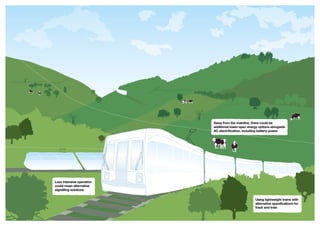
  • 63.
    2.154 Finding themost effective and efficient means to align IT with freight customers’ systems will be complex as there are many freight customers and many systems. Generic IT platforms would be the simplest solution for integration but this requires careful assessment and planning. Collaboration between businesses to examine the feasibility would be an initial step towards producing heterogeneous results. Benefits could be derived at local and system levels. Similar to the TSI TAP, the TSI TAF will harmonise the functional and technical standards for exchanging information between the parties involved in rail freight transport. 63THEFUTURERAILWAY | THE INDUSTRY’S RAIL TECHNICAL STRATEGY 2012
  • 64.
    THEMES - CUSTOMEREXPERIENCE Door to Door Journey Demographic Research Infrastructure Access Health And Safety Ticketing Security Passenger Information Freight Customers IMPROVE THE END TO END JOURNEY EXPERIENCE IMPROVE CUSTOMER ACCESS RTS CUSTOMER EXPERIENCE VISION Rail is customers’ preferred form of transport for reliability, ease of use and perceived value PRE 2010 2011 - 2020 CP 4 CP 5 CP 6 CP 7 CP 8 CP 9 2021 - 2030 2031 - 2040 CONTROL HEALTH, SAFETY AND SECURITY RISKS INTEGRATE RAIL AND FREIGHT CUSTOMER INFORMATION SYSTEMS PROVIDE INFORMATION TO DISTRIBUTION CHANNELS Intellige Industry Delivery Activity Government direction on security constraints and requirements Railway as a key part of a (holistic) national and international transport system Develop one-to-one relationship between customer and providers PRM TSI Rail system made PRM compatible Enhance ticketing options and delivery architecture Develop strategic relationships with other transport providers Industry Development Activity Improve transport hubs: efficient movement of passengers and freight between modes Improve web-based end to end journey booking and information systems Anti-fraud and information protection technology Intelligent Traffic management systems feed real time Customer information Integrate freight scheduling & traffic managementAlign freight IT systems Real-time cross network consignment tracking Continue to improve ticketing and information systems for passengers TSLG Completed activity TSLG In progress RSSB continue to provide focus to ensure safe customer environment TSLG Planned TSLG Potential Understand door to door journey through a whole system approach Demographic research Determine future customer needs & trends Intelligent monitoring of passengers for stations and trains Enhance sensor technology coupled with predictive algorithms Real time networking and automation (real time analysis) of sensors Identify and evaluate technologies/approaches to support rail freight integration Understand the future customer: passenger and freight, preferences, parameters and practices Passive customer recognition for automated ticketing All dates and durations should be regarded as indicative Deploy contactless technology across the networkCommon smartcard definition Mandated incident response TAF TSI Customer ‘App’ & web services available Establish relationships with information providers Use of customer-based technologies (e.g. personal communications) to improve customer experience on the railway RSSB established Improve decision making through better information flow 64
  • 65.
    WHOLE-SYSTEM APPROACH 65THEFUTURERAILWAY | THEINDUSTRY’S RAIL TECHNICAL STRATEGY 2012
  • 66.
    Specifying assets ina whole-system context and a whole-life perspective, they will initially cost more... ...but the components will work well together, the system will be reliable and passenger needs fulfilled... ...customers will be impressed and more will arrive Train tuned to track, track tuned to train Pantagraphs and wires work in harmony Sensors send signal from the track and train to satellite ...subsystems will be ‘tuned’ to the wider system, assets last longer, maintainance cheaper, less downtime, safer and more reliable railway
  • 67.
    VISION A whole-system approachenables the rail industry to implement change easily and improve reliability, availability, maintainability and safety OBJECTIVES An industry-wide framework for a whole-system approach Coordinated planning, delivery and operations Integrated asset management techniques STRATEGY Adopt a whole-system approach Improve industry whole-system modelling capability and tools Develop a set of aligned asset management plans for the railway ENABLERS Effective cross-functional and cross-industry communication Common modelling and planning tools Common asset information systems Best practices in whole-systems approaches 67THEFUTURERAILWAY | THE INDUSTRY’S RAIL TECHNICAL STRATEGY 2012
  • 68.
    CONTEXT 3.1 The RTS2012 whole-system is the rail sector, its assets, organisations, operations and stakeholders. It is the railway’s people, processes and systems. The railway has many thousands of assets owned, operated and maintained by a range of organisations, each with their own business objectives, priorities, timescales, policies and incentives. 3.2 The inherited railway was often designed as single sub-systems and not as a whole. This legacy presents many constraints on service quality and requires a whole-system approach for a cost-effective and efficient upgrade. 3.3 The whole-system engineering challenge has been recognised: • TSLG has been formed to provide technical leadership for the industry • System Interface Committees (SICs) have been established to examine and improve performance and cost across sub-system boundaries • The Rail Delivery Group (RDG) has been established • Industry initiatives for a whole-system approach are increasing, such as RTS 2012, cross-industry remote condition monitoring (XIRCM), cross-industry information systems (XIIS) and whole-life and cost asset management. • The RUS process supports planning on a whole-industry basis (eg Network RUS: Passenger Rolling stock) VISION 3.4 The rail industry adapts easily to change and implements innovative new designs and methods using a whole-system approach. 3.5 The industry’s embedded whole-system approach has increased reliability, availability and safety at reduced cost and is easier to maintain. Advanced signalling and traffic control systems have reduced the likelihood of train collisions and a whole-system approach has reduced the rolling stock collision requirements and saved train weight, cost and energy consumption. 3.6 Cross-industry coordination of the design and development of sub- systems and components reduces duplication and minimises negative cross-system impacts. 3.7 Improved remote asset monitoring, including RCM and fewer asset failures increases the reliability of infrastructure and rolling stock. Across the industry, updated maintenance policies and tested contingency plans result in customers rarely experiencing disruption. OBJECTIVES 3.8 A whole-system framework has been established within which suppliers can develop products with confidence to meet the industry’s requirements. Cross-industry strategic planning allows new solutions to be developed and implemented easily. The diverse planning horizons within the industry are aligned to deliver whole-system, whole-life solutions. WHOLE-SYSTEM APPROACH 68
  • 69.
    3.9 Greater collaborationwithin the industry fosters coordinated planning and operations which has led to increased levels of reliability and resilience. Customer satisfaction is raised through the improved service levels. 3.10 Asset management is aligned across the industry. Excellent asset knowledge and evidence-based decision-making improves performance at lower cost and with less business risk. STRATEGY 3.11 A cross-industry, whole-system approach to design, maintenance, delivery and safe operation should be adopted. A holistic understanding of the railway is needed to identify risk factors during design stages to allow for any necessary adjustments. This approach would avoid duplication of effort, reduce negative impacts and simplify the introduction of new components and processes. 3.12 Effective whole-system planning requires models suitable for industry, innovators, academia, suppliers and investors. These models could be used to understand the impact of changes to the whole system and support whole-system research and development by: • Using a virtual design and development environment • Defining requirements, especially across sub-system boundaries • Analysing priorities between competing options • Testing resilience • Optimising the system 3.13 Life-cycle costing tools would optimise decision-making processes for maintenance and renewal. The tools should be able to model a variety of options, including the impact on services, passengers and technicians, to provide comprehensive assessments for work volumes, costs and outputs. 3.14 The industry should collaborate to develop a set of aligned asset management plans for the railway. Common policies and strategies, that encompass a full range of outputs ranging from service delivery to environmental impacts, are required to manage the industry’s assets. Aligned asset management plans should facilitate the implementation for other parts of the industry, operations and external parties. ENABLERS 3.15 Better organisational structure and communication channels between all industry stakeholders are necessary to improve technical and asset interfaces. Improved collaboration between rail operators, engineers and asset managers and close interaction with planners will help to develop and deliver appropriate rail technologies. 3.16 Cross-industry alignment and planning need to remove constraints on operations and services for future infrastructure requirements - be it passenger, freight or international traffic. Alterations to infrastructure system capability/flexibility should be within the prevailing processes and procedures and adhere to whole industry requirements. 69THEFUTURERAILWAY | THE INDUSTRY’S RAIL TECHNICAL STRATEGY 2012
  • 70.
    3.17 Infrastructure routesand train operating companies (TOC) should form alliances to communicate better and work towards common goals. Collaboration could address issues at the wheel/rail interface, such as rolling contact fatigue (RCF) more efficiently through Vehicle-Track Interaction Strategic Model (VTISM) and TrackEx19 . Work carried out by the five SICs, including VTISM, demonstrate the importance of understanding the impact of operational change on individual railway assets. 3.18 The industry needs to establish a common standard language and catalogue for sub-components. Currently, each railway asset is assigned a code by each organisation that uses it. For example, a set of automatic doors at a station may be numbered DR001 in NR’s asset register and SEF102 in the TOC’s register. A single industry asset register which is accessible, accurate and provides real-time updates is very likely to simplify and improve the quality of asset information. 3.19 Asset information underpins a modern approach to asset management. Adopting ISO 55000, the international development of the British PAS 55 standard for asset management, would offer a more consistent approach throughout the rail sector and improve the flow of information for risk-based safety, maintenance and other operational decisions. Consolidating existing system types of asset information, for example, ORBIS (Offering Rail Better Information Services) would also improve consistency across the sector. 3.20 Careful attention should be given to learning from proven best practices. For example, different approaches to route-based alliances could provide useful best practice lessons to aid the development of a whole-system approach for the railway. This would help the rail industry to adapt faster to changes in technology and accelerate potential cost savings. 19 TrackEx is a systems analysis tool used to plan and manage track degradation. It is an NR bespoke product and used by the industry. COMMON FOUNDATIONS - WHOLE-SYSTEM APPROACH70
  • 71.
    Approach Planning Business Models Management Knowledge System Models &Tools Benchmarking System Tools System Models ISO55000 (PAS55) Asset Management Asset Information Asset Programmes ADOPT A WHOLE-SYSTEM APPROACH RTS WHOLE SYSTEM APPROACH VISION A whole-system approach enables the rail industry to implement change easily and improve reliability, availability, maintainability and safety PRE 2010 2011 - 2020 CP 4 CP 5 CP 6 CP 7 CP 8 CP 9 2021 - 2030 2031 - 2040 IMPROVE INDUSTRY WHOLE-SYSTEM MODELLING CAPABILITY AND TOOLS DEVELOP A SET OF ALIGNED ASSET MANAGEMENT PLANS FOR THE RAILWAY Intellige Industry Delivery Activity ISO55000 established Sector-wide adoption of ISO5500 Initial ISO5500 audit of whole industry Produce set of cross-industry aligned asset plans Second ISO55000 audit of whole industry Rail Delivery Group Rail Value for Money Study Assimilate best practice from other sectors Benchmark railway programme management capability against recognised industry leader Greater collaboration towards coordinated planning Coordinate across railway planning cycles Learn lessons from early route based alliances Transport KTN established Vision and leadership feeding into and from Transport Catapult, Innovation Funds ERRAC/JTI Cross industry alignment of planning Develop whole system business models Continuous improvement in interface optimisation via fleet and infrastructure procurement & management Industry Development Activity Asset information sharing Coordinate asset registers Consistent approach to asset information (storing & sharing) Establish knowledge exchange practices TSLG Completed activity TSLG Completed activity System Interface Committees formed TSLG In progress Effective cross functional and cross industry communication Develop and promote a holistic view of the railway TSLG Planned Cross-industry whole systems leadership Improve cross-system boundary knowledge exchange TSLG Potential Implement common approach to naming and managing components Define optimal and further develop models and tools for optimisation Development programme for modelling tools Identify gaps in whole system modelling capability Produce whole system models Produce life-cycle costing tools Whole railway system models to aid simulation/experimentation Whole system, whole life, whole cost modelling capability Implement rail industry standard for whole system management All dates and durations should be regarded as indicative VTISM Model Developed FMECA Whole system reliability monitoring Cross Industry Remote Condition Monitoring DRACAS 71THEFUTURERAILWAY | THE INDUSTRY’S RAIL TECHNICAL STRATEGY 2012
  • 72.
  • 73.
    INNOVATION 73THEFUTURERAILWAY | THEINDUSTRY’S RAIL TECHNICAL STRATEGY 2012
  • 74.
    VISION A dynamic industrythat innovates to evolve, grow and attract the best entrepreneurial talent OBJECTIVES Innovation makes a significant and continuing contribution to rail business success An industry with an international reputation for innovation, which contributes to an expanding export market An integrated cross-industry system for innovation Innovation requirements are fully supported STRATEGY Continue to remove barriers to innovation Achieve Innovation Capability Maturity Model Level 5 amongst leading rail companies during CP6 Develop commercial models to facilitate the use and exploitation of intellectual property Support innovators with facilities, identified priorities and funding ENABLERS Guidance on standards for the benefit of innovators Identification of priority technical areas 74
  • 75.
    CONTEXT 3.21 Transport isan increasingly competitive sector which needs to innovate constantly to produce future products, systems and services and to become more attractive to new investors. Railway investment in innovation has been less than in other transport sectors, reported as 0.5%20 against international best practice of 3.5%21 . The railway must continue to foster innovation across the industry to realise the significant cost savings identified in the RVfM by 2019 and contribute to the longer term 4C challenges. 3.22 The railway is capable of learning from other industries and transport sectors. The Transport Knowledge Transfer Network (KTN) and the proposed Transport Systems Catapult Centre show that there is much common ground in both the challenges and the potential solutions. Other sectors have been successful in achieving substantial investment to develop and secure the UK capability in key technologies and improve business prospects. For example, over £400m of government funding supports the automotive industry in its extensive demonstration programme for low carbon vehicles. Aerospace has secured £200m of government research and innovation funding since 2011 to ensure that the UK retains a world-class aerospace industry. 3.23 Research on barriers to innovation22 identified actions (see Table 1) and led TSLG to make the case for innovation funding in CP5, which has been recognised in the High Level Output Statement (2012). To take this initiative forward, TSLG has now established the Rail Industry Enabling Innovation Team (EIT) and the Rail Innovation Fund. 3.24 TSLG has collaborated with the Technical Strategy Board in three significant initiatives: • The launch of the Transport KTN to encourage and facilitate communication between research bodies and suppliers to embed new knowledge and ideas • The jointly funded £10m R&D Accelerating Innovation in Rail competition, to develop projects between companies • The case for the £30m/year Transport Systems Catapult technology innovation centre 3.25 TSLG is actively supporting complementary initiatives, including: • The Rail Industry Association’s (RIA) Unlocking Innovation programme • The European Rail Association’s Shift2Rail proposal for a joint technology initiative, which has potential funding of £800m for the railway 3.26 EIT has been established to assist the industry to match challenges with potential solutions and secure funding where appropriate. This innovation may be led by business, technology or the supply chain. The challenge may include an approach, perhaps technology-enabled, from another domain or railway and prove the case for its adoption in the rail industry in the UK. 20 Rail Value for Money study, 2010: estimated investment in £11bn turnover in 2009/10 21 RSSB T934 Enabling Technical Innovation in the Industry – Barriers and Solutions, 2010 22 ibid INNOVATION 75THEFUTURERAILWAY | THE INDUSTRY’S RAIL TECHNICAL STRATEGY 2012
  • 76.
    VISION 3.27 The railwayin the UK is recognised as a dynamic and key contributor to the world-wide integrated transport sector, excelling at delivering cost-effective and timely innovative products, services and systems. Maintaining Level 5 of the Innovation Capability Maturity Model (ICMM) demonstrates the industry’s continuous improvement approach to enabling innovation. 3.28 The rail industry is a magnet for the best entrepreneurial talent, attracted by opportunities to develop, implement and use leading-edge technical applications for business benefit. 3.29 A holistic approach is embedded in the rail industry, with a wide range and quantity of innovative ideas progressing rapidly through technical readiness levels (TRL) through increasingly rigorous business cases. Innovators are supported further by: • Clarity on the priority areas for innovation • Access to industry experts • Access to development and test facilities • A range of funding sources 3.30 EIT, on behalf of the rail industry, provides innovators and investors with knowledge of risk and expected rewards associated with innovative concepts. Incentives within and between industry players have been aligned by matching investment cycles and provision of value transfer mechanisms between stakeholders. OBJECTIVES 3.31 Clear direction and guidance from EIT provides the basis for innovators to make valuable contributions to the rail industry. This helps the railway to address the 4Cs and maximise timely business success for its stakeholders. 3.32 Achievement by leading rail companies of ICMM Level 5 during CP6 (2019-2024) demonstrates the rail industry’s commitment to enabling a persistent innovative culture. The commercialisation of innovation leads to increased export sales for UK-based businesses. 3.33 A pan-industry system, designed to achieve a step-change in the innovation ecosystem, allows the full scale and scope of RTS 2012 to be realised. Innovation operates across functional and commercial boundaries and along the supply chain, from component SMEs to customers. Effective mechanisms evaluate and apportion benefit, cost and risk. 3.34 To support investors, technical priority areas are identified, development and test facilities are available and adequate funding is secured. UK academic and industrial capabilities are understood so that investment can be prioritised to achieve the maximum benefits. COMMON FOUNDATIONS - INNOVATION76
  • 77.
    STRATEGY 3.35 Research23 has identifiedbarriers to innovation in leadership, industry capability and risk reduction. The actions begun in 2010 should continue to address these barriers. Table 1 summarises the progress and actions remaining. Table 1: Actions for three specific areas of strategic interventions 23 RSSB T934 Enabling technical innovation in the GB rail industry – barriers and solutions, 2010 24 Open Innovation is a concept/paradigm that encourages sharing and trading of knowledge across and between organisations to improve an industry and/or organisation’s innovation and know how capabilities. INTERVENTION ACTION STATUS DECEMBER 2012 Create system leadership 1. Establish a rail system leadership function. 2. Establish a top-level sponsor function. 3. Create cascaded specifications for contract conditions to align industry incentives. 1. Done. TSLG provides the leadership function; EIT leads the everyday activities. 2. Done. RDG provides the top-level sponsor function. 3. To be started. EIT will develop commercial models to encourage alignment of incentives and clear ownership of intellectual property. Enhance industry capability for innovation 1. Design and develop effective mechanisms to translate ideas into demonstrable, de-risked, system-level radical innovation projects. 2. Build upon existing materials and disseminate models of good practice. 3. Promote and provide culture change programmes. Promote Open Innovation24 for the front end of the innovation process. All to start: EIT will support the industry to address these issues and increase the industry innovation capability. Progress should be measured against the ICMM. 77THEFUTURERAILWAY | THE INDUSTRY’S RAIL TECHNICAL STRATEGY 2012
  • 78.
    25 http://www.ice.org.uk/News-Public-Affairs/Media-and-press-centre/Specifying-Successful-Standards 26 RSSB T965 Testingand trialling. A good practice guide for testing and trialling new technology for Britain’s railways, November 2011 27 Foreground IP is the intellectual property developed or acquired from the start of the contractual agreement. 28 Background IP is the intellectual property that has been developed or acquired before the start of the contractual agreement. COMMON FOUNDATIONS - INNOVATION Table 1 Continued INTERVENTION ACTION STATUS DECEMBER 2012 Reduce the risks of introducing innovation to the system 1. Create support and coaching resources/ombudsman for acceptance processes and standards. 2. Develop industry agreement on acceptable types of test results from other environments. 3. Take steps to ensure good access to appropriate test facilities. 4. Find mechanisms to manage the commercial risk of testing on the operating railway. 1. In progress: RSSB is exploring what type of leadership role it can take on behalf of the industry to rationalise and harmonise railway interface standards as proposed in the report Specifying Successful Standards25 . 2. In progress: TSLG has commissioned research. 3. In progress: TSLG has published a guide on access to test facilities26 as a first step. 4. To be addressed by EIT. 3.36 RIA has developed the general five-level ICMM for the railway’s approach to innovation. An overview of the ICMM and the growth curve that leading rail companies should aim to follow to achieve Level 5 during CP6 is shown in figure 1. 3.37 The scale and ambition of RTS 2012 demands a fit-for-purpose innovation system. A new approach should be defined, drawing on emerging concepts from industries recognised as best-in-class for innovation. 3.38 The railway’s innovation system should develop commercial models to allow intellectual property (IP) to be accessed, shared and evolved for cross-industry benefits. These models need to ensure that rights in and ownership of foreground IP27 , where appropriate, are secured. Background IP28 should be protected but support the exploitation of foreground IP. The commercial model and returns should be based on the respective level of investment made in background and foreground IP to be acceptable for all parties. Further, the commercial model should support a quicker development cycle. This would allow products and services to enter the market more quickly and provide opportunities for wider exploitation throughout the rail industry and beyond. 78
  • 79.
    3.39 Facilities ownedby or available to the rail industry29 should be open to innovators, researchers and developers. Where facilities do not exist, the case to develop new facilities should be explored so that innovative projects have the necessary environment to progress rapidly. 3.40 TSLG, through EIT, should define technical architectures by operational concept, using these to identify priority technical areas for innovation. This would allow the rail industry to focus on the developments that deliver the best business and technical results and meet the long-term rail strategy. These priority areas should identify, build on and where appropriate, develop the rail industry’s technological strengths. 3.41 The railway should continue to secure funding sources for innovation and set benchmarks again other more successful innovating sectors. ENABLERS 3.42 The railway has a necessary range of standards that need to be considered when developing new products, services and systems. The breadth and depth of these standards is often cited by innovators as a barrier to innovation. To remove this barrier, guidance will be given about these standards, how they fit into the railway system and how the standards processes contribute to innovation. 3.43 Priority areas with the potential to drive economic growth and exports will be determined through analysis of industry and academia capabilities in the rail sector. The results will be used to enable both EIT and industry innovators and investors to make informed decisions on where to employ their financial and technical resources. EIT will provide guidance and information to allow the innovator to understand the early business case and process for such innovation. 29 RSSB T965, November 2011 79THEFUTURERAILWAY | THE INDUSTRY’S RAIL TECHNICAL STRATEGY 2012
  • 80.
    Figure 1: Usinginitiatives to raise the innovation maturity level COMMON FOUNDATIONS - INNOVATION Level 5: Integrated/Adaptive Feature: Integrated and strategic approach across transport sectors CP4 (2009:2014) CP5 (2014:2019) CP6 (2019:2024) Characterisation: Rail sector technology and innovation strategy is visible and used by organisations to set direction. System perspectives prioritise and pursue best options. Research and technology base is integrated with supply chain innovation. Technology demonstrators are extensively used to reduce risk. Innovation within and between organisations is widespread and methodologies are continuously refined. Good facilities and resources Characterisation: Organisations are developing their individual innovation strategies based on their understanding of customers’ needs. Bilateral relationships within supply chains are being formed to support innovation. Research outputs are disseminated for wider benefit Characterisation: Organisations innovate effectively individually but find it difficult to manage up and down the supply chain. Integration and testing/trialling of new products and systems is difficult and few mechanisms manage the risks of introduction Characterisation: Innovation is ad-hoc, conducted by individual organisations independently with in-house facilities. Little use of UK research base Level 4: Optimised Feature: Rail sector fully coordinated and focused Level 3: Managed Feature: Limited coordination within supply chain and with key clients Level 2: Competent Feature: Competent but uncoordinated Level 1: Initial Feature: Inconsistent Characterisation: Widely used mechanisms across systems and down supply chains direct innovation efforts. Sector strategy and capability are pursued. The strategy is integrated with other national strategies, e.g. transport, energy, communications, manufacturing and exports. Integrated national infrastructure strategies Support for integrated and large scale demonstrators Extended commercial horizons Enabling Innovation Team formed New collaborative business models Initiatives for testing to reduce risks with new technology Transport Systems Catapult established Knowledge transfer, open innovation and sharing needs, priorities and strategies Whole system / cross industry demonstrators for integrated approach to 4Cs 80
  • 81.
    Leadership Increase Capability Risk Reduction ICMM Approach Commercial Facilities Funding Priorities CONTINUE TO REMOVE BARRIERSTO INNOVATION RTS INNOVATION VISION A dynamic industry that innovates to evolve, grow and attract the best entrepreneurial talent PRE 2010 2011 - 2020 CP 4 CP 5 CP 6 CP 7 CP 8 CP 9 2021 - 2030 2031 - 2040 ACHIEVE INNOVATION CAPABILITY MATURITY MODEL LEVEL 5 AMONGST LEADING RAIL COMPANIES DURING CP6 SUPPORT INNOVATORS WITH FACILITIES, IDENTIFIED PRIORITIES AND FUNDING DEVELOP COMMERCIAL MODELS THAT FACILITATE THE USE AND EXPLOITATION OF INTELLECTUAL PROPERTY Intellige Industry Delivery Activity Maintain appropriate access to test facilities Align innovation activity with long term planning for the industry Transform Industry Innovation Leadership Industry Development Activity Identify priority areas for railway innovation Develop mechanisms to enable and de-risk innovation programmes Promote ‘open innovation’ TSLG Completed activity Test & trial facilities web- site established T934 Enabling Innovation (Barriers to Innovation Research TSLG In progress Secure funding to develop appropriate test/trial/development facilities ICMM Level 1: initial ICMM Level 2: Competent ICMM Level 3: Managed EIT to develop commercial models to support innovation and align incentives Address the barriers identified in TSLG’s ‘Enabling Innovation Report TSLG Planned Innovation policies established: standards, resources, knowledge base TSLG Potential Develop mechanisms to manage risk of testing on the operating railway Provide guidance on railway standards for innovators Support collaborative working to develop whole system solutions All dates and durations should be regarded as indicative Disseminate models of good practice Transport KTN Established RIA Industry Maturity Model Achieve ICMM Level 5 Range of established funding sources Continue to secure funding sources for innovators ICMM Level 5: Integrated & Adaptive Develop commercial models to allow IP to be used for cross industry benefits Establish Transport Systems Catapult Reduce the risks of (introducing) innovation to the system ICMM Level 4: Optimised Cross Industry Technology watch Technology requirements list maintained 81THEFUTURERAILWAY | THE INDUSTRY’S RAIL TECHNICAL STRATEGY 2012
  • 82.
  • 83.
    PEOPLE 83THEFUTURERAILWAY | THEINDUSTRY’S RAIL TECHNICAL STRATEGY 2012
  • 84.
    VISION Skilled, committed andadaptable people delivering an efficient and customer-focused railway OBJECTIVES A culture of continuous improvement, effectiveness and customer service Excellent leadership and a workforce supporting all aspects of the railway A reliable supply chain for high-quality skills provision STRATEGY Assess the skills requirements for the future railway Adopt a common standard for effective collaboration between organisations Improve learning methods to maximise benefits from new technology Design technology and roles with people in mind Automate repetitive and arduous tasks ENABLERS Skills forecasting Partnerships with education providers Employee skills passport National competencies database Decision-support tools 84
  • 85.
    3.44 People arekey drivers as well as enablers in business. As the pace of technological and technical changes accelerates, people working in the rail industry must be equipped with the necessary skills to cope with the new technologies and techniques. With a whole-system approach, people need to understand and adapt to new working practices. 3.45 International competition and uncertainty about demand is risking the availability of suitably skilled people for the industry, although not all the required skills are railway-specific. Sometimes availability is low and costs are artificially high because technical and professional competence is not recognised without railway experience or qualifications. 3.46 Work carried out by NSARE30 suggests that a major gap in engineering skills is likely to develop unless remedial action is undertaken. It identified that only 17% of the engineering workforce has qualifications at higher academic levels (above ‘A’ level). VISION 3.47 Lifelong learning is an expectation within the industry, with learning and competence seen as part of a continual professional development (CPD) continuum from novice to expert. 3.48 Learning programmes take full account of the implications of technological transitions and training prepares staff for technology- driven changes. Virtual learning environments and simulations are used to rehearse responses to both routine work and unplanned situations. 3.49 Strategic relationships with other sectors include learning from industries that have made radical technological transitions to understand the skills that are required and minimise the risk in adopting new skill sets. Railway companies have confidence in the supply chain to provide qualified additional or specialist resources. 3.50 Leaders drive the industry towards achieving the 4Cs and facilitate the technological changes. There is a shared vision of customer focus across the industry and a common desire to optimise performance. Rail is the employer of choice and knowledge is transferred with people from other sectors into the rail industry. OBJECTIVES 3.51 The culture and leadership style inspires staff to strive for continuous improvement in all aspects of the railway’s business. This is demonstrated by efficiency, effectiveness, quality and value in all operations and a palpable ethos of customer service. 30 NSARE is the National Skills Academy for Railway Engineering, a key facilitator for matching specialised training requirements for rail employees with appropriate providers PEOPLE 85THEFUTURERAILWAY | THE INDUSTRY’S RAIL TECHNICAL STRATEGY 2012
  • 86.
    3.52 The futurerailway is likely to be technologically complex, more automated and managed by fewer but highly skilled people. A coordinated long-term view of the required skills, competencies and potential has identified skill sets and defined roles. These skill sets enhance mobility of personnel and career development and present opportunities to fine-tune skill mixes across the industry. 3.53 A reliable supply chain secures a consistently high-quality level of expertise for the industry. STRATEGY 3.54 The operation, maintenance and development of a more technically advanced railway will require a suitably adapted management style. A systematic approach to career development, adopted by companies across the industry, would equip the Class of 2020 with the technical and leadership skills to run the railway in 2030 and beyond. These skills need to include an appreciation of cross-organisational business requirements and how to practise a whole-system approach. 3.55 Realising the potential of new technologies, adapting to the pace of change and the expectation of longer working lifetimes will require appropriate staff training. The industry will need to pay attention to the core skills of potential employees, engage with those who set the curriculum and teach in schools, colleges and universities and influence them to develop the skill sets that meet the needs of the industry. 3.56 Coherent standards for collaboration would lead to more effective cooperation between organisations to improve operational and business performance. Benefits of cooperation would include: • An established common language and consistent approach • Improved risk management • Clear paths for continued improvement • If certification were introduced, a mutual understanding of an organisation’s base capability 3.57 Skills to handle an increasingly rich data environment and to manage the real-world environment efficiently will require appropriate training methods. Improved methods could include virtual reality and simulation, role play and improved on-the-job training. 3.58 Design and introduction of new technology should take careful account of the people who will use it and match the planned level of human engagement. The effect of this interface on success is often under- appreciated, with detrimental business consequences. Understanding the people dimension is fundamental to planning new schemes. 3.59 New technologies in the industry will alter the workplace and automation could take over repetitive and arduous tasks. The railway has the opportunity to use these techniques and technologies to create an attractive work environment that makes it the employment sector of choice. COMMON FOUNDATIONS - PEOPLE86
  • 87.
    ENABLERS 3.60 Forecasts ofthe skills the railway will need in the future and analysis of any gaps in skills is essential to direct the planning effort. A continual process of resource planning and preparation is necessary to develop people with the appropriate range of skills to meet future requirements. 3.61 Workforce education, training and CPD will be enabled through: • Widening the scope of NSARE beyond engineering, working across the industry and in partnership with independent education providers • Development of continuous learning programmes 3.62 NSARE is also involved in developing tools designed to increase the flexibility of railway staff to work across the industry. These include: • Skills passports showing portable competencies to support academic and professional qualifications • A national database of competencies in core areas such as engineering 3.63 These educational initiatives could also improve the industry’s retention of corporate memory and guard against skills fade. 3.64 New technology will bring increased amounts of data, information and intelligence which require enhanced interpretation skills for decision- making. The workforce will also be assisted by the introduction of a new generation of decision support tools, including timetabling and maintenance schedule planning. 87THEFUTURERAILWAY | THE INDUSTRY’S RAIL TECHNICAL STRATEGY 2012
  • 88.
    COMMON FOUNDATIONS -PEOPLE Management Career Development Manpower Planning NSARE Decision making Collaboration Culture Human Factors Automation ASSESS THE SKILLS REQUIREMENTS FOR THE FUTURE RAILWAY RTS PEOPLE VISION Skilled, commited and adaptable people delivering an efficient and customer-focused railway PRE 2010 2011 - 2020 CP 4 CP 5 CP 6 CP 7 CP 8 CP 9 2021 - 2030 2031 - 2040 ADOPT A COMMON STANDARD FOR EFFECTIVE COLLABORATION BETWEEN ORGANISATIONS IMPROVE LEARNING METHODS TO MAXIMISE BENEFITS FROM NEW TECHNOLOGY AUTOMATE REPETITIVE AND ARDUOUS TASKS DESIGN TECHNOLOGY AND ROLES WITH PEOPLE IN MIND Intellige Industry Delivery Activity Cross rail sector adoption of BS11000 principles and practices Develop coherent standards for collaboration (Human Resources) Skills passports: recognising and exporting capability Implement National Competencies database Continue development (Evolution) of National Skills Academy for Railway Engineers (NSARE) Partnerships with education providers Long term skills and resource planning & forecasting across the industry NSARE established Industry Development Activity Develop Human Factor Engineering discipline across the industry TSLG Completed activity TSLG In progress TSLG Planned TSLG Potential All dates and durations should be regarded as indicative Examine potential future technologies that are able to automate rail activities Use innovation to propose future automation Decision Support tools and aides Create virtual and simulation (‘safe’) environments to practice decision making skills and understand consequences Understand the range and type of decisions that need to be made to sustain future railway operations Improve resilience of rail operations through improved decision making Prevent skill fade by developing corporate memory capability Promote Graduate engineering careers in railway engineering Encourage personal development by making it easier for people to move within the industry Systematic approach to career development Identify skills categories implied by future railway use/employment of technology Management styles for more technically advanced railway 88
  • 89.
    4.1 Common designconcepts traverse the specific rail strategies and are relevant to the development plans that may result from RTS 2012. WHOLE-SYSTEM RELIABILITY 4.2 Reliability is fundamental for customer satisfaction and lower costs and each part of the system contributes to the overall reliability. Reliable assets mean fewer delays for customers and less unplanned maintenance for technicians. If the approach to reliability were the same as for safety, there would be a step change in performance. 4.3 Explorative studies sponsored by TSLG sought to understand how reliability as a business objective could be improved and how unreliability constrains the ability to increase network capacity. Two distinct areas for reliability improvement emerged: operations and assets. 4.4 Performance targets addressing both railway assets and operations need to be set at system level if improvements are to be optimised. 4.5 Detailed modelling work has shown that the existing railway could double its capacity and still provide the current levels of public performance measures if these conditions were met: • Some key infrastructure, such as points, underwent a step change in performance • Train reliability performance at the level of the best • A significant reduction in vandalism, cable thefts, suicides • Shorter and more tightly controlled dwell and turnaround times • Trains running at two-minute headways, at the right place and speed everywhere to reduce the three-minute tolerance significantly 4.6 Testing and trialling is an important factor for reliability – for assets, timetables and people. Innovative technologies need to be thoroughly tested and demonstrated at sub-system, then system level – away from the live railway and in environments that will be experienced in service. RESILIENCE 4.7 The future railway should be resilient to: • Operational disruption • Externally caused disruption • Climate change, extreme weather and other climate issues 4.8 A flexible timetable and network-wide control systems contribute to a resilient rail by minimising the effects of perturbations, allowing operations to continue as normal across the wider network, without causing secondary delays. 4.9 A whole-system approach would reduce asset failure and enhance the overall resilience and reliability of infrastructure and rolling stock. Improved asset monitoring, for example by RCM and maintenance policies have the potential to eliminate many in-service asset failures. Research31 estimated a potential reduction of 15% delay, valued at £90m/year, if RCM were effectively deployed. Of this, £12m/year is derived from sharing RCM data across industry boundaries. 31 RSSB T844 Mapping current remote condition monitoring, April 2009 COMMON DESIGN CONCEPTS 89THEFUTURERAILWAY | THE INDUSTRY’S RAIL TECHNICAL STRATEGY 2012
  • 90.
    4.10 Automated andmanual contingency plans that are regularly updated and practised could improve response times. Disruptions to passenger journeys would be minimised and the majority of customers would experience no reduction in service levels. 4.11 The railway’s resilience to external events, normally outside its control, could be augmented through strategic relationships with supply, service and security sectors. For example, an electrified railway draws about 1% of the UK output. Distributed and alternative power routing could provide options for power supplies. Self-powered rolling stock should be able to sustain short-term operations until normal service can be resumed. 4.12 Planning and design tools for resilience, together with a more integrated approach to managing risk, aim to reduce the consequences of extreme external events caused for example, by terrorism. Without detracting from the primary function of rail, resilience engineering and materials could be deployed to mitigate risks in key areas. 4.13 Tomorrow’s Rail and Climate Change Adaptation (TRaCCA) report32 provides the basis for understanding the expected impacts on asset management of climate changes over the next 20 years. Areas covered in the report include: • Climate risk assessment for rail operations • Mathematical models to assess climate change impact by areas • Preliminary asset management policies for climate change 4.14 Adapting to climate change is increasingly important and needs to be embedded in the core of railway businesses. Potential solutions need to be evaluated from a whole-system perspective for sustainability. For the electrification programme, for example, overhead power systems are more resilient to extreme rainfall than third-rail above-ground systems but may need to be re-evaluated for resilience to extreme heat. SECURITY AND RISK MITIGATION 4.15 Britain has one of the best safety records when compared to other national rail organisations and this record will need to be maintained and improved in the face of new threats, challenges and risks. Several programmes are underway and more are outlined for delivery in CP5. Continuous improvement and preparation to cope with new and emerging threats, whether from terrorism or crime, are integral in RTS 2012. 4.16 In the longer term, technologies such as automatic facial recognition could be deployed for preventative security. The cost of complying with safety, security and health requirements is already embedded in operating costs. Careful choice of deployment and whole-life strategies could offset initial cost drivers for new risk mitigation initiatives. 4.17 System security should be maintained and continually checked and tested against a number of security threats, for example: • Cyber threats could be minimised by resilient architectures and by additional layers of security including sophisticated firewalls between operational systems 32 RSSB T925 Adapting to extreme climate change (TRaCCA) COMMON DESIGN CONCEPTS90
  • 91.
    • Automatic back-upand dual redundancy should be built into all key systems • Emergency use of the UK internet backbone might be possible in certain circumstances for data and communication systems • Customer service IT, such as on-train internet access should be isolated from key systems • Active and passive systems could provide constant vigilance against terrorism and cyber-attacks, supplemented by trained staff and Transport Police with additional capabilities to call on if necessary 4.18 For health, the increasing world population and mobility heighten the risk of pandemic viruses. Rapid responses to mitigate outbreaks are already in place but the longer term strategy requires increased preparedness for such an event. Preparations could include: cleaning technologies, anti-viral technologies and increased sensors. 4.19 Contingency plans should be in place and rehearsed to respond to a variety of security alerts. Governance procedures should be reviewed regularly and periodic staff training carried out to keep personnel up-to- date and aware of risks. 4.20 Train and station designs should be revised regularly to include new safety measures and materials where appropriate. AUTOMATION 4.21 The introduction of automated systems should be based on analyses to show which systems should be operated by staff, which should be partially automated and which should be fully automated to maximise efficiencies and service quality. 4.22 Increased levels of automation could provide benefits in three main areas: • Operations • Customer service • Maintenance and asset management 4.23 Driver aids, such as ATO, improve predictability of train movements and precise control of traction energy and fuel usage, as well as potentially increasing network capacity. Similarly, intelligent traffic management systems are expected to enable significant improvements for network capacity and offer greater flexibility to meet customer demands, resolve perturbations and reduce operational costs. 4.24 Automation of a wider range of maintenance operations lowers the risk to maintenance personnel. Automated asset data provision would improve asset management and maintenance schedules. Better predictability subsequently increases the flexibility to respond to unpredicted events more efficiently. SIMPLICITY 4.25 Many of the strategies in the themes offer concepts supporting a simple railway. 4.26 A whole-system approach for rolling stock and infrastructure should reduce asset failures and maintenance requirements. 4.27 Standard modular systems architectures would reduce the unnecessary complexity of working with bespoke systems and requirements. 91THEFUTURERAILWAY | THE INDUSTRY’S RAIL TECHNICAL STRATEGY 2012
  • 92.
    Similarly, standard assetsand interfaces simplify maintenance requirements and reduce costs. 4.28 Standard language and glossaries such as a common data dictionary would simplify data flows and be easier to use if unnecessary jargon were removed. Misunderstandings that arise from different terminologies would also be avoided. 4.29 Simplified procedures, where possible, would give clear, unambiguous instructions to assist personnel to carry out tasks more efficiently. 4.30 Virtual and mathematical modelling should test the impacts of change to the system before implementation. Risks would be reduced when the potential complexities are understood before the event. FLEXIBILITY 4.31 Flexibility means that the railway can adapt to circumstances quickly and efficiently in operating and planning contexts to meet the needs of passengers and freight customers. 4.32 Intelligent control systems would be able to re-route trains in real-time in the (increasingly rare) case of a perturbation. 4.33 Flexible rolling stock designs allow trains to have wider access to the network than is currently the case. SUSTAINABILITY 4.34 Passengers may be more attracted to an environmentally-friendly railway and make it their preferred choice of transport, especially if environmental factors become increasingly important in the future. Other sectors are already researching and promoting ‘green’ initiatives. 4.35 The industry has identified the environmental impacts that can be reduced. These include: noise and vibration, waste and pollution, sustainable consumption and production, air pollutant emission and biodiversity33 . Improvements can be achieved with the application of a whole-life, whole-system approach towards decision-making, considering both cost and environmental impacts. 4.36 Large quantities of steel, concrete, aggregates and other materials are used for maintenance, renewal and enhancement. Lower carbon options which do not adversely affect performance or cost could replace many of these materials. For example, using low carbon concrete which contains fly ash, a waste product from electricity generation and slag, a waste product from the steel industry, can reduce carbon life-cycle impacts by up to 80%. 33 The Rail Industry Sustainable Development Principles, February 2009 COMMON DESIGN CONCEPTS92
  • 93.
    4Cs Cost, carbon,capacity and customer satisfaction 4G Fourth generation of mobile communications standards AC Alternating current ATO Automatic train operation ATOC Association of Train Operating Companies bn Billion CCS Control and Command Systems CCC Control, command and communication COTS Commercial off-the-shelf CP Control period CPD Continuing professional development DAS Driver advisory systems DC Direct current DfT Department for Transport DMU Diesel multiple units EC European Commission EMU Electrical multiple units ERTMS European Rail Traffic Management System ETCS European Train Control System FuTRO Future Traffic Regulation Optimisation GPS Global positioning system GSM-R Global System for Mobile Communications - Rail HLOS High Level Output Specification HS High-speed ICMM Innovation Capability Maturity Model IEP Intercity Express Programme IP Intellectual property; internet protocol IT Information technology KTN Knowledge Transfer Network kV Kilovolt m Million mph Miles per hour ABBREVIATIONS AND ACRONYMS 93THEFUTURERAILWAY | THE INDUSTRY’S RAIL TECHNICAL STRATEGY 2012
  • 94.
    LTE Long-term evolution NDT Non Destructive Testing NISC National Information Systems Catalogue NR Network Rail NSARE National Skills Academy for Railway Engineering OLE Overhead line equipment ORBIS Offering Rail Better Information Services ORR Office of Rail Regulation R&D Research and development RAMS Reliability, availability, maintainability, safety RCF Rolling contact fatigue RCM Remote condition monitoring RDG Rail Delivery Group RoSCo Rolling stock companies RSSB Rail Safety and Standards Board RTS Rail Technical Strategy RUS Route Utilisation Strategies RVfM Rail Value for Money SIC Systems Interface Committees SME Subject matter expert; small and medium enterprises TAF Telematics applications for freight services TAP Telematics applications for passenger services TOC Train operating companies TRaCCA Tomorrow’s Railway and Climate Change Adaption TRL Technology readiness level TSAG Technical Strategy Advisory Group TSLG Technical Strategy Leadership Group TSI Technical Specifications for Interoperability VOSE Vision, Objectives, Strategy and Enablers VTISM Vehicle-Track Interaction Strategic Model XIRCM Cross-interface RCM XIIS Cross-industry information systems ABBREVIATIONS AND ACRONYMS94
  • 95.
    4Cs The rail industry’skey strategic challenges: cost and carbon reduction, increased capacity and improved customer satisfaction. Automatic train operation (ATO) Control of train propulsion and braking without intervention of a driver. Axle counter An alternative to track circuits for track-based train detection. Axle load Axle load refers to the maximum weight permitted on a single axle. A four-axle vehicle weighing 60 t (metric tonnes) would have an axle load of approximately 15 t depending on how the weight was distributed. In the UK the maximum axle load is 25 t on most main lines. The European maximum is 22.5 t. Balise A track-mounted device for communicating with passing trains. Balises have six different types: inductive, radio-based, active, passive, intelligent and dumb. Ballast Selected material place on the sub-grade to support and hold the track with respect to its alignment within the bounds of specified top (vertical) and line (horizontal). Cab signalling Display of signal indications or other movement authorities within the cab. Communication-based train control (CBTC) A continuous automatic train control system also known in the UK as transmission-based signalling (TBS) and in Europe as ERTMS Level 3. The characteristics are: high-resolution train location measurement, independent of track circuits; continuous high-capacity bi-directional train-to-track radio frequency data communications; trainborne and wayside processors capable of implementing vital functions. Dwell time The interval between when a vehicle comes to a stand at a station and restarts. Sources: Rail Lexicon Mark 24, University of Birmingham and Network Rail, 2011 Glossary of railway terminology, European Railway Agency, www.railway-technical.com, RTS 2007 GLOSSARY 95THEFUTURERAILWAY | THE INDUSTRY’S RAIL TECHNICAL STRATEGY 2012
  • 96.
    Eddy current A localisedelectric current induced in a conductor by a varying magnetic field. Eddy current technology offers the potential for frictionless braking at high speeds but in practice relies on external factors such as signalling and train control systems and track structure. Electric multiple unit (EMU) The generic term for an electrically-powered train where traction drive and control system is contained under or in the roof space of various carriages. Electrification The installation of overhead wire or third (or fourth) rail power distribution facilities to enable operation of EMU trains, or trains hauled by electric locomotives. European Integrated Railways Radio Enhanced Network (EIRENE) An International Union of Railway’s project to develop GSM-R specifications for a train radio system suitable for transmitting the information required by ERTMS and facilitate its standardisation. It uses GSM in the 900 MHz band for railways. European Rail Traffic Management System (ERTMS) Signalling and operation management system using ETCS for cab-based speed control and GSM-R for voice and data transmission. There are three levels of ERTMS: Levels 1 and 2 use track-based equipment for train detection and Level 3 uses onboard equipment in the cab. European Train Control System (ETCS) A train-based computer which provides the signalling aspect of ERTMS. There are three levels of train control: Level 1 is a standardised ATP system with lineside signals. Levels 2 and 3 require output from project EIRENE to assure transmission of movement authority by radio. GSM-R Specialised global system for mobile communications with cellular personal mobile radio (PMR) for railways using 900 MHz band with higher reliability and safety and more features than GSM. Headway Minimum interval between trains on the same line in the same direction allowed by the signalling system. Hotel power The part of a train’s power consumption used for air-conditioning, lighting, heating and kitchen facilities. It is often greater than 10-20% of the total energy requirement. Hybrids Hybrid technology combines a diesel engine/generator and batteries to produce a more efficient means of powering trains, using electric power to move a train at low speed, with the engine cutting in to provide extra power for acceleration. The kinetic energy from braking would be converted into electrical energy to recharge the batteries. GLOSSARY96
  • 97.
    Interlocking A system oflogically linking points and signal operation to prevent route conflict. Interlockings are now largely computerised using a two-in-three voting system, diverse hardware and software or protocols. Intermodal Descriptive term for freight traffic involving transfer of containers to and from road and rail vehicles. Sometimes referred to as container traffic. Interoperability The ability of the trans-European conventional rail system to allow the safe and uninterrupted movement of trains which accomplish the required levels of performance for these lines. This ability rests on all the regulatory, technical and operational conditions which must be met to satisfy the essential requirements. Metro An urban railway running exclusively on its own right of way, often underground. Movement authority Information given by the signalling system as to how far a train can proceed. Multiple unit (MU) The practice of distributing traction power to units along the length of the train and for coupling two or more power units. MUs can be EMU (electrical) or DMU (diesel). Network capacity The Institution of Railway Operators define network capacity as: The number of trains that can be incorporated into a timetable that is conflict-free, commercially attractive, compliant with regulatory requirements and can be operated whilst meeting agreed performance targets in the face of anticipated levels of primary delay. Network modelling framework A comprehensive set of models developed by the industry under the leadership of the DfT to predict the impact of changes to the network and services operated on cost, performance, safety and crowding. Passenger capacity The number of passengers that can be accommodated in a passenger vehicle. The network modelling framework defines the capacity of a vehicle as the number of seats plus the number of passengers who can be accommodated in the available standing space at a given allocation of space per standing passenger. The total capacity of the railway system to carry passengers is then the resultant of the passenger capacity of each vehicle, the number of vehicles on each train and the network capacity. 97THEFUTURERAILWAY | THE INDUSTRY’S RAIL TECHNICAL STRATEGY 2012
  • 98.
    Path A possible schedulefor a train along its route that reflects the achievable sectional running times and does not infringe the permitted planning separations from schedules of other trains. Primary delay Delay to trains arising directly from an incident such as a technical failure or line blockage through an external cause, as opposed to a secondary delay. Regenerative braking A way of slowing an electrically-powered train by using the motors as brakes. The motors act as generators and return the surplus energy as electricity into the supply rail or overhead wire. Remote condition monitoring The use of telemetry and complex algorithms to assess the state of railway infrastructure and rolling stock remotely and manage maintenance effort so that assets cannot deteriorate to the point that affects safety and reliability. Robustness The ability of a timetable and network to experience primary delay without introducing a secondary delay. Route availability (RA) A code to indicate which rolling stock can use which routes; must be used in conjunction with loading gauge availability and axle load. Secondary delay Delay caused by one train to another, remote from the incident location, which itself would not have delayed the other train. Slab track Rails secured to or cast into a continuous concrete slab instead of intermittent sleepers. Smart grid An electric grid that analyses consumption and automatically makes adjustments according to demand to improve the efficiency, reliability, economics and sustainability of the production and distribution of electricity. Switches Movable rails that direct trains from one line to another at junctions. System capacity The total capacity of the railway system to carry passengers or freight. This is the resultant of the passenger capacity of each vehicle or payload of each freight wagon, the number of vehicles on each train and the network capacity, or that part of it allocated to either passenger or freight traffic. Unless line, network or passenger capacity is specified, capacity can be understood to denote system capacity. GLOSSARY98
  • 99.
    System Interface Committees(SICs) The five cross-industry groups whose purpose is to identify opportunities for improving efficiency at the interface between vehicles and infrastructure and to consider ways to develop and implement these solutions. The SICs are: Vehicle/Structures SIC, Vehicle/Track SIC, Vehicle/Train Energy SIC, Vehicle/ Train Control and Command SIC and Vehicle/Vehicle SIC. Tamping The process that pushes ballast under sleepers to fill voids so as to maintain the correct geometry of the track. Tamping can damage the ballast and may not be effective due to ‘ballast memory’, that is, the tendency for ballast to return to the mutual positions existing before tamping. Through ticketing The ability to buy a ticket in one transaction for a journey using more than one operator. Train detection The function of the signalling system that identifies train location on the network to ensure physical separation from other trains. Whole-system approach A whole-system approach considers all parts within an integral whole. Decisions are reached by evaluating the impact of any change on all aspects in the system and with the recognition that isolated changes to parts may have negative effects on other parts. 99THEFUTURERAILWAY | THE INDUSTRY’S RAIL TECHNICAL STRATEGY 2012
  • 100.
    TSLG would liketo thank the following bodies, who have contributed their expertise and supported the development of RTS 2012: Association of Train Operating Companies (ATOC) ATOC Engineering Council ATOC Operations Council ATOC Technical Strategy Group DB Schenker Rail (UK) Ltd Department for Transport Freightliner Ltd Institute of Asset Management Institute of Logistics and Transport National Skills Academy for Railway Engineering National Task Force Network Rail Office of Rail Regulation Passenger Focus Passenger train operators Planning Oversight Group Rail Delivery Group Rail Freight Group Rail Freight Operations Managers Group Railway Industry Association (RIA) RIA Electrification Technical Interest Group RIA Engineering Committee RIA Signalling and Telecommunications Technical Interest Group RIA Traction and Rolling Stock Standards Group RIA Traction and Rolling Stock Technical Interest Group RoSCo Technical Liaison Group Rail Research UK Association (RRUKA) RSSB The five System Interface Committees Transport Scotland Welsh Assembly Government TSLG would also like to thank all the individuals who have participated in, or responded to the industry workshops and all who served as members of the Steering Group for the RTS 2012 project. ACKNOWLEDGEMENTS 100
  • 101.
    101THEFUTURERAILWAY | THEINDUSTRY’S RAIL TECHNICAL STRATEGY 2012
  • 103.
    THEFUTURERAILWAY | THEINDUSTRY’S RAIL TECHNICAL STRATEGY 2012
  • 104.
    PRODUCED BY RSSBON BEHALF OF TSLG RSSB Block 2 Angel Square 1 Torrens Street London EC1V 1NY www.rssb.co.uk T: 020 3142 5300