Branch and Bound
( unit-vii )
 Backtracking is effective for subset or permutation
problems.
 Backtracking is not good for optimization problems.
 This drawback is rectified by using Branch And Bound
technique.
 Branch And Bound is applicable for only optimization
problems.
 Branch and Bound also uses bounding function similar to
backtracking.
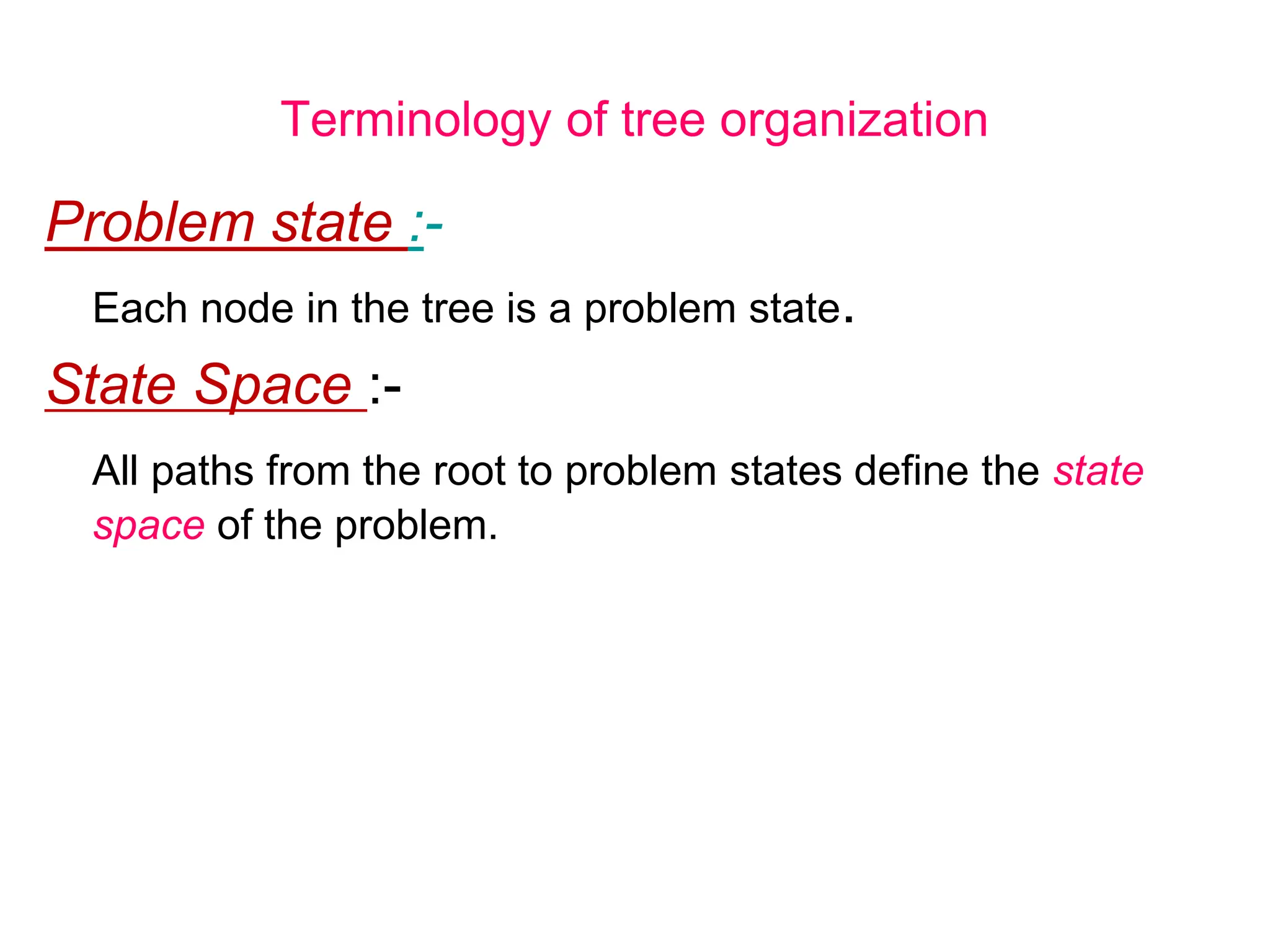
Problem state :-
Each node in the tree is a problem state.
State Space :-
All paths from the root to problem states define the state
space of the problem.
Terminology of tree organization
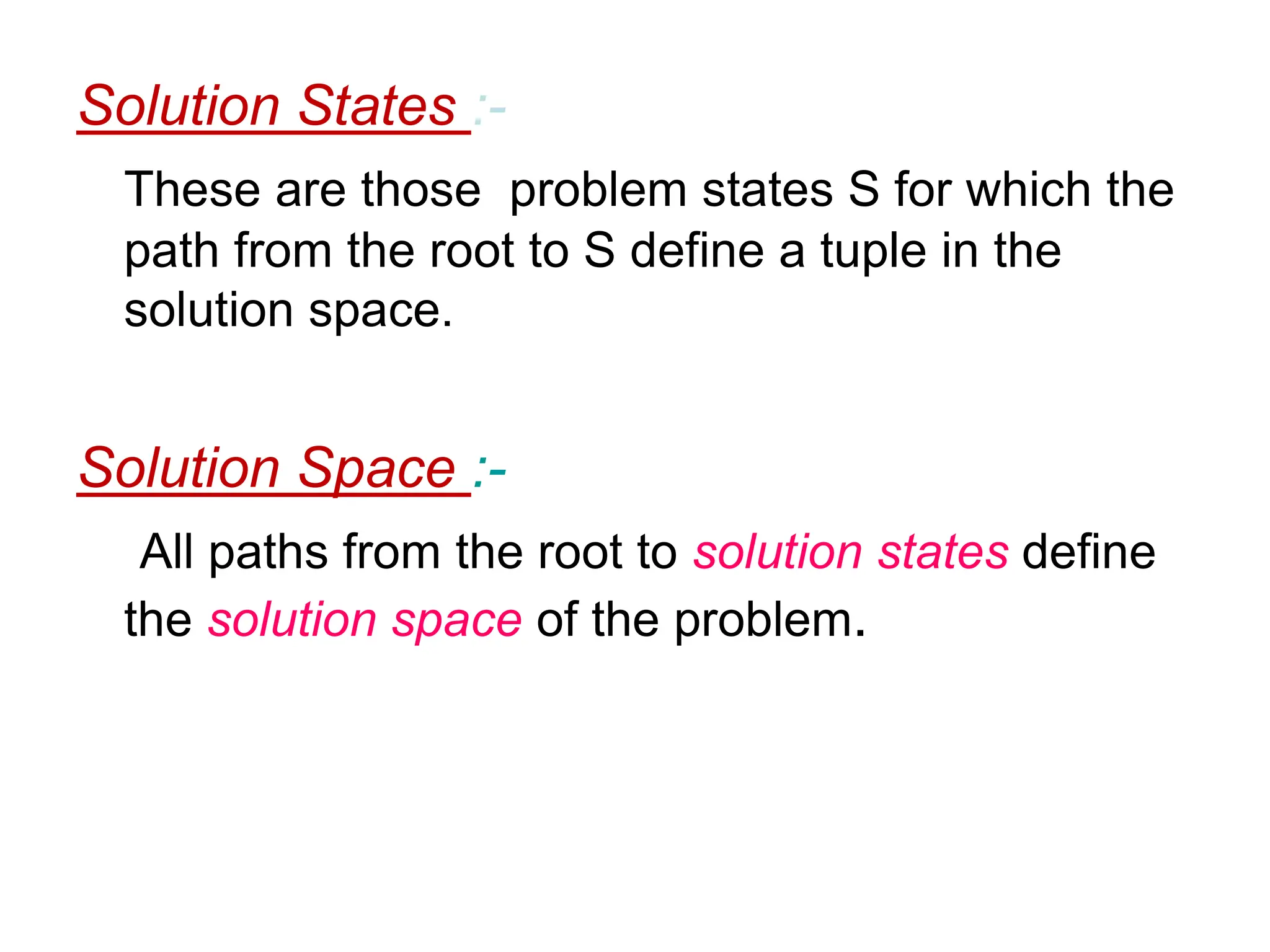
Solution States :-
These are those problem states S for which the
path from the root to S define a tuple in the
solution space.
Solution Space :-
All paths from the root to solution states define
the solution space of the problem.
1
34
18
50
2
8 13 19
3
5 7 12
10 15 17 23
21 26 28 33
31 37 39 44
42 47 9 55
53 58 60 65
63
4 6 11
9 14 16 22
20 25 27 32
30 36 38 43
41 46 48 54
52 57 59 64
62
29 35 40
24 51 56 61
45
X1=1
X1=2 X1=3
X1=4
2 3 4 1 3 4
1 2 4 1 2 3
3 4 2 4 2 3 3 4 1 4 1 3 2 4 1 4 1 2 2 3 1 3 1 2
4 3 4 2 3 2 4 3 4 1 3 1 4 2 4 1 2 1 3 2 3 1 2 1
x2=
x3=
x4=
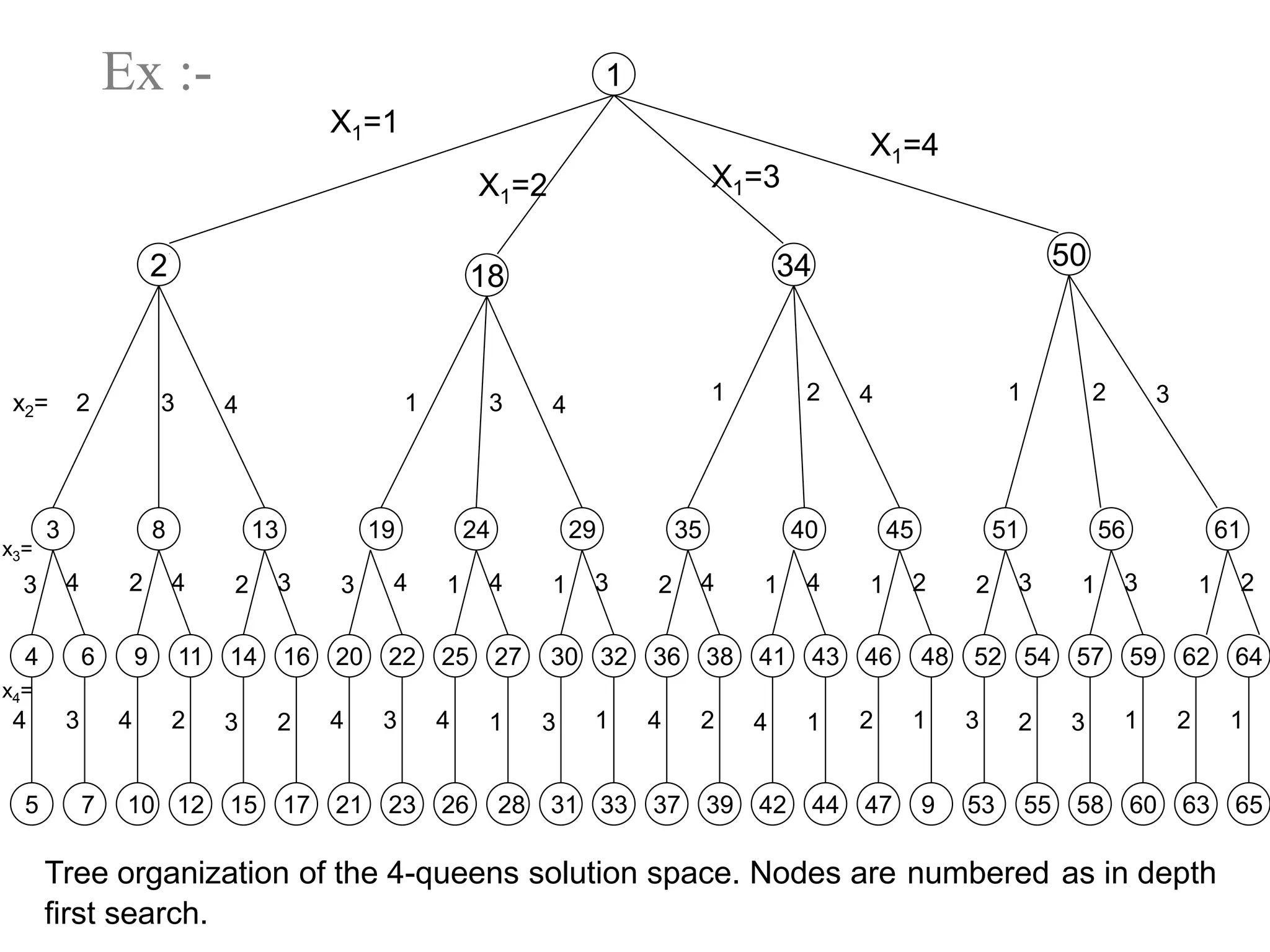
Tree organization of the 4-queens solution space. Nodes are numbered as in depth
first search.
Ex :-
– A node which has been generated and all of whose
children have not yet been generated is called a live
node.
– The live node whose children are currently being
generated is called E-node ( Expanding node ).
– A dead node is a generated node which can not to be
expanded further or all of whose children have been
generated.
Branch And Bound
Nodes will be expanded in three ways.
• FIFO branch and bound-- queue
• LIFO branch and bound-- stack
• Least-Cost (or max priority) branch and bound)—priority
queue.
• Least-cost branch and bound directs the search
to the parts which most likely to contain the answer.
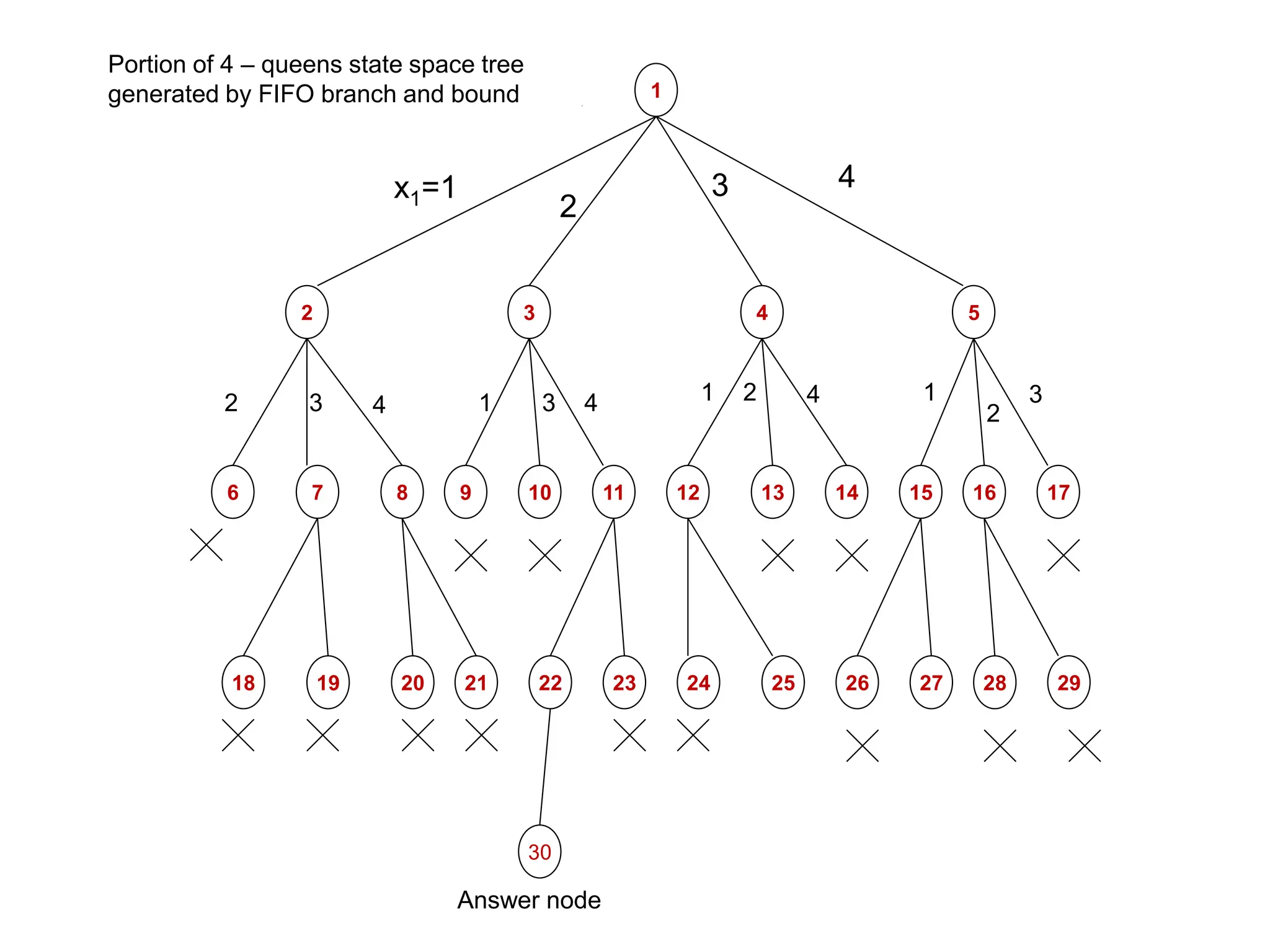
Ex:- 4 – Queens Problem
FIFO Branch And Bound Algorithm
18 19 20 21 22 23 24 25 26 27 28 29
6 7 8 9 10 11 12 13 14 15 16 17
2 3 4 5
1
30
Answer node
Portion of 4 – queens state space tree
generated by FIFO branch and bound
2 3 4 1 3 4 1 2 4 1
2
3
x1=1
2
3 4
 In this case backtracking method is
superior than branch and bound method.
Least Cost ( LC) search :-
• In both FIFO and LIFO branch and bound the selection
rule for the next E-node does not give any preference to
a node that has a very good chance of getting an answer
node quickly.
• In the above example when node 22 is generated, it
should have become obvious that this node will lead to
an answer node in one move.
• However , the FIFO rule first requires the expansion of
all live nodes generated before node 22 was expanded.
• The search for an answer node can be speeded by using
an “intelligent “ ranking function c (.) for live nodes.
• The next E-node is selected on the basis of this ranking
function.
• If we use ranking function that assigns node 22 a better
rank than all other live nodes , then node 22 will become
the E-node following node 29.
^
• The ideal way to assign ranks will be on the basis of the
additional effort ( cost) needed to reach an answer node
from the live node.
For any node x, this could be
1) The number of nodes in the subtree with root x that need
to be generated before an answer node is generated.
OR more simply
2) The number of levels in the subtree with root x that need
to be generated to get an answer node.
Using cost measure 2,
 In the above fig. the cost of the root is 4 ( node 30 is four
levels from node 1) .
 The difficulty with cost functions is that computing the
cost of the node usually involves a search of the subtree
x for an answer node.
 Hence , by the time the cost of a node is determined ,
that subtree has been searched and there is no need to
explore x again. For this reason , search algorithms
usually rank nodes only on the basis of an estimated
cost g( . ) .
^
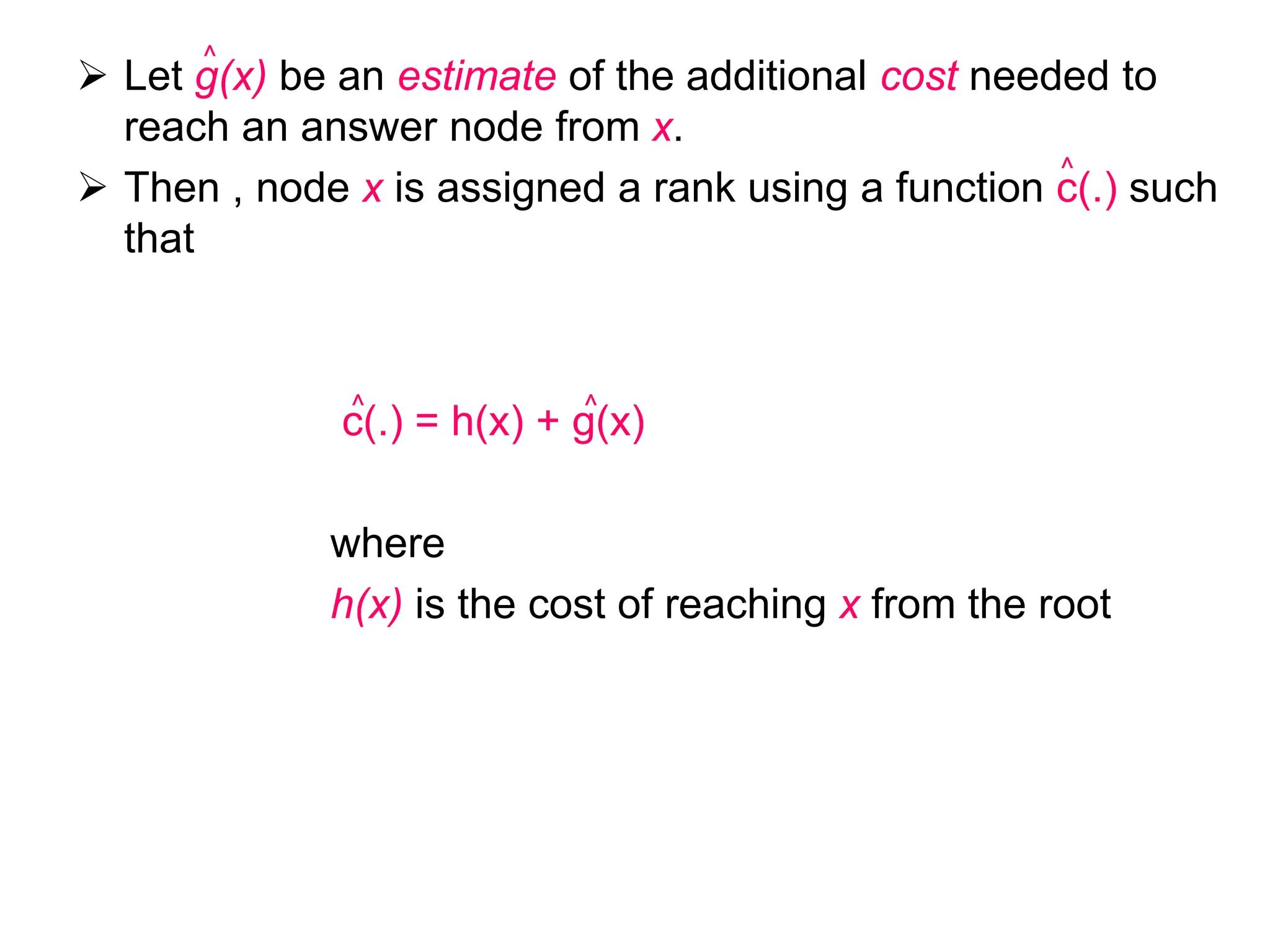
 Let g(x) be an estimate of the additional cost needed to
reach an answer node from x.
 Then , node x is assigned a rank using a function c(.) such
that
c(.) = h(x) + g(x)
where
h(x) is the cost of reaching x from the root
^
^
^ ^
Actual cost function c(.) is defined as follows:
if x is an answer node , then c(x) is the cost of reaching
x from the root .
if x is not an answer node , then c(x)=∞, it means that
subtree with root x contains no answer node.
otherwise c(x) equal to the cost of a minimum cost
node in the subtree with root x.
 c(.) is an approximation to c(.)
^
 A FIFO or LIFO search always generates the state space tree by
levels.
 What we need is more “intelligent” search method .
 We can associate a cost c(x) with each node x in the state space
tree.
 The cost c(x) is the length of a path from the root to a nearest goal
node( if any ) in the subtree with root x.
Thus in the above fig c(1)=c(4)=c(10)=c(23)=3.
 When such a cost function is available, a very efficient search can
be carried out.
 In this search strategy , the only nodes to become E-nodes are
nodes on the path from the root to a nearest goal node.
 Unfortunately, this is an impractical.
We can only compute estimate c(x) of c(x). we can write
c(x)=f(x) +g(x), where f(x) is the length of the path from
the root to node x and g(x) is an estimate of the length
of a shortest path from x to a goal node in the subtree
with root x.
one possible choice for g( x ) is
g( x ) = number of nonblank tiles not in their goal
position.
^
^ ^
^
^
^
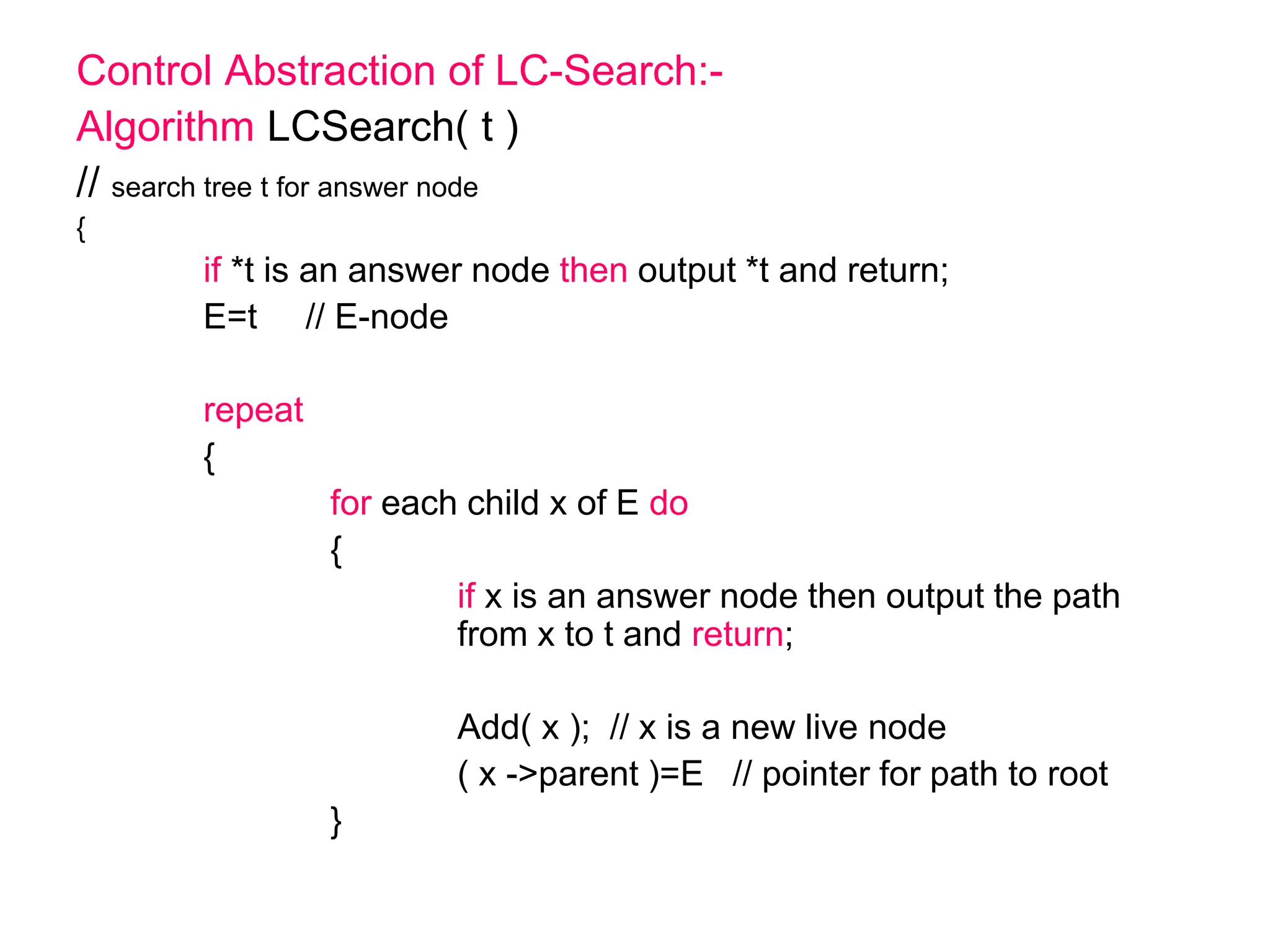
Control Abstraction of LC-Search:-
Algorithm LCSearch( t )
// search tree t for answer node
{
if *t is an answer node then output *t and return;
E=t // E-node
repeat
{
for each child x of E do
{
if x is an answer node then output the path
from x to t and return;
Add( x ); // x is a new live node
( x ->parent )=E // pointer for path to root
}
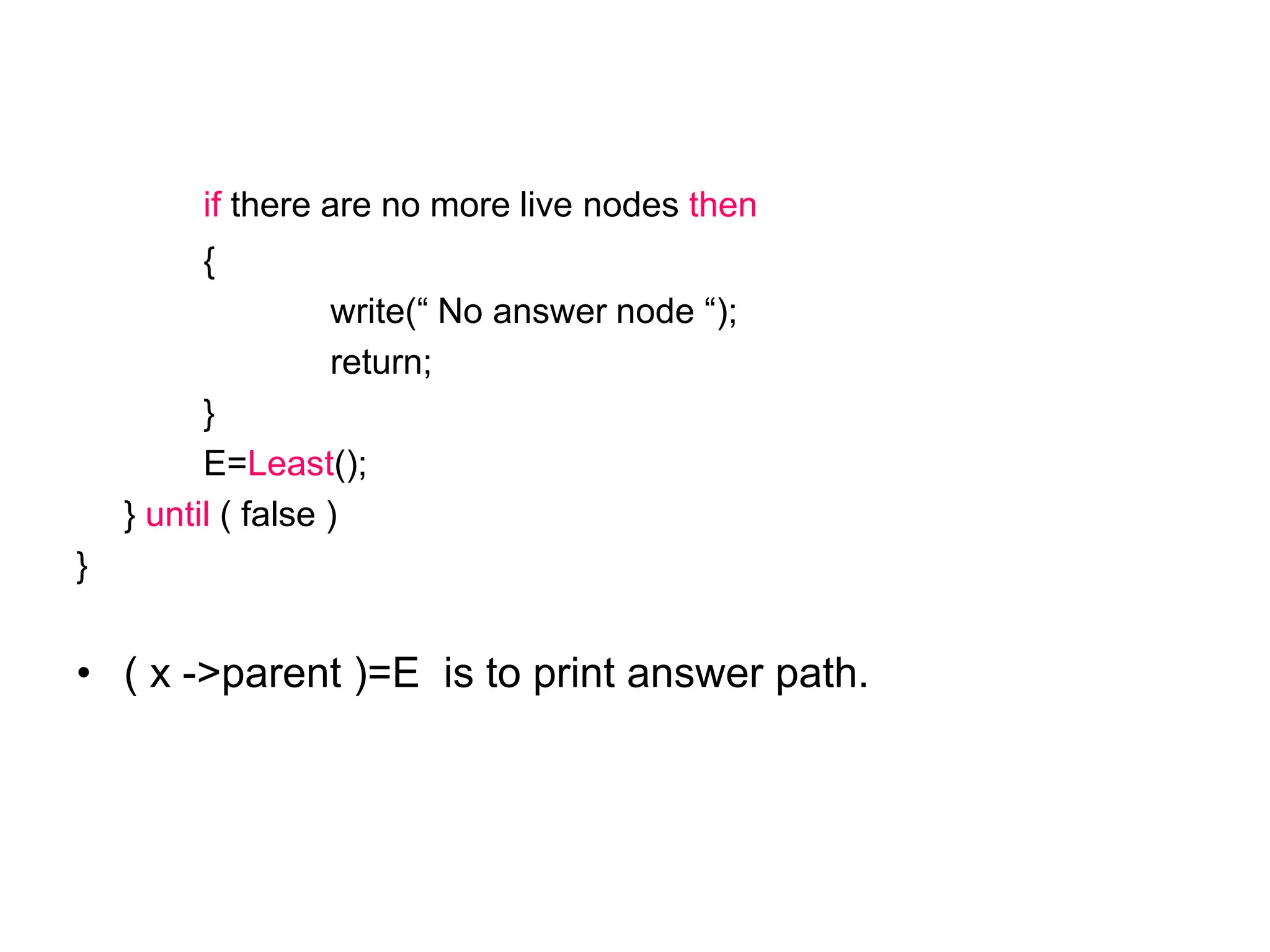
if there are no more live nodes then
{
write(“ No answer node “);
return;
}
E=Least();
} until ( false )
}
• ( x ->parent )=E is to print answer path.
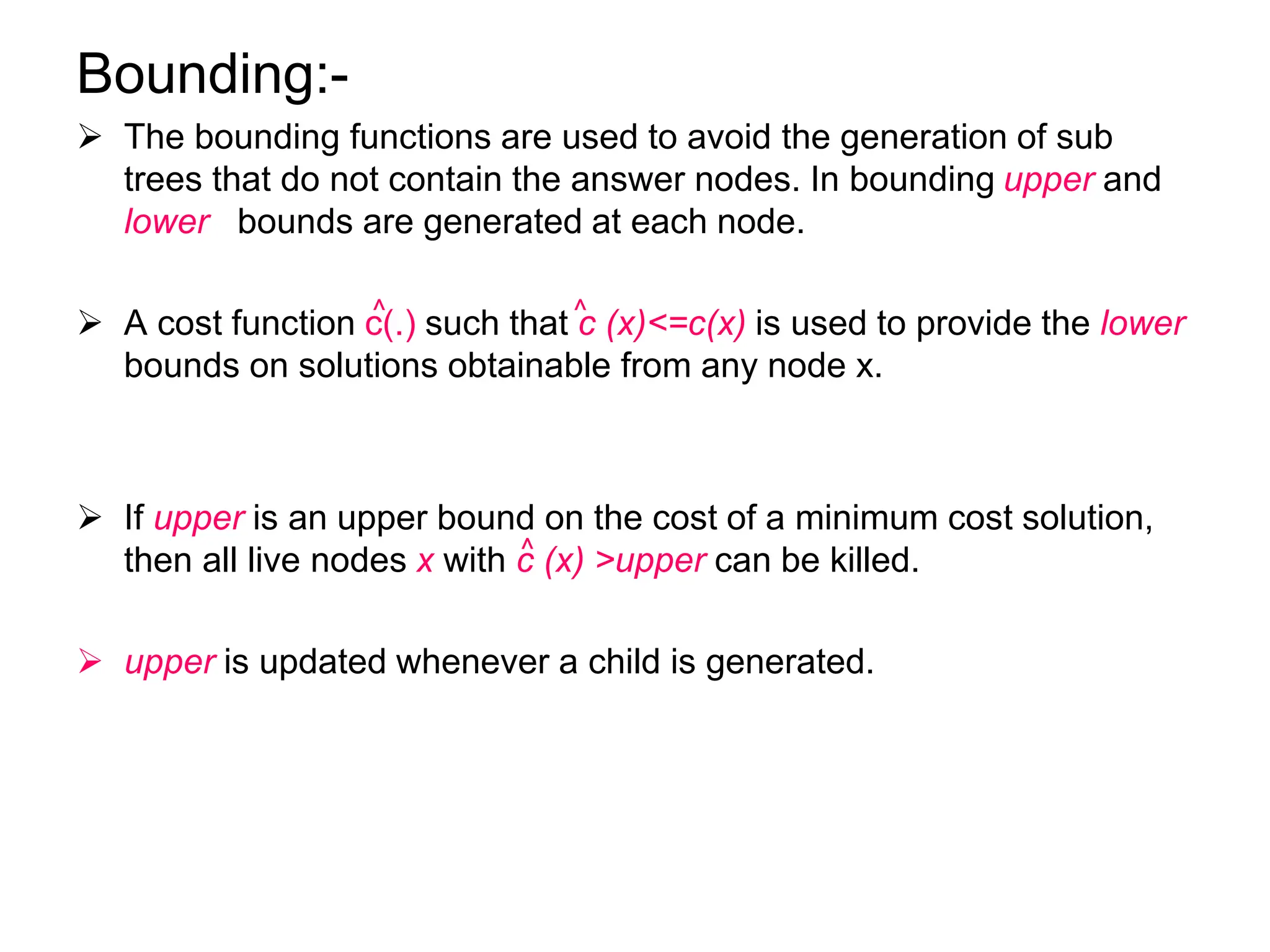
Bounding:-
 The bounding functions are used to avoid the generation of sub
trees that do not contain the answer nodes. In bounding upper and
lower bounds are generated at each node.
 A cost function c(.) such that c (x)<=c(x) is used to provide the lower
bounds on solutions obtainable from any node x.
 If upper is an upper bound on the cost of a minimum cost solution,
then all live nodes x with c (x) >upper can be killed.
 upper is updated whenever a child is generated.
^
^
^
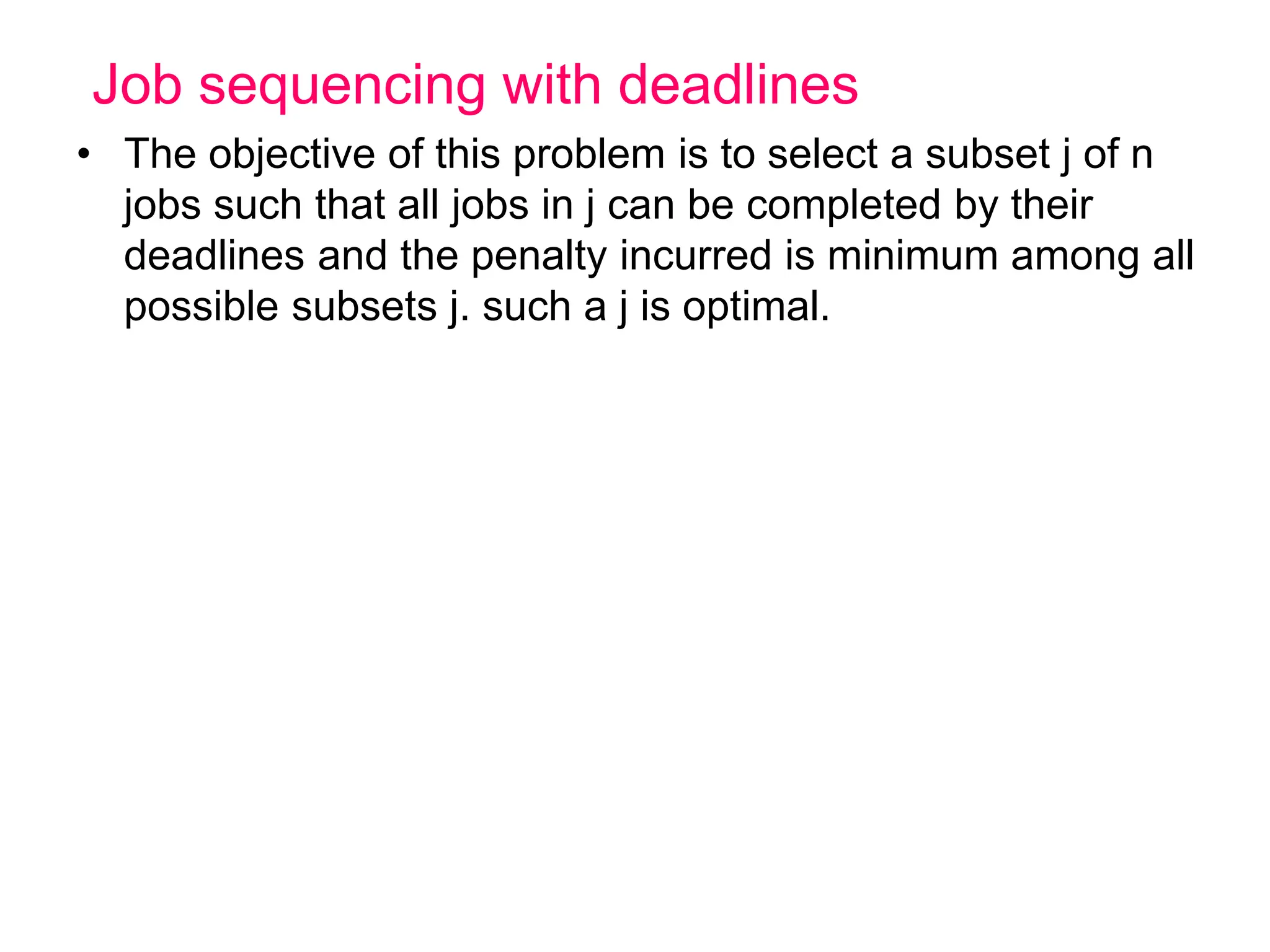
Job sequencing with deadlines
• The objective of this problem is to select a subset j of n
jobs such that all jobs in j can be completed by their
deadlines and the penalty incurred is minimum among all
possible subsets j. such a j is optimal.
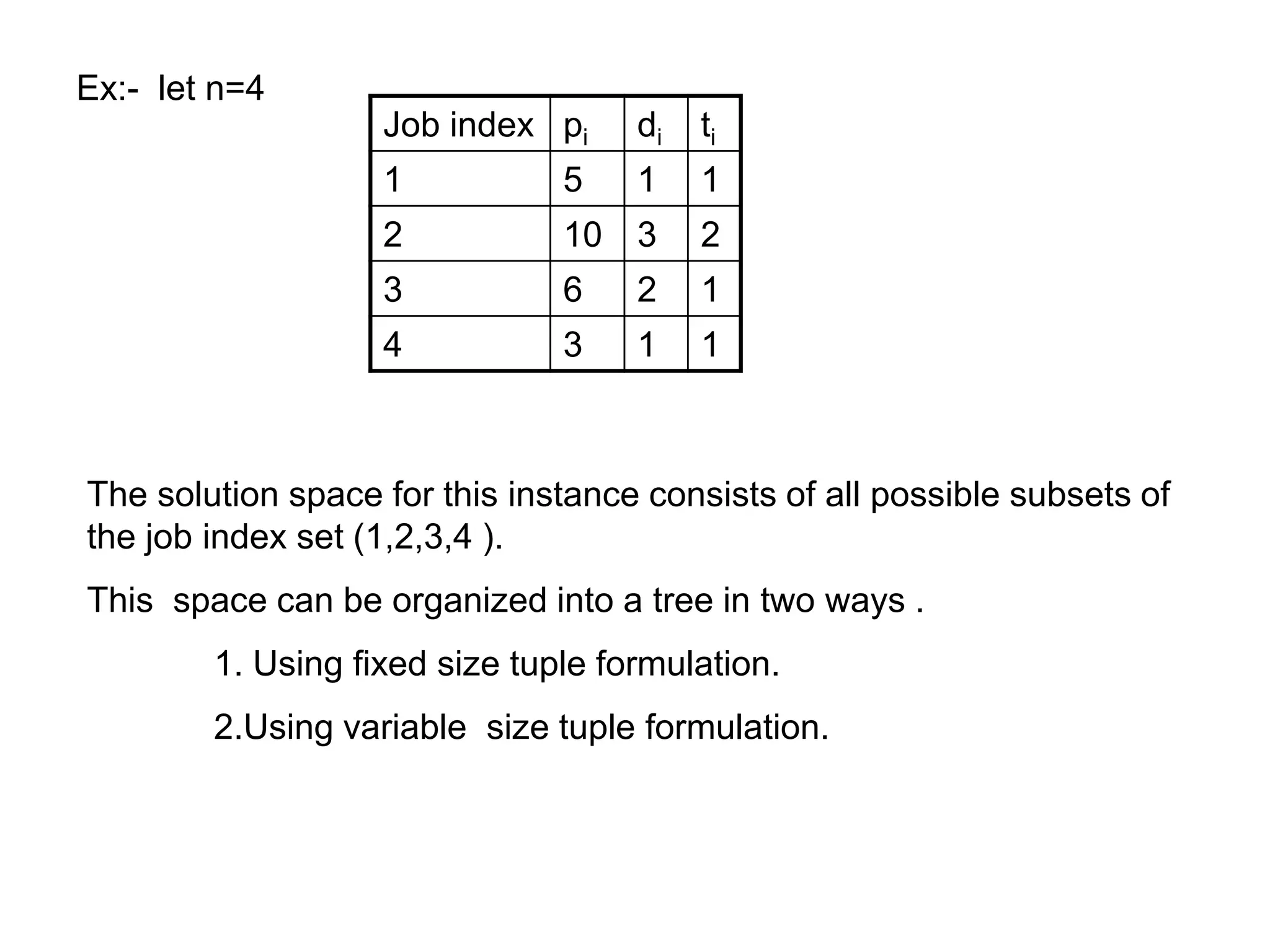
Ex:- let n=4
Job index pi di ti
1 5 1 1
2 10 3 2
3 6 2 1
4 3 1 1
The solution space for this instance consists of all possible subsets of
the job index set (1,2,3,4 ).
This space can be organized into a tree in two ways .
1. Using fixed size tuple formulation.
2.Using variable size tuple formulation.
1
2
3 4
5
6 7
12 14
13
8
9 10
15
11
X1=1 X1=2 X1=3
X1=4
X2=2
X2=3
X2=4
X3=3 X3=4 X3=4
X2=3 X2=4 X2=4
X3=4
C =0
^
C =0
C =0
C =10
C =5 C =15 C =21
C =15
C =11
C =5
^
^
^
^
^
^
^
^
^
U =19
U =24
U =14
U =18
U =21
U =9
U =13
U =8
U =11
U =15
C =8
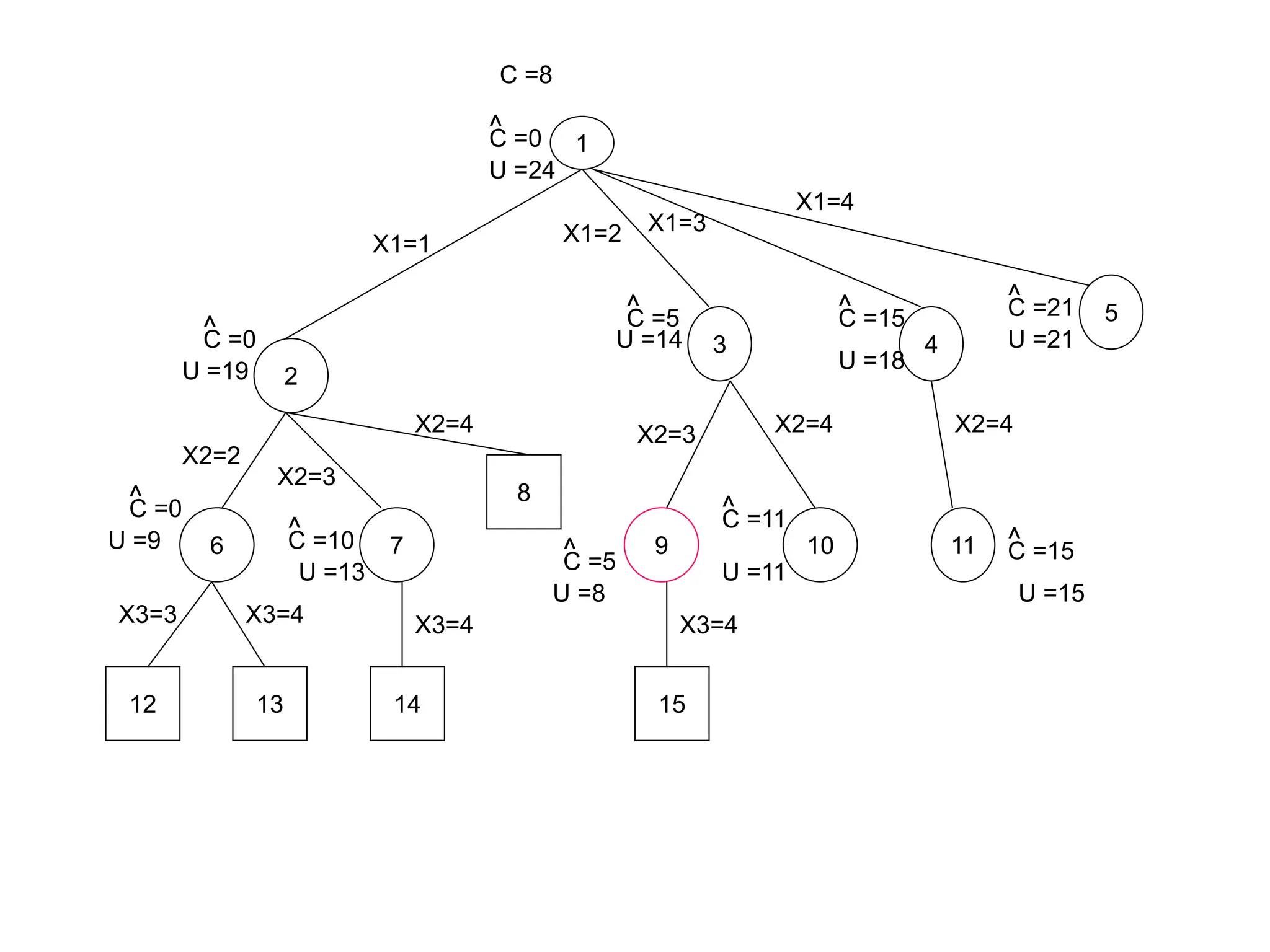
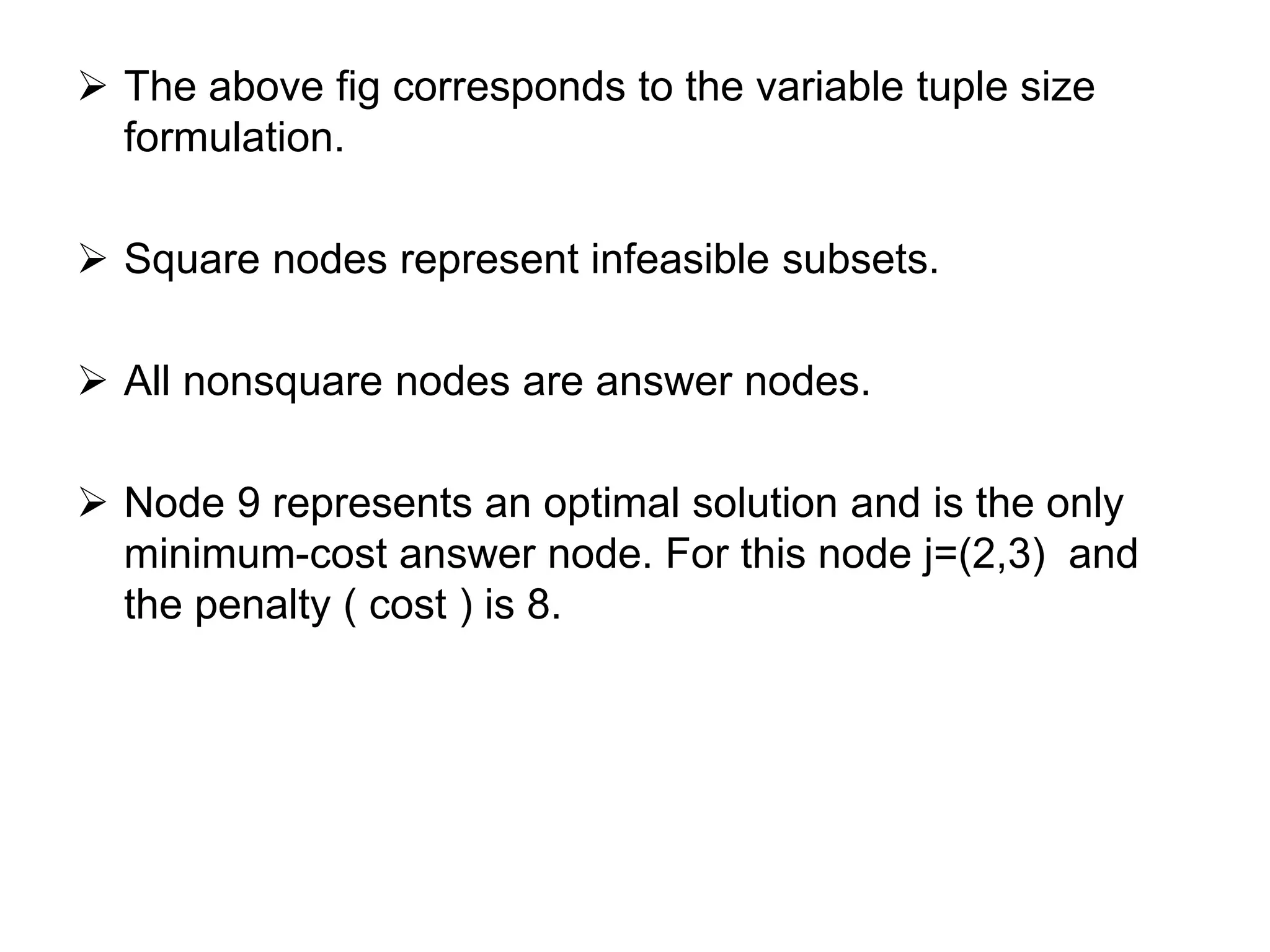
 The above fig corresponds to the variable tuple size
formulation.
 Square nodes represent infeasible subsets.
 All nonsquare nodes are answer nodes.
 Node 9 represents an optimal solution and is the only
minimum-cost answer node. For this node j=(2,3) and
the penalty ( cost ) is 8.
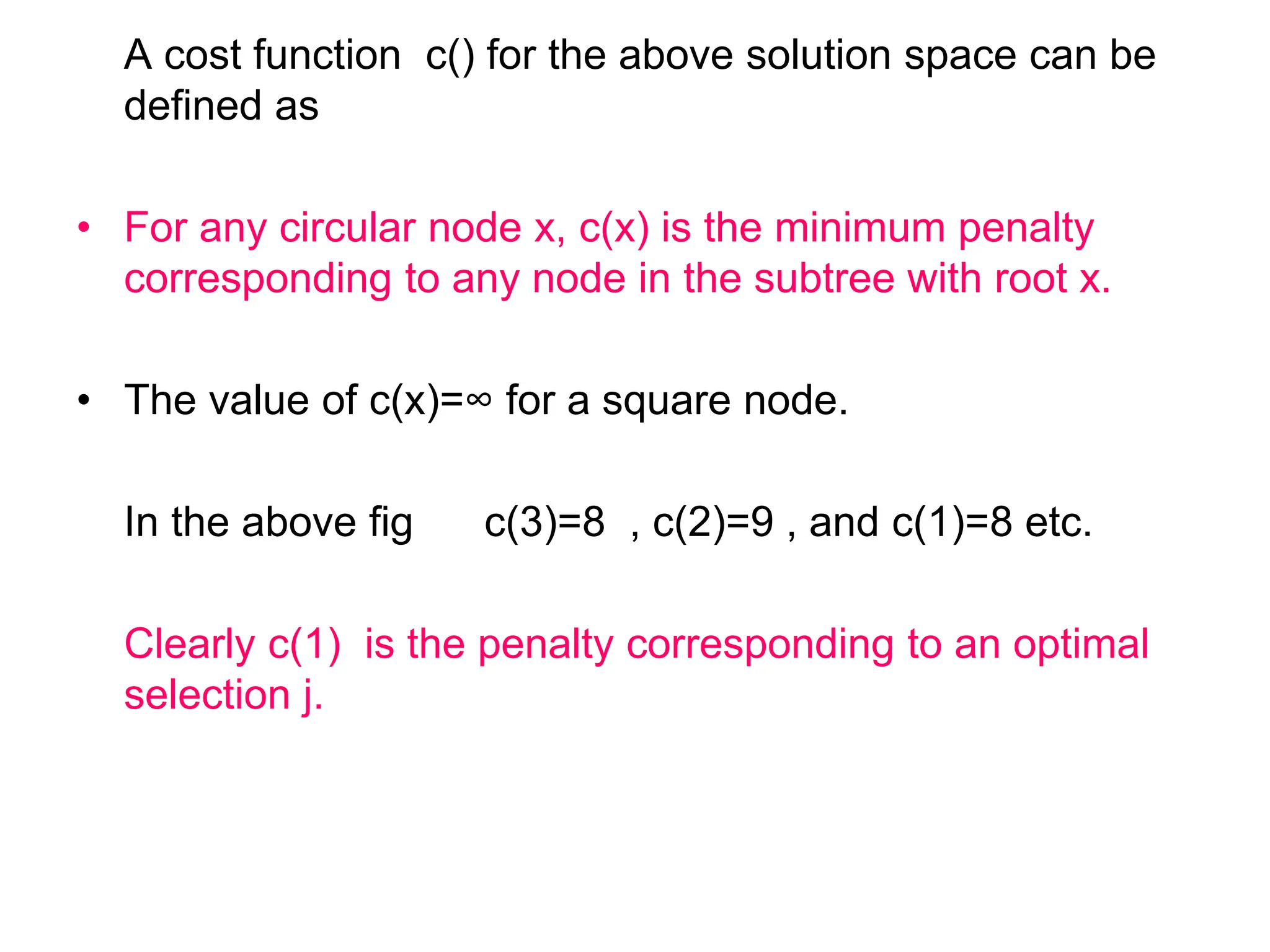
A cost function c() for the above solution space can be
defined as
• For any circular node x, c(x) is the minimum penalty
corresponding to any node in the subtree with root x.
• The value of c(x)=∞ for a square node.
In the above fig c(3)=8 , c(2)=9 , and c(1)=8 etc.
Clearly c(1) is the penalty corresponding to an optimal
selection j.
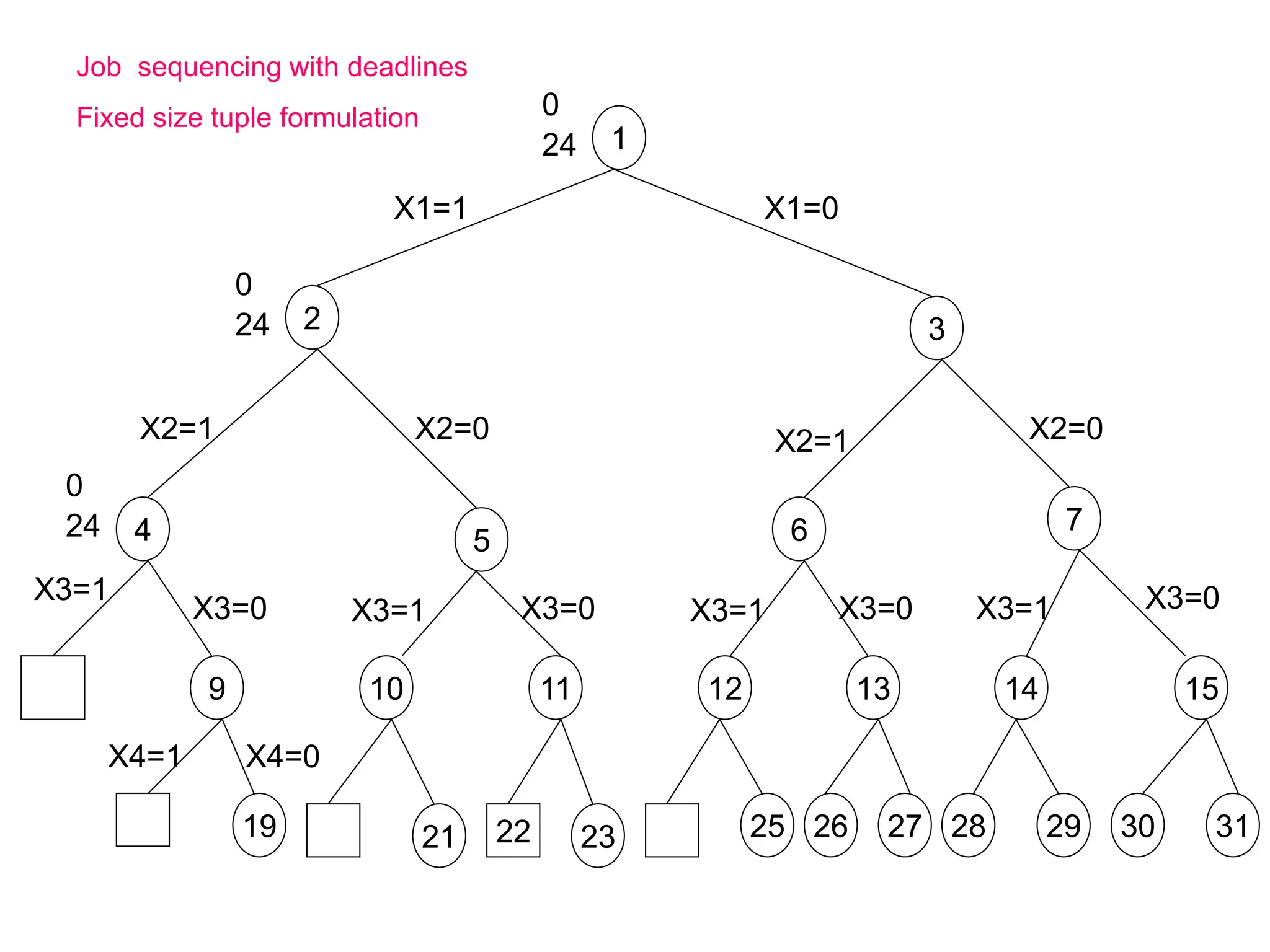
4 5 6 7
2 3
1
9 10 11 12 13 14 15
19 21 22 23 25 26 27 28 29 30 31
24
0
24
0
24
0
X1=1 X1=0
X2=1 X2=0 X2=0
X2=1
X3=1
X3=1 X3=1 X3=1 X3=0
X3=0
X3=0
X4=0
X4=1
X3=0
Job sequencing with deadlines
Fixed size tuple formulation
FIFO Branch and Bound
Refer page no.391
LIFO Branch and Bound
Do it yourself.
LC Branch and Bound
Refer page no.392
0/1 Knapsack Problem
 Generally Branch and Bound will minimize the objective
function.
 The 0/1 knapsack problem is a maximization problem.
 This difficulty can be avoided by replacing the objective
function ∑ pixi by - ∑ pixi .
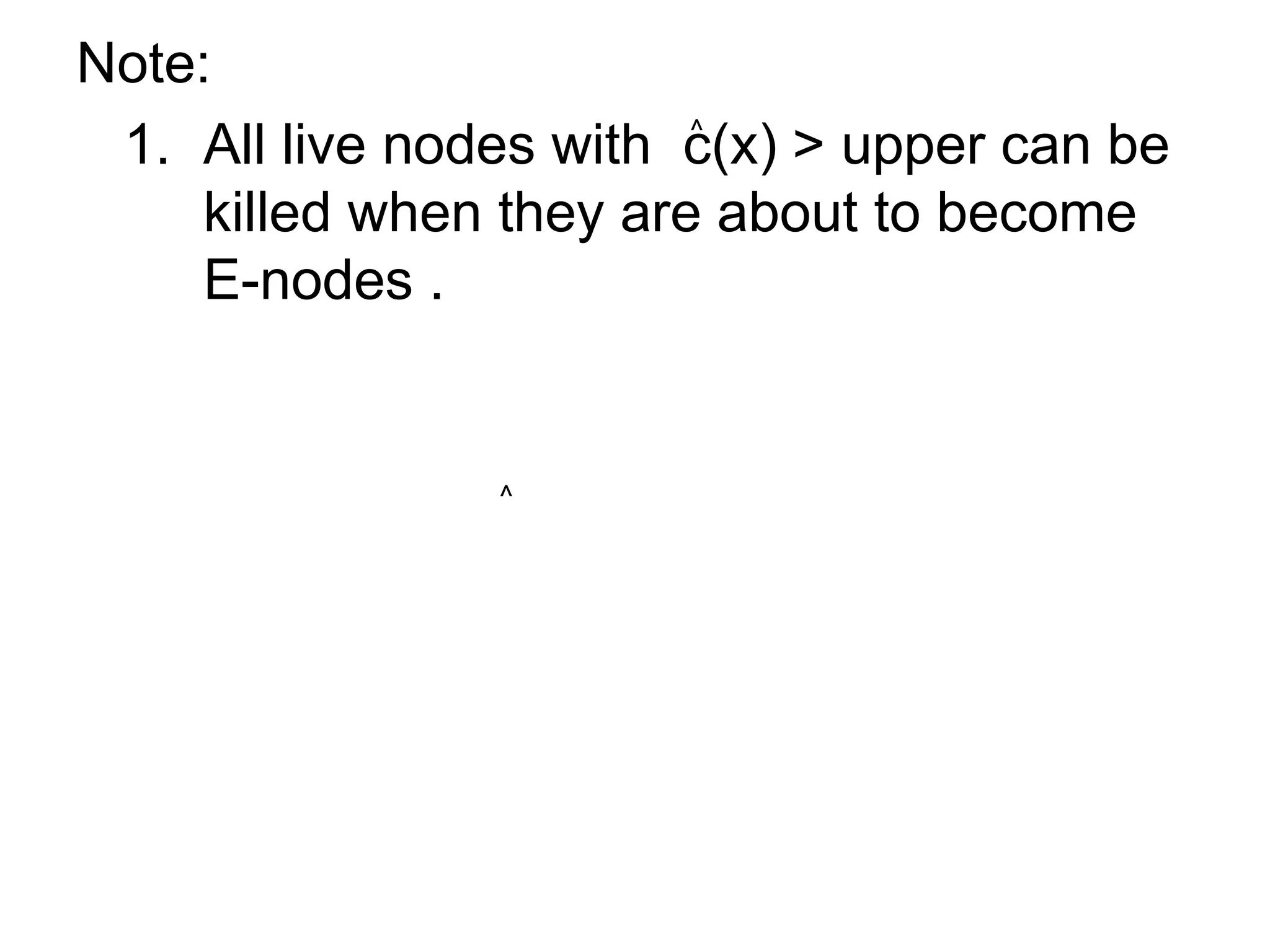
Note:
1. All live nodes with c(x) > upper can be
killed when they are about to become
E-nodes .
^
^
1
2 3
7
8 9
4
6
5
-38
-32
-38
-32
-38
-32
-38
-32 -38
-38
-38
-38
-20
-20
-32
-22
-22
-36
Upper number = c
Lower number = u
^
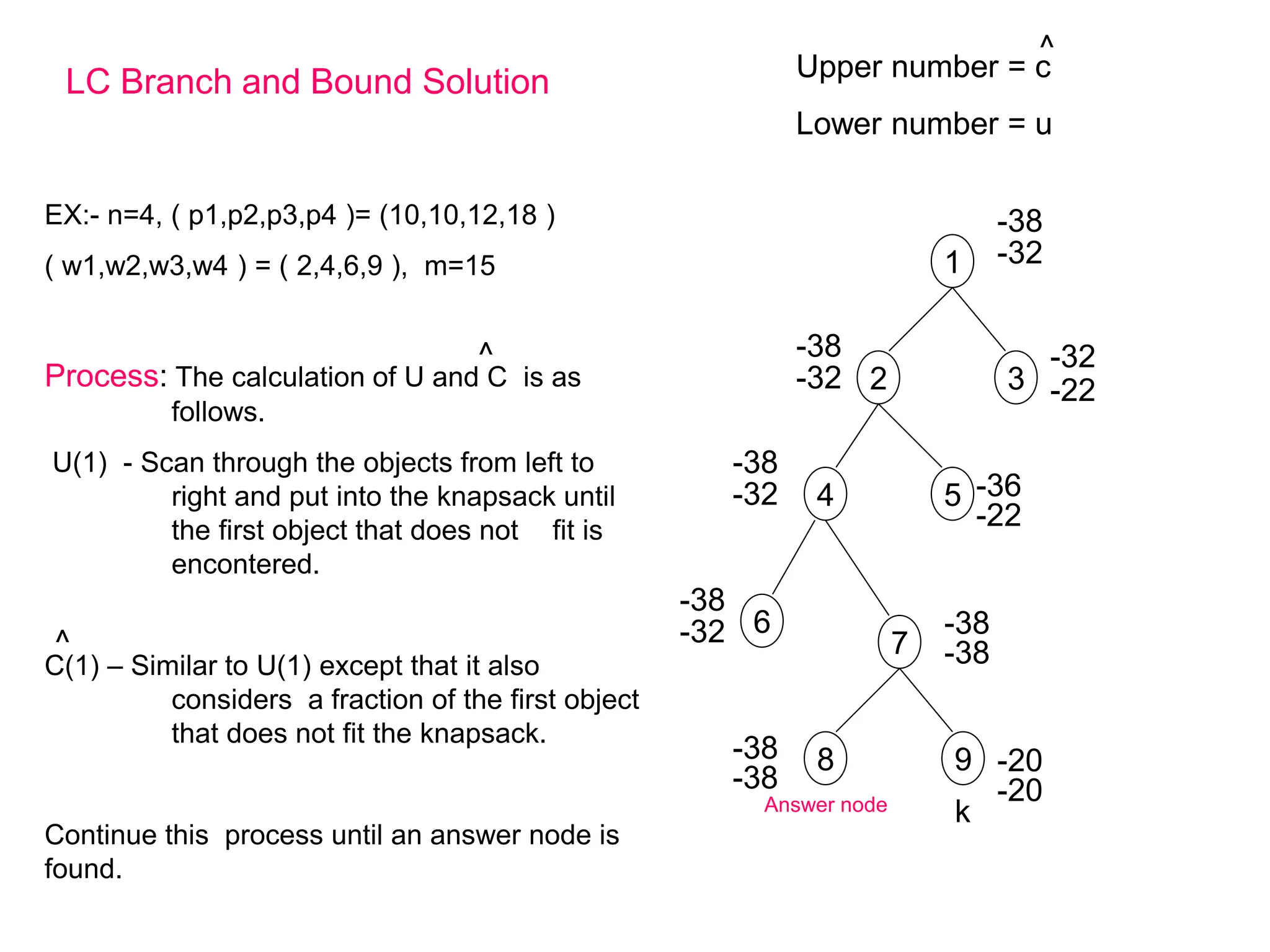
LC Branch and Bound Solution
k
Answer node
EX:- n=4, ( p1,p2,p3,p4 )= (10,10,12,18 )
( w1,w2,w3,w4 ) = ( 2,4,6,9 ), m=15
Process: The calculation of U and C is as
follows.
U(1) - Scan through the objects from left to
right and put into the knapsack until
the first object that does not fit is
encontered.
C(1) – Similar to U(1) except that it also
considers a fraction of the first object
that does not fit the knapsack.
Continue this process until an answer node is
found.
^
^
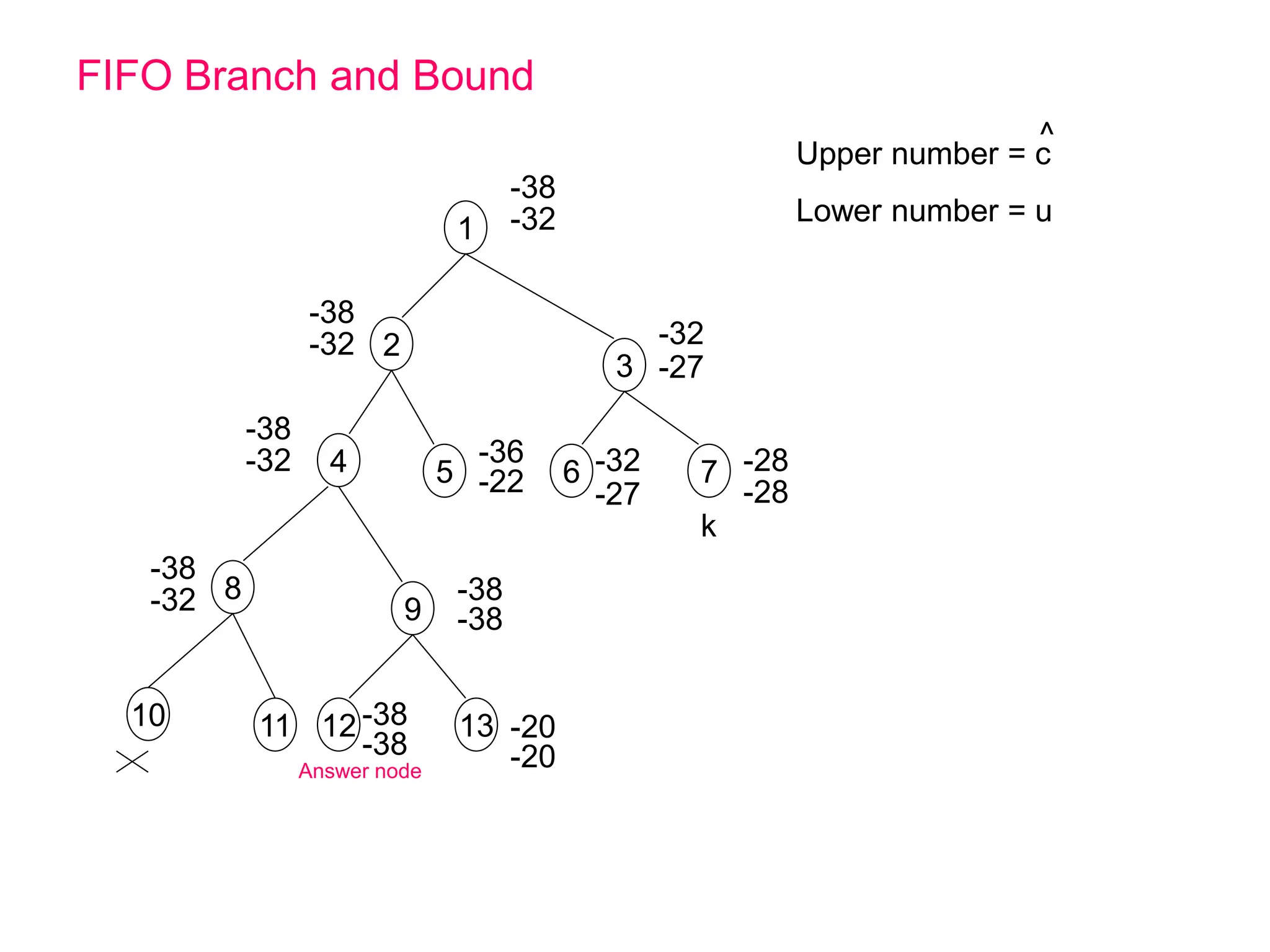
FIFO Branch and Bound
1
2
3
9
12 13
4
8
5
-38
-32
-38
-32
-38
-32
-38
-32 -38
-38
-38
-38
-20
-20
-32
-27
-22
-36
6 7
10 11
-32
-27
k
-28
-28
Upper number = c
Lower number = u
^
Answer node
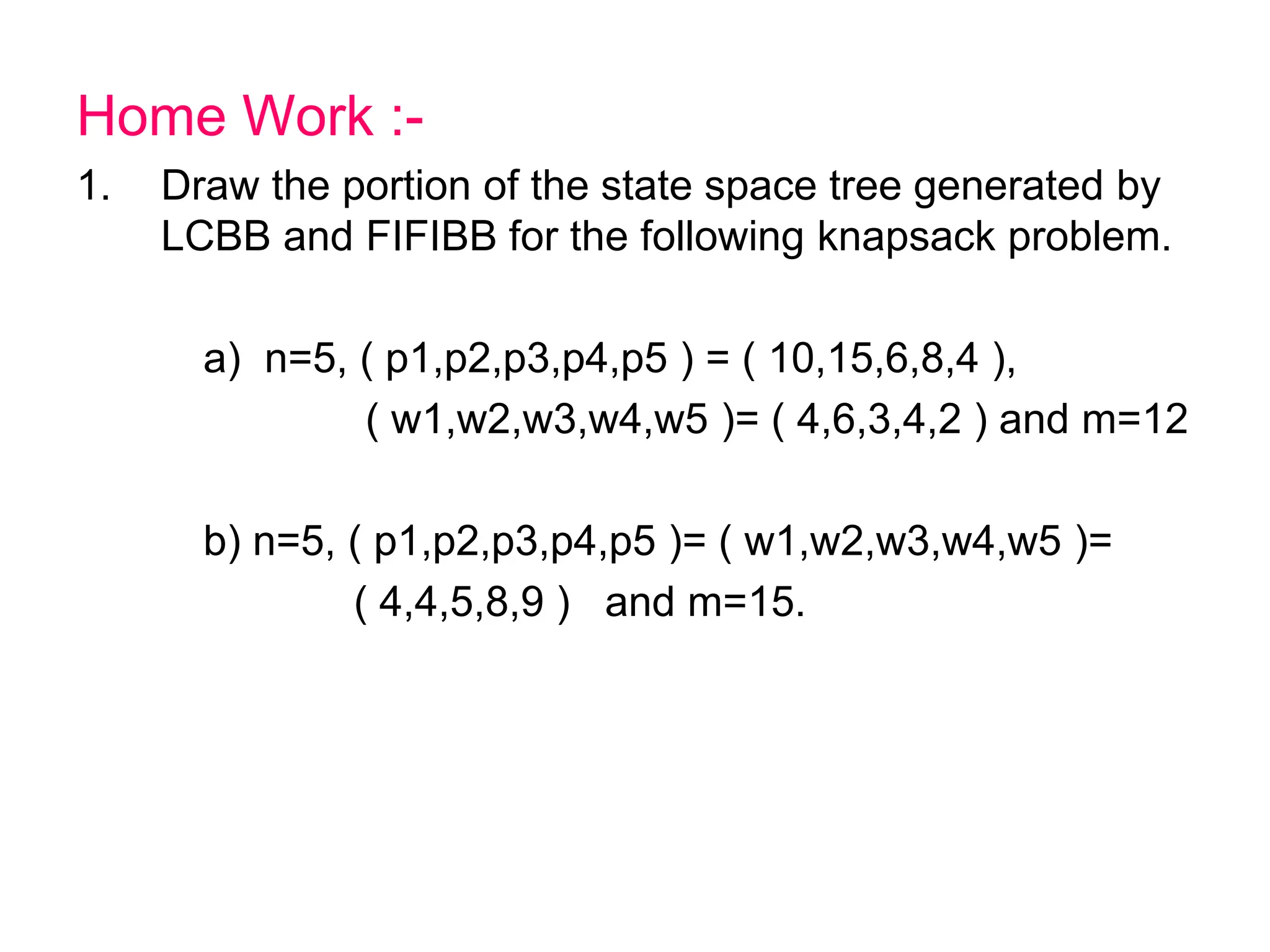
Home Work :-
1. Draw the portion of the state space tree generated by
LCBB and FIFIBB for the following knapsack problem.
a) n=5, ( p1,p2,p3,p4,p5 ) = ( 10,15,6,8,4 ),
( w1,w2,w3,w4,w5 )= ( 4,6,3,4,2 ) and m=12
b) n=5, ( p1,p2,p3,p4,p5 )= ( w1,w2,w3,w4,w5 )=
( 4,4,5,8,9 ) and m=15.

designanalysisalgorithm_unit-v-part2.pptx

  • 1.
    Branch and Bound (unit-vii )  Backtracking is effective for subset or permutation problems.  Backtracking is not good for optimization problems.  This drawback is rectified by using Branch And Bound technique.  Branch And Bound is applicable for only optimization problems.  Branch and Bound also uses bounding function similar to backtracking.
  • 2.
    Problem state :- Eachnode in the tree is a problem state. State Space :- All paths from the root to problem states define the state space of the problem. Terminology of tree organization
  • 3.
    Solution States :- Theseare those problem states S for which the path from the root to S define a tuple in the solution space. Solution Space :- All paths from the root to solution states define the solution space of the problem.
  • 4.
    1 34 18 50 2 8 13 19 3 57 12 10 15 17 23 21 26 28 33 31 37 39 44 42 47 9 55 53 58 60 65 63 4 6 11 9 14 16 22 20 25 27 32 30 36 38 43 41 46 48 54 52 57 59 64 62 29 35 40 24 51 56 61 45 X1=1 X1=2 X1=3 X1=4 2 3 4 1 3 4 1 2 4 1 2 3 3 4 2 4 2 3 3 4 1 4 1 3 2 4 1 4 1 2 2 3 1 3 1 2 4 3 4 2 3 2 4 3 4 1 3 1 4 2 4 1 2 1 3 2 3 1 2 1 x2= x3= x4= Tree organization of the 4-queens solution space. Nodes are numbered as in depth first search. Ex :-
  • 5.
    – A nodewhich has been generated and all of whose children have not yet been generated is called a live node. – The live node whose children are currently being generated is called E-node ( Expanding node ). – A dead node is a generated node which can not to be expanded further or all of whose children have been generated.
  • 6.
    Branch And Bound Nodeswill be expanded in three ways. • FIFO branch and bound-- queue • LIFO branch and bound-- stack • Least-Cost (or max priority) branch and bound)—priority queue.
  • 7.
    • Least-cost branchand bound directs the search to the parts which most likely to contain the answer.
  • 8.
    Ex:- 4 –Queens Problem FIFO Branch And Bound Algorithm
  • 9.
    18 19 2021 22 23 24 25 26 27 28 29 6 7 8 9 10 11 12 13 14 15 16 17 2 3 4 5 1 30 Answer node Portion of 4 – queens state space tree generated by FIFO branch and bound 2 3 4 1 3 4 1 2 4 1 2 3 x1=1 2 3 4
  • 10.
     In thiscase backtracking method is superior than branch and bound method.
  • 11.
    Least Cost (LC) search :- • In both FIFO and LIFO branch and bound the selection rule for the next E-node does not give any preference to a node that has a very good chance of getting an answer node quickly. • In the above example when node 22 is generated, it should have become obvious that this node will lead to an answer node in one move. • However , the FIFO rule first requires the expansion of all live nodes generated before node 22 was expanded.
  • 12.
    • The searchfor an answer node can be speeded by using an “intelligent “ ranking function c (.) for live nodes. • The next E-node is selected on the basis of this ranking function. • If we use ranking function that assigns node 22 a better rank than all other live nodes , then node 22 will become the E-node following node 29. ^
  • 13.
    • The idealway to assign ranks will be on the basis of the additional effort ( cost) needed to reach an answer node from the live node. For any node x, this could be 1) The number of nodes in the subtree with root x that need to be generated before an answer node is generated. OR more simply 2) The number of levels in the subtree with root x that need to be generated to get an answer node. Using cost measure 2,  In the above fig. the cost of the root is 4 ( node 30 is four levels from node 1) .
  • 14.
     The difficultywith cost functions is that computing the cost of the node usually involves a search of the subtree x for an answer node.  Hence , by the time the cost of a node is determined , that subtree has been searched and there is no need to explore x again. For this reason , search algorithms usually rank nodes only on the basis of an estimated cost g( . ) . ^
  • 15.
     Let g(x)be an estimate of the additional cost needed to reach an answer node from x.  Then , node x is assigned a rank using a function c(.) such that c(.) = h(x) + g(x) where h(x) is the cost of reaching x from the root ^ ^ ^ ^
  • 16.
    Actual cost functionc(.) is defined as follows: if x is an answer node , then c(x) is the cost of reaching x from the root . if x is not an answer node , then c(x)=∞, it means that subtree with root x contains no answer node. otherwise c(x) equal to the cost of a minimum cost node in the subtree with root x.  c(.) is an approximation to c(.) ^
  • 17.
     A FIFOor LIFO search always generates the state space tree by levels.  What we need is more “intelligent” search method .  We can associate a cost c(x) with each node x in the state space tree.  The cost c(x) is the length of a path from the root to a nearest goal node( if any ) in the subtree with root x. Thus in the above fig c(1)=c(4)=c(10)=c(23)=3.  When such a cost function is available, a very efficient search can be carried out.  In this search strategy , the only nodes to become E-nodes are nodes on the path from the root to a nearest goal node.
  • 18.
     Unfortunately, thisis an impractical. We can only compute estimate c(x) of c(x). we can write c(x)=f(x) +g(x), where f(x) is the length of the path from the root to node x and g(x) is an estimate of the length of a shortest path from x to a goal node in the subtree with root x. one possible choice for g( x ) is g( x ) = number of nonblank tiles not in their goal position. ^ ^ ^ ^ ^ ^
  • 19.
    Control Abstraction ofLC-Search:- Algorithm LCSearch( t ) // search tree t for answer node { if *t is an answer node then output *t and return; E=t // E-node repeat { for each child x of E do { if x is an answer node then output the path from x to t and return; Add( x ); // x is a new live node ( x ->parent )=E // pointer for path to root }
  • 20.
    if there areno more live nodes then { write(“ No answer node “); return; } E=Least(); } until ( false ) } • ( x ->parent )=E is to print answer path.
  • 21.
    Bounding:-  The boundingfunctions are used to avoid the generation of sub trees that do not contain the answer nodes. In bounding upper and lower bounds are generated at each node.  A cost function c(.) such that c (x)<=c(x) is used to provide the lower bounds on solutions obtainable from any node x.  If upper is an upper bound on the cost of a minimum cost solution, then all live nodes x with c (x) >upper can be killed.  upper is updated whenever a child is generated. ^ ^ ^
  • 22.
    Job sequencing withdeadlines • The objective of this problem is to select a subset j of n jobs such that all jobs in j can be completed by their deadlines and the penalty incurred is minimum among all possible subsets j. such a j is optimal.
  • 23.
    Ex:- let n=4 Jobindex pi di ti 1 5 1 1 2 10 3 2 3 6 2 1 4 3 1 1 The solution space for this instance consists of all possible subsets of the job index set (1,2,3,4 ). This space can be organized into a tree in two ways . 1. Using fixed size tuple formulation. 2.Using variable size tuple formulation.
  • 24.
    1 2 3 4 5 6 7 1214 13 8 9 10 15 11 X1=1 X1=2 X1=3 X1=4 X2=2 X2=3 X2=4 X3=3 X3=4 X3=4 X2=3 X2=4 X2=4 X3=4 C =0 ^ C =0 C =0 C =10 C =5 C =15 C =21 C =15 C =11 C =5 ^ ^ ^ ^ ^ ^ ^ ^ ^ U =19 U =24 U =14 U =18 U =21 U =9 U =13 U =8 U =11 U =15 C =8
  • 25.
     The abovefig corresponds to the variable tuple size formulation.  Square nodes represent infeasible subsets.  All nonsquare nodes are answer nodes.  Node 9 represents an optimal solution and is the only minimum-cost answer node. For this node j=(2,3) and the penalty ( cost ) is 8.
  • 26.
    A cost functionc() for the above solution space can be defined as • For any circular node x, c(x) is the minimum penalty corresponding to any node in the subtree with root x. • The value of c(x)=∞ for a square node. In the above fig c(3)=8 , c(2)=9 , and c(1)=8 etc. Clearly c(1) is the penalty corresponding to an optimal selection j.
  • 27.
    4 5 67 2 3 1 9 10 11 12 13 14 15 19 21 22 23 25 26 27 28 29 30 31 24 0 24 0 24 0 X1=1 X1=0 X2=1 X2=0 X2=0 X2=1 X3=1 X3=1 X3=1 X3=1 X3=0 X3=0 X3=0 X4=0 X4=1 X3=0 Job sequencing with deadlines Fixed size tuple formulation
  • 28.
    FIFO Branch andBound Refer page no.391
  • 29.
    LIFO Branch andBound Do it yourself.
  • 30.
    LC Branch andBound Refer page no.392
  • 31.
    0/1 Knapsack Problem Generally Branch and Bound will minimize the objective function.  The 0/1 knapsack problem is a maximization problem.  This difficulty can be avoided by replacing the objective function ∑ pixi by - ∑ pixi .
  • 32.
    Note: 1. All livenodes with c(x) > upper can be killed when they are about to become E-nodes . ^ ^
  • 33.
    1 2 3 7 8 9 4 6 5 -38 -32 -38 -32 -38 -32 -38 -32-38 -38 -38 -38 -20 -20 -32 -22 -22 -36 Upper number = c Lower number = u ^ LC Branch and Bound Solution k Answer node EX:- n=4, ( p1,p2,p3,p4 )= (10,10,12,18 ) ( w1,w2,w3,w4 ) = ( 2,4,6,9 ), m=15 Process: The calculation of U and C is as follows. U(1) - Scan through the objects from left to right and put into the knapsack until the first object that does not fit is encontered. C(1) – Similar to U(1) except that it also considers a fraction of the first object that does not fit the knapsack. Continue this process until an answer node is found. ^ ^
  • 34.
    FIFO Branch andBound 1 2 3 9 12 13 4 8 5 -38 -32 -38 -32 -38 -32 -38 -32 -38 -38 -38 -38 -20 -20 -32 -27 -22 -36 6 7 10 11 -32 -27 k -28 -28 Upper number = c Lower number = u ^ Answer node
  • 35.
    Home Work :- 1.Draw the portion of the state space tree generated by LCBB and FIFIBB for the following knapsack problem. a) n=5, ( p1,p2,p3,p4,p5 ) = ( 10,15,6,8,4 ), ( w1,w2,w3,w4,w5 )= ( 4,6,3,4,2 ) and m=12 b) n=5, ( p1,p2,p3,p4,p5 )= ( w1,w2,w3,w4,w5 )= ( 4,4,5,8,9 ) and m=15.