Design Thinking
The Hill School
December 2013
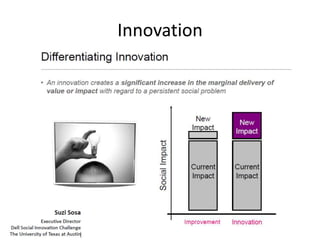
Innovation
• Design Thinking for Educators Toolkit from
IDEO
Human Centered Design Toolkit from IDEO
Design Thinking
Design Thinking
Design Thinking
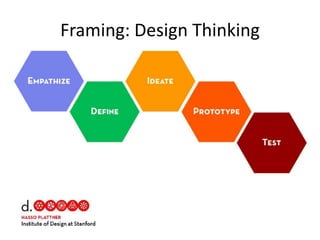
Framing: Design Thinking
Design Thinking

Build to think and launch to learn.
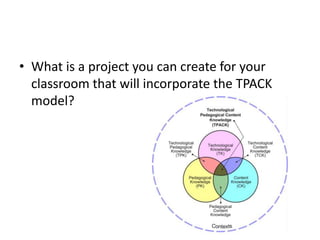
• What is a project you can create for your
classroom that will incorporate the TPACK
model?
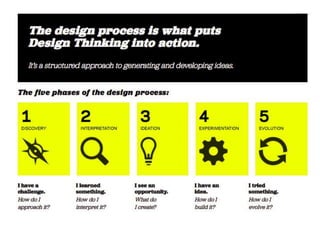
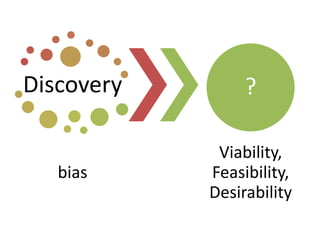
Discovery

?

bias

Viability,
Feasibility,
Desirability
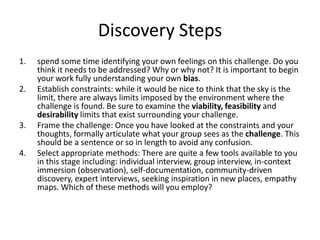
Discovery Steps
1.
2.

3.
4.

spend some time identifying your own feelings on this challenge. Do you
think it needs to be addressed? Why or why not? It is important to begin
your work fully understanding your own bias.
Establish constraints: while it would be nice to think that the sky is the
limit, there are always limits imposed by the environment where the
challenge is found. Be sure to examine the viability, feasibility and
desirability limits that exist surrounding your challenge.
Frame the challenge: Once you have looked at the constraints and your
thoughts, formally articulate what your group sees as the challenge. This
should be a sentence or so in length to avoid any confusion.
Select appropriate methods: There are quite a few tools available to you
in this stage including: individual interview, group interview, in-context
immersion (observation), self-documentation, community-driven
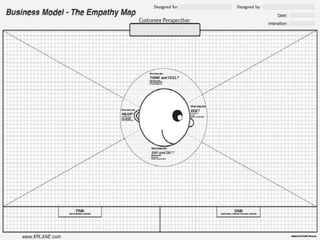
discovery, expert interviews, seeking inspiration in new places, empathy
maps. Which of these methods will you employ?
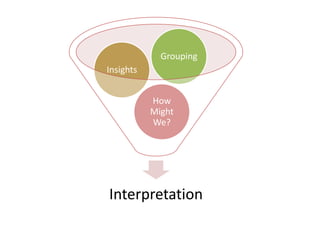
Grouping
Insights
How
Might
We?

Interpretation
Design Thinking Exercise
In the traditional Design Thinking sequence, the
discovery stage also includes extensive research.
The next stage, Interpretation, involves the
sorting and grouping of this research in order to
determine insights and develop a “how might
we question.”
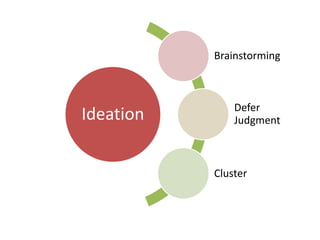
Brainstorming

Ideation

Defer
Judgment

Cluster
Design Thinking Exercise
Ideation Stage: In this stage, the sky is the limit. Sometimes that can be the challenge in itself
because many people want to limit their thinking or edit their ideas or the ideas or others. The
big challenge here will be to stick to “green light” thinking and just generate ideas. There are no
bad ideas at this point and you need to remain open-minded in order to find the next innovation.
This is a good exercise because we often encourage our students to brainstorm, but how often do
we model this?
Process: Begin brainstorming: Follow these rules of brainstorming as you work through a session
with your group to determine what possible solutions to your challenge may be. Be sure to have
someone recorded all of your ideas. You may also want to have a facilitator that can keep the
group on track.
Rules:
Defer judgment
Encourage wild ideas
Stay focused on topic
Be visual
Go for quantity
Cluster ideas and narrow them down: The sky is no longer the limit and you need to move on to
the stage where you are actually creating something.
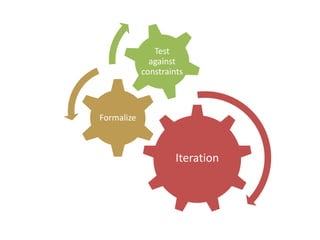
Test
against
constraints

Formalize

Iteration
Design Thinking Exercise
Iteration Stage: Here is where you take your ideas and start to
formulate concrete solutions to the challenge. Now dreaming becomes
more concrete and you will be asked to construct something from your
ideas.
Process:
Test ideas: Take your top ideas from the brainstorming session and test
them out against the constraints of desirability, feasibility and viability.
Choose the one that stands up best to these three challenges.
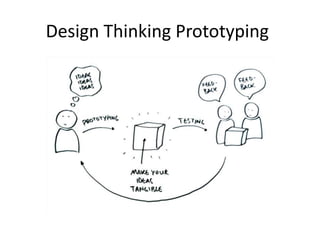
Prototype
Formalize your idea: summarize your idea in a single sentence,
describe how it will work where other things may not have worked in
the past, explain how it addresses the needs and opportunities
identified through your field research, list questions and challenges.
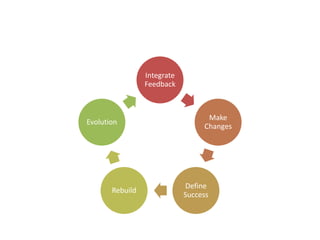
Integrate
Feedback

Evolution

Rebuild

Make
Changes

Define
Success
Design Thinking Prototyping
Design Thinking Exercise
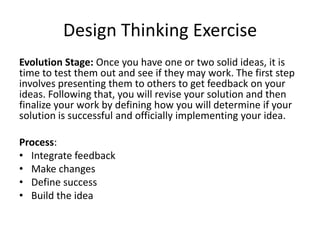
Evolution Stage: Once you have one or two solid ideas, it is
time to test them out and see if they may work. The first step
involves presenting them to others to get feedback on your
ideas. Following that, you will revise your solution and then
finalize your work by defining how you will determine if your
solution is successful and officially implementing your idea.
Process:
• Integrate feedback
• Make changes
• Define success
• Build the idea
Design Thinking Exercise

Sharing
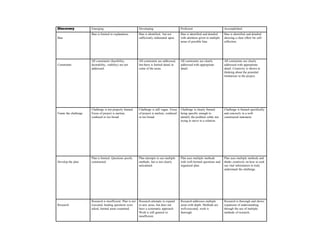
Discovery

Emerging

Developing

Proficient

Accomplished

Bias is limited in explanation.

Bias is identified, but not
sufficiently elaborated upon.

Bias is identified and detailed
with attention given to multiple
areas of possible bias.

Bias is identified and detailed
showing a clear effort for selfreflection.

Constraints

All constraints (feasibility,
desirability, viability) are not
addressed.

All constraints are addressed,
but there is limited detail in
some of the areas.

All constraints are clearly
addressed with appropriate
detail.

All constraints are clearly
addressed with appropriate
detail. Creativity is shown in
thinking about the potential
limitations to the project.

Frame the challenge

Challenge is not properly framed.
Focus of project is unclear,
confused or too broad.

Challenge is still vague. Focus
of project is unclear, confused
or too broad.

Challenge is clearly framed
being specific enough to
identify the problem while not
trying to move to a solution.

Challenge is framed specifically
and concisely in a wellconstructed statement.

Plan is limited. Questions poorly
constructed.

Plan attempts to use multiple
methods, but is not clearly
articulated.

Plan uses multiple methods
with well-formed questions and
organized plan.

Plan uses multiple methods and
thinks creatively on how to seek
out vital information to truly
understand the challenge.

Research is insufficient. Plan is not
executed, leading questions were
asked, limited areas examined.

Research attempts to expand
to new areas, but does not
have a systematic approach.
Work is still general or
insufficient.

Research addresses multiple
areas with depth. Methods are
well-executed, work is
thorough.

Research is thorough and shows
expansion of understanding
through the use of multiple
methods of research.

Bias

Develop the plan

Research
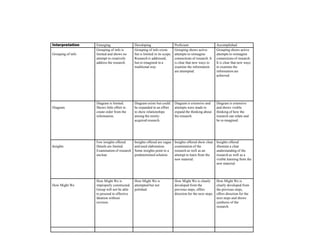
Interpretation
Grouping of info

Diagram

Insights

How Might We

Emerging
Grouping of info is
limited and shows no
attempt to creatively
address the research.

Developing
Grouping of info exists
but is limited in its scope.
Research is addressed,
but re-imagined in a
traditional way.

Proficient
Grouping shows active
attempts to reimagine
connections of research. It
is clear that new ways to
examine the information
are attempted.

Accomplished
Grouping shows active
attempts to reimagine
connections of research.
It is clear that new ways
to examine the
information are
achieved.

Diagram is limited.
Shows little effort to
create order from the
information.

Diagram exists but could
be expanded in an effort
to show relationships
among the newlyacquired research.

Diagram is extensive and
attempts were made to
expand the thinking about
the research.

Diagram is extensive
and shows visible
thinking of how the
research can relate and
be re-imagined.

Few insights offered.
Details are limited.
Examination of research
unclear.

Insights offered are vague
and need elaboration.
Some insights point to a
predetermined solution.

Insights offered show clear
examination of the
research as well as an
attempt to learn from the
new material.

Insights offered
illustrate a clear
understanding of the
research as well as a
visible learning from the
new material.

How Might We is
improperly constructed.
Group will not be able
to proceed to effective
Ideation without
revision.

How Might We is
attempted but not
polished.

How Might We is clearly
developed from the
previous steps, offers
direction for the next steps.

How Might We is
clearly developed from
the previous steps,
offers direction for the
next steps and shows
synthesis of the
research.
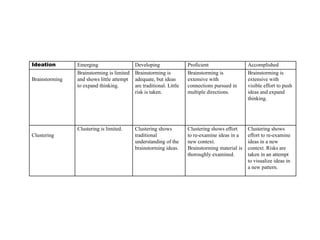
Ideation

Clustering

Developing
Brainstorming is
adequate, but ideas
are traditional. Little
risk is taken.

Proficient
Brainstorming is
extensive with
connections pursued in
multiple directions.

Accomplished
Brainstorming is
extensive with
visible effort to push
ideas and expand
thinking.

Clustering is limited.

Brainstorming

Emerging
Brainstorming is limited
and shows little attempt
to expand thinking.

Clustering shows
traditional
understanding of the
brainstorming ideas.

Clustering shows effort
to re-examine ideas in a
new context.
Brainstorming material is
thoroughly examined.

Clustering shows
effort to re-examine
ideas in a new
context. Risks are
taken in an attempt
to visualize ideas in
a new pattern.
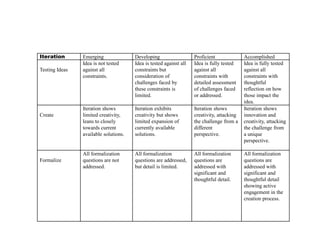
Iteration
Testing Ideas

Create

Formalize

Emerging
Idea is not tested
against all
constraints.

Developing
Idea is tested against all
constraints but
consideration of
challenges faced by
these constraints is
limited.

Proficient
Idea is fully tested
against all
constraints with
detailed assessment
of challenges faced
or addressed.

Iteration shows
limited creativity,
leans to closely
towards current
available solutions.

Iteration exhibits
creativity but shows
limited expansion of
currently available
solutions.

Iteration shows
creativity, attacking
the challenge from a
different
perspective.

All formalization
questions are not
addressed.

All formalization
questions are addressed,
but detail is limited.

All formalization
questions are
addressed with
significant and
thoughtful detail.

Accomplished
Idea is fully tested
against all
constraints with
thoughtful
reflection on how
those impact the
idea.
Iteration shows
innovation and
creativity, attacking
the challenge from
a unique
perspective.
All formalization
questions are
addressed with
significant and
thoughtful detail
showing active
engagement in the
creation process.
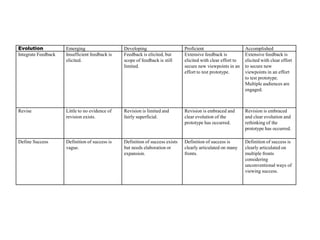
Evolution
Integrate Feedback

Emerging
Insufficient feedback is
elicited.

Developing
Feedback is elicited, but
scope of feedback is still
limited.

Proficient
Extensive feedback is
elicited with clear effort to
secure new viewpoints in an
effort to test prototype.

Accomplished
Extensive feedback is
elicited with clear effort
to secure new
viewpoints in an effort
to test prototype.
Multiple audiences are
engaged.

Revise

Little to no evidence of
revision exists.

Revision is limited and
fairly superficial.

Revision is embraced and
clear evolution of the
prototype has occurred.

Revision is embraced
and clear evolution and
rethinking of the
prototype has occurred.

Define Success

Definition of success is
vague.

Definition of success exists
but needs elaboration or
expansion.

Definition of success is
clearly articulated on many
fronts.

Definition of success is
clearly articulated on
multiple fronts
considering
unconventional ways of
viewing success.

Design thinking the hill school

  • 1.
    Design Thinking The HillSchool December 2013
  • 3.
  • 4.
    • Design Thinkingfor Educators Toolkit from IDEO Human Centered Design Toolkit from IDEO
  • 5.
  • 6.
  • 7.
  • 8.
  • 11.
    Design Thinking Build tothink and launch to learn.
  • 12.
    • What isa project you can create for your classroom that will incorporate the TPACK model?
  • 13.
  • 14.
    Discovery Steps 1. 2. 3. 4. spend sometime identifying your own feelings on this challenge. Do you think it needs to be addressed? Why or why not? It is important to begin your work fully understanding your own bias. Establish constraints: while it would be nice to think that the sky is the limit, there are always limits imposed by the environment where the challenge is found. Be sure to examine the viability, feasibility and desirability limits that exist surrounding your challenge. Frame the challenge: Once you have looked at the constraints and your thoughts, formally articulate what your group sees as the challenge. This should be a sentence or so in length to avoid any confusion. Select appropriate methods: There are quite a few tools available to you in this stage including: individual interview, group interview, in-context immersion (observation), self-documentation, community-driven discovery, expert interviews, seeking inspiration in new places, empathy maps. Which of these methods will you employ?
  • 15.
  • 16.
    Design Thinking Exercise Inthe traditional Design Thinking sequence, the discovery stage also includes extensive research. The next stage, Interpretation, involves the sorting and grouping of this research in order to determine insights and develop a “how might we question.”
  • 17.
  • 18.
    Design Thinking Exercise IdeationStage: In this stage, the sky is the limit. Sometimes that can be the challenge in itself because many people want to limit their thinking or edit their ideas or the ideas or others. The big challenge here will be to stick to “green light” thinking and just generate ideas. There are no bad ideas at this point and you need to remain open-minded in order to find the next innovation. This is a good exercise because we often encourage our students to brainstorm, but how often do we model this? Process: Begin brainstorming: Follow these rules of brainstorming as you work through a session with your group to determine what possible solutions to your challenge may be. Be sure to have someone recorded all of your ideas. You may also want to have a facilitator that can keep the group on track. Rules: Defer judgment Encourage wild ideas Stay focused on topic Be visual Go for quantity Cluster ideas and narrow them down: The sky is no longer the limit and you need to move on to the stage where you are actually creating something.
  • 19.
  • 20.
    Design Thinking Exercise IterationStage: Here is where you take your ideas and start to formulate concrete solutions to the challenge. Now dreaming becomes more concrete and you will be asked to construct something from your ideas. Process: Test ideas: Take your top ideas from the brainstorming session and test them out against the constraints of desirability, feasibility and viability. Choose the one that stands up best to these three challenges. Prototype Formalize your idea: summarize your idea in a single sentence, describe how it will work where other things may not have worked in the past, explain how it addresses the needs and opportunities identified through your field research, list questions and challenges.
  • 21.
  • 22.
  • 23.
    Design Thinking Exercise EvolutionStage: Once you have one or two solid ideas, it is time to test them out and see if they may work. The first step involves presenting them to others to get feedback on your ideas. Following that, you will revise your solution and then finalize your work by defining how you will determine if your solution is successful and officially implementing your idea. Process: • Integrate feedback • Make changes • Define success • Build the idea
  • 24.
  • 25.
    Discovery Emerging Developing Proficient Accomplished Bias is limitedin explanation. Bias is identified, but not sufficiently elaborated upon. Bias is identified and detailed with attention given to multiple areas of possible bias. Bias is identified and detailed showing a clear effort for selfreflection. Constraints All constraints (feasibility, desirability, viability) are not addressed. All constraints are addressed, but there is limited detail in some of the areas. All constraints are clearly addressed with appropriate detail. All constraints are clearly addressed with appropriate detail. Creativity is shown in thinking about the potential limitations to the project. Frame the challenge Challenge is not properly framed. Focus of project is unclear, confused or too broad. Challenge is still vague. Focus of project is unclear, confused or too broad. Challenge is clearly framed being specific enough to identify the problem while not trying to move to a solution. Challenge is framed specifically and concisely in a wellconstructed statement. Plan is limited. Questions poorly constructed. Plan attempts to use multiple methods, but is not clearly articulated. Plan uses multiple methods with well-formed questions and organized plan. Plan uses multiple methods and thinks creatively on how to seek out vital information to truly understand the challenge. Research is insufficient. Plan is not executed, leading questions were asked, limited areas examined. Research attempts to expand to new areas, but does not have a systematic approach. Work is still general or insufficient. Research addresses multiple areas with depth. Methods are well-executed, work is thorough. Research is thorough and shows expansion of understanding through the use of multiple methods of research. Bias Develop the plan Research
  • 26.
    Interpretation Grouping of info Diagram Insights HowMight We Emerging Grouping of info is limited and shows no attempt to creatively address the research. Developing Grouping of info exists but is limited in its scope. Research is addressed, but re-imagined in a traditional way. Proficient Grouping shows active attempts to reimagine connections of research. It is clear that new ways to examine the information are attempted. Accomplished Grouping shows active attempts to reimagine connections of research. It is clear that new ways to examine the information are achieved. Diagram is limited. Shows little effort to create order from the information. Diagram exists but could be expanded in an effort to show relationships among the newlyacquired research. Diagram is extensive and attempts were made to expand the thinking about the research. Diagram is extensive and shows visible thinking of how the research can relate and be re-imagined. Few insights offered. Details are limited. Examination of research unclear. Insights offered are vague and need elaboration. Some insights point to a predetermined solution. Insights offered show clear examination of the research as well as an attempt to learn from the new material. Insights offered illustrate a clear understanding of the research as well as a visible learning from the new material. How Might We is improperly constructed. Group will not be able to proceed to effective Ideation without revision. How Might We is attempted but not polished. How Might We is clearly developed from the previous steps, offers direction for the next steps. How Might We is clearly developed from the previous steps, offers direction for the next steps and shows synthesis of the research.
  • 27.
    Ideation Clustering Developing Brainstorming is adequate, butideas are traditional. Little risk is taken. Proficient Brainstorming is extensive with connections pursued in multiple directions. Accomplished Brainstorming is extensive with visible effort to push ideas and expand thinking. Clustering is limited. Brainstorming Emerging Brainstorming is limited and shows little attempt to expand thinking. Clustering shows traditional understanding of the brainstorming ideas. Clustering shows effort to re-examine ideas in a new context. Brainstorming material is thoroughly examined. Clustering shows effort to re-examine ideas in a new context. Risks are taken in an attempt to visualize ideas in a new pattern.
  • 28.
    Iteration Testing Ideas Create Formalize Emerging Idea isnot tested against all constraints. Developing Idea is tested against all constraints but consideration of challenges faced by these constraints is limited. Proficient Idea is fully tested against all constraints with detailed assessment of challenges faced or addressed. Iteration shows limited creativity, leans to closely towards current available solutions. Iteration exhibits creativity but shows limited expansion of currently available solutions. Iteration shows creativity, attacking the challenge from a different perspective. All formalization questions are not addressed. All formalization questions are addressed, but detail is limited. All formalization questions are addressed with significant and thoughtful detail. Accomplished Idea is fully tested against all constraints with thoughtful reflection on how those impact the idea. Iteration shows innovation and creativity, attacking the challenge from a unique perspective. All formalization questions are addressed with significant and thoughtful detail showing active engagement in the creation process.
  • 29.
    Evolution Integrate Feedback Emerging Insufficient feedbackis elicited. Developing Feedback is elicited, but scope of feedback is still limited. Proficient Extensive feedback is elicited with clear effort to secure new viewpoints in an effort to test prototype. Accomplished Extensive feedback is elicited with clear effort to secure new viewpoints in an effort to test prototype. Multiple audiences are engaged. Revise Little to no evidence of revision exists. Revision is limited and fairly superficial. Revision is embraced and clear evolution of the prototype has occurred. Revision is embraced and clear evolution and rethinking of the prototype has occurred. Define Success Definition of success is vague. Definition of success exists but needs elaboration or expansion. Definition of success is clearly articulated on many fronts. Definition of success is clearly articulated on multiple fronts considering unconventional ways of viewing success.