IDEA-BUILDING
TOOLKIT
FOR ENTREPRENEURSHIP SCHOLARS
APPLICANTS
WELCOME!
THIS TOOLKIT CONTAINS
• Rules of the challenge
• Design thinking information to help you come up with a solution to your
problem
• Reference material to help you build your pitch
RULES
ENTREPRENEURSHIP SCHOLARS PITCH
• To compete for a spot as a Lycoming Entrepreneurship Scholar, you must create a
Rocket Pitch (3 slides, 3 minutes) for a business idea to tackle a “wicked”
problem.
• The best presentations could win up to $5,000 towards a start-up or other
entrepreneurial experience during your sophomore, junior, or senior year at
Lycoming.
• A “wicked” problem is: a complex social problem with no obvious solutions and
competing viewpoints as to how best to go about solving it. You will choose between
these wicked problems:
• Urban poverty
• Climate change
• The rising cost of medical care
• Lack of access to clean water
• Low U.S. rankings in quality of education
RULES (cont.)
ENTREPRENEURSHIP SCHOLARS PITCH
• Follow the Pitch Deck Template to create your presentation and come
prepared to deliver it in three minutes
• Bring your PowerPoint with you to Scholars Day on a flash drive, and
print a copy of your slides for the judges
FINDING YOUR IDEA
HOW DOES ONE COME UP WITH A WAY TO SAVE THE WORLD?
• One method used by many entrepreneurs is called “design thinking,” which
involves generating and testing ideas to decide which ones are likely to
work.
• Design thinking is all about generating lots of ideas, turning piles of
ideas into a few good ideas, and then testing those good ideas to see if
they actually work.
• You’ll need to invest some time in the process!
DESIGN THINKING EXERCISE:
UNDERSTANDING THE PROBLEM
INSTRUCTION:
Once you have selected your problem, you should familiarize yourself with the
problem. Don’t develop any biases about what a solution must look like, but try
to thoroughly understand the causes and effects surrounding the problem.
Find information from….
• Credible news outlets
• Activist groups that deal directly with the problem
• Think tanks and research institutes
• Scholars who study your problem
• Books
• Your teachers may be able to direct you to good sources
DESIGN THINKING EXERCISE:
INDIVIDUAL BRAINSTORMING
INSTRUCTION:
Once you have selected your problem, you should use the prompts below to
individually write 3-7 sticky notes with insights answering each prompt. No idea
is too crazy!
Prompt #1
• Who are the groups that are impacted by this problem and how large are those
groups?
• What happens that affects these groups?
• Can these effects be reversed and how? Can they be limited and how?
• What other similar problems have been solved before that you can look to for
inspiration?
• Are there tools and/or technology available that could help?
• What are the root causes of this problem and can we tackle them?
• Why would we want to solve the problem?
DESIGN THINKING EXERCISE:
BUILD ON IDEAS
INSTRUCTION:
One by one, post your sticky notes on a wall and review them. If you would
like to add to the pile at this point, go ahead. Do not eliminate any ideas
you’ve posted as implausible—we’re not there yet. Besides, thinking inside
the box hasn’t helped anyone solve these problems yet!
DESIGN THINKING EXERCISE:
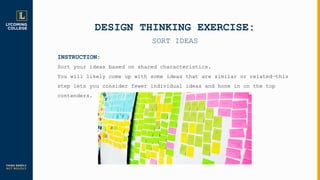
SORT IDEAS
INSTRUCTION:
Sort your ideas based on shared characteristics.
You will likely come up with some ideas that are similar or related—this
step lets you consider fewer individual ideas and hone in on the top
contenders.
DESIGN THINKING EXERCISE:
SELECTING IDEAS
INSTRUCTION:
Grab a marker and put an X on the sticky next to the 3 ideas you think
would best inform a plan to tackle a piece of your wicked problem. This
process highlights which idea you want to develop into a concept in the
next step.
PUT YOUR IDEA TO THE TEST
INSTRUCTION:
Ideas that don’t hold up under scrutiny will be unlikely to truly solve the
problem. Vet your ideas by thinking critically and asking others for their
input.
1. Start with the people at hand
Share your idea with your parents, neighbors, friends, etc., anyone who can
challenge you to prove it makes sense.
2. Talk to a teacher or outside expert
People who have training in how to understand problems can provide unique
perspectives on your ideas. Teachers and local leaders who are willing to
help can be great assets.
3. Ask someone affected
No one knows a problem better than someone who has lived through it. If you
know anyone who has been affected by your problem, ask them what they think
of your idea.
SYNTHESIZE, CREATE, & PREPARE TO PITCH
INSTRUCTION:
Next, you should select, refine, and submit a single business concept for
judging by following the steps below.
1. Synthesize your best insights into one actionable idea.
Frame it in the Pitch Deck Template in terms of the problem, your solution,
and what you need.
2. Use the Business Model Canvas
• Understand how the organization will operate
• Identify who can help you
• Assess the sustainability of the company
3. Create or find an image/caption that captures the idea for your title slide
ADDITIONAL HELP
DESIGN THINKING RESOURCES:
• https://www.ideou.com/pages/brainstorming
• https://hbr.org/2014/03/the-future-of-prototyping-is-now-
live
• https://www.fastcompany.com/3045148/8-habits-of-curious-
people
• https://www.ted.com/talks/tim_brown_urges_designers_to_thi
nk_big
• https://designthinkingforeducators.com/
• https://dschool.stanford.edu/resources/design-thinking-
bootleg
• https://www.edutopia.org/blog/film-festival-design-
thinking-in-schools
EMPATHIZE
DEFINE
IDEATE
PROTOTYPE
TEST
PITCH-MAKING RESOURCES
FOR YOUR SCHOLARS DAY PRESENTATION
• https://www.entrepreneur.com/article/251311
• https://www.entrepreneur.com/video/337050
• https://articles.bplans.com/9-things-that-
take-a-pitch-from-good-to-great/
• https://www.entrepreneur.com/article/316786
Watch this (and the other episodes of
“Entrepreneur Elevator Pitch”) to see a
great example of how quick pitches can be
effective.

the-idea-building-toolkit.pptx

  • 1.
  • 2.
    WELCOME! THIS TOOLKIT CONTAINS •Rules of the challenge • Design thinking information to help you come up with a solution to your problem • Reference material to help you build your pitch
  • 3.
    RULES ENTREPRENEURSHIP SCHOLARS PITCH •To compete for a spot as a Lycoming Entrepreneurship Scholar, you must create a Rocket Pitch (3 slides, 3 minutes) for a business idea to tackle a “wicked” problem. • The best presentations could win up to $5,000 towards a start-up or other entrepreneurial experience during your sophomore, junior, or senior year at Lycoming. • A “wicked” problem is: a complex social problem with no obvious solutions and competing viewpoints as to how best to go about solving it. You will choose between these wicked problems: • Urban poverty • Climate change • The rising cost of medical care • Lack of access to clean water • Low U.S. rankings in quality of education
  • 4.
    RULES (cont.) ENTREPRENEURSHIP SCHOLARSPITCH • Follow the Pitch Deck Template to create your presentation and come prepared to deliver it in three minutes • Bring your PowerPoint with you to Scholars Day on a flash drive, and print a copy of your slides for the judges
  • 5.
    FINDING YOUR IDEA HOWDOES ONE COME UP WITH A WAY TO SAVE THE WORLD? • One method used by many entrepreneurs is called “design thinking,” which involves generating and testing ideas to decide which ones are likely to work. • Design thinking is all about generating lots of ideas, turning piles of ideas into a few good ideas, and then testing those good ideas to see if they actually work. • You’ll need to invest some time in the process!
  • 6.
    DESIGN THINKING EXERCISE: UNDERSTANDINGTHE PROBLEM INSTRUCTION: Once you have selected your problem, you should familiarize yourself with the problem. Don’t develop any biases about what a solution must look like, but try to thoroughly understand the causes and effects surrounding the problem. Find information from…. • Credible news outlets • Activist groups that deal directly with the problem • Think tanks and research institutes • Scholars who study your problem • Books • Your teachers may be able to direct you to good sources
  • 7.
    DESIGN THINKING EXERCISE: INDIVIDUALBRAINSTORMING INSTRUCTION: Once you have selected your problem, you should use the prompts below to individually write 3-7 sticky notes with insights answering each prompt. No idea is too crazy! Prompt #1 • Who are the groups that are impacted by this problem and how large are those groups? • What happens that affects these groups? • Can these effects be reversed and how? Can they be limited and how? • What other similar problems have been solved before that you can look to for inspiration? • Are there tools and/or technology available that could help? • What are the root causes of this problem and can we tackle them? • Why would we want to solve the problem?
  • 8.
    DESIGN THINKING EXERCISE: BUILDON IDEAS INSTRUCTION: One by one, post your sticky notes on a wall and review them. If you would like to add to the pile at this point, go ahead. Do not eliminate any ideas you’ve posted as implausible—we’re not there yet. Besides, thinking inside the box hasn’t helped anyone solve these problems yet!
  • 9.
    DESIGN THINKING EXERCISE: SORTIDEAS INSTRUCTION: Sort your ideas based on shared characteristics. You will likely come up with some ideas that are similar or related—this step lets you consider fewer individual ideas and hone in on the top contenders.
  • 10.
    DESIGN THINKING EXERCISE: SELECTINGIDEAS INSTRUCTION: Grab a marker and put an X on the sticky next to the 3 ideas you think would best inform a plan to tackle a piece of your wicked problem. This process highlights which idea you want to develop into a concept in the next step.
  • 11.
    PUT YOUR IDEATO THE TEST INSTRUCTION: Ideas that don’t hold up under scrutiny will be unlikely to truly solve the problem. Vet your ideas by thinking critically and asking others for their input. 1. Start with the people at hand Share your idea with your parents, neighbors, friends, etc., anyone who can challenge you to prove it makes sense. 2. Talk to a teacher or outside expert People who have training in how to understand problems can provide unique perspectives on your ideas. Teachers and local leaders who are willing to help can be great assets. 3. Ask someone affected No one knows a problem better than someone who has lived through it. If you know anyone who has been affected by your problem, ask them what they think of your idea.
  • 12.
    SYNTHESIZE, CREATE, &PREPARE TO PITCH INSTRUCTION: Next, you should select, refine, and submit a single business concept for judging by following the steps below. 1. Synthesize your best insights into one actionable idea. Frame it in the Pitch Deck Template in terms of the problem, your solution, and what you need. 2. Use the Business Model Canvas • Understand how the organization will operate • Identify who can help you • Assess the sustainability of the company 3. Create or find an image/caption that captures the idea for your title slide
  • 13.
    ADDITIONAL HELP DESIGN THINKINGRESOURCES: • https://www.ideou.com/pages/brainstorming • https://hbr.org/2014/03/the-future-of-prototyping-is-now- live • https://www.fastcompany.com/3045148/8-habits-of-curious- people • https://www.ted.com/talks/tim_brown_urges_designers_to_thi nk_big • https://designthinkingforeducators.com/ • https://dschool.stanford.edu/resources/design-thinking- bootleg • https://www.edutopia.org/blog/film-festival-design- thinking-in-schools EMPATHIZE DEFINE IDEATE PROTOTYPE TEST
  • 14.
    PITCH-MAKING RESOURCES FOR YOURSCHOLARS DAY PRESENTATION • https://www.entrepreneur.com/article/251311 • https://www.entrepreneur.com/video/337050 • https://articles.bplans.com/9-things-that- take-a-pitch-from-good-to-great/ • https://www.entrepreneur.com/article/316786 Watch this (and the other episodes of “Entrepreneur Elevator Pitch”) to see a great example of how quick pitches can be effective.