Submitted To:
ASSOC. PROF. DR. KABIR SADEGHI
GIRNE AMERICAN UNEVERSTIY
FACULTY OF ENGINEERING
CIVIL ENGINEERING DEPARTMENT
Special Project
CVEN 490
BY:
Faris Abuobaid
Laith Al-Habahbeh
Mahmoud Jumaa
Project overview
•Type of structure
•Type of building
•Location
•Area
•Members sections
Structural loads
Calculation
•Dead load
•Live load
•Environmental loads
•Snow load
•Wind load
•Earthquake load
Analysis &
design
•Ribbed slab
•Mat foundation
•Beams & Columns
comparison
•Members
Comparison
•Beams
•Columns
•Mat Foundation
•Total quantity
comparison
•Beams
•Columns
•Ribbed slab
•Mat foundation
TABLE OF CONTENTS
Project Overview
• Type of structure:
Reinforced Concrete structures (RC)
• Type of building:
Residential building (five story, including basement)
• Location:
Baalbeck – Lebanon
• Area:
Area of one floor 687 m2
Total area 4122 m2
Project Overview
• Columns :
Rectangular columns section
• Beams:
Rectangular beams section
• Slabs:
One way Ribbed Slabs
• Foundations:
Raft foundation
STRUCTURAL LOADS CALCULATION
STRUCTURAL LOADS:
ACCORDING TO UNIFORM BUILDING CODE – UBC97
I. DEAD LOAD
II. LIVE LOAD
III.ENVIRONMENTAL LOADS
a. SNOW LOAD
b. WIND LOAD
c. EARTHQUAKE LOAD
DEAD LOAD CALCULATION:
Material Unit weight g (kgf/m3)
Concrete 2500
Tile & fill 1845
Mortar 2250
block 1500
Asphalt 1600
Finishing 2200
Material Thickness (m) Total weight (kgf/m)
Concrete 0.07 175
Tile & fill 0.05 93
Mortar 0.03 68
Block 0.18 270
Finishing 0.03 66
Total 672
Material Thickness (m) Total weight (kgf/m)
Concrete 0.07 175
Block 0.18 270
Asphalt 0.02 32
Total 477
Total dead load for a typical floor:
Total dead load for roof:
LIVE LOAD CALCULATION:
Category Uniform Load (psf) Uniform Load (kgf/m)
Basic area 40 195.2
Exterior Balconies 60 292.8
Storage 40 195.2
Partitions 5 24.4
Corridors 51 250
Fires 114
Elevators 136
Stairs 488
Live loads according to UBC:
Category Unit area (m2) number Total (m2) Percentage (%)-
typical floor
Percentage
(%)-roof
Basic Area 414 4 1709.3 53 83
Balconies Balconies 1 54 4 216 7 8
Balconies 2 17 4 68 2 3
Balconies 3 22 4 88 2 3
Openings 4 4 16 0.5
Corridors 100 4 400 12
Elevator 3.2 5 16 0.5 1
Stairs 10.4 5 52 2 2
Partitions 23.4 4 94 3
Storage 580.7 1 580.7 18
Total 3240 100 100
Percentages of building categories.
Category Percentage (%) Live load (kgf/m2) Final Live Load
(kgf/m2)
Basic Area 53 195.2 104
Balconies Balconies 1 7 292.8 21
Balconies 2 2 292.8 6
Balconies 3 2 292.8 6
Openings 0.5 -
Corridors 12 250 30
Elevator 0.5 136 1
Stairs 2 488 8
Partitions 3 24.4 1
Storage 18 195.2 36
Total 213
Live Load Calculation for typical floor:
For typical floors, Live Load: L.L=220 kgf/m2
Category Percentage (%) Live load (kgf/m2) Final Live Load
(kgf/m2)
Basic Area 97 195.2 190
Elevator 1 136 2
Stairs 2 488 10
Total 100 202
Live Load Calculation for roof:
For roof, live load: L.L= 210 kgf/m2
ENVIRONMENTAL LOAD CALCULATION:
- SNOW LOAD:
For our project, it’s located in a region (1400m
above sea level) where snow load is an important
load for building.
Use snow load SL= 210 kgf/m2
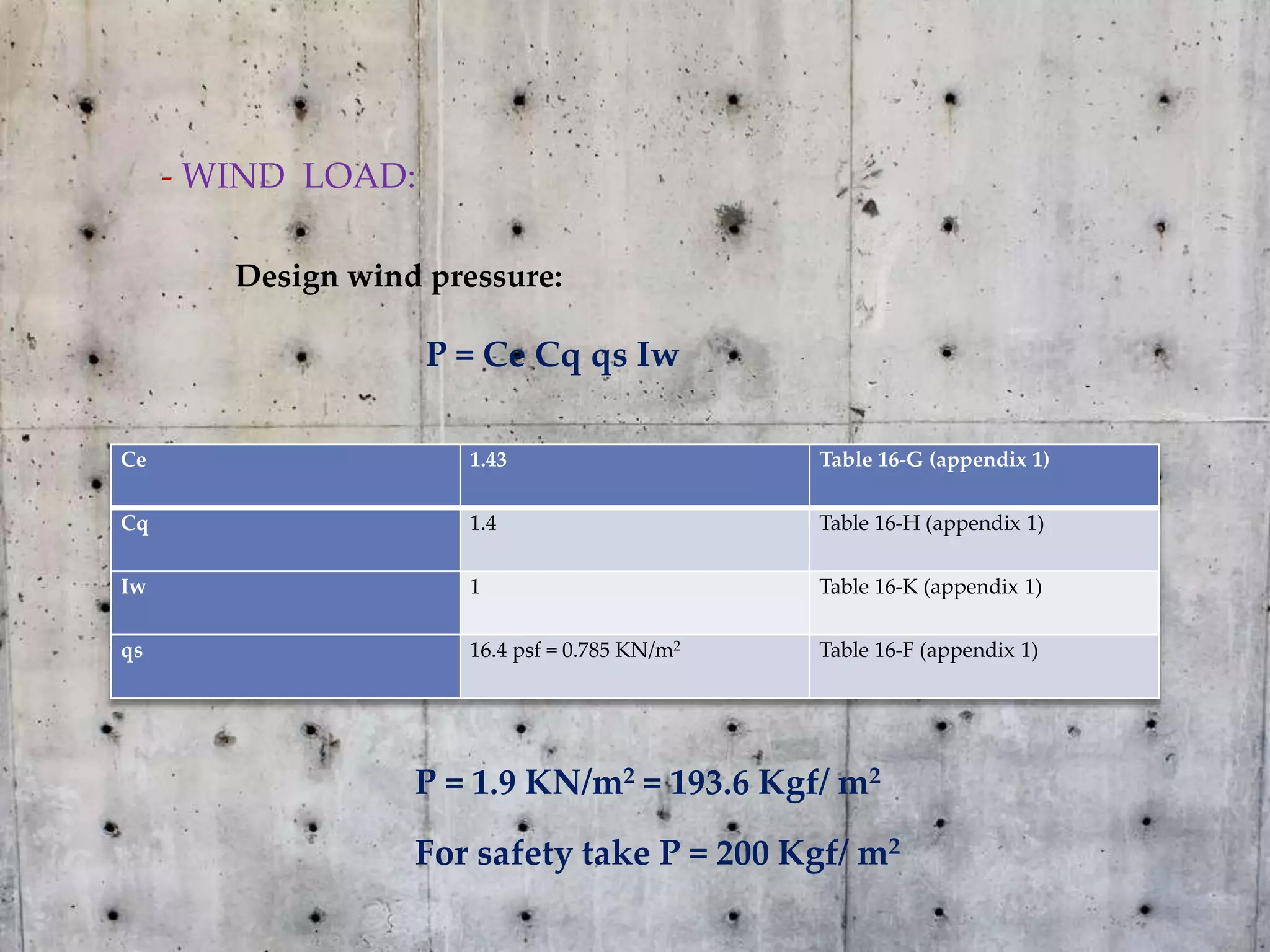
- WIND LOAD:
Design wind pressure:
P = Ce Cq qs Iw
Ce 1.43 Table 16-G (appendix 1)
Cq 1.4 Table 16-H (appendix 1)
Iw 1 Table 16-K (appendix 1)
qs 16.4 psf = 0.785 KN/m2 Table 16-F (appendix 1)
P = 1.9 KN/m2 = 193.6 Kgf/ m2
For safety take P = 200 Kgf/ m2
- EARTHQUAKE LOAD:
Fx=
𝑽−𝑭𝒕 𝑾𝒙𝒉𝒙
𝒊=𝟏
𝒏 𝑾𝒊𝒉𝒊
Fx : Force at level x (t)
V : Base shear force (t)
Wi, Wx : that portion of W located at or assigned to
Level i or x, respectively.
Hx : height of floor from ground level (m)
Ft=0.07TV
For T≤0.7sec, take Ft=0.
Design base shear:
V=
𝑪𝒗 𝑰
𝑹 𝑻
𝐖𝐭
The total design base shear need not exceed the following:
V1=
𝟐.𝟓 𝑪𝒂 𝑰
𝑹
𝐖𝐭
The total design base shear shall not be less than the following:
V2= 0.11 Ca I Wt
Where:
Cv : seismic coefficient, as set forth in Table 16-R (appendix 1).
I : importance factor given in Table 16-K (appendix 1).
R : numerical coefficient representative of the inherent over strength and
global
ductility capacity of lateral force- resisting systems, as set forth in Table
16-N (appendix 1).
T : elastic fundamental period of vibration, in seconds, of the
structure in the direction under consideration.
Wt : the total seismic dead load.
T= Ct (hn)3/4
Where:
Ct : numerical coefficient
hn : Total height of building (m)
Wt= W×A
Where:
W=1.2DL+1.6LL
A=Area of one floor = 648m2
Floor Height (m) Weight Wx (ton)
1 3.8 700
2 6.95 700
3 10.1 700
4 13.25 700
5 16.4 568
Total (Wt) 3368t
Weight and height of floors:
Z 0.30 Table 16-I (appendix 1)
Cv 0.84 Table 16-R (appendix1)
I 1 Table 16-K (appendix 1)
R 5.5 Table 16-N (appendix 1)
Ca 0.36 Table 16-Q (appendix 1)
Ct 0.0731
hn 16.4
Values of coefficient:
W 3368 ton
T 0.657 sec
V 783ton
V1 552 ton
V2 134 ton
Base shear force values:
V2=134 ton ˂ V=783 ton ˂ V1= 552 ton
Since V exceeds the maximum value recommended by UBC, we
should use V1.
i.e. V=552 ton.
Earthquake force Calculation:
Floor Height-x (m) Earthquake force- Fx (ton)
1 3.8 45
2 6.95 82
3 10.1 119
4 13.25 156
5 16.4 193
Values of Earthquake force at level x:
LOAD COMBINATION:
U = 1.4D
U = 1.2D + 1.6L + 0.5(Lr or S )
U = 1.2D + 1.6(Lr or S ) + (1.0L or 0.5W)
U = 1.2D + 1.0W + 1.0L + 0.5(Lr or S)
U = 1.2D + 1.0E + 1.0L + 0.2S
U = 0.9D + 1.0W
U = 0.9D + 1.0E
Where:
D: Dead load
L: Live Load
S: Snow load
W: Wind load
E: Earthquake load
Ribbed Slab
Calculating the weight
D.L= 672 kgf/𝑚2
L.L = 220 kgf/𝑚2
S.W = (0.52m × 0.07m × 2.25ton) + (0.18m × 0.012m × 2.5ton) + 0.02ton = 0.165 ton = 165 kgf/𝑚2
w = 1.2 D.L + 1.6 L.L = 1.1584 ton/𝑚2
𝒘 𝑡𝑜𝑡𝑎𝑙 = 1.1584 ton/𝑚2
+ 165 kgf/𝑚2
=1.3234 ton ≈ 1.4 ton/𝑚2
Moment Distribution Method
𝐹. 𝐸. 𝑀 𝑎 = −
𝑞𝑙2
2
=
1.4 ×2.12
2
= 3.087 t.m
𝐹. 𝐸. 𝑀 𝑎𝑏 = −
𝑞𝑙2
12
= −
1.4 ×3.252
12
= -1.233 t.m 𝐹. 𝐸. 𝑀 𝑏𝑎 =
𝑞𝑙2
12
=
1.4 ×3.252
12
= 1.233 t.m
𝐹. 𝐸. 𝑀 𝑏𝑐 = −
𝑞𝑙2
12
= −
1.4 ×32
12
= -1.05 t.m 𝐹. 𝐸. 𝑀𝑐𝑏 =
𝑞𝑙2
12
=
1.4 ×32
12
= 1.05 t.m
𝐹. 𝐸. 𝑀𝑐𝑑 = −
𝑞𝑙2
12
= −
1.4 ×2.22
12
= -0.565 t.m 𝐹. 𝐸. 𝑀 𝑑𝑐 =
𝑞𝑙2
12
=
1.4 ×2.22
12
= 0.565 t.m
𝐹. 𝐸. 𝑀 𝑑𝑐 = −
𝑞𝑙2
12
= −
1.4 ×4.22
12
= -2.058 t.m 𝐹. 𝐸. 𝑀𝑒𝑑 =
𝑞𝑙2
12
=
1.4 ×4.22
12
= 2.058 t.m
Fixed End Moment:
𝜌 𝑏 = 0.85 × 0.85 ×
0.003
𝑓 𝑦
𝐸 𝑠
×0.003
×
𝑓′ 𝑐
𝑓𝑦
= 0.85 × 0.85 ×
0.003
4200
2.1 × 106×0.003
×
250
4200
= 0.0258
𝜌 𝑚𝑎𝑥 = 0.75 × 𝜌 𝑏 = 0.0193
𝜌 𝑚𝑖𝑛 =
14.1
𝑓𝑦
= 0.00335
𝑀 𝑢 = 𝜙 × 𝜌 × 𝑓𝑦 × 𝑏 × 𝑑2 × (1 − 0.59 × 𝜌 ×
𝑓𝑦
𝑓′
𝑐
)
= 1.9 × 𝜌 × 4200 × 10 × 232 × 1 − 0.59 × 𝜌 ×
4200
250
6.174 × 105
= 19.9 × 10⁶
× 𝜌 = (1 − 9.912 × 𝜌)
For 𝑴 𝒖 = 𝟐. 𝟐 𝒕. 𝒎:
try and error :
𝜌 = 0.012 → 𝑀 = 2.1 × 10⁵
𝜌 = 0.015 → 𝑀 = 2.55 × 10⁵
𝜌 = 0.013 → 𝑀 = 2.3 × 10⁵
𝜌 𝑚𝑖𝑛=0.00335 < 𝜌 = 0.013 < 𝜌 𝑚𝑎𝑥= 0.0193 O.K
𝐴 𝑆 = 𝜌 × 𝑏 × 𝑑 = 0.013 × 10 × 23 = 2.99 𝑐𝑚2
≅ 3 𝑐𝑚2
𝐴 𝑠 =
2×𝜋×𝜙2
4
⟹
2𝜙14
𝐵𝑜𝑡𝑡𝑜𝑚
𝑀𝑠𝑐 = 𝑀 𝑈 − 𝑀𝑟 = 2.3 × 10⁵ − 2.2 × 105 = 0.1 × 10⁵
𝑀𝑠𝑐 = 𝜙 × 𝐴′ 𝑠 × 𝑓𝑦 × 𝑑 − 𝑑′
𝐴′ 𝑠 =
0.1×10⁵
0.9×4200×(23−2)
= 0.1259 𝑐𝑚2
⟹
1𝜙12
𝑇𝑂𝑃
For 𝑴 𝒖 = 𝟎. 𝟖 𝒕. 𝒎:
𝝆 = 0.0055 → 𝑀 𝑢 = 1.09 × 10⁵
> 𝑀 𝑢 = 0.8 × 10⁵
O.K
𝐴 𝑠 = 0.0055 × 10 × 23 = 1.265 𝑐𝑚2
⟹
2𝜙10
𝐵𝑂𝑇𝑇𝑂𝑀
,
1𝜙10
𝑇𝑂𝑃
For 𝑴 𝒄𝒂𝒏𝒕𝒊𝒍𝒆𝒗𝒆𝒓 =
𝒒×𝒍 𝟐
𝟐
=
𝟏.𝟒×𝟐.𝟏 𝟐
𝟐
= 𝟑. 𝟎𝟖𝟕 𝒕. 𝒎:
𝜌 = 0.019 → 𝑀 𝑢 = 3.2 × 10⁵ > 𝑀 𝑢 = 0.8 × 10⁵ O.K
𝐴 𝑠 = 0.019 × 10 × 23 = 4.37 𝑐𝑚2 ⟹
2𝜙10
𝐵𝑂𝑇𝑇𝑂𝑀
,
2𝜙18
𝑇𝑂𝑃
MAT FOUNDATION
Reasons For Mat
Foundation
1- in the site that we have the bearing capacity for soil
is 1.5 kgf/𝑐𝑚2
is this value is law and the soil is
weak to carry the whole loads.
2- High water table under foundation, so it effect on the soil
quality.
3- Columns loads are so huge. (more than 50% of the
area is covered by conventional spread footing.
Designing By SAFE
Design Steps:
1- import the Architecture drawing from AutoCAD
2- Define the materials:
a) Concrete with compressive strength f’c=250 kgf/𝑐𝑚2
.
b) Steel with yield stress Fy=4200 kgf/𝑐𝑚2
.
3-Define Slab properties:
a) We define the thickness t=80 cm
b) We define the stiffness for foundation with same t=80 cm
Designing By SAFE
• 4-Define soil sub-grade=120*bearing capacity.
• 5-Assign loads for each columns.
RUN & DESIGN
• The first checking after run the model is punching shear,
it should be less than 1 for each column
RUN & DESIGN
• Deformation shape checking
RUN & DESIGN
Slab stress top face Slab stress Bottom face
RUN & DESIGN
• Moment Diagram
Analysis & Design of: Beams & Columns
SOFTWARE:
 ETABS
MATERIALS PROPERTIES:
Analysis property data Design property data
Mass per unit volume (M) 245 kg/m3 Concert compressive strength
(f’c)
250 kgf/cm2
Weight per unit volume (w) 2400 kgf/m3 Yield stress
(fy)
4200 kgf/cm2
Modulus of elasticity
(Es)
2.1x10⁶ kgf/cm2
Modulus of elasticity
(Ec)
2.4x10⁵
Passion ratio
(V)
0.2
CODE:
 American Concrete Institute “ACI_318M_11”
SECTIONS:
 Column sections:
Column Dimensions (cm×cm)
C1 25×30
C2 25×60
C3 30×60
C4 25×25
 Beams sections:
Beam Dimensions (cm×cm)
B1 25×40
B2 25×70
SBEAM 25×30
According to the moment and shear stress diagrams, we will know if these
sections are ok or not.
LOADS ASSIGNING:
 Live load Dead load :
LOADS ASSIGNING:
 Snow load Wind load
LOADS ASSIGNING:
 Earthquake load :
ANALYZING:
After running analysis, moment and shear diagram were overstressed
for beams, as a result we change our sections.
 New Beams sections:
Beam Dimensions (cm×cm)
B1 50×30
B2 80×30
SBEAM 40×30
Moment stress diagram:
ANALYZING:
Shear stress diagram:
ANALYZING:
DESIGNING:
 Beams Reinforcement Table:
 Columns Reinforcement Table:
*C1, C2, C3, C4: Our columns.
*C1’, C3’, C4’: Real columns.
DESIGNING:
 Columns’ Stirrups Table:
DESIGNING:
COMPARISON
Structural Members Comparison Graphs:
 Beams comparison graphs:
 Beam B1’-B1:
 Beam B2’-B2:
 Beam B3’-B3:
 Beam B4’-B4:
 Secondary Beam SB-2N:
 Columns comparison graphs:
 Column C1’-C1:
 Column C2
 Column C3’-C3:
 Column C4’-C4:
 Stirrups of columns:
 MAT (RAFT) foundation comparison graphs:
 MAT foundation top reinforcement:
Total Quantity Comparison Graphs:
 Beams
 Columns:
 Ripped slab:
 MAT Foundation:

G.p presentation

  • 1.
    Submitted To: ASSOC. PROF.DR. KABIR SADEGHI GIRNE AMERICAN UNEVERSTIY FACULTY OF ENGINEERING CIVIL ENGINEERING DEPARTMENT Special Project CVEN 490 BY: Faris Abuobaid Laith Al-Habahbeh Mahmoud Jumaa
  • 2.
    Project overview •Type ofstructure •Type of building •Location •Area •Members sections Structural loads Calculation •Dead load •Live load •Environmental loads •Snow load •Wind load •Earthquake load Analysis & design •Ribbed slab •Mat foundation •Beams & Columns comparison •Members Comparison •Beams •Columns •Mat Foundation •Total quantity comparison •Beams •Columns •Ribbed slab •Mat foundation TABLE OF CONTENTS
  • 3.
    Project Overview • Typeof structure: Reinforced Concrete structures (RC) • Type of building: Residential building (five story, including basement) • Location: Baalbeck – Lebanon • Area: Area of one floor 687 m2 Total area 4122 m2
  • 4.
    Project Overview • Columns: Rectangular columns section • Beams: Rectangular beams section • Slabs: One way Ribbed Slabs • Foundations: Raft foundation
  • 5.
  • 6.
    STRUCTURAL LOADS: ACCORDING TOUNIFORM BUILDING CODE – UBC97 I. DEAD LOAD II. LIVE LOAD III.ENVIRONMENTAL LOADS a. SNOW LOAD b. WIND LOAD c. EARTHQUAKE LOAD
  • 7.
    DEAD LOAD CALCULATION: MaterialUnit weight g (kgf/m3) Concrete 2500 Tile & fill 1845 Mortar 2250 block 1500 Asphalt 1600 Finishing 2200
  • 8.
    Material Thickness (m)Total weight (kgf/m) Concrete 0.07 175 Tile & fill 0.05 93 Mortar 0.03 68 Block 0.18 270 Finishing 0.03 66 Total 672 Material Thickness (m) Total weight (kgf/m) Concrete 0.07 175 Block 0.18 270 Asphalt 0.02 32 Total 477 Total dead load for a typical floor: Total dead load for roof:
  • 9.
    LIVE LOAD CALCULATION: CategoryUniform Load (psf) Uniform Load (kgf/m) Basic area 40 195.2 Exterior Balconies 60 292.8 Storage 40 195.2 Partitions 5 24.4 Corridors 51 250 Fires 114 Elevators 136 Stairs 488 Live loads according to UBC:
  • 10.
    Category Unit area(m2) number Total (m2) Percentage (%)- typical floor Percentage (%)-roof Basic Area 414 4 1709.3 53 83 Balconies Balconies 1 54 4 216 7 8 Balconies 2 17 4 68 2 3 Balconies 3 22 4 88 2 3 Openings 4 4 16 0.5 Corridors 100 4 400 12 Elevator 3.2 5 16 0.5 1 Stairs 10.4 5 52 2 2 Partitions 23.4 4 94 3 Storage 580.7 1 580.7 18 Total 3240 100 100 Percentages of building categories.
  • 11.
    Category Percentage (%)Live load (kgf/m2) Final Live Load (kgf/m2) Basic Area 53 195.2 104 Balconies Balconies 1 7 292.8 21 Balconies 2 2 292.8 6 Balconies 3 2 292.8 6 Openings 0.5 - Corridors 12 250 30 Elevator 0.5 136 1 Stairs 2 488 8 Partitions 3 24.4 1 Storage 18 195.2 36 Total 213 Live Load Calculation for typical floor: For typical floors, Live Load: L.L=220 kgf/m2
  • 12.
    Category Percentage (%)Live load (kgf/m2) Final Live Load (kgf/m2) Basic Area 97 195.2 190 Elevator 1 136 2 Stairs 2 488 10 Total 100 202 Live Load Calculation for roof: For roof, live load: L.L= 210 kgf/m2
  • 13.
    ENVIRONMENTAL LOAD CALCULATION: -SNOW LOAD: For our project, it’s located in a region (1400m above sea level) where snow load is an important load for building. Use snow load SL= 210 kgf/m2
  • 14.
    - WIND LOAD: Designwind pressure: P = Ce Cq qs Iw Ce 1.43 Table 16-G (appendix 1) Cq 1.4 Table 16-H (appendix 1) Iw 1 Table 16-K (appendix 1) qs 16.4 psf = 0.785 KN/m2 Table 16-F (appendix 1) P = 1.9 KN/m2 = 193.6 Kgf/ m2 For safety take P = 200 Kgf/ m2
  • 15.
    - EARTHQUAKE LOAD: Fx= 𝑽−𝑭𝒕𝑾𝒙𝒉𝒙 𝒊=𝟏 𝒏 𝑾𝒊𝒉𝒊 Fx : Force at level x (t) V : Base shear force (t) Wi, Wx : that portion of W located at or assigned to Level i or x, respectively. Hx : height of floor from ground level (m) Ft=0.07TV For T≤0.7sec, take Ft=0.
  • 16.
    Design base shear: V= 𝑪𝒗𝑰 𝑹 𝑻 𝐖𝐭 The total design base shear need not exceed the following: V1= 𝟐.𝟓 𝑪𝒂 𝑰 𝑹 𝐖𝐭 The total design base shear shall not be less than the following: V2= 0.11 Ca I Wt Where: Cv : seismic coefficient, as set forth in Table 16-R (appendix 1). I : importance factor given in Table 16-K (appendix 1). R : numerical coefficient representative of the inherent over strength and global ductility capacity of lateral force- resisting systems, as set forth in Table 16-N (appendix 1).
  • 17.
    T : elasticfundamental period of vibration, in seconds, of the structure in the direction under consideration. Wt : the total seismic dead load. T= Ct (hn)3/4 Where: Ct : numerical coefficient hn : Total height of building (m) Wt= W×A Where: W=1.2DL+1.6LL A=Area of one floor = 648m2
  • 18.
    Floor Height (m)Weight Wx (ton) 1 3.8 700 2 6.95 700 3 10.1 700 4 13.25 700 5 16.4 568 Total (Wt) 3368t Weight and height of floors: Z 0.30 Table 16-I (appendix 1) Cv 0.84 Table 16-R (appendix1) I 1 Table 16-K (appendix 1) R 5.5 Table 16-N (appendix 1) Ca 0.36 Table 16-Q (appendix 1) Ct 0.0731 hn 16.4 Values of coefficient:
  • 19.
    W 3368 ton T0.657 sec V 783ton V1 552 ton V2 134 ton Base shear force values: V2=134 ton ˂ V=783 ton ˂ V1= 552 ton Since V exceeds the maximum value recommended by UBC, we should use V1. i.e. V=552 ton.
  • 20.
    Earthquake force Calculation: FloorHeight-x (m) Earthquake force- Fx (ton) 1 3.8 45 2 6.95 82 3 10.1 119 4 13.25 156 5 16.4 193 Values of Earthquake force at level x:
  • 21.
    LOAD COMBINATION: U =1.4D U = 1.2D + 1.6L + 0.5(Lr or S ) U = 1.2D + 1.6(Lr or S ) + (1.0L or 0.5W) U = 1.2D + 1.0W + 1.0L + 0.5(Lr or S) U = 1.2D + 1.0E + 1.0L + 0.2S U = 0.9D + 1.0W U = 0.9D + 1.0E Where: D: Dead load L: Live Load S: Snow load W: Wind load E: Earthquake load
  • 22.
  • 23.
    Calculating the weight D.L=672 kgf/𝑚2 L.L = 220 kgf/𝑚2 S.W = (0.52m × 0.07m × 2.25ton) + (0.18m × 0.012m × 2.5ton) + 0.02ton = 0.165 ton = 165 kgf/𝑚2 w = 1.2 D.L + 1.6 L.L = 1.1584 ton/𝑚2 𝒘 𝑡𝑜𝑡𝑎𝑙 = 1.1584 ton/𝑚2 + 165 kgf/𝑚2 =1.3234 ton ≈ 1.4 ton/𝑚2
  • 24.
  • 25.
    𝐹. 𝐸. 𝑀𝑎 = − 𝑞𝑙2 2 = 1.4 ×2.12 2 = 3.087 t.m 𝐹. 𝐸. 𝑀 𝑎𝑏 = − 𝑞𝑙2 12 = − 1.4 ×3.252 12 = -1.233 t.m 𝐹. 𝐸. 𝑀 𝑏𝑎 = 𝑞𝑙2 12 = 1.4 ×3.252 12 = 1.233 t.m 𝐹. 𝐸. 𝑀 𝑏𝑐 = − 𝑞𝑙2 12 = − 1.4 ×32 12 = -1.05 t.m 𝐹. 𝐸. 𝑀𝑐𝑏 = 𝑞𝑙2 12 = 1.4 ×32 12 = 1.05 t.m 𝐹. 𝐸. 𝑀𝑐𝑑 = − 𝑞𝑙2 12 = − 1.4 ×2.22 12 = -0.565 t.m 𝐹. 𝐸. 𝑀 𝑑𝑐 = 𝑞𝑙2 12 = 1.4 ×2.22 12 = 0.565 t.m 𝐹. 𝐸. 𝑀 𝑑𝑐 = − 𝑞𝑙2 12 = − 1.4 ×4.22 12 = -2.058 t.m 𝐹. 𝐸. 𝑀𝑒𝑑 = 𝑞𝑙2 12 = 1.4 ×4.22 12 = 2.058 t.m Fixed End Moment:
  • 27.
    𝜌 𝑏 =0.85 × 0.85 × 0.003 𝑓 𝑦 𝐸 𝑠 ×0.003 × 𝑓′ 𝑐 𝑓𝑦 = 0.85 × 0.85 × 0.003 4200 2.1 × 106×0.003 × 250 4200 = 0.0258 𝜌 𝑚𝑎𝑥 = 0.75 × 𝜌 𝑏 = 0.0193 𝜌 𝑚𝑖𝑛 = 14.1 𝑓𝑦 = 0.00335 𝑀 𝑢 = 𝜙 × 𝜌 × 𝑓𝑦 × 𝑏 × 𝑑2 × (1 − 0.59 × 𝜌 × 𝑓𝑦 𝑓′ 𝑐 ) = 1.9 × 𝜌 × 4200 × 10 × 232 × 1 − 0.59 × 𝜌 × 4200 250 6.174 × 105 = 19.9 × 10⁶ × 𝜌 = (1 − 9.912 × 𝜌)
  • 28.
    For 𝑴 𝒖= 𝟐. 𝟐 𝒕. 𝒎: try and error : 𝜌 = 0.012 → 𝑀 = 2.1 × 10⁵ 𝜌 = 0.015 → 𝑀 = 2.55 × 10⁵ 𝜌 = 0.013 → 𝑀 = 2.3 × 10⁵ 𝜌 𝑚𝑖𝑛=0.00335 < 𝜌 = 0.013 < 𝜌 𝑚𝑎𝑥= 0.0193 O.K 𝐴 𝑆 = 𝜌 × 𝑏 × 𝑑 = 0.013 × 10 × 23 = 2.99 𝑐𝑚2 ≅ 3 𝑐𝑚2 𝐴 𝑠 = 2×𝜋×𝜙2 4 ⟹ 2𝜙14 𝐵𝑜𝑡𝑡𝑜𝑚 𝑀𝑠𝑐 = 𝑀 𝑈 − 𝑀𝑟 = 2.3 × 10⁵ − 2.2 × 105 = 0.1 × 10⁵ 𝑀𝑠𝑐 = 𝜙 × 𝐴′ 𝑠 × 𝑓𝑦 × 𝑑 − 𝑑′ 𝐴′ 𝑠 = 0.1×10⁵ 0.9×4200×(23−2) = 0.1259 𝑐𝑚2 ⟹ 1𝜙12 𝑇𝑂𝑃
  • 29.
    For 𝑴 𝒖= 𝟎. 𝟖 𝒕. 𝒎: 𝝆 = 0.0055 → 𝑀 𝑢 = 1.09 × 10⁵ > 𝑀 𝑢 = 0.8 × 10⁵ O.K 𝐴 𝑠 = 0.0055 × 10 × 23 = 1.265 𝑐𝑚2 ⟹ 2𝜙10 𝐵𝑂𝑇𝑇𝑂𝑀 , 1𝜙10 𝑇𝑂𝑃
  • 30.
    For 𝑴 𝒄𝒂𝒏𝒕𝒊𝒍𝒆𝒗𝒆𝒓= 𝒒×𝒍 𝟐 𝟐 = 𝟏.𝟒×𝟐.𝟏 𝟐 𝟐 = 𝟑. 𝟎𝟖𝟕 𝒕. 𝒎: 𝜌 = 0.019 → 𝑀 𝑢 = 3.2 × 10⁵ > 𝑀 𝑢 = 0.8 × 10⁵ O.K 𝐴 𝑠 = 0.019 × 10 × 23 = 4.37 𝑐𝑚2 ⟹ 2𝜙10 𝐵𝑂𝑇𝑇𝑂𝑀 , 2𝜙18 𝑇𝑂𝑃
  • 31.
  • 32.
    Reasons For Mat Foundation 1-in the site that we have the bearing capacity for soil is 1.5 kgf/𝑐𝑚2 is this value is law and the soil is weak to carry the whole loads. 2- High water table under foundation, so it effect on the soil quality. 3- Columns loads are so huge. (more than 50% of the area is covered by conventional spread footing.
  • 33.
    Designing By SAFE DesignSteps: 1- import the Architecture drawing from AutoCAD 2- Define the materials: a) Concrete with compressive strength f’c=250 kgf/𝑐𝑚2 . b) Steel with yield stress Fy=4200 kgf/𝑐𝑚2 . 3-Define Slab properties: a) We define the thickness t=80 cm b) We define the stiffness for foundation with same t=80 cm
  • 34.
    Designing By SAFE •4-Define soil sub-grade=120*bearing capacity. • 5-Assign loads for each columns.
  • 35.
    RUN & DESIGN •The first checking after run the model is punching shear, it should be less than 1 for each column
  • 36.
    RUN & DESIGN •Deformation shape checking
  • 37.
    RUN & DESIGN Slabstress top face Slab stress Bottom face
  • 38.
    RUN & DESIGN •Moment Diagram
  • 39.
    Analysis & Designof: Beams & Columns
  • 40.
    SOFTWARE:  ETABS MATERIALS PROPERTIES: Analysisproperty data Design property data Mass per unit volume (M) 245 kg/m3 Concert compressive strength (f’c) 250 kgf/cm2 Weight per unit volume (w) 2400 kgf/m3 Yield stress (fy) 4200 kgf/cm2 Modulus of elasticity (Es) 2.1x10⁶ kgf/cm2 Modulus of elasticity (Ec) 2.4x10⁵ Passion ratio (V) 0.2 CODE:  American Concrete Institute “ACI_318M_11”
  • 41.
    SECTIONS:  Column sections: ColumnDimensions (cm×cm) C1 25×30 C2 25×60 C3 30×60 C4 25×25  Beams sections: Beam Dimensions (cm×cm) B1 25×40 B2 25×70 SBEAM 25×30 According to the moment and shear stress diagrams, we will know if these sections are ok or not.
  • 42.
    LOADS ASSIGNING:  Liveload Dead load :
  • 43.
    LOADS ASSIGNING:  Snowload Wind load
  • 44.
  • 45.
    ANALYZING: After running analysis,moment and shear diagram were overstressed for beams, as a result we change our sections.  New Beams sections: Beam Dimensions (cm×cm) B1 50×30 B2 80×30 SBEAM 40×30
  • 46.
  • 47.
  • 48.
  • 49.
     Columns ReinforcementTable: *C1, C2, C3, C4: Our columns. *C1’, C3’, C4’: Real columns. DESIGNING:
  • 50.
     Columns’ StirrupsTable: DESIGNING:
  • 51.
  • 52.
    Structural Members ComparisonGraphs:  Beams comparison graphs:  Beam B1’-B1:
  • 53.
  • 54.
  • 55.
  • 56.
  • 57.
     Columns comparisongraphs:  Column C1’-C1:
  • 58.
  • 59.
  • 60.
  • 61.
  • 62.
     MAT (RAFT)foundation comparison graphs:  MAT foundation top reinforcement:
  • 63.
     MAT foundationtop reinforcement:
  • 64.
    Total Quantity ComparisonGraphs:  Beams
  • 65.
  • 66.
  • 67.